Showing posts with label politics. Show all posts

Saturday, 6 October 2012

After, and before

A colleague showed us a video from youtube.  A newly-married couple came out of a church.  The camera panned along the street.  There was a brief glimpse of a young girl looking out of a window, curious to see what was happening.  She could have been any girl of 12 or 13, watching the adult world and anticipating her own future.    This young girl's life is well-documented and her diary is translated into numerous languages.  Her name was Anne Frank.  She wasn't quite sixteen years old when she died in Bergen-Belsen concentration camp.

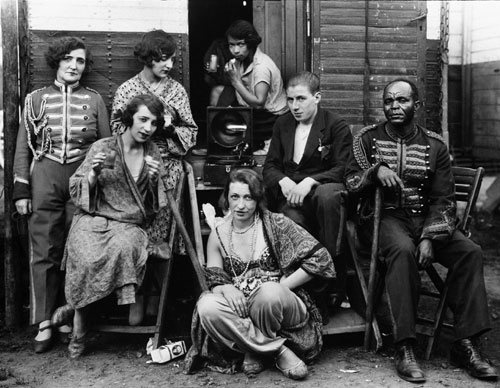
For most of the photographs of August Sander, now on display at Leicester's New Walk Museum, as part of a touring exhibition sponsored by the Art Fund, viewers can know little of how people began or ended.  Sander's initial aim was to present a study of German life, using individuals to represent different types within German society.  But however determined Sander's categorisation, the people he photographed resist being mere types.  Some perform their occupations, often surprisingly.  A farmer in the 1920s still ploughs with oxen  Another, in 1952, sows seed by hand, scattering it from a basket.  Others pose with the implements of their trade.  Almost all gaze straight into the camera, leaving the viewer with no more information that the brief labels provide.  The more I look, the more I understand the impossibility of reading a whole human being from a face.

I never have the sense that Sander's photography mocks or diminishes its subjects.  I always see them as complex, interesting human beings.  If I wish, I can build stories.  I have to set those stories in the time through which they lived.  Almost all of them were confronted by the dilemmas and persecutions of Nazism.  But when I start wondering "How did that farm-worker vote?" or "What did that woman do when the Nazis came to power?" I can't answer the questions I want to ask.  People's actions don't always harmonize with their faces.  An SS officer in one of the photos of Nazis looks benevolent and slightly unsure of himself.  His uniform does not.

I can and do make guesses.  Some of the circus people in the photo above are plainly not Aryans.  I hope they got away.  I would like to imagine a happy future for the gypsies, the children with severe disabilities, those who are simply labelled "persecuted people" or "political prisoners."  But I know most didn't get away.  The exhibition ends with a portrait of the death mask of Sander's son Erich, who died towards the end of his ten-year jail sentence.  Escapes are temporary.  None of us ever walks out of history or politics, however hard we try.  I wonder what future generations will think, if they ever look back on photographs, film and videos of the time in which we live.

August Sander didn't lead the life that was mapped out for him at childhood.  He was supposed to be a miner.  One day, working at the mine, he helped a visiting photographer and looked through the lens of a camera.  He never forgot what he saw - the sky, the movement of clouds.  That moment gave birth to one of the great photographers of the twentieth century.  He was part of his time but the records he made speak to the future.

I have paid one visit to the August Sander exhibition so far.  I hope to visit at least once a week while the exhibition is in Leicester.  I want to look more closely at many of the portraits.  I would like to commit them to memory, which is another way of letting the people of the past live on.  I also want to spend more time on Sander's pictures of human hands and of landscapes.

But I can't spend too long in the gallery with Sander's pictures.  There's too much humanity there, real people set to face a dreadful future.  

I think if I stayed too long, I would cry.

Sunday, 29 July 2012

An opening

Cynic though I sometimes am, I warmed to the Olympics opening ceremony.   Yes, I know it cost a lot and I know the performers were volunteers and that there are numerous problems with corporate sponsors and the treatment of dissent.  I might not have watched the ceremony had my daughter not been one of the volunteers but, once I'd got used to the style, I found a great deal to love.

It's easy to be critical of the account of history, especially since there was so little time and so much was going on.  I glimpsed the suffragettes but only learned later that the Jarrow marchers were also present.  Perhaps the Chartists were somewhere around though I don't think the Tolpuddle martyrs or the Diggers were included.  They didn't represent the the Commonwealth either - perhaps the execution of Charles I was judged unsuitable for all sorts of reasons - and Britain's uncomfortable colonial history was omitted.  But Blake's "Jerusalem" made a good starting point and the complexity of the Industrial Revolution - with its excitement, achievement and damage - was stupendous.  I'm still thinking about the implications of conflating Shakespeare's Caliban with Isambard Kingdom Brunel.  Perhaps because it appeals so strongly to my imagination, it's made a slight adjustment to my views of the 19th century.


I expect most viewers took what they wanted from the ceremony.  Some of my friends lauded J.K. Rowling. There was great enthusiasm for James Bond, the Queen and the corgis.  Mr Bean had even more fans than Simon Rattle.  I was thrilled to see a huge CND symbol in the arena, even though I understand that it was there as part of the history of Britain in the late twentieth ceremony.  But a huge number of people were excited when the letters "NHS" appeared.  Most people in Britain still agree that being able to go to the doctor and be treated in hospital when necessary without worrying about money is one of the great achievements of Britain's welfare state.  As the story of the health service was entangled with children's books, it wasn't surprising that villains from children's literature appeared to attack children in hospital nor that nurses and a number of Mary Poppinses finally defeated Lord Voldemort.


But perhaps the best thing about the opening ceremony was that it showed so many people what they love about Britain: its countryside, its industrial achievement; its literature;  its music; and above all the huge mixture of ordinary people who mostly live happily together, enjoy life and like one another.  It was an optimistic and hopeful picture of life here today, appropriate for the short period in which, in theory, there should be an Olympic peace.  I liked the way the peacemakers handed the Olympic flag to representatives of the armed forces, because, if we're ever to build peace, we'd be wise to involve armies in the movement away from violence.  


The parade of the athletes, many grinning broadly as they entered the stadium, fitted well with the show as a whole.  I know it's not always like this but I'd like to think of the Olympics as somewhere in which competitors form friendships across national boundaries and despite suspicion and conflict.  I'm also happy to celebrate the huge variety of people who take part in sports for love of it and who often aren't very well-known.  Since I joined a fencing club, I've learned about the amount of dedication shown by people in "minority" sports.  At my fencing club the coaches are unpaid (but qualified) volunteers and members of the committee donate their skills in such roles as web-designer, accountant, social secretary and armourer so that the club can keep its fees down and welcome members of the basis of interest.  It's given me a great respect for people involved in sport.

It seems that Danny Boyle's vision is one of peace, freedom and equality - one in which the contributions of all people are valued.  It's a fantasy, of course, and I see the strength of the objections.  People say it all costs too much in an age of austerity,  that it's a bit unreal and that sport isn't for everyone.  People quote Juvenal and talk about "bread and circuses" - some of them go on to ask "where's the bread?"  I can see their point.  They see sport and the arts as an extravagance when we need to to campaign once more: for the health service, for workers' rights, for food for the hungry, for an end to torture and oppression, for the welfare state, for equality, for freedom. I want all those things but I want circuses as well.  

Juvenal saw bread and circuses as something that distracted the people from Rome's serious political purposes.  He didn't like the people much.  For him they were the enemy of political decency - and he didn't reckon he belonged among them.  But I am happy to be one of "the people."  For me there's a different way of expressing what I want.  Just over a hundred years ago a poem declared that a life devoted to work and survival was not enough.  Two lines have often been repeated:

 Our lives shall not be sweated from birth until life closes;
 Hearts starve as well as bodies; give us bread, but give us roses!

 I want a world in which people experience delight as well as having enough to eat.  I don't think art and sport necessarily turn us into passive consumers of whatever the government says.  They can bring people together and widen their knowledge and understanding of the world.  They can set the imagination and intelligence alight, and bring people who would not normally encounter one another the joy of engaging in a shared activity.  They can give us some idea of how much better the world might be, even though they leave us with the task of achieving it.  


Photo by Nick Webb, courtesy of wikimedia commons.

Sunday, 18 July 2010

Waiting for the end


After the tame bribes of the election campaign, we're preparing for disaster.

The strange thing is that, long before the election campaign, we knew there would be cuts and that they would be severe. In the debate of the three prospective chancellors, all three agreed that the new government would impose cuts that were deeper than those made by Thatcher. But when the election campaign proper started, the candidates and parties slipped into the conventional mode of offering little inducements to voters: funding for this and that project, the promise that some groups of people would be better off. It was as though the entire country colluded with the leaders and candidates in an act of voluntary amnesia so that we could all enjoy the spectacle of the election campaign and participate in a limited political debate without considering the future.

On one level there was a serious public debate. For the first time in years people seemed to be taking their power seriously. Wherever I went – on the train, in the pub, in corridors at work – people were discussing the election and agonising how to cast their vote. I was agonising too. But there was a sense in which the major debates of the last few years had been forgotten. We seemed to have stepped back in time so that the parties could posture in their familiar roles rather than addressing the current crisis. A great deal was made of family values and immigration. The NHS was defended and “welfare scroungers” attacked. There were occasional mentions of Europe and Britain's need to defend itself. I was struck by how little was said on civil liberties and Afghanistan – and how all parties offered to spend more money on pet projects rather than talking about what they would cut. Meanwhile the newspapers assessed parties as much on the power to spin and present themselves as on any substantial policies. Looking good on TV or choosing the right poster designs was treated as a vital qualification for office.

On the day of the election, I heard several people remark that now the difficult times would begin. And then we held our breaths for a few days as though hoping that the failure to hand any party an overall majority would mean that the economic crisis would go away and we could all sit securely in our jobs, if we had them, and rely on the frayed safety net the welfare state continued to provide.

There was never going to be a happy ending. Even if a Labour -Lib Dem-Nationalist-Green coalition had been formed (and the arithmetic was against it), we all knew the cuts were coming. The only remaining question was where they would fall – and that had hardly been discussed in the election campaign. No party wants to threaten the jobs and income of voters. The coalition cabinet looked like a parody of the new parliament: overwhelmingly male, white, public-school educated, Oxbridge graduates, mostly millionaires, distinguished by the kind of overweening self-confidence and self-righteousness that politicians and the press sometimes praise as “leadership.” No-one speaks of followership, that quality of subservience that all strong leaders require.

I haven't been surprised by any of the proposed cuts – and I don't think they're different from anything the relaxed-about-the filthy-rich, market-driven New Labour party would have required. Perhaps Labour would have delayed for a year but perhaps not – politicians were never going to be good about keeping their election promises. I am shocked by how much the Liberal Democrats conceded, and how quickly. Abstentions on tuition fees, Trident renewal and nuclear power ensure they will pass. If abstention is a fig-leaf, it's transparent. They may be working toward an end to the detention of children but they have hooked up with a party happy to deport asylum seekers – including unaccompanied children – to Afghanistan, apparently on the grounds that they will be safe there. Documents exposing the previous government's enthusiastic involvement in extraordinary rendition and torture have been published but that was as a result of a court judgment – our new, human-rights loving government was just as keen as its predecessors on a cover-up. It's the same with the treatment of children in privatised jails; brutality was authorised by New Labour but the coalition government sought to keep the evidence secret – and, so far as I can see, advice on how to hurt and injure children in prison has not yet been withdrawn. Every so often a cabinet member says something on human rights or civil liberties that I applaud but I don't trust them a bit. And I note that the Labour Party, while opposing cuts in a half-hearted sort of way, has stepped up the kind of rhetoric that prevents me from voting for its candidates. Labour assumes its potential working-class voters are fearful racists, who cannot see beyond narrow self-interest. No, they are not. They insist civil liberties and human rights are a middle class concern. No, they are not.

I support moves towards greater equality. I am not “relaxed about people getting filthy rich” when the evidence of poverty is clear. I want to a society that combines concern for individual freedom with a belief in equality, that welcomes internationalism at a human level rather than supporting uncontrolled corporate globalisation, in which companies are more powerful than countries or their citizens. There is no major party in England that promotes these views, though I know plenty of people who share them.

Meanwhile, I wonder what the government's rush to cut and privatise means for my neighbourhood and for me. I'm angry at local cuts that don't affect me directly; the county council plans to close centres which support people with mental health problems – people who are unlikely to campaign on their own behalf. The theatres, galleries, libraries and arts projects which I love must be at risk – the benefits supplied by free or very cheap access to culture cannot be quantified easily in a balance sheet. Given my age and my work in the public sector – combined with the level of projected cuts - I should probably prepare to face unemployment. Every so often the polite millionaires who rule us remember to say that public employees are valued and that the contribution they're cutting has been provided with care and dedication. As they cut contractual rights and sell the welfare state's fixtures and fittings to the private sector, they assure us we're “all in it together” and that “everyone has to make sacrifices.” But there's another aspect of their rhetoric which has been picked up by the screaming editorials of the right-wing press. They insist I do a “non-job” and look forward to a “gold-plated pension.” I'm luckier than most. I simply wonder if I'll be able to pay off the rest of the mortgage, how I can help my children and what I can do if my elderly parents need help.

I'm trying to be positive about the possibility of unemployment. I'm planning a T-shirt for the day I sign on. It will feature the words “WELFARE SCROUNGER” in big letters. Meanwhile I'll make the most of my free time to enjoy free culture, write like mad and campaign against the government for a better, kinder world.

Friday, 21 May 2010

Robin in Nottingham


There are mild grumbles in Nottingham about the new Robin Hood film. Nottingham can live with an Australian playing the outlaw, a newish story and even the usual dodgy accents – outsiders tend to be uncertain how Nottingham people speak. But word has got round that the character played by Russell Crowe – Robin Longstride – is a Yorkshireman.

Reviews of the new film were lukewarm. Nonetheless, Nottingham has declared that May is Robin Hood Month. There's an exhibition (costumes and set, I think) at the Castle and I've seen signs of other events in the area.

I hadn't expected the mediaeval market. I came across it on my way to Nottingham Contemporary, paying my second visit to the Uneven Geographies exhibition. While I hate shops, with few exceptions, I find it hard to resist a market and began to explore the stalls.

I watched a man making a thick leather tankard. I hadn't heard of leather tankards before but the procedure looked convincingly mediaeval. Opposite was a stall selling sausages and another offering Transylvanian glass – nothing to do with Dracula but delicate and glowing. There were stalls selling food, jewellery, carvings – all sorts of delights. It wasn't until I reached the stall selling baseball caps made of panels cut from tin-cans that my lazy, sun-soaked mind began to wonder about the label “mediaeval.” Still, the Heineken cans are a pleasing shade of green though the Coca-Cola logo might look out of place in the greenwood.

I started spotting other inconsistencies – a sausage stall, staffed by two smiling men in Robin Hood hats, was named after “King Tut” - much earlier, I think, and unremembered in mediaeval times. I know the Crusades saw returning soldiers bringing all kind of new goods to England - but would they have brought smiling Buddhas fashioned from resin? Did they eat ostrich burgers in baguettes in Sherwood Forest? I couldn't rule it out but kangaroo meat is totally implausible. Wodwos carved from wood seemed more authentic.

For a few minutes I counted inconsistencies. Then I began to delight in them. I love the Robin Hood legend but I've never insisted on historical accuracy – it's a baggy myth which is refashioned with every telling and imagining. Robin probably didn't wear tights, despite Douglas Fairbanks, Errol Flynn and Richard Greene – and at the same time he did, because imagination makes it so.

My Robin Hood isn't Robin of Locksley, returning nobleman, but the outlaw beyond class who sees an unfair society and acts for liberty and justice. His greenwood is a place of freedom and equality – and women are equal there, because that's how I've imagined it.

I began to wonder how my Robin would be today. He might be with the migrants who live outside the law in our cities, aiming at invisibility but too often exploited. Or perhaps he'd be an eco-warrior, defending the wild places and remaining greenwood from those who exploit them for cash. Either would be a more uncomfortable Robin than any Hollywood has produced. Only the TV series of my childhood really engaged with contemporary politics.

But Nottingham's mediaeval market didn't seem entirely out of place in the Robin Hood myth. People who'd come to Nottingham for all sorts of reasons mingled at the stalls. There were Goths, political protesters, parents whose children wanted to splash in the fountain – all assembling in the Old Market Square and strolling round the stalls. They moved easily from demonstrations of weaving and wood-turning to chat with the vendors of amber, carved elephants and eco-clothing.

Myths update themselves all the time. No single version can hold them.


Saturday, 15 May 2010

Border police


From England, borders seem simple. There's sea. Motorway signs proclaim “Welcome to Scotland!” and “Croeso y Gymru” but passing these isn't a serious matter – even in Orkney or on Anglesey we're still in the United Kingdom.

Hadrian's Wall is a reminder of what a boundary might be but its watch-towers and forts have crumbled. Walking the path of Roman border patrols has become a challenge or delightful ramble. Sheep graze nearby and children scramble across what is left of the frontier. Like so many monuments built to control the neighbourhood, it's been reclaimed by the locals for tourism and play.

Maps tell another story. Boundaries are clear-cut – black lines that separate pink from green and yellow are as obvious as a railway track. There are even lines parcelling up the sea and white wildernesses governed by penguins and polar bears. In maps, boundaries are as unavoidable as the kiosks in which uniformed guards check and scan the passports of tourists.

Of course, I knew it was more complicated than that – just I knew there were nomadic people and people whose sense of nation and community crossed arbitrary frontiers. For years I've been fascinated by Auden's poem about the partition of India. The older Auden isn't often thought of as a radical poet but that poem is as critical as any I know about the cowardly bureaucracy of colonialism.

But I hadn't really thought about the no-man's-land crossed by migrants and patrolled by bored armed guards until I saw Ursula Biemann's video installation at Uneven Geographies, the latest exhibition at Nottingham Contemporary. Watching the guards in a nearly featureless desert, I suddenly saw the world from a perspective much closer to the migrants'.

The guards knew where the border was. There was a pile of stones here, the remnants of a building there and a railway line dividing to cross two indistinguishable pieces of ground. Sometimes the guards watched. They moved through crumbling buildings. At other times they just stood. One held a bunch of keys close to his waist. One drank water from a bottle. Dust and discarded plastic blew past them. They waited for the migrants to arrive.

The story was told of a Dutch tourist who found himself on the wrong side of the border. He was arrested and held for ten days. His belongings were confiscated. He never saw his car again. The story was routine – worth telling only because the man was an accidental migrant and a European. For those who cross frontiers these are everyday hazards.

Hunger and thirst don't stop the travellers. In another video, an imprisoned migrant told, without surprise, that ten men in his group of seventy had died of thirst when crossing the desert. The men who survived drank their own urine. They arrived and were imprisoned. They waited to be sent back – and to set out again.

Ursula Biemann's videos focus on the sub-Saharan area where the nomadic routes of the Tuareg have become the paths which migrants travel. She shows the practical demands of migrant life and the optimistic determination of travellers who are convinced life has more than poverty to offer.

Near the videos there's a series of photos of Tangier by Yto Barrada. One shows a football game on a run-down hard pitch in Tangier. The pitch is surrounded by torn wire. In the foreground a boy is making his way through a hole in the wire towards the players – it's another permeable boundary.

Between the photo and the videos, I began to see boundaries in a different way. I thought of the times when, as a child, I saw a boundary as a challenge. When my brother and I were small we liked to “go trespassing,” which meant entering any area where signs said we were forbidden. Building sites and college grounds were alluring. Most fascinating of all was an old air-raid shelter which I think we entered once – but I dreamt of it so often that dreams have obscured the reality. I can't recall exactly where the air-raid shelter was.

I still want to travel and see new places. Work and family detain me in Britain but I'm not rooted here. The film of the border guard awoke my migrant self. I realised that there aren't so many differences between me and the Africans setting out on their risky journey. I have some luck: the security provided by my red British passport and respectable appearance. I can book my journey on the internet or ask a travel agency to find me a tour and a guide.

The exhibition Uneven Geographies was worth visiting for the way it exposed and displaced my assumptions about boundaries. There's more to the exhibition than that. Delicate diagrams sketch out webs of financial power – webs so complicated it seems impossible to break free of them. The webs date back to the 1970s – it's all so much more complicated now. There are installations, photographs, displays. So many achieved a small adjustment in my way of seeing the world that, by the time I emerged, I was reeling.

Behind all the works is the net of global economic interests which holds us all. The exhibition lays bare the ways in which the rich west depends on people in other continents and the devastation of the earth. I'm haunted by new ways of seeing, in which the west is no longer central. I feel displaced from my safe, convenient way of life.

That doesn't mean I see a way out of the net. Neither vision nor analysis shows a way of adjusting the huge imbalance of power. But seeing differently still feels right and worthwhile. This is the first exhibition at Nottingham Contemporary that has changed my ideas.


Thursday, 22 April 2010

Democratic duties

I last went to a candidates' meeting in 1997, uncertain how to vote. Part of me desperately wanted an excuse to vote Labour so that I could be part of the overthrow of Thatcherism and be sure that things could only get better. There was only one meeting. I sat on a hard pew in the packed local Baptist church, surrounded by hopeful voters, and wished that I shared their optimism.

This year, there's a choice of candidates' meetings: five, I think, in our part of the constituency. The local newspaper has got involved and is sponsoring debates. I wondered how many people would attend the meeting I'd selected. It was in a local school and clashed with the beginning of the first party leaders' debate on TV. Once again, I wasn't keen but I accompanied my son who's thinking hard about how to use his first ever vote.

We were ten minutes early. The organisers must have been pessimistic about attendance as there were only eight or ten rows – mostly full. We found two seats together in the second row – apparently no-one wanted to be too near the candidates. As the hall filled, more chairs were found until the rows stretched to the back of the hall. Then I settled down to watch.

The meeting was more carefully managed than some, perhaps influenced by the rules for the leaders' meetings on TV. Members of the audience weren't even expected to ask their own question – instead questions were written down and handed to a steward who would pass them to the chair who relayed them to the candidates. Whole areas of policy, including education and civil liberties, were ignored except when a candidate mentioned a single measure in passing.

I'm not sure how clear an idea it gave me of the candidates. I didn't get any sense of the BNP man, since he chose not to turn up. I wasn't going to vote for him anyway. Personal impressions counted for a great deal.

The UKIP man was surprisingly likeable - I didn't agree with him but he listened to people, answered clearly and seemed straightforward. He seemed the sort of man who would be a good friend, colleague or boss – and probably a good conversationalist over a coffee, beer or wine.

I wanted to be impressed by the Green candidate. Every survey I take tells me I'm more aligned to the Green policies than those of any other party. Again the candidate seemed personally likeable and his experience – as a self-employed craftsman and school governor – is just the kind of experience that's needed in the House of Commons. But he was unclear on policies – actually unsure what they were or how big questions could be addressed – and plainly unready for parliament. With six months of hard work he might become a decent candidate but he's not ready yet. It's a shame.

The Liberal Democrat is a sitting councillor. He was confident on local issues and broad policy areas and was probably the best speaker of the evening. He had a couple of good soundbites - “We were right on Iraq and right on the economy” and “Charlie Kennedy was drunk and he was still right on Iraq” - and spoke particularly well on the need for international aid, drawing on experience of life in Malawi. Apart from that, I was worried that his strengths were local rather than national – an MP has to deal with national questions.

There was only one woman among the candidates – the conservative. I’m far from being a tory supporter but I’ve seen some good tory initiatives such as David Davies’ support for civil liberties. I’ve also had enough experience of being the only woman in a male environment to know it’s difficult so I tried, at least, to like the candidate. I couldn’t. She seemed like a lacquered version of Margaret Thatcher without the smiles. There was no pretence at liking the audience or the other candidates, just an array of facial expressions that ranged from the sneer to eye-rolling incredulity. Her manner as a speaker shifted between the deliberately informal to the rehearsed speech with hand gestures, reminding me that she had been a broadcaster and was now a barrister. Some of the things she said were good – she asserted that she had opposed the war in Iraq and favoured international aid – but she also declared that she agreed with every word in the tory manifesto.

The Labour candidate had all the advantage of 13 years as the constituency MP. He was familiar with the major political questions as well as local concerns so his answers were thoughtful and knowledgeable. He was polite to his opponents and took the audience seriously. He even said he’d been wrong to vote for the war in Iraq and that he now opposed ID cards because they would cost too much. This was quite a U-turn – he used to be a keen defender of government policy and took personal credit for advancing the proposal for ID cards. His line was the hackneyed one that people who had nothing to hide have nothing to fear – perhaps he’s the only person in the country to reckon he’s lived an entirely blameless life. He also spoke against government policy on asylum seekers on the grounds that it was too harsh – but I don’t think he’s ever voted against it.

I like the Labour candidate. I think he’s an honest man who honestly convinces himself that, in most circumstances, his government and party is absolutely right. I live in a Labour-Tory marginal and, if I don’t want a tory government, which I don’t, logic demands I should vote Labour. I won’t do it.

Labour is better on some issues. There’s a historic link with socialism and, although it’s frayed almost to breaking during New Labour days, it probably still means that the cuts which the new government will impose will hurt the poor less under Labour. But this government has supported war and opposed civil liberties to an extent that has made me fearful. The Serious Organised Crime and Police Act is one among many dangerous pieces of legislation. I used to think of myself of law-abiding. Now I take it for granted that, if the government wanted, they could find some law that I’ve broken and use it to imprison me. There’s a certain perverse freedom in that. I no longer worry much about what the law says.

New Labour has also supported mistreatment and torture of prisoners, including prisoners who haven’t been found guilty of any offence. These range from asylum seekers and their children – some very young indeed – to suspects who were kidnapped by the Americans, bundled into planes and transported overseas to be questioned under torture. It’s called “extraordinary rendition” and the Americans have now admitted that it happened. I wrote to my nice, tolerant Labour MP about this in January 2005, when the evidence was mounting up. There were witnesses who had seen what was happening, records of flights tallied and companies were named. My MP responded that the evidence was “thinly-based,” that the British government couldn’t be expected to ban flights from stopovers or subject them to scrutiny. He added, “If there was a specific allegation that a prisoner was being held captive in a plane … I’d take a different view and I’d think his lawyers would have a strong case for asylum.” The idea that someone who has just been kidnapped by the CIA will have access to lawyers us so ludicrous that it suggests my MP lives on a different planet.

When I think about the war, civil liberties and government attitudes to torture, I know I can’t vote Labour, even though I dread a tory government. I suppose it will have to be Lib Dem. I don’t feel happy about it. But at least it will annoy the press, which is on the attack. The Daily Mail this morning misrepresented a fine article Nick Clegg wrote as “Clegg’s Nazi slur”. I firmly expect an eve-of-poll headline saying “Nick Clegg will eat your babies.”

Saturday, 3 April 2010

Going slow


“Productivity” is one of the ways in which our work and lives are measured. It's an idea from time-and-motion studies and is allied to another word: “output.” Lately they've been linked to other words, like “targets” and “league tables.” Underlying these is the notion that speed and quantity are always valuable.

Speed and quantity have their uses. Nobody would suggest putting out a fire slowly or labouring for a week to produce the single, perfect baked bean. But somewhere in the rush to achieve meet targets and achieve maximum productivity, important qualities are lost.


I began thinking about this when I heard Will Self talking on the radio about the experience of walking to the airport. I was mostly concentrating on making coffee but, in my usual quest for maximum productivity, I was listening to the radio as well. The coffee was fine but I caught only a few sentences from Will Self. He pointed out that, in people's haste to reach an exotic destination, they neglected the places in between. Huge suburbs were diminished to places which are crossed as quickly as possible by travellers who want to be somewhere else. Walking to an airport might be one way of regaining an older, more leisurely experience of travel.


I liked this idea of slow travel. I've been toying with the idea of a walking holiday. Perhaps my inspiration was the opening of Dorothy L. Sayers' Have His Carcase, though I don't expect to meet Lord Peter Wimsey and could do without the discovery of a corpse. But I think women – even women of my age – are less inclined to solitary walking than they were in the 1930s and, even if I could handle the necessary luggage, I've a feeling my conduct would seem eccentric. Still, I'd love a slow holiday – slow, at least, by modern standards – taking trains, boats and buses as well as strolling by rivers and lounging in bars and cafĂ©s. I've been glancing at holiday brochures and they all seem rather intense.


Going slow shouldn't just be a treat for holiday times. There are moments when work is better for going slow. Not all tasks are best done at speed. I prefer the carpenter who works carefully to the hasty worker with an eye on the clock. I think workers who pause occasionally to talk to one another may find they enjoy their work more than those who are harried into silent, urgent speed. The shop assistant who asks after the health of an elderly woman customer may hold up the queue for half a minute, but she's doing a good job.

Teachers have to account for every minute of classroom time under national strategies. They don't have enough time to listen to pupils, go over ideas or even meander slightly from the point, seeing where a thought or a new idea might take them. Children are educated to make every minute “productive” until they're afraid of the kind of day-dreaming in which genuine inspiration strikes. No wonder so many young people see leisure as a time for binge-drinking. An approach to leisure governed by productivity and target-setting is bound to ask “how much can you drink in the time?” and “how quickly can you achieve drunkenness?”


This focus on productivity doesn't seem to have much to do with the way humans deal well with one another. It comes from business.
Schools and public services are still being told to model themselves on business, as though no business could ever fail. It comes from the desire to compete and make maximum profits. The demand for high productivity can be found in a number of industries where firms compete with one another for work. Robert Tressell's The Ragged-Trousered Philanthropists describes the house-painters' unwillingness to skimp work in a competitive system which drives down prices and therefore wages. It was heightened by mass-production, in which people serve machines.

The Ford factories of the 1920s and 1930s moved from the craft of car-making, in which workers served an apprenticeship and learnt to make a car as a whole, to machine-tenders who did one simple, easily-learnt task. Initially, the machine-tenders were well paid, although they could easily be laid off or replaced. High productivity lowered prices. This made goods and leisure more widely available in a hugely unequal society. Perhaps it also reduced the demand for greater equality and a fairer distribution of wealth.


I have a taste for things that are produced slowly and with care. I like the idea that someone took trouble and that an item suits me rather than my “demographic.” I like wine, beer, bread and cheeses that are made by people who aim at the best taste they can rather than a neatly-packaged and predictable uniformity. I enjoy books that are a pleasure to touch as well as to read, with elegant type and clear design. I like ideas that have taken years to mature, ideas that are still being made, thought through and tested – ideas too lengthy to be one of five points on a small card and far too rich and complex ever to be shrunk into the neatness of a soundbite.

Saturday, 28 November 2009

Magic!


I'd never thought of the relation between magic and politics before. Perhaps that's because I still have an idealistic notion of politics. I believe it's the shared responsibility of everyone, not just a way in which professional politicians (horrible phrase) can achieve power, fame and personal advancement.

By a series of lucky coincidences, I found myself at the preview opening of the touring Magic Show exhibition whcih has just opened at Derby's QUAD Gallery. Gallery openings can be a bit dull. There's often free wine but there are also speeches and sometimes crowds so dense it's hard to see any of the work.

This was a bit different. There were still crowds, free wine and speeches but, after the necessary thanks - and people should be thanked - the speakers were so enthusiastic about the exhibition that even the children in the audience gazed in awed fascination.

The exhibition isn't aimed at children but there was sufficient for children to enjoy: posters, magically moving exhibits, a 3-D display that looked as if it were performed by miniature humans in a Lilliputian theatre. We gazed at the two plain sheets of A4 paper that danced together on a low wooden table.

Other exhibits reminded viewers of more sinister uses of magic. There was John Mulholland's booklet on magic for CIA operatives in a cabinet which also held Tommy Cooper's duck, as well as and pro- and anti-Hitler magic tricks. There was reference to the way the techniques of stage magicians had been used for one of George W. Bush's appearances at a Republican Convention. I was suddenly reminded of Tony Blair's words, "Trust me." "I'm a pretty straight sort of guy." This was disconcertingly like the magician's display of the empty box, the empty hat and the empty hands before handkerchiefs knot and separate, money vanishes and multiplies, and rabbits jump. The connection between magic and politics was perhaps clearest in Annika Lundgren's slide-show, though I never managed to watch it straight through from the beginning - I'll have to go back and see it all.

It set me reflecting about the way we see politicians now: the way journalists praise them for clever use of spin, a convincing image and successful stage management of party conferences. It's as though smoke and mirrors matter more than justice, truth, equality, liberty or any of the big abstractions I care about. There's a moment in one of Jasper fforde's Thursday Next books when she attends the live broadcast of a popular TV programme called Evade the Question Time, in which politicians win points for their success in spouting meaningless platitudes in response to questions from the public. Sometimes this seems so close to the truth that it is barely satire.

The evening also included a performance by Ian Saville, socialist magician and ventriloquist. The connection between politics and magic was overt, funny and self-mocking. The small children in the audience may not have understood jokes about hegemony and alienated labour, but they knew a good trick when they saw one and watched with wide eyes and delighted smiles.


Note: I was half-way through this post - just commenting on Tony Blair's words and looking for useful links - when a virus invaded my laptop. It felt like a particularly malevolent brand of political magic. I'm finishing the post on a borrowed computer.

Saturday, 17 October 2009

Back to the blog


It wasn't swine flu. I didn't have the cough or the sudden high temperature. It was just the usual sort of autumn virus.

For a week or so, everyone except me seemed to have a virus so it wasn't surprising that I succumbed. It wasn't a good time. Taking time off work would have placed an impossible strain on colleagues, who were also working while ill. And adrenalin got me through the last week and a half, though not as successfully as I would have liked. Last Saturday involved six hours of non-stop talking, which became croaking and finally a hoarse whisper. At home everyday tasks like loading the washing machine or putting out the wheelie bin required sustained concentration. Away from work, I didn't go out or blog. Instead I huddled pathetically in an ill-made bed, grateful when the cat purred on the pillow beside me.

Every so often I noticed a subject for a blog. "I must write that down," I thought, but didn't. It seems a little late for my thoughts on the forthcoming government by the Bullingdon boys. I'd have liked to discuss the background to the postal strike and the need for a national, well-managed mail service but an article appeared with more knowledge and thought than I could provide. Others have written well on the recent political impact of Twitter. I managed a couple of tweets myself, mentioning Berlusconi, Blair and Jean Sarkozy. I felt old.

Meanwhile, I noticed reports on the economy. Some people said the crisis was over. Others predicted a steep rise in unemployment. Goldman-Sachs, which took public money, gave a lot of it to its employees in bonuses and was startled that anyone should object. Politicians competed in the savagery of the cuts they promised, assuming that voters would elect the candidate who threatened most jobs and the swiftest sell-off of public assets and resources. And every so often I met someone I knew who was threatened with redundancy or had lost a job.

Commentators assume there's a sharp line dividing those with jobs from those without. They assume the employed will spend until the economy surfaces from recession. I doubt that's the case. People live in families and circles of friends. Surely we'll help families and friends to purchase necessities before we head out on the extravagant spending binge urged by economists? That's enough to bring down a society built on debt and the sale of services and luxury goods.

Perhaps it's time to tear up the old model and start again. But where do we go from here? Can we really progress through co-operation when hatred and bitter competition have grown so strong?

Monday, 21 September 2009

Who pays?


Apparently we saved the banks. Now it's time to face the question of who pays.

The political conferences are full of politicians competing as to who can be the most threatening, though Nick Clegg of the Liberal Democrats, ditched the word "savage" at the last moment and chose instead to talk of "serious cuts."

The Confederation of British Industry, combined with university vice-chancellors, has decided that students should pay for the university through higher fees, higher interest and cuts in grants. Oh yes, and their degrees should do more to train them for work in industry. Leaving aside the question of why students should pay to be moulded in the way employers demand (shouldn't they develop a capacity for original thought that enables them to remake industry and shape the future?), there's clearly a problem in the economics of what the CBI and vice-chancellors suggest. The economy needs money now - the suggestion that students are lent more money from 2010 or 2011 won't bring in any repayments until 2013 at the earliest, even if all graduating students walk straight into well-paid jobs.

It's an uncomfortable time. There are plenty of shrieks of "Not me!" which is to be expected. But there's also a great deal of finger-pointing, usually at individuals and social groups. Comments in newspapers and on-line forums are directed at the usual groups: immigrants, asylum-seekers, single mothers, the poor, the unconventional. "Punish them!" editorials and commentators demand. Facts on how little the poor and needy receive in benefits are no use - anecdotes of luxury are everywhere. Nor does it help to point out that the poor have to spend most of the money they receive, thus returning it to the economy. Spending by the poor is instantly labelled fecklessness.

I don't have a solution - I can't see any way of finding these impossible sums without hurting the economy more and damaging even more individuals. (Withdrawing troops from Afghanistan would save money and lives, but it wouldn't be enough.) Every cut brings its cost. There are bound to be cuts in public servants who include nurses, teachers, ambulance drivers, cleaners, lollipop ladies, and many others on whom we rely. Most will be entitled to redundancy pay and benefits - and in many cases it won't be enough for the rent or the mortgage. The newly unemployed will become the newly desperate. They will cut their spending (savagely, of course) and this will have an effect on all the businesses which depend on selling services and minor luxuries. Lots of small and large businesses are just keeping going. With less money coming in they will first shed more staff - that's even less spending money in the system - and then collapse.

The government has to look for cuts which affect the fewest people and from which the economy can recover most quickly. Logic points to taxing the rich and inherited wealth - money that doesn't circulate in the system. It's not going to happen. There are too many millionaires and too few paupers in government. But even taxing the wealthy won't solve the problems. I don't know if the kind of redistribution and rationing employed in World War II would help. My mum remembers the Second World War as a time of plenty after the scarcity of the 1930s - rationing fed children who were used to going without. But I'd worry about the centralisation and trust in government that requires, particularly when I look at the way the three main parties are funded.

The more I listen to political debates, the more I realise that no-one has a solution. I hear stale rhetoric and the rehearsal of prejudices and realise these are going to influence what happens next. It's going to be nasty. I don't want to speculate any further. I'd rather not think about the future but it's lurking and waiting to hit me in the face.


Note: the illustration is by the street artist Meek. I hope s/he doesn't mind my use of it.

Tuesday, 10 March 2009

Billy and the bananas


On Friday evening I got to hear - and briefly talk to - Billy Bragg. On Saturday morning I encountered a large number of bananas. It was an unusual beginning to the weekend.

Billy Bragg was "in conversation." Tickets cost £3 and, as my son's a fan, I bought two. Then my son was ill with a virus. At the last minute, I asked a colleague. She turned out to be a fan and was delighted at the invitation - she'd been too late to get a ticket. "I'm going to marry Billy Bragg," she told me, as we headed to the event. "My husband says it's fine and he quite understands, so long as it's Billy."

I didn't have quite the same enthusiasm. I enjoy some of Billy Bragg's songs and was interested to hear him talk but half my reason for attending was to report back to my son.

Within two minutes' of Billy Bragg's arrival, I knew I'd made the right decision. He's quick-witted, intelligent, funny, modest and passionate about changing the world. One of the questioners from the audience asked why he didn't stand from parliament. Billy gave two answers. First, he's a singer, not a politicians. And second, he thinks politics is for ever, not just professional politicians.

I don't always agree with Billy. I can see why he thinks patriotism is important (and I'd like "Jerusalem" as an English national anthem) but I simply don't share his love of country. I love places and people but I'm not a patriot in that sense. Perhaps I felt an outsider to early in my life. And I think Billy is too optimistic - but that's a good fault. I wouldn't mind sharing his optimism.

What I share is his concern to involve people in political action and public debate. There are dangers in that - people won't always make the right decision - but sometimes the people are right and their leaders wrong. At least 1 in 50 people in Britain marched against the Iraq war and they were supported by the majority of the population. That opposition came out of public debate - but the leaders told us contemptuously that we were wrong, stupid and cowardly. On the question of Iraq, the majority was right and our leaders were disastrously, cruelly wrong.

Billy was on his way to a gig for the 25th anniversary of the miners' strike. He'd been involved in the campaign to support the miners. I wasn't. Living in London at the time, I thought Arthur Scargill should call a ballot - and that no government would ever close the coalmines on the scale Scargill suggested. I was wrong. I couldn't have done much to support the striking miners but I wish I'd done something.

On the day that Billy prepared for his gig, I too took political action - but it was more modestly expressed. I ate a banana.

It was part of an attempt to set a world banana-eating record (the most in a particular place in a 24-hour period) in support of Fair Trade. There were fairly-traded goods to try (mostly cake and chocolate) as well as games and information. Quite a few people were dressed as bananas.

I'm in support of Fair Trade. Rich countries have a bad record of exploiting poor people in poor countries, forcing them to work for low wages. Obviously we should pay decent wages rather than forcing farmers and labourers into near-destitution. But I'm uncomfortable about the way bigger companies have begun to use Fair Trade to lure shoppers away from small companies and shops. Cadbury is to start using Fair Trade cocoa in its chocolate bars, guaranteeing the minimum Fair Trade wage to its producers. But the world price of cocoa has risen so much in the recent market turmoil that it's not going to cost Cadbury anything just now.

The Fair Trade bananas which we ate for our attempt on the record were provided by Sainsbury's. Speakers thanked Sainsbury's for their generosity and the people in the square applauded. But I wonder what the small greengrocer on the edge of the square thought. Hallam's has been selling fish and vegetables for more than a century. I don't eat fish but the vegetables are good and often grown locally. They had a fine display of organic, fairly-traded bananas - but I wonder how many people bought from Hallam's when Sainsbury's was giving bananas away.


Sunday, 8 March 2009

Propaganda and art


Only two minutes' walk from the exhibition of American prints is a smaller, less flashy exhibition with much narrower scope. As its title suggests, Windows on War: Soviet War Posters 1943-45 looks at the development of a particular kind of propaganda poster in a narrow but significant period.

The collection of posters survived in Nottingham by a mixture of chance and generosity. A university professor - Vivian de Sola Pinto - was posted to Moscow on war service and collected a number of the window posters and printed posters which were produced by TASS (the Central Soviet Telegraph Agency). He collected more than 100 big window posters as well as some smaller printed posters and brought them home with them. Eventually he donated them to Nottingham University. They're a fragile collection and rare too - although major artists and poets collaborated on the work, the posters were a response to the war and intended to have an immediate effect.

I've never worried that artists of all kinds create work that is labelled "propaganda." Every work of art is propaganda for something, whether the work is loudly and ostentatiously political or quietly insists that art itself matters. All artistic creators have views, beliefs and prejudices - not necessarily comfortable ones - and these inevitably leak into their work. I'd rather deal with the unpleasant beliefs of Pound or the jingoism of Kipling, which are openly proclaimed, than the respectable-sounding class and racial sneers of T.S. Eliot or the deeply embedded prejudices of Philip Larkin. But it's the Eliot and Larkin who make it into school syllabuses while Pound and Kipling are judged too propagandist.

On the whole I can deal with overt propaganda, though I may dislike it and disagree strongly. I'm less comfortable when artists have been forced to produce propagandist art, not just because of the danger of bad art (though insincere art isn't necessarily bad; the compliments to Elizabeth I in A Midsummer Night's Dream are as delightful as they were - almost certainly - insincere). What I dislike is the power structure that harnesses art in this way and treats its effects as utilitarian and quantifiable. There's almost always something brutal about governments that do this.

The Soviet posters disturbed me for a range of reasons. Few of these were to do with power structures. To my surprise, Soviet leaders were rarely present in the posters though there was one in which a child held up a picture of Stalin as if brandishing an icon for veneration. The posters in the collection were largely focussed on hatred of Germans and the desire for vengeance. I suppose that in the years since World War II we've become so used to the evils of Nazism that we expect war posters to assert some sort of moral high ground. Looking back on British posters and cartoons of the period, they probably show the same desire for hatred and vengeance. I notice it less because it's rooted in traditions with which I'm familiar. But that desire to inflict known and unbearable pain on other human beings makes me feel sick and hopeless.

Occasionally the posters were gentler in tone. A headscarfed woman held her finger to her lips, warning that careless talk costs lives. A nurse gave water to a wounded soldier. A sturdy blond woman stood surrounded by her sturdy blond children. She was a "heroine of the Soviet Union," officially honoured for giving birth ten times. Her children, it was implied, would grow into new soldiers, replacing those who had died repelling the invaders.

Invading armies are not loved. It's not a new thought. From Sparta to the present day, mothers have sent their children to kill or be killed - and poets have praised vengeance as wel as lovel.