Monday, 21 September 2009

Who pays?


Apparently we saved the banks. Now it's time to face the question of who pays.

The political conferences are full of politicians competing as to who can be the most threatening, though Nick Clegg of the Liberal Democrats, ditched the word "savage" at the last moment and chose instead to talk of "serious cuts."

The Confederation of British Industry, combined with university vice-chancellors, has decided that students should pay for the university through higher fees, higher interest and cuts in grants. Oh yes, and their degrees should do more to train them for work in industry. Leaving aside the question of why students should pay to be moulded in the way employers demand (shouldn't they develop a capacity for original thought that enables them to remake industry and shape the future?), there's clearly a problem in the economics of what the CBI and vice-chancellors suggest. The economy needs money now - the suggestion that students are lent more money from 2010 or 2011 won't bring in any repayments until 2013 at the earliest, even if all graduating students walk straight into well-paid jobs.

It's an uncomfortable time. There are plenty of shrieks of "Not me!" which is to be expected. But there's also a great deal of finger-pointing, usually at individuals and social groups. Comments in newspapers and on-line forums are directed at the usual groups: immigrants, asylum-seekers, single mothers, the poor, the unconventional. "Punish them!" editorials and commentators demand. Facts on how little the poor and needy receive in benefits are no use - anecdotes of luxury are everywhere. Nor does it help to point out that the poor have to spend most of the money they receive, thus returning it to the economy. Spending by the poor is instantly labelled fecklessness.

I don't have a solution - I can't see any way of finding these impossible sums without hurting the economy more and damaging even more individuals. (Withdrawing troops from Afghanistan would save money and lives, but it wouldn't be enough.) Every cut brings its cost. There are bound to be cuts in public servants who include nurses, teachers, ambulance drivers, cleaners, lollipop ladies, and many others on whom we rely. Most will be entitled to redundancy pay and benefits - and in many cases it won't be enough for the rent or the mortgage. The newly unemployed will become the newly desperate. They will cut their spending (savagely, of course) and this will have an effect on all the businesses which depend on selling services and minor luxuries. Lots of small and large businesses are just keeping going. With less money coming in they will first shed more staff - that's even less spending money in the system - and then collapse.

The government has to look for cuts which affect the fewest people and from which the economy can recover most quickly. Logic points to taxing the rich and inherited wealth - money that doesn't circulate in the system. It's not going to happen. There are too many millionaires and too few paupers in government. But even taxing the wealthy won't solve the problems. I don't know if the kind of redistribution and rationing employed in World War II would help. My mum remembers the Second World War as a time of plenty after the scarcity of the 1930s - rationing fed children who were used to going without. But I'd worry about the centralisation and trust in government that requires, particularly when I look at the way the three main parties are funded.

The more I listen to political debates, the more I realise that no-one has a solution. I hear stale rhetoric and the rehearsal of prejudices and realise these are going to influence what happens next. It's going to be nasty. I don't want to speculate any further. I'd rather not think about the future but it's lurking and waiting to hit me in the face.


Note: the illustration is by the street artist Meek. I hope s/he doesn't mind my use of it.

Tuesday, 8 September 2009

The writing on the wall


When I was small, I went to Madame Tussaud's eager for the Chamber of Horrors. I rushed past the rather dull waxworks of unknown famous murderers. I wanted to see something horrid and scary, and to stroll on unafraid. It was something to do with testing courage, I think.

Children still love dungeons and horrors. They read the Horrible History books and learn details of torture. They haven't quite grasped - as I hadn't - that torture hurt people like us. Turning torture into a tourist thrill with wax victims, fake blood and feigned screams suggests that it's not quite real and, if it did happen, it was a long time ago to people wearing fancy costumes who talked rather differently from us.

We tend to ignore other people's pain, unless we're revelling in it. I'm startled when I see a teenage girl got up for a party with a gold cross - even a gold crucifix - worn on a chain. The twisted body of a man tortured to death is so familiar that it's lost its power to shock. We don't attend public executions but I've watched footage from real wars while eating supper in front of the TV. True crime sells well even if misery memoirs have waned in popularity.

We're protecting ourselves, I suppose. If I think about killing, torture and suffering today - really think about it and try to feel what it means - the thought becomes unbearable. The degree of suffering threatens to paralyse me but I should take action and protest.

Every so often the bleakness and pain of prisoners' lives reaches me. Wandering round the Chateau de Vincennes, I read notices which explained how the king's rooms had become cells where prisoners had sometimes been held for years. Usually prisoners find a means of scrawling or carving their names into the walls. There was less carving than usual at Vincennes. Instead the prisoners, who were often wealthy, had obtained paint and decorated their cells. This was no prison for paupers, whose lives were less important. The prison paintings of Vincennes are careful and accurate renditions of swagged curtains and lit candles on candelabras.

The plaster had begun to flake away before restoration was begun and I had to peer carefully to make out these creations of nostalgia and longing. There were words too but I couldn't make more than a fragmentary meaning:

"... ns la nuit de la tombe un jour desen...
..................................re nos noms ................
....la ..............................monde .....................
.... mais .....................rite profonde .............
P0urquoi ......................................................."

[......?.. the night of the tomb one day..?.....
...................................?..our names ...............
...the............?.....................world ....................
...but.................................?...deep..................
Why ..............................................................]

And after that, there's a word which might be "larmes" [tears] - but the more I look the less sure I am. I can understand nothing.

Saturday, 5 September 2009

Loving Paris


Arriving at the Gare du Nord, I was equipped with the carnet ticket that would take me to Montreuil. I like to keep fresh carnet tickets in my purse, telling myself that I have the tickets ready and therefore I must be back in Paris soon. I keep old tickets and use them as bookmarks so that every so often, when I pause in my reading, I'm reminded of journeys in the city I love.

This time I was over-confident. I didn't read the sign telling travellers to push their cases ahead of them. Instead I walked through the automatic gates pulling my suitcase behind me. They closed sharply and my case was trapped.

I was, of course, embarrassed. But a fellow-traveller, seeing my hopeless efforts to tug my case free, came to assist and quickly solved the problem. "You need a navigo," she told me (in French) and started asking other travellers whether they could help me by loaning one. Within a couple of minutes a young man realised what would work and laid his navigo on the panel that would recognize him as a legal traveller. The gates sprang open to admit him, the woman pushed my case through and went on when I'd hardly finishe stuttering my thanks.

It's hard to manage on the metro with a heavy case. The lines must have been built separately so the connections between them involve long tunnels, steep staircases and only occasional escalators or lifts. Sometimes I struggled alone but quite often people came to my help - smartly-dressed young people insisted on helping and so did one of the vendors of cheap toys and fluorescent Eiffel towers who left his pitch in the tunnel to run up a flight of stairs and help with my case.

Even with the help, my feet ached from the journey. Somehow they acquired small cuts and blisters which made walking difficult for the first part of the week. Perhaps the pain in my feet combined with my distaste for Versailles to make me less sympathetic than usual to the momuments to the French Republic.

I can't love the Panthéon. It's fine from the outside and when I stook in rue Soufflot under a dark grey sky with thunder crashing and lightning streaking across the sky the building came into its own. But the vast interior with its huge sculptural representation of the Convention doesn't grip me as much as the colourful Gothic delights of the much smaller Sainte Chapelle. Nor do I enjoy the collection of great men in the crypt (one woman is honoured there - Marie Curie was added in 1995). There are aspects to enjoy. I was amused by notices explaining how several people initially honoured at the Panthéon had later been demoted and buried elsewhere - even in death, it seems, the great men and their supporters were jostling for distinction. But it was good to see a memorial to Toussaint l'Ouverture and I could remember watching part of the ceremony in which the elder Alexandre Dumas was finally moved there in 2002. But it's part of the assertion of national greatness on a monumental scale which fails to touch me. In the same way, when I look at the Arc du Triomphe, so vast on its traffic island that it diminishes its visitors into insignificance, I feel regret rather than admiration.

Among all this neo-classical monumentalism, the Eiffel Tower is striking because it's so plainly linked to a people's Paris. It's a work of craft as well as art - whenever I see it I think of the skill with which it was designed and the hard work which created it. I've been to the top of the Eiffel Tower only once, when my son urged me to conquer my fear of heights. (That fear left me a year or so later but I faced my fear and got to the top - I still have the ticket to remind me.) But there's nothing intimidating about the Tower - it doesn't celebrate great men or the power of kings or state but human achievement in a city.

My favourite places aren't the great Haussmann boulevards, so convenient for crowds or armies and tanks. I like the small streets like the rue Mouffetard where people wander and work and shop and worry. I like places where the workers of Paris sit and talk at café tables the moment there's the faintest gleam of sun. I enjoy the everyday life of the city which can be rough as any city but which also has space for casual kindness. I'll remember all the sightseeing from my visit - and there's much I haven't mentioned here. But I'll also remember a comfortable basement cinema where the staff made viewers welcome, a hospitable African shop in Montreuil which serves - for 1 euro - the best espresso I've experienced in Paris, and a friendly Belgian pub near the Panthéon where happy hour starts at 4.00 p.m. so that draught Leffe arrives in double quantities.

Tuesday, 1 September 2009

Bare feet and unknown princesses


I was doing Paris on the cheap - and on my own. None of my friends were there but Anna offered the loan of her house in Montreuil. I needed to decide how to manage my holiday and make my money last.

Obviously, being alone, I wouldn't need to eat out. A regular morning coffee and the occasional pression - Leffe, by preference - would be bound to keep me going. And in Paris you can almost always find a boulangerie when you need one. I could have a good breakfast in the mornings and make myself an excellent salad with wine when I returned home.

I decided the time had come for the kind of tourism I'd been putting off for years. A web investigation told me a 6-day museum pass would be a good investment if I was serious about sightseeing. It costs 64 euros but many of the places I wanted to visit cost between 8 and 10 euros, and I reckoned I'd probably visit two or three in a day. It has the additional advantage of letting the holder bypass the long queues for tickets.

The metro was easy too. Thanks to Gerard, I already had a navigo (the French equivalent to the London oyster card) and had been educated in how the pricing systems work. I checked the zone map on the internet. Versailles was in zone 4 so it would be sensible to go on Sunday, using a 4-zone mobilis which allows flexible travel for the day. Then I would load a 2-zone weekly carte orange on my navigo from Monday. The carte orange, which is now virtual and therefore no longer orange, always starts on a Monday. It's a bargain for anyone staying for most of a calendar week. For just over 17 euros I could travel by bus, metro, the regional RER trains (some of them double-deckers) and even a little ferry on the Seine - the voguéo. While my museum pass made me feel like a tourist, the navigo let me think of myself as a true Parisienne.

But it was hard to settle into sightseeing after the oppressive grandeur and gilding of Versailles. I thought I'd better follow the Marie Antoinette trail to the Conciergerie, where her former cell is now equipped with a TV. There were expiatory mouments too. Louis XVIII was keen that the French people and the Parisiens in particular should repent of executing a monarch and his consort. I had more sympathy for the victims of the Terror of whom nothing was known but their name. All those guilloutined - more than 2,000 of them, which was fewer than I'd thought - were listed; the Terror was conducted along carefully bureaucratic lines. Former titles and professions were written down but there were many who had nothing but a name to record that they had once been sentenced to die quickly and in public. Of course I looked for familiar names - Madame Roland, Charlotte Corday, Georges Danton, Camille Desmoulins, Philippe Egalité - but then I lingered on professions. There was an actress, a tailor, a servant. I wondered if they'd really cared for the ideals of some revolutionary or counter-revolutionary group or if they were victims of a local grudge. And how about all those people with no rank and no profession? What circumstances brought them to the tumbril, the abuse and the rough but efficient blade? They could have been anyone - rough-sleepers, immigrants, the destitute. Most regimes have their favoured victims on whom suspicion for all disruption and disorder rests. Even Robespierre had his special white plaque and many of the famous prisoners - including criminals killed slowly in pre-guillotine days - were recalled in pictures, words or sculpture. But my mind kept returning to those of whom nothing was known but their name.

After the Conciergerie, the colourful Gothic exuberance of Sante-Chapelle was a delight. But soon I'd left the Ile-de-la Cité and was in Saint-Denis, heading past the children playing football in the square to enter the church and its necropolis. (Katie had told me I shouldn't miss it.)

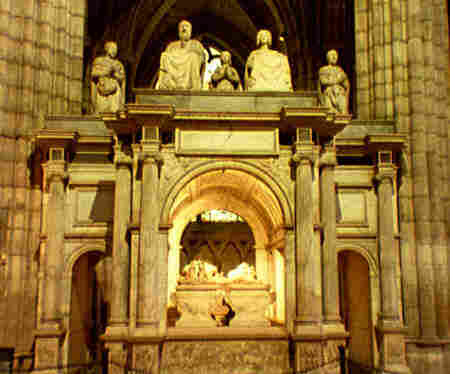
The first thing I noticed was the bare, marble feet. At the centre of the huge marble monument effigies of the almost naked monarch and consort lay, the soles of their feet facing tourists as they entered. At last I saw the human vulnerability of the monarchs. It was only later that I saw the fully-dressed king and queen kneeling in prayer, their children behind them, on the high top of the monument.

I wandered among the dead kings and queens. There was Marie Antoinette again, slightly larger than life and kneeling elegantly next to husband. And there were the plainer, earlier kings, from Clovis onward, looking stiff, still and much the same as one another.

Wandering among the royal monuments, I caught sight of a notice on one of the stiff mediaeval ladies: "une princesse inconnue" - an unknown princess. She may not have been a very significant princess but presumably, a long time ago, she thought herself an important person in the world. And now she was just a monument, much like all the others, and no-one even knew her name or which of the many dead princesses she was.

Beyond her lay another, smaller monument, no longer than a five-year-old but a miniaturised adult in polished white marble. I leant over to look at the notice - another "princesse inconnue."


Thursday, 27 August 2009

Rechauffage


There are no kitchens at Versailles.

English tours of palaces, castles and stately homes show visitors where the servants lived and worked. That's where most of us see ourselves. We know, logically, that we wouldn't be the ones in the fancy dresses. We'd have been taking orders, making things, clearing up after grand parties and making do on too little sleep.

But in Versailles, cooking was seen as messy and vulgar. Meals were transported from a huge building in the town to be reheated, tasted for poison and served. Even in Le Petit Trianon, Marie Antoinette's modest mansion in the park grounds, there was a room for reheating the meals. And in the farm and model village she created, there's a whole building dedicated to rechauffage - reheating.

The farm and village created for Marie Antoinette has a picturesque unreality, although there was a real farmer who has to provide eggs and milk for the queen's dairy. Everything is clean and fake. The houses, dovecote, mill and so on may seem miniature compared to the vastness of Versailles. Perhaps Marie Antoinette really believed that this was how peasants lived as she and her friends played at being poor but it's Disneyfication before Disney. Versailles left me marvelling at the remoteness of the French monarchy but the little fake village, constructed so prettily around a carp-filled lake, sickened me. I was also reminded of Poundbury.

There was a gift shop, of course, selling mementos, mostly of Marie Antoinette. And the real farm has become an animal sanctuary where sheep, cows, goats, rabbits and donkeys enjoyed plentiful feed, sunshine and admiring glances. Nearby, horses graze and a couple of farm carts - tumbrils - stand empty, ready for use.

Tuesday, 25 August 2009

Being Jupiter


Nothing prepared me for the gilded enormity of Versailles. I tried to imagine being in a mob storming the castle and could manage only incredulity at the excess. I've never seen a better argument for republicanism.

I don't understand the way of thinking that commissioned such an enormity nor the way the court understood itself. I thought Tale of Two Cities an exaggeration but now I realise it understated the reality.

There are notices at Versailles about the practices of the court. Every evening at 10 p.m. Louis XIV dined with his family. This was a public event and members of the court were privileged to watch. They didn't get to eat. The ladies perched on small stools and the gentlemen stood behind them as they watched the monarch and his family at dinner.

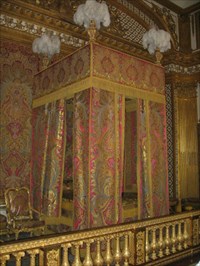
Going to bed and getting up were ceremonies too. There are gilded rails in front of the high four-poster beds and at the top corners of the bed - the structure must be fifteen feet high - are white fleur-de-lis made out of ostrich feathers. A few chairs stools are placed nearby, presumably for the attendance at court.

It's perhaps not remarkable that the chapel is a baroque riot or that there were strict rules based on orders of precedence about who could attend and where different levels of the nobility could sit.

But strangest of all are the paintings. Some are religious, with Jesus and his disciples in peasant dress. At a last supper, an extravagantly-dressed Mary Magdalen washes Jesus' feet. You wouldn't catch the royals in any such gestures of humility. Anne of Austria appears as Minerva, Louis XIV as Jupiter. One of Louis XV's toddler sons reclines as Cupid. Louis is everywhere: winning wars, making peace, implicitly compared with Alexander the Great, honoured by a winged Victory as he stays aloof from the battle. He even poses to show off his red shoes and his fine leg - he could sing and dance as well as making war.

The French royal family moved among paintings of themselves as divinities, usually in the Roman style. How they combined this with their public Christian faith, I don't know. But they seem to have seen themselves as more than heroes. In the oddest painting of all, Hercules, nude but for a carefully-placed drape, paints a portrait of Le Grand Condé on a lion-skin while assorted nymphs and divinities stand around.


Thursday, 13 August 2009

When the statue moves


There are a few moments in film, opera and drama that always move me to tears. In Casablanca it's the bit where the Nazis are singing round the piano and Victor Laszlo tells the band to play the "Marseillaise". As the customers in Rick's Bar stand to sing and drown out the Nazis, I feel the familiar lump in my throat.

Resistance moves me. So does reconciliation - often the moment when parent and child are reunited. When, at the end of The Railway Children, Roberta finally cries out "Oh! My Daddy, my Daddy!" once again I'm moved to tears. The same happens with the less well-known reunion between father and daughter in Shakespeare's Pericles when the father summons up the sea metaphors to express his joy at seeing his sea-born daughter Marina:

"Give me a gash, put me to present pain;
Lest this great sea of joys rushing upon me
O'erbear the shores of my mortality,
And drown me with their sweetness."

There's another kind of reconciliation that affects me at the end of Mozart's Marriage of Figaro when the Count asks the Countess for forgiveness and she, in the most heartbreakingly sweet music of the opera agrees. In the reality of the 18th century, she doesn't have much choice. Beaumarchais' third Figaro play, La Mere Coupable, takes a more cynical view of the characters while Mozart's own music in the final chorus seems to anticipate the greater cynicism of Cosi fan Tutte.

But the betrayal the Countess forgives is nothing to the forgiveness shown by Hermione at the end of Shakespeare's A Winter's Tale. Hermione cannot regain all that her husband's cruelty took from her. She has lost her small son for ever and has spent sixteen years in isolation, uncertain whether the baby stolen from her has survived. Her husband's guilt and suffering may be clear but he's still far from perfect as his reaction to Perdita and Florizel's romance makes plain. Yet when he stands before what he believes to be the statue of his dead wife, the audience usually holds its breath, willing the miracle that will bring forgiveness and reconciliation. And so, after long stillness, music sounds, the statue moves and the living woman reunited with husband and daughter.

This ideal of forgiveness despite deep wrong runs through many of Shakespeare's plays. In Measure for Measure, the would-be nun Isabella believes her brother has been executed on the orders of Angelo and still, at the pleading of Angelo's new wife, kneels to beg for mercy on his behalf. At least in Measure for Measure, the audience knows that Isabella's brother is still alive - but there is very little to be said in Angelo's favour. The most Isabella can say on his behalf is that he used the law to kill her brother and that he failed in his intention to rape her. When I find myself in tears at this point, it is not because I feel much sympathy for Angelo, or even his new wife who is never quite convincing as a character.

What moves me to tears is the generosity of those who forgive, despite their pain. It's an impossible, even risky act. In Hermione's case, it seems to be brought about by love but Isabella acts on the appeal from a woman who has helped her, sustained by the belief that mercy is better than the fierce justice that kills.

Forgiveness seems a long way from the public mood at present. I went to a school that required me to attend church regularly so I absorbed the words of the General Confession from the Prayer Book: "We have erred and strayed from thy ways, like lost sheep, We have followed too much the devices and desires of our own hearts, We have offended against thy holy laws, We have left undone those things which we ought to have done, And we have done those things which we ought not to have done, And there is no health in us: But thou, O Lord, have mercy upon us, miserable offenders; Spare thou them, O God, which confess their fault, Restore thou them that are penitent ...." This may seem like too much abasement but at least it united members of the congregation in the understanding that they required forgiveness as much as anyone else.

I wouldn't claim that Christians have a good record in offering forgiveness - history shows that many Christians in power have been smug, punitive, violent, racist and vicious. But that sense of the value of forgiveness, which comes from passages in the Gospels rather than the actions of so-called Christians, may have been lost for good. The rhetoric of justice - which is even harder to achieve - seems to have replaced any sense of the beauty of mercy and reconciliation. For me, forgiveness deals with the reality of fallible human people who don't seem able to avoid hurting one another but who are still capable of great love.

Future generations may still be moved by the singing of the "Marseillaise" in
Casablanca. Resistance to wrong will still be necessary. Roberta's cry as she realises her father is free will still be potent because his release from prison is a matter of justice and his restoration to his family a vindication of their faith and love.

But what about the works where flawed and unworthy human beings are nonetheless loved and forgiven. Will future audiences have any sense of why those passages from Mozart and Shakespeare move me to tears?