 I'm fussy about tea. I like it in large quantities. If it's ordinary tea in a market or transport café, I like a half-pint mug. If I go to a café or tea-room - or if I drink tea at home - I expect to pour my tea from a pot.
Just lately, tea-drinking at home has improved, thanks to my daughter. She never got round to sending her mother's day present but brought it with her when she visited for Easter. She knows I enjoy tea and presented me with an elaborately-wrapped wooden tea-box with tea pigs inside. I think they're called tea pigs. They are exotic, silky tea bags which feel as though they've been hand-crafted. The tea is delicious, worthy of my best Chinese tea-pot, which I bought as a treat for myself in my student days. It makes tea-drinking even more of a special occasion.
I felt the contrast when I made a journey to a good, free exhibition at a local art gallery. I'd decided the whole outing could be a special treat and that I'd round it off with tea and cake in the café. There was carrot cake - in the kind of big, chunky slices that require tea in a pot, ideally with a pot of hot water on the side to keep tea at the proper strength.
I chose my cake and asked for a pot of tea for one. "You can't have that," the young woman at the counter said. "You have to have a cup of tea. We only do pots of tea for two."
I smiled and asked whether I could just have one tea bag in a large pot. "Yes, but we'd have to charge you for a pot of tea for two."
I gave up. I was feeling embarrassed. Plainly there was something odd and awkward about the idea that someone should sit in a café alone and enjoy tea and cake. I was given a cup of tea, which consisted of a tea-bag floating in hot water. The tea was stewed before I paid for it and cold before I'd finished my cake. It wasn't much of a treat.
I wrote it off as a solitary episode. But the following week I went to the theatre. I decided to order an interval drink: nothing exciting - just a half of cider. "Just ONE drink?" the young woman serving me asked. She was polite and friendly. I explained that I had gone to the theatre alone - as I've been doing since my teens - and wondered if she pitied me. Or perhaps women on their own are expected to have ice cream in the interval rather than alcohol.
At this point I was feeling fed up. I tweeted about the theatre and, to my surprise, got a polite and friendly tweet in reply from the theatre. I felt better. I finally sent a message to the café and got a reply from them too, telling me their cups are big (yes, they may be, but they don't keep the tea warm and there's something depressing about a teabag floating in a cup) and that, if I asked, staff would provide tea for one in a pot at a reasonable price. I may try again, when I'm feeling tougher.
I'm beginning to notice a world increasingly geared for pairs and couples. Even the café of Nottingham Contemporary, one of my favourite places, has an evening menu based around "sharing platters." When I'm alone I can order "nibbles" but that's all. I like olives but sometimes I want bread and cheese. Sometimes I want to feel it's OK for a single, middle-aged woman to venture out alone. There's lots going on in the world and I'd like to enjoy it.
 "Can I have a word?"
It was early evening and I was walking down Leicester's New Walk. I looked at the young man who had accosted me. He was polite, hesitant, holding a clip-board and pen.
"I'd like a word," he said. "Just one. Any word you like."
This was difficult. There are so many words. I paused for a few moments and thought.
"Insubstantial," I offered.
He looked hesitant, then held out his clip-board. "Would you write it down, please?"
I wrote it as clearly as I could, in capital letters, at the bottom of his word-crammed page.
"Thank you," he said as I handed back the clip-board.
I smiled, wished him a good evening, and walked on.
When I tell friends about the encounter, they assume I'm making it up. I don't know why. I often want a word. Asking people for words seems an altogether sensible endeavour. I did my best to respond with a good one - I wouldn't have wanted to fob the young man off with something like "nice" or "tomato." And I didn't want to ask why he wanted a word. That was his own business - a question would have seemed too intrusive and familiar. It would have wasted his time. After all, there are lots of words out there and he needed the time to track as many as he could. I hope he made good use of them.
I thought of that young man again when I headed to the Turkey Café for an evening of poetry. I'd been looking forward to the launch of Cleaves Magazine's East Midlands section. But it had been a long day and I wondered if I was tired enough to concentrate on an evening of difficult poetry. At the bar I was persuaded to try a Cosmopolitan cocktail - it didn't take much persuasion and was worth it for the sight of flaming orange peel alone.
Poetry seems to pull in the punters in the East Midlands. As soon as the doors were opened, there was a dash for the chairs. The young were asked to sit on the floor instead - but soon the floor was full too. Late-comers stood by the door. Dazed by heat, crowds, tiredness and a cocktail, perched on a high stool in a hot room, cocktail in hand, I wondered if I'd be able to concentrate.
That's when I remembered the young man making his assiduous collection of words. I didn't have to take in every poem in all its complexity - as if this could ever be achieved when hearing a poem for the first time. This was a poetry reading, not an exam, and it was up to me how I enjoyed it. If all I could take in was a few words and the curving melody of a rhythm, that would be enough.
I settled down as comfortably as I could, and listened without straining. If I wanted, I could find the poems elsewhere and read them.
Readers performed in alphabetical order. Jennifer Cooke offered harsh words and disturbing images, pushing the boundaries of a sonnet. Kerry Featherstone offered English and French words; they almost mirrored each other but not quite - there are no exact translations. Mark Goodwin offered a kingfisher and the mountainous slopes of Ullswater.
There was an interval. Then Daniel O'Donnell-Smith offered modern technology and loss. I love his poems. They move reader or hearer without the easy tricks of modern sentimentality. Finally, as I was tiring, Simon Perril read and summoned up werewolves.
I was unsurprised to see clouds streaking a full moon as I left - an image from silent cinema, I thought.
I ran. Words from the reading clattered and echoed in my brain.
 Political conversations are everywhere. Not all elections are like this. The last election was marked by apathy and the sense that, when it was over, the New Labour regime would continue. I heard discussions of how to vote that were marked by a sense of guilt and despair – we hadn't stopped the war in Iraq and the war-mongers were about to claim their electoral victory as popular endorsement. Thatcher's dreadful phrase “There is no alternative” hung over us.I assumed this election would be similarly despairing. After the chancellors' debate on TV, when Darling. Osborne and Cable agreed that, whoever got in, the cuts would be deeper and more painful than under Thatcher, I settled into the gloomy certainty that the next five years would mean the rapid unravelling of everything I value in the hard-won welfare state. Worries about my parents and my children broke into my sleep and woke me in the middle of the night.I'm still worried. But there's a new thrill in the air. Many young people who never voted before seem to have infected the public debate with their excitement and conviction that change and hope are possible. They aren't agreeing with one another and many are still uncertain how to vote, but they want to listen to the arguments and join in the debates. The power of a single vote makes them feel like citizens.I was in Leicester yesterday when Nick Clegg visited. I've seen visiting politicians before and remember how, when Tony Blair came to Leicester in 1997, everything was stage-managed and spun to ensure good camera angles. Blair's campaign team provided the crowds with flags to wave, played music (D-ream) interminably and swept dissenters aside.Nick Clegg's visit wasn't like that. Students, enjoying the sunshine and their last day of term, came to join the crowds and see what Clegg had to say. Most banners were home-made though a couple of Labour supporters brought their own banners to wave. Plainly Clegg's team was taken aback by the hundreds of people. I heard them on mobile phones: “Yes, there really are that many.” Then the battle bus arrived.A narrow pathway meant that Clegg could get through the crowd, preceded by photographers and cameramen who found it hard to get the pictures they wanted. Clegg stopped as he walked to answer questions – a socialist friend of mine who came at my suggestion managed to ask him about students and bankers. She got an answer though I couldn't hear it.There was a speech with questions and applause but I was too far away to hear. Instead of trying to break into the crowds I started taking photographs of the posters. The pair produced by the Politics and Pints society cheered me, though Clegg didn't accept their invitation to the pub.There were more banners today at Nottingham's all-purpose, leftish-to-revolutionary May Day march. The organisers couldn't afford the marches usual base near the castle so had booked Victoria Park instead, to remind locals of the recent closure of the Victoria Baths nearby. The weather forecast threatened rain and gloom and I packed a waterproof jacket. I didn't need it.There were fewer people than in previous years. With only five days till the election, some of the regulars may have been out campaigning. But there was still a good range of stalls including one celebrating Nottingham's radical history in which a loaf on a stick, decorated with a black ribbon, had served as an incitement to riot. Of course, someone was carrying a loaf on a stick. I couldn't resist a badge with the words “TO THE CASTLE”, recalling the burning of Nottingham Castle in the 1831 riot in support of the Great Reform Bill. I hope no-one arrests me for incitement to violence. I'm still a Quaker and a pacifist – but I can't help wanting to celebrate Britain's radical past and the workers who demanded that their voice be heard.Women dancers, energetic and costumed as if for an extravagantly-pagan Morris, led the march. Various factions of the left chanted their competing slogans without getting further than detailed debates. Home-made banners greeted the shoppers of Nottingham, mostly with thoughtful, witty and challenging slogans that might make people think. (I was a little uncertain about the demand for “revolutionary praxis now” - the word“praxis” is underused in most conversations I have.) A gorilla danced and handed out leaflets for Greenpeace. I wondered where to fit into the march and found a place with CND and near Friends of the Earth.
Behind me two socialists had a lengthy discussion about how to vote. One argued that a Labour defeat was the only hope for radical elements in the Labour Party. I didn't catch the response. I wondered whether competing groups urging people not to vote, on the grounds that direct action is needed, were debating the best way not to put a ballot paper in the ballot box.We walked, sang, chanted and danced past the derelict wreck of a business which still proclaimed in large, wrought-iron letters "PALMER & SON LTD. BYRON WORKS." I thought we made a cheerful display and was pleased to see answering smiles from some of the shoppers. There were cheerful displays everywhere. Outside the glossy new pawnbrokers with its shiny blue fascia, smiling young women handed out white and blue balloons.It wasn't a long walk to Nottingham's speaker's corner, by the Brian Clough statue. The Clarion Choir were there to greet us. So was Robin Hood in a home-made and decorated banner-gown. I stayed for a while to listen to the songs and speeches, marvelling at how harmonious and tolerant Nottingham radicals can be on such occasions. I'd have liked to go back to Victoria Park with the march but my back was hurting. I slipped away and decided to blog about the march instead.

 I missed St. George's Day itself. I was too busy with work to head to Leicester Market for the traditional dragon-slaying and distribution of red roses. But Leicester has never been content with small festivals. St. George's Day has spilled over to become a three-day event, involving more than any individual could fit into the time available.
I scanned the programme in amazement. Everyone was getting in on the act. There were morris dances, a maypole, church services and a beer festival. There was face-painting and dragon-making and a choice between Shakespeare, poetry readings outdoors and prose and poetry indoors. Some of the events had a rather slight connection to St. George, unless there's something I missed - there wasn't any flamenco dancing in any version of the story I knew. But why not? It all sounded like great fun. I determined to attend on Saturday and take lots of pictures.
Plans don't always work. My back, still painful after my fall on the ice in January, was hurting more than usual. I left home late with my camera in my bag. Photogenic sights abounded. I saw the bunting first - I wonder if the council will leave it up for the World Cup. Two minutes later I spotted my first St George, accompanied by his maiden. They posed for a photo and smiled. I framed the picture, clicked - and the resulting image was flooded with light. I thought I'd messed up the settings, tried to check them, wished I had an instruction book. I tried new settings, more pictures. No luck - and they would have been such good pictures too. The ones that get away are always the best.
I listened to some readings. They were good but, worried about the camera and other matters, I could give then only half my concentration. I wriggled in my seat, trying to make my back comfortable. I failed and headed out into the sun.
Leicester was flooded with St. Georges, all much better-looking than the slightly sad specimen escorting Nick Griffin at the BNP manifesto launch. (I wonder if Nick Griffin knows how multi-cultural Leicester celebrates St. George's Day - and how pathetic his own attempt looks by comparison.) I think there was even a St. George on stilts but I was too far away to check the identification. I was happily impressed by the George and Dragon cupcakes.
I headed to the station via my favourite camera shop. The staff inspected my camera, checked the programming and eventually diagnosed the problem - serious and expensive. "It would cost a lot to mend it," one said. They didn't need to spell it out - I knew it would cost more than the camera itself. "Which is your cheapest camera?" I asked, and got out my credit card.
By the time I reached Nottingham St. George's Day celebrations were winding down - they had lasted a mere two days. Here England's special days involved William Booth and Feargus O'Connor as well as more markets, Georges and dragons. Shoppers, children, Goths and football supporters ambled in the sunny Market Square.
I didn't pause for long. My destination was the Playhouse and a play about another George. I read Julian Barnes' novel Arthur and George a couple of years ago and was curious to see what sort of play David Edgar would make of it. It didn't seem a natural choice for a drama - the novel goes back and forth in time and deals with complex questions of law and evidence. But David Edgar's a confident, experienced playwright who knows how to move characters and keep the audience interested. He's not to reshape a novel to ensure it works as a play.
In a way, Arthur and George is a play about Englishness, although Edgar doesn't labour the point. George Edalji, a vicar's son and solicitor, sees himself as an Englishman. His passions are railways and English law - he likes to see the world as an orderly place. Chris Nayak, in an entirely convincing performance, brought out the character's slight strangeness which the play relates in part to a protective and defensive family and in part to George's extreme short-sightedness and consequent focus on details.
At the beginning of the 20th century George takes his isolated life and its oddities for granted. When he comes under suspicion for horrific crimes - maiming horses and leaving them to bleed to death - he limits his consideration of the case to matters of evidence, law and courtroom practice. He never mentions the virulent racial hatred that condemns him because he is the product of a mixed marriage - his father is Indian and his mother Scottish. Eventually, when his life has been shattered, he turns for help to Sir Arthur Conan Doyle
Arthur - famous, admired but also an outsider - looks at the larger picture and is determined to secure justice, compensation and public vindication for George. Adrian Lukis's performance shows the bluff, hearty persona Arthur presents to the world but there's also a hint of vulnerability - Arthur is uneasy with his fame and the complications of his own personal life. George's case provides Arthur with an escape from guilt and worry as well as a cause to fight. One of the enjoyable aspects of the play is the way in which George and Arthur, who, with little in common, treat each other with careful respect and do their best to see one another's point of view.
It's an delightful play. The two major characters are complex and layered. Actors in the other roles take the opportunity to hint at complexity on occasion. While racism is uncovered - the kind of racism that was written into British text books at the time - it's not the only factor working against George. Ideas of manliness play part and so do networks of unspoken loyalty. George is a very convenient scapegoat.
Watching the play was entirely pleasurable. It helped that pain-killers, combined with rather good cider, banished my back-pain for a a few hours. Comfortable seats at the Playhouse helped too.
George Edalji probably contributed more to Britain than the historical St. George - or even the legendary dragon-killer. George Edlaji's case - and Arthur's defence of George - was a major factor in creating the Court of Appeal.
 I last went to a candidates' meeting in 1997, uncertain how to vote. Part of me desperately wanted an excuse to vote Labour so that I could be part of the overthrow of Thatcherism and be sure that things could only get better. There was only one meeting. I sat on a hard pew in the packed local Baptist church, surrounded by hopeful voters, and wished that I shared their optimism.This year, there's a choice of candidates' meetings: five, I think, in our part of the constituency. The local newspaper has got involved and is sponsoring debates. I wondered how many people would attend the meeting I'd selected. It was in a local school and clashed with the beginning of the first party leaders' debate on TV. Once again, I wasn't keen but I accompanied my son who's thinking hard about how to use his first ever vote.We were ten minutes early. The organisers must have been pessimistic about attendance as there were only eight or ten rows – mostly full. We found two seats together in the second row – apparently no-one wanted to be too near the candidates. As the hall filled, more chairs were found until the rows stretched to the back of the hall. Then I settled down to watch.The meeting was more carefully managed than some, perhaps influenced by the rules for the leaders' meetings on TV. Members of the audience weren't even expected to ask their own question – instead questions were written down and handed to a steward who would pass them to the chair who relayed them to the candidates. Whole areas of policy, including education and civil liberties, were ignored except when a candidate mentioned a single measure in passing.I'm not sure how clear an idea it gave me of the candidates. I didn't get any sense of the BNP man, since he chose not to turn up. I wasn't going to vote for him anyway. Personal impressions counted for a great deal. The UKIP man was surprisingly likeable - I didn't agree with him but he listened to people, answered clearly and seemed straightforward. He seemed the sort of man who would be a good friend, colleague or boss – and probably a good conversationalist over a coffee, beer or wine.I wanted to be impressed by the Green candidate. Every survey I take tells me I'm more aligned to the Green policies than those of any other party. Again the candidate seemed personally likeable and his experience – as a self-employed craftsman and school governor – is just the kind of experience that's needed in the House of Commons. But he was unclear on policies – actually unsure what they were or how big questions could be addressed – and plainly unready for parliament. With six months of hard work he might become a decent candidate but he's not ready yet. It's a shame.The Liberal Democrat is a sitting councillor. He was confident on local issues and broad policy areas and was probably the best speaker of the evening. He had a couple of good soundbites - “We were right on Iraq and right on the economy” and “Charlie Kennedy was drunk and he was still right on Iraq” - and spoke particularly well on the need for international aid, drawing on experience of life in Malawi. Apart from that, I was worried that his strengths were local rather than national – an MP has to deal with national questions.There was only one woman among the candidates – the conservative. I’m far from being a tory supporter but I’ve seen some good tory initiatives such as David Davies’ support for civil liberties. I’ve also had enough experience of being the only woman in a male environment to know it’s difficult so I tried, at least, to like the candidate. I couldn’t. She seemed like a lacquered version of Margaret Thatcher without the smiles. There was no pretence at liking the audience or the other candidates, just an array of facial expressions that ranged from the sneer to eye-rolling incredulity. Her manner as a speaker shifted between the deliberately informal to the rehearsed speech with hand gestures, reminding me that she had been a broadcaster and was now a barrister. Some of the things she said were good – she asserted that she had opposed the war in Iraq and favoured international aid – but she also declared that she agreed with every word in the tory manifesto.The Labour candidate had all the advantage of 13 years as the constituency MP. He was familiar with the major political questions as well as local concerns so his answers were thoughtful and knowledgeable. He was polite to his opponents and took the audience seriously. He even said he’d been wrong to vote for the war in Iraq and that he now opposed ID cards because they would cost too much. This was quite a U-turn – he used to be a keen defender of government policy and took personal credit for advancing the proposal for ID cards. His line was the hackneyed one that people who had nothing to hide have nothing to fear – perhaps he’s the only person in the country to reckon he’s lived an entirely blameless life. He also spoke against government policy on asylum seekers on the grounds that it was too harsh – but I don’t think he’s ever voted against it.I like the Labour candidate. I think he’s an honest man who honestly convinces himself that, in most circumstances, his government and party is absolutely right. I live in a Labour-Tory marginal and, if I don’t want a tory government, which I don’t, logic demands I should vote Labour. I won’t do it.Labour is better on some issues. There’s a historic link with socialism and, although it’s frayed almost to breaking during New Labour days, it probably still means that the cuts which the new government will impose will hurt the poor less under Labour. But this government has supported war and opposed civil liberties to an extent that has made me fearful. The Serious Organised Crime and Police Act is one among many dangerous pieces of legislation. I used to think of myself of law-abiding. Now I take it for granted that, if the government wanted, they could find some law that I’ve broken and use it to imprison me. There’s a certain perverse freedom in that. I no longer worry much about what the law says.
New Labour has also supported mistreatment and torture of prisoners, including prisoners who haven’t been found guilty of any offence. These range from asylum seekers and their children – some very young indeed – to suspects who were kidnapped by the Americans, bundled into planes and transported overseas to be questioned under torture. It’s called “extraordinary rendition” and the Americans have now admitted that it happened. I wrote to my nice, tolerant Labour MP about this in January 2005, when the evidence was mounting up. There were witnesses who had seen what was happening, records of flights tallied and companies were named. My MP responded that the evidence was “thinly-based,” that the British government couldn’t be expected to ban flights from stopovers or subject them to scrutiny. He added, “If there was a specific allegation that a prisoner was being held captive in a plane … I’d take a different view and I’d think his lawyers would have a strong case for asylum.” The idea that someone who has just been kidnapped by the CIA will have access to lawyers us so ludicrous that it suggests my MP lives on a different planet.When I think about the war, civil liberties and government attitudes to torture, I know I can’t vote Labour, even though I dread a tory government. I suppose it will have to be Lib Dem. I don’t feel happy about it. But at least it will annoy the press, which is on the attack. The Daily Mail this morning misrepresented a fine article Nick Clegg wrote as “Clegg’s Nazi slur”. I firmly expect an eve-of-poll headline saying “Nick Clegg will eat your babies.”
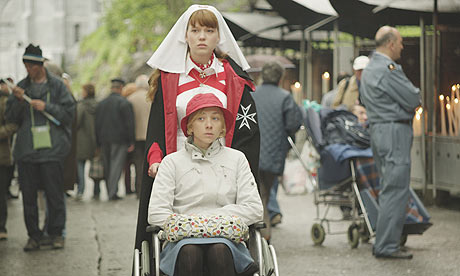 I didn't plan a trip to the cinema. I just popped in to use the loo. Then, out of curiosity, I looked at the board to see what was on. The screening of Lourdes started in two minutes. I'd read a good review the day before and reasoned that it might improve my French. I bought a ticket, handed it to the usher and settled down to watch.I wasn't in the mood for a film. The advertisements and trailers, which can amuse me if I'm in the right mood, annoyed me with their bright, rapid, manipulative images. Within five minutes of taking my seat, I was regretting my decision. Then the film started.In less than a minute, I'd relaxed. The opening sequence - people entering a hotel dining room - was sufficient to tell me that I was in the hands of an expert film maker. I don't know quite what it was: the balance of colours, the composition of the frame, the camera angle, the movements of the actors - probably a mixture of all these but more as well. Lourdes isn't a film that offers obvious thrills and dramatic scenery - it's focus is on a small place, a short time-span and a small group of characters. But what is most startling about the film is what it doesn't tell the audience.Standard Hollywood films construct neat "backstories" for all the characters, which are quickly revealed to the audience. I'm sure the actors in Lourdes knew what their backstories were, but they didn't bother to tell us. We had to observe them in the present tense and make our own guesses and judgements - just as we do when meeting people in real life. There were plenty of questions and mysteries about the characters, who had as much depth as any human beings, but their complexity meant that the puzzles we had couldn't be resolved in the short timespan of a film. I left the cinema still wondering about them.As director, Jessica Hausner did something unusual - at least in relation to most of the films in British cinemas: she left members of the audience to make up their own minds. And we were left to think on the usual human basis of not knowing everything. I made judgements during the film, because that's what humans do, but I was uneasily aware of how little I knew. Every so often a new fact would be disclosed and I'd be forced to adjust my previous judgement. Most films simplify but Lourdes indicated a complexity that couldn't be resolved prettily in the course of a film.The setting of the film had been one reason for my hesitation. I've never felt comfortable with the idea of religions offering mass healing to the sick, disabled and unhappy. I worry about those who go and are not healed - some must feel guilty, judged and self-critical because they were not thought worthy of healing. I may be wrong, of course - this is guesswork and imagination. I've also felt uneasy about films of such places and events - I don't want to be a voyeur of other people's hope and misery. Perhaps I'm evading something. It was certainly good to see what a pilgrimage offered to the central character, Christine. Dependent on the help of others, she'd become a connoisseur of pilgrimages, which were her best chance to see the world though, as she explained, she preferred cultural trips.There were moments when the film did, quite rightly, make me feel uncomfortably voyeuristic. Pain and unhappiness are intimate subjects and the film was so close to life that I felt uneasy at seeing so much. But at times I also saw the pilgrimage from Christine's level, though not through her eyes, and became aware of the discomfort of forced dependency and casual, thoughtless cruelties.The film has, I discovered later, divided audiences. Some think it favours religion while others condemn it as atheistic propaganda. I don't think it sets out change people's views but it might uncover their doubts. It seems to me that it's a grown-up film that expects an audience of thoughtful adults - it explores a situation without telling people what to think. As a result, I've been thinking about it ever since.
 Every so often, I like a taste of luxury. It was years since I'd last hidden in the Grand Hotel but I wanted a morning away from the office. Sometimes that's the only way to get things done. At the same time, I needed to keep in touch. The Grand wasn't far off my route. I checked the sign in the window: "free wi-fi." It would do.
Coffee at the Grand is good but expensive, even by the standards of frothy coffee bars. I usually make my own coffee or head for a small, independently-run coffee bar. There's an Italian coffee stall in Nottingham's Victoria Centre market which may just offer the best coffee in the East Midlands - and I can practise my Italian too. But I can't linger too long in an independent coffee shop - I know the manager needs my table and the profits from a continuous line of customers. The Grand Hotel is big and wealthy enough not to disturb me. It also has the benefits of comfortable sofas and piped music that is quiet enough not to disturb. The loos are luxurious too. And the woman who brings my cafetiere is quietly welcoming.
I used to be afraid of grand hotels. I thought they were meant only for the rich, that they had strange dress-codes and obscure rituals I wouldn't understand. I thought the well-dressed porters and waitresses would laugh, refuse to serve me and throw me out. Luckily, in my late teens, I encountered fellow teenagers who thought nothing of ordering coffee in a posh hotel - and it would have been more embarrassing to confess my fears than to join them.
I wouldn't want coffee at the Grand to be a regular experience. I like my luxuries to seem special. Perhaps I've already been too over-indulgent lately. As well as coffee in the Grand, I experienced another quiet luxury - first class rail travel.
I was booking on-line for a journey to see my parents. I was fairly flexible about times and looking for the best deal - a complex process that probably merits a higher-level GCSE. Then I saw that the cheapest single price on one train - the best deal going! - was the same for first or standard class. I booked it at once and then found a first class ticket back at only £5 more than the cheapest journey. It seemed worthwhile - even with a seat booked in advance, I've found myself standing for part of the journey lately and first class would surely guarantee a seat.
I was startled by the quiet spaciousness of first class travel. I think the thick carpets help. On the way back the carriage was full so there were the usual interruptions of mobile phone-calls and eager children. Neither were more interesting than fellow travellers in standard class and I didn't manage any more work or reading than usual. Instead I spent my time marvelling at the way the carriage seemed to soak up the sound and wondering whether the views were just slightly different from first class carriage windows. I didn't reach a conclusion. I was simply grateful for the quiet and the chance to rest my back. I think I could have gone to the buffet and collected a free coffee too, just by showing my ticket. But I fear that railway coffee doesn't reach the high standards achieved by the Grand Hotel. I did without.


