Tuesday, 2 November 2010

Transit camps for the poor


Growing up in our block of flats, there were always small tasks for children. I had slim, flexible wrists and was in demand whenever a neighbour accidentally let the front door slam behind her and found that she was locked out. I could slide my fore-arm through the letter-box and, using a hooked kitchen utensil, pull the inside door handle down until the door opened again. Sometimes I'd be offered sixpence as a reward but I was sufficiently well-schooled by my parents to refuse it, unless the neighbour was particularly existence. Helping out was a way of life.

Often someone would run out of a basic food. I would be given a cup to ask the neighbours if we could borrow flour or sugar, with the promise to return it the next day. Back then, the shops shut at 5.30 and shopping was a daily activity. Best of all was running out of milk. Only one of our neighbours had a fridge and borrowing milk meant drinking milk that was icy instead of room temperature or, in a hot summer – and despite our efforts to cool by evaporation in a sink full of water – not far from going off.

I don't recall envying the wealthier neighbours. I enjoyed the excitement of rummaging through jumble sales for books, ornaments and clothes (my order of priorities). I would have liked a holiday and wished my mother could have better shoes – but she insisted her canvas plimsoles were comfortable and children are apt to take parents' reassurances at face value. Mum did her best to convince us that holidays were boring, though Butlin's sounded terrifically exciting. Instead we had Sunday school outings and days out roaming Putney Heath, Richmond Park and Wimbledon Common. Sometimes we walked as far as Kew Gardens or took advantage of our cheap tube fares to explore London's (mostly free) sights and museums. There were always books, libraries and sometimes theatre trips to Shakespeare in the parks or plays, musicals and ballet from the gods of the nearby theatres.

As a small child I observed and marvelled at all kinds of glamour: I remember golden beehive hairstyles, possibly tinted by the hairdresser, and stiletto heels. One neighbour invited us for drinks at Christmas and we sat nervously in her pristine living room where she offered a choice of tea, squash and Bristol cream. (Mum disapproved of the sherry - she thought it the first step to alcoholism). Usefully, one neighbour acquired a telephone and gave us all his number for use in emergency. We were instructed in the routine of the phone box – when to press button A and button B – and learnt to deliver a quick message in ten seconds should we depend on the return of twopence for the bus fare home. The telephone and fridge-owner even had a small car. He worked as a chauffeur and once, resplendent in his chauffeur's uniform, gave me a lift into central London. I'll never forget how he stood and saluted as I emerged from his small grey morris minor.

I suppose we were still in the post-war atmosphere and believed we were “all in it together,” whatever “it” was. Linked by our need for council houses, we were a surprising jumble of people: young couples with children, older people, respectable types who had lost homes in the war, ex-servicemen and women, refugees (some with numerical tattoos we didn't mention), people with shady pasts. There was a loving father who occasionally vanished into jail for a few months. One glamorous woman was said to be “on the game” but “a very good mother..” There were loving marriages and couples who fought. Being a child, I probably missed a great deal – it was more exciting to explore “the woods,” “the bomb-site,” to “go trespassing” and to dream of the big adventure of going down the steps of the underground air-raid shelter. I needed occasional risks - children do when they feel secure.

I still visit my parents in the council estate where I grew up. I don't get there often enough and these days I feel like an outsider. The atmosphere has changed – we're no longer in the post-war world, in which progress was taken for granted. At some point during my childhood a council house ceased to be a badge of respectability and “council tenant” became a term of abuse. Perhaps the upper middle classes needed someone new to fear and despise. Or perhaps they always did fear and despise people like me and I didn't know it. I remember the rants in the press about the evils of tower blocks - I loved and still love the high-rise block in which I lived – and the new acquaintances who examined me for evidence of neurosis or criminality, if they didn't (as some did) cut me dead on discovering where I lived. At around that time, people on the estate seemed to lose a certain self-confidence. It didn't help to know that an address might disqualify you for a desired job. I was assured, by people who didn't know my background, that council tenants were stupid, ignorant and never read books, went to museums or walked in London parks. I was told that people like me were vandals, racists, criminals and scroungers who didn't care to know right from wrong. The transition from home to wider society was uneasy. I learnt to keep quiet about my background and to mimic the nonchalance of the rich.

There was a shortage of council homes in London. For a while councils bought up big houses in wealthy areas and converted them into flats. Then the policy changed. Under Mrs Thatcher, tenants were encouraged to buy, at a substantial discount, and councils were not allowed to spend the proceeds on further council homes. We were to become a home-owning society. My parents, who had paid more than the value of their flat to the council in thirty years of renting, took advantage of the discount and used Dad's redundancy pay to buy their flat. While the policy as a whole seemed dodgy, I was glad for them. There were voices on the extreme right of the tory party suggesting that tenants with spare rooms should be moved. After bringing up a son and a daughter in a 2-bedroom flat, Mum and Dad finally had a little extra space – a room where their children and, eventually, their grandchildren, could bed down for the night.

There's more to that flat than extra space. Mum and Dad, who are still there and approaching their nineties, know the neighbours. They visit a familiar GP and are greeted by adults who remember Mum from the days she worked as an infant helper at the local primary school. The bus drivers recognize and lower the platform on the bus so that Mum can get on without difficulty. The views are the familiar views of Richmond Park. It's changed a little from my childhood by storms and the fall of trees. There are no longer sheep in the park and I don't know if the parrots who arrived in the 1980s survived the last harsh winter. But you can still hear the bark of foxes at night and the rough call of rutting stags. Sometimes you can look down on a hawk as it stoops for prey. When I stay there in summer I'm often woken by the rowdy clamour of the dawn chorus. It all brings back memories – memories cherished by my parents who have now lived there more than fifty years.

The sale of council houses brought changes, of course. Flats were the least popular part of the council's housing stock. It wasn't just the contempt in which tower-block dwellers are held which caused that. Anyone buying a flat has to contribute to maintenance, repairs, renovations and upgrades for the block as a whole – my parents had to put money aside for bills which can run into thousands or tens of thousands. So far they've managed. They are secure in their home with their memories.

Other neighbours bought, then sold and moved away. Tenants died and were replaced with new tenants. Suddenly individual and families on the council house waiting list needed more than inadequate housing to qualify and reach the head of the list. Desperation helped. So did illness or personal disaster. The shortage of council houses made it harder for relatives to live near one another – grown-up sons and daughters sometimes stayed as tenants or carers but many found themselves driven from London. I have a four-hour journey each way when visiting my parents and that's not unusual. I still feel comfortable on the estate. The sight of library, maisonettes and tower blocks among the trees tells me I'm coming home.

Now even faster change is arriving. It sounds as though the Big Society will mean higher rents, lower income for people on housing benefit (some of whom work at several jobs for low wages) and insecure tenancies. People who can't find work for a year will be punished by a cut in housing benefit, although their housing will be no cheaper. Rents are set to rise to 80% of the private equivalent rent – and in London that will be high if the housing shortage continues to contribute to landlords' profiteering.

It all worries me but it's the insecurity that nags at me most. If council houses are allotted only for a short period and, as has been suggested, those who are luckier with pay or promotion are rewarded with eviction, there will be no chance for a mixed community to grow. At the same time, the jobless – and the latest projections suggest unemployment is about to rise by 1.6 million – may also be punished by eviction as their housing benefit falls. Will they join the council outposts in Slough or Hastings, where cheaper landlords are said to be offering bulk bed-and-breakfast accommodation for the needy and homeless?

If all this happens, children growing up now on the council estate where I lived will never have the secure childhood I had. Their parents will take less pride in their homes as they wait to be moved on. If they are cautious and anxious they will save any spare pennies and pounds for the cost of the move and the demands of the next home. They will hesitate to root themselves in a community of temporary dwellers. Schools and doctors will see pupils and patients who pass through and never settle for education or care.

I'm concerned for all who live on the estate where I was so happy. I fear that these policies will swell a tide of anger and despair, leading at times to wide, directionless anger. I know how I feel when my security is threatened – and how my anger is trebled when those I love are at risk.

I fear that my parents, who still take pride in their flat and its views, will wake one morning to find themselves marooned in a transit camp for the poor.

Tuesday, 26 October 2010

Seeing the naked youth

Just as I succumbed to a horror of a cold – combined, inevitably, with a busy period at work – the East Midlands offered a cultural cornucopia of events. I missed too many, some because they clashed with work or other events and some because I feared to interrupt a reading or performance with a hacking cough. At least I made it to a recital by Trevor Pinnock, which included works by Couperin, Bach and Elizabeth Jacquet de la Guerre and to a range of poetry events including a small but well-attended celebration of National Poetry Day in Leicester and the first reading in the Nottingham Poetry Series.

I also attended a reading at the first Beeston International Poetry Festival. I hope it's the first of many. The festival, organised by poet, professor and jazz-man John Lucas, offers bargain-price (£3!) and free events at small venues including shops, libraries and the splendid Flying Goose café which also hosts a series of literary events through the year. I hope to attend further Beeston poetry events and will blog about them later. This paragraph should be seen as a taster and an advertisement for the rest of the festival – details can be found by clicking here.

However the major event of the cultural calendar – at least as far as the national press is concerned – must be the arrival of the British Art Show, In The Days of the Comet. It's a quinquennial event and this year it opened in Nottingham, taking over four venues: Nottingham Contemporary, Nottingham Castle, the New Art Exchange and One Thoresby Street. By luck, I found myself invited to the preview and finally well enough to take advantage of the invitation.

Previews are strange events, half party and half excitable tour of art. There are speeches too and, as I walked up the stairs towards the Long Gallery at Nottingham Castle I realised that listening to speeches would be the first part of my duty. At first the combination of microphone and echo so distorted the sound that I was reminded of the opening of Chaplin's City Lights. Perhaps they aren't speeches at all but an installation, I reflected. But they were speeches and, as I moved round the gallery, the sound became clearer. There were several references to the cuts and quite a few to “bonking bunnies”. “In the Days of the Comet” seemed an apt title for the show – if the Comet was a metaphorical reference to George Osborne's hacksaw.

There was something strange about the roughness of the art in the 19th century grandeur of Nottingham Castle. But hints of destruction also seemed apt both for the castle's past - the locals set it alight and watched it burn in the Reform Bill riots of 1831 - and for current anxieties. "It feels like the end of days," a colleague remarked a week or so ago, and her words chimed so well with my own feelings that they have haunted me ever since.

While some works were carefully wrought - sometimes for wealthy patrons - others spoke of change, anger and destruction. I couldn't see all the art clearly for the crowds at the preview and have decided to go back and see the exhibitions again when they were less crowded. I certainly couldn't give the video installations the time they demanded. But I was mesmerised by a mysterious monochrome work with people and peacocks that turned out by a tapestry. And I gazed at what appeared to be a cross between a bombed and deserted house and the kind of cart tugged through battlefields by Mother Courage. It was fragile, dilapidated and strangely beautiful.

Downstairs in the castle café there was free champagne, provided by the exhibition's sponsors, for any visitor with the patience to get through the crush. I met my friend Katie there and we savoured a moment of cool luxury on the castle balcony before returning to look once more at the art.

We were both tired - Katie had come straight from teaching - so decided to leave our visit to the New Art Exchange for another day. Instead we made our way to the Nottingham Contemporary which was also so packed that it was sometimes hard to view the exhibits. I was pleased to find work by the remarkable Alasdair Gray on show - I'm so fond of his fiction that I often forget that he's an artist and designer as well. I hoped to spot him among the hordes but, if he was there, I didn't see him.

Tiredness induced frivolity. Katie looked at what appeared to be a giant teddy-bear's head made out of canvas and wondered if it would be possible to use it for camping. We inspected the guy ropes and looked for tent flaps before sadly concluding that there was no useful entrance to the main space. Then I saw the fire.

It was plainly meant to be there. As I approached I could see that the flame occupied part of a metal park bench. Perched next to it was an extraordinarily accurate life-size model of a bearded young man wearing only a pair of blue y-fronts. As I got closer, I realised that it was not a model at all but a young man, sitting very still and gazing at the flame beside him. There's something strange about being invited to stare at a semi-nude man in an art gallery. I became aware of textures, flesh tones, the unnevenness of toes, softness, imperfection, vulnerability.

Katie and I read the notice together. It informed us that the flame would be lit once a day and that, once a week, it would be tended by "a naked youth." "But he isn't naked," I whispered to Katie. She instantly urged me to complain. But how could I complain to a still youth who was involved in a work of art?

Katie considered other grounds for complaint. He wasn't tending the flame, merely watching it. As if to reinforce her comments, the flame extinguished itself and went out. We wandered back in the direction of the youth, who had started engaging in conversation with visitors. But we were too late. Just as we arrived at his bench, a curator appeared holding a dressing gown which the youth put on before departing round a corner.

We saw the youth later, in the bar. By this time he was wearing a check shirt and looking cheerful. Frivolity was taking over. Katie drew my attention to the visitors' shoes and fashion sense. Then she suggested we were too tired for more art - and indeed we were. We headed, briefly, to a cocktail bar before going home.

It's comforting to know that the exhibitions continue till January. That should give me the opportunity for several visits. I may even attempt a more serious review. In the meantime, the first newspaper reviews are being published, and they're good.

Wednesday, 13 October 2010

Dolly in the downturn


Wherever I go, I find myself wondering what will survive. Announcements of cuts have speeded up and I feel battered already, though the axe is still poised to fall. These months are a reversal of the norm, as if convalescence came before serious illness. Everyone seems to be waiting for things to get much, much worse.

It's hard to make culture a priority when so much else is under threat. How can I value a trip to the theatre or art gallery – even a book borrowed from a library – above the local day centre for people with mental health problems (under threat of closure)? Yet I notice that many of the activities offered by that day centre depend on what are broadly termed "the arts". The people whose lives are improved by help and friendship at the day centre also improve their lives by sculpting, painting, writing and singing. They share their skills with one another – and arrange local trips to take in the exhibitions which I also enjoy.

Millionaires never have to do without the arts. As patrons they commanded poets, painters, sculptors and musicians - they could buy whatever entertainment they fancied. I'll always be grateful to those millionaires who gave money to build theatres and public libraries. But my sympathies are with those who lived on the fringes of culture, grabbing whatever they saw and desired, without any sense of entitlement. I've always grabbed at culture.

Now the wealthy men in our government are snatching back. Education in arts and humanities will be restricted to the very rich and those prepared to embrace enormous debt. Were I young now, I'd have to give up my dreams of a good education. Meanwhile opportunities for self-education are being snatched away. Library hours are being cut. Soon galleries and concert halls will close and theatres will darken – though I suppose millionaires will continue to enjoy their holidays abroad and whatever command performances they choose to buy.

Until then, I'm grabbing as much culture as I can fit round work and a heavy cold. I've seen two shows at Nottingham Playhouse (She Stoops to Conquer and Twelfth Night – both excellent fun) and, most recently, a new play, Dolly by Andy Barrett, which is touring the region. I caught it at the Darwin Rooms in Derby.

The Darwin Rooms aren't a typical venue for New Perspectives, the theatre company behind the production. It's one of those small, regional touring companies which rarely get noticed in the national press touring the region. Mostly performances are in village halls and sports centres - the actors move around the region, setting up temporary stages, lighting rigs and sound systems for a night at the time.

I haven't seen the company before but they seem to take rural settings as their starting point. This play was set in Rosslyn near Edinburgh - according to the play a small farming community where any outsider was instantly identified as a visitor to the research laboratory. It picked up themes of ambition, success and failure. Farmer's daughter, Bettina, longed to be a country and western singer like her idol Dolly Parton. Her story was told in parallel to the story of the first cloned sheep, created at the Rosslyn Institute.

To my surprise, I found myself warming to the enthusiasm of the researchers as they explained what they were doing and why it was so difficult. Ethical questions lurked in the background - as did the desire of mourners to use cloning to bring back the dead. But the playwright and production trusted the audience to think through the questions - they weren't hammered out but left for thought and discussion later. The play was more interested in celebrating human achievement, whether the success of scientists in an improbable project or the ability of Dolly Parton to write and sing songs about triumph in the face of difficulty.

When I say that my favourite performer was Dolly the sheep, this is not a criticism of the cast. They almost convinced me that the two puppets - Dolly the new-born lamb and Dolly the adult sheep - were real and I held my breath for a moment when Dolly was born and presented to the waiting scientists. It still seems unlikely that messing around with theories, formulae and test tubes can produce a warm and breathing creature, let alone a sheep of character.

But even if ambitious and imaginative scientific research escapes, I don't suppose the idea of science will warm people through the cold isolation of the cuts. Dolly Parton, for all her artifice, may be a better source of warmth. She can, on occasion, be very funny - and she has a clear sense of what it's like to go without.

Thursday, 7 October 2010

No to the Kindle

British friends have occasionally asked me why I visit Paris in August. “There's no-one there,” they assure me. “The real Parisiens are all on holiday and everything's shut.”

It's a simplification. Some Parisiens – those who can afford it – try to take holidays in August. Some shops, businesses – even museums – are closed. Last year I was sorry to miss the municipal museum of Montreuil, which I still hope to visit one day. The Comedie Francaise and the Paris Opera are on holiday. Friends I would have liked to see were away – as was the owner of the splendid apartment I sublet.


Yet I enjoy Paris in August. It has a leisurely air. The discovery that a local shop or restaurant is shut for “les vacances” is not a disaster. It's a reminder that workers need holidays and there's more to life than making money.


In previous Augusts I did little to look for live events in Paris. Paris Plage was fun – and full of locals – but I missed it by a day this year. I wondered if my British friends were right in saying nothing else was on. I decided to investigate. I paused at a kiosk and invested in a copy of Pariscope – not a huge gamble at 40 eurocents – to see what was going on.
Leafing through the pages I read of theatres, cinemas, concerts, spectacles and markets.

At first I was baffled by the choice, then began to make decisions. The Lucernaire looked worth a visit, and quite near where I was staying. The second and third Millennium films were showing at the Cinema Chaplin, not too far away. There was a fund-raising piano festival at the Armenian Cathedral in the Marais – and much more.


I began at the Lucernaire. The list of theatre shows made me hesitate. I'd missed Cooking with Elvis at the local amateur theatre and was prepared to miss the French version as well. But I wondered about a one-man show of Oscar Wilde's De Profundis, well-reviewed in a number of French national papers. The price – 22 euros – is more than I usually pay for theatre tickets. But when I thought about seeing Wilde in French, there was a pleasant logic too it.
De Profundis is Wilde's long letter to his young lover, Lord Alfred Douglas, written from Reading Gaol. Some years ago I would have said I knew the English text reasonably well, although it has faded in my mind since. I recalled that, after leaving prison, Wilde went to Paris, where he died, and was buried in Pere Lachaise cemetery. And while I hesitated about seeing a work in translation, I recalled that I had twice seen Wilde's play Salomé, which he wrote in French for Sarah Bernhardt, in the translation by Lord Alfred Douglas. The idea of Wilde in French translation was almost symmetrical. I bought my ticket.

The set up at the Lucernaire wasn't quite like a theatre in England. Notices on the wall told us that the “ouvrieuses” (specifically female workers) showing us to our seats were unpaid and dependent on tips. The ouvrieuses were charming and had a neat way of sliding the proffered tips into a purse – but I felt uncomfortable about the procedure. Workers are often required to display charm as part of their jobs but I didn't want to measure and reward that charm directly with a tip – it felt too intimate a purchase. However as they were, according to the notices, dependent on the audience's generosity, it was plain that generosity was my responsibility. I handed over the tip as I was shown to my seat and wondered if I'd bought the bright smile that followed.


The theatre was small – a studio space without the formal grandeur of a proscenium arch. The actor playing Wilde was already on the stage, perched on a step-ladder and half-covered by a blanket. The audience leaned forward expectantly, displaying a quality of intense concentration that is rare in English theatre audiences – and this continued throughout the performance.


Occasionally I found the use of French distancing and at times my understanding flickered out - I probably grasped 80 to 85% of the text. Despite the strangeness, a French Wilde seemed a convincing possibility. I even found his mispronunciation of Reading (to resemble the activity rather than the town ir the gaol – endearing).
It was an intense and moving performance. I was surprised to find that, towards the end, I felt sympathy not just for Wilde but also for Lord Alfred Douglas – Bosie. De Profundis chronicles instances of Bosie's selfishness but, listed by Wilde, they seem like the follies of a very young man faced by an adoration he could not quite reciprocate and an intelligence he could not match. Even his cruel statements seemed like a dull attempt to match Wilde's wit while his neglect of Wilde's feelings could be forgiven as the uncertainty of a young man suffering from an appalling upbringing and unsure how to respond across the barriers of age and c lass. The young often do run from suffering – and how was Bosie to respond to Wilde's imprisonment and agony? Biographies suggest that Bosie was unpleasant throughout his long life but the pictures reveal a startling beauty which may also have been a disadvantage.

A week was not enough for all the events listed in Pariscope. I saw Millennium 2 – subtitled in French, which I find far easier than dubbing – and enjoyed a riveting performance of piano music by Chopin and Rachmaninov. That was as much cultural performance as I could take. I also haunted the bookshops, trying to add to my small collection of books in French.


There were two books I aimed to buy: Victor Hugo's Notre Dame de Paris and Eugene Sue's Les Mysteres de Paris. Both have been on my list of books I need to read for some time. But I was confronted by something unfamiliar from my life in the East Midlands – a wealth of bookshops. There were big shops like the many branches of Gibert Joseph in the Boul' Mich and the art chain Mona Lisait. Then there were many small independent shops – far more than in London, I think – where the stock seemed to reflect either the manager's taste or the surprises that often delight and infuriate in secondhand volumes.

I browsed contentedly and puzzled over what to buy.
I find nineteenth century French literature easier to read than modern light fiction; lengthy paragraphs allow unfamiliar words to become clear from the context and puzzles can be resolved with the aid of a dictionary. Recent thrillers, for all their popular appeal, are harder because they use so much contemporary slang. I have a further interest. I've noticed that, for generations, working-class readers in particular were absorbed by popular French fiction from the mid-19th century. Stories like The Count of Monte Cristo and Les Miserables are mentioned in working-class writing from the 1850s to the 1950s. And I knew that writers for the working class drew on French writers. For instance, G.W.M. Reynolds' terrific and popular serial, The Mysteries of London – which makes Dickens seem restrained in style and detail – was directly influenced by Sue's Mysteries of Paris. So far as I can see, no-one has gone into much detail chronicling this influence. While the effort necessary for a wide-ranging survey is beyond me – I imagine I'd need a year or so in French archives with no guarantee of success as well as another year combing comparable English publications - I could at least see what popular fiction of the period was available in paperback.

One of the joys of reading in French is the vast and largely unknown library of possible titles which spreads before me. Looking at Paul Feval's Le Bossu – which was the source for a couple of terrific swashbuckling films - I discovered that the same author had written his own Mysteres de Londres – quite different from Reynolds' serial. I haven't read it yet but, according to the back of the book jacket, it tells the story of an Irish plot against the British government and is set in exotically English locations. I had to buy a copy. There was a fine multi-volume edition of Les Mysteres de Paris, with illustrations, but in the end I concluded that it was too heavy.

I was also tempted by Eugene Sue's last book, Les Mysteres du Peuple, apparently a fictional account of working-class revolution from the time of Jesus to the era of Napoleon III. I wondered why so startling a book was so little known. Until I stumbled across a copy in Gibert Joseph, I hadn't heard of its existence. I nearly bought it but once again I hesitated, feeling the weight of the book. I could delay, I thought, and order it from amazon.fr when I had time to read it.


In the end, I succumbed to ten or twelve books, including a fine hardback edition of Notre Dame de Paris from one of the second hand shops set up by Abbé Pierre's Emmaus charity. A friend tipped me off that these were a great place for bargains and the shop I visited gave me an excuse for travel on the voguéo - I find it hard to resist river travel. My reading of French is still slow and I have less free time than I would like so my purchases will last me a long time. But I still regret the two books by Sue – perhaps I need to go to Paris again, very soon.


The chief problem was one of space – and what I reckoned I could carry home in my suitcase. Eurostar may not have a weight allowance but travellers still have to heave their cases onto the conveyor belt for scanning and manoeuvre them into the luggage areas of trains.


Briefly I thought of the solution suggested by a couple of friends: if I purchased a kindle or e-reader I could carry a whole library with me, unworried by weight. But I like the weight of books. I like the smell and texture of paper, the designs of covers. I like turning the pages with my fingers. I love the sensation of opening a new book for the first time – and I adore books with history, which carry a sense of their past readers. I can see the logic of an electronic reader but not the pleasure.


Nor would there be opportunities for communication. I discovered the novels of Michael Chabon after seeing a taxi driver was reading one. It was the beginning of a good conversation about books, which would never have been sparked by the anonymous cover of an e-reader. I like seeing what my fellow travellers are reading.


Then think of the hazards. I couldn't read an e-book in the bath – at least not safely. Amazon has been known to withdraw a text from the kindle, regardless of readers who were half-way through. An equipment failure or expired battery could put an entire library beyond my reach.

My books may occupy too much space. It's also true I don't always know where a particular title is. But I know my books by their shape, size, colours and texture. I could never gain so much affection for an electronic index.
Perhaps this simply marks me as a member of a dying generation, to be as much pitied or mocked as those who could not adjust from the scroll to the book. Wandering through the market of old and antique books in the Parc Georges Brassens (on the site of a former abattoir), I was unable to imagine surrendering my love for the book in favour of a screen called into grey and white life at the flick of a button.

Mind you, I didn't buy any of the book on sale in the Parc George Brassens. It was the last day of my holiday – and another book would have made my suitcase too heavy.

Thursday, 16 September 2010

Balzac's cafetiere


Much as I love Victor Hugo, I can't commend his taste in interior design. The intricate elaborations and extravagances that delight me in his prose style seem heavy and unnecessary when used to decorate a room. The reconstruction of the sitting room he designed for Juliette Drouet in Guernsey – moved to the Maison Victor Hugo on the place des Vosges – leaves me filled with admiration for Juliette's patient and tolerant love. I hope for her sake that Hugo's wife had more of a say on domestic interiors.

I returned to the Hugo house and the Musée Carnavalet, wondering if I would view them in a new way after reading Hugo novels and histories of Paris. Although I saw them with greater knowledge, it was the same things that struck me. In the Hugo house I lingered over his drawings, letters and the display connected with the death of his daughter, drowned when travelling with his new husband. I noticed a poem about her which I hadn't observed before, written for the fifth anniversary of her death – and, because such things trouble me, I wondered how I might translate it, given that the final stanza sets an impossible task. The rhymes give way to exact repetition: “tombe” is used first in its more usual sense of “fall” and then with the meaning of “tomb” while the second rhyme, which matches the place, Harfleur, with “fleur,” the word for “flower,” ends the poem on a lighter syllable than any English equivalent I can imagine. I suspect I'll keep returning to this poem for many years, as I do to Callimachus's recollection of Heracleitus and Catullus's early declaration of passion for Lesbia. I don't expect to solve the problem.

In the Carnavalet it was again the section on Revolution and war that held my attention longest. I noticed how the thoughtful declarations of rights gave way to the rigid imposition of a military discipline which forbade all question. The words “Liberté, Egalité, Fraternité” seemed out of place on a soldier's drum. Once again I admired the souvenirs made from the stone of the demolished Bastille, especially the doll's-house-sized solid model of the Bastille itself. But I wanted more – Paris deserves a bigger museum, though none would be sufficiently complex to do justice to the city's history and people.

But revisiting museums wasn't enough for me. With my urge for self-education, I looked at the list of Paris Museums and settled on Balzac's house. My reading of Hazan's book on Paris (not yet finished) has made me guiltily aware of how little French literature I have read. Although names from Balzac's fiction lurk at the fringes of my awareness, I don't think I've ever read any Balzac novel. His name and the titles of his books are heavily forbidding as were the pictures on the covers of the black-backed Penguin classics editions. I assumed the house would be a similarly forbidding presence but found a simple bus route with the aid of my Indispensable.

The street was steep, lined with tall and heavy houses, dating, I would guess from the late 19th century. There was nothing of the lightness of the Montparnasse apartment blocks. I counted my way by house numbers. The quiet in the street was almost oppressive – evidently there was no rush of devoted Balzac enthusiasts.

I passed a striking and very heavy 19th century building and then, just as the numbers told me I was reaching Balzac's house, there was a gap in the buildings, a garden and a small, light, white building with a grey roof and green window-frames and shutters. It looked like a bungalow and, compared to the heavy surrounding buildings, could have been an elaborate shed. The garden was small but delightfully leafy with archways and paths. Sitting there you would believe yourself far from the city, until you looked up to see the Eiffel Tower.

A few steep steps took me into the Balzac house and an interior as quiet and calm as the garden. It seems that Balzac liked quiet. His house was simple – not a bungalow, as I first thought: the uneven terrain meant that the main living quarters were on the upper floor, which led to the garden, but there was also an airy lower storey below. I decided that I would have liked to live in Balzac's house. He had a fine desk and chair. I could imagine myself sitting there and getting things done.

I found his method of working sympathetic too. He would start writing at midnight when the city was cool and quiet, and work through till 8 in the morning, fuelled by coffee from his personal cafetiere. I admired the cafetiere. It's now kept in a glass case, which makes it hard to photograph. I'm not entirely sure Balzac should have added his initials. Perhaps he wanted to make sure no-one walked off with his coffee-making equipment. I can understand that. Anyone would feel possessive about so fine a cafetiere.

As an additional and unexpected treat, the house offered the screening of a complete Japanese “ganime” version of Balzac's early novella “La Grenadiere” directed by Koji Fukada. I was charmed and moved by the fusion of pictures, music, Japanese voices and French subtitles. I'd love to find a copy for myself so that I can share it with friends. At the moment all I can locate is the trailer on youtube.

After leaving the Balzac house, I sat in the garden for a while, enjoying the light breeze and soft fragrances. Eventually I left, walked up the road past the late 19th century apartment blocks and caught a bus that would take me across the Seine and towards the Eiffel Tower. As I walked, I resolved to buy and read something by Balzac. I doubt it will surprise and delight me quite as much as his house.

Saturday, 11 September 2010

The patron saint of smoking


I was looking for Samuel Beckett. He was hard to find. Instead I stumbled across Serge Gainsbourg.

I'm never sure what to make of Gainsbourg. The recent film, which didn't aim at accuracy, deepened my ambivalence - and reminded me how erotic "Je t'aime ... moi non plus" is. So I stopped at Gainsbourg's grave.

I was in the Montparnasse cemetery. I hadn't meant to visit but, as I drifted round the 14th, that was where my feet took me.

The Cimetiere de Montparnasse not a tourist haunt in the way Pere Lachaise is. No-one was hawking pictures of the graves or plans of the cemetery. However there were casual and dedicated strollers as well as the mourners who came to place flowers on family graves. I was pleased to find a helpful plan of which graves were where although that didn't always make them easy to find.

Gainsbourg's grave was plainly a place of pilgrimage. There were flowers, photos, a packet of Gitanes and a colourful selection of cigarette lighters. As I watched, a young couple standing by the grave rolled cigarettes in silence and solemnly lit up. Whatever else he may have been, Gainsbourg has become the patron saint of smokers.

I've been anti-smoking for as long as I can remember. I recall my father's serious illness when I was six. As he was too ill to be moved, hospital staff brought equipment - including, I think, a portable x-ray machine - to the flat where we lived. As he recovered he was warned to give up smoking and struggled for years to overcome the addiction. Now, in his late 80s, he can't stand the stench of cigarette smoke.

But when I watched the young couple, I saw their cigarettes as a form of protest against a controlling state - and that too seemed admirable. France has a history of resistance which is the ground of the national belief in liberty, equality and fraternity. That belief is at the heart of protests from left and right against the forced deportations of "les Roms", the Roma who have travelled from eastern and central Europe, as allowed by law. Some deportations have been stopped by the courts - the grounds can be as slender as finding smoking in public which is not, the tribunal found, a serious public order offence - but many families, seeing their children scared by early-morning police raids, have simply agreed to leave, taking the very small amount of money the French state will pay as inducement or compensation.

It's easy to look away when a small group is under attack. Paris has numerous plaques to remind residents and visitors of the round-ups and deportations carried out by French police during the Occupation - and these are often cited as a reason to oppose the deportation of "les Roms". There's even a plaque commemorating the 1961 police massacre of Algerian protesters, although the French seem less comfortable considering the implications of that episode.

As a tourist I was observing and doing nothing. I strolled round the cemetery contemplating past injustice and resistance.

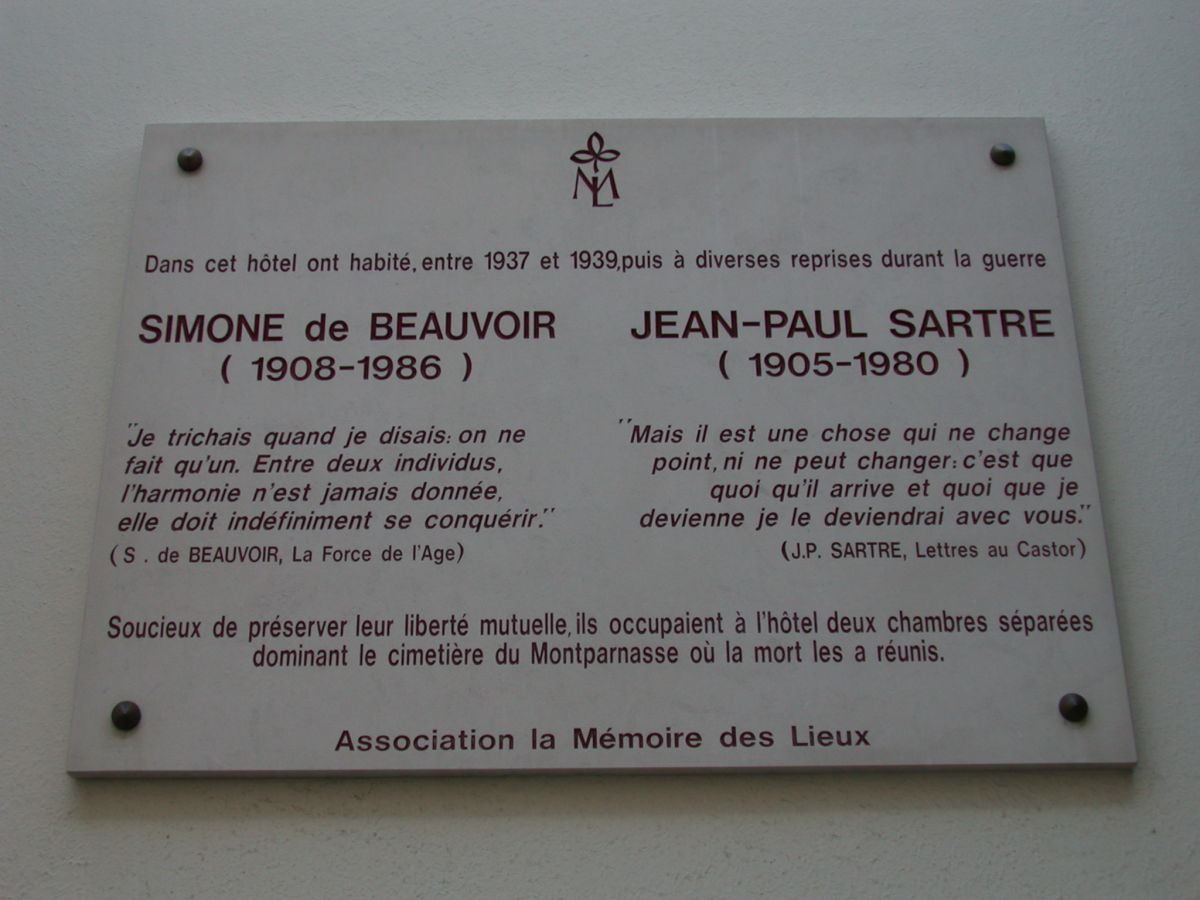
I chanced on the grave of Dreyfus, who sparked Zola's famous letter "J'accuse" and a huge campaign of resistance. I saw where Sartre and de Beauvoir were together in death, though forced to occupy separate hotel rooms in life, as a plaque on the Hotel Mistral recounts. They were forced by events to make difficult choices and their messy, muddled lives remind me that political involvement can't be limited to those whose lives are above reproach.

As the cemetery was closing, I made another attempt to find Beckett, who chose to stay in occupied France (though he could have escaped to neutral Ireland) and was awarded the Médaille de la Résistance and the Croix de Guerre for his activities. He didn't talk much about what he did but I wanted to pay tribute to his courage and reported kindness as well as his plays.

At last I found the grave, thanks to a shabbily-dressed and unshaven man who stood contemplating it. As I paused, the man turned to me. "Samuel Beckett," he said. "En attendant Godot."

I made a slightly stumbling attempt to explain why I thought Beckett a great man, trying to recall the French titles he gave his works when he first wrote them. But the man wasn't listening. "En attendant Godot," he repeated. "Samuel Beckett. En attendant Godot."

Then he bent down and began to clear the blossoms which had obscured the names of Beckett and his partner Suzanne.

I'm not sure what he meant to say. Was he just naming Beckett's most famous work? Was he telling me that in death too Beckett was "waiting for Godot." Or was he himself Godot, arrived too late and tenderly clearing the playwright's tomb?

Friday, 10 September 2010

In praise of Alphand


Paris again, and luck brought me to a quiet apartment in the 14th. I looked it up in my history of Paris and found familiar names: Denfert-Rochereau, Raspail, Montparnasse. I knew them from books and metro maps - it wasn't an area I knew at all and had no idea what to expect. All I knew was that I was very tired and it was time to take things easily.

I'm also trying to budget carefully without being absurdly stingy. Like so many people, I'm anxious about what George Osborne's statement of cuts on the 20th October will bring. Every time I hear him there seems to be an additional note of relish in his tones. As the millionaire heir to a baronetcy he's cushioned from any temptation to join the "welfare-scroungers" he condemns. I remember interrogations by job centre staff in the 1980s; they made it plain that my pregnancy was proof of my feckless laziness and told me off severely for wanting to breast-feed my baby. However much I wanted to escape from memories and fears, they were bound to gang up on me. Sleep wasn't easy; three nights in a row I was carried back to England in vivid nightmares.

Days were for calm wandering. Last year I visited a wealth of museums and monuments. This year I looked for the free Paris city museums and wandered vaguely, sometimes taking buses with only a vague idea of their destination. Suddenly I came across the rue Soufflot, which leads up to the Panthéon. But I turned, strolled in the opposite direction and found myself at an entrance to the Luxembourg gardens where Parisiens strolled, watched their children and sat, in considerable numbers, on the white metal chairs provided. Some ate picnics but more had brought books and enjoyed the sun and the calm as they read.

As I strolled, I seemed to have found an August Paris that was in holiday mood and not over-run by tourists. I gazed at the pond and the palace which houses the Senate, reflecting that no government building in London is so lightly protected - but the people seem to have a sense that they own the gardens and the city.

I decided that this week in Paris would include time spent wandering in gardens, partly in tribute the engineer Alphand who decided that a city needed parks as a body needs lungs. The Park of Montsouris was one of his creations and only a short bus-ride or long stroll from the wonderful boulangerie where I could enjoy an espresso with mini-croissant or brioche for a delicious and leisurely breakfast.

Montsouris is made for slow wandering, though excellent small playgrounds allow parents to rest can watch their energetic children. There's a lake, trees and curving paths. It's easy to get lost, so I did. Gradually the gardens of Paris unpicked the nightmares and brought me back to calm. I knew it wouldn't last - and much as I love Paris, it has its own anxieties - but Alphand's gardens gave me the breathing space I needed.