Saturday, 27 February 2010

Shopping and space


I bribed myself to go shopping. If I forced myself into clothes shops, tried on jeans and actually purchased a pair, I would allow myself to revisit Nottingham Contemporary's current exhibition, Star City: The Future under Communism.

Even with the bribe, it was difficult. However I suddenly found two pairs of trousers that would do. My mood lightened as I climbed the short hill to the gallery.

It wasn't my first visit to Star City. I popped in on Light Night, the very first day it was opening, but didn't stay long. I wanted a range of Light Night experiences - and found them in the jitterbugging skeletons, a candlelit church, a free Schumann recital, giant insects in the castle grounds and fencers in the Long Gallery of the castle itself. Most of the Light Night events were for one night only. I knew I could return to Nottingham Contemporary.

The exhibition itself is a puzzle. Perhaps this is as it should be since many people of my generation and older are puzzled by their own reaction to the loss of the Soviet Union and the fall of the Berlin wall. We knew a great deal was wrong with the Soviet Union - I grew up aware of the show trials, the events in Hungary and saw the first black-and-white footage of Soviet tanks arriving in Prague. I haven't forgotten the name of Jan Palach.

Yet while the the smart-suited bureaucrats and party officials made speeches that betrayed their followers' ideals and their own lack of conviction, there seemed to be another Soviet Union composed of the dreams of many who wanted a different, better life. Those dreams - of comradeship, freedom from want, real involvement in the government of a country, hope for the future - still seem worth preserving. I don't believe that I live in the best system there will ever be, nor that freedom to shop is a major test of liberty.

A couple of the more recent works at the gallery seemed to equate consumerism with democracy. I wasn't sure what point Diango Hernandez was making by using elderly kitchen appliances to vibrate to a speech by Castro in morse code. I had a slight suspicion that my reaction - "I like the look of that blender" - wasn't quite what the artist hoped. But other exhibits let me remember and reflect.

The Soviet posters of the space age recalled the excitement I felt on hearing that Yuri Gagarin had become the first man in space and the thrill in learning just two years later that a woman, Valentina Tereshkova, had also become an astronaut. I didn't particularly want to travel in space when I grew up but I liked the sense that it was possible. The posters had the bright excitement of Janet and John books or Sunday school displays, infused with the glamour of space and Cyrillic script.

It was disappointing, therefore, to find that the Light Night opening featured two pretend Soviet astronauts at the entrance to the gallery. They played at space walks, called everyone "comrade" with exaggerated accents and treated the whole thing as a grand joke, as though going into space was nothing and seeking comradeship an absurd archaism. I wasn't angry but something inside me was hurt. Perhaps I still cherish a lost dream after all.

Elsewhere the exhibition was more complex and harder to put in words. I was reminded of Leon Rosselson's song "Wo sind die Elefanten?" which can convey its sense of loss only through an absurd sentence from a German language course. The gallery had several huge exhibits but I spent most time with a series of small illustrations by Ilya Kabakov, produced in the late Soviet era and called "The Flying Komarov." These pictures, which started in a cupboard and moved on to a world in which most people flew, seem to speak of hope for liberty and the importance of dreams. They allow space for the viewer too - not outer space but inner space to interpret and question.

I haven't given Star City all the time it needs. I'll be there again, wondering what to make of it all. I can drop in again and again - that's the benefit of a free gallery.

I'll go on thinking of the dreams we build about other countries and our own. It's not the dreams that are wrong. But across the world there are leaders and would-be leaders who twist those dreams to a hateful shape for the sake of riches and power.

Saturday, 20 February 2010

The limits of language


I once heard Harold Pinter read. It must have been in the early 1980s. The occasion was a CND benefit and it took place, I think, in Kensington Town Hall. Numerous poets were reading and Harold Pinter's name came some way down the list. However, as soon as I entered the hall I realised that the Longford clan was out in support. I wasn't sure whether they were backing CND or their new son-in-law but they were very noticeable, perhaps because of the aristocratic confidence with which they took possession of their area of the hall. I watched with curiosity. I didn't recognize Pinter himself. I rather expected him to look and sound like a character in one of his plays - perhaps Aston in The Caretaker.

Plenty of poets read before Pinter. It was a difficult audience - more interested in nuclear disarmament than in poetry - and the hall itself made it hard to achieve intimate effects, though Ivor Cutler drew the audience together with his surreal wit. By the time Pinter's turn came, about half the audience were sneaking glances at their watches.

I hadn't realised Pinter had been an actor but he knew how to command an audience. His voice surprised me with its richness and I was startled by his choice of reading. After a number of poets reading their own work, Pinter chose to introduce and read John Donne's "Nocturnal upon St. Lucie's Day." I think it may be the best reading of a poem I have ever heard. It also changed my view of Harold Pinter. I realised that this playwright, most famous for his pauses, had a deep love and understanding of the music and meaning of language.

I haven't seen many Pinter plays so when the opportunity came, through this blog, to see A Pair of Pinters at the Guildhall in Derby, I couldn't resist the opportunity. I had two worries: were my expectations too high? and would my back injury prevent me from concentrating? I chose a matinée perfomance as the discomfort worsens in the evening.

I knew I was right to attend before a word was spoken. I was not just comfortable in my seat - and that's become an important consideration in the past five weeks. I felt the kind of comfort that comes from seeing actors who are secure in their roles, the production and with one another - and who communnicate that security to the audience. I sat back in my chair and prepared to be unsettled.

Two men talked, joked, and argued while waiting for a message from a third, who did not appear. The echoes of Waiting for Godot were unmissable at first - The Dumb Waiter was written two years after the London premiere of Beckett's play - but Pinter's characters have less freedom than Beckett's. Ben and Gus are enclosed in a windowless room. They may be disturbed by the series of jobs they are required to perform but they never question the obedience required. At most Gus (James Holmes) complains and Ben (Joe Tucker) betrays his anxiety by threatening Gus. It would be possible to suggest that the play means more than it says or shows but I think the best way of enjoying it is to enter the world of the play, laugh at the jokes and to let the memory of it resonate later.

After the interval comes the much later play, A Kind of Alaska, set in another enclosed room. There are no mirrors and presumably, once again, no windows since Deborah, the central character, cannot see her reflection. But while the characters in The Dumb Waiter inhabit a violent world, kindness and love cause pain in the later play. Deborah has woken after a 29-year sleep - she suffers from Encephalitis. In her mind she hovers between childhood and adolescence but and cannot quite understand that her younger sister is suddenly middle-aged. Julia Tarnoky is luminous and heart-breaking as Deborah, stretching out urgent, awkward hands and evoking the lost promise of her teenage years. Simon Molloy and Eunice Roberts as Hornby and Pauline are gently self-controlled as they try to work out how much reality the newly-woken Deborah can bear.

I was struck in these plays by the small range of language with which Pinter does so much. Every word counts and repeated words and phrases add depth and complexity. But both plays also reach through language to areas for which there are no words, for which the immediate human response may be a prickle on the spine or the ache behind the eyes when tears are unshed.


Thank you, Esther Richardson, for posting on my blog to offer tickets - and for directing these plays.

Monday, 15 February 2010

The purpose of the Pantheon


For six weeks I've been too busy to blog. I've a number of excuses: work took over my life, my computer keyboard started playing tricks on me, and I slipped on black ice causing painful damage to my back.

Perhaps these are merely excuses. I may not have blogged but I found time - even when I should have slept - to keep reading Les Misérables. It gripped me in the way books caught and held me in my teens. As I neared the end of the final volume, I wasn't merely reading it on trains and buses, and in bed at night. I was reading while cooking and even while walking down the road. On one occasion I was so caught up in the story that I left a suitcase on a train. (Fortunately the helpful station staff ensured that the suitcase and I were reunited.)

I'm not sure what was so gripping about Les Misérables. A few years ago I tried to re-read it in the old translation I'd read in my early teens and was soon bogged down in the heavy prose. Reading in French should have been harder but I followed the advice to stay away from dictionaries and the story came to life through Hugo's words. Of course, every so often I would check a tricky word or phrase - but how bland the English seemed next to the French, and how untranslateable. A neatly-turned phrase loses so much in translation. There's no equivalent for "amourette pour lui, passion pour elle" or "Parfois insurrection, c'est résurrection" that echoes and dances as the original does.

Of course, reading in French demanded an unfamiliar level of concentration. My French O-level of many years ago didn't demand so high a level of expertise, although we were expected to read Camus's L'Etranger and easy extracts from older works. But the language alone wouldn't have held me for through three volumes and more than 1500 pages. And I already knew the story from that first reading and various film and TV versions. But I had missed so much.

In French, Hugo is sometimes funny, sometimes angry, and frequently moves me to tears. There was much I'd missed on that early reading: the chapter in praise of "le mot de Cambronne", for instance. The word attributed to Cambronne, spoken as he was taken prisoner at the end of the gruelling battle of Waterloo, is "merde". (The nearest English equivalent would be "shit.") Hugo dedicates a whole chapter to fulsome praise of the acuity and rhetorical brilliance of this word. My Victorian translation was too delicate to tell me what the word was, offering a myserious dash instead. Moreover, as a teenager I was insufficiently used to 19th century novels to realise how different French and British attitudes were. Hugo thinks it necessary to explain - at length - just why Cosette and Marius (aged 16 and 21) haven't had sex, even though they have met one another every evening for a whole six weeks without a chaperone.

Cosette and Marius are young, silly and more conventional than they realise. Hugo knows that and at times he invites the reader to laugh at them. I never found them as interesting as the wilder characters, Eponine and Gavroche, nor as sympathetic as the numerous elderly characters who are frequently at the centre of the story. Perhaps my age is showing.

What startled me most was Hugo the revolutionary. I remembered the depiction of the failed rising of 5th- 6th June, 1832 from film versions. It was exciting but not particularly important - part of the lead-up to the journey through the Paris sewers. But Hugo takes the rising seriously and asks the readers to consider both why it was necessary and why it failed.

Hugo believed in revolutions - not all revolutions but those on the side of progress. He discusses when revolutions are necessary. His characters tear up paving stones, seize vehicles, grab weapons and barricades the streets of Paris. Hugo may like individual kings and royalists - as human beings - but he believes a republic is necessary and that the royalist cause must, for the sake of freedom and justice, end in defeat. He is furious - far angrier than Dickens - at the ill-treatment of children who are left to roam the streets and starve. He sees that the poor are suffering. He's appalled by inhumanity. He wants a better world and understands why sometimes people might decide to die or kill so that the future can be happier and more just.

Les Misérables is also a love letter to the lost streets of Paris. Hugo wrote most of Les Misérables from exile. He knew that the dangerous, dirty and loveable Paris he described was being ripped apart by Napoléon III and his architect Haussmann. In place of the familiar mediaeval mazes, whose squalor Hugo condemned, they constructed new, broad boulevards that welcomed shoppers and armies and were harder to barricade.

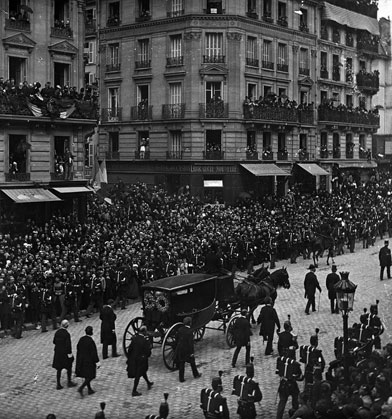
Hugo wrote most of his novel during his 19-year exile from France. He didn't return until six years after the first (Belgian) publication of Les Misérables. His return was greeted by celebrations in the streets. He was now a Parisien. He died in Paris at the age of 83. His will set out his wishes for his funeral. His body was to be carried to Pere Lachaise on a pauper's hearse and buried in the part of the cemetery reserved for paupers. The government decided otherwise. The church of Saint Genevieve, otherwise known as the Panthéon, was restored to its revolutionary secular state so that Hugo could be buried there. Hugo's body lay in state under the Arc de Triomphe and the pauper's hearse was escorted down the new, broad streets by senators, academicians and a military procession. Most of Paris seems to have turned out to watch. There were no riots - the spectacle of Hugo's funeral was carefully ordered.

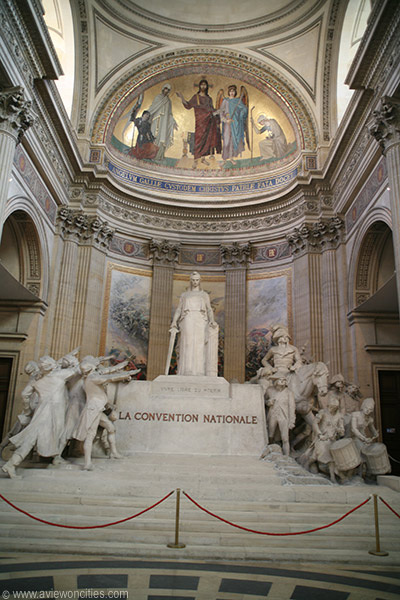
The account of Hugo's funeral, which I discovered in Colin Jones' biography of Paris, has made me reconsider the Panthéon - a place that has puzzled me since my second visit last year. There's something odd about this commemoration of greatness. Even revolution is solidified into marble. The Panthéon seems to offer the rulers of France a means in which they can attempt to curb dissent. The belated reburial of the elder Alexandre Dumas, like the recent memorial to Toussaint l'Ouverture, insists that France has recovered from the racism and cruelties of its colonial past - but I'm not sure that all French citizens would agree.

Recently President Sarkozy has attempted to move the remains of
Camus to the Panthéon. The account of Hugo's funeral has set me wondering what Sarkozy's agenda is - and why the demand to own the bones of the great persists. I can show my love of Victor Hugo by reading his books (Quatre-Vingt Treize and L'Homme Qui Rit) come next. And perhaps, if I'm lucky, I'll go back to Paris soon to explore what is left of the Paris of Les Misérables: not that cold monument the Panthéon but the lively warmth of the nearby rue Mouffetard.

But before I start on another Hugo volume, I'm back to blogging. And, in an attempt to improve my inadequate Italian, I've started on Pinocchio, that cruel and painful book for children which is quite unlike the cute neatness of the Disney film.

Thursday, 7 January 2010

Snow


In the end, snow replaced the ice. For a day or so, the temperature rose to freezing - or higher - and I watched the flakes and remembered past winters.

Once snow mesmerised me as I sat in an exam room. For forty minutes I watched the snowfall through the window, past the faded print of a blue and gold nativity that hung above the teacher's desk. Suddenly I saw the clock and realised I should have been writing but ink on paper in a test of skill seemed less important than a snowfall.

When I was small, there was a harsh winter when snowdrifts were taller than me. I was eight and one morning, before breakfast, my 5-year-old brother and I dressed ourselves, left a note and went out to play in the snow while our mother slept. We found big boys on the slope behind the library, sailing downhill on torn pieces of cardboard boxes. They let us join them. The speed and thrill must have warmed us for, when we returned to the flat, we weren't cold at all. It's only Mum's concern that remind me that we'd gone out dressed in shorts and T-shirts.

The snow is compacting now and turning to thick ice on the pavements and pathways. Soon I'll head to the station, kitted for a trek instead of the usual stroll. I'm still staying in when I can, wishing I could curl with the cat in front of the fire. But two days ago, when I had to leave the house, snow lay newly bright on paths, leaves and branches and diamonds of ice sparkled from the pavement. Even in my tame suburb, sheltered from the worst of winter, I felt for a few moments an old delight in the fierce beauty of the world.

Friday, 1 January 2010

Goodbye to Christmas


For the moment, the artificial Christmas tree is aglow with white lights. Their fragile sparkle blurs across tinsel and imitation pine needles. The gold pear shines and there's a sheen of gold on the baubles made years back by my niece and nephew. There's even a brief warmth on the blank face of the wicker angel. But when I've finished writing this post, I'll turn off the lights, take down the decorations, dismantle the tree and put it away until next Christmas. I no longer wish to celebrate.

News of a friend's death reached me yesterday afternoon. It was sudden - he was on his way home from Skye where he's spent Christmas with his wife and a friend when illness and death overtook him. The day after he died I'd been wondering when he'd be home and online again - I didn't know that the answer was "never." There will be no more emails, no more poems, no more comments urging the value of liberty and the human spirit.

For me, 2009 has been a year of loss. The absence of friends marks this new year more than the uncertainties of the present.

I'm looking forward without much confidence. My vision for the future is a gloomy one: greater poverty and greater hatred - politicians and the press urging us to a frenzy of self-interest. I see thought discouraged, freedom curtailed, fear proclaimed as a sacred cause and armies sent abroad with bombs in the name of "peace". I fear for the language. I fear for the earth and all its people. It is not a future I wish to share.

Yet, in the early hours I had a dream. I thought I was awake. I lay in bed and there was a constriction about my chest, as though it was bound tight. My friends who had died were close and asked, "Do you want to join us?" I could see only faint reasons to say "no" - death seemed safer and friendlier than this perilous world. I thought of my responsibilities and paused. There are people I love who would grieve at my death, I think, as I grieve for the deaths of friends. Still the company of the dead seemed warm and pleasant. There would be stories to tell and laughter, I thought, and an end to struggle and worry. Yet despite that warmth I felt a small, dull urge to remain on earth and knew, reluctantly, that my place was still with the living.

I slid back from my dream into sleep. When I woke, hours later, it was daylight.

Thursday, 31 December 2009

Millennium dreams


The children stayed up to mark the moment when 1999 slipped into 2000. I think we toasted the new millennium. There was a crash of fireworks and a splatter of colour in the sky. Then came the sound of people laughing and singing. I opened the door and saw a dancing procession of neighbours and friends doing the conga round our cul-de-sac. We left the door open and joined in. Suddenly it seemed that the future could be filled with trust and friendship.

Before that, we'd been watching the celebrations from the new Millennium Dome and flashes from around the world. I recall Tuvalu, Sydney and Paris. I remember little of Britain's Millennium celebration. Tony Blair and his family were there, still glossy with the people's love and trust. I noted that, of all the celebrations shown from all over the world, ours was the only one with a guest list and entrance fee - others were free and open to the public. George Carey as archbishop of Canterbury had insisted on a Christian element to the event. He was a late addition to the programme and was squeezed in long before midnight. He stood in the centre of the vast dome and the words of the Lord's prayer echoed emptily. The audience seemed rightly embarrassed - religion was out of place in this monument to commercial sponsorship.

At some point before going to bed, I rang my brother in Canada. "This is the voice of the next millennium," I declared. Looking back on the 20th century, it seemed possible that I'd reached a better time. The Berlin Wall had come down, apartheid had ended and it still seemed possible that the divisiveness and hatreds of Thatcherism would be pushed back. The afterglow of the 1997 election still shed a little light, even though I hadn't brought myself to vote New Labour. I mistrusted the surface shimmer and worried about the number of times Blair urged the voters, "Trust me." Honest people rarely insist that they tell the truth - they simply speak.

On the morning of 1st January 2000, hope persisted. Nations and people could work together. If we couldn't save Tuvalu from global warming, surely we'd welcome its dispossessed people. Perhaps as a world we could learn to love the stranger, just as the dancers in the streets welcomed all comers, regardless of origin or ability. I chose to take the conga as my symbol of the millennium rather than that exclusive, expensive party in London which I'd watched at a distance through the glass of my TV screen.

I don't know when hope dispersed.

I'm not sure it's possible to recover that hope. But the people I meet are so much better than party politicians, gearing up for the election, suggest. There's much more to human beings than the hatred of strangers and blind pursuit of personal profit.

I don't think I'll be able to celebrate the new decade. But, when midnight tolls, if I'm still up, I'll toast it with a small glass of Jura malt, hoping for hope in 2010.

Tuesday, 22 December 2009

Surveillance in the snow


Snow isn't a problem here - we could cope with a few more inches. The problem is the cold. As people walk in the snow, or as cars drive on the less-travelled roads, the snow turns to slush. Then it refreezes. I don't need to head to an ice-rink for thrills - between home and the station I slide precariously every few yards. My new technique for walking involves checking for crisp, snowy patches and cluching at walls, fences, lamp-posts and railings. What was usually a walk of less than ten minutes required concentration. balance and quick reactions. As my feet slid away from me, I bent my legs and caught hold of the railing, pleased to have avoided a serious tumble.

I was determined to have a day out. I'd booked leave - I'd told my friends I would do something special, even if my ambition had shrunk to a china boot filled with gluhwein and a visit to the exhibition at Nottingham Castle. I was feeling good about it. If nothing else worked out, I could always settle down in a warm café with Les Misérables.

I rang the castle in advance. The man who answered assured me that it was open and, more importantly, that the steep path up Castle Mound was well-gritted. He didn't mention that the steep pavements in the way to Castle Mound were glazed with ice and compacted snow. I staggered and slithered uphill, looking anxiously at the other tottering pedestrians who seemed more practised at walking on ice. Somehow I didn't topple down the slope but, carefully taking small steps, passed the Robin Hood statue and reached the castle gate. At last there were clear paths. I walked up the slope, delighting in the sight of the black branches above the snowy bandstand; the small, cold Christmas tree and even two or three warmly-wrapped children playing in chill of the white playground.

Perhaps an exhibition of art inspired by prisons and surveillance wouldn't have been everyone's choice for a day out but it suited my mood - and my sense of questions that matter in Britain today. I walked up the stairs inside the castle and into the exhibition. The first two exhibits are probably the ones that will stay longest with me. Louise Bourgeois's "Cell (Eyes and Mirrors)" may not comment on wider social and political questions in any obvious ways but it evokes the horror of being imprisoned and watched. It seems right that this horror should provide the basis of any political consideration of prison and surveillance - surely horror is the natural reaction to both.

I don't always spend long in video installations but I caught Manu Luksch's Faceless shortly after it had started and stayed nearly fifty minutes till the end. The film consists entirely of CCTV images, following rules set out in a manifesto. CCTV has also inspired the story of the film, which is told in a voice-over by Tilda Swinton. Again, the film isn't a direct comment on contemporary life - it's set in a future envisioned according to the CCTV trail each of us leaves every day. I emerged disturbed and impressed by the way blurrily familiar CCTV film had been turned into narrative with actors and choreographed dancers performing amid passers by for the mechanical gaze of the cameras.

I blinked as I emerged from the viewing booth and caught sight of the "Millbank Penitentiary" a model by Langlands and Bell of a now-demolished panoptical prison. The idea of the pantopticon was originated by Jeremy Bentham. It envisaged prisoners kept in separate cells, never seeing their fellow inmates but believing that they were watched at all times. A modified version has influenced prison design for many years. Bentham thought up the design as a benevolent model that would achieve reform of the prisoners. When developed to the extremes of Bentham's vision, many prisoners went mad.

I wandered into the next room. The gallery was empty apart from me, the attendant and a man leaning over a computer at a desk. I smiled at the attendant as I passed him and began to concentrate on the exhibits.

First I gazed at a history of imprisonment and death in Nottingham Castle. The past seemed to blend into present as I saw the orange jumpsuits in a nearby photo.

Then my attention was caught by what looked like Lego boxes opened up and spread out on the wall. Looking closely, I realised the scenes involved black-clad armed guards herding, beating and executing white skeletons. The notice beside gave the title and artist: "Concentration Camp Series" by Zbigniew Libera. I gazed some more.

They had captured my attention more than the flayed man in the Marc Quinn sculpture though pictures of Quinn's work had drawn me to the exhibition. Christine Borland's "Air Heads" were similarly powerful but I was following a different trail of thought. I looked at the words projected on the wall ahead of me.

"LONDON REVIEW OF BOOKS," I read. "The lady with the LROB bag looks at the Lego posters." I paused and checked my bag. It's my favourite fabric bag from the London Review of Books. I was being watched and my actions were being described in large letters on the wall.

I looked round. The attendant was still sitting in the corner. The man with a computer on his desk was typing. I read an earlier entry projected on the wall. It referred to "desk man." Desk man was watching me.

I tried to forget the presence of desk man and gazed at an exhibit which invited members of the public to operate a surveillance camera. But the exhibit was enclosed in plastic - I couldn't see how this should be done and wasn't sure I wished to watch anything like that, not even plastic trees and houses. I moved on, out of sight of desk man. Looking up at the wall I saw that my uncertainty about the exhibit was now described for new visitors. I moved into a corner where I felt sure I'd be out of sight. Then I saw the joystick to move the CCTV camera. I touched it tentatively and moved it just slightly, catching a plastic house and tree in a dark noose of shadow.

A few minutes later the words on the wall said that I had touched the joystick but hadn't moved it. I stayed out of sight and was glad when a family came into the gallery. Desk man shifted his attention to them and I sidled out into a suddenly sinister collection of Victorian paintings. Every model seemed to be a victim of the artist's gaze.

I made my way down the stairs, uncertain whether desk man - or some CCTV operator - was watching my back. Then I paused in the café for an excellent macchiato and mince pie. I took out my copy of Les Misérables. Jean Valjean has eluded Javert again and is carefully staying out of sight. Reassured by a fictional past, I headed out of the castle to meet my children and enjoy a celebratory gluhwein in the Old Market Square.