I was looking for Samuel Beckett. He was hard to find. Instead I stumbled across Serge Gainsbourg.
I'm never sure what to make of Gainsbourg. The recent film, which didn't aim at accuracy, deepened my ambivalence - and reminded me how erotic "Je t'aime ... moi non plus" is. So I stopped at Gainsbourg's grave.
I was in the Montparnasse cemetery. I hadn't meant to visit but, as I drifted round the 14th, that was where my feet took me.
The Cimetiere de Montparnasse not a tourist haunt in the way Pere Lachaise is. No-one was hawking pictures of the graves or plans of the cemetery. However there were casual and dedicated strollers as well as the mourners who came to place flowers on family graves. I was pleased to find a helpful plan of which graves were where although that didn't always make them easy to find.
Gainsbourg's grave was plainly a place of pilgrimage. There were flowers, photos, a packet of Gitanes and a colourful selection of cigarette lighters. As I watched, a young couple standing by the grave rolled cigarettes in silence and solemnly lit up. Whatever else he may have been, Gainsbourg has become the patron saint of smokers.
I've been anti-smoking for as long as I can remember. I recall my father's serious illness when I was six. As he was too ill to be moved, hospital staff brought equipment - including, I think, a portable x-ray machine - to the flat where we lived. As he recovered he was warned to give up smoking and struggled for years to overcome the addiction. Now, in his late 80s, he can't stand the stench of cigarette smoke.
But when I watched the young couple, I saw their cigarettes as a form of protest against a controlling state - and that too seemed admirable. France has a history of resistance which is the ground of the national belief in liberty, equality and fraternity. That belief is at the heart of protests from left and right against the forced deportations of "les Roms", the Roma who have travelled from eastern and central Europe, as allowed by law. Some deportations have been stopped by the courts - the grounds can be as slender as finding smoking in public which is not, the tribunal found, a serious public order offence - but many families, seeing their children scared by early-morning police raids, have simply agreed to leave, taking the very small amount of money the French state will pay as inducement or compensation.
It's easy to look away when a small group is under attack. Paris has numerous plaques to remind residents and visitors of the round-ups and deportations carried out by French police during the Occupation - and these are often cited as a reason to oppose the deportation of "les Roms". There's even a plaque commemorating the 1961 police massacre of Algerian protesters, although the French seem less comfortable considering the implications of that episode.
As a tourist I was observing and doing nothing. I strolled round the cemetery contemplating past injustice and resistance.
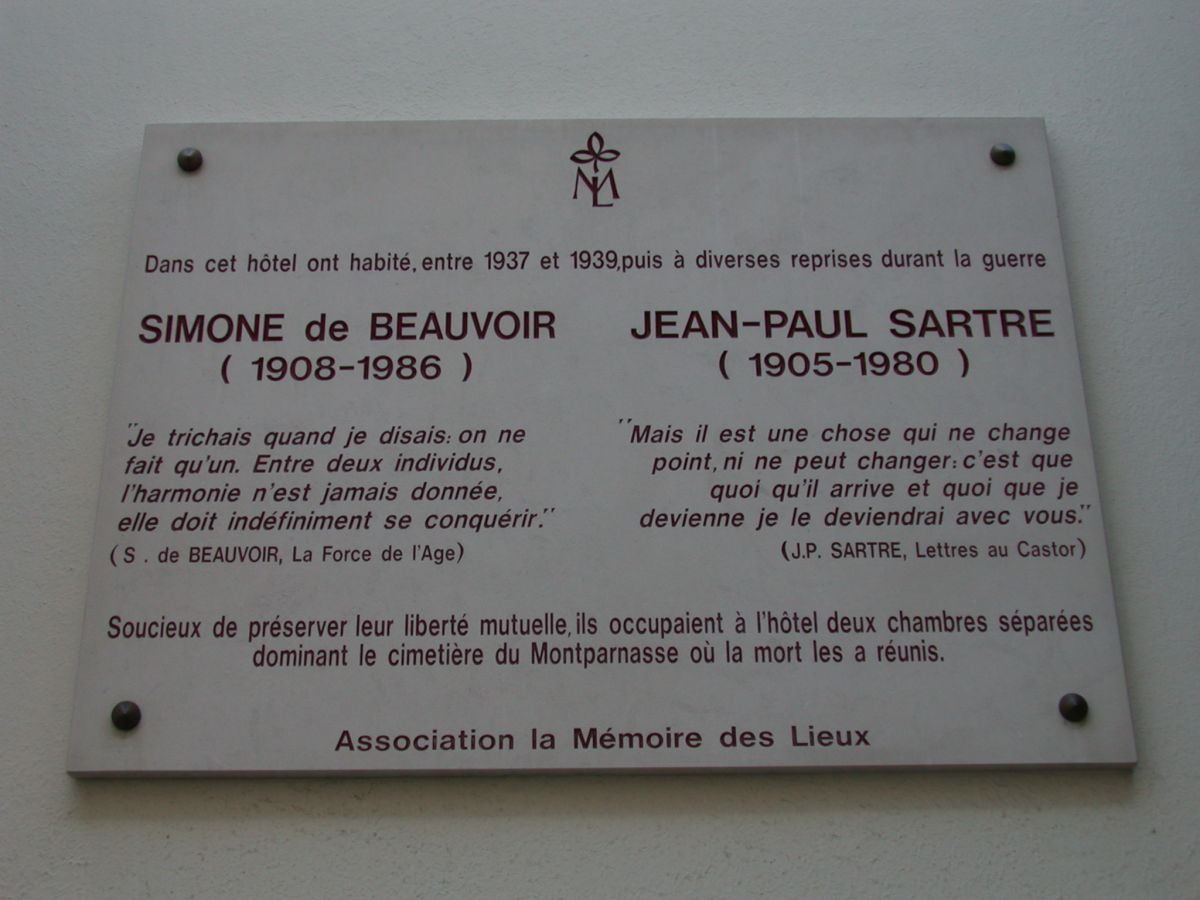
I chanced on the grave of Dreyfus, who sparked Zola's famous letter "J'accuse" and a huge campaign of resistance. I saw where Sartre and de Beauvoir were together in death, though forced to occupy separate hotel rooms in life, as a plaque on the Hotel Mistral recounts. They were forced by events to make difficult choices and their messy, muddled lives remind me that political involvement can't be limited to those whose lives are above reproach.
As the cemetery was closing, I made another attempt to find Beckett, who chose to stay in occupied France (though he could have escaped to neutral Ireland) and was awarded the Médaille de la Résistance and the Croix de Guerre for his activities. He didn't talk much about what he did but I wanted to pay tribute to his courage and reported kindness as well as his plays.
At last I found the grave, thanks to a shabbily-dressed and unshaven man who stood contemplating it. As I paused, the man turned to me. "Samuel Beckett," he said. "En attendant Godot."
I made a slightly stumbling attempt to explain why I thought Beckett a great man, trying to recall the French titles he gave his works when he first wrote them. But the man wasn't listening. "En attendant Godot," he repeated. "Samuel Beckett. En attendant Godot."
Then he bent down and began to clear the blossoms which had obscured the names of Beckett and his partner Suzanne.
I'm not sure what he meant to say. Was he just naming Beckett's most famous work? Was he telling me that in death too Beckett was "waiting for Godot." Or was he himself Godot, arrived too late and tenderly clearing the playwright's tomb?

 I can't recall exactly where in our flat the saying was. I think there was a paperweight – perhaps in a multi-sided geometrical shape – with a number of catch-phrases and sayings. When I first read it, I was too young to work out what it meant. I spent ages puzzling over the words: “Work is the curse of the drinking class.” Apparently it was a joke that I couldn't understand.I suppose the joke played on too many assumptions: that work is a good thing, that the working class are seen (especially by the rich) as idlers, that drunkenness is a working-class problem and that the working class live feckless lives dedicated to the pursuit of pleasure. If someone had explained all that to me then, I'd have been politely incredulous. I could see that my parents worked hard and that they put the interests of others (including their children) first. They didn't even drink. My mother was fearful of pubs and drinkers and, although my father enjoyed beer, he gave it up for years for my mother's sake and, even now, finds a single can of lager turns a meal or an evening into a special occasion.But there's one way in which the group of assumptions did chime with my parents' attitudes. They worked hard at their jobs and often found them rewarding. But they hadn't fallen for the idea so ingrained into many middle-class minds: that work is what gives meaning to people's lives. My parents put other things first: family, friends, neighbours, duty, social responsibility – and pleasure. They handed those values on to me.Quite a lot came under that heading of “pleasure.” It could be a walk in Richmond Park, a trip to the theatre, a jazz concert, a TV programme, drawing, a maths puzzle, a cryptic crossword, a visit to a museum or a good book. We didn't make the usual distinction between high-brow and low-brow. I watched the London Transport Players perform Ivor Novello or Rogers & Hammerstein in a “proper” theatre and amateur Shakespeare in the London parks. I picked up whatever reading material was lying around: Tit-Bits magazine with its intriguing advertisements for Joan the Wad, poetry anthologies, Plato in translation. I learnt by watching that the aim of work was to live a good and enjoyable life. My parents encouraged us to work hard at school but they didn't pretend that the aim of education was a career. Education was a means of expanding opportunities for pleasure – and might give us the chance to choose a job that was more enjoyable than those our parents did. I could see the point of that. In my early years my mum was a cleaner and a kitchen assistant. I didn't think I'd be much good at either and, given my incompetence in tidying my room, I didn't think I'd be much good at being a cleaner. I liked reading books and learning poems and plays by heart but I wasn't sure that many jobs would draw upon those skills. And I realised that I might want money so that I could buy books, travel to museums, go to the theatre and so on.There's nothing in my parents' approach that seems wrong. The idea of devoting a life to work for its own sake seems ungenerous and mean-spirited. I'm lucky enough to enjoy much of my work – but not the bits involving form-filling, managerial jargon, the distress of others, or tidying my office. It's a good job but does it really shock you to learn that I do it for the money? After I've paid for the usual necessities of life, I spend that money on family, friends, duty, responsibility and – of course – on pleasure.
 One of the merits of advancing age is increasing invisibility. By the time my hair is white, I shall probably float ghost-like down streets and be able to act exactly as I like without anyone noticing. But I'm not quite there yet.I went to London to visit my parents on the day before Mother's Day. I reckoned I was probably even less visible than usual, slightly shuffling and convalescent after a late winter virus got me by the throat and left me tired and shaky. I stopped at an unfamiliar supermarket to get lunch ingredients and when a young woman rammed my shopping trolley into me, complaining that I wasn't quick or efficient enough at making way for her, I decided I'd probably slipped into the role of Unnecessary Older Person, as far as she was concerned. Perhaps she was too young to realise that most women are so accustomed to mild brutality and insults from strangers, that a rammed shopping trolley is hardly more than a slight annoyance. As an older woman, I feel rather safer than when I was young. I've never forgotten the time - nearly thirty years ago - when I was walking across a university carpark and a car-load of drunken students thought it funny to drive the car at me a few times, hurling sexual insults and shrieking with laughter at their "wit." That really was frightening. I don't think they planned to hit me - though I couldn't be sure - but I wasn't sure they were sober enough to control the car, or that I could run fast enough to get away. I didn't go to the police. The headlights dazzled me so that I couldn't see their faces though I had a good idea who they were from the brayed, precise insults. The police were unlikely to take my word against a group of posh - and well-connected - young men.That was the scariest instance but of course there were others. Men sometimes tell me I'm stupid to walk alone after dark but years ago I decided that I preferred to risk abuse and threats rather than live in a prison created by abusive strangers. I've had a fuller life as result. And by now I'm used to dealing with the occasional insult. They've tailed off as I've grown older and become more confident. I worry for my daughter, of course.It was good to see my parents. I don't visit often enough. This was another short visit - four hours' travelling each way doesn't allow much time to stay, but at least I managed to cook lunch, wash up and deliver small gifts to my mum. I was pleased I'd made it, but more tired than usual - this year's viruses seem particularly draining. I'd worried a little about getting the tube at Putney Bridge. Dad and I had been watching the football results and the unlikely scoreline - Fulham 2, Manchester United 0 - could result in a few disconsolate United fans on the way home. But all I saw were yellow-jacketed police - some on horseback - outside the supporters' favourite pub. Jubilant songs and chants filled the air.Reaching the Piccadilly Line, I realised I could be standing for quite a while. The Victoria Line was closed for the weekend, pushing passengers onto other routes. The platform wasn't too crowded as I arrived but within two minutes passengers were three or four deep and more kept arriving. There was no point in letting a crowded train go in the hope of a seat on the next one. I boarded and followed the usual command to "Move right down the carriage." I was just reflecting on how shaky I felt and my probable invisibility when a young man stood up and offered me his seat. I wasn't so invisible after all - and immensely lucky. Plenty of other people who could have done with a seat were left swaying and strap-hanging. After thanking the young man, I immersed myself in my book - one of the Scandanavian detective stories to which I've recently become addicted.My journey involved a change of mainline trains and a pause in a waiting room. The book, which involved axe murders, a bright young woman inspector and an older beer-drinking, chess-playing detective, had gripped me. I settled down for my 25-minute wait and continued with the story.There were three other people in waiting-room: a young couple wrapped up in one another and a solitary man listening to music. It felt safe enough. Then the youths came in, giggling, pleased with themselves, possibly a bit drunk. They swaggered round, giggling. I was more interested in my book and perhaps this annoyed them. They stood in front of me, staring, thinking of an insult. Eventually, one of them came up with the epithet they wanted: "Book-reader!" They giggled. They tried it out a few more times, circling round me. I looked up, unimpressed, and went back to my book, "Book-reader!" they said again. And then one tried, bemusingly, "Sexy! She's sexy for a book-reader. Sexy for a nerd." I think I was supposed to be scared. I wasn't. They went out.Later, when a couple of more people had entered the waiting room, they came back. They tried saying, at no-one in particular, the worst racial insult they could think of. They said it again and laughed. It plainly didn't apply to any of the people in the waiting room. They tried to start a conversation with a solitary young woman who was witting there. She dismissed them with monosyllables and they gave up, giggled and went outside again. I think the youths were beginning to feel cross that no-one responded to them - I hope they were. Perhaps it was their turn to feel invisible.
 I hope the owner of this toolbox doesn't mind that I've borrowed the picture. It comes from a page of pictures of a garage workshop - and I love workshops like this. They remind me of my dad, who is not just intelligent but skilled at all kinds of craft. Even in the flat where I grew up, he assembled a range of tools, with small items like nuts and drillbits kept carefully in Golden Virginia tobacco tins.I wish I had the practical skills of my parents - or that my school had taught me useful things like woodworking. But these were seen as boys' skills. The idea was that we girls would marry. We would sew and cook for husbands and children but husbands would do the repairs. The boys' school included woodwork and metalwork on the curriculum; my brother produced a poker and toasting fork, which were things of beauty but of little use in our centrally-heated flat.When the cat-flap shattered in a fierce wind, I realised I had to do something about it. I may know that the first reference to a catflap comes in Chaucer (the Miller's Tale) but I had no idea how to fit one. At first I worried. Then I asked my son to choose a new one of about the same size. It arrived with incomprehensible illustrations that were suppsoed to indicate how to fit it. I gave up looking and began to piece the catflap parts together for myself. After a while it seemed clear. I went to the shed to look for the drill and discovered I no longer had one. Fortunately a neighbour lent me a drill, a crewdriver and a pair of pliers. It was a fine, hand-held drill - like the one my Dad has. I cracked, peeled and unscrewed the wreckage of the old catflap and my son and I went to work.Together we marked the places where the new screws would go and took turns at the drilling. It wasn't easy - the holes had to be very close to the edge of the gap and it's hard to drill at the bottom of a door. I was glad that my son did most of the work but felt quite pleased that I was also playing a useful part. I've never fitted a catflap before.Gradually we got it in place - not particularly skilfully as one of the screws is crooked. But fitting it at all seemed like an achievement - and a great improvement on the hole in the back door. Joe didn't approve, however. He had thought the hole much better than a catflap - easier to manage. He looked at the new contraption unconvincedly and tried to persuade us to open the door instead.It's not a great catflap but it has three advantages: it's transparent, it has a magnet which stops it from flapping in the wind, and it can be sealed with a small plastic sheet that holds it shut. I'm not sure Joe sees these as advantages.Odd jobs proliferate. The washing-line snapped under the weight of sodden sheets which I hung up just before a downpour. We need a new backdoor - and the garden is in a desperate state. Unfortunately work is busier than ever and after 11-hour days I find it hard to summon the energy for anything else, except fencing, which seems to have a brief energising effect. Yesterday my Chinese horoscope urged me to do sport or "relaxing activities like odd jobs." The odd jobs didn't seem particularly relaxing. I chose fencing. They didn't teach that at my school either.
 I photographed this Isle of Wight train for my dad. He has a personal connection with it. This was part of the stock he kept running in his work as a fitter for London Transport.We took the Fastcat to Ryde. Then the little tube train hurtled us along the track to Sandown. I remember taking a steam train there, when I was very small - at least, I think I remember. It was probably part of a Sunday School outing. But in 1967 the Isle of Wight railway was electrified and the tube trains arrived, freed from underground tunnels to trundle through fields and past houses.I've posted a few comments on swimming in the sea elsewhere so I shan't write about that particular pleasure here. I liked the Isle of Wight and wondered if it would be a good place for holidays in another year. I'd like to trace the literary connections.One of the attractions of the Isle of Wight is good public transport. There seems to be a good bus service as well as the trains, and there might be an opportunity to hire bicycles. And if my heel recovers, I could do plenty of walking too.I was planning to use buses in Southsea and Portsmouth until Bryn, the guest teenager, pointed out that, with four of us, minicabs would probably be cheaper. So we took to using Aqua Cars and saved time as well as cash. They were splendidly prompt and efficient, except on the last day when a sudden downpour raised demand. We never had the same cab driver twice. But mostly they were friendly and all were helpful. Occasionally music on the radio wasn't to our taste but we all enjoyed listening to The Now Show while heading to Portsmouth Harbour Station on our way home. There's something very cheering in finding that a cab driver laughs at the same jokes.Cab drivers gave us advice about local shops and pedestrian walks. They helped us load and unload shopping. And, to my delight, one turned out to have a wide knowledge of English literature.I discovered this when I asked about the book he was reading. He wasn't reading while driving but the book lay face down beside him with his place marked - he was evidently reading it between fares. It was The Amazing Adventures of Kavalier and Clay by Michael Chabon and the driver outlined its themes with enthusiasm. The subsequent conversation led our driver into brief discourses on a range of topics including the rise of the graphic novel, American fiction, the pleasures of postmodernism (introduced almost apologetically with a clear one-line explanation), the contrast between the playful experimentation of Sterne's Tristram Shandy and what the driver insisted was the materialism of Richardson's Clarissa. I fear the driver was disappointed in my preference for Richardson and my acknowledgement that I have read Clarissa three times.I didn't want that journey to end. I wanted to know more about the cab driver's tastes and get further book recommendations. But I expect he wanted to get back to his book.I've now bought Kavalier and Clay and am planning another attempt on Tristram Shandy - perhaps it's time to stop dipping and read it from cover to cover.Now I'm back to buses and trains. Unfortunately bus and train drivers have fewer opportunities to share their literary tastes with passengers.