Showing posts with label Paris. Show all posts

Thursday, 7 October 2010

No to the Kindle

British friends have occasionally asked me why I visit Paris in August. “There's no-one there,” they assure me. “The real Parisiens are all on holiday and everything's shut.”

It's a simplification. Some Parisiens – those who can afford it – try to take holidays in August. Some shops, businesses – even museums – are closed. Last year I was sorry to miss the municipal museum of Montreuil, which I still hope to visit one day. The Comedie Francaise and the Paris Opera are on holiday. Friends I would have liked to see were away – as was the owner of the splendid apartment I sublet.


Yet I enjoy Paris in August. It has a leisurely air. The discovery that a local shop or restaurant is shut for “les vacances” is not a disaster. It's a reminder that workers need holidays and there's more to life than making money.


In previous Augusts I did little to look for live events in Paris. Paris Plage was fun – and full of locals – but I missed it by a day this year. I wondered if my British friends were right in saying nothing else was on. I decided to investigate. I paused at a kiosk and invested in a copy of Pariscope – not a huge gamble at 40 eurocents – to see what was going on.
Leafing through the pages I read of theatres, cinemas, concerts, spectacles and markets.

At first I was baffled by the choice, then began to make decisions. The Lucernaire looked worth a visit, and quite near where I was staying. The second and third Millennium films were showing at the Cinema Chaplin, not too far away. There was a fund-raising piano festival at the Armenian Cathedral in the Marais – and much more.


I began at the Lucernaire. The list of theatre shows made me hesitate. I'd missed Cooking with Elvis at the local amateur theatre and was prepared to miss the French version as well. But I wondered about a one-man show of Oscar Wilde's De Profundis, well-reviewed in a number of French national papers. The price – 22 euros – is more than I usually pay for theatre tickets. But when I thought about seeing Wilde in French, there was a pleasant logic too it.
De Profundis is Wilde's long letter to his young lover, Lord Alfred Douglas, written from Reading Gaol. Some years ago I would have said I knew the English text reasonably well, although it has faded in my mind since. I recalled that, after leaving prison, Wilde went to Paris, where he died, and was buried in Pere Lachaise cemetery. And while I hesitated about seeing a work in translation, I recalled that I had twice seen Wilde's play Salomé, which he wrote in French for Sarah Bernhardt, in the translation by Lord Alfred Douglas. The idea of Wilde in French translation was almost symmetrical. I bought my ticket.

The set up at the Lucernaire wasn't quite like a theatre in England. Notices on the wall told us that the “ouvrieuses” (specifically female workers) showing us to our seats were unpaid and dependent on tips. The ouvrieuses were charming and had a neat way of sliding the proffered tips into a purse – but I felt uncomfortable about the procedure. Workers are often required to display charm as part of their jobs but I didn't want to measure and reward that charm directly with a tip – it felt too intimate a purchase. However as they were, according to the notices, dependent on the audience's generosity, it was plain that generosity was my responsibility. I handed over the tip as I was shown to my seat and wondered if I'd bought the bright smile that followed.


The theatre was small – a studio space without the formal grandeur of a proscenium arch. The actor playing Wilde was already on the stage, perched on a step-ladder and half-covered by a blanket. The audience leaned forward expectantly, displaying a quality of intense concentration that is rare in English theatre audiences – and this continued throughout the performance.


Occasionally I found the use of French distancing and at times my understanding flickered out - I probably grasped 80 to 85% of the text. Despite the strangeness, a French Wilde seemed a convincing possibility. I even found his mispronunciation of Reading (to resemble the activity rather than the town ir the gaol – endearing).
It was an intense and moving performance. I was surprised to find that, towards the end, I felt sympathy not just for Wilde but also for Lord Alfred Douglas – Bosie. De Profundis chronicles instances of Bosie's selfishness but, listed by Wilde, they seem like the follies of a very young man faced by an adoration he could not quite reciprocate and an intelligence he could not match. Even his cruel statements seemed like a dull attempt to match Wilde's wit while his neglect of Wilde's feelings could be forgiven as the uncertainty of a young man suffering from an appalling upbringing and unsure how to respond across the barriers of age and c lass. The young often do run from suffering – and how was Bosie to respond to Wilde's imprisonment and agony? Biographies suggest that Bosie was unpleasant throughout his long life but the pictures reveal a startling beauty which may also have been a disadvantage.

A week was not enough for all the events listed in Pariscope. I saw Millennium 2 – subtitled in French, which I find far easier than dubbing – and enjoyed a riveting performance of piano music by Chopin and Rachmaninov. That was as much cultural performance as I could take. I also haunted the bookshops, trying to add to my small collection of books in French.


There were two books I aimed to buy: Victor Hugo's Notre Dame de Paris and Eugene Sue's Les Mysteres de Paris. Both have been on my list of books I need to read for some time. But I was confronted by something unfamiliar from my life in the East Midlands – a wealth of bookshops. There were big shops like the many branches of Gibert Joseph in the Boul' Mich and the art chain Mona Lisait. Then there were many small independent shops – far more than in London, I think – where the stock seemed to reflect either the manager's taste or the surprises that often delight and infuriate in secondhand volumes.

I browsed contentedly and puzzled over what to buy.
I find nineteenth century French literature easier to read than modern light fiction; lengthy paragraphs allow unfamiliar words to become clear from the context and puzzles can be resolved with the aid of a dictionary. Recent thrillers, for all their popular appeal, are harder because they use so much contemporary slang. I have a further interest. I've noticed that, for generations, working-class readers in particular were absorbed by popular French fiction from the mid-19th century. Stories like The Count of Monte Cristo and Les Miserables are mentioned in working-class writing from the 1850s to the 1950s. And I knew that writers for the working class drew on French writers. For instance, G.W.M. Reynolds' terrific and popular serial, The Mysteries of London – which makes Dickens seem restrained in style and detail – was directly influenced by Sue's Mysteries of Paris. So far as I can see, no-one has gone into much detail chronicling this influence. While the effort necessary for a wide-ranging survey is beyond me – I imagine I'd need a year or so in French archives with no guarantee of success as well as another year combing comparable English publications - I could at least see what popular fiction of the period was available in paperback.

One of the joys of reading in French is the vast and largely unknown library of possible titles which spreads before me. Looking at Paul Feval's Le Bossu – which was the source for a couple of terrific swashbuckling films - I discovered that the same author had written his own Mysteres de Londres – quite different from Reynolds' serial. I haven't read it yet but, according to the back of the book jacket, it tells the story of an Irish plot against the British government and is set in exotically English locations. I had to buy a copy. There was a fine multi-volume edition of Les Mysteres de Paris, with illustrations, but in the end I concluded that it was too heavy.

I was also tempted by Eugene Sue's last book, Les Mysteres du Peuple, apparently a fictional account of working-class revolution from the time of Jesus to the era of Napoleon III. I wondered why so startling a book was so little known. Until I stumbled across a copy in Gibert Joseph, I hadn't heard of its existence. I nearly bought it but once again I hesitated, feeling the weight of the book. I could delay, I thought, and order it from amazon.fr when I had time to read it.


In the end, I succumbed to ten or twelve books, including a fine hardback edition of Notre Dame de Paris from one of the second hand shops set up by Abbé Pierre's Emmaus charity. A friend tipped me off that these were a great place for bargains and the shop I visited gave me an excuse for travel on the voguéo - I find it hard to resist river travel. My reading of French is still slow and I have less free time than I would like so my purchases will last me a long time. But I still regret the two books by Sue – perhaps I need to go to Paris again, very soon.


The chief problem was one of space – and what I reckoned I could carry home in my suitcase. Eurostar may not have a weight allowance but travellers still have to heave their cases onto the conveyor belt for scanning and manoeuvre them into the luggage areas of trains.


Briefly I thought of the solution suggested by a couple of friends: if I purchased a kindle or e-reader I could carry a whole library with me, unworried by weight. But I like the weight of books. I like the smell and texture of paper, the designs of covers. I like turning the pages with my fingers. I love the sensation of opening a new book for the first time – and I adore books with history, which carry a sense of their past readers. I can see the logic of an electronic reader but not the pleasure.


Nor would there be opportunities for communication. I discovered the novels of Michael Chabon after seeing a taxi driver was reading one. It was the beginning of a good conversation about books, which would never have been sparked by the anonymous cover of an e-reader. I like seeing what my fellow travellers are reading.


Then think of the hazards. I couldn't read an e-book in the bath – at least not safely. Amazon has been known to withdraw a text from the kindle, regardless of readers who were half-way through. An equipment failure or expired battery could put an entire library beyond my reach.

My books may occupy too much space. It's also true I don't always know where a particular title is. But I know my books by their shape, size, colours and texture. I could never gain so much affection for an electronic index.
Perhaps this simply marks me as a member of a dying generation, to be as much pitied or mocked as those who could not adjust from the scroll to the book. Wandering through the market of old and antique books in the Parc Georges Brassens (on the site of a former abattoir), I was unable to imagine surrendering my love for the book in favour of a screen called into grey and white life at the flick of a button.

Mind you, I didn't buy any of the book on sale in the Parc George Brassens. It was the last day of my holiday – and another book would have made my suitcase too heavy.

Thursday, 16 September 2010

Balzac's cafetiere


Much as I love Victor Hugo, I can't commend his taste in interior design. The intricate elaborations and extravagances that delight me in his prose style seem heavy and unnecessary when used to decorate a room. The reconstruction of the sitting room he designed for Juliette Drouet in Guernsey – moved to the Maison Victor Hugo on the place des Vosges – leaves me filled with admiration for Juliette's patient and tolerant love. I hope for her sake that Hugo's wife had more of a say on domestic interiors.

I returned to the Hugo house and the Musée Carnavalet, wondering if I would view them in a new way after reading Hugo novels and histories of Paris. Although I saw them with greater knowledge, it was the same things that struck me. In the Hugo house I lingered over his drawings, letters and the display connected with the death of his daughter, drowned when travelling with his new husband. I noticed a poem about her which I hadn't observed before, written for the fifth anniversary of her death – and, because such things trouble me, I wondered how I might translate it, given that the final stanza sets an impossible task. The rhymes give way to exact repetition: “tombe” is used first in its more usual sense of “fall” and then with the meaning of “tomb” while the second rhyme, which matches the place, Harfleur, with “fleur,” the word for “flower,” ends the poem on a lighter syllable than any English equivalent I can imagine. I suspect I'll keep returning to this poem for many years, as I do to Callimachus's recollection of Heracleitus and Catullus's early declaration of passion for Lesbia. I don't expect to solve the problem.

In the Carnavalet it was again the section on Revolution and war that held my attention longest. I noticed how the thoughtful declarations of rights gave way to the rigid imposition of a military discipline which forbade all question. The words “Liberté, Egalité, Fraternité” seemed out of place on a soldier's drum. Once again I admired the souvenirs made from the stone of the demolished Bastille, especially the doll's-house-sized solid model of the Bastille itself. But I wanted more – Paris deserves a bigger museum, though none would be sufficiently complex to do justice to the city's history and people.

But revisiting museums wasn't enough for me. With my urge for self-education, I looked at the list of Paris Museums and settled on Balzac's house. My reading of Hazan's book on Paris (not yet finished) has made me guiltily aware of how little French literature I have read. Although names from Balzac's fiction lurk at the fringes of my awareness, I don't think I've ever read any Balzac novel. His name and the titles of his books are heavily forbidding as were the pictures on the covers of the black-backed Penguin classics editions. I assumed the house would be a similarly forbidding presence but found a simple bus route with the aid of my Indispensable.

The street was steep, lined with tall and heavy houses, dating, I would guess from the late 19th century. There was nothing of the lightness of the Montparnasse apartment blocks. I counted my way by house numbers. The quiet in the street was almost oppressive – evidently there was no rush of devoted Balzac enthusiasts.

I passed a striking and very heavy 19th century building and then, just as the numbers told me I was reaching Balzac's house, there was a gap in the buildings, a garden and a small, light, white building with a grey roof and green window-frames and shutters. It looked like a bungalow and, compared to the heavy surrounding buildings, could have been an elaborate shed. The garden was small but delightfully leafy with archways and paths. Sitting there you would believe yourself far from the city, until you looked up to see the Eiffel Tower.

A few steep steps took me into the Balzac house and an interior as quiet and calm as the garden. It seems that Balzac liked quiet. His house was simple – not a bungalow, as I first thought: the uneven terrain meant that the main living quarters were on the upper floor, which led to the garden, but there was also an airy lower storey below. I decided that I would have liked to live in Balzac's house. He had a fine desk and chair. I could imagine myself sitting there and getting things done.

I found his method of working sympathetic too. He would start writing at midnight when the city was cool and quiet, and work through till 8 in the morning, fuelled by coffee from his personal cafetiere. I admired the cafetiere. It's now kept in a glass case, which makes it hard to photograph. I'm not entirely sure Balzac should have added his initials. Perhaps he wanted to make sure no-one walked off with his coffee-making equipment. I can understand that. Anyone would feel possessive about so fine a cafetiere.

As an additional and unexpected treat, the house offered the screening of a complete Japanese “ganime” version of Balzac's early novella “La Grenadiere” directed by Koji Fukada. I was charmed and moved by the fusion of pictures, music, Japanese voices and French subtitles. I'd love to find a copy for myself so that I can share it with friends. At the moment all I can locate is the trailer on youtube.

After leaving the Balzac house, I sat in the garden for a while, enjoying the light breeze and soft fragrances. Eventually I left, walked up the road past the late 19th century apartment blocks and caught a bus that would take me across the Seine and towards the Eiffel Tower. As I walked, I resolved to buy and read something by Balzac. I doubt it will surprise and delight me quite as much as his house.

Saturday, 11 September 2010

The patron saint of smoking


I was looking for Samuel Beckett. He was hard to find. Instead I stumbled across Serge Gainsbourg.

I'm never sure what to make of Gainsbourg. The recent film, which didn't aim at accuracy, deepened my ambivalence - and reminded me how erotic "Je t'aime ... moi non plus" is. So I stopped at Gainsbourg's grave.

I was in the Montparnasse cemetery. I hadn't meant to visit but, as I drifted round the 14th, that was where my feet took me.

The Cimetiere de Montparnasse not a tourist haunt in the way Pere Lachaise is. No-one was hawking pictures of the graves or plans of the cemetery. However there were casual and dedicated strollers as well as the mourners who came to place flowers on family graves. I was pleased to find a helpful plan of which graves were where although that didn't always make them easy to find.

Gainsbourg's grave was plainly a place of pilgrimage. There were flowers, photos, a packet of Gitanes and a colourful selection of cigarette lighters. As I watched, a young couple standing by the grave rolled cigarettes in silence and solemnly lit up. Whatever else he may have been, Gainsbourg has become the patron saint of smokers.

I've been anti-smoking for as long as I can remember. I recall my father's serious illness when I was six. As he was too ill to be moved, hospital staff brought equipment - including, I think, a portable x-ray machine - to the flat where we lived. As he recovered he was warned to give up smoking and struggled for years to overcome the addiction. Now, in his late 80s, he can't stand the stench of cigarette smoke.

But when I watched the young couple, I saw their cigarettes as a form of protest against a controlling state - and that too seemed admirable. France has a history of resistance which is the ground of the national belief in liberty, equality and fraternity. That belief is at the heart of protests from left and right against the forced deportations of "les Roms", the Roma who have travelled from eastern and central Europe, as allowed by law. Some deportations have been stopped by the courts - the grounds can be as slender as finding smoking in public which is not, the tribunal found, a serious public order offence - but many families, seeing their children scared by early-morning police raids, have simply agreed to leave, taking the very small amount of money the French state will pay as inducement or compensation.

It's easy to look away when a small group is under attack. Paris has numerous plaques to remind residents and visitors of the round-ups and deportations carried out by French police during the Occupation - and these are often cited as a reason to oppose the deportation of "les Roms". There's even a plaque commemorating the 1961 police massacre of Algerian protesters, although the French seem less comfortable considering the implications of that episode.

As a tourist I was observing and doing nothing. I strolled round the cemetery contemplating past injustice and resistance.

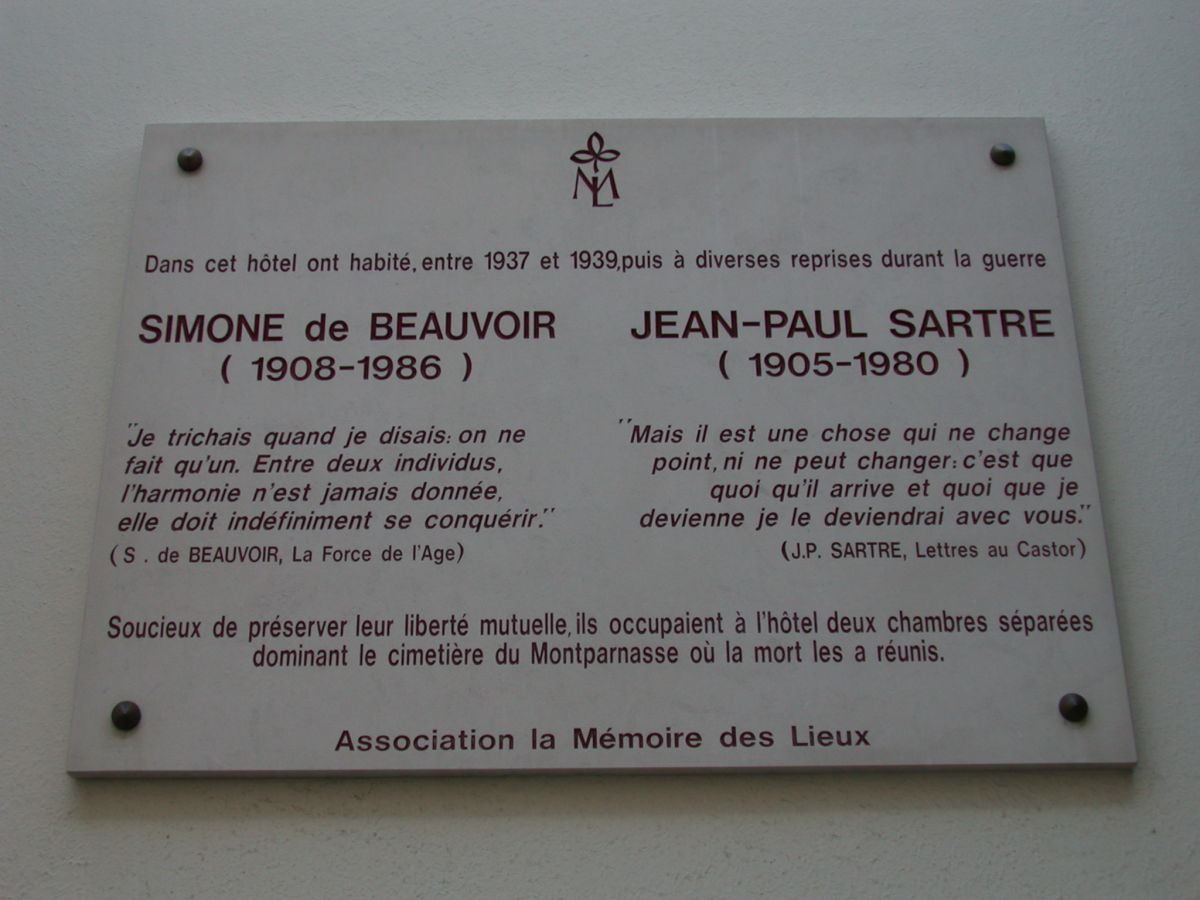
I chanced on the grave of Dreyfus, who sparked Zola's famous letter "J'accuse" and a huge campaign of resistance. I saw where Sartre and de Beauvoir were together in death, though forced to occupy separate hotel rooms in life, as a plaque on the Hotel Mistral recounts. They were forced by events to make difficult choices and their messy, muddled lives remind me that political involvement can't be limited to those whose lives are above reproach.

As the cemetery was closing, I made another attempt to find Beckett, who chose to stay in occupied France (though he could have escaped to neutral Ireland) and was awarded the Médaille de la Résistance and the Croix de Guerre for his activities. He didn't talk much about what he did but I wanted to pay tribute to his courage and reported kindness as well as his plays.

At last I found the grave, thanks to a shabbily-dressed and unshaven man who stood contemplating it. As I paused, the man turned to me. "Samuel Beckett," he said. "En attendant Godot."

I made a slightly stumbling attempt to explain why I thought Beckett a great man, trying to recall the French titles he gave his works when he first wrote them. But the man wasn't listening. "En attendant Godot," he repeated. "Samuel Beckett. En attendant Godot."

Then he bent down and began to clear the blossoms which had obscured the names of Beckett and his partner Suzanne.

I'm not sure what he meant to say. Was he just naming Beckett's most famous work? Was he telling me that in death too Beckett was "waiting for Godot." Or was he himself Godot, arrived too late and tenderly clearing the playwright's tomb?

Friday, 10 September 2010

In praise of Alphand


Paris again, and luck brought me to a quiet apartment in the 14th. I looked it up in my history of Paris and found familiar names: Denfert-Rochereau, Raspail, Montparnasse. I knew them from books and metro maps - it wasn't an area I knew at all and had no idea what to expect. All I knew was that I was very tired and it was time to take things easily.

I'm also trying to budget carefully without being absurdly stingy. Like so many people, I'm anxious about what George Osborne's statement of cuts on the 20th October will bring. Every time I hear him there seems to be an additional note of relish in his tones. As the millionaire heir to a baronetcy he's cushioned from any temptation to join the "welfare-scroungers" he condemns. I remember interrogations by job centre staff in the 1980s; they made it plain that my pregnancy was proof of my feckless laziness and told me off severely for wanting to breast-feed my baby. However much I wanted to escape from memories and fears, they were bound to gang up on me. Sleep wasn't easy; three nights in a row I was carried back to England in vivid nightmares.

Days were for calm wandering. Last year I visited a wealth of museums and monuments. This year I looked for the free Paris city museums and wandered vaguely, sometimes taking buses with only a vague idea of their destination. Suddenly I came across the rue Soufflot, which leads up to the Panthéon. But I turned, strolled in the opposite direction and found myself at an entrance to the Luxembourg gardens where Parisiens strolled, watched their children and sat, in considerable numbers, on the white metal chairs provided. Some ate picnics but more had brought books and enjoyed the sun and the calm as they read.

As I strolled, I seemed to have found an August Paris that was in holiday mood and not over-run by tourists. I gazed at the pond and the palace which houses the Senate, reflecting that no government building in London is so lightly protected - but the people seem to have a sense that they own the gardens and the city.

I decided that this week in Paris would include time spent wandering in gardens, partly in tribute the engineer Alphand who decided that a city needed parks as a body needs lungs. The Park of Montsouris was one of his creations and only a short bus-ride or long stroll from the wonderful boulangerie where I could enjoy an espresso with mini-croissant or brioche for a delicious and leisurely breakfast.

Montsouris is made for slow wandering, though excellent small playgrounds allow parents to rest can watch their energetic children. There's a lake, trees and curving paths. It's easy to get lost, so I did. Gradually the gardens of Paris unpicked the nightmares and brought me back to calm. I knew it wouldn't last - and much as I love Paris, it has its own anxieties - but Alphand's gardens gave me the breathing space I needed.

Monday, 15 February 2010

The purpose of the Pantheon


For six weeks I've been too busy to blog. I've a number of excuses: work took over my life, my computer keyboard started playing tricks on me, and I slipped on black ice causing painful damage to my back.

Perhaps these are merely excuses. I may not have blogged but I found time - even when I should have slept - to keep reading Les Misérables. It gripped me in the way books caught and held me in my teens. As I neared the end of the final volume, I wasn't merely reading it on trains and buses, and in bed at night. I was reading while cooking and even while walking down the road. On one occasion I was so caught up in the story that I left a suitcase on a train. (Fortunately the helpful station staff ensured that the suitcase and I were reunited.)

I'm not sure what was so gripping about Les Misérables. A few years ago I tried to re-read it in the old translation I'd read in my early teens and was soon bogged down in the heavy prose. Reading in French should have been harder but I followed the advice to stay away from dictionaries and the story came to life through Hugo's words. Of course, every so often I would check a tricky word or phrase - but how bland the English seemed next to the French, and how untranslateable. A neatly-turned phrase loses so much in translation. There's no equivalent for "amourette pour lui, passion pour elle" or "Parfois insurrection, c'est résurrection" that echoes and dances as the original does.

Of course, reading in French demanded an unfamiliar level of concentration. My French O-level of many years ago didn't demand so high a level of expertise, although we were expected to read Camus's L'Etranger and easy extracts from older works. But the language alone wouldn't have held me for through three volumes and more than 1500 pages. And I already knew the story from that first reading and various film and TV versions. But I had missed so much.

In French, Hugo is sometimes funny, sometimes angry, and frequently moves me to tears. There was much I'd missed on that early reading: the chapter in praise of "le mot de Cambronne", for instance. The word attributed to Cambronne, spoken as he was taken prisoner at the end of the gruelling battle of Waterloo, is "merde". (The nearest English equivalent would be "shit.") Hugo dedicates a whole chapter to fulsome praise of the acuity and rhetorical brilliance of this word. My Victorian translation was too delicate to tell me what the word was, offering a myserious dash instead. Moreover, as a teenager I was insufficiently used to 19th century novels to realise how different French and British attitudes were. Hugo thinks it necessary to explain - at length - just why Cosette and Marius (aged 16 and 21) haven't had sex, even though they have met one another every evening for a whole six weeks without a chaperone.

Cosette and Marius are young, silly and more conventional than they realise. Hugo knows that and at times he invites the reader to laugh at them. I never found them as interesting as the wilder characters, Eponine and Gavroche, nor as sympathetic as the numerous elderly characters who are frequently at the centre of the story. Perhaps my age is showing.

What startled me most was Hugo the revolutionary. I remembered the depiction of the failed rising of 5th- 6th June, 1832 from film versions. It was exciting but not particularly important - part of the lead-up to the journey through the Paris sewers. But Hugo takes the rising seriously and asks the readers to consider both why it was necessary and why it failed.

Hugo believed in revolutions - not all revolutions but those on the side of progress. He discusses when revolutions are necessary. His characters tear up paving stones, seize vehicles, grab weapons and barricades the streets of Paris. Hugo may like individual kings and royalists - as human beings - but he believes a republic is necessary and that the royalist cause must, for the sake of freedom and justice, end in defeat. He is furious - far angrier than Dickens - at the ill-treatment of children who are left to roam the streets and starve. He sees that the poor are suffering. He's appalled by inhumanity. He wants a better world and understands why sometimes people might decide to die or kill so that the future can be happier and more just.

Les Misérables is also a love letter to the lost streets of Paris. Hugo wrote most of Les Misérables from exile. He knew that the dangerous, dirty and loveable Paris he described was being ripped apart by Napoléon III and his architect Haussmann. In place of the familiar mediaeval mazes, whose squalor Hugo condemned, they constructed new, broad boulevards that welcomed shoppers and armies and were harder to barricade.

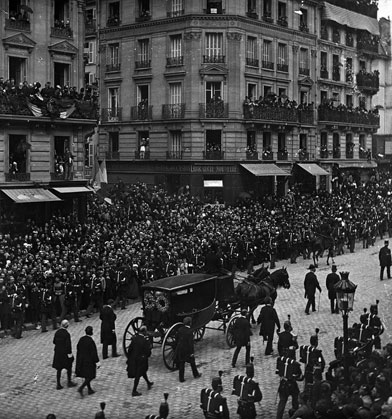
Hugo wrote most of his novel during his 19-year exile from France. He didn't return until six years after the first (Belgian) publication of Les Misérables. His return was greeted by celebrations in the streets. He was now a Parisien. He died in Paris at the age of 83. His will set out his wishes for his funeral. His body was to be carried to Pere Lachaise on a pauper's hearse and buried in the part of the cemetery reserved for paupers. The government decided otherwise. The church of Saint Genevieve, otherwise known as the Panthéon, was restored to its revolutionary secular state so that Hugo could be buried there. Hugo's body lay in state under the Arc de Triomphe and the pauper's hearse was escorted down the new, broad streets by senators, academicians and a military procession. Most of Paris seems to have turned out to watch. There were no riots - the spectacle of Hugo's funeral was carefully ordered.

The account of Hugo's funeral, which I discovered in Colin Jones' biography of Paris, has made me reconsider the Panthéon - a place that has puzzled me since my second visit last year. There's something odd about this commemoration of greatness. Even revolution is solidified into marble. The Panthéon seems to offer the rulers of France a means in which they can attempt to curb dissent. The belated reburial of the elder Alexandre Dumas, like the recent memorial to Toussaint l'Ouverture, insists that France has recovered from the racism and cruelties of its colonial past - but I'm not sure that all French citizens would agree.

Recently President Sarkozy has attempted to move the remains of
Camus to the Panthéon. The account of Hugo's funeral has set me wondering what Sarkozy's agenda is - and why the demand to own the bones of the great persists. I can show my love of Victor Hugo by reading his books (Quatre-Vingt Treize and L'Homme Qui Rit) come next. And perhaps, if I'm lucky, I'll go back to Paris soon to explore what is left of the Paris of Les Misérables: not that cold monument the Panthéon but the lively warmth of the nearby rue Mouffetard.

But before I start on another Hugo volume, I'm back to blogging. And, in an attempt to improve my inadequate Italian, I've started on Pinocchio, that cruel and painful book for children which is quite unlike the cute neatness of the Disney film.

Thursday, 12 November 2009

Derby revisited


I went back to Derby. I was determined to see L'Armee du Crime. This time I'd checked with QUAD that the film had been properly ingested. My cold was a bit better. Something at the back of my mind warned me that I wasn't quite well enough but I was fed up with limitations and headed back to the cinema.

I think this is only the second French film about the Resistance I've seen. The first, L'Armée des Ombres (Army of Shadows), shook me with its darkness. It began and ended during the occupation and showed members of a Resistance cell punishing their own members - always with execution - when any disobedience made the group vulnerable to betrayal. Although I knew that the Occupation ended, there was no happy ending of Liberation.

The title of L'Armée du Crime suggested a dialogue with the earlier film. There are other similarities. The film is similar in shape: it begins and ends during the Occupation, shows a key character being captured early in the film and ends by explaining what happened to the surviving characters. But there are key differences.

In L'Armée des Ombres, the main characters are members of mainstream French society who therefore seem to represent French opposition to Nazi occupation. I may be misrembering, but the film seemed to me as shadowy as its title. Shades were sombre as though brightness had been leached from the film-maker's palette.

L'Armée du Crime, like the recently-released photographs by André Zucca, has sequences of light. There are moments of happiness when Paris is, as one of the characters says, "beautiful". Ordinary Parisiens get on with their lives in technicolor. They - like the Resistance members and Nazi occupiers - have picnics, enjoy food, sing and make love. The Nazi occupiers who are killed and blown up by the Resistance are not deeply characterised but - perhaps more disturbingly - are shown enjoying life in Paris. The stroll in the sunshine, look at the Eiffel Tower, attend a book launch, chat with laughing young women in the doorway of a brothel. Neither they nor the Resistance members have lost their capacity for happiness.

Inevitably the light and happiness is in tension with darker events. Communist prisoners are executed in revenge for every Nazi killed. First ten are executed for every one Nazi, then twenty. A policeman who seems as kindly and anxious as every hero of a police procedural sighs as he reports a woman's anxieties about her neighbour - and sighs again when he watched the neighbour being tortured. Jews, trusting the French commitment to the "rights of man" stitch yellow stars onto their clothes. Then they obey the French policemen who cram them into ordinary buses on their way to the internment camp at Drancy. The buses roll past ordinary Parisiens who are unconcerned.

As the film proceeds, the contrast between everyday happiness and the cruelties that ordinary people would rather ignore becomes sharper. A soundtrack of Charles Trenet singing "Je chante" plays as a Jewish restaurant is smashed. Human beings are tortured in a cellar and no-one - not even the victims - questions that this is how things are. Outside is familiar Paris. There is still sunlight and beauty.

This isn't a film about typical French heroes defending their country from an external invader. Its focus is the cell led by the Armenian poet Missak Manouchian. Almost all the cell members are immigrants or stateless refugees. Manouchian's father was killed in the Armenian genocide and the group included Poles, Hungarians, Italians, Romanians and Spaniards. Some were Spanish Civil War veterans. Several were Jewish. Most were Communists and the story begins with news of the German invasion of the Soviet Union in 1941, which brought the Nazi-Soviet pact to an end, heightening the vulnerability of communist exiles in France.

The decision to resist violently is not treated lightly in this film. Manouchian in particular, chooses to abandon his ethical principles. But there are no easy choices for the members of this Resistance cell. Most of them risk death merely by being "untermensch." But the official poster - l'affiche rouge - issued after their death failed in its attempt to show the cell members as criminals rather than liberators. Its description of the activities of the Manouchian group led to the accolade "morts pour la France" (died for France).

It's a long, complex and gripping film. I walked away from the cinema reflecting on French response to the film. Although it was shown out of competition at Cannes - and despite the director's reputation - the film did badly in reviews and at the box office. I wondered whether this was caused by the film's implicit response to L'Armée des Ombres. It's an uncomfortable film, given the way the Liberation of Paris is currently perceived: achieved by the Resistance with the support of the people of Paris. I wondered uncomfortably how current anti-immigrant feeling had worked against the film. Imprisonment and deportation of refugees take place regularly - in England too - to widespread silence from the safe, passport-holding citizens of Europe.

I was nervous on the dark, damp and empty streets that led to the station. After all the violence of the film, I was alert to the risk of attack. I glanced ahead and tried to check no-one was lurking in the shadowy spaces behind bollards or advertisements. Gradually, as the few strangers on the roads failed to attack me - I think they were more concerned with getting home or to the pub - I became calmer.

There was some time to wait before my train. I took up the recommendation of a commenter on my previous post and enjoyed a swift half in the Brunswick, a restored Georgian pub with micro-brewery. It's very convenient for the station and I hope to go there again when I'm next in Derby. A £1 cone of chips from the Station Fish Bar provided a warming supper as I headed home.

Tuesday, 8 September 2009

The writing on the wall


When I was small, I went to Madame Tussaud's eager for the Chamber of Horrors. I rushed past the rather dull waxworks of unknown famous murderers. I wanted to see something horrid and scary, and to stroll on unafraid. It was something to do with testing courage, I think.

Children still love dungeons and horrors. They read the Horrible History books and learn details of torture. They haven't quite grasped - as I hadn't - that torture hurt people like us. Turning torture into a tourist thrill with wax victims, fake blood and feigned screams suggests that it's not quite real and, if it did happen, it was a long time ago to people wearing fancy costumes who talked rather differently from us.

We tend to ignore other people's pain, unless we're revelling in it. I'm startled when I see a teenage girl got up for a party with a gold cross - even a gold crucifix - worn on a chain. The twisted body of a man tortured to death is so familiar that it's lost its power to shock. We don't attend public executions but I've watched footage from real wars while eating supper in front of the TV. True crime sells well even if misery memoirs have waned in popularity.

We're protecting ourselves, I suppose. If I think about killing, torture and suffering today - really think about it and try to feel what it means - the thought becomes unbearable. The degree of suffering threatens to paralyse me but I should take action and protest.

Every so often the bleakness and pain of prisoners' lives reaches me. Wandering round the Chateau de Vincennes, I read notices which explained how the king's rooms had become cells where prisoners had sometimes been held for years. Usually prisoners find a means of scrawling or carving their names into the walls. There was less carving than usual at Vincennes. Instead the prisoners, who were often wealthy, had obtained paint and decorated their cells. This was no prison for paupers, whose lives were less important. The prison paintings of Vincennes are careful and accurate renditions of swagged curtains and lit candles on candelabras.

The plaster had begun to flake away before restoration was begun and I had to peer carefully to make out these creations of nostalgia and longing. There were words too but I couldn't make more than a fragmentary meaning:

"... ns la nuit de la tombe un jour desen...
..................................re nos noms ................
....la ..............................monde .....................
.... mais .....................rite profonde .............
P0urquoi ......................................................."

[......?.. the night of the tomb one day..?.....
...................................?..our names ...............
...the............?.....................world ....................
...but.................................?...deep..................
Why ..............................................................]

And after that, there's a word which might be "larmes" [tears] - but the more I look the less sure I am. I can understand nothing.

Saturday, 5 September 2009

Loving Paris


Arriving at the Gare du Nord, I was equipped with the carnet ticket that would take me to Montreuil. I like to keep fresh carnet tickets in my purse, telling myself that I have the tickets ready and therefore I must be back in Paris soon. I keep old tickets and use them as bookmarks so that every so often, when I pause in my reading, I'm reminded of journeys in the city I love.

This time I was over-confident. I didn't read the sign telling travellers to push their cases ahead of them. Instead I walked through the automatic gates pulling my suitcase behind me. They closed sharply and my case was trapped.

I was, of course, embarrassed. But a fellow-traveller, seeing my hopeless efforts to tug my case free, came to assist and quickly solved the problem. "You need a navigo," she told me (in French) and started asking other travellers whether they could help me by loaning one. Within a couple of minutes a young man realised what would work and laid his navigo on the panel that would recognize him as a legal traveller. The gates sprang open to admit him, the woman pushed my case through and went on when I'd hardly finishe stuttering my thanks.

It's hard to manage on the metro with a heavy case. The lines must have been built separately so the connections between them involve long tunnels, steep staircases and only occasional escalators or lifts. Sometimes I struggled alone but quite often people came to my help - smartly-dressed young people insisted on helping and so did one of the vendors of cheap toys and fluorescent Eiffel towers who left his pitch in the tunnel to run up a flight of stairs and help with my case.

Even with the help, my feet ached from the journey. Somehow they acquired small cuts and blisters which made walking difficult for the first part of the week. Perhaps the pain in my feet combined with my distaste for Versailles to make me less sympathetic than usual to the momuments to the French Republic.

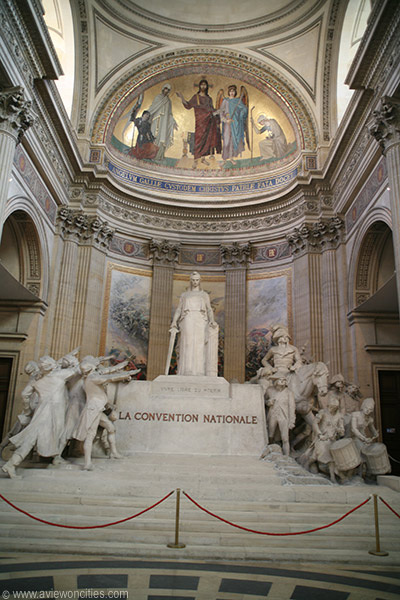
I can't love the Panthéon. It's fine from the outside and when I stook in rue Soufflot under a dark grey sky with thunder crashing and lightning streaking across the sky the building came into its own. But the vast interior with its huge sculptural representation of the Convention doesn't grip me as much as the colourful Gothic delights of the much smaller Sainte Chapelle. Nor do I enjoy the collection of great men in the crypt (one woman is honoured there - Marie Curie was added in 1995). There are aspects to enjoy. I was amused by notices explaining how several people initially honoured at the Panthéon had later been demoted and buried elsewhere - even in death, it seems, the great men and their supporters were jostling for distinction. But it was good to see a memorial to Toussaint l'Ouverture and I could remember watching part of the ceremony in which the elder Alexandre Dumas was finally moved there in 2002. But it's part of the assertion of national greatness on a monumental scale which fails to touch me. In the same way, when I look at the Arc du Triomphe, so vast on its traffic island that it diminishes its visitors into insignificance, I feel regret rather than admiration.

Among all this neo-classical monumentalism, the Eiffel Tower is striking because it's so plainly linked to a people's Paris. It's a work of craft as well as art - whenever I see it I think of the skill with which it was designed and the hard work which created it. I've been to the top of the Eiffel Tower only once, when my son urged me to conquer my fear of heights. (That fear left me a year or so later but I faced my fear and got to the top - I still have the ticket to remind me.) But there's nothing intimidating about the Tower - it doesn't celebrate great men or the power of kings or state but human achievement in a city.

My favourite places aren't the great Haussmann boulevards, so convenient for crowds or armies and tanks. I like the small streets like the rue Mouffetard where people wander and work and shop and worry. I like places where the workers of Paris sit and talk at café tables the moment there's the faintest gleam of sun. I enjoy the everyday life of the city which can be rough as any city but which also has space for casual kindness. I'll remember all the sightseeing from my visit - and there's much I haven't mentioned here. But I'll also remember a comfortable basement cinema where the staff made viewers welcome, a hospitable African shop in Montreuil which serves - for 1 euro - the best espresso I've experienced in Paris, and a friendly Belgian pub near the Panthéon where happy hour starts at 4.00 p.m. so that draught Leffe arrives in double quantities.

Tuesday, 1 September 2009

Bare feet and unknown princesses


I was doing Paris on the cheap - and on my own. None of my friends were there but Anna offered the loan of her house in Montreuil. I needed to decide how to manage my holiday and make my money last.

Obviously, being alone, I wouldn't need to eat out. A regular morning coffee and the occasional pression - Leffe, by preference - would be bound to keep me going. And in Paris you can almost always find a boulangerie when you need one. I could have a good breakfast in the mornings and make myself an excellent salad with wine when I returned home.

I decided the time had come for the kind of tourism I'd been putting off for years. A web investigation told me a 6-day museum pass would be a good investment if I was serious about sightseeing. It costs 64 euros but many of the places I wanted to visit cost between 8 and 10 euros, and I reckoned I'd probably visit two or three in a day. It has the additional advantage of letting the holder bypass the long queues for tickets.

The metro was easy too. Thanks to Gerard, I already had a navigo (the French equivalent to the London oyster card) and had been educated in how the pricing systems work. I checked the zone map on the internet. Versailles was in zone 4 so it would be sensible to go on Sunday, using a 4-zone mobilis which allows flexible travel for the day. Then I would load a 2-zone weekly carte orange on my navigo from Monday. The carte orange, which is now virtual and therefore no longer orange, always starts on a Monday. It's a bargain for anyone staying for most of a calendar week. For just over 17 euros I could travel by bus, metro, the regional RER trains (some of them double-deckers) and even a little ferry on the Seine - the voguéo. While my museum pass made me feel like a tourist, the navigo let me think of myself as a true Parisienne.

But it was hard to settle into sightseeing after the oppressive grandeur and gilding of Versailles. I thought I'd better follow the Marie Antoinette trail to the Conciergerie, where her former cell is now equipped with a TV. There were expiatory mouments too. Louis XVIII was keen that the French people and the Parisiens in particular should repent of executing a monarch and his consort. I had more sympathy for the victims of the Terror of whom nothing was known but their name. All those guilloutined - more than 2,000 of them, which was fewer than I'd thought - were listed; the Terror was conducted along carefully bureaucratic lines. Former titles and professions were written down but there were many who had nothing but a name to record that they had once been sentenced to die quickly and in public. Of course I looked for familiar names - Madame Roland, Charlotte Corday, Georges Danton, Camille Desmoulins, Philippe Egalité - but then I lingered on professions. There was an actress, a tailor, a servant. I wondered if they'd really cared for the ideals of some revolutionary or counter-revolutionary group or if they were victims of a local grudge. And how about all those people with no rank and no profession? What circumstances brought them to the tumbril, the abuse and the rough but efficient blade? They could have been anyone - rough-sleepers, immigrants, the destitute. Most regimes have their favoured victims on whom suspicion for all disruption and disorder rests. Even Robespierre had his special white plaque and many of the famous prisoners - including criminals killed slowly in pre-guillotine days - were recalled in pictures, words or sculpture. But my mind kept returning to those of whom nothing was known but their name.

After the Conciergerie, the colourful Gothic exuberance of Sante-Chapelle was a delight. But soon I'd left the Ile-de-la Cité and was in Saint-Denis, heading past the children playing football in the square to enter the church and its necropolis. (Katie had told me I shouldn't miss it.)

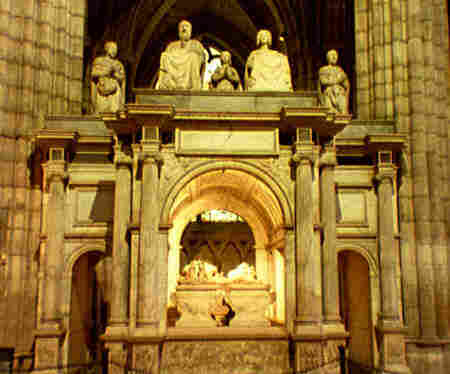
The first thing I noticed was the bare, marble feet. At the centre of the huge marble monument effigies of the almost naked monarch and consort lay, the soles of their feet facing tourists as they entered. At last I saw the human vulnerability of the monarchs. It was only later that I saw the fully-dressed king and queen kneeling in prayer, their children behind them, on the high top of the monument.

I wandered among the dead kings and queens. There was Marie Antoinette again, slightly larger than life and kneeling elegantly next to husband. And there were the plainer, earlier kings, from Clovis onward, looking stiff, still and much the same as one another.

Wandering among the royal monuments, I caught sight of a notice on one of the stiff mediaeval ladies: "une princesse inconnue" - an unknown princess. She may not have been a very significant princess but presumably, a long time ago, she thought herself an important person in the world. And now she was just a monument, much like all the others, and no-one even knew her name or which of the many dead princesses she was.

Beyond her lay another, smaller monument, no longer than a five-year-old but a miniaturised adult in polished white marble. I leant over to look at the notice - another "princesse inconnue."


Monday, 20 April 2009

Chucking out time at the cemetery

Any sense of the dead remained stubbornly absent as I headed back to the main entrance of Pere Lachaise to meet my friends. They're younger than me: Vicky's 30 and Katie was a day short of 27. The sun and the imminent birthday celebration made for a cheerful mood as we strolled, climbed and clambered among the graves.

We consulted the plan together and tried to work out a route, negotiating between our favourite dead people.
We began by retreading the tourist trail to Jim Morrison, with a short detour to Heloise and Abelard. I was glad to glimpse Francis Poulenc on the way. Then we headed up towards Edith Piaf. I suppose the black marble, adorned with crucifix, bore some relationship to her life but I wanted something as rough and moving as her songs.

While our route was determined by the locations of some of Pere Lachaise's famous inhabitants, we were soon distracted by the delights of unexpected monuments. None of us knew who Andre Gill was but we were cheered by his bust with bright red chrysanthemum button-hole - not to mention a starfish laid before it. Katie, facing her advancing age with determination, decided to contemplate the possibilities of her own tomb, and decided that she too would have a fresh button-hole every day and that the duty of replacing the flower would be linked to a scholarship for poor postgraduates.

As we progressed, Katie's tomb designs grew more extravagant. She liked the bats carved into a metal door, art nouveau mosaics, the numerous mourning figures (almost always female). She wondered how to commemorate her books, her study and her shoes. Seeing a gigantic obelisk which towered over a family tomb vast enough to accommodate a living family on two storeys, she briefly hesitated over which to choose, then announced that she wanted both. "I won't have a tomb - I'll have a theme park," she declared. This added to our enthusiastic search for extravagant memorials.

Then Vicky admitted, when she was a child having dramatic tantrums, her parents had compared her to Sarah Bernhardt. Katie and I decided that we must find Sarah Bernhardt's tomb and photograph Vicky (in suitably dramatic pose) beside it. Unfortunately the "divine Sarah" was interred some way back from the path and her tomb was hard to photograph. Just as we'd readied our cameras and persuaded Vicky to adopt a suitable pose, a group arrived with their tour guide to trudge round the tomb. Vicky immediately abandoned her pose and the tour group prevented us from taking photos.

There was little gloom at Pere Lachaise. Jacob Epstein's huge, angular angel over Oscar Wilde's grave was a place of particular jollity and celebration. Oscar's last three years were spent as a bankrupt in Paris. I wondered what he would have made of the lipstick kisses on his tomb or the beaming male couple who posed hand-in-hand in front of it for a photo.

But at the top of the cemetery, as we neared the wall where the last Communards were shot, I stopped taking photos. This the part of the cemetery which reminds strollers of the past inhumanities. At first I hastened to see the spectacular sculptures but then I realised they commemorated the people who had been denounced, rounded up and deported to concentration and extermination camps. Underneath the romance of "abroad" there lies, almost always, the barbarism of the past which calls to mind the barbarism of today. I was shaken but wanted to recapture the holiday mood.

As we walked in the courtyard of the vast, domed crematorium, I tried to sweep aside thoughts of other crematorium chimneys and focus on the rows of little boxes in which ashes were stored. We found Stephane Grappelli and Georges Perec - but it was hard to see any relation between their brilliance and the simple inscriptions. By then it was past 5, and the cemetery was due to close at 6. We decided to make some last searches.

We saw Melies and then set out in search of Brunhoff, inspired by Katie's love of the Babar books. But the tomb, belonging to the Brunhoff family, was a disappointment. There were absolutely no elephants. We made our way back to the cemetery's main entrance.

It was 10 to 6 and chucking out time at the cemetery. An attendant sped past us on a motorbike, shouting at everyone to get out. The gardiens at the gates vigorously urged everyone to leave. We took their advice and headed out in search of a bar.


Friday, 17 April 2009

With the dead


I arrived early at the cemetery. I'd planned this in advance. I wanted to wander round alone.

I wasn't there to grieve but as a tourist. For years I'd planned to visit Pere Lachaise cemetery in Paris and I'd finally arranged to do so. I was going to wander round with two younger friends but it was a sunny day and I'd heard there was lots to see. I got there an hour before them.

Pere Lachaise is a tourist attraction but it's still used for new burials and cremations. Families who bought their plots in perpetuity, as attested by numbers on the monuments, continue to use them and my first walk took me past families tending graves and watering flowers. (There are taps provided where visitors can fill jugs.)

I had expected to experience gloom in Pere Lachaise - a sense of being surrounded by the dead. Homer calls them "the silent majority" but they didn't crowd in on me. The monuments, often like small houses with doors that could open or stand sternly locked, got in the way of the people they housed. The tomb of Heloise and Abelard - the first tourist attraction of Pere Lachaise, reuniting the lovers on a stone bed beneath a Gothic canopy - shows them so monumentally calm that it's hard to associate the peaceful figures with the messiness of their lives and emotions. I was pleased to see the tomb surrounded by scaffolding; that and the clustering tourists was the nearest I reached to an evocation of mediaeval Paris. It was a slight disappointment. I read Helen Waddell's novel about Abelard in my teens and moved on through her translations to enjoy mediaeval Latin poems - my classics teacher was distressed at my vulgar enjoyment of Latin poetry that rhymed.

I'd been told Pere Lachaise was big but hadn't realised quite how large it was. I thought I knew about large cemeteries having wandered through Highgate a few times as a child - my aunt lived nearby. I was glad I'd purchased a map showing the locations of the famous dead for 2 euros. This showed me that Jim Morrison was relatively near Heloise and Abelard so I walked in his direction, determined to get photos for my son, who sometimes wears a Doors T-shirt. It was easy enough to find the grave as sightseers - all younger than me - were crowded around, gazing at the simple polished inscription, the photos and bouquets. As I watched, one young man vaulted over the rail to get close to the grave. All at once, a uniformed French caretaker, who had been watching the scene, moved in to order him away. I realised that there were at least three guards on this grave - the only ones I saw anywhere in the cemetery before chucking-out time.

I waited my turn and got close enough to take my photos. Then I headed away in search of Chopin, whose tomb with numerous floral tributes, was next to the neglected splendours of Cherubini. Close to them both was a ginger cat, purring as he slept on a jacket. There were flowers around him too as well as bowls of water and cat biscuits. But I had little time to talk to the sleeping cat - it was time to walk back to the entrance to meet my friends.


Monday, 25 August 2008

Taking the tram


There's a point at which a new place ceases to be strange and foreign without becoming quite familiar. That's particularly true of places I love. There are places in Northumberland which I could explore with confidence. I might even swim in the North Sea off Bamburgh Beach without being particularly aware of the louring castle. I could direct a tourist to Grace Darling's grave or Barter Books in Alnwick, though it's years since I've been there. And, although I couldn't give directions, if I were in Edinburgh I would confidently find my way to the Grassmarket and negotiate the different levels, sloping streets and bridges.

I'm not quite so familiar with Paris, but I no longer feel exactly like a tourist. Going to the boulangerie remains a pleasure but the word "tabac" no longer produces a frisson of excitement. I haven't "done" all the tourist sites but I no longer feel so touristy that I need to do more. Instead of looking at galleries, I want to see exhibitions - Mantegna at the Louvre seems particularly tempting but probably not possible. Instead I want to absorb Parisien life. I may not be able to pass for a Frenchwoman, but I like to think I might become a temporary Parisienne.

I was restless and decided to spend an afternoon wandering. At Porte d'Italie I took the tram with no particular destination in mind. The Indispensible showed that there was an exhibition centre at Porte de Versailles so I decided I would get off there. Then I could walk or get a bus and perhaps head for the centre. One possibility seemed a Metro to Solferino and the Musee d'Orsay, but it was a little late and I wasn't sure I had the patience or concentration for art.

So far as I could tell, there were no tourists on the tram. I was the only passenger consulting a map. I gazed out of the window for places to visit on my return journey. The park at Cité Universitaire seemed a possibility. I admired the shiny exterior of the
stade Charléty, with its elegant curves, and briefly wondered whether to stay on the tram till the end of the line.

The tramway, circling central Paris, took me through areas of wealth, student quarters, places where people work hard for low wages and check the prices if everything they buy. I suppose people who ride the tram daily get used to those contrasts. I was being a tourist of everyday Paris and this struck me as much as the patience of people in queues and the tired helpfulness of drivers and shop assistants.

There was no exhibition at the Porte de Versailles. I hadn't expected one and headed in the direction of central Paris. I contemplated the Metro, which would take me quickly to the museums, the Ile de la Cite and the Seine, and decided to walk. I thought I might stop in a cafe for an espresso but many cafes were shut for the holiday season. Instead, I entered a Monoprix and browsed among the household implements before sitting down for a coffee. I lingered a while before walking further and devised plans involving buses towards the centre. Then I saw the bookshop.

I wasn't looking for books - and was trying to avoid stationery, which lures me into extravagance. But I stayed for a long while, buying a postcard, a book bag, a slim anthology of well-known French poems and a copy of Phedre. It took me back to a production by the Glasgow Citizens, some time in the 1980s - the last time I saw Glenda Jackson on the stage. But what I remember most is the voice of Robert Eddison outlining the tragedy and horror in the messenger's speech. That voice seemed to link back to the theatre of the past and conjured a link to the era of greasepaint, footlights and shattering emotion. No other voice in theatre has affected me quite so much, though Ralph Fiennes came close when he played Henry VI for the Royal Shakespeare Company.

I came out of the shop and emerged from my reflections to find it had rained. It was later than I'd intended - time to move on.

Instead of heading to the centre, I cut along another road, then another and bought olive bread in a boulangerie. Then I started to look at bus stops and found a route to connect with the tramway. (I was pleased with myself for remembering that a stop was called "George Brassens.")

Back on the tram, I had to stand. Two minutes after I boarded, the rain fell, torrentially, and I gave up my plan of walking in the park. Perhaps a beer at Porte d'Italie, I thought. But the rain continued and, when I left the tram, I was thankful that tram stops had places to shelter. I stood for a while, coatless, waiting for the rain to lessen, trying to be patient like a real Parisienne.

Friday, 1 August 2008

To the Bois de Vincennes


I spent the morning in Ivry on an errand for a friend. I'd never been there before and found it delightful. There were no tourist sites - or if there were, I didn't notice them. What I discovered was a small town within the Paris metro, apparently peaceful and cared for by its inhabitants. For a while I wished I could live in Ivry.

My errand included an inspection of a highly-recommended boulangerie/patisserie. I spent a euro on one of their specialist baguettes, put it in my bag and headed towards the Bois de Vincennes.

The word "bois" was enough to attract me as the heat increased. I dreamt of breezes in woodland. The chateau had also been recommended - I'd heard it was the scene of Henry V's death and thought that perhaps I'd sign up for a tour. But my first stop was close to the Porte Doree, where the Palais originally called the Musee Coloniale has now become a Museum of the History of Immigration, with, for historical reasons, an aquarium in the basement.

The palais is a glorious example of inter-war architecture, but the reliefs and murals recall the prejudices which were endorsed by the French government when the Palais opened as the central hall of the Colonial Exhibition of 1931.

The new museum has taken those prejudices as its starting point in mounting a splendid exhibition - about the exhibition of 1931. The Colonial Exhibition was a huge, popular spectacle. Indivdually, many of the exhibits told of complex cultures and artistic achievement. However the effect of showing all France's colonies together diminished this element. The powerful and the banal were jumbled together, offering a vision in which the overpowering impact was of quaintness and difference. Talented citizens from the colonies took part but the exhibition as a whole glorified French colonial power and took for granted the superiority of the French to their colonial subjects.

Reflecting on 1931, the current exhibition doesn't permit a simple response - it would be too easy to say "Things were bad then," and pass on. But the exhibition, which merges with the permanent exhibits, shows the complexity of what the exhibition offered and what it achieved.

There are films, installations, sculptures, photographs, information boards. And there are the identity cards and simple records of people accepted - or rejected - for residency or citizenship. Each entry in a register, each tiny photo represents a whole life.

The exhibition explores ideas about race and immigration before the exhibition, the protests against the exhibition (which led to an anti-colonial exhibition, and the influence the exhibition had on the arts in France. There are the histories of different groups of immigrants. The lucky were accepted as French but the less fortunate, who included Sigmund Freud and Pablo Picasso, had their applications refused. There's one chilling photograph from the early 1940s: a group of men stand in front of a hut, looking towards the camera. Without the caption I wouldn't have known its purpose. The picture was taken for a major French newspaper during the occupation. The men, photographed in a concentration camp, had been selected to demonstrate different semitic types - presumably so that French citizens could identify and denounce their neighbours.

I didn't emerge with an easy solution or simple summary in response to all the prejudice and hatred. I became aware of a multitude of perspectives and numberless experiences. I wanted to read more but was growing tired. The effort of reading in French and trying to follow a largely unfamiliar political and economic history, was lowering my concentration. I paused for an espresso, then headed out, baguette in hand, to eat as I walked through the Bois de Vincennes.

I got as far as the entrance to the zoo and looked at the outside of the chateau. I decided that hiring a boat or bicycle must wait for another visit and simply wandered through the paths, enjoying the cool breeze, drinking water and eating torn hunks of bread.

Eventually I turned back, only to realise that I was on a different path. Inidispensible in hand, I worked out a new route back to my friends. It involved changing buses, taking a metro and catching another bus. Luckily this was Parisien public transport - regular and reliable. I had one wait of more than ten minutes but the route worked perfectly.

I was welcomed by the offer of tea or a drink, followed by one of Jana's splendid meals.


I think it was over supper that I learned that my hosts' son, who was born in Paris,has never lived anywhere else, and speaks French as his first language, missed his right to automatic French citizenship by a month, under the reforms of 1992. Although they are long-term residents, neither of his parents is a French citizen. Though their son takes an interest in the countries of both his parents, he is plainly, above all, a Parisien - but not, it seems, French.