Looking back, I think my first encounter with the photos of Diane Arbus must have been in one of the glossy Sunday supplements – the sort with shiny paper that makes everything ravishing, even grief and poverty.
I don't know if the glossiness conditioned my response to Arbus, whether I was influenced by the accompanying text or whether it was the work itself that upset me. Her stark, black and white photos of poor people and people with disabilities – people who would never buy a glossy Sunday supplement – seemed to have the glamour and allure of a freak-show. I shuddered and looked away.
News of a forthcoming Diane Arbus exhibition at Nottingham Contemporary disappointed me. It seemed less interesting than the accompanying, more recent work by the Tobias twins. The brochure, with colour pictures of Tobias paintings, also suggested they might have more to offer although the one Arbus reproduction, of twin girls, haunted my imagination.
Accompanied by a friend, I looked at the Tobias works with curiosity and baffled amusement, which may be the response the brothers hoped to evoke. Many seem like a cross between a kitsch version of folk art and a Gothic, Transylvanian Disney. My strongest emotion in their presence was an amused affection. I drifted on to the Arbus rooms and was transfixed by something I hadn't noticed in that early encounter with her work: tenderness.
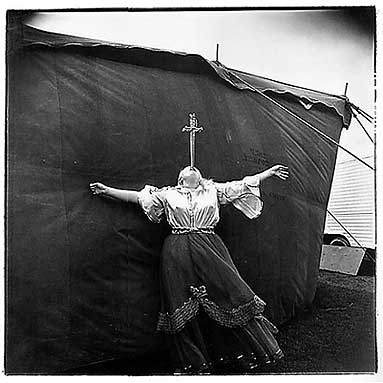
It wasn't in all the photos. Some, especially those of over-dressed rich women, seemed to expose their subjects to ridicule. I thought I glimpsed cruelty in the curve of the lips of a masked man. But in other pictures there seemed more gentleness and respect than I expected. I noticed how one of two drag queens, dressing or undressing for their act, seemed to reassure the other with a touch. I saw the dignified melancholy of a tattooed man, gazing into the distance beyond the camera. The albino girl, arms outstretched and head back as she swallowed a sword, seemed in control of her pose as she mirrored a crucifixion. So many of the subjects, often strange to the viewer or on the fringes of society, seemed to convey an inexplicable depth. Even the photographs of nudists seemed about much more than the nakedness of the subjects.
Some photographs still disturbed. I worried that the children might have disliked their portrayal – who would want to be shown in a gallery as “fat girl laughing” or to be famous as a skinny, laughing boy clutching a toy hand grenade? The extreme close-ups of babies' faces turned them into dolls or death masks. But when I came to the photos of people with disabilities which had so disturbed my teenage self, I began to ask other questions.
The subjects I'd characterised as a “freak show” looked out at me with self-confidence. They seemed as happy as any of the sitters to be recorded. So what exactly had disturbed me? Did I really think that photography was only for the beautiful, the confident or the normal (whatever that was) unless it had a proclaimed manifesto to change the world? These people just were – and were recorded.
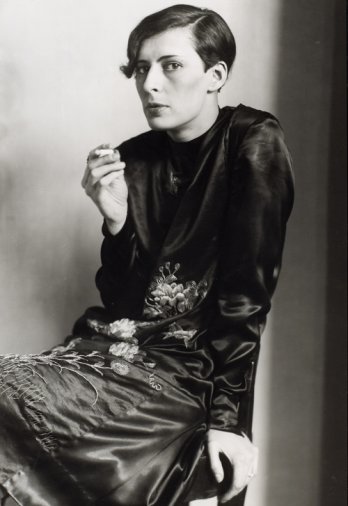
This took me back to the photographs of August Sander and the records he made of Germany in the 1920s and 30s. Before Arbus, he had photographed people in fairgrounds and institutions, apparently letting them arrange their own poses before the camera. It was impossible to look at his photographs without the knowledge Sander lacked. I wondered how many of the people he recorded had been imprisoned, abused and killed in the Nazi regime's euthanasia programme, in concentration camps and in the bureaucratically-ordered extermination of those in the “wrong” racial groups.
My sense of recording and the influence of Sander became even stronger when I returned to the gallery for a guided tour by Alexander Nemerov, Arbus's nephew. He talked about her focus on the subjects of her portraits and the way she documented them as though in the face of impending catastrophe. I reflected later that Arbus looked more for a variety of individuals in every setting while Sander, though recording individuals, saw them more as representatives of types.
There are still problems with photography and the act of recording. For many people, the fact of being recorded and visible places them at risk. I can't help wondering whether any harm came to the subjects of Arbus's photos. It wasn't easy, in the 1960s, to be a mixed race couple, even in New York – and Arbus's caption makes it clear that the couple are married and the wife is pregnant. I wondered if the transsexuals and transvestites later regretted giving so much away or whether the disabled people in the institution suffered discomfort from the response to the publication of the photos. A photographer can try to achieve neutrality and simply observe, understandingly, a range of subjects. But as soon as the photographs are on display they enter an environment that is not neutral and which is all too eager to judge and condemn the lives of others.
Too many people still face a choice between vulnerability and invisibility. On any day I can say, without hesitation, which I would choose – but my answer isn't always the same.
Even some portraits are made for time-consuming adoration. These are usually pictures of the powerful, commissioned to demonstrate their finery as well as their faces. But the poor as well as the rich can seem in control of their images. Murillo's street urchins often display the confidence of the young and free. Even Goya's Maja, clothed or naked, seems in control of how we see her – as does Lucian Freud's model Sue Tilley, the Benefits Supervisor.
Elsewhere the subjects of paintings see less happy with the viewer's gaze. There are nudes by Titian whose lowered or averted eyes can cause discomfort. And I can never look at portraits or even staged domestic interiors by Vermeer for long. The framing of the paintings always brings me slightly too close – I'm forced into the scene like an intruder, as I am.
This history of looking was at the back of my mind as I dithered in the entrance hall of Tate Modern. I couldn't make up my mind about the new exhibition. Not only was the entrance ticket £10 – very high by East Midlands standards, especially for a show of photographs and videos – but the subject itself made me wonder whether I ought to look. The exhibition is called Exposed and the material it shows is grouped around themes of voyeurism and surveillance.
At first I decided I wouldn't look. I'd taken the long escalator to the third floor when I changed my mind and returned to the entrance. The escalator journey felt too much like running away.
There was, of course, something uncomfortable about so many photos grouped around such a theme. Few of them on their own would have sparked such concern even though some areas were banned to under-eighteens because of their sexual subject.
But sex and violence are too familiar to shock. Even the napalm picture, with the running, naked girl (her clothes burnt off) in a world beyond fear and pain, has been reproduced so often that I'm now immune to the horror. I was more moved by the photo of Jackie Kennedy with the new president Johnson and his wife. She seemed numbly vulnerable as she took on the unfamiliar role of presidential widow – beyond comfort and open to the camera's exploitation.
Elsewhere too the camera's glance was surreptitiously controlling. I was disturbed by Walker Evans' pictures of travellers on the New York subway, some tired at the end of the day and enjoying private rest in the carriage's public space. The photos were taken, before the Second World War, with a camera concealed in a coat-sleeve so that no-one could object. All the subjects must be dead by now. For all I know they would have liked the idea that gallery visitors would pay the unbelievable sum of £10 to see their faces – it's a kind of immortality.
Having seen the subway photos, I was initially suspicious of the work of August Sander as he posed and classified “types” - by profession, disability, social status – in his project to document the layers of German society. But as I looked at the individuals he photographed with such care, I warmed to him. The pictures seemed to be the product of a kind of negotiation between photographer and subject. Most of them gazed back at the photographer with the confidence of people who had chosen their pose. There were exceptions of course: the boy labelled “idiot” or the blind girls, sitting together at a school desk. They were photographed in the mid 1920s and despite the labels the children appeared individuals. I wondered what happened to them after the Nazis came to power. Sander's sympathetic categorisation reminded me of the Nazis' brutal hierarchy of types. Yet the Nazis disapproved of Sander's project. His son Erich, a socialist, was imprisoned in the early days of the Nazi regime. After many years, Erich died in prison. Sander photographed his son's death mask.
Of course the exhibition disturbed – it was meant to. But it was far less disturbing than the film I saw two days before, Renzo Martens' Episode 3: Enjoy Poverty.
Martens' film explores poverty in the Congo – the sort of daily, agonising poverty that causes children to die painfully of slow starvation. But it's not like the kind of TV documentary that ends with an appeal to send money, offering the comforting, self-congratulatory reflection that we in the west are nice, charitable people. This begins with a man in the Congo complaining about poverty as he works and angrily showing his small daughter's sores – a result of malnutrition.
At first the film seems a tourist's journey through poverty in which Martens' occasional efforts to understand what he sees don't measure up to the reality. He seems too innocent, too polite. But the guns of the U.N. peacekeepers disturb as do the sharp suits of the wealthy.
But it's easier to look at the powerful than the underpaid workers whose children die so that people like me can buy goods cheaply. And then there's the war and the photo-journalists who follow war and starvation, looking for a scoop. They cluster together with their expensive, heavy cameras, each trying to find the best lighting and angle for a picture of a corpse. The going rate for a publishable picture is $50, on top of the travel and expenses already paid to the photographers. Martens, playing the innocent, asks a photographer a series of questions. Who owns the picture? Do the people in it – or the relatives of the corpse - earn money from it? What pictures sell?
Of course, it's the photographer who profits. The poor children, who aid workers strip and arrange for the camera, get nothing. So Martens reaches his conclusion. Congo has few assets apart from poverty. If the people of Congo are to profit, they must learn to exploit their own poverty. He finds two Congolese photographers, making a small living from pictures of festivals, birthdays and weddings, and urges them to change their subject, telling them that the highest profits come from photographing the dead and injured, raped women and starving children. I'm used to seeing such pictures but I've never before had to sit uncomfortably still while the subject's pose is adjusted and the photographer closes in for the most affecting and aesthetic angle.
There were questions and answers after the film. Martens insisted his work changed nothing – it was art, not politics. But he made a telling comparison with Jonathan Swift's “Modest Proposal,” identifying the film as satire based on a horrible truth. And he said there would be no change because there was no will to change. The people in Congo thought that if those on the outside saw what was happening, they would act – they would not allow such suffering to continue. But there is no outside – we're all in the same world and those of us with power to act do nothing because we benefit from the same system.
Meanwhile, for reasons we cannot bring ourselves to comprehend, pictures of pain and suffering are bought in the west as though they were things of beauty. And the sufferers get nothing for them.
Writer, former Creative Writing tutor who quit in order to write and escape stress. Quaker, concerned with equality and truth. Currently socially distant, usually more approachable.