There was an anxious cluster of people outside the Victoria and Albert Museum. They were reading the hoardings that had appeared. "NEW RESIDENTIAL DEVELOPMENT" it proclaimed, and a second line added, "AT PRIME CULTURAL HERITAGE LOCATION."
I could hear what the people were saying, although their voices rarely rose above a quiet mutter. "They're selling everything off." "I never thought we'd lose the V&A." "It's such a shame - I'll miss it." But although passers-by really thought that the government had decided to convert one of London's great museum into luxury housing, none of those I heard suggested a protest. They minded, they were upset, but not one of them even suggested wearing a badge or writing a letter to an MP. This was what the government was doing and they would have to put up with it.
I'd have been there with a banner and loud-hailer if I thought the government was selling off the V&A to property developers. I've loved this museum since, as a London child, I wandered through its galleries and got lost amidst its marvels. There used to be a reproduction of the Bayeaux Tapestry on rollers so that you could view it in stages. I lost count of the number of times my brother and I surveyed it, looking for the figure we believed was Harold with the arrow in his eye. The huge and detailed Raphael cartoons were another attraction and for some reason I was fascinated by the sculpture of the serpents entangling Laocoon and his sons. There were even visits to the cast gallery, if I could persuade an adult to take me past the sign which banned unaccompanied children under 15. I don't know if this was to project the fragile casts or to keep us from the replica of Michaelangelo's David with which I was obsessed, though more for the expression of his face than for his nudity. Fortunately I rarely had any problem in finding a grown-up to escort me past the museum guards. If only for the strength of my memories, I would fight to preserve the V&A for future generations of children.
But I knew that, for now at least, the V&A is safe from property developers. I was on my way to see the Elmgreen and Dragset installation and, after a moment's shock, came to the conclusion that the hoardings were part of the game they were playing with visitors.
It was Friday evening. I've never been to a late evening opening at the V&A before and the feel of the museum is different. As the skies darken outside, the light in the museum changes. Visitors seem more hushed and slightly tentative, as though they fear they're trespassing. And because some of the galleries were closed, I had to find new routes and, as usual with so large a museum, I found myself in unfamiliar rooms. I couldn't work out if I'd seen the Turners before and hurried past but on Friday evening they were luminous and compelling. I've only just begun to appreciate Turner after the hackneyed reproductions of The Fighting Temeraire that appeared on so many biscuit tins in my childhood. But after spending time in the small room of the National Gallery where two Turners are hung with two paintings by Claude, I have gradually come to realise, some years after falling for Claude, that I've learned to like Turner as well.
I wanted to linger by the Turners but I had come to the V&A to see the Elmgreen and Dragset installation, called Tomorrow. I loved the idea of the installation: five galleries of the V&A have been turned into the apartment of a rich and unsuccessful architect which he has been compelled to sell but has not yet left. Visitors are encouraged to snoop on the invisible inhabitant while the museum guards, dressed as butlers and maids, stand about and respond to queries with deferential courtesy.
At first I thought the installation was great. My sense of being an intruder matched my sense of strangeness at being in the museum at night. There weren't many other visitors just then, and I wondered if some of them were part of the installation. Nervously I picked up items, stroked them, read postcards and bills, leafed through newspapers (lots of stories of the London riots) and perched on sofas and chairs. There were a few moments which added to my uneasiness - but not many and, for my taste, not enough. In the end I wasn't sufficiently engaged with the setting nor with the film script which was provided to accompany it. I was left as cold as I was by Elmgreen and Dragset's consciously kitsch sculpture on the fourth plinth in Trafalgar Square. It's the only fourth plinth sculpture that I've actually disliked.
I've been trying to work out why I was so unengaged by the installation. I know other visitors have liked it. There were elements I enjoyed: the unwashed coffee cups, the unmade bed, the sound of the shower, the fireplace in the living room and the vultures. But in the end I was uninterested in the people that the room conjured up - apart from the servants. The servants were great and I'd like to have known more about them. I leafed through the postcards and photograph album and worked out, from the pictures, that I was supposed to understand that the rich inhabitant of the flat was gay and liked looking at attractive young men - but why was this presented as a puzzle? It seemed to be presenting the character's sexuality as a not-very-hidden secret, which would have made some sense forty or fifty years ago but is a little strange now. I looked at the architecture posters and models and wondered what point was being made, then found that I didn't much care. The installation seemed to be about wealth and people to whom wealth came easily. In real life I feel much more uneasy in such a world than I did in the installation. I left unmoved.
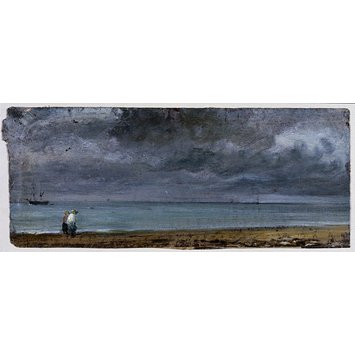
But then I found myself among the drawings in the V&A's collection, and I was riveted. Here there were people and scenes I could care about. There was clear craft as well as art, and surprising experimentation. A startling ink drawing which Constable made in old age caught my attention, and I looked with care at some of the tiny oil sketches he had made too. I particularly loved those of the seashore. I fell into conversation with people who had taken a different route to the museum and been distracted by the small Constables on their way to the installation. They were more knowledgeable than me and could trace the influence Constable had on twentieth century artists. I couldn't stay long enough but I want to get back to see the Turners and Constables again. It seems that my views of Constable have been unfairly limited by exposure to frequent reproductions of his paintings of Salisbury Cathedral and the Hay Wain.
So it wasn't the temporary installation that awoke my sense of wonder but the familiar seen anew. I left the V&A determined to return again soon - and on a Friday evening if I can.
Showing posts with label museum. Show all posts
Saturday, 12 October 2013
Saturday, 4 June 2011
Bread and circuses

After a busy period at work when I haven't found time to blog, I'm experiencing the delights of bread and circuses.
The bread is literally bread. I've finally explored one of the Polish shops near work and discovered a range of central European breads: heavy rye bread, bread with sunflower seeds and so on, reflecting the cuisine of various countries - not just Poland but also Latvia and Lithuania. They seem to me better than the supermarket "specialty" brands - and cheaper too.
I went to a circus as well - the Moscow State Circus which was touring near me on the day of the Royal Wedding. It was a good counter-balance to that other circus. It had a story too. If I grasped the moral correctly, it was something about taking money from the rich and spending it sensibly so that everyone could enjoy the arts. Just now that seems a pretty good idea.
All round me there's anxiety. Friends find their jobs at risk. (I seem to be safe - at least till next year, and that's ages in the present economic climate.) Health and social care are in the news. The Financial Times has picked up a story about health authorities and hospitals at risk. In many cases the risk has been caused or worsened by the involvement of private companies, who were quick to enter into Private Finance Initiative agreements that safeguarded profits at the expense of the ill, the injured and the dying. Meanwhile the big companies that make money out of caring for frail elderly people and those with disabilities have in their turn been brought close to collapse by private equity companies. From the point of view of profiteers, it seemed a neat arrangement: sell the homes to other companies, agree an ever-rising rent, trust the market - and get out quickly when the economy falters.
Obviously I should have arranged a better pension for myself, according to the right-wingers. That's the same right-wingers who object that my public-sector pension will be too generous (if I ever get there) and who tell me I should find ever more to spend on my children, my parents and every cause and charity near to my heart. But if I do my best, it's never quite enough. According to them, I should also spend more on insurance and save more - but in the present economic climate insurance companies can go bust. Even banks, which may be bailed out, seem a bit of a gamble. They depend on the markets, which depend on an ever-increasing chain of gambles and exploitation.
So besides bread, I comfort myself with circuses. I may have visited only one actual circus in the past month, but I've been making up for it by enjoying other activities which give me pleasure. They remind me that life is more than a dragged-out existence. Life isn't just about duty - we need pleasure too. For some people that means getting out into a new place, whether it's roaming the countryside or strolling through towns. Others enjoy dancing or sport - and my regular experience of wielding an epée makes me understand that these can be sources of intense pleasure. For other people it's watching sport going to gigs that's important. My circuses involve engagement with the arts.
I headed to London to see my parents, travelling as lightly as I could so that I could sandwich my visit with artistic pleasures. I was a groundling for a matinée of All's Well That Ends Well at the Globe - a difficult play that's rarely performed. It's not just its unfamiliarity that makes it one of my favourites. There's a pair of determined, assertive young women - even though the times mean that the best either can hope is an attractive, wealthy husband to lord it over them.
I've seen All's Well twice before - and in both productions the focus was on the central relationship between Helena and Bertram. The comedy was played either as abstruse courtly wit, at a distance from the audience, or a cue for over-emphasis with lots of "isn't this funny?" expressions in the hope that the audience would laugh. The revelation of this production was that, for the groundlings at least, the comedy worked and was genuinely funny. It comes, I think, from the shape of the theatre which encourages the actors to establish a relationship with the audience. Comic lines were played with the clarity of the successful stand-up - and were irresistible. I engaged with the play as a whole - how could I do otherwise with my forearms leaning on the front of the stage? - and, when the final scene of reconciliation came, my eyes filled with unexpected tears.
I stayed overnight with my parents, still in their own flat so less immediately threatened by the private profits of the market. We had supper and a quiet evening. In the morning I left with them when they headed out to the shops but my aim was a further exploration of London.
I was unsure of my destination but eventually decided on the Guildhall Museum, which I hadn't visited before, followed by the London Museum, which I hadn't seen for many years. Walking between and around the two, I found myself in a many-layered city, where modern structures of glass and metal loomed high above small Wren churches. There are traces of an even older city. I glimpsed the old London Wall through a museum window and saw what's left of the Roman amphitheatre in the Guildhall Museum basement.
That's the kind of structure Juvenal meant when he talked about bread and circuses: a place where shows of all kinds were put on, including gladiatorial combat and public execution. Being in some ways a typical Roman of his class, I don't suppose he minded the gladiators or the executions. But he was concerned that the citizens of Rome, once the source of democratic power, had been diverted from their proper concerns for the state to making demands for bread and circuses.
I agree with Juvenal that people should recognize and exert their democratic power. But I think he's wrong to dismiss bread and circuses. We all need food to live - not just food for the body but something that nourishes the imagination and tells us that life is worthwhile. It's also the circuses, whether we find them in physical activity, travel, music or the arts, that open us to a wider imaginative understanding of the world. They nourish curiosity and sympathy. They offer laughter, tears and reconciliation.
Yes, Juvenal - I want democratic involvement and responsibility. But I'll take the bread and circuses as well.

Monday, 4 April 2011
The Harrods of the ancient world
How could something so fragile last so long?
I gazed at the remains of brittle gold bowls and goblets. I could see where the stem of the goblet should be. The amazing thing is not that it has vanished but the thin, ridged bowl should have survived. I peered closer to make out the outlines of bulls on part of a bowl. A craftsman scored them gently into the gold around four thousand years ago. They are evidence of a vanished civilization of which little else is known. They come from Afghanistan.
I was hesitant about visiting the Afghan Treasures exhibition at the British Museum. I thought uncomfortably of conquerors, loot and triumphal processions. Exhibitions often arrive with an agenda, especially when they have been negotiated by diplomats. But this exhibition seems to have a gentler and more laudable cause. The British Museum has been restoring ivories that were stolen in the looting of Kabul Museum and recovered by an unnamed philanthropists. The British Museum staff have been working with the staff of Kabul Museum and the exhibition, however dependent on diplomatic goodwill and corporate sponsors, comes out of their joint work. The exhibition tells another story too – of museum staff who hid the treasures so that the history of their country could be preserved.
The history of Afghanistan is not well known. There is much that has not yet been recovered or understood. Western history books have tended to simplify the region as a place of romantic barbarism which briefly encountered civilization with the arrival of Alexander the Great. Alexander the Great, who married an Afghan wife and adopted local customs, may have viewed it differently.
So far as I can gather and recollect, the region had two reasons for importance in the world. It was a source of lapis lazuli, which was rare and much in demand. And although its terrain is difficult by contemporary vehicles, it stood on major trade routes, bordering India, China and the Persian Empire. Traders went as far as Greece and Rome, although the journey each way would have taken a year. The treasures they brought back, particularly to Begram, are protected in glass cases in the exhibition.
Captions show the uncertainty of the curators about the exhibits on view. There is a head of Silenus, clearly recognizable, but did the Afghans really know who Silenus was? Its unclear whether the owners of valuable items purchased deities or just attractive statues – rather as a modern mantlepiece may bear statues of Ganesh or the Buddha without necessarily demonstrating any religious allegiance or knowledge.
There's glass, too – Roman glass most probably or perhaps made in Egypt - the curators cannot be sure how it reached Begram from Rome since the way was blocked by war with Parthia. One piece is enamelled with full-length figures which even I can see are Roman in style. Another's delicately ornamented with vines made from the glass itself. But beside these are statues carved in turned ivory – chair-legs, the inscription suggests – each with a swaying female figure in what seems to me an Indian style. There are glass fish, a face that resembles a Greek or Chinese theatrical mask. There are Corinthian columns and finials. Some items must have been made in Afghanistan by craftsmen who had learnt skills from crafts practised elsewhere. But many items are imports, suggesting a place like Britain today where beautiful objects from all over the world can be prized and owned.
Half-way round the exhibition, I realised something else that was troubling me, though it's not unusual. I had little sense of the lives of the people who owned these objects, other than that they were very rich and could afford goods imported from far-off places. It was as if, one day far in the future, someone were to excavate Harrods and, finding only a few of the goods on show, tried to understand life today on that basis. Perhaps that is what has survived. Perhaps these expensive, traded goods represent the Harrods of the ancient world.
As I wandered through the exhibition, the past seemed both more distant and more familiar. I couldn't grasp past Afghan cultures but then, if asked, I couldn't give a simple account that took in the whole of west European culture today. Artefacts left by Afghan trading centres, which drew goods and influence from across the world, speak of a complex, varied society. This shouldn't be surprising or unusual. But I began to realise that many exhibitions treat the past as a collection of small, separate societies. They don't just assume that societies are culturally pure – they often treat cultural purity as something good in itself. The textbooks I studied at school were wary of cultural mixing. Rome's interest in things Greek was regarded with disdain although the Renaissance interest in Greek art and sculpture was excused as a means of regaining artistic purity after the confused muddle of the Middle Ages.
Looking at the wide range of objects on display and marvelling at their variety, I realised how much ancient history has been filtered through subjective and questionable value judgements. I suppose curators have to simplify – just as their displays provide the kind of neat, comforting pattern humans are trained to prefer. But in real life I like variety and complexity – and am glad that human existence resists a neatly moral narrative arc.
At last I neared the object I recognized from the posters for the exhibition: the gold crown once worn, so the captions assured me, by a nomad princess. I expected something bright and golden but I hadn't realised the tiny golden discs would tremble continuously, as though there were a breeze or breath inside the glass case. I read that the crown could be packed away and folded – and that all the nomad treasures, buried two thousand years ago, could be carried easily on horseback. In my imagination an Afghan princess rode through wild landscapes, the trembling crown on her head and a gold-studded cloak behind her. It's an improbable fantasy. I have no idea what the concept “princess” means in terms of nomadic people two thousand years ago - I wonder if the women were princesses in any way we can understand.
Little seems to be known of Afghan nomadic life beyond the six graves in Tilya Tepe. But the adornments found in the tombs of five women and one man link the items closely to the humans who wore them. It's not just the photos showing how the bodies lay when the tombs were opened or the glass case where the golden items mark out the shape of a human form. It's more to do with the sense that these items once touched living flesh and the the gold was caught on wisps of cloth the tombs were found. I peered as directed to see that the bracelets show signs of wear – in contact with an arm over time, gold diminishes.
The exhibition isn't big or cheap (I got in for half price – £5 – with my Art Fund membership). Space inside is limited because items are small and, when I visited on Saturday, that meant queuing briefly before reaching most cabinets. I haven't carried away a neat package of knowledge about an obscure culture. Instead I have grounds for wonder and wondering – more than enough.
Labels:
Afghanistan,
art,
culture,
Greek,
history,
London,
museum,
travel,
travellers
Sunday, 6 March 2011
The problem with patrons
I was almost impossibly tired when I arrived at the National Gallery. I'd had a good but busy week and was still recovering from the amazing and absorbing experience of hearing Alan Moore, the Magus of Northampton, read aloud from his novel-in-process. [Note to anyone who hasn't come across Alan Moore: he is not only a remarkable writer but also one of the kindest and most courteous authors I have encountered. His reading held everyone in a huge lecture theatre spellbound for nearly an hour and he spent a further hour and a half speaking to everyone who had queued to have their books signed.]
The day after Alan Moore, I was on my way to visit my parents, unsure I was sufficiently awake to take in the Gossaert exhibition but knowing that I was unlikely to find another opportunity to see it. I also had my new Art Fund card with me - at last I've fulfilled my resolution to join, not just for the very welcome benefits but also because I have benefited from the Art Fund through a lifetime of gallery visits.
The route to the exhibition took me past many familiar paintings. On one side I spotted a favourite Titian. Through the entrance to another room I thought I glimpsed a Vermeer. There was Murillo, staring out of his frame like a competent marketer of his own paintings.
In my susceptible state of mind, even Rubens seemed set to lure me from my path toward Gossaert. After all, Rubens was not only free but there were comfortable padded benches from which his work could be admired. (I don't usually admire Rubens that much.)
I forced myself to make the long trek to the basement of the Sainsbury wing where the Gossaerts were displayed. It was worth it. I realised that I had seen and admired individual paintings by Gossaert in the past but I'd never seen them in relation to one another before. I hadn't even registered the artist's name.
There are six rooms in the exhibition. Gossaert's drawings and paintings are complemented by the work of artists who influenced him - a startling range from Northern European artists like Durer to the classical tradition of the Italian Renaissance. Although he's only mentioned in the timeline at the start of this exhibition, it's easy to see Holbein as the heir of this remarkable combination of influences.
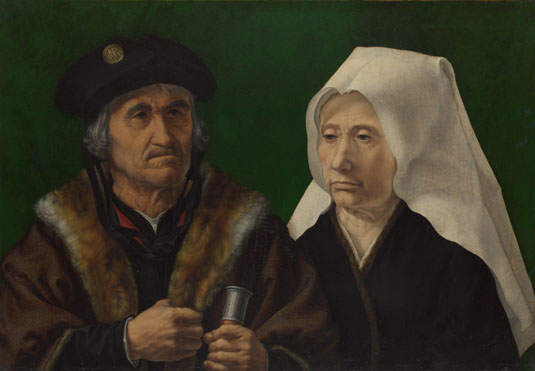
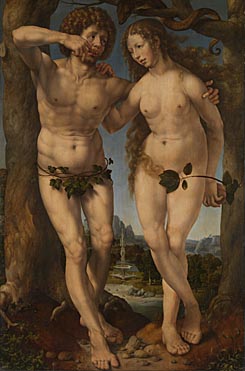
There's more to Gossaert than his portraits but these are the most obviously remarkable part of his work. The people he paints in portraits convince as human beings, simultaneously familiar and unknowable. This isn't just true of his secular portraits. There's a lavishly clad Mary Magdalen with sly glance and dirty fingernails. But he also paints relationships, including erotic relationships. There are various works showing Adam and Eve, including some copies of lost originals, but all convey an astonishing blend of tenderness and desire.
The work that stunned me most - and nearly moved me to tears - was a painting of Christ in the Garden of Gethsemane. It's a dark painting - even the red robes of the flying angel and the sleeping St John are barely lit. An elderly figure - St Peter, perhaps, lies on his back, asleep in the foreground. He has the pallor of exhaustion. But at the centre is the kneeling figure of a youthful Christ, beardless, confused and close to despair. It's not an attractive figure but terrifyingly recognizable. It's the expression of any child confronting an incomprehensible horror. It could be Libya or Afghanistan - or, too often, the U.K.
At the end of the exhibition I couldn't give an account of Gossaert. I had no sense of the man who painted the pictures, except that he could see and reproduce with pencil on paper or paint on canvas. He had, it seems, some human understanding that didn't take a verbal form. And he had the luck to be taken up by a succession of patrons who took him within reach of the influences he needed to develop his art.
It was luck. That's the problem with patrons. While Gossaert had the right patrons for his development as an artist, he was limited to painting what they required: a portrait of a marriageable daughter, erotic works for a private collection, an altar piece, a sketch for a tomb. There is no way of knowing what Gossaert would have liked to paint. It's lucky that some of his patrons' requirements suited a style that we can now appreciate.
It's luck too that has made me so familiar with the works in the National Gallery - the luck of living near a free art gallery and being encouraged by my parents to look inside. I was brought up to take advantage of free and cheap culture - to see culture as a good that should be shared.
It was shocking, therefore, to read, the day after my visit to the National Gallery, of a Labour MP calling for the introduction of admission charges to London's museums. He's not just any Labour MP. The Hon. Tristram Hunt, son of a life peer and a historian with a proclaimed interest in radicalism and the working class, has written an introduction to a recent edition of Robert Tressell's The Ragged-Trousered Philanthropists. In this book, Robert Tressell, through his main socialist characters, argues that culture is one of the necessities of life and should be available to all. I assume Tristram Hunt read the book before writing the introduction. It's a shame he didn't take in its arguments.
It's fair to say that Tristram Hunt wants free admission to the museums in his own constituency of Stoke-on-Trent and, by extension, to other regional museums. I think they should be free too. But I don't think the country's great art galleries and museums should become the preserve of the wealthy. And I'm not interested in any party that can consider excluding the poor from culture, which is not just an education but a means to nourish imagination.
Had there been a charge for the National Gallery, I might have visited once or twice when I was growing up. I know I wouldn't have gone there often - and I wouldn't have learnt much about the history of art. I remember when Mrs Thatcher introduced admission charges for museums and galleries in the 1980s. I was poor then and on many occasions I was stuck outside, wishing I could afford to go in.
Now I've joined the Art Fund. I make donations because museums and galleries were free in my childhood and it's time to say thank-you. If there had been a charge, I wouldn't have bothered. I'd have known museums and galleries weren't for the likes of me.
Labels:
art,
class,
culture,
economics,
exhibition,
museum,
New Labour
Subscribe to:
Posts (Atom)