 There are mild grumbles in Nottingham about the new Robin Hood film. Nottingham can live with an Australian playing the outlaw, a newish story and even the usual dodgy accents – outsiders tend to be uncertain how Nottingham people speak. But word has got round that the character played by Russell Crowe – Robin Longstride – is a Yorkshireman.
Reviews of the new film were lukewarm. Nonetheless, Nottingham has declared that May is Robin Hood Month. There's an exhibition (costumes and set, I think) at the Castle and I've seen signs of other events in the area.
I hadn't expected the mediaeval market. I came across it on my way to Nottingham Contemporary, paying my second visit to the Uneven Geographies exhibition. While I hate shops, with few exceptions, I find it hard to resist a market and began to explore the stalls.
I watched a man making a thick leather tankard. I hadn't heard of leather tankards before but the procedure looked convincingly mediaeval. Opposite was a stall selling sausages and another offering Transylvanian glass – nothing to do with Dracula but delicate and glowing. There were stalls selling food, jewellery, carvings – all sorts of delights. It wasn't until I reached the stall selling baseball caps made of panels cut from tin-cans that my lazy, sun-soaked mind began to wonder about the label “mediaeval.” Still, the Heineken cans are a pleasing shade of green though the Coca-Cola logo might look out of place in the greenwood.
I started spotting other inconsistencies – a sausage stall, staffed by two smiling men in Robin Hood hats, was named after “King Tut” - much earlier, I think, and unremembered in mediaeval times. I know the Crusades saw returning soldiers bringing all kind of new goods to England - but would they have brought smiling Buddhas fashioned from resin? Did they eat ostrich burgers in baguettes in Sherwood Forest? I couldn't rule it out but kangaroo meat is totally implausible. Wodwos carved from wood seemed more authentic.
For a few minutes I counted inconsistencies. Then I began to delight in them. I love the Robin Hood legend but I've never insisted on historical accuracy – it's a baggy myth which is refashioned with every telling and imagining. Robin probably didn't wear tights, despite Douglas Fairbanks, Errol Flynn and Richard Greene – and at the same time he did, because imagination makes it so.
My Robin Hood isn't Robin of Locksley, returning nobleman, but the outlaw beyond class who sees an unfair society and acts for liberty and justice. His greenwood is a place of freedom and equality – and women are equal there, because that's how I've imagined it.
I began to wonder how my Robin would be today. He might be with the migrants who live outside the law in our cities, aiming at invisibility but too often exploited. Or perhaps he'd be an eco-warrior, defending the wild places and remaining greenwood from those who exploit them for cash. Either would be a more uncomfortable Robin than any Hollywood has produced. Only the TV series of my childhood really engaged with contemporary politics.
But Nottingham's mediaeval market didn't seem entirely out of place in the Robin Hood myth. People who'd come to Nottingham for all sorts of reasons mingled at the stalls. There were Goths, political protesters, parents whose children wanted to splash in the fountain – all assembling in the Old Market Square and strolling round the stalls. They moved easily from demonstrations of weaving and wood-turning to chat with the vendors of amber, carved elephants and eco-clothing.
Myths update themselves all the time. No single version can hold them.
 Political conversations are everywhere. Not all elections are like this. The last election was marked by apathy and the sense that, when it was over, the New Labour regime would continue. I heard discussions of how to vote that were marked by a sense of guilt and despair – we hadn't stopped the war in Iraq and the war-mongers were about to claim their electoral victory as popular endorsement. Thatcher's dreadful phrase “There is no alternative” hung over us.I assumed this election would be similarly despairing. After the chancellors' debate on TV, when Darling. Osborne and Cable agreed that, whoever got in, the cuts would be deeper and more painful than under Thatcher, I settled into the gloomy certainty that the next five years would mean the rapid unravelling of everything I value in the hard-won welfare state. Worries about my parents and my children broke into my sleep and woke me in the middle of the night.I'm still worried. But there's a new thrill in the air. Many young people who never voted before seem to have infected the public debate with their excitement and conviction that change and hope are possible. They aren't agreeing with one another and many are still uncertain how to vote, but they want to listen to the arguments and join in the debates. The power of a single vote makes them feel like citizens.I was in Leicester yesterday when Nick Clegg visited. I've seen visiting politicians before and remember how, when Tony Blair came to Leicester in 1997, everything was stage-managed and spun to ensure good camera angles. Blair's campaign team provided the crowds with flags to wave, played music (D-ream) interminably and swept dissenters aside.Nick Clegg's visit wasn't like that. Students, enjoying the sunshine and their last day of term, came to join the crowds and see what Clegg had to say. Most banners were home-made though a couple of Labour supporters brought their own banners to wave. Plainly Clegg's team was taken aback by the hundreds of people. I heard them on mobile phones: “Yes, there really are that many.” Then the battle bus arrived.A narrow pathway meant that Clegg could get through the crowd, preceded by photographers and cameramen who found it hard to get the pictures they wanted. Clegg stopped as he walked to answer questions – a socialist friend of mine who came at my suggestion managed to ask him about students and bankers. She got an answer though I couldn't hear it.There was a speech with questions and applause but I was too far away to hear. Instead of trying to break into the crowds I started taking photographs of the posters. The pair produced by the Politics and Pints society cheered me, though Clegg didn't accept their invitation to the pub.There were more banners today at Nottingham's all-purpose, leftish-to-revolutionary May Day march. The organisers couldn't afford the marches usual base near the castle so had booked Victoria Park instead, to remind locals of the recent closure of the Victoria Baths nearby. The weather forecast threatened rain and gloom and I packed a waterproof jacket. I didn't need it.There were fewer people than in previous years. With only five days till the election, some of the regulars may have been out campaigning. But there was still a good range of stalls including one celebrating Nottingham's radical history in which a loaf on a stick, decorated with a black ribbon, had served as an incitement to riot. Of course, someone was carrying a loaf on a stick. I couldn't resist a badge with the words “TO THE CASTLE”, recalling the burning of Nottingham Castle in the 1831 riot in support of the Great Reform Bill. I hope no-one arrests me for incitement to violence. I'm still a Quaker and a pacifist – but I can't help wanting to celebrate Britain's radical past and the workers who demanded that their voice be heard.Women dancers, energetic and costumed as if for an extravagantly-pagan Morris, led the march. Various factions of the left chanted their competing slogans without getting further than detailed debates. Home-made banners greeted the shoppers of Nottingham, mostly with thoughtful, witty and challenging slogans that might make people think. (I was a little uncertain about the demand for “revolutionary praxis now” - the word“praxis” is underused in most conversations I have.) A gorilla danced and handed out leaflets for Greenpeace. I wondered where to fit into the march and found a place with CND and near Friends of the Earth.
Behind me two socialists had a lengthy discussion about how to vote. One argued that a Labour defeat was the only hope for radical elements in the Labour Party. I didn't catch the response. I wondered whether competing groups urging people not to vote, on the grounds that direct action is needed, were debating the best way not to put a ballot paper in the ballot box.We walked, sang, chanted and danced past the derelict wreck of a business which still proclaimed in large, wrought-iron letters "PALMER & SON LTD. BYRON WORKS." I thought we made a cheerful display and was pleased to see answering smiles from some of the shoppers. There were cheerful displays everywhere. Outside the glossy new pawnbrokers with its shiny blue fascia, smiling young women handed out white and blue balloons.It wasn't a long walk to Nottingham's speaker's corner, by the Brian Clough statue. The Clarion Choir were there to greet us. So was Robin Hood in a home-made and decorated banner-gown. I stayed for a while to listen to the songs and speeches, marvelling at how harmonious and tolerant Nottingham radicals can be on such occasions. I'd have liked to go back to Victoria Park with the march but my back was hurting. I slipped away and decided to blog about the march instead.

 The gatehouse is what tourists expect - or near enough. You can imagine Robin Hood lurking. There's a statue of him nearby but it's not how I imagine Robin - but then my imaginings were built by Errol Flynn and Richard Greene.
Robin wasn't much in my mind as I climbed the steep approach to Nottingham Castle - but he had to be there somewhere. There are leafy, green walks at the base of the Castle Rock, a steep hill and winding pathways,  and even the major oak represented in a mosaic of pansies.
I wasn't meant to be in Nottingham. I was meant to be in a meeting - one of those necessary committees with long agendas and jargon-filled papers for discussion. I'd decided to work from home in the morning and allow myself an hour in the office with the preliminary paperwork. Just before mid-day I left for the station.
The trains I needed were cancelled - there was a signalling problem. Station staff promised a bus but it wouldn't get me to work in time for the meeting and it would be hard to get back again. I rang in with apologies.
I was about to go home when I realised that some trains were running and, if I waited a few minutes, I could go to Nottingham instead. I waited a few minutes. After all, I had work in my bag and could get some done while enjoying a cup of tea - or even the picnic lunch I'd planned to eat at my desk.
Once in Nottingham, I wasn't sure what I would do, but the day was warm and sunny and gradually my wanderings drew me towards the castle. I remembered a tea-room and free admission on week-days.

There's much discussion in Nottingham of the disappointment tourists experience on first seeing the castle. The fine mediaeval building of Robin Hood's day was destroyed after the Civil War when Charles I fought parliament, lost and was executed. The Civil War used to be one of the best known parts of British history. I grew up on stories of battling Cavaliers and Roundheads which were told much as 1066 and all That put it: that Roundheads were "Right but Repulsive" and Caveliers "Wrong but Wromantic." It seemed like a contest of hairstyles and costumes, until I came across an account and portait of the young John Milton, a dedicated anti-monarchist who didn't fit the Roundhead image. The English Civil War is largely forgotten now - many young people are surprised to learn that England was once a republic. However it marked Nottingham.  The king chose Nottingham Castle to raise his standard in 1642. I'm not sure why he chose Nottingham which became a parliamentary stronghold during the war - the castle was held for parliament and later used as a prison. In the end it was demolished, for fear royalists would attack and hold it. The site must have made it one of the most powerful fortresses in the country.
In the 1670s, after the Restoration of Charles II, the site was leased by the Royalist William Cavendish, first Duke of Nottingham, whose son built a small mansion on top of the rock. The poor lived and drank below, not just in houses but in man-made caves. Nottingham's caves were officially inhabited until the beginning of the twentieth century. Unofficially, people were living there a few years ago. Maybe they still are.
I wonder what the Cavendishes thought when they looked down on the poor, or if they spent much time in Nottingham. In 1831, the Duke of Newcastle opposed the Great Reform Bill, which proposed extending votes to the middle classes and providing parliamentary representation for the new industrial areas. The Bill was intended to undermine aristocratic patronage and the aristocracy objected. When the House of Lords threw out the Bill, which had been passed by parliament, there were riots in Nottingham and the Duke's castle was burnt down. The Duke left the burnt-out wreck as a reminder to the people of Nottingham.
The mansion was rebuilt in the 1870s and taken over by the local council, who used it to create the first municipal art gallery outside London. The castle is still owned by the local council.  It's not one of the best municipal galleries but I always find something there to delight me. Every so often a campaign springs up to demolish the current castle and replace it with a Disneyfied tourist attraction but I would hate that. The current building may not be exciting but I'd rather not unpick 400 years of history. "City of legend" is a fine marketing slogan but there's more to Nottingham than that.
Yesterday, however, I was set on tea and a picnic. 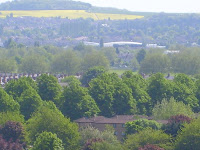 I drank Earl Grey while working, then moved to a bench on the terrace for my picnic and more work. There was a breeze. I could see the sails of Green's Mill turning. Beyond the houses, churches and office buildings there were high, sunlit fields. For an hour or so, this was my workplace.
Then I walked down the steep path through the trees to the memorial to Captain Albert Ball, V.C., a fighter pilot killed in World War I.  It's a strange memorial showing the young airman with a female figure flying beside him - a Victory, perhaps. From some angles their cheeks seem to be touching. I don't suppose Albert Ball had much opportunity to be close to women. He was only 20 when he died.


