Tuesday, 12 June 2012
The battle of e-readers
Tuesday, 15 March 2011
Against the dark times
I have succumbed to temptation again.
The Flying Goose café hosted one of its regular poetry readings and I returned with books by the three poets who read - Ann Atkinson, Alan Baker and Wayne Burrows - as well as books by the Australian Andrew Sant and the Dutch poet and children's writer Toon Tellegen.
As I carried my shiny treasures home I reflected that these are not the kind of books you see in Waterstone's. They come from small presses - Shoestring, Skysill and Smith/Doorstop - and are, like so many books from small presses, lovingly made. While mass market paperbacks can seem impersonal - made to fit in with a marketing officer's idea of what "brand" each book fits - small press books often show the personal care of the tiny teams that put them together. The smallest presses are run by people who make no money from them but work for pay elsewhere. The books small presses produce have a personality which seems to come from their close link with both publisher and author.
These carefully-crafted books and the skilfully-managed poems within them cannot compensate for the horrors on the news. The optimistic and peaceful protests in the Middle East seem to be ending in bloody repression and torture by regimes to whom the British government has been - and in most cases still is - selling military equipment. The threats and massacres that silence dissent have been knocked off the front page by the pain of Japan for which I have no words.
I can't look at the television for long - it's not just the sense of helplessness I experience that prevents me but the fear that if I look too long I'll be a mere voyeur - or worse, be hardened to ignore the devastation and anguish of others.
But literature (and art and music and many other sources of beauty and pleasure) still have their place in the world. I was reminded of this by a short blog message to her Japanese readers from the science fiction writer Ursula Le Guin, who posted at the request of her translator and friend. Reading this - and the first comment that followed - made me feel reassured that there is nothing wrong in the refuge I seek in words, art and music. These have many roles. They deepen understanding and cause us to question. They also nourish and console, in part because of the care with which they are wrought.
So I feel less bad about the joy I take in music on Radio 3, in sunshine, in books, in poetry. These good things exist in the same world in which humans and nature cause great damage. I'll campaign and write letters and even march against great wrongs. I'll try to work out how the world might be better and say what I think. I'll never have most of the answers but can try to contribute to debate and trains of thought - the more people share ideas and work together, the better hope for humanity. And I'll pay attention to things that are quite small and made with love.
This Saturday Leicester hosts States of Independence II, an independent press fair where small and independent publishers will display their wares and writers will read, talk and answer questions. It's a free, all-day event to which members of the public are welcome. It's a chance to celebrate words and the makers of books. However dark the world, these remain worthy of celebration.
Thursday, 7 October 2010
No to the Kindle
British friends have occasionally asked me why I visit Paris in August. “There's no-one there,” they assure me. “The real Parisiens are all on holiday and everything's shut.” It's a simplification. Some Parisiens – those who can afford it – try to take holidays in August. Some shops, businesses – even museums – are closed. Last year I was sorry to miss the municipal museum of Montreuil, which I still hope to visit one day. The Comedie Francaise and the Paris Opera are on holiday. Friends I would have liked to see were away – as was the owner of the splendid apartment I sublet.
Yet I enjoy Paris in August. It has a leisurely air. The discovery that a local shop or restaurant is shut for “les vacances” is not a disaster. It's a reminder that workers need holidays and there's more to life than making money.
In previous Augusts I did little to look for live events in Paris. Paris Plage was fun – and full of locals – but I missed it by a day this year. I wondered if my British friends were right in saying nothing else was on. I decided to investigate. I paused at a kiosk and invested in a copy of Pariscope – not a huge gamble at 40 eurocents – to see what was going on. Leafing through the pages I read of theatres, cinemas, concerts, spectacles and markets.
At first I was baffled by the choice, then began to make decisions. The Lucernaire looked worth a visit, and quite near where I was staying. The second and third Millennium films were showing at the Cinema Chaplin, not too far away. There was a fund-raising piano festival at the Armenian Cathedral in the Marais – and much more.
I began at the Lucernaire. The list of theatre shows made me hesitate. I'd missed Cooking with Elvis at the local amateur theatre and was prepared to miss the French version as well. But I wondered about a one-man show of Oscar Wilde's De Profundis, well-reviewed in a number of French national papers. The price – 22 euros – is more than I usually pay for theatre tickets. But when I thought about seeing Wilde in French, there was a pleasant logic too it. De Profundis is Wilde's long letter to his young lover, Lord Alfred Douglas, written from Reading Gaol. Some years ago I would have said I knew the English text reasonably well, although it has faded in my mind since. I recalled that, after leaving prison, Wilde went to Paris, where he died, and was buried in Pere Lachaise cemetery. And while I hesitated about seeing a work in translation, I recalled that I had twice seen Wilde's play Salomé, which he wrote in French for Sarah Bernhardt, in the translation by Lord Alfred Douglas. The idea of Wilde in French translation was almost symmetrical. I bought my ticket.
The set up at the Lucernaire wasn't quite like a theatre in England. Notices on the wall told us that the “ouvrieuses” (specifically female workers) showing us to our seats were unpaid and dependent on tips. The ouvrieuses were charming and had a neat way of sliding the proffered tips into a purse – but I felt uncomfortable about the procedure. Workers are often required to display charm as part of their jobs but I didn't want to measure and reward that charm directly with a tip – it felt too intimate a purchase. However as they were, according to the notices, dependent on the audience's generosity, it was plain that generosity was my responsibility. I handed over the tip as I was shown to my seat and wondered if I'd bought the bright smile that followed.
The theatre was small – a studio space without the formal grandeur of a proscenium arch. The actor playing Wilde was already on the stage, perched on a step-ladder and half-covered by a blanket. The audience leaned forward expectantly, displaying a quality of intense concentration that is rare in English theatre audiences – and this continued throughout the performance.
Occasionally I found the use of French distancing and at times my understanding flickered out - I probably grasped 80 to 85% of the text. Despite the strangeness, a French Wilde seemed a convincing possibility. I even found his mispronunciation of Reading (to resemble the activity rather than the town ir the gaol – endearing). It was an intense and moving performance. I was surprised to find that, towards the end, I felt sympathy not just for Wilde but also for Lord Alfred Douglas – Bosie. De Profundis chronicles instances of Bosie's selfishness but, listed by Wilde, they seem like the follies of a very young man faced by an adoration he could not quite reciprocate and an intelligence he could not match. Even his cruel statements seemed like a dull attempt to match Wilde's wit while his neglect of Wilde's feelings could be forgiven as the uncertainty of a young man suffering from an appalling upbringing and unsure how to respond across the barriers of age and c lass. The young often do run from suffering – and how was Bosie to respond to Wilde's imprisonment and agony? Biographies suggest that Bosie was unpleasant throughout his long life but the pictures reveal a startling beauty which may also have been a disadvantage.
A week was not enough for all the events listed in Pariscope. I saw Millennium 2 – subtitled in French, which I find far easier than dubbing – and enjoyed a riveting performance of piano music by Chopin and Rachmaninov. That was as much cultural performance as I could take. I also haunted the bookshops, trying to add to my small collection of books in French.
There were two books I aimed to buy: Victor Hugo's Notre Dame de Paris and Eugene Sue's Les Mysteres de Paris. Both have been on my list of books I need to read for some time. But I was confronted by something unfamiliar from my life in the East Midlands – a wealth of bookshops. There were big shops like the many branches of Gibert Joseph in the Boul' Mich and the art chain Mona Lisait. Then there were many small independent shops – far more than in London, I think – where the stock seemed to reflect either the manager's taste or the surprises that often delight and infuriate in secondhand volumes.
I browsed contentedly and puzzled over what to buy. I find nineteenth century French literature easier to read than modern light fiction; lengthy paragraphs allow unfamiliar words to become clear from the context and puzzles can be resolved with the aid of a dictionary. Recent thrillers, for all their popular appeal, are harder because they use so much contemporary slang. I have a further interest. I've noticed that, for generations, working-class readers in particular were absorbed by popular French fiction from the mid-19th century. Stories like The Count of Monte Cristo and Les Miserables are mentioned in working-class writing from the 1850s to the 1950s. And I knew that writers for the working class drew on French writers. For instance, G.W.M. Reynolds' terrific and popular serial, The Mysteries of London – which makes Dickens seem restrained in style and detail – was directly influenced by Sue's Mysteries of Paris. So far as I can see, no-one has gone into much detail chronicling this influence. While the effort necessary for a wide-ranging survey is beyond me – I imagine I'd need a year or so in French archives with no guarantee of success as well as another year combing comparable English publications - I could at least see what popular fiction of the period was available in paperback.
One of the joys of reading in French is the vast and largely unknown library of possible titles which spreads before me. Looking at Paul Feval's Le Bossu – which was the source for a couple of terrific swashbuckling films - I discovered that the same author had written his own Mysteres de Londres – quite different from Reynolds' serial. I haven't read it yet but, according to the back of the book jacket, it tells the story of an Irish plot against the British government and is set in exotically English locations. I had to buy a copy. There was a fine multi-volume edition of Les Mysteres de Paris, with illustrations, but in the end I concluded that it was too heavy.
I was also tempted by Eugene Sue's last book, Les Mysteres du Peuple, apparently a fictional account of working-class revolution from the time of Jesus to the era of Napoleon III. I wondered why so startling a book was so little known. Until I stumbled across a copy in Gibert Joseph, I hadn't heard of its existence. I nearly bought it but once again I hesitated, feeling the weight of the book. I could delay, I thought, and order it from amazon.fr when I had time to read it.
In the end, I succumbed to ten or twelve books, including a fine hardback edition of Notre Dame de Paris from one of the second hand shops set up by Abbé Pierre's Emmaus charity. A friend tipped me off that these were a great place for bargains and the shop I visited gave me an excuse for travel on the voguéo - I find it hard to resist river travel. My reading of French is still slow and I have less free time than I would like so my purchases will last me a long time. But I still regret the two books by Sue – perhaps I need to go to Paris again, very soon.
The chief problem was one of space – and what I reckoned I could carry home in my suitcase. Eurostar may not have a weight allowance but travellers still have to heave their cases onto the conveyor belt for scanning and manoeuvre them into the luggage areas of trains.
Briefly I thought of the solution suggested by a couple of friends: if I purchased a kindle or e-reader I could carry a whole library with me, unworried by weight. But I like the weight of books. I like the smell and texture of paper, the designs of covers. I like turning the pages with my fingers. I love the sensation of opening a new book for the first time – and I adore books with history, which carry a sense of their past readers. I can see the logic of an electronic reader but not the pleasure.
Nor would there be opportunities for communication. I discovered the novels of Michael Chabon after seeing a taxi driver was reading one. It was the beginning of a good conversation about books, which would never have been sparked by the anonymous cover of an e-reader. I like seeing what my fellow travellers are reading.
Then think of the hazards. I couldn't read an e-book in the bath – at least not safely. Amazon has been known to withdraw a text from the kindle, regardless of readers who were half-way through. An equipment failure or expired battery could put an entire library beyond my reach.
My books may occupy too much space. It's also true I don't always know where a particular title is. But I know my books by their shape, size, colours and texture. I could never gain so much affection for an electronic index. Perhaps this simply marks me as a member of a dying generation, to be as much pitied or mocked as those who could not adjust from the scroll to the book. Wandering through the market of old and antique books in the Parc Georges Brassens (on the site of a former abattoir), I was unable to imagine surrendering my love for the book in favour of a screen called into grey and white life at the flick of a button.
Mind you, I didn't buy any of the book on sale in the Parc George Brassens. It was the last day of my holiday – and another book would have made my suitcase too heavy.
Sunday, 7 March 2010
Falling in love with books

What is happening to books?
Even the most committed and enthusiastic writers and publishers have scare stories. On World Book Day I listened to a talk by Chris Hamilton-Emery of independent publisher Salt. He's gambled his own and his family's livelihood on the idea that books - including books of short stories and poetry - have a future.
My first job, for four months before university, was at Foyle's bookshop in London. The manager was said to believe all staff were potential thieves. He certainly acted that way. New staff members were kept away from departments in which they had any interest, so that members of the public tended to be served by ill-informed shop assistants. Our bags were searched from time to time, in case we were stealing the stock.
As a book-lover, I was placed in an office that was little more than a cupboard safely away from temptation and provided with a candle in a bottle. It was the three-day week and the candle meant I could work through power-cuts. In front of me was a large book with a list of the names and addresses of publishers, a stack of envelopes and a huge, unsorted heap of flimsy order-forms. My task was to reduce the backlog, place orders in the correct pigeon-holes and then, if they weren't collected, send them out in envelopes which I had to address. I felt a little like the would-be princess in the story of Rumplestiltskin. No-one from the shop had sorted the orders for the past six weeks - they had simply piled up waiting for someone to do something.
My allies were the publishers' representatives, who would find their way to my cubby-hole and help me to rummage. They showed me how to find my way round the pigeon-holes, which required expert knowledge about which publishers had merged and which clubbed together to share a rep. The reps also told me about their glossy new books and grumbled when the manager of Foyle's failed to see their sales potential. Occasionally they offered me free books from their back catalogues. Gifts included some lovely Loeb parallel texts, a hardback of Women in Love and a slim Samuel Beckett volume. There were lots of reps, mostly enthusiastic and never seriously in competition with one another. There were many bookshops and many buyers.
Those of us who worked there - mostly on insecure, temporary contracts - sometimes wondered how long Foyle's could survive on the strength of its famous name. We muttered among ourselves that it had lost touch with books and book-lovers - that its concern with making money was driving customers away and even encouraging them to shoplift, though the two store-detectives regularly hauled suspects to the manager's office.
Somehow Foyle's re-invented itself and survived - there's even a small, helpful branch at St. Pancras. Instead the small shops - small rooms in paradise to their devotees - quietly crumpled and vanished. Chains are collapsing too. Waterstone's survives but it's no longer the treasure-house Tim Waterstone created. Now any branch in any city is much any other. Bestsellers are piled high and 3 for 2 offers abound. Display space and promotions are paid for by publishers and it shows. I don't browse there often - what's the point? There's little chance of being surprised into a purchase or of falling in love with a hitherto-unknown book.
Bookshops and publishers always needed to make money. I'm sure that most of the people who start work in the book trade choose their career out of love. But something seems to have gone wrong. As modest publishing houses are swept up by conglomerates, I have to look very hard to find the books I like. Some authors - established, prize-winning authors - find that publishers won't take a risk on their work. Joolz Denby, who was recently short-listed for the Orange prize, is offering her novel free to readers as an email attachment. While publishers praise her writing, they're no longer willing to take a risk on a book that doesn't fit neatly into a marketable genre.
At least there are still independent publishing houses, like Chris Hamilton-Emery's Salt, though it's hard to find the books the smaller houses publish in Waterstone's, or W.H. Smith's (or Tesco). When I want to recapture the thrill of the bookshop, I have to head to London or Cromford - or go to one of the one-day-only independent press fairs where smaller, keener publishers who really care about books can display and sell their wares.
Monday, 15 February 2010
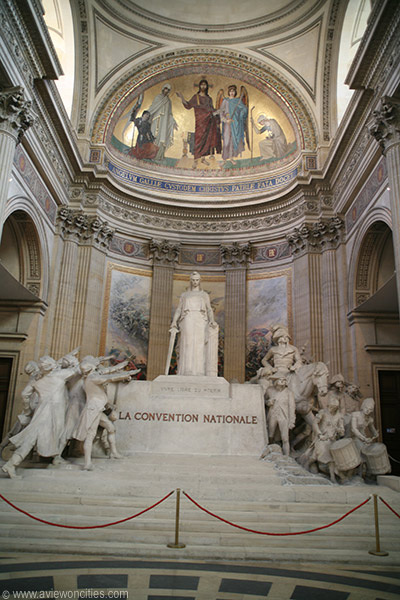
The purpose of the Pantheon
For six weeks I've been too busy to blog. I've a number of excuses: work took over my life, my computer keyboard started playing tricks on me, and I slipped on black ice causing painful damage to my back.
Perhaps these are merely excuses. I may not have blogged but I found time - even when I should have slept - to keep reading Les Misérables. It gripped me in the way books caught and held me in my teens. As I neared the end of the final volume, I wasn't merely reading it on trains and buses, and in bed at night. I was reading while cooking and even while walking down the road. On one occasion I was so caught up in the story that I left a suitcase on a train. (Fortunately the helpful station staff ensured that the suitcase and I were reunited.)
I'm not sure what was so gripping about Les Misérables. A few years ago I tried to re-read it in the old translation I'd read in my early teens and was soon bogged down in the heavy prose. Reading in French should have been harder but I followed the advice to stay away from dictionaries and the story came to life through Hugo's words. Of course, every so often I would check a tricky word or phrase - but how bland the English seemed next to the French, and how untranslateable. A neatly-turned phrase loses so much in translation. There's no equivalent for "amourette pour lui, passion pour elle" or "Parfois insurrection, c'est résurrection" that echoes and dances as the original does.
Of course, reading in French demanded an unfamiliar level of concentration. My French O-level of many years ago didn't demand so high a level of expertise, although we were expected to read Camus's L'Etranger and easy extracts from older works. But the language alone wouldn't have held me for through three volumes and more than 1500 pages. And I already knew the story from that first reading and various film and TV versions. But I had missed so much.
In French, Hugo is sometimes funny, sometimes angry, and frequently moves me to tears. There was much I'd missed on that early reading: the chapter in praise of "le mot de Cambronne", for instance. The word attributed to Cambronne, spoken as he was taken prisoner at the end of the gruelling battle of Waterloo, is "merde". (The nearest English equivalent would be "shit.") Hugo dedicates a whole chapter to fulsome praise of the acuity and rhetorical brilliance of this word. My Victorian translation was too delicate to tell me what the word was, offering a myserious dash instead. Moreover, as a teenager I was insufficiently used to 19th century novels to realise how different French and British attitudes were. Hugo thinks it necessary to explain - at length - just why Cosette and Marius (aged 16 and 21) haven't had sex, even though they have met one another every evening for a whole six weeks without a chaperone.
Cosette and Marius are young, silly and more conventional than they realise. Hugo knows that and at times he invites the reader to laugh at them. I never found them as interesting as the wilder characters, Eponine and Gavroche, nor as sympathetic as the numerous elderly characters who are frequently at the centre of the story. Perhaps my age is showing.
What startled me most was Hugo the revolutionary. I remembered the depiction of the failed rising of 5th- 6th June, 1832 from film versions. It was exciting but not particularly important - part of the lead-up to the journey through the Paris sewers. But Hugo takes the rising seriously and asks the readers to consider both why it was necessary and why it failed.
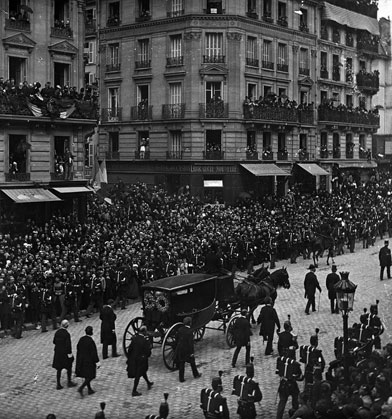
Recently President Sarkozy has attempted to move the remains of Camus to the Panthéon. The account of Hugo's funeral has set me wondering what Sarkozy's agenda is - and why the demand to own the bones of the great persists. I can show my love of Victor Hugo by reading his books (Quatre-Vingt Treize and L'Homme Qui Rit) come next. And perhaps, if I'm lucky, I'll go back to Paris soon to explore what is left of the Paris of Les Misérables: not that cold monument the Panthéon but the lively warmth of the nearby rue Mouffetard.
But before I start on another Hugo volume, I'm back to blogging. And, in an attempt to improve my inadequate Italian, I've started on Pinocchio, that cruel and painful book for children which is quite unlike the cute neatness of the Disney film.
Friday, 11 December 2009
Voilà Jean

It seems as though I've always known the story. Before I first read Victor Hugo's story in my early teens, there was a classic comic - then a BBC Sunday evening serial. Perhaps my mother told me the tale - it was certainly one of her favourites. Cosette, Marius, Fantine, the Thenardiers and, above all, Javert and Jean Valjean weren't just characters in a book - they were part of the mythic structure by which I understood the world.
These days, fewer people read Les Misérables. "It's too long," someone told me last night." "I was put off by the musical," another commented. "I've read The Hunchback of Notre Dame," was another defence, as if one Hugo novel could stand for all the rest. Mind you, I haven't read much by Hugo. I'd like to find time for the late novels L'Homme qui Rit (The Man who Laughs) and Quatre-vingt Treize (1793). But before I do that, I have to finish Les Misérables and I'm still only 260 pages in. There are about 1200 to go so I'll be busy reading over Christmas.
Last time I tried to re-read Les Misérables, I picked up my old English-language version. It's a bulky tome from Collins, with mock-leather binding and pages as thin as any Bible's. I thought it the height of elegance when I was 13. A few years ago, I found the prose style dull and was bored by Hugo's sententious moralising. I put it down again.
This summer, in one of the French bookshops at South Kensington, I picked it up again - perhaps in an abridged edition - and the magic returned. I hesitated, thought I might buy a copy, then left the shop. I was having a small economy drive and wasn't convinced I'd get through more than a chapter. Besides, the exchange rate means that French books are no longer as cheap as they were. I thought I'd get over it. But throughout the autumn I found myself looking for copies in English bookshops and secondhand shops, checking the prices on-line and wondering if perhaps, for Christmas, for my birthday, I should buy myself a copy.
I didn't expect to find the three-volume paperback edition in the Canterbury Oxfam shop. I checked carefully to ensure it was a complete text, looked at the price (£4.99) and reflected that, even if I didn't read it, Oxfam could do with my money. Most of my long journey home was consumed with work but on the tube, on the bus, when waiting at stations, I started to read ... and I found it hard to stop. Even now I don't want to blog about Les Misérables - I want to read it, and I'm tired from reading it last night when I should have been catching up on sleep.
The first eighty or so pages dragged slightly - they focus on the good bishop who changes Jean Valjean's life. Maybe I needed to read myself into the book or just to get used to Hugo in French. Once Jean Valjean arrived, I found myself at risk of missing my stop on the bus. I've even walked along the road while reading - something I haven't done for at least forty years.
Perhaps it's the focus on the poor that commands my attention. I may respect the bishop but I care about Valjean, Fantine and the other "misérables" of the book's title. Reading in French makes me consider what "misérable" means. It's not "unhappy." I've seen the word translated as "wretched." But surely in France where Catholicism and the Latin Mass were so important, there's a connection to the Latin prayer "miserere nobis" - "have mercy upon us." Many of the people in Les Misérables are wretched and unhappy but, above all, they need and deserve mercy.
Hugo's conviction that mercy is a greater human responsibility than truth, justice or any other accepted virtue is startling in today's society. Mercy isn't restricted to the cute or angelic. When Jean Valjean first appears he is compared to a brute and an animal. His grievances about his treatment in jail have placed him outside human society. He's never been a great part of it. He doesn't even have a proper name. Hugo explains that he's inherited the name "Valjean" or "Vlajean" from his father and that it was simply a corruption of "Voilà Jean" - "There's Jean." He's an individual who has been despised all his life and who has learnt to hate in return.
In Les Misérables, Hugo insists that human beings can learn and change - that mercy transforms lives and communities. He was writing against the trend in his own time. Les Misérables was published in 1862, five years before Zola's Thérese Raquin, the first of a string of major novels which proclaimed the belief that humans were controlled by the circumstances of their lives and had no means of escape or power over the events that affected them. I may care about Zola's characters but his view of the world doesn't fit the people I encounter.
The world I live in includes people who are cruel and vindictive like the Thenardiers. I've met plenty of people like Javert who obey laws and rules unthinkingly because they assume the forces of law government always know best - people who assume that the wealth and its trappings are a badge of virtue and respectability. But there are also many people like Jean Valjean and Fantine and even the Bishop - trying to do their best, making mistakes, giving way anger and misjudgement but also capable of enormous love and generosity. These are the flawed, good people who are willing to learn and change. They show mercy to others, even at great cost, because they also need and receive mercy.
It's not a very modern view of the world but I'm rushing back to it. I should be in bed asleep but Jean Valjean is on his way to Arras and I want to know - even though I know already - what happens next.
Tuesday, 1 December 2009
Miss Sayers and Lord Peter
My laptop continues to languish in laptop hospital. I have odd moments when I get at computers but feel strangely cut-off from cyberworld. Fortunately there are still books - and time to think about writing blog entries.
Like most people, I have a pile of popular fiction for soothing bedtime reading. Recently I've returned to Dorothy L. Sayers.
"But she's a dreadful snob," some people respond. "She's a tory writing about an aristocrat."
There's some truth in that but it's not the whole truth. In the later novels, written in the mid-1930s, she sees Lord Peter Wimsey's class as a problem - at the same time as suggesting it is dangerously attractive. This isn't unusual in the 1930s. Winifred Holtby's South Riding - certainly not a tory novel - makes the same observation and shares Sayers' belief that the power of the aristocracy is doomed.
Most recently I've been reading Gaudy Night and remembered the influence it had over my teenage years. It influenced me in two ways. Like many girls, I grew up in a society that was uncertain of the value of education for girls. I remember debates - even in the 1970s - about whether girls should enter higher education or whether this rendered them unfit for their natural destiny as wives and mothers. Sayers painted such an alluring picture of a women's college in the 1930s that I knew university was for me. At Oxford and later I met other women who chose Oxford because they had read Gaudy Night. I have to thank Dorothy L. Sayers for my three years there.
Gaudy Night - and Oxford - attracted me for another reason. Like many young teenagers. I'd fallen into the habit of convenient, self-protective lies. Suddenly, when I was thirteen, I wanted to change that. I realised that the world was confusing and difficult to understand - and that lies and deceptions made it harder to reach the truth. I made a resolution to stop lying.
In Gaudy Night the values that are repeatedly attached to universities and learning are associated with truth and integrity. The dons may behave badly at times but they value evidence, facts and honesty, even when honesty hurts. The subjects of their research - English prosody, the economics of Tudor England, and so on - may have no immediate relevance to contemporary life but the dons' aim is to uncover the truth in their chosen field. Their integrity is set in opposition to Nazi oppression and the risks women run if they submit to their husbands.
There are, of course, arguments against women's equality and education in the novel. Lord Peter Wimsey is never more admirable in my eyes than when he shows, without question, his support for women at universities and for honesty, whatever the cost. It's undoubtedly an idealised view of university life but there's a lot to be said for ideals.
My latest reading of Gaudy Night set me wondering what Dorothy L Sayers would say to a different Lord Peter: the head of the governments Department of Business and Skills, which also has responsibility for higher education. I must have been at Oxford at the same time as Peter Mandelson but I don't recall him there. As minister in charge of the universities, he doesn't seem to care much for some of the values Sayers cherished. While she foresaw the end of the House of Lords, I don't think it occurred to her that universities would be told to sell their scholarship for economic advantage.
Lord Peter Mandelson doesn't look at universities and see scholars motivated by the search for truth. If he saw that, he would probably think it a bad idea. Instead he sees them as part of the "knowledge economy," and wants them to make money and teach the skill of making money. Universities are instructed to teach their students "business awareness" and to ask business people (bankers, perhaps) to come into universities and design courses which academics will deliver. Educations is now a product consumed by students. But students are also the product of education. They are to be prepared for their consumption by business and government. Research is another product and will be judged not for its truth but for its impact on business, the economy and government policy.
Disagreement with government policy or uncomfortable truths about new products. business and the market are unlikely to have much immediate impact. I wonder what value Lord Peter Mandelson places on academic honesty.
Saturday, 3 October 2009
Goose Fair unvisited

I learnt about Goose Fair on my first visit to Nottingham, twenty-one years ago. The traffic jams were the first clue that something was going on. "Goose Fair," locals explained, and later, leaving Nottingham, I gazed at the huge expanse of fairground lights and wished I were among the crowds clutching bags, purses, toys, balloons and children as they swarmed around the vast site.
No-one is quite sure of the origins of Goose Fair. A book from the 1930s comments snootily that it is "not of any high antiquity, for the earliest mention of it is in 1541." People in Nottingham know that's rubbish. The fair celebrated its 700th anniversary in 1994 - I was there with my parents and children. More recently, writers have suggested it's more than 1,000 years old. It won't be long before someone establishes that it was set up by Druids or visited by Alfred the Great or Julius Caesar. But in fiction it was certainly visited by Arthur Seaton in Alan Sillitoe's novel Saturday Night and Sunday Morning, which captures some of the wildness.
My mum didn't see the point of fairs - all that money for a short ride when you could buy a good book or a theatre ticket instead. But I loved the thrills, the garish prizes, the crowds, the shouting, the smells and the tastes of fairground food. I don't think I've ever bought the Nottingham speciality of "cocks on sticks," usually bought with a giggle from a stall-holder who was bored with the joke years ago and is more concern with the quality of the lurid confections. But it was at Goose Fair that I discovered the joys of hot mushy peas, seasoned with pepper and mint sauce and eaten from a small tub.
It's proper Goose Fair weather today: cold, windy with the possibility of rain. Sometimes the crowd stomp and teeter through mud to the cakewalk, the gallopers, the big wheel, the hook-a-duck stalls and all the other rides and games of chance. Bad weather is no excuse for missing Goose Fair though it drives many to the Scouts' simple brick building where the sale of tea and sandwiches to sheltering crowds probably funds activities for the following year.
I'd like to go to Goose Fair again though I no longer have the excuse of taking children. I can hardly take a tall 18-year-old to hear the ringing of the Goose Fair bell or suggest he hold my hand if he's scared by the rush of the Magic Mouse or the neon skeletons of the ghost train. Perhaps next year I'll take my camera again or see if a friend wants to experience the rides. This year it would definitely be unwise. I've pulled a muscle and don't want to risk the pain of jostling crowds or further damage that might be caused by the attempt to maintain my balance on the jiggling of the cakewalk. Tying my shoelaces is quite bad enough though I'm surprised to discover that attempting to stab people with an epee turns out to be an almost pain-free experience.
Perhaps next year I'll find time to go on the quiet first afternoon, when rides are cheaper. I may even stop at one of the fortune-telling booths in the neighbouring front gardens - not because I believe in fortune-telling but because I'm uneasy about the rules banning fortune-tellers from the Goose Fair site. When I first moved to the East Midlands, people said openly that gypsies weren't allowed on the Goose Fair site. The current rules simply say that fortune-telling and character-reading are banned.
The wind is getting stronger - it just threw one of the wheelie bins to the ground. I reckon I'll be warmer and more comfortable indoors - and I have the fifth Thursday Next book to finish.
Monday, 22 June 2009
Reading difficult books

Of course, I like reading easy books. I read books for pleasure and one pleasure is being absorbed into a world, a set of characters and train of events so thoroughly that, while I'm reading it, I feel involved. I'm still reading Scandanavian crime fiction - wondering if Erlendur's life will become any more miserable and looking forward to the second volume in Stieg Larsson's Millennium trilogy.
But sometimes I'm not looking for escape or easy answers. I want a book that makes demands on me, that takes me somewhere I hadn't expected or presents me with problems I won't be able to resolve and put away as I reach the final page.
With some books, the subject, plot and characters linger powerfully. I'm still caught in the world of Hilary Mantel's Wolf Hall, which I finished only a few weeks ago. This is partly because it seems to present ethical dilemmas which resonate now: problems of wealth and poverty, the nature of influence in politics, the role of money and the market, the point at which the most well-intentioned individuals become complicit in violence and torture. But while these questions are raised, the novel also evokes a strong sense of the time and place in which it is set - it's a novel set around Henry VIII's court at the time of his obsession with Anne Boleyn.
Elsewhere the difficulty and the strangeness of part of the attraction. This is often at the level of language. I don't think I'll ever forget the delight I felt in opening a slim Penguin book in a small bookshop and finding the lines:
It's the opening of the anonymous mediaeval poem, Sir Gawain and the Green Knight, and something in the language enthralled me in a way that Chaucer never has. It was the difficulty and the sense of strangeness, I think.
At about the same time I found a copy of Teach Yourself Greek in the library and found myself sounding out the Greek word for sand - and that determined me to find a way of learning Classical Greek. I was never particularly good at it but in recent days I've picked up my Loeb parallel text of books 1-12 of the Odyssey and am wallowing in the pleasure of a language I don't fully understand and systems of customs and belief that are strange to me.
I've also returned to Finnegans Wake. It's famously difficult and I haven't got very far. I keep re-reading, relishing the language and catching the jokes. Yes! There are jokes in Finnegans Wake. Nobody warned me about that but I found them for myself. It happened as I was reading (for the third time) the passage which, I think, is about a visit to a Dublin museum with exhibits about the Duke of Wellington and the Battle of Waterlook. It begins like this, with the voice of the museum guide:
This the way to the museyroom. Mind your hats goan in! Now yiz are in the Willingdone Museyroom. This is a Prooshi-ous gunn. This is a ffrinch. Tip. This is the flag of the Prooshi— ous, the Cap and Soracer. This is the bullet that byng the flag of the Prooshious. This is the ffrinch that fire on the Bull that bang the flag of the Prooshious. Saloos the Crossgunn! Up with your pike and fork! Tip. (Bullsfoot! Fine!) This is the triplewon hat of Lipoleum. Tip. Lipoleumhat. This is the Willingdone on his same white harse, the Cokenhape. This is the big Sraughter Wil-lingdone, grand and magentic in his goldtin spurs and his ironed dux and his quarterbrass woodyshoes and his magnate’s gharters and his bangkok’s best and goliar’s goloshes and his pullupon-easyan wartrews. This is his big wide harse. Tip.
In Finnegans Wake it's necessary to hear someone else's voice and take the risk that all children take when learning to speak and read - the risk of not understanding everything all at once. Learning a language is like that too. We have to face moments of uncertainty and live with incomprehension. It's not a bad basis for life. I'd recommend more difficult books and more willingness to say "I'm not sure" or "I don't understand." After all, the alternative is clinging to the safety of the familiar and never daring to leave home.
Sunday, 22 March 2009
Book-reader!

One of the merits of advancing age is increasing invisibility. By the time my hair is white, I shall probably float ghost-like down streets and be able to act exactly as I like without anyone noticing. But I'm not quite there yet.
I went to London to visit my parents on the day before Mother's Day. I reckoned I was probably even less visible than usual, slightly shuffling and convalescent after a late winter virus got me by the throat and left me tired and shaky. I stopped at an unfamiliar supermarket to get lunch ingredients and when a young woman rammed my shopping trolley into me, complaining that I wasn't quick or efficient enough at making way for her, I decided I'd probably slipped into the role of Unnecessary Older Person, as far as she was concerned. Perhaps she was too young to realise that most women are so accustomed to mild brutality and insults from strangers, that a rammed shopping trolley is hardly more than a slight annoyance.
As an older woman, I feel rather safer than when I was young. I've never forgotten the time - nearly thirty years ago - when I was walking across a university carpark and a car-load of drunken students thought it funny to drive the car at me a few times, hurling sexual insults and shrieking with laughter at their "wit." That really was frightening. I don't think they planned to hit me - though I couldn't be sure - but I wasn't sure they were sober enough to control the car, or that I could run fast enough to get away. I didn't go to the police. The headlights dazzled me so that I couldn't see their faces though I had a good idea who they were from the brayed, precise insults. The police were unlikely to take my word against a group of posh - and well-connected - young men.
That was the scariest instance but of course there were others. Men sometimes tell me I'm stupid to walk alone after dark but years ago I decided that I preferred to risk abuse and threats rather than live in a prison created by abusive strangers. I've had a fuller life as result. And by now I'm used to dealing with the occasional insult. They've tailed off as I've grown older and become more confident. I worry for my daughter, of course.
It was good to see my parents. I don't visit often enough. This was another short visit - four hours' travelling each way doesn't allow much time to stay, but at least I managed to cook lunch, wash up and deliver small gifts to my mum. I was pleased I'd made it, but more tired than usual - this year's viruses seem particularly draining.
I'd worried a little about getting the tube at Putney Bridge. Dad and I had been watching the football results and the unlikely scoreline - Fulham 2, Manchester United 0 - could result in a few disconsolate United fans on the way home. But all I saw were yellow-jacketed police - some on horseback - outside the supporters' favourite pub. Jubilant songs and chants filled the air.
Reaching the Piccadilly Line, I realised I could be standing for quite a while. The Victoria Line was closed for the weekend, pushing passengers onto other routes. The platform wasn't too crowded as I arrived but within two minutes passengers were three or four deep and more kept arriving. There was no point in letting a crowded train go in the hope of a seat on the next one. I boarded and followed the usual command to "Move right down the carriage." I was just reflecting on how shaky I felt and my probable invisibility when a young man stood up and offered me his seat. I wasn't so invisible after all - and immensely lucky. Plenty of other people who could have done with a seat were left swaying and strap-hanging. After thanking the young man, I immersed myself in my book - one of the Scandanavian detective stories to which I've recently become addicted.
My journey involved a change of mainline trains and a pause in a waiting room. The book, which involved axe murders, a bright young woman inspector and an older beer-drinking, chess-playing detective, had gripped me. I settled down for my 25-minute wait and continued with the story.
There were three other people in waiting-room: a young couple wrapped up in one another and a solitary man listening to music. It felt safe enough. Then the youths came in, giggling, pleased with themselves, possibly a bit drunk. They swaggered round, giggling. I was more interested in my book and perhaps this annoyed them. They stood in front of me, staring, thinking of an insult. Eventually, one of them came up with the epithet they wanted: "Book-reader!" They giggled. They tried it out a few more times, circling round me. I looked up, unimpressed, and went back to my book, "Book-reader!" they said again. And then one tried, bemusingly, "Sexy! She's sexy for a book-reader. Sexy for a nerd." I think I was supposed to be scared. I wasn't. They went out.
Later, when a couple of more people had entered the waiting room, they came back. They tried saying, at no-one in particular, the worst racial insult they could think of. They said it again and laughed. It plainly didn't apply to any of the people in the waiting room. They tried to start a conversation with a solitary young woman who was witting there. She dismissed them with monosyllables and they gave up, giggled and went outside again. I think the youths were beginning to feel cross that no-one responded to them - I hope they were. Perhaps it was their turn to feel invisible.
Wednesday, 25 February 2009
Poems and pancakes
From time to time, during the busy day, I thought of pancakes. I had the ingredients: flour, eggs and milk. And while there are numerous shortcomings in my abilities as a cook, I have one remarkable skill: I can toss a pancake and catch it, flipped over, in the pan. I don't know how I do it but I remember the teacher's face in the school cookery lesson when pancakes were on the agenda.
Cookery lessons were a perpetual misery. Under my mother's tuition I'd learnt a few useful skills: peeling vegetables, making a cheese sauce, roasting meat (I wasn't a vegetarian in those days). But I never used a recipe. My mother's instructions involved looking, feeling and tasting to get things right. In cookery lessons I was made to weigh and measure. Cakes collapsed under my assiduity so that gateaux had to be reconstituted as trifles. I dreaded the double lessons in which the cookery teacher would berate me with the direst threat she could imagine, "If you don't use the proper knife, you'll never get a husband." (The cookery teacher was unmarried.)
I still look forward to Pancake Day - and worry in case I've lost the knack.
I'd meant to leave work early but at 6.15 I was caught in one of those corridor-conversations that generate ideas and produce better ideas that two hours in a meeting or at a computer. Suddenly I remembered another plan for the evening: a poetry reading. I'd meant to get home, make pancakes and cycle to a poetry reading that started at 7.30. There didn't seem to be a chance. "Give it a go," my colleague said.
The only train left in less than 25 minutes. I didn't wash my coffee mug (yes, I know what my cookery teacher would have said) and bundled my belongings into three bags and a laptop case. Running was out of the question but I walked so briskly that passers by must have thought me a bag lady on speed. I caught the train. I rang my teenage son - would he mind if the promised pancakes were delayed? I reached home, untethered the bike and sped to the cafe where the poets were billed to read.
The Flying Goose is a small, out-of-the-way venue that has been hosting poetry evenings for years - usually on evenings when I'm working late or can't get out of another obligation. After some rapid pedalling, I arrived early to find the cafe already crowded. It was an international evening: the poets were Adrian Caesar, representing Australia and Alexander Hutchison, representing Scotland. The bargain admission price was £3, which included a glass of wine.I knew Adrian Caesar's work as a critic from his book on 1930s poetry. The poems he read were filled with gloom but this was, in a strange way, cheering because the gloom was mostly the gloom of daily life and middle age - and it was lightened with humour. But for me the most memorable poem was one that compared the work of a poet and academic with the valuable work of the poet's grandparents who had been miners. It's the miners, the poem reminds us, who seek out what is valuable and bring warmth into our lives - but no-one applauds them for it. We duly applauded the poet.
I didn't know Alexander Hutchison's work but as soon as he started to read I knew this was work I would like. His poetry could be simultaneously moving and playful - it included translations from Catullus into broad Scots, a fanciful and extravagant poem about haggises, poems filled with romantic longings and poems of light-hearted mockery. Above all, they were poems that celebrated language with delighted exuberance. I'd promised myself no extravagance but I couldn't resist buying a copy of his elegantly plain book, Carbon Atom. Alexander Hutchison sang too, and included a brief reminiscence of Jessie Kesson, one of my favourite 20th century writers.
So home to make pancakes and this time my skill deserted me. I couldn't get the oil right and the pancakes stuck to the base, so that I had to ease the batter away. I ended with mis-shapen pieces which didn't look much like pancakes. I tossed them anyway and my son added sugar and lemon, assuring me he didn't care what the food looked like. I asked how many he'd like. "As many as you make," he replied. I suppose that was a success of sorts.
Friday, 20 February 2009
Hope

I remember the opening of Roehampton Library. The class above me at primary school went to watch when Noel Streatfield declared the library open. I was so jealous. Surely none of them loved books as I did? Surely none of them had worked their way through all the library copies of Noel Streatfield in Putney Library, a bus ride away. After missing the library opening I wrote to Noel Streatfield and she wrote back - a lovely letter that I treasured for years.
Libraries mattered to me even more then than they do now. Libraries were so many things: they held information and imaginative possibilities; they were warm and friendly; they were staffed by librarians who could recommend books I'd never heard of; they had desks, tables and, in Roehampton, sofas on which I could lounge at full-length, exploring book after book.
Libraries mattered most when I was poor. In Bidford-on-Avon the library was a van which arrived once a week for two hours. It wobbled when I climbed up the stairs to enter it. There were no desks or sofas and very little space. Choice of books was limited: there were never more than three in the poetry section (one was always about Shakespeare) but they changed from time to time. I still lurked there, carrying my small baby daughter in a harness that made it impossible for me to browse the lower shelves. Books were more than life - they were the possibility that things could be different. The world of the imagination is also a place of hope.
In times of crisis and falling incomes local governments focus on what they see as their core tasks: rubbish collection, streets, schools and all the services that councils are required by central government to provide. Libraries - and museums, art galleries, leisure centres, theatres - are facing cuts and closures. But hope too is a necessity. Taking these things away damages the poor more than the rich. It's like putting a lever in the gulf between rich and poor and forcing it to ten times its width.
In The Ragged Trousered Philanthropists, Frank Owen, the main character, says: “What I call poverty is when people are not able to secure for themselves all the benefits of civilisation; the necessaries, comforts, pleasures and refinements of life, leisure, books, theatres, pictures, music, holidays, travel, good and beautiful homes, good clothes, good and pleasant food.”
When councils close libraries they deprive the poor of one of the benefits of civilization. They close off imaginative possibilities and stunt lives. If the council burnt books there would be a protest. But books are killed just as surely if they're thrown into landfill, pulped to make motorways, or locked away unread.
Monday, 25 August 2008
Taking the tram
There's a point at which a new place ceases to be strange and foreign without becoming quite familiar. That's particularly true of places I love. There are places in Northumberland which I could explore with confidence. I might even swim in the North Sea off Bamburgh Beach without being particularly aware of the louring castle. I could direct a tourist to Grace Darling's grave or Barter Books in Alnwick, though it's years since I've been there. And, although I couldn't give directions, if I were in Edinburgh I would confidently find my way to the Grassmarket and negotiate the different levels, sloping streets and bridges.
I'm not quite so familiar with Paris, but I no longer feel exactly like a tourist. Going to the boulangerie remains a pleasure but the word "tabac" no longer produces a frisson of excitement. I haven't "done" all the tourist sites but I no longer feel so touristy that I need to do more. Instead of looking at galleries, I want to see exhibitions - Mantegna at the Louvre seems particularly tempting but probably not possible. Instead I want to absorb Parisien life. I may not be able to pass for a Frenchwoman, but I like to think I might become a temporary Parisienne.
I was restless and decided to spend an afternoon wandering. At Porte d'Italie I took the tram with no particular destination in mind. The Indispensible showed that there was an exhibition centre at Porte de Versailles so I decided I would get off there. Then I could walk or get a bus and perhaps head for the centre. One possibility seemed a Metro to Solferino and the Musee d'Orsay, but it was a little late and I wasn't sure I had the patience or concentration for art.
So far as I could tell, there were no tourists on the tram. I was the only passenger consulting a map. I gazed out of the window for places to visit on my return journey. The park at Cité Universitaire seemed a possibility. I admired the shiny exterior of the stade Charléty, with its elegant curves, and briefly wondered whether to stay on the tram till the end of the line.
The tramway, circling central Paris, took me through areas of wealth, student quarters, places where people work hard for low wages and check the prices if everything they buy. I suppose people who ride the tram daily get used to those contrasts. I was being a tourist of everyday Paris and this struck me as much as the patience of people in queues and the tired helpfulness of drivers and shop assistants.
There was no exhibition at the Porte de Versailles. I hadn't expected one and headed in the direction of central Paris. I contemplated the Metro, which would take me quickly to the museums, the Ile de la Cite and the Seine, and decided to walk. I thought I might stop in a cafe for an espresso but many cafes were shut for the holiday season. Instead, I entered a Monoprix and browsed among the household implements before sitting down for a coffee. I lingered a while before walking further and devised plans involving buses towards the centre. Then I saw the bookshop.
I wasn't looking for books - and was trying to avoid stationery, which lures me into extravagance. But I stayed for a long while, buying a postcard, a book bag, a slim anthology of well-known French poems and a copy of Phedre. It took me back to a production by the Glasgow Citizens, some time in the 1980s - the last time I saw Glenda Jackson on the stage. But what I remember most is the voice of Robert Eddison outlining the tragedy and horror in the messenger's speech. That voice seemed to link back to the theatre of the past and conjured a link to the era of greasepaint, footlights and shattering emotion. No other voice in theatre has affected me quite so much, though Ralph Fiennes came close when he played Henry VI for the Royal Shakespeare Company.
I came out of the shop and emerged from my reflections to find it had rained. It was later than I'd intended - time to move on.
Instead of heading to the centre, I cut along another road, then another and bought olive bread in a boulangerie. Then I started to look at bus stops and found a route to connect with the tramway. (I was pleased with myself for remembering that a stop was called "George Brassens.")
Back on the tram, I had to stand. Two minutes after I boarded, the rain fell, torrentially, and I gave up my plan of walking in the park. Perhaps a beer at Porte d'Italie, I thought. But the rain continued and, when I left the tram, I was thankful that tram stops had places to shelter. I stood for a while, coatless, waiting for the rain to lessen, trying to be patient like a real Parisienne.
Wednesday, 6 August 2008
Not on the long list
I’ve looked at the Booker longlist. I haven’t read any of the books, which isn’t surprising as I rarely read hardbacks. I’m not sure whether I’ve read any novels by any of the authors. This is encouraging, I think, as there’s a good chance I’ll find one or two delights there. I particularly want to read the John Berger – perhaps because his early Booker winner, G, was one of the very few books in my school library that I didn’t read.I did, however, treat myself to one hardback as holiday reading – James Kelman’s new novel, Kieron Smith, Boy. I had to justify the extravagance to myself and thought up a list of excuses: I could teach it one day (not this year – the paperback isn’t due out till April), I might discuss it with students, it would put an Amazon order into the “free postage” category. But the real reason was simple. I wanted to read it.
Somewhere – I can’t remember where – I found the first paragraph. And that was it. It took me into the world of a small boy growing in Glasgow with such immediacy that I wanted to know what happened next. This wasn’t the appeal of a thriller or sci-fi, where I wanted to read the next event – I wanted to live in this boy’s world and know it better.
This is how the novel begins:
"In the old place the river was not far from our street. There was a park and all different things in between. The park had a great pond with paddleboats and people sailed model yachts. Ye caught fish in it too. Ye caught them with poles that had wee nets tied at the end. But most people did not have these. Ye just caught them with yer hands. Ye laid down on yer front close into the edge on the ground. Here it sloped sharp into the water, so ye did not go too close. Just yer shoulders reached that bit where the slope started. Ye rolled up yer sleeves and put yer hands together and let them go down it. Just slow, then touching the water and yer hands going in. If ye went too fast ye went right in up yer arms over yer shoulders. Ye only went a wee bit, a wee bit, a wee bit till yer hands were down as far. Then yer palms up the way, holding together. If a fish came by ye saw it and just waited till it came in close. If it stayed there over yer hands, that was how ye were waiting. It was just looking about. What was it going to do? Oh be careful if ye do it too fast, if yer fingers just move and even if it is the totiest wee bit. Its tail whisked and it was away or else it did not and stayed there, so if ye grabbed it and ye got it and it did not get away. So that was you, ye caught it."
I don’t know exactly what caught me: the language, the voice, the precise physical details, the sense of character. But I knew I had to read on.
I read half the book avidly – then life got in the way and it was a couple of weeks before I returned to it. I regret that gap. I’d like to have sat down and read the book cover to cover without stopping. Not that Kieron Smith’s world is enviable . Like most people’s worlds, it’s mixed. There are elements of love, affection, cruelty and neglect, as there are, I imagine, in every childhood. But the setting is precise and a time is evoked without reference to dates or public events.
If I were to compare Kieron Smith, Boy to any other book, it would be James Joyce’s Portrait of the Artist as a Young Man. But it doesn’t have the same sense of self-importance – unlike Stephen Daedalus, Kieron Smith doesn’t think he is special and has no sense of artistic destiny. And although Kelman’s narrative is just as carefully shaped, it isn’t structured into six episodes with culminating epiphanies. The sections run into one another so that Kieron gradually grows from a small child to an adolescence with no major events. The period is sketched only as events and trends concern Kieron – the move into a housing scheme flat, selective secondary schools, a keenness to wear and be seen in denim.
In one of his essays, James Kelman talks about the way working-class Glaswegians are seen – as violent drunks who lack any “rich inner life.” While Kieron and his family are not exemplary – they have the prejudices of their time, place and culture - Kieron Smith’s story is told with an awareness that a rich inner life is not the preserve of the rich and powerful – it is what marks our common humanity.
Kieron Smith, Boy may not have made the Booker longlist but I have a strong suspicion that it will be my personal book of the year.