I took another look at the peace-camp on Saturday. It's been shifted to the pavement in Parliament Square while the grass, which London mayor Boris Johnson said he wanted to preserve for the people of London, is closed off with tall fences and patrolled by security guards.
The peace-campers' tents are neat and there's plenty of space for pedestrians on the pavement. I was one of many people visiting to read the banners. But it's still hard to reach the traffic island – I've yet to find a set of traffic lights that enable the public to reach the island. I had to employ my usual technique of a quick dash as the third lane of traffic slowed.
I suspect there will be an attempt, on some pretext or other, to remove the peace-campers before Friday's Royal Wedding, even though they offer no more risk than a fairly quiet protest on a range of issues, most – but not all – related to war. One man's banners announce that he is undertaking a hunger strike because he has been unjustly imprisoned. If he were in Tripoli the British press would probably declare him a hero. As it was, none of the campers even offered me a leaflet. I read their hand-made banners without interruption. Theirs is a quiet, enduring protest.If the peace-camp is cleared, it will make the streets more home-like and welcoming for the despots and their representatives who are attending Prince William's wedding. The Crown Prince of Bahrain has finally pulled out, citing troubles at home – these could include the brutality his own and Saudi troops are showing to unarmed demonstrators and the doctors who treat them. But London and the Royal Family will still welcome representatives of Saudi Arabia, Zimbabwe and Swaziland.
Looking at summaries of the Guantanamo files, I can't help thinking that these tyrants have much in common with our other allies – and perhaps with our own, more secretive activities elsewhere in the world. Apparently the United States military didn't just take people to Guantanamo because they thought they were terrorists. They also kidnapped and imprisoned people who they thought might have useful information. A taxi-driver, for instance, was reckoned to have good knowledge of a particular region because his work took him through it. One man – a British citizen – was held because he had been imprisoned by the Taliban and was therefore likely to have good knowledge of their interrogation techniques. A 14-year-old who had been kidnapped and was known to be innocent of all terrorist activities was kidnapped again – this time by the Americans – because he might have knowledge of the Taliban and local leaders.
As for evidence of terrorist activities – the U.S. military didn't need much ground for arrest, deportation and torture. Visiting Afghanistan after 9/11 was enough. So was possession of a Casio watch, although the models the U.S. found suspicious are cheap and widely available.
I expect the United States ambassador will be at the Royal Wedding. After all, the North Korean ambassador has been invited – as have kings, queens, princes and princesses from several countries that have been republics for a long time. I hope that none of them – and none of the “ordinary” people invited – are wearing Casio watches. That could set off some serious security alarms.
More than that, I hope the peace-camp survives Will and Kate's special day. It would be good to think there's still a small patch of pavement in London where freedom survives, despite the actions of the state.

 I was doing Paris on the cheap - and on my own. None of my friends were there but Anna offered the loan of her house in Montreuil. I needed to decide how to manage my holiday and make my money last.
Obviously, being alone, I wouldn't need to eat out. A regular morning coffee and the occasional pression - Leffe, by preference - would be bound to keep me going. And in Paris you can almost always find a boulangerie when you need one. I could have a good breakfast in the mornings and make myself an excellent salad with wine when I returned home.
I decided the time had come for the kind of tourism I'd been putting off for years. A web investigation told me a 6-day museum pass would be a good investment if I was serious about sightseeing. It costs 64 euros but many of the places I wanted to visit cost between 8 and 10 euros, and I reckoned I'd probably visit two or three in a day. It has the additional advantage of letting the holder bypass the long queues for tickets.
The metro was easy too. Thanks to Gerard, I already had a navigo (the French equivalent to the London oyster card) and had been educated in how the pricing systems work. I checked the zone map on the internet. Versailles was in zone 4 so it would be sensible to go on Sunday, using a 4-zone mobilis which allows flexible travel for the day. Then I would load a 2-zone weekly carte orange on my navigo from Monday. The carte orange, which is now virtual and therefore no longer orange, always starts on a Monday. It's a bargain for anyone staying for most of a calendar week. For just over 17 euros I could travel by bus, metro, the regional RER trains (some of them double-deckers) and even a little ferry on the Seine - the voguéo. While my museum pass made me feel like a tourist, the navigo let me think of myself as a true Parisienne.
But it was hard to settle into sightseeing after the oppressive grandeur and gilding of Versailles. I thought I'd better follow the Marie Antoinette trail to the Conciergerie, where her former cell is now equipped with a TV. There were expiatory mouments too. Louis XVIII was keen that the French people and the Parisiens in particular should repent of executing a monarch and his consort. I had more sympathy for the victims of the Terror of whom nothing was known but their name. All those guilloutined - more than 2,000 of them, which was fewer than I'd thought - were listed; the Terror was conducted along carefully bureaucratic lines. Former titles and professions were written down but there were many who had nothing but a name to record that they had once been sentenced to die quickly and in public. Of course I looked for familiar names - Madame Roland, Charlotte Corday, Georges Danton, Camille Desmoulins, Philippe Egalité - but then I lingered on professions. There was an actress, a tailor, a servant. I wondered if they'd really cared for the ideals of some revolutionary or counter-revolutionary group or if they were victims of a local grudge. And how about all those people with no rank and no profession? What circumstances brought them to the tumbril, the abuse and the rough but efficient blade? They could have been anyone - rough-sleepers, immigrants, the destitute. Most regimes have their favoured victims on whom suspicion for all disruption and disorder rests. Even Robespierre had his special white plaque and many of the famous prisoners - including criminals killed slowly in pre-guillotine days - were recalled in pictures, words or sculpture. But my mind kept returning to those of whom nothing was known but their name.
After the Conciergerie, the colourful Gothic exuberance of Sante-Chapelle was a delight. But soon I'd left the Ile-de-la Cité and was in Saint-Denis, heading past the children playing football in the square to enter the church and its necropolis. (Katie had told me I shouldn't miss it.)
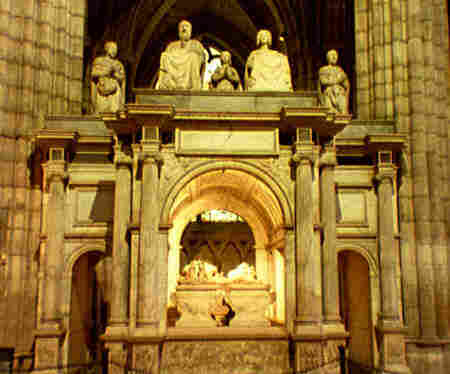
The first thing I noticed was the bare, marble feet. At the centre of the huge marble monument effigies of the almost naked monarch and consort lay, the soles of their feet facing tourists as they entered. At last I saw the human vulnerability of the monarchs. It was only later that I saw the fully-dressed king and queen kneeling in prayer, their children behind them, on the high top of the monument.
I wandered among the dead kings and queens. There was Marie Antoinette again, slightly larger than life and kneeling elegantly next to husband. And there were the plainer, earlier kings, from Clovis onward, looking stiff, still and much the same as one another.
Wandering among the royal monuments, I caught sight of a notice on one of the stiff mediaeval ladies: "une princesse inconnue" - an unknown princess. She may not have been a very significant princess but presumably, a long time ago, she thought herself an important person in the world. And now she was just a monument, much like all the others, and no-one even knew her name or which of the many dead princesses she was.
Beyond her lay another, smaller monument, no longer than a five-year-old but a miniaturised adult in polished white marble. I leant over to look at the notice - another "princesse inconnue."

 There are no kitchens at Versailles.
English tours of palaces, castles and stately homes show visitors where the servants lived and worked. That's where most of us see ourselves. We know, logically, that we wouldn't be the ones in the fancy dresses. We'd have been taking orders, making things, clearing up after grand parties and making do on too little sleep.
But in Versailles, cooking was seen as messy and vulgar. Meals were transported from a huge building in the town to be reheated, tasted for poison and served. Even in Le Petit Trianon, Marie Antoinette's modest mansion in the park grounds, there was a room for reheating the meals. And in the farm and model village she created, there's a whole building dedicated to rechauffage - reheating.
The farm and village created for Marie Antoinette has a picturesque unreality, although there was a real farmer who has to provide eggs and milk for the queen's dairy. Everything is clean and fake. The houses, dovecote, mill and so on may seem miniature compared to the vastness of Versailles. Perhaps Marie Antoinette really believed that this was how peasants lived as she and her friends played at being poor but it's Disneyfication before Disney. Versailles left me marvelling at the remoteness of the French monarchy but the little fake village, constructed so prettily around a carp-filled lake, sickened me. I was also reminded of Poundbury.
There was a gift shop, of course, selling mementos, mostly of Marie Antoinette. And the real farm has become an animal sanctuary where sheep, cows, goats, rabbits and donkeys enjoyed plentiful feed, sunshine and admiring glances. Nearby, horses graze and a couple of farm carts - tumbrils - stand empty, ready for use.

 Nothing prepared me for the gilded enormity of Versailles. I tried to imagine being in a mob storming the castle and could manage only incredulity at the excess. I've never seen a better argument for republicanism.
I don't understand the way of thinking that commissioned such an enormity nor the way the court understood itself. I thought Tale of Two Cities an exaggeration but now I realise it understated the reality.
There are notices at Versailles about the practices of the court. Every evening at 10 p.m. Louis XIV dined with his family. This was a public event and members of the court were privileged to watch. They didn't get to eat. The ladies perched on small stools and the gentlemen stood behind them as they watched the monarch and his family at dinner.
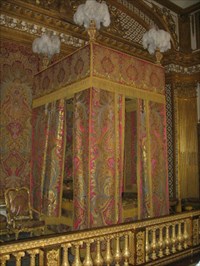
Going to bed and getting up were ceremonies too. There are gilded rails in front of the high four-poster beds and at the top corners of the bed - the structure must be fifteen feet high - are white fleur-de-lis made out of ostrich feathers. A few chairs stools are placed nearby, presumably for the attendance at court.
It's perhaps not remarkable that the chapel is a baroque riot or that there were strict rules based on orders of precedence about who could attend and where different levels of the nobility could sit.
But strangest of all are the paintings. Some are religious, with Jesus and his disciples in peasant dress. At a last supper, an extravagantly-dressed Mary Magdalen washes Jesus' feet. You wouldn't catch the royals in any such gestures of humility. Anne of Austria appears as Minerva, Louis XIV as Jupiter. One of Louis XV's toddler sons reclines as Cupid. Louis is everywhere: winning wars, making peace, implicitly compared with Alexander the Great, honoured by a winged Victory as he stays aloof from the battle. He even poses to show off his red shoes and his fine leg - he could sing and dance as well as making war.
The French royal family moved among paintings of themselves as divinities, usually in the Roman style. How they combined this with their public Christian faith, I don't know. But they seem to have seen themselves as more than heroes. In the oddest painting of all, Hercules, nude but for a carefully-placed drape, paints a portrait of Le Grand Condé on a lion-skin while assorted nymphs and divinities stand around.

 I couldn't do that. I couldn't take an oath while crossing my fingers and believe that gave me an excuse to lie. That's what little children do. It's not proper for adults - certainly not for adults who become MPs and magistrates.
I'm disqualified from being either. Plenty of MPs and magistrates lie when they take the oath, or make a mental reservation that, if they had the chance, they would vote against a monarchy or call for a referendum to let the people decide.
I don't think I'd make a particularly good MP, though once I would have liked to stand for parliament. I briefly thought I could consider being a magistrate but didn't have to investigate further. I'm disqualified. If there were a referendum I would vote for a republic and that means I'm disqualified from a range of positions. I couldn't even join the police although, oddly, the Royal Navy is exempt from the oath of allegiance.
Of course, I can lobby my MP and ask him to vote for the abolition of the monarchy. But my MP was only able to take his seat after swearing allegiance to the Queen and her heirs. Moreover, even if he changed his mind and became an ardent republican, Members of Parliament aren't allowed to pass any laws affecting the Crown without the Queen's express permission.
There's criticism of royal expenses but, on the whole, the Queen is admired. I don't think republicans would win if there were a referendum to abolish the monarchy. Although I would almost certainly vote for abolition, I don't make a great deal of fuss about the matter. I have many more urgent political concerns.
Yet it irks me that I, and other honest republicans, are banned from so many posts simply because we would be unwilling to comence our public service with a public lie. It worries me that, were people to vote for an honest republican in such numbers that he or she were elected, the new MP would be banned from the House of Commons. And I'm really annoyed that MPs aren't allowed to debate this unless they first ask for the Queen's permission.
There's a simple petition on the Downing Street website which urges a change in the law. It asks that MPs and lords should no longer be required to swear allegiance to the Crown. In my opinion, it would be a good first step in making this country a proper democracy and opening public service to all who care about it. It would widen the choice for voters and put honest republicans on equal terms with those who swear dishonest oaths.
The petition closes tomorrow (5th July, 2008). It already has sufficient signatures to gain a response from the government. If you would like to sign the petition and receive that government response when the petition closes, click here. Monarchists can sign as well as republicans. The petition seeks honesty, responsibility in public life, and true democracy - that is, giving all the people the right to choose.
 I took another look at the peace-camp on Saturday. It's been shifted to the pavement in Parliament Square while the grass, which London mayor Boris Johnson said he wanted to preserve for the people of London, is closed off with tall fences and patrolled by security guards.