A colleague showed us a video from youtube. A newly-married couple came out of a church. The camera panned along the street. There was a brief glimpse of a young girl looking out of a window, curious to see what was happening. She could have been any girl of 12 or 13, watching the adult world and anticipating her own future. This young girl's life is well-documented and her diary is translated into numerous languages. Her name was Anne Frank. She wasn't quite sixteen years old when she died in Bergen-Belsen concentration camp.
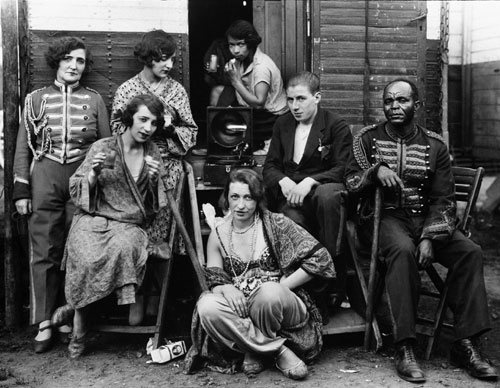
For most of the photographs of August Sander, now on display at Leicester's New Walk Museum, as part of a touring exhibition sponsored by the Art Fund, viewers can know little of how people began or ended. Sander's initial aim was to present a study of German life, using individuals to represent different types within German society. But however determined Sander's categorisation, the people he photographed resist being mere types. Some perform their occupations, often surprisingly. A farmer in the 1920s still ploughs with oxen Another, in 1952, sows seed by hand, scattering it from a basket. Others pose with the implements of their trade. Almost all gaze straight into the camera, leaving the viewer with no more information that the brief labels provide. The more I look, the more I understand the impossibility of reading a whole human being from a face.
I never have the sense that Sander's photography mocks or diminishes its subjects. I always see them as complex, interesting human beings. If I wish, I can build stories. I have to set those stories in the time through which they lived. Almost all of them were confronted by the dilemmas and persecutions of Nazism. But when I start wondering "How did that farm-worker vote?" or "What did that woman do when the Nazis came to power?" I can't answer the questions I want to ask. People's actions don't always harmonize with their faces. An SS officer in one of the photos of Nazis looks benevolent and slightly unsure of himself. His uniform does not.
I can and do make guesses. Some of the circus people in the photo above are plainly not Aryans. I hope they got away. I would like to imagine a happy future for the gypsies, the children with severe disabilities, those who are simply labelled "persecuted people" or "political prisoners." But I know most didn't get away. The exhibition ends with a portrait of the death mask of Sander's son Erich, who died towards the end of his ten-year jail sentence. Escapes are temporary. None of us ever walks out of history or politics, however hard we try. I wonder what future generations will think, if they ever look back on photographs, film and videos of the time in which we live.
August Sander didn't lead the life that was mapped out for him at childhood. He was supposed to be a miner. One day, working at the mine, he helped a visiting photographer and looked through the lens of a camera. He never forgot what he saw - the sky, the movement of clouds. That moment gave birth to one of the great photographers of the twentieth century. He was part of his time but the records he made speak to the future.
I have paid one visit to the August Sander exhibition so far. I hope to visit at least once a week while the exhibition is in Leicester. I want to look more closely at many of the portraits. I would like to commit them to memory, which is another way of letting the people of the past live on. I also want to spend more time on Sander's pictures of human hands and of landscapes.
But I can't spend too long in the gallery with Sander's pictures. There's too much humanity there, real people set to face a dreadful future.
I think if I stayed too long, I would cry.
 Looking back, I think my first encounter with the photos of Diane Arbus must have been in one of the glossy Sunday supplements – the sort with shiny paper that makes everything ravishing, even grief and poverty.
I don't know if the glossiness conditioned my response to Arbus, whether I was influenced by the accompanying text or whether it was the work itself that upset me. Her stark, black and white photos of poor people and people with disabilities – people who would never buy a glossy Sunday supplement – seemed to have the glamour and allure of a freak-show. I shuddered and looked away.
News of a forthcoming Diane Arbus exhibition at Nottingham Contemporary disappointed me. It seemed less interesting than the accompanying, more recent work by the Tobias twins. The brochure, with colour pictures of Tobias paintings, also suggested they might have more to offer although the one Arbus reproduction, of twin girls, haunted my imagination.
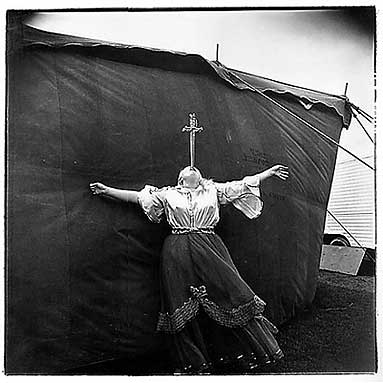
Accompanied by a friend, I looked at the Tobias works with curiosity and baffled amusement, which may be the response the brothers hoped to evoke. Many seem like a cross between a kitsch version of folk art and a Gothic, Transylvanian Disney. My strongest emotion in their presence was an amused affection. I drifted on to the Arbus rooms and was transfixed by something I hadn't noticed in that early encounter with her work: tenderness.It wasn't in all the photos. Some, especially those of over-dressed rich women, seemed to expose their subjects to ridicule. I thought I glimpsed cruelty in the curve of the lips of a masked man. But in other pictures there seemed more gentleness and respect than I expected. I noticed how one of two drag queens, dressing or undressing for their act, seemed to reassure the other with a touch. I saw the dignified melancholy of a tattooed man, gazing into the distance beyond the camera. The albino girl, arms outstretched and head back as she swallowed a sword, seemed in control of her pose as she mirrored a crucifixion. So many of the subjects, often strange to the viewer or on the fringes of society, seemed to convey an inexplicable depth. Even the photographs of nudists seemed about much more than the nakedness of the subjects.
Some photographs still disturbed. I worried that the children might have disliked their portrayal – who would want to be shown in a gallery as “fat girl laughing” or to be famous as a skinny, laughing boy clutching a toy hand grenade? The extreme close-ups of babies' faces turned them into dolls or death masks. But when I came to the photos of people with disabilities which had so disturbed my teenage self, I began to ask other questions.
The subjects I'd characterised as a “freak show” looked out at me with self-confidence. They seemed as happy as any of the sitters to be recorded. So what exactly had disturbed me? Did I really think that photography was only for the beautiful, the confident or the normal (whatever that was) unless it had a proclaimed manifesto to change the world? These people just were – and were recorded.This took me back to the photographs of August Sander and the records he made of Germany in the 1920s and 30s. Before Arbus, he had photographed people in fairgrounds and institutions, apparently letting them arrange their own poses before the camera. It was impossible to look at his photographs without the knowledge Sander lacked. I wondered how many of the people he recorded had been imprisoned, abused and killed in the Nazi regime's euthanasia programme, in concentration camps and in the bureaucratically-ordered extermination of those in the “wrong” racial groups.My sense of recording and the influence of Sander became even stronger when I returned to the gallery for a guided tour by Alexander Nemerov, Arbus's nephew. He talked about her focus on the subjects of her portraits and the way she documented them as though in the face of impending catastrophe. I reflected later that Arbus looked more for a variety of individuals in every setting while Sander, though recording individuals, saw them more as representatives of types.
There are still problems with photography and the act of recording. For many people, the fact of being recorded and visible places them at risk. I can't help wondering whether any harm came to the subjects of Arbus's photos. It wasn't easy, in the 1960s, to be a mixed race couple, even in New York – and Arbus's caption makes it clear that the couple are married and the wife is pregnant. I wondered if the transsexuals and transvestites later regretted giving so much away or whether the disabled people in the institution suffered discomfort from the response to the publication of the photos. A photographer can try to achieve neutrality and simply observe, understandingly, a range of subjects. But as soon as the photographs are on display they enter an environment that is not neutral and which is all too eager to judge and condemn the lives of others.Too many people still face a choice between vulnerability and invisibility. On any day I can say, without hesitation, which I would choose – but my answer isn't always the same.