Showing posts with label reading. Show all posts

Tuesday, 12 June 2012

The battle of e-readers

I resisted for a long time. I like paper.  I like the sensation of holding a book in my hands, feeling its weight, leafing backwards and forwards.   I like using postcards and bus tickets as bookmarks - I leave them in the books I have finished, then find them years later.  This helps me reconstruct the experience of reading.  "Ah yes," I think, "that is where I was so concerned about Jean Valjean that I missed my stop," or "How sunny it was when I first followed Little Dorritt across the iron bridge."

My children persuaded me.  Indeed, they forced my hand by giving me, as a most generous mother's day gift, a kobo e-reader.  I'd begun to wonder how e-reading would feel but resisted the experiment.  Now resistance was useless.  I had an e-reader pre-loaded with a hundred books.

When they chose a kobo, my children respected my concerns.  I do my best to avoid Amazon and won't have anything to do with the kindle.  There are many reasons for this.  Amazon has a bad record for its treatment of employees.  It avoids paying British taxes.  Worst of all, it is trying to take such a position of power in the international marketplace that it risks establishing a near-monopoly position in which it would control authors, editing, bookselling and the way in which people read new books.

A monopoly in the production and reading of books would be a disaster, not just for book-lovers but for all who value history, free thought and the exchange of ideas.  Imagine a world where one company provided the only access to the means of reading and also controlled and selected what was available to read.  Even if the company began with the most benevolent motives, it would be bound to select certain titles for promotion above others and to give low priority to those it reckoned would be least profitable.  (All companies have to take account of economics.)  I'm not a great proponent of free-market capitalism but, when it comes to books, I'm with Milton in believing that we get nearest to truth - or progress - when ideas from numerous sources are allowed to clash with one another.  My preference for avoiding Amazon is a small act of resistance.  And in the matter of e-readers I was particularly determined to avoid Amazon.  

As I understand it (and I'm not highly technically aware) mobi - the format used by the kindle - locks readers into the kindle and Amazon.  By contrast epub - the rival format - allows users to switch from one kind of reader to another and import books from a range of sources.  While this over-simplifies the conflict - it is, for instance, to have a kindle-reader installed on a pc or an ipad - there are plainly problems in Amazon's approach and these are intensified by their offer of better terms to self-published authors who are prepared to make their work available through kindle only.  I can't comment on the quality of their books because I shan't be reading them.

For me, the kobo will never supersede books.  It does less than them.  However it does mean that I can leave the house knowing that I have, at the latest count, 176 books in my handbag.  They are mostly 19th century works - free and out of copyright.  I have most of them as paper books as well.  But there are exceptions.  I've managed to find books that are obscure and out of print - and I've obtained books in French that aren't easy to find in England.  It's great for bus and train journeys and I'm old enough to appreciate the ease with which I can enlarge the font when my eyes are tired.

So far I haven't read a great deal on my kobo.  I enjoyed Bel Ami (in French with the original illustrations) and, in honour of the Dickens bicentenary, I re-read Little Dorritt.  Now, attracted by the title, I've turned to Zola's L'Argent.  It will take me some time to get used to Zola's sentence structure.  

But I've noticed something about reading on the kobo that I hadn't expected.  It makes me focus on smaller sections of text - just because the page is smaller than the double spread of a paperback.  That means that the books which are most pleasurable are those which are densely written or which require careful attention.  The works of Dickens and books in French are ideal but I can't imagine wanting to read a modern thriller in English on my kobo.  I can't read poetry on it either - epub seems to lose the layout which is such an important element.  So it's a rather old-fashioned means of reading and I'm enjoying its old-fashioned elements.

I wonder if e-readers will last in their present form.  I rather hope they do as they're very convenient and a good aid to concentration.  But the popularity of multi-media tablets suggests that literature in its wordy form may give way to something more complex, where words, sounds and images are mixed and where pathways through the work are multi-linear and even driven by chance.  The literature of the future may mutate into a cross between the experimental novel and the computer game.  It may even return to its oral roots and become more of a social and communal experience as readers take the opportunities offered by the internet to read and respond together.

But meanwhile I'm loving my solitary experience of the 19th century.  As my train passes flooded fields I'm plunging back in time and wandering through the crowded backstreets of London and Paris.  I recommend the journey.

Thursday, 16 September 2010

Balzac's cafetiere


Much as I love Victor Hugo, I can't commend his taste in interior design. The intricate elaborations and extravagances that delight me in his prose style seem heavy and unnecessary when used to decorate a room. The reconstruction of the sitting room he designed for Juliette Drouet in Guernsey – moved to the Maison Victor Hugo on the place des Vosges – leaves me filled with admiration for Juliette's patient and tolerant love. I hope for her sake that Hugo's wife had more of a say on domestic interiors.

I returned to the Hugo house and the Musée Carnavalet, wondering if I would view them in a new way after reading Hugo novels and histories of Paris. Although I saw them with greater knowledge, it was the same things that struck me. In the Hugo house I lingered over his drawings, letters and the display connected with the death of his daughter, drowned when travelling with his new husband. I noticed a poem about her which I hadn't observed before, written for the fifth anniversary of her death – and, because such things trouble me, I wondered how I might translate it, given that the final stanza sets an impossible task. The rhymes give way to exact repetition: “tombe” is used first in its more usual sense of “fall” and then with the meaning of “tomb” while the second rhyme, which matches the place, Harfleur, with “fleur,” the word for “flower,” ends the poem on a lighter syllable than any English equivalent I can imagine. I suspect I'll keep returning to this poem for many years, as I do to Callimachus's recollection of Heracleitus and Catullus's early declaration of passion for Lesbia. I don't expect to solve the problem.

In the Carnavalet it was again the section on Revolution and war that held my attention longest. I noticed how the thoughtful declarations of rights gave way to the rigid imposition of a military discipline which forbade all question. The words “Liberté, Egalité, Fraternité” seemed out of place on a soldier's drum. Once again I admired the souvenirs made from the stone of the demolished Bastille, especially the doll's-house-sized solid model of the Bastille itself. But I wanted more – Paris deserves a bigger museum, though none would be sufficiently complex to do justice to the city's history and people.

But revisiting museums wasn't enough for me. With my urge for self-education, I looked at the list of Paris Museums and settled on Balzac's house. My reading of Hazan's book on Paris (not yet finished) has made me guiltily aware of how little French literature I have read. Although names from Balzac's fiction lurk at the fringes of my awareness, I don't think I've ever read any Balzac novel. His name and the titles of his books are heavily forbidding as were the pictures on the covers of the black-backed Penguin classics editions. I assumed the house would be a similarly forbidding presence but found a simple bus route with the aid of my Indispensable.

The street was steep, lined with tall and heavy houses, dating, I would guess from the late 19th century. There was nothing of the lightness of the Montparnasse apartment blocks. I counted my way by house numbers. The quiet in the street was almost oppressive – evidently there was no rush of devoted Balzac enthusiasts.

I passed a striking and very heavy 19th century building and then, just as the numbers told me I was reaching Balzac's house, there was a gap in the buildings, a garden and a small, light, white building with a grey roof and green window-frames and shutters. It looked like a bungalow and, compared to the heavy surrounding buildings, could have been an elaborate shed. The garden was small but delightfully leafy with archways and paths. Sitting there you would believe yourself far from the city, until you looked up to see the Eiffel Tower.

A few steep steps took me into the Balzac house and an interior as quiet and calm as the garden. It seems that Balzac liked quiet. His house was simple – not a bungalow, as I first thought: the uneven terrain meant that the main living quarters were on the upper floor, which led to the garden, but there was also an airy lower storey below. I decided that I would have liked to live in Balzac's house. He had a fine desk and chair. I could imagine myself sitting there and getting things done.

I found his method of working sympathetic too. He would start writing at midnight when the city was cool and quiet, and work through till 8 in the morning, fuelled by coffee from his personal cafetiere. I admired the cafetiere. It's now kept in a glass case, which makes it hard to photograph. I'm not entirely sure Balzac should have added his initials. Perhaps he wanted to make sure no-one walked off with his coffee-making equipment. I can understand that. Anyone would feel possessive about so fine a cafetiere.

As an additional and unexpected treat, the house offered the screening of a complete Japanese “ganime” version of Balzac's early novella “La Grenadiere” directed by Koji Fukada. I was charmed and moved by the fusion of pictures, music, Japanese voices and French subtitles. I'd love to find a copy for myself so that I can share it with friends. At the moment all I can locate is the trailer on youtube.

After leaving the Balzac house, I sat in the garden for a while, enjoying the light breeze and soft fragrances. Eventually I left, walked up the road past the late 19th century apartment blocks and caught a bus that would take me across the Seine and towards the Eiffel Tower. As I walked, I resolved to buy and read something by Balzac. I doubt it will surprise and delight me quite as much as his house.

Monday, 15 February 2010

The purpose of the Pantheon


For six weeks I've been too busy to blog. I've a number of excuses: work took over my life, my computer keyboard started playing tricks on me, and I slipped on black ice causing painful damage to my back.

Perhaps these are merely excuses. I may not have blogged but I found time - even when I should have slept - to keep reading Les Misérables. It gripped me in the way books caught and held me in my teens. As I neared the end of the final volume, I wasn't merely reading it on trains and buses, and in bed at night. I was reading while cooking and even while walking down the road. On one occasion I was so caught up in the story that I left a suitcase on a train. (Fortunately the helpful station staff ensured that the suitcase and I were reunited.)

I'm not sure what was so gripping about Les Misérables. A few years ago I tried to re-read it in the old translation I'd read in my early teens and was soon bogged down in the heavy prose. Reading in French should have been harder but I followed the advice to stay away from dictionaries and the story came to life through Hugo's words. Of course, every so often I would check a tricky word or phrase - but how bland the English seemed next to the French, and how untranslateable. A neatly-turned phrase loses so much in translation. There's no equivalent for "amourette pour lui, passion pour elle" or "Parfois insurrection, c'est résurrection" that echoes and dances as the original does.

Of course, reading in French demanded an unfamiliar level of concentration. My French O-level of many years ago didn't demand so high a level of expertise, although we were expected to read Camus's L'Etranger and easy extracts from older works. But the language alone wouldn't have held me for through three volumes and more than 1500 pages. And I already knew the story from that first reading and various film and TV versions. But I had missed so much.

In French, Hugo is sometimes funny, sometimes angry, and frequently moves me to tears. There was much I'd missed on that early reading: the chapter in praise of "le mot de Cambronne", for instance. The word attributed to Cambronne, spoken as he was taken prisoner at the end of the gruelling battle of Waterloo, is "merde". (The nearest English equivalent would be "shit.") Hugo dedicates a whole chapter to fulsome praise of the acuity and rhetorical brilliance of this word. My Victorian translation was too delicate to tell me what the word was, offering a myserious dash instead. Moreover, as a teenager I was insufficiently used to 19th century novels to realise how different French and British attitudes were. Hugo thinks it necessary to explain - at length - just why Cosette and Marius (aged 16 and 21) haven't had sex, even though they have met one another every evening for a whole six weeks without a chaperone.

Cosette and Marius are young, silly and more conventional than they realise. Hugo knows that and at times he invites the reader to laugh at them. I never found them as interesting as the wilder characters, Eponine and Gavroche, nor as sympathetic as the numerous elderly characters who are frequently at the centre of the story. Perhaps my age is showing.

What startled me most was Hugo the revolutionary. I remembered the depiction of the failed rising of 5th- 6th June, 1832 from film versions. It was exciting but not particularly important - part of the lead-up to the journey through the Paris sewers. But Hugo takes the rising seriously and asks the readers to consider both why it was necessary and why it failed.

Hugo believed in revolutions - not all revolutions but those on the side of progress. He discusses when revolutions are necessary. His characters tear up paving stones, seize vehicles, grab weapons and barricades the streets of Paris. Hugo may like individual kings and royalists - as human beings - but he believes a republic is necessary and that the royalist cause must, for the sake of freedom and justice, end in defeat. He is furious - far angrier than Dickens - at the ill-treatment of children who are left to roam the streets and starve. He sees that the poor are suffering. He's appalled by inhumanity. He wants a better world and understands why sometimes people might decide to die or kill so that the future can be happier and more just.

Les Misérables is also a love letter to the lost streets of Paris. Hugo wrote most of Les Misérables from exile. He knew that the dangerous, dirty and loveable Paris he described was being ripped apart by Napoléon III and his architect Haussmann. In place of the familiar mediaeval mazes, whose squalor Hugo condemned, they constructed new, broad boulevards that welcomed shoppers and armies and were harder to barricade.

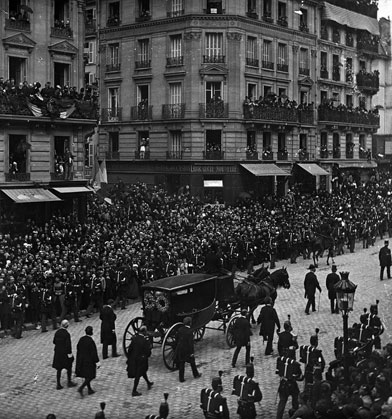
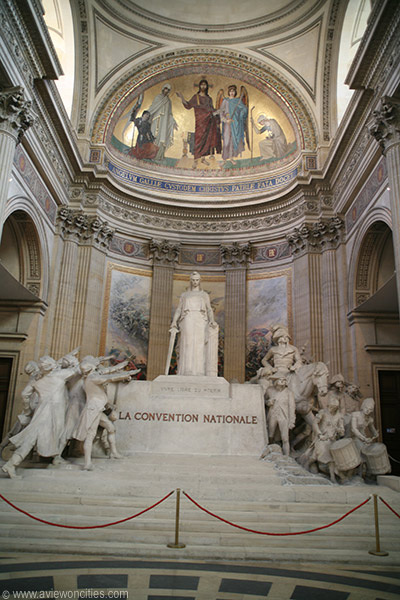
Hugo wrote most of his novel during his 19-year exile from France. He didn't return until six years after the first (Belgian) publication of Les Misérables. His return was greeted by celebrations in the streets. He was now a Parisien. He died in Paris at the age of 83. His will set out his wishes for his funeral. His body was to be carried to Pere Lachaise on a pauper's hearse and buried in the part of the cemetery reserved for paupers. The government decided otherwise. The church of Saint Genevieve, otherwise known as the Panthéon, was restored to its revolutionary secular state so that Hugo could be buried there. Hugo's body lay in state under the Arc de Triomphe and the pauper's hearse was escorted down the new, broad streets by senators, academicians and a military procession. Most of Paris seems to have turned out to watch. There were no riots - the spectacle of Hugo's funeral was carefully ordered.

The account of Hugo's funeral, which I discovered in Colin Jones' biography of Paris, has made me reconsider the Panthéon - a place that has puzzled me since my second visit last year. There's something odd about this commemoration of greatness. Even revolution is solidified into marble. The Panthéon seems to offer the rulers of France a means in which they can attempt to curb dissent. The belated reburial of the elder Alexandre Dumas, like the recent memorial to Toussaint l'Ouverture, insists that France has recovered from the racism and cruelties of its colonial past - but I'm not sure that all French citizens would agree.

Recently President Sarkozy has attempted to move the remains of
Camus to the Panthéon. The account of Hugo's funeral has set me wondering what Sarkozy's agenda is - and why the demand to own the bones of the great persists. I can show my love of Victor Hugo by reading his books (Quatre-Vingt Treize and L'Homme Qui Rit) come next. And perhaps, if I'm lucky, I'll go back to Paris soon to explore what is left of the Paris of Les Misérables: not that cold monument the Panthéon but the lively warmth of the nearby rue Mouffetard.

But before I start on another Hugo volume, I'm back to blogging. And, in an attempt to improve my inadequate Italian, I've started on Pinocchio, that cruel and painful book for children which is quite unlike the cute neatness of the Disney film.

Friday, 11 December 2009

Voilà Jean


It seems as though I've always known the story. Before I first read Victor Hugo's story in my early teens, there was a classic comic - then a BBC Sunday evening serial. Perhaps my mother told me the tale - it was certainly one of her favourites. Cosette, Marius, Fantine, the Thenardiers and, above all, Javert and Jean Valjean weren't just characters in a book - they were part of the mythic structure by which I understood the world.

These days, fewer people read Les Misérables. "It's too long," someone told me last night." "I was put off by the musical," another commented. "I've read The Hunchback of Notre Dame," was another defence, as if one Hugo novel could stand for all the rest. Mind you, I haven't read much by Hugo. I'd like to find time for the late novels L'Homme qui Rit (The Man who Laughs) and Quatre-vingt Treize (1793). But before I do that, I have to finish Les Misérables and I'm still only 260 pages in. There are about 1200 to go so I'll be busy reading over Christmas.

Last time I tried to re-read Les Misérables, I picked up my old English-language version. It's a bulky tome from Collins, with mock-leather binding and pages as thin as any Bible's. I thought it the height of elegance when I was 13. A few years ago, I found the prose style dull and was bored by Hugo's sententious moralising. I put it down again.

This summer, in one of the French bookshops at South Kensington, I picked it up again - perhaps in an abridged edition - and the magic returned. I hesitated, thought I might buy a copy, then left the shop. I was having a small economy drive and wasn't convinced I'd get through more than a chapter. Besides, the exchange rate means that French books are no longer as cheap as they were. I thought I'd get over it. But throughout the autumn I found myself looking for copies in English bookshops and secondhand shops, checking the prices on-line and wondering if perhaps, for Christmas, for my birthday, I should buy myself a copy.

I didn't expect to find the three-volume paperback edition in the Canterbury Oxfam shop. I checked carefully to ensure it was a complete text, looked at the price (£4.99) and reflected that, even if I didn't read it, Oxfam could do with my money. Most of my long journey home was consumed with work but on the tube, on the bus, when waiting at stations, I started to read ... and I found it hard to stop. Even now I don't want to blog about Les Misérables - I want to read it, and I'm tired from reading it last night when I should have been catching up on sleep.

The first eighty or so pages dragged slightly - they focus on the good bishop who changes Jean Valjean's life. Maybe I needed to read myself into the book or just to get used to Hugo in French. Once Jean Valjean arrived, I found myself at risk of missing my stop on the bus. I've even walked along the road while reading - something I haven't done for at least forty years.

Perhaps it's the focus on the poor that commands my attention. I may respect the bishop but I care about Valjean, Fantine and the other "misérables" of the book's title. Reading in French makes me consider what "misérable" means. It's not "unhappy." I've seen the word translated as "wretched." But surely in France where Catholicism and the Latin Mass were so important, there's a connection to the Latin prayer "miserere nobis" - "have mercy upon us." Many of the people in Les Misérables are wretched and unhappy but, above all, they need and deserve mercy.

Hugo's conviction that mercy is a greater human responsibility than truth, justice or any other accepted virtue is startling in today's society. Mercy isn't restricted to the cute or angelic. When Jean Valjean first appears he is compared to a brute and an animal. His grievances about his treatment in jail have placed him outside human society. He's never been a great part of it. He doesn't even have a proper name. Hugo explains that he's inherited the name "Valjean" or "Vlajean" from his father and that it was simply a corruption of "Voilà Jean" - "There's Jean." He's an individual who has been despised all his life and who has learnt to hate in return.

In Les Misérables, Hugo insists that human beings can learn and change - that mercy transforms lives and communities. He was writing against the trend in his own time. Les Misérables was published in 1862, five years before Zola's
Thérese Raquin, the first of a string of major novels which proclaimed the belief that humans were controlled by the circumstances of their lives and had no means of escape or power over the events that affected them. I may care about Zola's characters but his view of the world doesn't fit the people I encounter.

The world I live in includes people who are cruel and vindictive like the Thenardiers. I've met plenty of people like Javert who obey laws and rules unthinkingly because they assume the forces of law government always know best - people who assume that the wealth and its trappings are a badge of virtue and respectability. But there are also many people like Jean Valjean and Fantine and even the Bishop - trying to do their best, making mistakes, giving way anger and misjudgement but also capable of enormous love and generosity. These are the flawed, good people who are willing to learn and change. They show mercy to others, even at great cost, because they also need and receive mercy.

It's not a very modern view of the world but I'm rushing back to it. I should be in bed asleep but Jean Valjean is on his way to Arras and I want to know - even though I know already - what happens next.

Monday, 22 June 2009

Reading difficult books


Of course, I like reading easy books. I read books for pleasure and one pleasure is being absorbed into a world, a set of characters and train of events so thoroughly that, while I'm reading it, I feel involved. I'm still reading Scandanavian crime fiction - wondering if Erlendur's life will become any more miserable and looking forward to the second volume in Stieg Larsson's Millennium trilogy.

But sometimes I'm not looking for escape or easy answers. I want a book that makes demands on me, that takes me somewhere I hadn't expected or presents me with problems I won't be able to resolve and put away as I reach the final page.

With some books, the subject, plot and characters linger powerfully. I'm still caught in the world of Hilary Mantel's Wolf Hall, which I finished only a few weeks ago. This is partly because it seems to present ethical dilemmas which resonate now: problems of wealth and poverty, the nature of influence in politics, the role of money and the market, the point at which the most well-intentioned individuals become complicit in violence and torture. But while these questions are raised, the novel also evokes a strong sense of the time and place in which it is set - it's a novel set around Henry VIII's court at the time of his obsession with Anne Boleyn.

Elsewhere the difficulty and the strangeness of part of the attraction. This is often at the level of language. I don't think I'll ever forget the delight I felt in opening a slim Penguin book in a small bookshop and finding the lines:

SIÞEN þe sege and þe assaut watz sesed at Troye,
Þe borȝ brittened and brent to brondeȝ and askez,
Þe tulk þat þe trammes of tresoun þer wroȝt
Watz tried for his tricherie, þe trewest on erthe:
Hit watz Ennias þe athel, and his highe kynde,
Þat siþen depreced prouinces, and patrounes bicome
Welneȝe of al þe wele in þe west iles.

It's the opening of the anonymous mediaeval poem, Sir Gawain and the Green Knight, and something in the language enthralled me in a way that Chaucer never has. It was the difficulty and the sense of strangeness, I think.

At about the same time I found a copy of Teach Yourself Greek in the library and found myself sounding out the Greek word for sand - and that determined me to find a way of learning Classical Greek. I was never particularly good at it but in recent days I've picked up my Loeb parallel text of books 1-12 of the Odyssey and am wallowing in the pleasure of a language I don't fully understand and systems of customs and belief that are strange to me.

I've also returned to Finnegans Wake. It's famously difficult and I haven't got very far. I keep re-reading, relishing the language and catching the jokes. Yes! There are jokes in Finnegans Wake. Nobody warned me about that but I found them for myself. It happened as I was reading (for the third time) the passage which, I think, is about a visit to a Dublin museum with exhibits about the Duke of Wellington and the Battle of Waterlook. It begins like this, with the voice of the museum guide:

This the way to the museyroom. Mind your hats goan in! Now yiz are in the Willingdone Museyroom. This is a Prooshi-ous gunn. This is a ffrinch. Tip. This is the flag of the Prooshi— ous, the Cap and Soracer. This is the bullet that byng the flag of the Prooshious. This is the ffrinch that fire on the Bull that bang the flag of the Prooshious. Saloos the Crossgunn! Up with your pike and fork! Tip. (Bullsfoot! Fine!) This is the triplewon hat of Lipoleum. Tip. Lipoleumhat. This is the Willingdone on his same white harse, the Cokenhape. This is the big Sraughter Wil-lingdone, grand and magentic in his goldtin spurs and his ironed dux and his quarterbrass woodyshoes and his magnate’s gharters and his bangkok’s best and goliar’s goloshes and his pullupon-easyan wartrews. This is his big wide harse. Tip.

In Finnegans Wake it's necessary to hear someone else's voice and take the risk that all children take when learning to speak and read - the risk of not understanding everything all at once. Learning a language is like that too. We have to face moments of uncertainty and live with incomprehension. It's not a bad basis for life. I'd recommend more difficult books and more willingness to say "I'm not sure" or "I don't understand." After all, the alternative is clinging to the safety of the familiar and never daring to leave home.