Showing posts with label culture. Show all posts

Saturday, 4 June 2011

Bread and circuses


After a busy period at work when I haven't found time to blog, I'm experiencing the delights of bread and circuses.

The bread is literally bread. I've finally explored one of the Polish shops near work and discovered a range of central European breads: heavy rye bread, bread with sunflower seeds and so on, reflecting the cuisine of various countries - not just Poland but also Latvia and Lithuania. They seem to me better than the supermarket "specialty" brands - and cheaper too.

I went to a circus as well - the Moscow State Circus which was touring near me on the day of the Royal Wedding. It was a good counter-balance to that other circus. It had a story too. If I grasped the moral correctly, it was something about taking money from the rich and spending it sensibly so that everyone could enjoy the arts. Just now that seems a pretty good idea.

All round me there's anxiety. Friends find their jobs at risk. (I seem to be safe - at least till next year, and that's ages in the present economic climate.) Health and social care are in the news. The Financial Times has picked up a story about health authorities and hospitals at risk. In many cases the risk has been caused or worsened by the involvement of private companies, who were quick to enter into Private Finance Initiative agreements that safeguarded profits at the expense of the ill, the injured and the dying. Meanwhile the big companies that make money out of caring for frail elderly people and those with disabilities have in their turn been brought close to collapse by private equity companies. From the point of view of profiteers, it seemed a neat arrangement: sell the homes to other companies, agree an ever-rising rent, trust the market - and get out quickly when the economy falters.

Obviously I should have arranged a better pension for myself, according to the right-wingers. That's the same right-wingers who object that my public-sector pension will be too generous (if I ever get there) and who tell me I should find ever more to spend on my children, my parents and every cause and charity near to my heart. But if I do my best, it's never quite enough. According to them, I should also spend more on insurance and save more - but in the present economic climate insurance companies can go bust. Even banks, which may be bailed out, seem a bit of a gamble. They depend on the markets, which depend on an ever-increasing chain of gambles and exploitation.

So besides bread, I comfort myself with circuses. I may have visited only one actual circus in the past month, but I've been making up for it by enjoying other activities which give me pleasure. They remind me that life is more than a dragged-out existence. Life isn't just about duty - we need pleasure too. For some people that means getting out into a new place, whether it's roaming the countryside or strolling through towns. Others enjoy dancing or sport - and my regular experience of wielding an epée makes me understand that these can be sources of intense pleasure. For other people it's watching sport going to gigs that's important. My circuses involve engagement with the arts.

I headed to London to see my parents, travelling as lightly as I could so that I could sandwich my visit with artistic pleasures. I was a groundling for a matinée of All's Well That Ends Well at the Globe - a difficult play that's rarely performed. It's not just its unfamiliarity that makes it one of my favourites. There's a pair of determined, assertive young women - even though the times mean that the best either can hope is an attractive, wealthy husband to lord it over them.

I've seen All's Well twice before - and in both productions the focus was on the central relationship between Helena and Bertram. The comedy was played either as abstruse courtly wit, at a distance from the audience, or a cue for over-emphasis with lots of "isn't this funny?" expressions in the hope that the audience would laugh. The revelation of this production was that, for the groundlings at least, the comedy worked and was genuinely funny. It comes, I think, from the shape of the theatre which encourages the actors to establish a relationship with the audience. Comic lines were played with the clarity of the successful stand-up - and were irresistible. I engaged with the play as a whole - how could I do otherwise with my forearms leaning on the front of the stage? - and, when the final scene of reconciliation came, my eyes filled with unexpected tears.

I stayed overnight with my parents, still in their own flat so less immediately threatened by the private profits of the market. We had supper and a quiet evening. In the morning I left with them when they headed out to the shops but my aim was a further exploration of London.

I was unsure of my destination but eventually decided on the Guildhall Museum, which I hadn't visited before, followed by the London Museum, which I hadn't seen for many years. Walking between and around the two, I found myself in a many-layered city, where modern structures of glass and metal loomed high above small Wren churches. There are traces of an even older city. I glimpsed the old London Wall through a museum window and saw what's left of the Roman amphitheatre in the Guildhall Museum basement.

That's the kind of structure Juvenal meant when he talked about bread and circuses: a place where shows of all kinds were put on, including gladiatorial combat and public execution. Being in some ways a typical Roman of his class, I don't suppose he minded the gladiators or the executions. But he was concerned that the citizens of Rome, once the source of democratic power, had been diverted from their proper concerns for the state to making demands for bread and circuses.

I agree with Juvenal that people should recognize and exert their democratic power. But I think he's wrong to dismiss bread and circuses. We all need food to live - not just food for the body but something that nourishes the imagination and tells us that life is worthwhile. It's also the circuses, whether we find them in physical activity, travel, music or the arts, that open us to a wider imaginative understanding of the world. They nourish curiosity and sympathy. They offer laughter, tears and reconciliation.

Yes, Juvenal - I want democratic involvement and responsibility. But I'll take the bread and circuses as well.


Tuesday, 26 April 2011

Pina and the stereoscope


I decided to give myself an Easter treat. Having found suitable eggs for my parents, who like milk chocolate; my son, who is a vegan and my daughter, who doesn't like chocolate very much, it seemed time to give myself a present. I determined on an Easter Day trip to the cinema and resolutely ignored the demands of house, garden and work.

My first idea was to see the film Oranges and Sunshine by Jim Loach. I still hope to see that some time. The scandal of children shipped from Britain to Australia, where many were abused and exploited, has particular resonance in the East Midlands, where the story was first brought to public attention. Jim Loach's film, which tells that story, is well-cast and has received excellent reviews. But I wasn't sure I wanted to be distressed on Easter Sunday, which is supposed to be a day of rejoicing.

A glimpse of a good review turned my attention to Wim Wenders' film, Pina. My daughter studied Pina Bausch's work at university and her views shifted from mild dislike to enthusiastic appreciation. It isn't easy to shift my daughter's views and I thought I would like to learn more about the choreographer who achieved that. While dance isn't one of my greatest interests, every so often a dance work does excite me and Pina Bausch, who used the term Tanztheater (dance-theatre) for her work, seemed the kind of creator who would at least be interesting. And when I heard of Wim Wenders' enthusiasm for 3D, my choice was settled.

I've never taken 3D cinema seriously before. I've enjoyed a couple of 3D cinema experiences – at least, I think I have – but while they were probably exciting at the time they had the quality of theme-park rides: intense at the time but ultimately unmemorable. Yet 3D is a logical development of cinema which includes the stereoscope among its origins.

I like stereoscopes. I've peered through them in museums and seen two similar, apparently-faded sepia prints spring into something resembling solidity. They recapture an unalterable past and give it a brief air of tangibility. The images shimmer into solidity before my uncertain gaze. I wasn't sure how 3D would work for dance but it seemed an appropriately elegaic mode for this subject – Pina Bausch died just as Wenders was starting work on a film about her.

The film Wenders has made is an elegy. Dancers' words recalling Pina are heard as they gaze silently into camera. There are also clips which show Pina dancing. These are, of course, in 2D but the stereoscopic effect is achieved by the use of an on-screen audience, reminding us that what we watch belongs to the past and cannot be recreated. The inclusion of 2D footage also has the effect of ensuring that the 3D effects remain vivid and startling – the brain isn't allowed to become acclimatised to the novelty of the experience.

I'm not sure I understand Pina Bausch's work. Even if I did, it resists being put into words. As she says during the film (so far as I can recollect), dance is an ideal medium for things which can be hinted but not spoken directly. Once I start describing what the dancers do and how they move, I know I'm diminishing their work. More than for most art-forms, the meaning of dance is unsayable.

Moreover the dances Pina Bausch created work, like most dance, by repetition of movement. A sequence which is initially startling – often because of the skill employed by the dancers – ceases to astonish and appeals to the emotions as it is performed again and again. My brain can't unscramble the effects but I can feel them.

At times, of course, my concentration flagged. Sometimes all I saw were the startling 3D effects as dancers moved towards me and away. That may have been because I was tired, because I'm insufficiently familiar with the vocabulary of dance or even because Wim Wenders is not yet sufficiently in command of 3D cinema and its effects. But my interest never fell away and I emerged from the darkened cinema feeling that I'd seen something that isn't usually available away from the screen.

“After all,” I reflected on the train home, “3D is never quite so intensive and exciting in the real world. The 3D of reality is flatter than that.” And then, when I left the station, I looked up and was suddenly aware of distance – between sky, houses, trees, road and lamp-posts. It seems that the film has re-educated my brain. The world I see now has sprung back into its real, 3D perspective.

Monday, 4 April 2011

The Harrods of the ancient world


How could something so fragile last so long?

I gazed at the remains of brittle gold bowls and goblets. I could see where the stem of the goblet should be. The amazing thing is not that it has vanished but the thin, ridged bowl should have survived. I peered closer to make out the outlines of bulls on part of a bowl. A craftsman scored them gently into the gold around four thousand years ago. They are evidence of a vanished civilization of which little else is known. They come from Afghanistan.


I was hesitant about visiting the Afghan Treasures exhibition at the British Museum. I thought uncomfortably of conquerors, loot and triumphal processions. Exhibitions often arrive with an agenda, especially when they have been negotiated by diplomats. But this exhibition seems to have a gentler and more laudable cause. The British Museum has been restoring ivories that were stolen in the looting of Kabul Museum and recovered by an unnamed philanthropists. The British Museum staff have been working with the staff of Kabul Museum and the exhibition, however dependent on diplomatic goodwill and corporate sponsors, comes out of their joint work. The exhibition tells another story too – of museum staff who hid the treasures so that the history of their country could be preserved.


The history of Afghanistan is not well known. There is much that has not yet been recovered or understood. Western history books have tended to simplify the region as a place of romantic barbarism which briefly encountered civilization with the arrival of Alexander the Great. Alexander the Great, who married an Afghan wife and adopted local customs, may have viewed it differently.


So far as I can gather and recollect, the region had two reasons for importance in the world. It was a source of lapis lazuli, which was rare and much in demand. And although its terrain is difficult by contemporary vehicles, it stood on major trade routes, bordering India, China and the Persian Empire. Traders went as far as Greece and Rome, although the journey each way would have taken a year. The treasures they brought back, particularly to Begram, are protected in glass cases in the exhibition.


Captions show the uncertainty of the curators about the exhibits on view. There is a head of Silenus, clearly recognizable, but did the Afghans really know who Silenus was? Its unclear whether the owners of valuable items purchased deities or just attractive statues – rather as a modern mantlepiece may bear statues of Ganesh or the Buddha without necessarily demonstrating any religious allegiance or knowledge.


There's glass, too – Roman glass most probably or perhaps made in Egypt - the curators cannot be sure how it reached Begram from Rome since the way was blocked by war with Parthia. One piece is enamelled with full-length figures which even I can see are Roman in style. Another's delicately ornamented with vines made from the glass itself. But beside these are statues carved in turned ivory – chair-legs, the inscription suggests – each with a swaying female figure in what seems to me an Indian style. There are glass fish, a face that resembles a Greek or Chinese theatrical mask. There are Corinthian columns and finials. Some items must have been made in Afghanistan by craftsmen who had learnt skills from crafts practised elsewhere. But many items are imports, suggesting a place like Britain today where beautiful objects from all over the world can be prized and owned.


Half-way round the exhibition, I realised something else that was troubling me, though it's not unusual. I had little sense of the lives of the people who owned these objects, other than that they were very rich and could afford goods imported from far-off places. It was as if, one day far in the future, someone were to excavate Harrods and, finding only a few of the goods on show, tried to understand life today on that basis. Perhaps that is what has survived. Perhaps these expensive, traded goods represent the Harrods of the ancient world.


As I wandered through the exhibition, the past seemed both more distant and more familiar. I couldn't grasp past Afghan cultures but then, if asked, I couldn't give a simple account that took in the whole of west European culture today. Artefacts left by Afghan trading centres, which drew goods and influence from across the world, speak of a complex, varied society. This shouldn't be surprising or unusual. But I began to realise that many exhibitions treat the past as a collection of small, separate societies. They don't just assume that societies are culturally pure – they often treat cultural purity as something good in itself. The textbooks I studied at school were wary of cultural mixing. Rome's interest in things Greek was regarded with disdain although the Renaissance interest in Greek art and sculpture was excused as a means of regaining artistic purity after the confused muddle of the Middle Ages.


Looking at the wide range of objects on display and marvelling at their variety, I realised how much ancient history has been filtered through subjective and questionable value judgements. I suppose curators have to simplify – just as their displays provide the kind of neat, comforting pattern humans are trained to prefer. But in real life I like variety and complexity – and am glad that human existence resists a neatly moral narrative arc.


At last I neared the object I recognized from the posters for the exhibition: the gold crown once worn, so the captions assured me, by a nomad princess. I expected something bright and golden but I hadn't realised the tiny golden discs would tremble continuously, as though there were a breeze or breath inside the glass case. I read that the crown could be packed away and folded – and that all the nomad treasures, buried two thousand years ago, could be carried easily on horseback. In my imagination an Afghan princess rode through wild landscapes, the trembling crown on her head and a gold-studded cloak behind her. It's an improbable fantasy. I have no idea what the concept “princess” means in terms of nomadic people two thousand years ago - I wonder if the women were princesses in any way we can understand.


Little seems to be known of Afghan nomadic life beyond the six graves in Tilya Tepe. But the adornments found in the tombs of five women and one man link the items closely to the humans who wore them. It's not just the photos showing how the bodies lay when the tombs were opened or the glass case where the golden items mark out the shape of a human form. It's more to do with the sense that these items once touched living flesh and the the gold was caught on wisps of cloth the tombs were found. I peered as directed to see that the bracelets show signs of wear – in contact with an arm over time, gold diminishes.


The exhibition isn't big or cheap (I got in for half price – £5 – with my Art Fund membership). Space inside is limited because items are small and, when I visited on Saturday, that meant queuing briefly before reaching most cabinets. I haven't carried away a neat package of knowledge about an obscure culture. Instead I have grounds for wonder and wondering – more than enough.


Wednesday, 30 March 2011

Berkoff and Dionysos


Last week, I realised I'd never seen Sophocles' King Oedipus on stage.

Few people would be surprised by that, but I was. These days I don't get to the theatre as often as I'd like but I still think of myself as a theatre-goer. In the past, I've sought out obscure productions of Greek plays – in Greek as well as in English – because of the challenge they pose to today's theatre.

I'm not an expert but, when I struggled through two happy years to achieve a weak pass in Greek A-level, I supplemented my tussles with verbs and syntax with reading everything I could find on Greek history and culture. According to the curriculum, my school didn't offer Greek. Greek, like writing Latin verse, tended to be the preserve of boys' grammar and public schools. But somehow I wangled my way into Greek A-level, which was taught intensively from scratch in the Latin teacher's spare time. I've been grateful to her ever since. I was an unpromising prospect with nothing except a desire to learn to recommend me. There must have been considerable doubt whether I would pass. But the teacher – her name was Miss Blench – did her very best for me, setting plenty of work and urging me to read as much as I could. I think there were four shelves of books about Ancient and Classical Greece in the school library. I probably read every one.

I don't suppose any school would let a pupil take that risk nowadays, what with league tables and so on. But I'm more proud of the grade D I attained (a clear pass!) than any other academic achievement.

My teenage passion for things Greek has subsided now but I still turn to Greek texts from time to time – often in translation with the original Greek beside me, if I can find it, so that I can have some idea of the sound and the way meaning is made. But heading to Steven Berkoff's production of Oedipus at Nottingham Playhouse, I couldn't find a Greek text. I had to make do with a few extracts in The Oxford Book of Greek Verse, which were far too difficult for me.

Instead I thought of the problems posed by staging Greek tragedy today. It's never going to be the same for us as the Greeks. A director could offer a singing, dancing chorus and principle actors in masks and elevated shoes, but it wouldn't have the same effect. The Greeks were as familiar with that convention as we are with drawing-room comedies or Shakespeare framed by a proscenium arch.

Nor does theatre have the same role in society. These days there's a debate about the purpose of theatre and whether it should be funded. There's always someone to say it's superfluous and that, if people want theatre, they should pay for it, however high the prices and however limited their means. The defenders of theatre talk of heritage and culture. They even act like economists and produce charts showing how much money theatres bring into their towns and cities. Meanwhile the government imposes cuts which are made at one remove, leaving the lovers of theatre and custodians of culture to decide whose potential will be stifled and whose lives they will impoverish

None of that would have made sense in Athens, when Sophocles' play was first produced at the Great Dionysia. Performing plays and going to the theatre was a religious duty. Citizens attended to honour the god Dionysos. There was a fund to ensure that those who couldn't afford the tickets could still join the audience. And it was an honour to be the wealthy citizen who sponsored a playwright's work.

As I remember – it's a long time since I worked through those books – the Great Dionysia was also a theatrical competition. A small jury would vote for the best set of plays (three from each playwright and a satyr play). However not all the votes were counted, giving the god a chance to intervene. And the plays were all on familiar topics so the question was not what the story was but always how it was told – and how it honoured the god - in the vast Athenian auditorium.

There was no way Steve Berkoff could offer that experience for an audience seeing a single play from the comfortable seats of the Playhouse. I did wonder whether he would try to bring the audience to a state of catharsis – the state of purification from emotions which King Oedipus achieves, according to Aristotle. But I'm not convinced such a state is possible today. We see the world differently.

One of the main differences is the set of questions we can't help asking about Oedipus: what did he do wrong? what could he have done differently? does he deserve his punishment? But these aren't, I think, the questions Sophocles' original audience would have askes. (These aren't my own ideas. I'm following classical scholars. I don't have my books to hand but I believe I encountered the arguments in essays by E.R. Dodds and Erich Segal.)

Sophocles' first audience believed in curses and prophecies. They probably didn't think about it all the time but the question could even enter politics. When things were going badly, citizens would mutter that there was a curse on the family of Pericles and Alcibiades – not because they thought there must be but because the curse was a matter of historical fact. Electing a leader from a cursed family could cause problems for the city as a whole.

The baby Oedipus was no more than three days old when the prophecy was pronounced – and it derived from a curse on his family. From the time of his birth it was inevitable that he would kill his father and marry his mother. The Christian idea of sin doesn't come into it because his fate was always inescapable. So is the punishment he and his family must endure for his actions – not because Oedipus has committed any conscious or willed wrong but because father-murder and incest are punished by divine law, even if they occur accidentally. What the play shows is not the way we should live but the way the power of the gods and prophecies work out. If it has a moral – and I think it does – it is simply that humans should believe in oracles and honour the gods.

I can see those views at a distance and understand logically that people held them but, like most people, I'm too wrapped up in a world that believes in personal guilt, human responsibility and the innocence of babies to feel what such views mean. Although people today often suffer for the actions of their rulers, few would find it just that a whole city should suffer from plague because its king has acted in the way the gods or Fate ordained. Because our understanding of the world has changed, ideas like this don't work in the theatre of today. Actors need characters they can inhabit and audiences need to sense a world that isn't too distant from their own.

In Steven Berkoff's production (after Oedipus rather than an exact translation) it's surprising how little this difference matters and how much of Sophocles' play survives. Berkoff may have created an Oedipus who is something of a mobster or mafioso rather than a king but Stephen Merrells' arrogant boss fits the play – he is the sort of man who, unfortunately for him, is bound to attract the notice of the gods.

I admired Louise Jameson's Jocasta too. She seemed softer than I would have expected – sympathetic and believable. I don't shudder in the way the original audience would have done when she repeatedly denies the power of oracles – to the watching Athenians this was the kind of blasphemy that could threaten the city as well as the speaker. For a modern audience this is more understandable. She's a mother who has lost her child and her husband and whose love for Oedipus is, in consequence, tender and protective.

What interested me above all was how the play itself would work. After all, telling a well-known story can mean there's little suspense. But just as children like to repeat the same suspense-filled journey, grown-ups can be interested in how a familiar story is told – and knowing the ending doesn't necessarily spoil the excitement.

I was surprised how well the tension builds. As members of the audience we observe the unfolding of events, alert to every little irony and clue. When Oedipus promises, with an oath as binding as an oracle, that he will punish the murderer of Laius with exile, we already know that he is promising to punish himself. And when we're told of his similarity to Laius, we know this is because he is Laius's son. Yet the inevitability enthralls the audience, as I suppose it enthralls the audience of a slasher-movie. And I found that, whereas I would watch Hamlet, which I've seen many times, for how the play is staged and acted, with Oedipus most of my attentions was given to the way in which the story unfolds. I suppose in that respect the modern audience is very like the Greek audience, who would have seen a number of plays on the Oedipus theme.

There were two points where I was less certain of the production, though this may suggest I'm something of a purist when it comes to Greek theatre. While at times the stylised mime of the chorus worked well – when performing clear emotions or recognizable actions, as, for instance, when a member of the ensemble suddenly became a horseback messenger – at other times I found the movements too vague in intent, though performed with complete conviction. But what a pleasure it was to see such a range of faces. Each chorus-member was both part of an ensemble and a human individual, whose face could at times be transformed into the fixed pain and astonishment of a Greek tragedian's mask.

For me one of the highlights of Greek or French classical drama is the messenger's speech when an actor tells the story of horrors that happen offstage. I'll never forget Robert Edison in the Phedre of Racine, holding a full theatre still and on edge as his mellifluous voice painted a succession of cruel catastrophes. The horror that occurs in my imagination is always more terrible than any that can be shown on stage.

I was unhappy, therefore, at the decision to show Jocasta's suicide and Oedipus's eye-gouging on stage. Even a simple dumb-show distracts from the power of language to shock. The conclusion did allow a moment that moved me deeply: when Oedipus gently embraced and kissed his dead mother-wife. But that gentleness somehow made the ending less bleak and powerful. The play moved me but not to the extent that I felt purged and purified by having seen it. Good as the production was, it offered me no catharsis.

But then, I didn't go to Nottingham Playhouse to worship Dionysos. I'm not sure I believe in him.

Sunday, 6 March 2011

The problem with patrons


I was almost impossibly tired when I arrived at the National Gallery. I'd had a good but busy week and was still recovering from the amazing and absorbing experience of hearing Alan Moore, the Magus of Northampton, read aloud from his novel-in-process. [Note to anyone who hasn't come across Alan Moore: he is not only a remarkable writer but also one of the kindest and most courteous authors I have encountered. His reading held everyone in a huge lecture theatre spellbound for nearly an hour and he spent a further hour and a half speaking to everyone who had queued to have their books signed.]

The day after Alan Moore, I was on my way to visit my parents, unsure I was sufficiently awake to take in the Gossaert exhibition but knowing that I was unlikely to find another opportunity to see it. I also had my new Art Fund card with me - at last I've fulfilled my resolution to join, not just for the very welcome benefits but also because I have benefited from the Art Fund through a lifetime of gallery visits.

The route to the exhibition took me past many familiar paintings. On one side I spotted a favourite Titian. Through the entrance to another room I thought I glimpsed a Vermeer. There was Murillo, staring out of his frame like a competent marketer of his own paintings.

In my susceptible state of mind, even Rubens seemed set to lure me from my path toward Gossaert. After all, Rubens was not only free but there were comfortable padded benches from which his work could be admired. (I don't usually admire Rubens that much.)

I forced myself to make the long trek to the basement of the Sainsbury wing where the Gossaerts were displayed. It was worth it. I realised that I had seen and admired individual paintings by Gossaert in the past but I'd never seen them in relation to one another before. I hadn't even registered the artist's name.

There are six rooms in the exhibition. Gossaert's drawings and paintings are complemented by the work of artists who influenced him - a startling range from Northern European artists like Durer to the classical tradition of the Italian Renaissance. Although he's only mentioned in the timeline at the start of this exhibition, it's easy to see Holbein as the heir of this remarkable combination of influences.

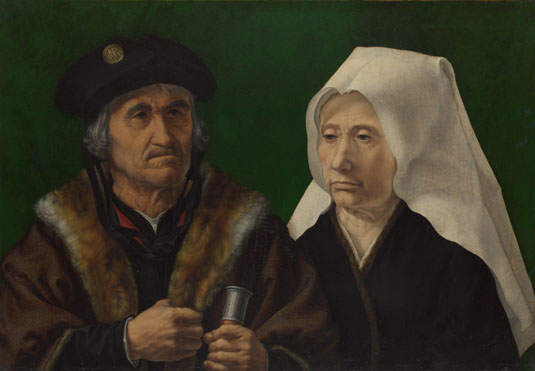
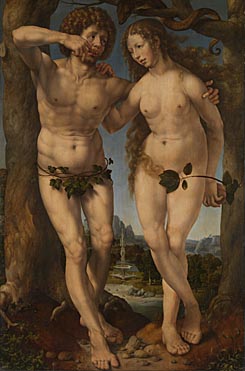
There's more to Gossaert than his portraits but these are the most obviously remarkable part of his work. The people he paints in portraits convince as human beings, simultaneously familiar and unknowable. This isn't just true of his secular portraits. There's a lavishly clad Mary Magdalen with sly glance and dirty fingernails. But he also paints relationships, including erotic relationships. There are various works showing Adam and Eve, including some copies of lost originals, but all convey an astonishing blend of tenderness and desire.

The work that stunned me most - and nearly moved me to tears - was a painting of Christ in the Garden of Gethsemane. It's a dark painting - even the red robes of the flying angel and the sleeping St John are barely lit. An elderly figure - St Peter, perhaps, lies on his back, asleep in the foreground. He has the pallor of exhaustion. But at the centre is the kneeling figure of a youthful Christ, beardless, confused and close to despair. It's not an attractive figure but terrifyingly recognizable. It's the expression of any child confronting an incomprehensible horror. It could be Libya or Afghanistan - or, too often, the U.K.

At the end of the exhibition I couldn't give an account of Gossaert. I had no sense of the man who painted the pictures, except that he could see and reproduce with pencil on paper or paint on canvas. He had, it seems, some human understanding that didn't take a verbal form. And he had the luck to be taken up by a succession of patrons who took him within reach of the influences he needed to develop his art.

It was luck. That's the problem with patrons. While Gossaert had the right patrons for his development as an artist, he was limited to painting what they required: a portrait of a marriageable daughter, erotic works for a private collection, an altar piece, a sketch for a tomb. There is no way of knowing what Gossaert would have liked to paint. It's lucky that some of his patrons' requirements suited a style that we can now appreciate.

It's luck too that has made me so familiar with the works in the National Gallery - the luck of living near a free art gallery and being encouraged by my parents to look inside. I was brought up to take advantage of free and cheap culture - to see culture as a good that should be shared.

It was shocking, therefore, to read, the day after my visit to the National Gallery, of a Labour MP calling for the introduction of admission charges to London's museums. He's not just any Labour MP. The Hon. Tristram Hunt, son of a life peer and a historian with a proclaimed interest in radicalism and the working class, has written an introduction to a recent edition of Robert Tressell's The Ragged-Trousered Philanthropists. In this book, Robert Tressell, through his main socialist characters, argues that culture is one of the necessities of life and should be available to all. I assume Tristram Hunt read the book before writing the introduction. It's a shame he didn't take in its arguments.

It's fair to say that Tristram Hunt wants free admission to the museums in his own constituency of Stoke-on-Trent and, by extension, to other regional museums. I think they should be free too. But I don't think the country's great art galleries and museums should become the preserve of the wealthy. And I'm not interested in any party that can consider excluding the poor from culture, which is not just an education but a means to nourish imagination.

Had there been a charge for the National Gallery, I might have visited once or twice when I was growing up. I know I wouldn't have gone there often - and I wouldn't have learnt much about the history of art. I remember when Mrs Thatcher introduced admission charges for museums and galleries in the 1980s. I was poor then and on many occasions I was stuck outside, wishing I could afford to go in.

Now I've joined the Art Fund. I make donations because museums and galleries were free in my childhood and it's time to say thank-you. If there had been a charge, I wouldn't have bothered. I'd have known museums and galleries weren't for the likes of me.

Friday, 4 March 2011

Banishing the mouse


I'm in danger of succumbing to a new addiction. In the past few weeks I don't just come downstairs desperate to ignite the gas beneath the espresso-maker. I also tune feverishly to Radio 3.

It began with Buchner. I read his plays years ago and have twice seen excellent productions of Berg's opera Wozzeck. But I've never seen the original plays performed. So when, by chance, I noticed that Danton's Death was being broadcast on Radio 3, I tuned to the station - and didn't tune away.

In the past Radio 4 has been my default station. But the new and views have weighed on me, as has the immense wordiness of it all. I spend so much of my life with words that every so often, I need a break - and the music on Radio 3, at its best, provides that.

But this week started unfortunately. Paul Dukas is composer of the week - and that should have been excellent, because I know so little about him or his work. It was a shame that, early on, the compiler of the programmes felt compelled to play his most famous work, "The Sorcerer's Apprentice." I'd have liked to consider it in relation to the Goethe poem on which it was based but I couldn't. I've seen Fantasia. My mind was flooded with images of Mickey Mouse.

It was a relief, therefore, to find a piece of music which I could experience simply as music - which didn't crowd my mind with words and images but existed in sound and space, on its own terms.

I was at De Montfort University's Cultural eXchanges festival - an annual event that offers a range of cultural events, talks and debates - mostly for free - to locals in Leicester and the wider East Midlands. I've managed to attend a number of sessions but the one that stands out for me is the one that's hardest to describe and explain. Its resistance to description and explanation is one of the things I liked best about it.

Simon Emmerson's Memory Machine is an installation. I didn't know what to expect. What I found was a darkened studio - there were coloured lights and bean-bags. We entered in small groups, advised to walk carefully andlet our eyes adjust. Some people chose to sit or lie on the floor. I remained standing and, from time to time, walked around. My interest was in the sound.

When sound doesn't conform to the normal expectations of music - when it isn't in a definable strict form and doesn't include words - the only thing to do is to experience it and either succumb or not succumb. There were occasional sounds that seemed familiar - the fall of water, for instance - that conjured up ideas and past experiences. But other sounds I seemed to feel physically - in my body as much as through my ears. The sound came from different directions at once - the balance changed as I moved (as quietly as I could) across the studio. I felt at times excited - and at others intensely relaxed.

I couldn't stay as long as I wished. Perhaps that is as well. If I'd stayed too long I might have felt I was floating. As it was I had found, briefly, something I craved - a way of being that was neither speech nor image.

I suppose some people would dismiss such work as "avant-garde" or label it "difficult." I found it neither - but I know little about music. All I know is that sometimes, when I choose to experience a new work and am ready to accept what it has to offer, I discover new and unexpected sources of delight.


Note: The photograph is not associated with Simon Emmerson's composition. It was taken during a performance of Ligeti's Poeme Symphonique for a hundred metronomes at Covent Garden last year.

Wednesday, 22 December 2010

Svengali and strawberry cremes


I have seen Svengali and I was afraid.

I could just about cope with seeing him on stage, though in the small space of the Finborough that meant that, at times, I could have reached out to touch him – but who would dare to touch Svengali? But seeing Svengali in the bar afterwards, drinking Leffe and smiling in my direction …. that was scary.

I treated myself to two shows in London – an afternoon and evening out while visiting my parents. The first I booked for was Trilby. It's a long time since I read the novel but the thought of a late Victorian melodrama for Christmas was enticing. I enjoy shows that provoke thought and reflection but I also love to be caught up in events, to laugh and to feel a shiver down my spine.

On one level, it's impossible to take Trilby seriously. It purports to reinforce the virtues of manly Englishness but, although the actors deliver lines like “You must bear it like a man” with the necessary conviction, the audience can't take them quite seriously. The three would-be artists who share a Paris studio are endearing and appeal, like the cultural references, to the audience's sense of superiority. But the studio setting, however comic and delightful, is merely the background against which the relationship between Trilby, the artists' model, and Svengali, the dangerous oustider, is played out.

In theory, the story of Svengali and Trilby should be regarded with caution. Trilby is poor, charming and generous – her only ambition is to care for Little Billee, the diminutive artist whose respectable family warn her that their marriage represents ruin. As for Svengali, the East European Jew who craves power, wealth and adoration, and achieves all three through his mesmeric powers – he could easily seem no more than an anti-semitic fantasy.

But in David Cottis's production, the audience falls victim to the fascination of both Rebecca Brewer's delightfully Bohemian Trilby and the unblinking stare of Jack Klaff's Svengali, who in one instant assumes the fawning posture of a beggar only to dismiss his landlady and generous neighbours as “pig-dogs” in a venemously angry aside. The artists, whose English sense of superiority includes contemptuous xenophobia, are never as interesting as the man they despise. They are also little more than tourists in the Latin Quarter where Trilby and Svengali are so engagingly at home. The production also includes a brief scene in which Svengali, fearing death, identifies himself as a bad Jew, atypical of his race and religion.

The cast worked so well together that it's hard to single out any of the other actors. However I liked Jon Shaw's concerned and loyal Taffy and laughed a great deal at the prurience of Christopher Morgan's Rev. Bagot, justifying his pleasure in the nude drawings in the studio as specimens of “the antique.” Congratulations are also due to the artist whose work decorated the set.

It should have been enough to see Trilby but I reasoned that I could have a whole day at the theatre and see Quality Street as well. I couldn't resist seeing the play that inspired the chocolates, even though I've boycotted Nestlé for years.

This is the fifth play by J.M. Barrie I've seen. I've observed that they shine in performance. I'm also fascinated by his treatment of class (mostly servants) and how this is connected with ideas of self-deception and masquerade.

Quality Street seems to be about the virtues of ladylike behaviour and women's quiet strength and endurance. But other questions keep surfacing: the double standards applied to the behaviour or mistress and servant; the barely-suppressed desires of women for men and the financial stability they represent; the bad behaviour of English soldiers in war; and the maimed men who return home. Phoebe (charmingly played by Claire Redcliffe) may be the play's embodiment of strong and long-suffering female virtue but she is implicated in dishonesty from the first scene of the play. First she pretends to exert power over her servant and then, in a telling exchange with the Recruiting Sergeant, refuses to accept that English soldiers join the army to sack, to loot and even, it is implied, to rape.

Patty, the servant, wonderfully played by Catherine Harvey, seems to know all this. She is the real power in the household, though she too would like to escape into the security of marriage, reasoning that her chance may come with the returning soldiers who will need wives to take off and put on their wooden legs.

Louise Hill's delightful production sensibly plays down these elements, allowing the audience to revel in the comedy and frothy sweetness. The play is superficially reassuring, suggesting that England is at its best as a place of ladylike deception. But Quality Street has the synthetic sweetness of strawberry cremes – delicious at first but with a disturbingly metallic aftertaste.

I recommend the Finborough to everyone but hope that there isn't too big a rush to this tiny theatre -I'd hate to find a show sold out next time I try to book.

Saturday, 13 November 2010

Problems in Pangbourne


Many years ago, I went to the National Theatre to see Coriolanus. It was a preview, so I had no idea what to expect from the production. Unusually, I was going with friends who had taken the opportunity to book low-priced “stage seats,” with no idea what this might mean.

We arrived in our smart work clothes and were ushered onto the stage. At once our role became clear. I remember Peter declaring loudly, “I can't be mob in this tie” as he undid his tie and stuffed it in his suit pocket.

We were indeed cast as mob. From where we sat, stood or at times, were herded round the stage, we fell into the role quite easily. As Coriolanus, Ian McKellen unleashed his venomous contempt in our direction. At times we felt vulnerable, particularly when swords were unsheathed. But we were happy to join in the calls of our leaders: “The people are the city.” From where we stood or sat it seemed like a call for justice and democracy – and Coriolanus hated it.

The rest of the audience hated it too. The people in stalls and circle of the Olivier Theatre were on Coriolanus's side. Often, when you're on a stage, the emotions of the audience are palpable. It was like that then, even though we weren't really members of the cast. I felt a great wave of anger and hatred rolling towards us from the body of the auditorium. We were in a Shakespeare play, we were audience but we were getting it wrong – this play wasn't intended for the angry, demanding mob.

I was reminded of that experience as I reflected on my reaction to Amy's View at Nottingham Playhouse. I've been hesitant about describing this because the play provided so much that I want from the theatre. It was excellently acted and I don't think it could have been better directed. Everything was right from the pictures on the walls of the set to the piano music between scenes - I wish I knew what it was. It was a play by a living playwright who did his best to take women's lives seriously. At its centre were questions about culture, politics and economics.

And yet … though I laughed in all the right places, the play didn't speak to me. Most of the theatre-goers were having a lovely time. I felt like an intruder from the wrong background. I didn't belong in the posh house in Pangbourne where most of the debates took place. Had I been there, I'd have been working in the pub (offstage) or hanging out with the cleaners and gardeners who must have been employed to keep the rich people's rooms in pristine order. I started wondering where ordinary people lived and realised that, for the playwright and most of the audience, the people on stage were ordinary.

There was something odd about the on-stage discussions. The play involves long and often funny debates about the merits of theatre (good) versus film and TV (bad). It's plain which side the audience is supposed to be on. The representative of modernity is a dodgy young man who doesn't go to the theatre. He's a bastard in both the literal and metaphorical sense and this is plainly supposed undermine the views he expresses. He's also the only character on stage with a regional accent.

The young man insists theatre is dead and that the masses – or the mob – are on his side. Theatre-goers are hardly likely to agree. But at times the argument and scenario are so heavily skewed against him that I wanted to offer my support. In that setting I might even have cheered Kelvin McKenzie or Rupert Murdoch. I'd have felt I had more in common with them than the secure and unworried defenders of theatre.


Of course, worries do intrude. Since the days of Aeschylus drama has demanded reversals of fortune. But I was untouched by the characters' miseries. Certainly bad things happened to them but it was always plain that someone would provide food, home and subsistence. Even massive catastrophe doesn't mean destitution. The sort of disasters that threaten most people are a good deal worse than that.

On one level it was a good evening at the theatre, if a strangely isolating one. I always like watching good acting and laughing at well-timed jokes. But it's odd to feel alienated by a defence of live theatre, which I've loved for as long as I can remember. I wanted something wilder, more connected with a world I recognize as mine – perhaps something as angry as the plays of Peter Barnes or Edward Bond. I'd have liked excitement – the kind of confused physical and intellectual response I had to a student production of Sergeant Musgrave's Dance when the gun was trained on the audience. Perhaps a production of Blasted would have reminded me of the strengths of live theatre. I don't know. Productions of Sarah Kane have yet to reach the East Midlands.

Watching Amy's View gave me a sense of exclusion. Theatre tickets used to say on the back “The management reserves the right to refuse admission.” Sometimes, when I was young, I would worry that a theatrical management would tell me to go away because I didn't belong – that I'd dressed wrong, didn't understand the ways of theatre-goers, that theatres weren't meant for working-class children like me. Of course it never happened. By now I know I look and sound as if I belong.

The ever-hospitable staff at Nottingham Playhouse took my money, helped me choose the best available seat at the price I selected and treated me like a guest. The actors performed well in the play which David Hare wrote. It was the play itself which refused me admission.


I may be a theatre-lover but I know my place. I'm mob.

Tuesday, 26 October 2010

Seeing the naked youth

Just as I succumbed to a horror of a cold – combined, inevitably, with a busy period at work – the East Midlands offered a cultural cornucopia of events. I missed too many, some because they clashed with work or other events and some because I feared to interrupt a reading or performance with a hacking cough. At least I made it to a recital by Trevor Pinnock, which included works by Couperin, Bach and Elizabeth Jacquet de la Guerre and to a range of poetry events including a small but well-attended celebration of National Poetry Day in Leicester and the first reading in the Nottingham Poetry Series.

I also attended a reading at the first Beeston International Poetry Festival. I hope it's the first of many. The festival, organised by poet, professor and jazz-man John Lucas, offers bargain-price (£3!) and free events at small venues including shops, libraries and the splendid Flying Goose café which also hosts a series of literary events through the year. I hope to attend further Beeston poetry events and will blog about them later. This paragraph should be seen as a taster and an advertisement for the rest of the festival – details can be found by clicking here.

However the major event of the cultural calendar – at least as far as the national press is concerned – must be the arrival of the British Art Show, In The Days of the Comet. It's a quinquennial event and this year it opened in Nottingham, taking over four venues: Nottingham Contemporary, Nottingham Castle, the New Art Exchange and One Thoresby Street. By luck, I found myself invited to the preview and finally well enough to take advantage of the invitation.

Previews are strange events, half party and half excitable tour of art. There are speeches too and, as I walked up the stairs towards the Long Gallery at Nottingham Castle I realised that listening to speeches would be the first part of my duty. At first the combination of microphone and echo so distorted the sound that I was reminded of the opening of Chaplin's City Lights. Perhaps they aren't speeches at all but an installation, I reflected. But they were speeches and, as I moved round the gallery, the sound became clearer. There were several references to the cuts and quite a few to “bonking bunnies”. “In the Days of the Comet” seemed an apt title for the show – if the Comet was a metaphorical reference to George Osborne's hacksaw.

There was something strange about the roughness of the art in the 19th century grandeur of Nottingham Castle. But hints of destruction also seemed apt both for the castle's past - the locals set it alight and watched it burn in the Reform Bill riots of 1831 - and for current anxieties. "It feels like the end of days," a colleague remarked a week or so ago, and her words chimed so well with my own feelings that they have haunted me ever since.

While some works were carefully wrought - sometimes for wealthy patrons - others spoke of change, anger and destruction. I couldn't see all the art clearly for the crowds at the preview and have decided to go back and see the exhibitions again when they were less crowded. I certainly couldn't give the video installations the time they demanded. But I was mesmerised by a mysterious monochrome work with people and peacocks that turned out by a tapestry. And I gazed at what appeared to be a cross between a bombed and deserted house and the kind of cart tugged through battlefields by Mother Courage. It was fragile, dilapidated and strangely beautiful.

Downstairs in the castle café there was free champagne, provided by the exhibition's sponsors, for any visitor with the patience to get through the crush. I met my friend Katie there and we savoured a moment of cool luxury on the castle balcony before returning to look once more at the art.

We were both tired - Katie had come straight from teaching - so decided to leave our visit to the New Art Exchange for another day. Instead we made our way to the Nottingham Contemporary which was also so packed that it was sometimes hard to view the exhibits. I was pleased to find work by the remarkable Alasdair Gray on show - I'm so fond of his fiction that I often forget that he's an artist and designer as well. I hoped to spot him among the hordes but, if he was there, I didn't see him.

Tiredness induced frivolity. Katie looked at what appeared to be a giant teddy-bear's head made out of canvas and wondered if it would be possible to use it for camping. We inspected the guy ropes and looked for tent flaps before sadly concluding that there was no useful entrance to the main space. Then I saw the fire.

It was plainly meant to be there. As I approached I could see that the flame occupied part of a metal park bench. Perched next to it was an extraordinarily accurate life-size model of a bearded young man wearing only a pair of blue y-fronts. As I got closer, I realised that it was not a model at all but a young man, sitting very still and gazing at the flame beside him. There's something strange about being invited to stare at a semi-nude man in an art gallery. I became aware of textures, flesh tones, the unnevenness of toes, softness, imperfection, vulnerability.

Katie and I read the notice together. It informed us that the flame would be lit once a day and that, once a week, it would be tended by "a naked youth." "But he isn't naked," I whispered to Katie. She instantly urged me to complain. But how could I complain to a still youth who was involved in a work of art?

Katie considered other grounds for complaint. He wasn't tending the flame, merely watching it. As if to reinforce her comments, the flame extinguished itself and went out. We wandered back in the direction of the youth, who had started engaging in conversation with visitors. But we were too late. Just as we arrived at his bench, a curator appeared holding a dressing gown which the youth put on before departing round a corner.

We saw the youth later, in the bar. By this time he was wearing a check shirt and looking cheerful. Frivolity was taking over. Katie drew my attention to the visitors' shoes and fashion sense. Then she suggested we were too tired for more art - and indeed we were. We headed, briefly, to a cocktail bar before going home.

It's comforting to know that the exhibitions continue till January. That should give me the opportunity for several visits. I may even attempt a more serious review. In the meantime, the first newspaper reviews are being published, and they're good.

Wednesday, 13 October 2010

Dolly in the downturn


Wherever I go, I find myself wondering what will survive. Announcements of cuts have speeded up and I feel battered already, though the axe is still poised to fall. These months are a reversal of the norm, as if convalescence came before serious illness. Everyone seems to be waiting for things to get much, much worse.

It's hard to make culture a priority when so much else is under threat. How can I value a trip to the theatre or art gallery – even a book borrowed from a library – above the local day centre for people with mental health problems (under threat of closure)? Yet I notice that many of the activities offered by that day centre depend on what are broadly termed "the arts". The people whose lives are improved by help and friendship at the day centre also improve their lives by sculpting, painting, writing and singing. They share their skills with one another – and arrange local trips to take in the exhibitions which I also enjoy.

Millionaires never have to do without the arts. As patrons they commanded poets, painters, sculptors and musicians - they could buy whatever entertainment they fancied. I'll always be grateful to those millionaires who gave money to build theatres and public libraries. But my sympathies are with those who lived on the fringes of culture, grabbing whatever they saw and desired, without any sense of entitlement. I've always grabbed at culture.

Now the wealthy men in our government are snatching back. Education in arts and humanities will be restricted to the very rich and those prepared to embrace enormous debt. Were I young now, I'd have to give up my dreams of a good education. Meanwhile opportunities for self-education are being snatched away. Library hours are being cut. Soon galleries and concert halls will close and theatres will darken – though I suppose millionaires will continue to enjoy their holidays abroad and whatever command performances they choose to buy.

Until then, I'm grabbing as much culture as I can fit round work and a heavy cold. I've seen two shows at Nottingham Playhouse (She Stoops to Conquer and Twelfth Night – both excellent fun) and, most recently, a new play, Dolly by Andy Barrett, which is touring the region. I caught it at the Darwin Rooms in Derby.

The Darwin Rooms aren't a typical venue for New Perspectives, the theatre company behind the production. It's one of those small, regional touring companies which rarely get noticed in the national press touring the region. Mostly performances are in village halls and sports centres - the actors move around the region, setting up temporary stages, lighting rigs and sound systems for a night at the time.

I haven't seen the company before but they seem to take rural settings as their starting point. This play was set in Rosslyn near Edinburgh - according to the play a small farming community where any outsider was instantly identified as a visitor to the research laboratory. It picked up themes of ambition, success and failure. Farmer's daughter, Bettina, longed to be a country and western singer like her idol Dolly Parton. Her story was told in parallel to the story of the first cloned sheep, created at the Rosslyn Institute.

To my surprise, I found myself warming to the enthusiasm of the researchers as they explained what they were doing and why it was so difficult. Ethical questions lurked in the background - as did the desire of mourners to use cloning to bring back the dead. But the playwright and production trusted the audience to think through the questions - they weren't hammered out but left for thought and discussion later. The play was more interested in celebrating human achievement, whether the success of scientists in an improbable project or the ability of Dolly Parton to write and sing songs about triumph in the face of difficulty.

When I say that my favourite performer was Dolly the sheep, this is not a criticism of the cast. They almost convinced me that the two puppets - Dolly the new-born lamb and Dolly the adult sheep - were real and I held my breath for a moment when Dolly was born and presented to the waiting scientists. It still seems unlikely that messing around with theories, formulae and test tubes can produce a warm and breathing creature, let alone a sheep of character.

But even if ambitious and imaginative scientific research escapes, I don't suppose the idea of science will warm people through the cold isolation of the cuts. Dolly Parton, for all her artifice, may be a better source of warmth. She can, on occasion, be very funny - and she has a clear sense of what it's like to go without.

Thursday, 16 September 2010

Balzac's cafetiere


Much as I love Victor Hugo, I can't commend his taste in interior design. The intricate elaborations and extravagances that delight me in his prose style seem heavy and unnecessary when used to decorate a room. The reconstruction of the sitting room he designed for Juliette Drouet in Guernsey – moved to the Maison Victor Hugo on the place des Vosges – leaves me filled with admiration for Juliette's patient and tolerant love. I hope for her sake that Hugo's wife had more of a say on domestic interiors.

I returned to the Hugo house and the Musée Carnavalet, wondering if I would view them in a new way after reading Hugo novels and histories of Paris. Although I saw them with greater knowledge, it was the same things that struck me. In the Hugo house I lingered over his drawings, letters and the display connected with the death of his daughter, drowned when travelling with his new husband. I noticed a poem about her which I hadn't observed before, written for the fifth anniversary of her death – and, because such things trouble me, I wondered how I might translate it, given that the final stanza sets an impossible task. The rhymes give way to exact repetition: “tombe” is used first in its more usual sense of “fall” and then with the meaning of “tomb” while the second rhyme, which matches the place, Harfleur, with “fleur,” the word for “flower,” ends the poem on a lighter syllable than any English equivalent I can imagine. I suspect I'll keep returning to this poem for many years, as I do to Callimachus's recollection of Heracleitus and Catullus's early declaration of passion for Lesbia. I don't expect to solve the problem.

In the Carnavalet it was again the section on Revolution and war that held my attention longest. I noticed how the thoughtful declarations of rights gave way to the rigid imposition of a military discipline which forbade all question. The words “Liberté, Egalité, Fraternité” seemed out of place on a soldier's drum. Once again I admired the souvenirs made from the stone of the demolished Bastille, especially the doll's-house-sized solid model of the Bastille itself. But I wanted more – Paris deserves a bigger museum, though none would be sufficiently complex to do justice to the city's history and people.

But revisiting museums wasn't enough for me. With my urge for self-education, I looked at the list of Paris Museums and settled on Balzac's house. My reading of Hazan's book on Paris (not yet finished) has made me guiltily aware of how little French literature I have read. Although names from Balzac's fiction lurk at the fringes of my awareness, I don't think I've ever read any Balzac novel. His name and the titles of his books are heavily forbidding as were the pictures on the covers of the black-backed Penguin classics editions. I assumed the house would be a similarly forbidding presence but found a simple bus route with the aid of my Indispensable.

The street was steep, lined with tall and heavy houses, dating, I would guess from the late 19th century. There was nothing of the lightness of the Montparnasse apartment blocks. I counted my way by house numbers. The quiet in the street was almost oppressive – evidently there was no rush of devoted Balzac enthusiasts.

I passed a striking and very heavy 19th century building and then, just as the numbers told me I was reaching Balzac's house, there was a gap in the buildings, a garden and a small, light, white building with a grey roof and green window-frames and shutters. It looked like a bungalow and, compared to the heavy surrounding buildings, could have been an elaborate shed. The garden was small but delightfully leafy with archways and paths. Sitting there you would believe yourself far from the city, until you looked up to see the Eiffel Tower.

A few steep steps took me into the Balzac house and an interior as quiet and calm as the garden. It seems that Balzac liked quiet. His house was simple – not a bungalow, as I first thought: the uneven terrain meant that the main living quarters were on the upper floor, which led to the garden, but there was also an airy lower storey below. I decided that I would have liked to live in Balzac's house. He had a fine desk and chair. I could imagine myself sitting there and getting things done.

I found his method of working sympathetic too. He would start writing at midnight when the city was cool and quiet, and work through till 8 in the morning, fuelled by coffee from his personal cafetiere. I admired the cafetiere. It's now kept in a glass case, which makes it hard to photograph. I'm not entirely sure Balzac should have added his initials. Perhaps he wanted to make sure no-one walked off with his coffee-making equipment. I can understand that. Anyone would feel possessive about so fine a cafetiere.

As an additional and unexpected treat, the house offered the screening of a complete Japanese “ganime” version of Balzac's early novella “La Grenadiere” directed by Koji Fukada. I was charmed and moved by the fusion of pictures, music, Japanese voices and French subtitles. I'd love to find a copy for myself so that I can share it with friends. At the moment all I can locate is the trailer on youtube.

After leaving the Balzac house, I sat in the garden for a while, enjoying the light breeze and soft fragrances. Eventually I left, walked up the road past the late 19th century apartment blocks and caught a bus that would take me across the Seine and towards the Eiffel Tower. As I walked, I resolved to buy and read something by Balzac. I doubt it will surprise and delight me quite as much as his house.

Saturday, 11 September 2010

The patron saint of smoking


I was looking for Samuel Beckett. He was hard to find. Instead I stumbled across Serge Gainsbourg.

I'm never sure what to make of Gainsbourg. The recent film, which didn't aim at accuracy, deepened my ambivalence - and reminded me how erotic "Je t'aime ... moi non plus" is. So I stopped at Gainsbourg's grave.

I was in the Montparnasse cemetery. I hadn't meant to visit but, as I drifted round the 14th, that was where my feet took me.

The Cimetiere de Montparnasse not a tourist haunt in the way Pere Lachaise is. No-one was hawking pictures of the graves or plans of the cemetery. However there were casual and dedicated strollers as well as the mourners who came to place flowers on family graves. I was pleased to find a helpful plan of which graves were where although that didn't always make them easy to find.

Gainsbourg's grave was plainly a place of pilgrimage. There were flowers, photos, a packet of Gitanes and a colourful selection of cigarette lighters. As I watched, a young couple standing by the grave rolled cigarettes in silence and solemnly lit up. Whatever else he may have been, Gainsbourg has become the patron saint of smokers.

I've been anti-smoking for as long as I can remember. I recall my father's serious illness when I was six. As he was too ill to be moved, hospital staff brought equipment - including, I think, a portable x-ray machine - to the flat where we lived. As he recovered he was warned to give up smoking and struggled for years to overcome the addiction. Now, in his late 80s, he can't stand the stench of cigarette smoke.

But when I watched the young couple, I saw their cigarettes as a form of protest against a controlling state - and that too seemed admirable. France has a history of resistance which is the ground of the national belief in liberty, equality and fraternity. That belief is at the heart of protests from left and right against the forced deportations of "les Roms", the Roma who have travelled from eastern and central Europe, as allowed by law. Some deportations have been stopped by the courts - the grounds can be as slender as finding smoking in public which is not, the tribunal found, a serious public order offence - but many families, seeing their children scared by early-morning police raids, have simply agreed to leave, taking the very small amount of money the French state will pay as inducement or compensation.

It's easy to look away when a small group is under attack. Paris has numerous plaques to remind residents and visitors of the round-ups and deportations carried out by French police during the Occupation - and these are often cited as a reason to oppose the deportation of "les Roms". There's even a plaque commemorating the 1961 police massacre of Algerian protesters, although the French seem less comfortable considering the implications of that episode.

As a tourist I was observing and doing nothing. I strolled round the cemetery contemplating past injustice and resistance.

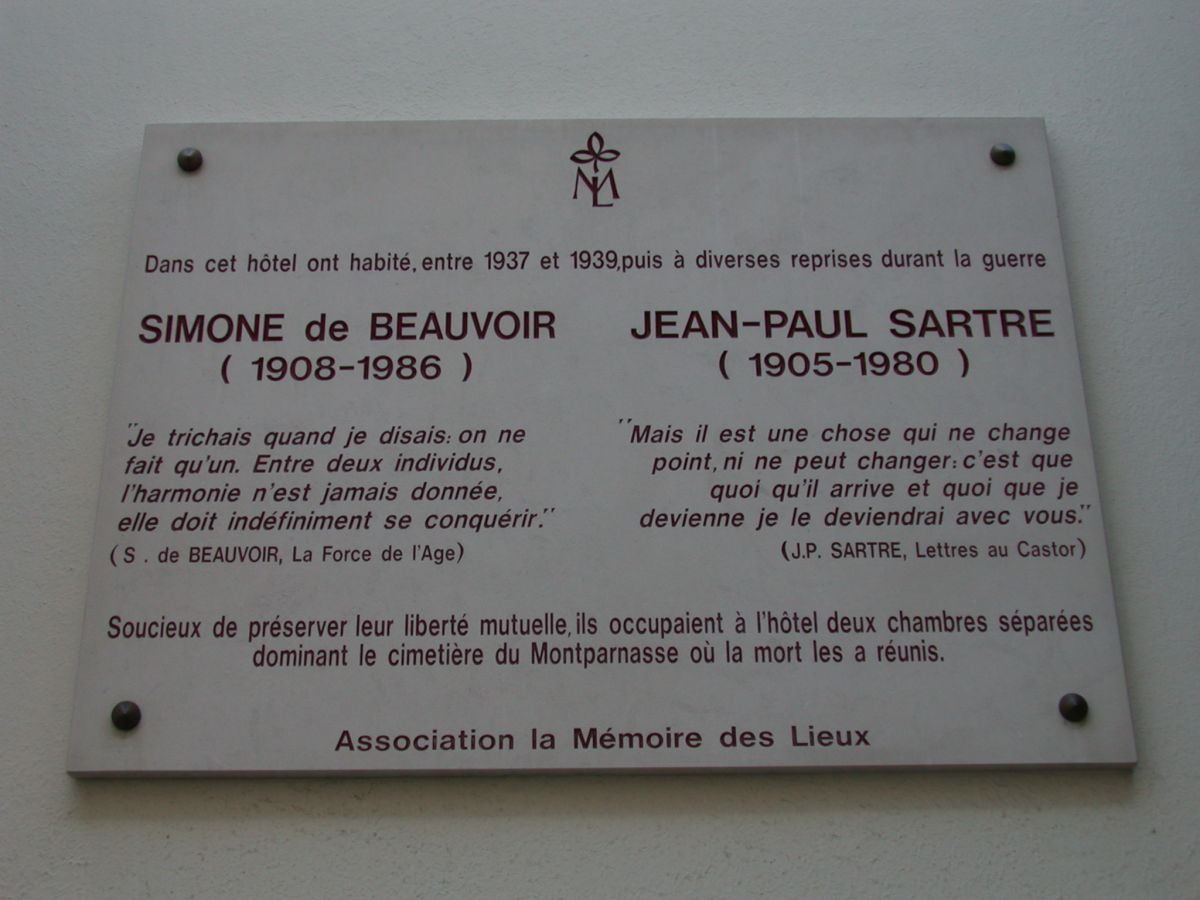
I chanced on the grave of Dreyfus, who sparked Zola's famous letter "J'accuse" and a huge campaign of resistance. I saw where Sartre and de Beauvoir were together in death, though forced to occupy separate hotel rooms in life, as a plaque on the Hotel Mistral recounts. They were forced by events to make difficult choices and their messy, muddled lives remind me that political involvement can't be limited to those whose lives are above reproach.

As the cemetery was closing, I made another attempt to find Beckett, who chose to stay in occupied France (though he could have escaped to neutral Ireland) and was awarded the Médaille de la Résistance and the Croix de Guerre for his activities. He didn't talk much about what he did but I wanted to pay tribute to his courage and reported kindness as well as his plays.

At last I found the grave, thanks to a shabbily-dressed and unshaven man who stood contemplating it. As I paused, the man turned to me. "Samuel Beckett," he said. "En attendant Godot."

I made a slightly stumbling attempt to explain why I thought Beckett a great man, trying to recall the French titles he gave his works when he first wrote them. But the man wasn't listening. "En attendant Godot," he repeated. "Samuel Beckett. En attendant Godot."

Then he bent down and began to clear the blossoms which had obscured the names of Beckett and his partner Suzanne.

I'm not sure what he meant to say. Was he just naming Beckett's most famous work? Was he telling me that in death too Beckett was "waiting for Godot." Or was he himself Godot, arrived too late and tenderly clearing the playwright's tomb?

Saturday, 21 August 2010

Myths of work and money


I can't recall exactly where in our flat the saying was. I think there was a paperweight – perhaps in a multi-sided geometrical shape – with a number of catch-phrases and sayings. When I first read it, I was too young to work out what it meant. I spent ages puzzling over the words: “Work is the curse of the drinking class.” Apparently it was a joke that I couldn't understand.

I suppose the joke played on too many assumptions: that work is a good thing, that the working class are seen (especially by the rich) as idlers, that drunkenness is a working-class problem and that the working class live feckless lives dedicated to the pursuit of pleasure. If someone had explained all that to me then, I'd have been politely incredulous. I could see that my parents worked hard and that they put the interests of others (including their children) first. They didn't even drink. My mother was fearful of pubs and drinkers and, although my father enjoyed beer, he gave it up for years for my mother's sake and, even now, finds a single can of lager turns a meal or an evening into a special occasion.

But there's one way in which the group of assumptions did chime with my parents' attitudes. They worked hard at their jobs and often found them rewarding. But they hadn't fallen for the idea so ingrained into many middle-class minds: that work is what gives meaning to people's lives. My parents put other things first: family, friends, neighbours, duty, social responsibility – and pleasure. They handed those values on to me.

Quite a lot came under that heading of “pleasure.” It could be a walk in Richmond Park, a trip to the theatre, a jazz concert, a TV programme, drawing, a maths puzzle, a cryptic crossword, a visit to a museum or a good book. We didn't make the usual distinction between high-brow and low-brow. I watched the London Transport Players perform Ivor Novello or Rogers & Hammerstein in a “proper” theatre and amateur Shakespeare in the London parks. I picked up whatever reading material was lying around: Tit-Bits magazine with its intriguing advertisements for Joan the Wad, poetry anthologies, Plato in translation. I learnt by watching that the aim of work was to live a good and enjoyable life.

My parents encouraged us to work hard at school but they didn't pretend that the aim of education was a career. Education was a means of expanding opportunities for pleasure – and might give us the chance to choose a job that was more enjoyable than those our parents did. I could see the point of that. In my early years my mum was a cleaner and a kitchen assistant. I didn't think I'd be much good at either and, given my incompetence in tidying my room, I didn't think I'd be much good at being a cleaner. I liked reading books and learning poems and plays by heart but I wasn't sure that many jobs would draw upon those skills. And I realised that I might want money so that I could buy books, travel to museums, go to the theatre and so on.

There's nothing in my parents' approach that seems wrong. The idea of devoting a life to work for its own sake seems ungenerous and mean-spirited. I'm lucky enough to enjoy much of my work – but not the bits involving form-filling, managerial jargon, the distress of others, or tidying my office. It's a good job but does it really shock you to learn that I do it for the money? After I've paid for the usual necessities of life, I spend that money on family, friends, duty, responsibility and – of course – on pleasure.