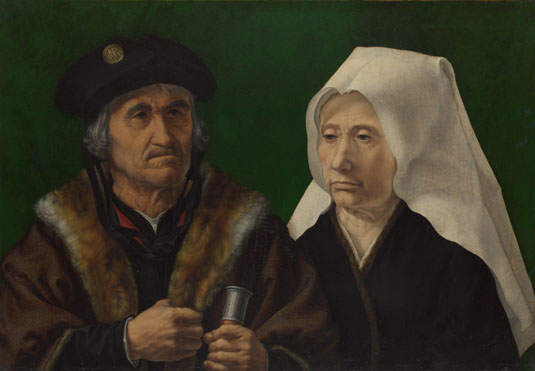
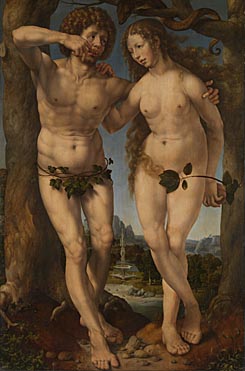
I was almost impossibly tired when I arrived at the National Gallery. I'd had a good but busy week and was still recovering from the amazing and absorbing experience of hearing Alan Moore, the Magus of Northampton, read aloud from his novel-in-process. [Note to anyone who hasn't come across Alan Moore: he is not only a remarkable writer but also one of the kindest and most courteous authors I have encountered. His reading held everyone in a huge lecture theatre spellbound for nearly an hour and he spent a further hour and a half speaking to everyone who had queued to have their books signed.]The day after Alan Moore, I was on my way to visit my parents, unsure I was sufficiently awake to take in the Gossaert exhibition but knowing that I was unlikely to find another opportunity to see it. I also had my new Art Fund card with me - at last I've fulfilled my resolution to join, not just for the very welcome benefits but also because I have benefited from the Art Fund through a lifetime of gallery visits.The route to the exhibition took me past many familiar paintings. On one side I spotted a favourite Titian. Through the entrance to another room I thought I glimpsed a Vermeer. There was Murillo, staring out of his frame like a competent marketer of his own paintings. In my susceptible state of mind, even Rubens seemed set to lure me from my path toward Gossaert. After all, Rubens was not only free but there were comfortable padded benches from which his work could be admired. (I don't usually admire Rubens that much.)I forced myself to make the long trek to the basement of the Sainsbury wing where the Gossaerts were displayed. It was worth it. I realised that I had seen and admired individual paintings by Gossaert in the past but I'd never seen them in relation to one another before. I hadn't even registered the artist's name.There are six rooms in the exhibition. Gossaert's drawings and paintings are complemented by the work of artists who influenced him - a startling range from Northern European artists like Durer to the classical tradition of the Italian Renaissance. Although he's only mentioned in the timeline at the start of this exhibition, it's easy to see Holbein as the heir of this remarkable combination of influences.There's more to Gossaert than his portraits but these are the most obviously remarkable part of his work. The people he paints in portraits convince as human beings, simultaneously familiar and unknowable. This isn't just true of his secular portraits. There's a lavishly clad Mary Magdalen with sly glance and dirty fingernails. But he also paints relationships, including erotic relationships. There are various works showing Adam and Eve, including some copies of lost originals, but all convey an astonishing blend of tenderness and desire.The work that stunned me most - and nearly moved me to tears - was a painting of Christ in the Garden of Gethsemane. It's a dark painting - even the red robes of the flying angel and the sleeping St John are barely lit. An elderly figure - St Peter, perhaps, lies on his back, asleep in the foreground. He has the pallor of exhaustion. But at the centre is the kneeling figure of a youthful Christ, beardless, confused and close to despair. It's not an attractive figure but terrifyingly recognizable. It's the expression of any child confronting an incomprehensible horror. It could be Libya or Afghanistan - or, too often, the U.K.At the end of the exhibition I couldn't give an account of Gossaert. I had no sense of the man who painted the pictures, except that he could see and reproduce with pencil on paper or paint on canvas. He had, it seems, some human understanding that didn't take a verbal form. And he had the luck to be taken up by a succession of patrons who took him within reach of the influences he needed to develop his art.It was luck. That's the problem with patrons. While Gossaert had the right patrons for his development as an artist, he was limited to painting what they required: a portrait of a marriageable daughter, erotic works for a private collection, an altar piece, a sketch for a tomb. There is no way of knowing what Gossaert would have liked to paint. It's lucky that some of his patrons' requirements suited a style that we can now appreciate.It's luck too that has made me so familiar with the works in the National Gallery - the luck of living near a free art gallery and being encouraged by my parents to look inside. I was brought up to take advantage of free and cheap culture - to see culture as a good that should be shared.It was shocking, therefore, to read, the day after my visit to the National Gallery, of a Labour MP calling for the introduction of admission charges to London's museums. He's not just any Labour MP. The Hon. Tristram Hunt, son of a life peer and a historian with a proclaimed interest in radicalism and the working class, has written an introduction to a recent edition of Robert Tressell's The Ragged-Trousered Philanthropists. In this book, Robert Tressell, through his main socialist characters, argues that culture is one of the necessities of life and should be available to all. I assume Tristram Hunt read the book before writing the introduction. It's a shame he didn't take in its arguments.It's fair to say that Tristram Hunt wants free admission to the museums in his own constituency of Stoke-on-Trent and, by extension, to other regional museums. I think they should be free too. But I don't think the country's great art galleries and museums should become the preserve of the wealthy. And I'm not interested in any party that can consider excluding the poor from culture, which is not just an education but a means to nourish imagination.Had there been a charge for the National Gallery, I might have visited once or twice when I was growing up. I know I wouldn't have gone there often - and I wouldn't have learnt much about the history of art. I remember when Mrs Thatcher introduced admission charges for museums and galleries in the 1980s. I was poor then and on many occasions I was stuck outside, wishing I could afford to go in.Now I've joined the Art Fund. I make donations because museums and galleries were free in my childhood and it's time to say thank-you. If there had been a charge, I wouldn't have bothered. I'd have known museums and galleries weren't for the likes of me.
 I last went to a candidates' meeting in 1997, uncertain how to vote. Part of me desperately wanted an excuse to vote Labour so that I could be part of the overthrow of Thatcherism and be sure that things could only get better. There was only one meeting. I sat on a hard pew in the packed local Baptist church, surrounded by hopeful voters, and wished that I shared their optimism.This year, there's a choice of candidates' meetings: five, I think, in our part of the constituency. The local newspaper has got involved and is sponsoring debates. I wondered how many people would attend the meeting I'd selected. It was in a local school and clashed with the beginning of the first party leaders' debate on TV. Once again, I wasn't keen but I accompanied my son who's thinking hard about how to use his first ever vote.We were ten minutes early. The organisers must have been pessimistic about attendance as there were only eight or ten rows – mostly full. We found two seats together in the second row – apparently no-one wanted to be too near the candidates. As the hall filled, more chairs were found until the rows stretched to the back of the hall. Then I settled down to watch.The meeting was more carefully managed than some, perhaps influenced by the rules for the leaders' meetings on TV. Members of the audience weren't even expected to ask their own question – instead questions were written down and handed to a steward who would pass them to the chair who relayed them to the candidates. Whole areas of policy, including education and civil liberties, were ignored except when a candidate mentioned a single measure in passing.I'm not sure how clear an idea it gave me of the candidates. I didn't get any sense of the BNP man, since he chose not to turn up. I wasn't going to vote for him anyway. Personal impressions counted for a great deal. The UKIP man was surprisingly likeable - I didn't agree with him but he listened to people, answered clearly and seemed straightforward. He seemed the sort of man who would be a good friend, colleague or boss – and probably a good conversationalist over a coffee, beer or wine.I wanted to be impressed by the Green candidate. Every survey I take tells me I'm more aligned to the Green policies than those of any other party. Again the candidate seemed personally likeable and his experience – as a self-employed craftsman and school governor – is just the kind of experience that's needed in the House of Commons. But he was unclear on policies – actually unsure what they were or how big questions could be addressed – and plainly unready for parliament. With six months of hard work he might become a decent candidate but he's not ready yet. It's a shame.The Liberal Democrat is a sitting councillor. He was confident on local issues and broad policy areas and was probably the best speaker of the evening. He had a couple of good soundbites - “We were right on Iraq and right on the economy” and “Charlie Kennedy was drunk and he was still right on Iraq” - and spoke particularly well on the need for international aid, drawing on experience of life in Malawi. Apart from that, I was worried that his strengths were local rather than national – an MP has to deal with national questions.There was only one woman among the candidates – the conservative. I’m far from being a tory supporter but I’ve seen some good tory initiatives such as David Davies’ support for civil liberties. I’ve also had enough experience of being the only woman in a male environment to know it’s difficult so I tried, at least, to like the candidate. I couldn’t. She seemed like a lacquered version of Margaret Thatcher without the smiles. There was no pretence at liking the audience or the other candidates, just an array of facial expressions that ranged from the sneer to eye-rolling incredulity. Her manner as a speaker shifted between the deliberately informal to the rehearsed speech with hand gestures, reminding me that she had been a broadcaster and was now a barrister. Some of the things she said were good – she asserted that she had opposed the war in Iraq and favoured international aid – but she also declared that she agreed with every word in the tory manifesto.The Labour candidate had all the advantage of 13 years as the constituency MP. He was familiar with the major political questions as well as local concerns so his answers were thoughtful and knowledgeable. He was polite to his opponents and took the audience seriously. He even said he’d been wrong to vote for the war in Iraq and that he now opposed ID cards because they would cost too much. This was quite a U-turn – he used to be a keen defender of government policy and took personal credit for advancing the proposal for ID cards. His line was the hackneyed one that people who had nothing to hide have nothing to fear – perhaps he’s the only person in the country to reckon he’s lived an entirely blameless life. He also spoke against government policy on asylum seekers on the grounds that it was too harsh – but I don’t think he’s ever voted against it.I like the Labour candidate. I think he’s an honest man who honestly convinces himself that, in most circumstances, his government and party is absolutely right. I live in a Labour-Tory marginal and, if I don’t want a tory government, which I don’t, logic demands I should vote Labour. I won’t do it.Labour is better on some issues. There’s a historic link with socialism and, although it’s frayed almost to breaking during New Labour days, it probably still means that the cuts which the new government will impose will hurt the poor less under Labour. But this government has supported war and opposed civil liberties to an extent that has made me fearful. The Serious Organised Crime and Police Act is one among many dangerous pieces of legislation. I used to think of myself of law-abiding. Now I take it for granted that, if the government wanted, they could find some law that I’ve broken and use it to imprison me. There’s a certain perverse freedom in that. I no longer worry much about what the law says.
New Labour has also supported mistreatment and torture of prisoners, including prisoners who haven’t been found guilty of any offence. These range from asylum seekers and their children – some very young indeed – to suspects who were kidnapped by the Americans, bundled into planes and transported overseas to be questioned under torture. It’s called “extraordinary rendition” and the Americans have now admitted that it happened. I wrote to my nice, tolerant Labour MP about this in January 2005, when the evidence was mounting up. There were witnesses who had seen what was happening, records of flights tallied and companies were named. My MP responded that the evidence was “thinly-based,” that the British government couldn’t be expected to ban flights from stopovers or subject them to scrutiny. He added, “If there was a specific allegation that a prisoner was being held captive in a plane … I’d take a different view and I’d think his lawyers would have a strong case for asylum.” The idea that someone who has just been kidnapped by the CIA will have access to lawyers us so ludicrous that it suggests my MP lives on a different planet.When I think about the war, civil liberties and government attitudes to torture, I know I can’t vote Labour, even though I dread a tory government. I suppose it will have to be Lib Dem. I don’t feel happy about it. But at least it will annoy the press, which is on the attack. The Daily Mail this morning misrepresented a fine article Nick Clegg wrote as “Clegg’s Nazi slur”. I firmly expect an eve-of-poll headline saying “Nick Clegg will eat your babies.”
 The children stayed up to mark the moment when 1999 slipped into 2000. I think we toasted the new millennium. There was a crash of fireworks and a splatter of colour in the sky. Then came the sound of people laughing and singing. I opened the door and saw a dancing procession of neighbours and friends doing the conga round our cul-de-sac. We left the door open and joined in. Suddenly it seemed that the future could be filled with trust and friendship.Before that, we'd been watching the celebrations from the new Millennium Dome and flashes from around the world. I recall Tuvalu, Sydney and Paris. I remember little of Britain's Millennium celebration. Tony Blair and his family were there, still glossy with the people's love and trust. I noted that, of all the celebrations shown from all over the world, ours was the only one with a guest list and entrance fee - others were free and open to the public. George Carey as archbishop of Canterbury had insisted on a Christian element to the event. He was a late addition to the programme and was squeezed in long before midnight. He stood in the centre of the vast dome and the words of the Lord's prayer echoed emptily. The audience seemed rightly embarrassed - religion was out of place in this monument to commercial sponsorship.At some point before going to bed, I rang my brother in Canada. "This is the voice of the next millennium," I declared. Looking back on the 20th century, it seemed possible that I'd reached a better time. The Berlin Wall had come down, apartheid had ended and it still seemed possible that the divisiveness and hatreds of Thatcherism would be pushed back. The afterglow of the 1997 election still shed a little light, even though I hadn't brought myself to vote New Labour. I mistrusted the surface shimmer and worried about the number of times Blair urged the voters, "Trust me." Honest people rarely insist that they tell the truth - they simply speak.On the morning of 1st January 2000, hope persisted. Nations and people could work together. If we couldn't save Tuvalu from global warming, surely we'd welcome its dispossessed people. Perhaps as a world we could learn to love the stranger, just as the dancers in the streets welcomed all comers, regardless of origin or ability. I chose to take the conga as my symbol of the millennium rather than that exclusive, expensive party in London which I'd watched at a distance through the glass of my TV screen.I don't know when hope dispersed.I'm not sure it's possible to recover that hope. But the people I meet are so much better than party politicians, gearing up for the election, suggest. There's much more to human beings than the hatred of strangers and blind pursuit of personal profit.I don't think I'll be able to celebrate the new decade. But, when midnight tolls, if I'm still up, I'll toast it with a small glass of Jura malt, hoping for hope in 2010.
 Sunday afternoon. I was invited to go swimming, which tempted me, but it was a sunny day and I knew I had to refuse the invitation. Rain followed by sun had had its usual effect and it was time to trim the hedge.
It's a vast, unruly hedge. One day I'll seek advice and cut it down to a more manageable level. I'm not tall enough to reach the top so I stand on tiptoe with the shears, trying to reach. It doesn't quite work. I have the only hedge in the area with a Mohican haircut.
There's an electric hedge-trimmer in the shed but I hadn't charged the battery. I thought I might get some useful exercise if I used the old, rust, manual trimmers. I tested them on a twig - they seemed to work.
It's some time since I've trimmed the hedge with shears. At first I was hesitant, not wanting to cut into the shiny, newly-opened leaves of privet and ivy. I had to remind myself that they would grow back. I looked at the uneven surface of the hedge, as wavy as if I viewed it through the bottom of a beer-glass. I wondered how the eighteenth century labourers who scythed lawns achieved the smooth surfaces shown in the paintings. Perhaps the paintings lied.
And then, as I got into the rhythm of hedge-trimming, my thoughts wandered.
I thought back to the beginning of the Iraq war and all the lies that gained consent in parliament and Congress. I remembered the falsehoods about "weapons of mass destruction." And I thought of more recent revelations that I read in Craig Murray's blog: that waterboarding was approved by Condoleeza Rice in 2002 - before the Iraq war - in order to extract confessions of the non-existent link between Saddam Hussein and Al-Qaida. I used to wonder why so few German people had the courage to oppose Hitler. I'm beginning to understand. When we question and oppose our own government, politicians respond with an appearance of aggrieved self-righteousness that is supported by torture and lies. We write to our MPs, we go on marches, we speak out again and again - and all we get in response are the same smiling lies. It seems impossible to achieve change.
I was gloomy as I swept the hedge-trimmings down the pavement.
But there are still people trying to speak the truth and achieve change.
I'm not sure who trawled through legal cases to uncover the case of a Texan sherrif and deputies who were put on trial in 1983 - under the Reagan administration - for waterboarding a suspect. The court decided it was torture; the sherrif was sentenced to ten years in jail and the deputies to four years each. George W. Bush's legal advisors didn't cite that case when they approved torture by waterboarding. I'm glad to see there are people who care sufficiently about the law and human rights to continue to bring the truth to light.
Today, Craig Murray, sacked as British Ambassador to Uzbekistan for opposing British collusion in torture by the Karimov regime, finally gives evidence to the Parliamentary Joint Committee on Human Rights. It's the first time he has given evidence and he is expected to point to the role of British government ministers in approving (even encouraging) the involvement of MI5 and MI6 in obtaining information through torture. The Committee proceedings will be screened live from 1.45 today (Tuesday, 28th April). Craig Murray was not merely sacked by New Labour; he was subject to a series of disgusting smears in a way which now seems almost routine. Our government's willingness to ruin lives - by policies, by torture, by smears - no longer horrifies us. We've got used to it. But we should be horrified. We need people like Craig Murray to remind us how horrific this all is.
There are still people who say we need torture to produce information in the "war against terror." But torture doesn't produce reliable information. Most people will say whatever the torturers want to stop the pain. Torture produces lies.
 It's depressing to read the message boards and comment columns. So many people blame all the country's ills on "scroungers" and the unemployed. The current financial crisis has nothing to do with unemployment. As economists point out, current problems, such as the rising price of oil, are causing unemployment. There are other causes too. Ending student grants forces poorer students into debt or work - often debt and work. Nearly half of students work during term-time, averaging just under 20 hours a week - and they work in vacations too. That's a huge pool of cheap labour ripe for exploitation - often working for mimimum wages (or less) at unsocial hours and too desperate for cash to complain about working conditions. Many schoolchildren are working too and, while they're under 18, they don't get the minimum wage.When I was unemployed, I told myself I'd remember how it felt. It's hard to recapture the hopeless depression that takes over after just a few weeks or the tiredness caused by a trek from shop to shop, hunting for reductions on bread, rice and lentils. I recall the desperation of wanting to afford a tiny luxury - a postcard or a small Christmas decoration - and the pride I felt in not letting friends and family know that I could afford so little.I can still remember the mixture of suspicion and contempt from one member of benefits staff, who thought me both too clever and too lazy. I was six months pregnant at the time and she managed to imply that pregnancy was another example of my fecklessness, telling me that my intention to breast-feed when the baby was born showed my lack of commitment to the world of work. I was summoned back for a detailed interview about my circumstances, which culminated in a long argument about my travel expenses. I got the expenses and benefits in the end, at the cost of a great deal of self-confidence. Only the knowledge that I needed money for the baby kept me going in the gap between temp. work and maternity pay.The Labour Party used to stand up for the unemployed. I chanced on a web-library of Scottish Labour election leaflets - appropriate for this week with the Glasgow East by-election set for Thursday. I found the election address of Agnes Dollan, who was standing for Glasgow Springburn ward in a Glasgow City by-election of 1921. One of the key paragraphs is headed "Our Workless Brethren" and reads: The condition of the unemployed in the city must be our first concern. Over 70,000 men and women are unable to obtain work, and their homes are shadowed by sorrow and poverty. Thousands could be employed in the building of houses, and on other schemes of civic welfare, if the State would give grants to finance these schemes. If the Government could afford £30,000,000 for warships, it can afford to finance work for the unemployed. The State must accept full responsibility for unemployment so that occupation or maintenance can be provided for the workless.
The election address goes on to guarantee that the unemployed of Glasgow will not be evicted and that the unemployed will be given the same moratorium on debt as was provided to bankers at the beginning of World War I.Today, the New Labour government is talking about getting the unemployed into work, but the language is all about force, threats and punishment. The jobless will be ordered to work - first clearing litter and cleaning graffiti in community projects and then at unspecified full-time jobs. This will affect almost all the 4.6 million people who are unemployed and claiming benefits - only those with the most serious disabilities will be exempt. I suppose we'll get used to seeing gangs of the sick and dying peeling chewing-gum off city streets. I don't know whose jobs will be given to the unemployed but I hope the government remembers its own minimum wage laws. Apparently the new rules will include an opportunity for private companies to profit.It looks as though the new regime will be piloted in Glasgow - but there won't be an announcement until the by-election is over. I wonder what Agnes Dollan would have made of adviser, David Freud, "investment banker and government welfare adviser," who seems to be behind the new scheme.
 Freedom has had a bad press lately. There was Operation Enduring Freedom, which turned out to be nothing of the kind. And there have been numerous statements from politicians throughout the west, declaring that the bedrock of freedom is free market economics. These are often made by the same politicians who proclaim that physical safety is the most important civil liberty.
But when I heard David Davis's speech resigning from the House of Commons to prompt a by-election, I was moved. He spoke about questions of freedom that have worried me for some time. He spoke of last night's vote to extend detention without trial to 42 days. He spoke of the growth of the surveillance society: the extension of CCTV cameras and the effect of ID cards, the threat to trial by jury and the prevention of peaceful protest.
Nu-Labour supporters hurried to attack David Davis, condemning his decisions as "expensive" and describing him as "unhinged." He sounded pretty sane to me. Of course, he may seem unhinged by Nu-Labour standards - ideas about democracy and civil liberties may seem pretty strange in an organisation that's apparently obsessed by micro-management and control.
I couldn't help noticing that David Davis undermines one of the arguments often advanced by Nu-Labour MPs: that the defence of freedom is a cause only supported by a comfortable, middle-class minority who don't know what poverty or "real life" is. David Davis and I have one thing in common: we both spent much of our childhood on Wandsworth council estates. He probably had a harder time than I did.
On many other questions I disagree strongly with David Davis. I have never voted Conservative. I strongly oppose some of the positions he has taken on law and order. In particular, I'm against capital punishment, which he supports. But I think the question of freedom that David Davis has raised is so very important that, if I were one of his constituents in Haltemprice and Howden, I'd vote for him. I might even campaign for him - on this issue alone.
I never thought I'd say that of a tory MP.