Showing posts with label London. Show all posts

Saturday, 12 October 2013

Museum by night

There was an  anxious cluster of people outside the Victoria and Albert Museum.  They were reading the hoardings that had appeared.  "NEW RESIDENTIAL DEVELOPMENT" it proclaimed, and a second line added, "AT PRIME CULTURAL HERITAGE LOCATION."

I could hear what the people were saying, although their voices rarely rose above a quiet mutter.  "They're selling everything off."  "I never thought we'd lose the V&A."  "It's such a shame - I'll miss it."  But although passers-by really thought that the government had decided to convert one of London's great museum into luxury housing, none of those I heard suggested a protest.  They minded, they were upset, but not one of them even suggested wearing a badge or writing a letter to an MP.  This was what the government was doing and they would have to put up with it.

I'd have been there with a banner and loud-hailer if I thought the government was selling off the V&A to property developers.  I've loved this museum since, as a London child, I wandered through its galleries and got lost amidst its marvels.  There used to be a reproduction of the Bayeaux Tapestry on rollers so that you could view it in stages.  I lost count of the number of times my brother and I surveyed it, looking for the figure we believed was Harold with the arrow in his eye.  The huge and detailed Raphael cartoons were another attraction and for some reason I was fascinated by the sculpture of the serpents entangling Laocoon and his sons.  There were even visits to the cast gallery, if I could persuade an adult to take me past the sign which banned unaccompanied children under 15.  I don't know if this was to project the fragile casts or to keep us from the replica of Michaelangelo's David with which I was obsessed, though more for the expression of his face than for his nudity.  Fortunately I rarely had any problem in finding a grown-up to escort me past the museum guards.  If only for the strength of my memories, I would fight to preserve the V&A for future generations of children.

But I knew that, for now at least, the V&A is safe from property developers.  I was on my way to see the Elmgreen and Dragset installation and, after a moment's shock, came to the conclusion that the hoardings were part of the game they were playing with visitors.  

It was Friday evening.  I've never been to a late evening opening at the V&A before and the feel of the museum is different.  As the skies darken outside, the light in the museum changes.  Visitors seem more hushed and slightly tentative, as though they fear they're trespassing.  And because some of the galleries were closed, I had to find new routes and, as usual with so large a museum, I found myself in unfamiliar rooms.  I couldn't work out if I'd seen the Turners before and hurried past but on Friday evening they were luminous and compelling.  I've only just begun to appreciate Turner after the hackneyed reproductions of The Fighting Temeraire that appeared on so many biscuit tins in my childhood.  But after spending time in the small room of the National Gallery where two Turners are hung with two paintings by Claude, I have gradually come to realise, some years after falling for Claude, that I've learned to like Turner as well.

I wanted to linger by the Turners but I had come to the V&A to see the Elmgreen and Dragset installation, called Tomorrow.  I loved the idea of the installation: five galleries of the V&A have been turned into the apartment of a rich and unsuccessful architect which he has been compelled to sell but has not yet left.  Visitors are encouraged to snoop on the invisible inhabitant while the museum guards, dressed as butlers and maids, stand about and respond to queries with deferential courtesy.

At first I thought the installation was great.  My sense of being an intruder matched my sense of strangeness at being in the museum at night.  There weren't many other visitors just then, and I wondered if some of them were part of the installation.  Nervously I picked up items, stroked them, read postcards and bills, leafed through newspapers (lots of stories of the London riots) and perched on sofas and chairs.  There were a few moments which added to my uneasiness - but not many and, for my taste, not enough.  In the end I wasn't sufficiently engaged with the setting nor with the film script which was provided to accompany it.  I was left as cold as I was by Elmgreen and Dragset's consciously kitsch sculpture on the fourth plinth in Trafalgar Square.  It's the only fourth plinth sculpture that I've actually disliked.  

I've been trying to work out why I was so unengaged by the installation.  I know other visitors have liked it.  There were elements I enjoyed: the unwashed coffee cups, the unmade bed, the sound of the shower, the fireplace in the living room and the vultures.  But in the end I was uninterested in the people that the room conjured up - apart from the servants.  The servants were great and I'd like to have known more about them.  I leafed through the postcards and photograph album and worked out, from the pictures, that I was supposed to understand that the rich inhabitant of the flat was gay and liked looking at attractive young men - but why was this presented as a puzzle?  It seemed to be presenting the character's sexuality as a not-very-hidden secret, which would have made some sense forty or fifty years ago but is a little strange now.  I looked at the architecture posters and models and wondered what point was being made, then found that I didn't much care.  The installation seemed to be about wealth and people to whom wealth came easily.  In real life I feel much more uneasy in such a world than I did in the installation.  I left unmoved.

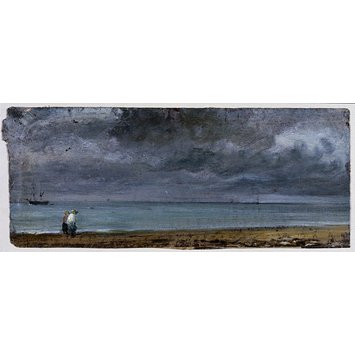
But then I found myself among the drawings in the V&A's collection, and I was riveted.  Here there were people and scenes I could care about.  There was clear craft as well as art, and surprising experimentation.  A startling ink drawing which Constable made in old age caught my attention, and I looked with care at some of the tiny oil sketches he had made too.  I particularly loved those of the seashore.  I fell into conversation with people who had taken a different route to the museum and been distracted by the small Constables on their way to the installation.  They were more knowledgeable than me and could trace the influence Constable had on twentieth century artists.   I couldn't stay long enough but I want to get back to see the Turners and Constables again.  It seems that my views of Constable have been unfairly limited by exposure to frequent reproductions of his paintings of Salisbury Cathedral and the Hay Wain.

So it wasn't the temporary installation that awoke my sense of wonder but the familiar seen anew.  I left the V&A determined to return again soon - and on a Friday evening if I can.

Sunday, 4 November 2012

The satyr dances

I don't feel comfortable in Piccadilly.  It's the province of the rich, who can afford its casual extravagances.  Suited and cloaked doormen - they are always men - stand at the entrances of buildings.  I would be reluctant to risk their contempt.  In Piccadilly, Fortnum and Mason's is mid-range while Pret-a-Manger is dangerously down-market.

It's partly my uneasiness with Piccadilly that keeps me away from the Royal Academy exhibitions, and partly the high cost of admission.  It's expensive even with an Art Fund card.  But when I saw the picture of the dancing satyr, I knew I had to brave Piccadilly, pay the admission price and see the exhibition in which he appeared.  It's called "Bronze" and bronze is the linking motif between all the exhibits.  It's about the material and its qualities rather than a period of history or changes in ideas.  Its focus is what stays the same.

 It's not just the material that is a constant in the exhibition.  There was also a repeated response to it from numerous visitors throughout the exhibition.  The gasps of awed admiration began as visitors opened the door to the exhibition and saw the first piece: the dancing satyr, in a room by himself.

The satyr is a recent discovery, found by fishermen in the sea off Sicily only fifteen years ago.  He's slightly larger than life-size and displayed so that viewers have to look up to him.  After his long immersion in salt-water, he's acquired a greenish patina and a slight roughness.  This only seems to aid the satyr's fluid movement.  It's as though his ecstatic dance continued without pause, whether he moved through air or water.  There's a smoothness about the curve of the limbs and body that made me want to reach out and touch him - but the flung-back head and the blank eyes speak of possession and tell the watcher to keep a distance.

So awe was there at the beginning and it continued.  There are massive statues: of saints, statesmen and peasants.  There is even Rodin's Age of Bronze which conveys uses the material to convey masculinity - or perhaps masculinity to convey the material.  There are tiny works.  Perhaps the most disturbing are the tiny copulating grasshoppers, whose image was cast by encasing them in molten metal.  There are gods and domestic objects.  Men ride horses, and panthers, battle monsters,  suffer agonies of torture or gaze sternly on the world.

Women are less in evidence.  There are goddesses and rulers; a stern and prickly Catherine de Medici, showing off the fashion of the day, is particularly memorable.  There are grief-stricken madonnas and a wonderful South Indian sculpture of the infant Krishna with his wet-nurse Mukhara.  And there are objects of desire - often small pieces presumably intended for private collectors.  Venus (naked, of course) removes a thorn from her foot, a satyr uncovers a sleeping nymph and, in another piece, a satyr and nymph are engaged in enthusiastic sexual intimacy.  It's a mark of the exhibition's focus on the craft of casting that my first thought on seeing this explicit and detailed piece was awe at the skill involved in creating so fragile a scenario in bronze.  Most of the workers in bronze have traditionally been men, so far as we can tell, but two twentieth-century pieces by women sculptors had a considerable impact: a large Louise Bourgeois spider mounted high on the wall and a curved abstract piece by Barbara Hepworth, which seemed to echo the sea evoked in the dancing satyr.

It's impossible to go into detail about all that is wonderful in an exhibition so far-ranging.  The Royal Academy has borrowed pieces from many parts of the world, inviting viewers to make comparisons across cultures and time.  I found myself particularly struck by a small chariot from Denmark made of bronze and gold in the 14th century B.C.  No-one knows its purpose or why the horse is placed within the chariot rather than pulling it along.  It is tiny, delicate and magical in its incomprehensibility - and the gilding on the circle which may be a sun, a shield or a great wheel is a thing of wonder.  And, as the films shown in the exhibition display, it was probably made by one of the two main methods still in use all over the world today.

Coming away from this exhibition, I knew it had changed something in the way in which I saw the world.  It had encouraged me to make comparisons and connections across cultures.  It had helped me look at art through the materials it uses rather than just the period in which it was made.  And it showed me the flexibility of that material in conveying a huge range of emotions and evoking numerous responses.  I wondered if there was any emotion it could not show or evoke.  Then I realised what was missing from that range which included desire, ecstasy, pride, fear, admiration and awe.  A word trickled into my mind and reminded me that one emotion and response had been absence.  Maybe bronze is for every emotion, every response - except love.

Sunday, 8 July 2012

Saying [uz]


I didn't mean to go to London. I'd thought about Tony Harrison's poetry reading. I saw it advertised and considered buying a ticket. Then I realise it was on the evening of a day when I was working and that I'd have to rush to London after work and get home again the same evening. I thought about how tired I'd be, and how much the train tickets would cost. Plainly it wasn't sensible.

I blame Twitter for what happened next. I just glanced at my Twitterfeed – I don't have time to read every tweet of every person I follow – and saw a quiz question from the Poetry Society, offering tickets to Tony Harrison's reading as a prize. I knew the answer. I didn't stop to think but tweeted back to them – and won the prize. A journey to London still didn't seem sensible but, after a little dithering, I began to realise it was inevitable. I wanted to go.

I first became aware of Tony Harrison as a playwright and translator. I was still at school when I saw his translation of The Misanthrope – into heroic couplets, I think – at the Old Vic. It was clear and witty. It was more than a translation; instead of its original setting in the time of Louis XIV, Moliere's play was transposed to the Paris of Charles de Gaulle. And despite the outstanding acting of Alec McCowen and Diana Rigg, what struck me most was the pulse and neatness of the verse.

Harrison's poetry took longer to reach me. My reading has always been a chancy affair. Then I chose books following from the advice of others, because a couple of lines quoted in a review startled me into a response, or because of an encounter in a library or bookshop. I found Tony Harrison's collection Continuous in a second-hand shop and, in a quick glance through the poems, realised that there was something in the voice that interested me. It took me a while to read more but, as I did, I recognized not only the complexity and the wordplay. This was a poet who was saying something important – and something that mattered to me.

Harrison's work is grounded in his two experiences I share: a sense – emphasised by certain teachers at his schools – that he could never fit into the cultural life of his country because he was born into the working class, and a yearning to acquire knowledge and articulate it. These experiences are part of what fuels his sequence from the School of Eloquence but they are amplified by his awareness that in gaining the education he desired he lost the close communication with his parents that he knew in childhood.

I'm not sure how much that was caused by education. Children often do find a separation from their parents and education may be merely a convenient way to name it. However when a child begins to move in cultural circles which are peopled mainly by those who seem rich and self-confident, the child's apparent confidence among such people can add to the parents' sense of awkwardness, even as they enjoy their child's success. When that is allied, as so much is in Britain, to a rigid class system, the high class barriers – which really do exist – are bound to underline and intensify the separation of child and parent.

Harrison's reading at the Purcell Room began with some of his public poems, which characteristically move from a small personal perception: in one poem the starting point is fish-scales scattered as cormorants fly with gasping fish in the sky above Lindisfarne Castle. From this sight, glimpsed through a train window, the poem moves to consider history, war, politics and the tragedies of past and present life.

The length, scope and formal exactness of his public poems - often published on the news pages of a newspaper - makes them unusual. When Harrison said that his chief influence and model for these works was the messenger's speech in Greek tragedy, I suddenly understood what he was doing much more clearly. The messenger, who arrives towards the end of the play to explain what has happened, is not a major actor in events. He is someone who is on the edge of the action, who is not in himself particularly important but whose role is to tell what he has seen as he saw it. It's a good position for a political poet since it is neither powerful nor directly preachy. It is based in the “I” of personal experience.

I was glad that Harrison's reading included some sonnets from the School of Eloquence sequence. They are what is known as “Meredithian sonnets” and have sixteen lines instead of the usual fourteen. This allows for a more sustained conclusion or reversal than is possible in the fourteen lines of the Shakespearean sonnet. The poems were interspersed with illuminating anecdotes. Before reading “Classics Society,” Harrison explained that, as a schoolboy, he was instructed to translate all Greek and Latin into a high-flown language. This led to some absurdities. Translating a comedy by the Roman playwright Plautus, Harrison had a character who was the Roman equivalent of a policeman saying “Move along there.” The schoolmaster crossed this through and substituted the more elevated command: “Vacate the thoroughfare.”

Harrison also recalled overhearing a woman in the audience for The Misanthrope say (and I paraphrase from memory for I was listening too intently to take notes): “What a command of the English language, my dear – even though he comes from Sheffield” This led Harrison to address the question of his own articulacy. He added to the little poem “Heredity” the recollection of his father's deep shyness.

This made me return with renewed understanding to Harrison's concern to speak for the working class now and in history. The idea of someone speaking on behalf of a class makes me uneasy. I think that the problem is not so much that the working class are silent but that they are often unheard. The problem lies with the powerful who may mock but rarely listen.

But I share is Harrison's anger – an anger which plainly lives on. I have heard recordings of Harrison reading his paired sonnets “Them and [uz]” but I have never heard such anger in them. Harrison takes the teacher's contempt for him and his Leeds accent, expressed in the lines “You're one of those/ Shakespeare gives the comic bits to: prose” and turns it back against the teacher, using his knowledge to insist that poetry does not come only in Received Pronunciation. The voices of poets of the past have, as Harrison says, been “dubbed” into RP as a foreign language film is dubbed into English – and much is lost in the translation.

I can't give details of all Harrison said or all that he read. I was moved – as he was – by the poems grieving at his parents' deaths. There was also a more hopeful poem – though against a dark backdrop – which Harrison had addressed to his grandson Alfie. On this occasion he read it for the first time at a reading with his grandson in the audience. But one of the final poems came from a play – Harrison's adaptation of Sophocles' Trackers of Oxyrhyncus, which exists only in fragments of papyrus. I have neither seen nor read the play but when I heard the speech I wondered how I could have missed it.

 Harrison's introduction explained that the play had made allusions to the cardboard city that grew up beneath Waterloo Bridge and in other sheltered spaces on the South Bank in the 1980s. It was where the homeless lived and established a community. I remember walking past on occasions; it was not a dangerous place. In the end they were moved on, their homes were dismantled and the area was cleansed. I don't know where the people went.

But the fate of cardboard city and its people was beyond the scope or Harrison's reading. Instead he offered a speech in voice of the satyr Silenus, brother of Marsyas, who was flayed alive on the command of Apollo for daring to learn to play the flute. The satyrs – half man, half goat – are allowed to be comical and inexpert but the Olympian gods will not permit them to be are capable of art and culture. In the speech Apollo stands by, playing the lute as Marsyas is tortured to death. At the end of the speech Silenus resolves to conform and know his place – to take the safe option.

It's a while since Harrison has given public readings. He claims that he was prompted to resume by the discovery that newspapers are updating his obituaries ready for use. But judging from this reading, he's still unwilling to take the safe option. His anger persists and he still uses his poetry as a weapon to attack cruelty and injustice. And the rhythms still sing and the words play on.

 My very brief visit to London brought another joy.  For the first time in more than thirty-five years I encountered the English teacher who taught and encouraged me in my last year and a half at school.  She was also at the reading.  She was an excellent teacher who shared her love of literature and I owe her a very great deal.  Thank you, Miss Hann.

Saturday, 4 June 2011

Bread and circuses


After a busy period at work when I haven't found time to blog, I'm experiencing the delights of bread and circuses.

The bread is literally bread. I've finally explored one of the Polish shops near work and discovered a range of central European breads: heavy rye bread, bread with sunflower seeds and so on, reflecting the cuisine of various countries - not just Poland but also Latvia and Lithuania. They seem to me better than the supermarket "specialty" brands - and cheaper too.

I went to a circus as well - the Moscow State Circus which was touring near me on the day of the Royal Wedding. It was a good counter-balance to that other circus. It had a story too. If I grasped the moral correctly, it was something about taking money from the rich and spending it sensibly so that everyone could enjoy the arts. Just now that seems a pretty good idea.

All round me there's anxiety. Friends find their jobs at risk. (I seem to be safe - at least till next year, and that's ages in the present economic climate.) Health and social care are in the news. The Financial Times has picked up a story about health authorities and hospitals at risk. In many cases the risk has been caused or worsened by the involvement of private companies, who were quick to enter into Private Finance Initiative agreements that safeguarded profits at the expense of the ill, the injured and the dying. Meanwhile the big companies that make money out of caring for frail elderly people and those with disabilities have in their turn been brought close to collapse by private equity companies. From the point of view of profiteers, it seemed a neat arrangement: sell the homes to other companies, agree an ever-rising rent, trust the market - and get out quickly when the economy falters.

Obviously I should have arranged a better pension for myself, according to the right-wingers. That's the same right-wingers who object that my public-sector pension will be too generous (if I ever get there) and who tell me I should find ever more to spend on my children, my parents and every cause and charity near to my heart. But if I do my best, it's never quite enough. According to them, I should also spend more on insurance and save more - but in the present economic climate insurance companies can go bust. Even banks, which may be bailed out, seem a bit of a gamble. They depend on the markets, which depend on an ever-increasing chain of gambles and exploitation.

So besides bread, I comfort myself with circuses. I may have visited only one actual circus in the past month, but I've been making up for it by enjoying other activities which give me pleasure. They remind me that life is more than a dragged-out existence. Life isn't just about duty - we need pleasure too. For some people that means getting out into a new place, whether it's roaming the countryside or strolling through towns. Others enjoy dancing or sport - and my regular experience of wielding an epée makes me understand that these can be sources of intense pleasure. For other people it's watching sport going to gigs that's important. My circuses involve engagement with the arts.

I headed to London to see my parents, travelling as lightly as I could so that I could sandwich my visit with artistic pleasures. I was a groundling for a matinée of All's Well That Ends Well at the Globe - a difficult play that's rarely performed. It's not just its unfamiliarity that makes it one of my favourites. There's a pair of determined, assertive young women - even though the times mean that the best either can hope is an attractive, wealthy husband to lord it over them.

I've seen All's Well twice before - and in both productions the focus was on the central relationship between Helena and Bertram. The comedy was played either as abstruse courtly wit, at a distance from the audience, or a cue for over-emphasis with lots of "isn't this funny?" expressions in the hope that the audience would laugh. The revelation of this production was that, for the groundlings at least, the comedy worked and was genuinely funny. It comes, I think, from the shape of the theatre which encourages the actors to establish a relationship with the audience. Comic lines were played with the clarity of the successful stand-up - and were irresistible. I engaged with the play as a whole - how could I do otherwise with my forearms leaning on the front of the stage? - and, when the final scene of reconciliation came, my eyes filled with unexpected tears.

I stayed overnight with my parents, still in their own flat so less immediately threatened by the private profits of the market. We had supper and a quiet evening. In the morning I left with them when they headed out to the shops but my aim was a further exploration of London.

I was unsure of my destination but eventually decided on the Guildhall Museum, which I hadn't visited before, followed by the London Museum, which I hadn't seen for many years. Walking between and around the two, I found myself in a many-layered city, where modern structures of glass and metal loomed high above small Wren churches. There are traces of an even older city. I glimpsed the old London Wall through a museum window and saw what's left of the Roman amphitheatre in the Guildhall Museum basement.

That's the kind of structure Juvenal meant when he talked about bread and circuses: a place where shows of all kinds were put on, including gladiatorial combat and public execution. Being in some ways a typical Roman of his class, I don't suppose he minded the gladiators or the executions. But he was concerned that the citizens of Rome, once the source of democratic power, had been diverted from their proper concerns for the state to making demands for bread and circuses.

I agree with Juvenal that people should recognize and exert their democratic power. But I think he's wrong to dismiss bread and circuses. We all need food to live - not just food for the body but something that nourishes the imagination and tells us that life is worthwhile. It's also the circuses, whether we find them in physical activity, travel, music or the arts, that open us to a wider imaginative understanding of the world. They nourish curiosity and sympathy. They offer laughter, tears and reconciliation.

Yes, Juvenal - I want democratic involvement and responsibility. But I'll take the bread and circuses as well.


Monday, 25 April 2011

Enduring freedom

I took another look at the peace-camp on Saturday. It's been shifted to the pavement in Parliament Square while the grass, which London mayor Boris Johnson said he wanted to preserve for the people of London, is closed off with tall fences and patrolled by security guards.

The peace-campers' tents are neat and there's plenty of space for pedestrians on the pavement. I was one of many people visiting to read the banners. But it's still hard to reach the traffic island – I've yet to find a set of traffic lights that enable the public to reach the island. I had to employ my usual technique of a quick dash as the third lane of traffic slowed.


I suspect there will be an attempt, on some pretext or other, to remove the peace-campers before Friday's Royal Wedding, even though they offer no more risk than a fairly quiet protest on a range of issues, most – but not all – related to war. One man's banners announce that he is undertaking a hunger strike because he has been unjustly imprisoned. If he were in Tripoli the British press would probably declare him a hero. As it was, none of the campers even offered me a leaflet. I read their hand-made banners without interruption. Theirs is a quiet, enduring protest.


If the peace-camp is cleared, it will make the streets more home-like and welcoming for the despots and their representatives who are attending Prince William's wedding. The Crown Prince of Bahrain has finally pulled out, citing troubles at home – these could include the brutality his own and Saudi troops are showing to unarmed demonstrators and the doctors who treat them. But London and the Royal Family will still welcome representatives of Saudi Arabia, Zimbabwe and Swaziland.

Looking at summaries of the Guantanamo files, I can't help thinking that these tyrants have much in common with our other allies – and perhaps with our own, more secretive activities elsewhere in the world. Apparently the United States military didn't just take people to Guantanamo because they thought they were terrorists. They also kidnapped and imprisoned people who they thought might have useful information. A taxi-driver, for instance, was reckoned to have good knowledge of a particular region because his work took him through it. One man – a British citizen – was held because he had been imprisoned by the Taliban and was therefore likely to have good knowledge of their interrogation techniques. A 14-year-old who had been kidnapped and was known to be innocent of all terrorist activities was kidnapped again – this time by the Americans – because he might have knowledge of the Taliban and local leaders.


As for evidence of terrorist activities – the U.S. military didn't need much ground for arrest, deportation and torture. Visiting Afghanistan after 9/11 was enough. So was possession of a Casio watch, although the models the U.S. found suspicious are cheap and widely available.


I expect the United States ambassador will be at the Royal Wedding. After all, the North Korean ambassador has been invited – as have kings, queens, princes and princesses from several countries that have been republics for a long time. I hope that none of them – and none of the “ordinary” people invited – are wearing Casio watches. That could set off some serious security alarms.


More than that, I hope the peace-camp survives Will and Kate's special day. It would be good to think there's still a small patch of pavement in London where freedom survives, despite the actions of the state.


Monday, 4 April 2011

The Harrods of the ancient world


How could something so fragile last so long?

I gazed at the remains of brittle gold bowls and goblets. I could see where the stem of the goblet should be. The amazing thing is not that it has vanished but the thin, ridged bowl should have survived. I peered closer to make out the outlines of bulls on part of a bowl. A craftsman scored them gently into the gold around four thousand years ago. They are evidence of a vanished civilization of which little else is known. They come from Afghanistan.


I was hesitant about visiting the Afghan Treasures exhibition at the British Museum. I thought uncomfortably of conquerors, loot and triumphal processions. Exhibitions often arrive with an agenda, especially when they have been negotiated by diplomats. But this exhibition seems to have a gentler and more laudable cause. The British Museum has been restoring ivories that were stolen in the looting of Kabul Museum and recovered by an unnamed philanthropists. The British Museum staff have been working with the staff of Kabul Museum and the exhibition, however dependent on diplomatic goodwill and corporate sponsors, comes out of their joint work. The exhibition tells another story too – of museum staff who hid the treasures so that the history of their country could be preserved.


The history of Afghanistan is not well known. There is much that has not yet been recovered or understood. Western history books have tended to simplify the region as a place of romantic barbarism which briefly encountered civilization with the arrival of Alexander the Great. Alexander the Great, who married an Afghan wife and adopted local customs, may have viewed it differently.


So far as I can gather and recollect, the region had two reasons for importance in the world. It was a source of lapis lazuli, which was rare and much in demand. And although its terrain is difficult by contemporary vehicles, it stood on major trade routes, bordering India, China and the Persian Empire. Traders went as far as Greece and Rome, although the journey each way would have taken a year. The treasures they brought back, particularly to Begram, are protected in glass cases in the exhibition.


Captions show the uncertainty of the curators about the exhibits on view. There is a head of Silenus, clearly recognizable, but did the Afghans really know who Silenus was? Its unclear whether the owners of valuable items purchased deities or just attractive statues – rather as a modern mantlepiece may bear statues of Ganesh or the Buddha without necessarily demonstrating any religious allegiance or knowledge.


There's glass, too – Roman glass most probably or perhaps made in Egypt - the curators cannot be sure how it reached Begram from Rome since the way was blocked by war with Parthia. One piece is enamelled with full-length figures which even I can see are Roman in style. Another's delicately ornamented with vines made from the glass itself. But beside these are statues carved in turned ivory – chair-legs, the inscription suggests – each with a swaying female figure in what seems to me an Indian style. There are glass fish, a face that resembles a Greek or Chinese theatrical mask. There are Corinthian columns and finials. Some items must have been made in Afghanistan by craftsmen who had learnt skills from crafts practised elsewhere. But many items are imports, suggesting a place like Britain today where beautiful objects from all over the world can be prized and owned.


Half-way round the exhibition, I realised something else that was troubling me, though it's not unusual. I had little sense of the lives of the people who owned these objects, other than that they were very rich and could afford goods imported from far-off places. It was as if, one day far in the future, someone were to excavate Harrods and, finding only a few of the goods on show, tried to understand life today on that basis. Perhaps that is what has survived. Perhaps these expensive, traded goods represent the Harrods of the ancient world.


As I wandered through the exhibition, the past seemed both more distant and more familiar. I couldn't grasp past Afghan cultures but then, if asked, I couldn't give a simple account that took in the whole of west European culture today. Artefacts left by Afghan trading centres, which drew goods and influence from across the world, speak of a complex, varied society. This shouldn't be surprising or unusual. But I began to realise that many exhibitions treat the past as a collection of small, separate societies. They don't just assume that societies are culturally pure – they often treat cultural purity as something good in itself. The textbooks I studied at school were wary of cultural mixing. Rome's interest in things Greek was regarded with disdain although the Renaissance interest in Greek art and sculpture was excused as a means of regaining artistic purity after the confused muddle of the Middle Ages.


Looking at the wide range of objects on display and marvelling at their variety, I realised how much ancient history has been filtered through subjective and questionable value judgements. I suppose curators have to simplify – just as their displays provide the kind of neat, comforting pattern humans are trained to prefer. But in real life I like variety and complexity – and am glad that human existence resists a neatly moral narrative arc.


At last I neared the object I recognized from the posters for the exhibition: the gold crown once worn, so the captions assured me, by a nomad princess. I expected something bright and golden but I hadn't realised the tiny golden discs would tremble continuously, as though there were a breeze or breath inside the glass case. I read that the crown could be packed away and folded – and that all the nomad treasures, buried two thousand years ago, could be carried easily on horseback. In my imagination an Afghan princess rode through wild landscapes, the trembling crown on her head and a gold-studded cloak behind her. It's an improbable fantasy. I have no idea what the concept “princess” means in terms of nomadic people two thousand years ago - I wonder if the women were princesses in any way we can understand.


Little seems to be known of Afghan nomadic life beyond the six graves in Tilya Tepe. But the adornments found in the tombs of five women and one man link the items closely to the humans who wore them. It's not just the photos showing how the bodies lay when the tombs were opened or the glass case where the golden items mark out the shape of a human form. It's more to do with the sense that these items once touched living flesh and the the gold was caught on wisps of cloth the tombs were found. I peered as directed to see that the bracelets show signs of wear – in contact with an arm over time, gold diminishes.


The exhibition isn't big or cheap (I got in for half price – £5 – with my Art Fund membership). Space inside is limited because items are small and, when I visited on Saturday, that meant queuing briefly before reaching most cabinets. I haven't carried away a neat package of knowledge about an obscure culture. Instead I have grounds for wonder and wondering – more than enough.


Wednesday, 22 December 2010

Svengali and strawberry cremes


I have seen Svengali and I was afraid.

I could just about cope with seeing him on stage, though in the small space of the Finborough that meant that, at times, I could have reached out to touch him – but who would dare to touch Svengali? But seeing Svengali in the bar afterwards, drinking Leffe and smiling in my direction …. that was scary.

I treated myself to two shows in London – an afternoon and evening out while visiting my parents. The first I booked for was Trilby. It's a long time since I read the novel but the thought of a late Victorian melodrama for Christmas was enticing. I enjoy shows that provoke thought and reflection but I also love to be caught up in events, to laugh and to feel a shiver down my spine.

On one level, it's impossible to take Trilby seriously. It purports to reinforce the virtues of manly Englishness but, although the actors deliver lines like “You must bear it like a man” with the necessary conviction, the audience can't take them quite seriously. The three would-be artists who share a Paris studio are endearing and appeal, like the cultural references, to the audience's sense of superiority. But the studio setting, however comic and delightful, is merely the background against which the relationship between Trilby, the artists' model, and Svengali, the dangerous oustider, is played out.

In theory, the story of Svengali and Trilby should be regarded with caution. Trilby is poor, charming and generous – her only ambition is to care for Little Billee, the diminutive artist whose respectable family warn her that their marriage represents ruin. As for Svengali, the East European Jew who craves power, wealth and adoration, and achieves all three through his mesmeric powers – he could easily seem no more than an anti-semitic fantasy.

But in David Cottis's production, the audience falls victim to the fascination of both Rebecca Brewer's delightfully Bohemian Trilby and the unblinking stare of Jack Klaff's Svengali, who in one instant assumes the fawning posture of a beggar only to dismiss his landlady and generous neighbours as “pig-dogs” in a venemously angry aside. The artists, whose English sense of superiority includes contemptuous xenophobia, are never as interesting as the man they despise. They are also little more than tourists in the Latin Quarter where Trilby and Svengali are so engagingly at home. The production also includes a brief scene in which Svengali, fearing death, identifies himself as a bad Jew, atypical of his race and religion.

The cast worked so well together that it's hard to single out any of the other actors. However I liked Jon Shaw's concerned and loyal Taffy and laughed a great deal at the prurience of Christopher Morgan's Rev. Bagot, justifying his pleasure in the nude drawings in the studio as specimens of “the antique.” Congratulations are also due to the artist whose work decorated the set.

It should have been enough to see Trilby but I reasoned that I could have a whole day at the theatre and see Quality Street as well. I couldn't resist seeing the play that inspired the chocolates, even though I've boycotted Nestlé for years.

This is the fifth play by J.M. Barrie I've seen. I've observed that they shine in performance. I'm also fascinated by his treatment of class (mostly servants) and how this is connected with ideas of self-deception and masquerade.

Quality Street seems to be about the virtues of ladylike behaviour and women's quiet strength and endurance. But other questions keep surfacing: the double standards applied to the behaviour or mistress and servant; the barely-suppressed desires of women for men and the financial stability they represent; the bad behaviour of English soldiers in war; and the maimed men who return home. Phoebe (charmingly played by Claire Redcliffe) may be the play's embodiment of strong and long-suffering female virtue but she is implicated in dishonesty from the first scene of the play. First she pretends to exert power over her servant and then, in a telling exchange with the Recruiting Sergeant, refuses to accept that English soldiers join the army to sack, to loot and even, it is implied, to rape.

Patty, the servant, wonderfully played by Catherine Harvey, seems to know all this. She is the real power in the household, though she too would like to escape into the security of marriage, reasoning that her chance may come with the returning soldiers who will need wives to take off and put on their wooden legs.

Louise Hill's delightful production sensibly plays down these elements, allowing the audience to revel in the comedy and frothy sweetness. The play is superficially reassuring, suggesting that England is at its best as a place of ladylike deception. But Quality Street has the synthetic sweetness of strawberry cremes – delicious at first but with a disturbingly metallic aftertaste.

I recommend the Finborough to everyone but hope that there isn't too big a rush to this tiny theatre -I'd hate to find a show sold out next time I try to book.

Sunday, 7 March 2010

Falling in love with books


What is happening to books?

Even the most committed and enthusiastic writers and publishers have scare stories. On World Book Day I listened to a talk by Chris Hamilton-Emery of independent publisher Salt. He's gambled his own and his family's livelihood on the idea that books - including books of short stories and poetry - have a future.

My first job, for four months before university, was at Foyle's bookshop in London. The manager was said to believe all staff were potential thieves. He certainly acted that way. New staff members were kept away from departments in which they had any interest, so that members of the public tended to be served by ill-informed shop assistants. Our bags were searched from time to time, in case we were stealing the stock.

As a book-lover, I was placed in an office that was little more than a cupboard safely away from temptation and provided with a candle in a bottle. It was the three-day week and the candle meant I could work through power-cuts. In front of me was a large book with a list of the names and addresses of publishers, a stack of envelopes and a huge, unsorted heap of flimsy order-forms. My task was to reduce the backlog, place orders in the correct pigeon-holes and then, if they weren't collected, send them out in envelopes which I had to address. I felt a little like the would-be princess in the story of Rumplestiltskin. No-one from the shop had sorted the orders for the past six weeks - they had simply piled up waiting for someone to do something.

My allies were the publishers' representatives, who would find their way to my cubby-hole and help me to rummage. They showed me how to find my way round the pigeon-holes, which required expert knowledge about which publishers had merged and which clubbed together to share a rep. The reps also told me about their glossy new books and grumbled when the manager of Foyle's failed to see their sales potential. Occasionally they offered me free books from their back catalogues. Gifts included some lovely Loeb parallel texts, a hardback of Women in Love and a slim Samuel Beckett volume. There were lots of reps, mostly enthusiastic and never seriously in competition with one another. There were many bookshops and many buyers.

Those of us who worked there - mostly on insecure, temporary contracts - sometimes wondered how long Foyle's could survive on the strength of its famous name. We muttered among ourselves that it had lost touch with books and book-lovers - that its concern with making money was driving customers away and even encouraging them to shoplift, though the two store-detectives regularly hauled suspects to the manager's office.

Somehow Foyle's re-invented itself and survived - there's even a small, helpful branch at St. Pancras. Instead the small shops - small rooms in paradise to their devotees - quietly crumpled and vanished. Chains are collapsing too. Waterstone's survives but it's no longer the treasure-house Tim Waterstone created. Now any branch in any city is much any other. Bestsellers are piled high and 3 for 2 offers abound. Display space and promotions are paid for by publishers and it shows. I don't browse there often - what's the point? There's little chance of being surprised into a purchase or of falling in love with a hitherto-unknown book.

Bookshops and publishers always needed to make money. I'm sure that most of the people who start work in the book trade choose their career out of love. But something seems to have gone wrong. As modest publishing houses are swept up by conglomerates, I have to look very hard to find the books I like. Some authors - established, prize-winning authors - find that publishers won't take a risk on their work. Joolz Denby, who was recently short-listed for the Orange prize, is offering her novel free to readers as an email attachment. While publishers praise her writing, they're no longer willing to take a risk on a book that doesn't fit neatly into a marketable genre.

At least there are still independent publishing houses, like Chris Hamilton-Emery's Salt, though it's hard to find the books the smaller houses publish in Waterstone's, or W.H. Smith's (or Tesco). When I want to recapture the thrill of the bookshop, I have to head to London or Cromford - or go to one of the one-day-only independent press fairs where smaller, keener publishers who really care about books can display and sell their wares.

Sunday, 22 March 2009

Book-reader!


One of the merits of advancing age is increasing invisibility. By the time my hair is white, I shall probably float ghost-like down streets and be able to act exactly as I like without anyone noticing. But I'm not quite there yet.

I went to London to visit my parents on the day before Mother's Day. I reckoned I was probably even less visible than usual, slightly shuffling and convalescent after a late winter virus got me by the throat and left me tired and shaky. I stopped at an unfamiliar supermarket to get lunch ingredients and when a young woman rammed my shopping trolley into me, complaining that I wasn't quick or efficient enough at making way for her, I decided I'd probably slipped into the role of Unnecessary Older Person, as far as she was concerned. Perhaps she was too young to realise that most women are so accustomed to mild brutality and insults from strangers, that a rammed shopping trolley is hardly more than a slight annoyance.

As an older woman, I feel rather safer than when I was young. I've never forgotten the time - nearly thirty years ago - when I was walking across a university carpark and a car-load of drunken students thought it funny to drive the car at me a few times, hurling sexual insults and shrieking with laughter at their "wit." That really was frightening. I don't think they planned to hit me - though I couldn't be sure - but I wasn't sure they were sober enough to control the car, or that I could run fast enough to get away. I didn't go to the police. The headlights dazzled me so that I couldn't see their faces though I had a good idea who they were from the brayed, precise insults. The police were unlikely to take my word against a group of posh - and well-connected - young men.

That was the scariest instance but of course there were others. Men sometimes tell me I'm stupid to walk alone after dark but years ago I decided that I preferred to risk abuse and threats rather than live in a prison created by abusive strangers. I've had a fuller life as result. And by now I'm used to dealing with the occasional insult. They've tailed off as I've grown older and become more confident. I worry for my daughter, of course.

It was good to see my parents. I don't visit often enough. This was another short visit - four hours' travelling each way doesn't allow much time to stay, but at least I managed to cook lunch, wash up and deliver small gifts to my mum. I was pleased I'd made it, but more tired than usual - this year's viruses seem particularly draining.

I'd worried a little about getting the tube at Putney Bridge. Dad and I had been watching the football results and the unlikely scoreline - Fulham 2, Manchester United 0 - could result in a few disconsolate United fans on the way home. But all I saw were yellow-jacketed police - some on horseback - outside the supporters' favourite pub. Jubilant songs and chants filled the air.

Reaching the Piccadilly Line, I realised I could be standing for quite a while. The Victoria Line was closed for the weekend, pushing passengers onto other routes. The platform wasn't too crowded as I arrived but within two minutes passengers were three or four deep and more kept arriving. There was no point in letting a crowded train go in the hope of a seat on the next one. I boarded and followed the usual command to "Move right down the carriage." I was just reflecting on how shaky I felt and my probable invisibility when a young man stood up and offered me his seat. I wasn't so invisible after all - and immensely lucky. Plenty of other people who could have done with a seat were left swaying and strap-hanging. After thanking the young man, I immersed myself in my book - one of the Scandanavian detective stories to which I've recently become addicted.

My journey involved a change of mainline trains and a pause in a waiting room. The book, which involved axe murders, a bright young woman inspector and an older beer-drinking, chess-playing detective, had gripped me. I settled down for my 25-minute wait and continued with the story.

There were three other people in waiting-room: a young couple wrapped up in one another and a solitary man listening to music. It felt safe enough. Then the youths came in, giggling, pleased with themselves, possibly a bit drunk. They swaggered round, giggling. I was more interested in my book and perhaps this annoyed them. They stood in front of me, staring, thinking of an insult. Eventually, one of them came up with the epithet they wanted: "Book-reader!" They giggled. They tried it out a few more times, circling round me. I looked up, unimpressed, and went back to my book, "Book-reader!" they said again. And then one tried, bemusingly, "Sexy! She's sexy for a book-reader. Sexy for a nerd." I think I was supposed to be scared. I wasn't. They went out.

Later, when a couple of more people had entered the waiting room, they came back. They tried saying, at no-one in particular, the worst racial insult they could think of. They said it again and laughed. It plainly didn't apply to any of the people in the waiting room. They tried to start a conversation with a solitary young woman who was witting there. She dismissed them with monosyllables and they gave up, giggled and went outside again. I think the youths were beginning to feel cross that no-one responded to them - I hope they were. Perhaps it was their turn to feel invisible.

Sunday, 15 March 2009

Time and Relative Dimensions in Space


I wish I could remember which Big Issue seller to thank.

I wasn't going to buy a copy. I smiled, said sorry, walked past - and then had second thoughts. There was enough money in my pocket, I had a train journey ahead and the Big Issue seller would probably be cheered by a sale. I walked back and bought one.

I was already planning my trip to London. I'd have an afternoon free, starting in the Victoria area. Perhaps the V&A, I thought - free admission and I could enjoy treasures I'd loved in childhood, from the Bayeaux Tapestry reproduction to Tipoo's Tiger. But then I saw the picture of Mark Wallinger's TARDIS and read the review of the exhibition he's curating: The Russian Linesman. I looked up the cost of admission to the Hayward Gallery. £9. Quite a lot by East Midlands standards. But I hadn't been to a major London art exhibition for a couple of years.

The South Bank was peopled by large green lizards and faceless queens. That is not a metaphor. These were living statues and I don't know what had drawn them to congregate by the river. They sparkled in the March sun. Passers by and tourists stopped to marvel.

I'm less familiar with the South Bank than I was and briefly forgot which concrete walkway would take me to the Hayward. I found myself at the bottom of a damp-streaked stairwell stacked with rubbish where two young people in the bright uniforms of catering staff clung together in an intense embrace. I doubt they noticed me. From there I saw the way I should have gone and reached the Hayward entrance.

I hadn't realised there were three exhibitions. Before reaching The Russian Linesman, I had to pass through a retrospective exhibition of Annette Messager. I wasn't familiar with her work and at first I wasn't sure I wanted to be.

Messager uses all kinds of ordinary materials including pictures cut from magazines, soft toys, gloves, pencils and, disturbingly, dead birds to create sculptures and installations. Her early work was evidently influenced by the Women's Movement and concerned with how women were seen. People who look back on the Women's Movement tend to assume it simply criticised men for seeing women in sexual ways. But that wasn't the main problem. The real difficulty was that a particular way of seeing women had become so dominant that it was hard to establish any other way of seeing. The male view of women was so dominant that it influenced all areas of life: work, education, culture - even the way women saw themselves.

Messager's early work challenged this. She created alternative selves, presenting herself as a trickster who played with how women were seen (as mothers, lovers, objects of desire) and how women might see men. This was exciting - even dangerous - in the 1970s but I couldn't feel the raw thrill of it any more. I wanted something that challenged me now.

I found the first challenge in Messager's treatment of childhood and motherhood. Dead sparrows, dressed as dolls, fastened to miniature carriages for outings, pinned down for punishment reminded me of the cruelties that are taken for granted in conventional children's games. An exhibit called (I think) Children with their Eyes Scratched Out suggested that women's relationship to children and motherhood was less easy than society supposes.

The bigger, later works combined beauty and horror. Soft toys were dismembered and hung up like the kind of votive offerings I've seen in Mediterranean churches. And three room-sized exhibits were in motion. In Gonflage/Degonflage (Inflation/Deflation), huge body parts - pastel-shaded and cushiony soft - did what the title suggested: inflated and deflated. That wasn't frightening but filled me with awe. Casino (a section from Messager's Pinocchio-themed installation for the Venice Biennale) represented the interior of a whale. Movements of cloth, changes of light and the gradual descent of small shapes from the ceiling created an entrancing experience that simulatneously warmed and disturbed. Finally an installation triggered by mad cow disease created the kind of scene Hieronymus Bosch might have dreamt up if all he had at hand was a selection of human-size soft toys.

Disturbed by Messager's work, I fled up the stairs to the exhibition that had brought me to the gallery.

At first glance, The Russian Linesman looked small, restrained and sane. There was a lack of brightly-coloured soft toys. Instead there were sculptures, videos, frames. Most of the frames contained pictures. But there were also door frames (two frames, one door) and frames that were fragile outlines of thread, creating borders for empty air.

Borders were one of the themes of the exhibition - those fragile lines that contain us. But related to borders was the bigger theme of uncertainty and lack of knowledge. Some of the works exhibited were caught in history. No-one could see the Joseph Beuys lithograph, in which the twin towers are renamed Cosmos and Damian (for two saints killed because they refused to profit from good deeds) without recalling the destruction of 9/11 and the destruction that followed. There was no picture of Philippe Petit's tightrope walk between the towers but there was film from a CNN helicopter showing the thin cord still linking the towers, recalling what came immediately before as well as what occurred years later.

The exhibition showed how easily the brain processes and organises contradictory information - how we impose order on what is disorderly and incoherent. The most obvious way this was shown was the stereoscopic photographs, in which two different two-dimensional pictures - one seen by each eye - together create, in the brain of the viewer, an impossibly sharp and three-dimensional image. The photographs themselves were disturbing: including Nazi propaganda pictures of Hitler and a border post between Germany and Russia. But there were also films shown in parallel: East German feature films screened beside recreations in the same street twenty years later. It was hard to work out what I was seeing.

Everywhere the exhibition disconcerted me. There was raw footage from the recent conflict in Sarajevo - footage discarded by the BBC. It was shown in silence so that I was suddenly aware of how news footage is edited, and shaped by the commentary offered. When I watched film of a corpse clumsily taken from a river, I just saw that the man was dead and didn't know what side he was on. Somehow I was even more upset by the group of happy young people, relaxed and laughing in a bullet-pocked cafe.

There were tricks everywhere - old-style trompe-d'oeuil and Thomas Demand's Poll 2001, a huge photograph of a facsimile of the desk at the Palm Beach count which determined the United States election. There are no people, there is no writing, there are no numbers and the photograph has the same hyperreality as the stereoscopic images.

I wandered into an impossible maze, stood in a sound installation, looked at the 17th century painting by an unknown artist. It showed a dead, unknown soldier - so unknown that no-one knows what war he fought in nor what side he supported - only that he is quite young and wears the clothes of a wealthy man.

Finally I approached Mark Wallinger's stainless steel TARDIS. From a distance it looked disappointingly solid but, as I approached it, the shining, mirrored sides seemed less substantial. I walked round it. At times I caught sight of myself in the shining steel. At others, it seemed on the point of shimmering into nothingness. I walked away and found myself listening to the voice of James Joyce, reading from Anna Livia Plurabelle, in which words and meanings blur to make language anew.

I was losing track of the world. Between them, two exhibitions had skewed my visions so much that I'd find my way home if I stayed much longer. After two and a half hours it was time to leave, while I still could. Perhaps I'd return later, I thought, and asked if that was allowed. But once out, I knew I couldn't go back. I needed to reflect on what I'd seen.

On the way out, I spent time in the Hayward's third exhibition, an installation by Ujino and the Rotators. 1950s furniture and domestic appliances performed a cross between noise music and 1970s disco sounds. It seemed sensible and I listened for a while, feeling I'd returned to a safe, normal world.

Thursday, 12 March 2009

"All bright and glittering"


I was muttering as I crossed the bridge. Once I was word-perfect in Wordsworth's famous sonnet. I began securely enough, "Earth has not anything to show more fair ...", had a bit of a hiccup at the list of "Ships, towers, domes, theatres and temples" and jumped straight from the sky to the sun. I was pleased to recall the stand-alone line, "The river glideth at his own sweet will" and wondered, as I reached the end, if I'd managed the complete poem. I checked later - I'd missed the line "All bright and glittering in the smokeless air." That line still works although these days we expect our cities to be "smokeless."

Perhaps my muttering made others think I was mad. It would have had that effect in the East Midlands. But in London it's easier to be an eccentric. And I couldn't cross Westminster Bridge without trying to recall Wordsworth's lines, even though they weren't entirely applicable to a crowded lunchtime.

In some ways, my brief visit to London felt like coming home - it always does. London is where I belong. But it's more than twenty years since I lived and worked there. There were familiar sights - the Byzantine exterior of Westminster Cathedral is unchanged and a sign still points to the Royal Horticultural Hall. The Army and Navy Stores vanished years ago and I wasn't sure if it had been replaced by House of Fraser or a new row of expensive little shops. I marvelled at their shiny exterior and gazed through the plate glass. But I felt more at home wandering round one of the little markets for locals and office workers, in a street of cafes and shops selling all sorts of goods from hardware to secondhand books. I had to resist the temptation of cheap hot lunches to take away: food from a range of European and Asian cuisines.

We were near Westminster. Signs warned that the area was designated under the Serious Organised Crime and Police Act 2005 - and that any bicycles left near Westminster Abbey would be taken away. Brian Haw continued his camp, surrounded by flags of Commonwealth countries. Opposite him, policemen carried big guns. Westminster Abbey was closed for the day and no reason was given.

I wandered along the tourist routes and gradually realised what was strange about central London. Where were the empty shops, the "closing down" signs, the advertisements offering a "fantastic retail opportunities"? Nothing seemed to be "to let" or "for sale." Cafes where coffee costs £3 a cup were at least half-full.

There was so little evidence of poverty in London that I was relieved when I came across a young man, drunk and bruised, sitting on Maggi Hambling's monument to Oscar Wilde. The young man was solemnly sharing a bottle of white cider with "Sir Oscar," as he called him. "Sir Oscar's my friend," he told me. I hope Oscar would have approved.

Monday, 20 October 2008

Wanting more

Th
Beneath the layers of sentimentalism, Oliver Twist is a story of child abuse. This gets lost in the famous musical adaptation where Harry Secombe is a cuddly Mr Bumble and Ron Moody a witty, affectionate Fagin.

The new adaptation I caught in Derby last Friday was clear about the violence and brutality. Oliver was caught in the government-ordered cruelty of the workhouse and escaped to the similar cruelties of Fagin and Bill Sikes. Starvation, violence, prison and execution were more probable for children than the luck of meeting a generous philanthropist. And Nancy wasn't a cheerful tart with a heart but a desperate young woman in the clutches of her pimp, who had been one of Fagin's child-thieves at the age of six and moved into prostitution as the next step.

Adaptations of Dickens have to decide which plots to include and which to omit. For those who know the original novel, this included Monks and omitted Rose Maylie. If you don't know who they are, you can easily find out. People in the audience who had never read the novel gasped at some of the twists in the plot so I'm not planning to give it away.

Oliver Twist is still relevant. A programme note mentioned the way some of today's politicians blame the poor for everything that goes wrong in their life. It made me realise that today Oliver would be wearing a hoodie while the Artful Dodger would be glorying in a string of ASBOs.

But while it would be easy to update the plot, this version kept the story in its original setting. The first episodes were published in the months before Victoria came to the throne and it belongs to the violent class antagonisms of that time. In particular, the book attacks the inhumanity of the 1834 Poor Law Amendment, driven in part by the desire to punish "bastardy" - that's why Oliver is illegitimate. This version echoed this theme by emphasising the role of Oliver's young mother, driven to run away from a sense of shame and guilt.

There are songs too. Lionel Bart's songs have a lot going for them. They express a working-class determination to survive and celebrate - but they're a long way from Dickens. The songs in this play expressed radical criticism of injustice and inequality. I don't think Dickens would ever have sung such songs but the reminder of the anger that fuelled them said something about the audience of Dickens' novels. Anyone who finds Dickens' story too violent, extreme and sentimental should try G.W. M. Reynolds' monumental Mysteries of London, which became a much larger seller just ten years later. But that's another story - or, to be accurate, a compendium of interweaving stories - and far longer and more melodramatic than anything Dickens wrote.


Note: I wanted to find links to the songs from the play, since I think they may come from the period and they would have shown the contrast with Lionel Bart. But I couldn't find them. So I'm linking to Chumbawamba singing two songs which are probably a year or two later than Oliver Twist: The Chartist Anthem and Poverty Knock (which is from the north of England, not London). They're the nearest I can get.