There was an anxious cluster of people outside the Victoria and Albert Museum. They were reading the hoardings that had appeared. "NEW RESIDENTIAL DEVELOPMENT" it proclaimed, and a second line added, "AT PRIME CULTURAL HERITAGE LOCATION."
I could hear what the people were saying, although their voices rarely rose above a quiet mutter. "They're selling everything off." "I never thought we'd lose the V&A." "It's such a shame - I'll miss it." But although passers-by really thought that the government had decided to convert one of London's great museum into luxury housing, none of those I heard suggested a protest. They minded, they were upset, but not one of them even suggested wearing a badge or writing a letter to an MP. This was what the government was doing and they would have to put up with it.
I'd have been there with a banner and loud-hailer if I thought the government was selling off the V&A to property developers. I've loved this museum since, as a London child, I wandered through its galleries and got lost amidst its marvels. There used to be a reproduction of the Bayeaux Tapestry on rollers so that you could view it in stages. I lost count of the number of times my brother and I surveyed it, looking for the figure we believed was Harold with the arrow in his eye. The huge and detailed Raphael cartoons were another attraction and for some reason I was fascinated by the sculpture of the serpents entangling Laocoon and his sons. There were even visits to the cast gallery, if I could persuade an adult to take me past the sign which banned unaccompanied children under 15. I don't know if this was to project the fragile casts or to keep us from the replica of Michaelangelo's David with which I was obsessed, though more for the expression of his face than for his nudity. Fortunately I rarely had any problem in finding a grown-up to escort me past the museum guards. If only for the strength of my memories, I would fight to preserve the V&A for future generations of children.
But I knew that, for now at least, the V&A is safe from property developers. I was on my way to see the Elmgreen and Dragset installation and, after a moment's shock, came to the conclusion that the hoardings were part of the game they were playing with visitors.
It was Friday evening. I've never been to a late evening opening at the V&A before and the feel of the museum is different. As the skies darken outside, the light in the museum changes. Visitors seem more hushed and slightly tentative, as though they fear they're trespassing. And because some of the galleries were closed, I had to find new routes and, as usual with so large a museum, I found myself in unfamiliar rooms. I couldn't work out if I'd seen the Turners before and hurried past but on Friday evening they were luminous and compelling. I've only just begun to appreciate Turner after the hackneyed reproductions of The Fighting Temeraire that appeared on so many biscuit tins in my childhood. But after spending time in the small room of the National Gallery where two Turners are hung with two paintings by Claude, I have gradually come to realise, some years after falling for Claude, that I've learned to like Turner as well.
I wanted to linger by the Turners but I had come to the V&A to see the Elmgreen and Dragset installation, called Tomorrow. I loved the idea of the installation: five galleries of the V&A have been turned into the apartment of a rich and unsuccessful architect which he has been compelled to sell but has not yet left. Visitors are encouraged to snoop on the invisible inhabitant while the museum guards, dressed as butlers and maids, stand about and respond to queries with deferential courtesy.
At first I thought the installation was great. My sense of being an intruder matched my sense of strangeness at being in the museum at night. There weren't many other visitors just then, and I wondered if some of them were part of the installation. Nervously I picked up items, stroked them, read postcards and bills, leafed through newspapers (lots of stories of the London riots) and perched on sofas and chairs. There were a few moments which added to my uneasiness - but not many and, for my taste, not enough. In the end I wasn't sufficiently engaged with the setting nor with the film script which was provided to accompany it. I was left as cold as I was by Elmgreen and Dragset's consciously kitsch sculpture on the fourth plinth in Trafalgar Square. It's the only fourth plinth sculpture that I've actually disliked.
I've been trying to work out why I was so unengaged by the installation. I know other visitors have liked it. There were elements I enjoyed: the unwashed coffee cups, the unmade bed, the sound of the shower, the fireplace in the living room and the vultures. But in the end I was uninterested in the people that the room conjured up - apart from the servants. The servants were great and I'd like to have known more about them. I leafed through the postcards and photograph album and worked out, from the pictures, that I was supposed to understand that the rich inhabitant of the flat was gay and liked looking at attractive young men - but why was this presented as a puzzle? It seemed to be presenting the character's sexuality as a not-very-hidden secret, which would have made some sense forty or fifty years ago but is a little strange now. I looked at the architecture posters and models and wondered what point was being made, then found that I didn't much care. The installation seemed to be about wealth and people to whom wealth came easily. In real life I feel much more uneasy in such a world than I did in the installation. I left unmoved.
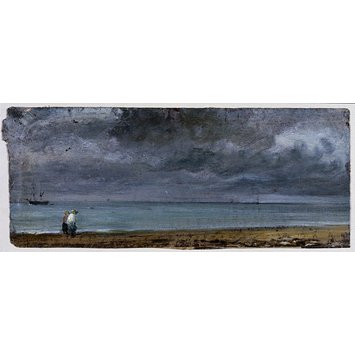
But then I found myself among the drawings in the V&A's collection, and I was riveted. Here there were people and scenes I could care about. There was clear craft as well as art, and surprising experimentation. A startling ink drawing which Constable made in old age caught my attention, and I looked with care at some of the tiny oil sketches he had made too. I particularly loved those of the seashore. I fell into conversation with people who had taken a different route to the museum and been distracted by the small Constables on their way to the installation. They were more knowledgeable than me and could trace the influence Constable had on twentieth century artists. I couldn't stay long enough but I want to get back to see the Turners and Constables again. It seems that my views of Constable have been unfairly limited by exposure to frequent reproductions of his paintings of Salisbury Cathedral and the Hay Wain.
So it wasn't the temporary installation that awoke my sense of wonder but the familiar seen anew. I left the V&A determined to return again soon - and on a Friday evening if I can.
Showing posts with label art. Show all posts
Saturday, 12 October 2013
Sunday, 4 November 2012
The satyr dances
I don't feel comfortable in Piccadilly. It's the province of the rich, who can afford its casual extravagances. Suited and cloaked doormen - they are always men - stand at the entrances of buildings. I would be reluctant to risk their contempt. In Piccadilly, Fortnum and Mason's is mid-range while Pret-a-Manger is dangerously down-market.
It's partly my uneasiness with Piccadilly that keeps me away from the Royal Academy exhibitions, and partly the high cost of admission. It's expensive even with an Art Fund card. But when I saw the picture of the dancing satyr, I knew I had to brave Piccadilly, pay the admission price and see the exhibition in which he appeared. It's called "Bronze" and bronze is the linking motif between all the exhibits. It's about the material and its qualities rather than a period of history or changes in ideas. Its focus is what stays the same.
It's not just the material that is a constant in the exhibition. There was also a repeated response to it from numerous visitors throughout the exhibition. The gasps of awed admiration began as visitors opened the door to the exhibition and saw the first piece: the dancing satyr, in a room by himself.
The satyr is a recent discovery, found by fishermen in the sea off Sicily only fifteen years ago. He's slightly larger than life-size and displayed so that viewers have to look up to him. After his long immersion in salt-water, he's acquired a greenish patina and a slight roughness. This only seems to aid the satyr's fluid movement. It's as though his ecstatic dance continued without pause, whether he moved through air or water. There's a smoothness about the curve of the limbs and body that made me want to reach out and touch him - but the flung-back head and the blank eyes speak of possession and tell the watcher to keep a distance.
So awe was there at the beginning and it continued. There are massive statues: of saints, statesmen and peasants. There is even Rodin's Age of Bronze which conveys uses the material to convey masculinity - or perhaps masculinity to convey the material. There are tiny works. Perhaps the most disturbing are the tiny copulating grasshoppers, whose image was cast by encasing them in molten metal. There are gods and domestic objects. Men ride horses, and panthers, battle monsters, suffer agonies of torture or gaze sternly on the world.
Women are less in evidence. There are goddesses and rulers; a stern and prickly Catherine de Medici, showing off the fashion of the day, is particularly memorable. There are grief-stricken madonnas and a wonderful South Indian sculpture of the infant Krishna with his wet-nurse Mukhara. And there are objects of desire - often small pieces presumably intended for private collectors. Venus (naked, of course) removes a thorn from her foot, a satyr uncovers a sleeping nymph and, in another piece, a satyr and nymph are engaged in enthusiastic sexual intimacy. It's a mark of the exhibition's focus on the craft of casting that my first thought on seeing this explicit and detailed piece was awe at the skill involved in creating so fragile a scenario in bronze. Most of the workers in bronze have traditionally been men, so far as we can tell, but two twentieth-century pieces by women sculptors had a considerable impact: a large Louise Bourgeois spider mounted high on the wall and a curved abstract piece by Barbara Hepworth, which seemed to echo the sea evoked in the dancing satyr.
It's impossible to go into detail about all that is wonderful in an exhibition so far-ranging. The Royal Academy has borrowed pieces from many parts of the world, inviting viewers to make comparisons across cultures and time. I found myself particularly struck by a small chariot from Denmark made of bronze and gold in the 14th century B.C. No-one knows its purpose or why the horse is placed within the chariot rather than pulling it along. It is tiny, delicate and magical in its incomprehensibility - and the gilding on the circle which may be a sun, a shield or a great wheel is a thing of wonder. And, as the films shown in the exhibition display, it was probably made by one of the two main methods still in use all over the world today.
Coming away from this exhibition, I knew it had changed something in the way in which I saw the world. It had encouraged me to make comparisons and connections across cultures. It had helped me look at art through the materials it uses rather than just the period in which it was made. And it showed me the flexibility of that material in conveying a huge range of emotions and evoking numerous responses. I wondered if there was any emotion it could not show or evoke. Then I realised what was missing from that range which included desire, ecstasy, pride, fear, admiration and awe. A word trickled into my mind and reminded me that one emotion and response had been absence. Maybe bronze is for every emotion, every response - except love.
It's partly my uneasiness with Piccadilly that keeps me away from the Royal Academy exhibitions, and partly the high cost of admission. It's expensive even with an Art Fund card. But when I saw the picture of the dancing satyr, I knew I had to brave Piccadilly, pay the admission price and see the exhibition in which he appeared. It's called "Bronze" and bronze is the linking motif between all the exhibits. It's about the material and its qualities rather than a period of history or changes in ideas. Its focus is what stays the same.
It's not just the material that is a constant in the exhibition. There was also a repeated response to it from numerous visitors throughout the exhibition. The gasps of awed admiration began as visitors opened the door to the exhibition and saw the first piece: the dancing satyr, in a room by himself.
The satyr is a recent discovery, found by fishermen in the sea off Sicily only fifteen years ago. He's slightly larger than life-size and displayed so that viewers have to look up to him. After his long immersion in salt-water, he's acquired a greenish patina and a slight roughness. This only seems to aid the satyr's fluid movement. It's as though his ecstatic dance continued without pause, whether he moved through air or water. There's a smoothness about the curve of the limbs and body that made me want to reach out and touch him - but the flung-back head and the blank eyes speak of possession and tell the watcher to keep a distance.
So awe was there at the beginning and it continued. There are massive statues: of saints, statesmen and peasants. There is even Rodin's Age of Bronze which conveys uses the material to convey masculinity - or perhaps masculinity to convey the material. There are tiny works. Perhaps the most disturbing are the tiny copulating grasshoppers, whose image was cast by encasing them in molten metal. There are gods and domestic objects. Men ride horses, and panthers, battle monsters, suffer agonies of torture or gaze sternly on the world.
Women are less in evidence. There are goddesses and rulers; a stern and prickly Catherine de Medici, showing off the fashion of the day, is particularly memorable. There are grief-stricken madonnas and a wonderful South Indian sculpture of the infant Krishna with his wet-nurse Mukhara. And there are objects of desire - often small pieces presumably intended for private collectors. Venus (naked, of course) removes a thorn from her foot, a satyr uncovers a sleeping nymph and, in another piece, a satyr and nymph are engaged in enthusiastic sexual intimacy. It's a mark of the exhibition's focus on the craft of casting that my first thought on seeing this explicit and detailed piece was awe at the skill involved in creating so fragile a scenario in bronze. Most of the workers in bronze have traditionally been men, so far as we can tell, but two twentieth-century pieces by women sculptors had a considerable impact: a large Louise Bourgeois spider mounted high on the wall and a curved abstract piece by Barbara Hepworth, which seemed to echo the sea evoked in the dancing satyr.
It's impossible to go into detail about all that is wonderful in an exhibition so far-ranging. The Royal Academy has borrowed pieces from many parts of the world, inviting viewers to make comparisons across cultures and time. I found myself particularly struck by a small chariot from Denmark made of bronze and gold in the 14th century B.C. No-one knows its purpose or why the horse is placed within the chariot rather than pulling it along. It is tiny, delicate and magical in its incomprehensibility - and the gilding on the circle which may be a sun, a shield or a great wheel is a thing of wonder. And, as the films shown in the exhibition display, it was probably made by one of the two main methods still in use all over the world today.
Coming away from this exhibition, I knew it had changed something in the way in which I saw the world. It had encouraged me to make comparisons and connections across cultures. It had helped me look at art through the materials it uses rather than just the period in which it was made. And it showed me the flexibility of that material in conveying a huge range of emotions and evoking numerous responses. I wondered if there was any emotion it could not show or evoke. Then I realised what was missing from that range which included desire, ecstasy, pride, fear, admiration and awe. A word trickled into my mind and reminded me that one emotion and response had been absence. Maybe bronze is for every emotion, every response - except love.
Saturday, 6 October 2012
After, and before
A colleague showed us a video from youtube. A newly-married couple came out of a church. The camera panned along the street. There was a brief glimpse of a young girl looking out of a window, curious to see what was happening. She could have been any girl of 12 or 13, watching the adult world and anticipating her own future. This young girl's life is well-documented and her diary is translated into numerous languages. Her name was Anne Frank. She wasn't quite sixteen years old when she died in Bergen-Belsen concentration camp.
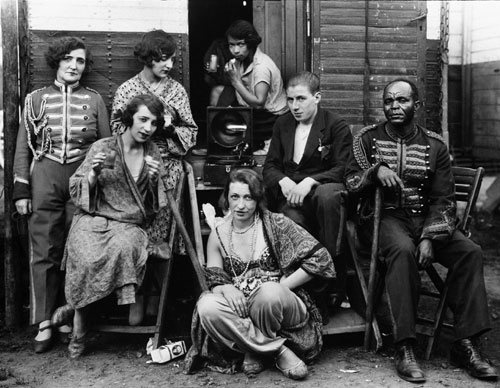
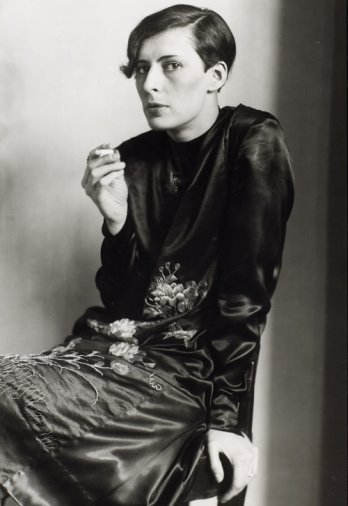
For most of the photographs of August Sander, now on display at Leicester's New Walk Museum, as part of a touring exhibition sponsored by the Art Fund, viewers can know little of how people began or ended. Sander's initial aim was to present a study of German life, using individuals to represent different types within German society. But however determined Sander's categorisation, the people he photographed resist being mere types. Some perform their occupations, often surprisingly. A farmer in the 1920s still ploughs with oxen Another, in 1952, sows seed by hand, scattering it from a basket. Others pose with the implements of their trade. Almost all gaze straight into the camera, leaving the viewer with no more information that the brief labels provide. The more I look, the more I understand the impossibility of reading a whole human being from a face.
I never have the sense that Sander's photography mocks or diminishes its subjects. I always see them as complex, interesting human beings. If I wish, I can build stories. I have to set those stories in the time through which they lived. Almost all of them were confronted by the dilemmas and persecutions of Nazism. But when I start wondering "How did that farm-worker vote?" or "What did that woman do when the Nazis came to power?" I can't answer the questions I want to ask. People's actions don't always harmonize with their faces. An SS officer in one of the photos of Nazis looks benevolent and slightly unsure of himself. His uniform does not.
I can and do make guesses. Some of the circus people in the photo above are plainly not Aryans. I hope they got away. I would like to imagine a happy future for the gypsies, the children with severe disabilities, those who are simply labelled "persecuted people" or "political prisoners." But I know most didn't get away. The exhibition ends with a portrait of the death mask of Sander's son Erich, who died towards the end of his ten-year jail sentence. Escapes are temporary. None of us ever walks out of history or politics, however hard we try. I wonder what future generations will think, if they ever look back on photographs, film and videos of the time in which we live.
August Sander didn't lead the life that was mapped out for him at childhood. He was supposed to be a miner. One day, working at the mine, he helped a visiting photographer and looked through the lens of a camera. He never forgot what he saw - the sky, the movement of clouds. That moment gave birth to one of the great photographers of the twentieth century. He was part of his time but the records he made speak to the future.
I have paid one visit to the August Sander exhibition so far. I hope to visit at least once a week while the exhibition is in Leicester. I want to look more closely at many of the portraits. I would like to commit them to memory, which is another way of letting the people of the past live on. I also want to spend more time on Sander's pictures of human hands and of landscapes.
But I can't spend too long in the gallery with Sander's pictures. There's too much humanity there, real people set to face a dreadful future.
I think if I stayed too long, I would cry.
For most of the photographs of August Sander, now on display at Leicester's New Walk Museum, as part of a touring exhibition sponsored by the Art Fund, viewers can know little of how people began or ended. Sander's initial aim was to present a study of German life, using individuals to represent different types within German society. But however determined Sander's categorisation, the people he photographed resist being mere types. Some perform their occupations, often surprisingly. A farmer in the 1920s still ploughs with oxen Another, in 1952, sows seed by hand, scattering it from a basket. Others pose with the implements of their trade. Almost all gaze straight into the camera, leaving the viewer with no more information that the brief labels provide. The more I look, the more I understand the impossibility of reading a whole human being from a face.
I never have the sense that Sander's photography mocks or diminishes its subjects. I always see them as complex, interesting human beings. If I wish, I can build stories. I have to set those stories in the time through which they lived. Almost all of them were confronted by the dilemmas and persecutions of Nazism. But when I start wondering "How did that farm-worker vote?" or "What did that woman do when the Nazis came to power?" I can't answer the questions I want to ask. People's actions don't always harmonize with their faces. An SS officer in one of the photos of Nazis looks benevolent and slightly unsure of himself. His uniform does not.
I can and do make guesses. Some of the circus people in the photo above are plainly not Aryans. I hope they got away. I would like to imagine a happy future for the gypsies, the children with severe disabilities, those who are simply labelled "persecuted people" or "political prisoners." But I know most didn't get away. The exhibition ends with a portrait of the death mask of Sander's son Erich, who died towards the end of his ten-year jail sentence. Escapes are temporary. None of us ever walks out of history or politics, however hard we try. I wonder what future generations will think, if they ever look back on photographs, film and videos of the time in which we live.
August Sander didn't lead the life that was mapped out for him at childhood. He was supposed to be a miner. One day, working at the mine, he helped a visiting photographer and looked through the lens of a camera. He never forgot what he saw - the sky, the movement of clouds. That moment gave birth to one of the great photographers of the twentieth century. He was part of his time but the records he made speak to the future.
I have paid one visit to the August Sander exhibition so far. I hope to visit at least once a week while the exhibition is in Leicester. I want to look more closely at many of the portraits. I would like to commit them to memory, which is another way of letting the people of the past live on. I also want to spend more time on Sander's pictures of human hands and of landscapes.
But I can't spend too long in the gallery with Sander's pictures. There's too much humanity there, real people set to face a dreadful future.
I think if I stayed too long, I would cry.
Monday, 4 April 2011
The Harrods of the ancient world
How could something so fragile last so long?
I gazed at the remains of brittle gold bowls and goblets. I could see where the stem of the goblet should be. The amazing thing is not that it has vanished but the thin, ridged bowl should have survived. I peered closer to make out the outlines of bulls on part of a bowl. A craftsman scored them gently into the gold around four thousand years ago. They are evidence of a vanished civilization of which little else is known. They come from Afghanistan.
I was hesitant about visiting the Afghan Treasures exhibition at the British Museum. I thought uncomfortably of conquerors, loot and triumphal processions. Exhibitions often arrive with an agenda, especially when they have been negotiated by diplomats. But this exhibition seems to have a gentler and more laudable cause. The British Museum has been restoring ivories that were stolen in the looting of Kabul Museum and recovered by an unnamed philanthropists. The British Museum staff have been working with the staff of Kabul Museum and the exhibition, however dependent on diplomatic goodwill and corporate sponsors, comes out of their joint work. The exhibition tells another story too – of museum staff who hid the treasures so that the history of their country could be preserved.
The history of Afghanistan is not well known. There is much that has not yet been recovered or understood. Western history books have tended to simplify the region as a place of romantic barbarism which briefly encountered civilization with the arrival of Alexander the Great. Alexander the Great, who married an Afghan wife and adopted local customs, may have viewed it differently.
So far as I can gather and recollect, the region had two reasons for importance in the world. It was a source of lapis lazuli, which was rare and much in demand. And although its terrain is difficult by contemporary vehicles, it stood on major trade routes, bordering India, China and the Persian Empire. Traders went as far as Greece and Rome, although the journey each way would have taken a year. The treasures they brought back, particularly to Begram, are protected in glass cases in the exhibition.
Captions show the uncertainty of the curators about the exhibits on view. There is a head of Silenus, clearly recognizable, but did the Afghans really know who Silenus was? Its unclear whether the owners of valuable items purchased deities or just attractive statues – rather as a modern mantlepiece may bear statues of Ganesh or the Buddha without necessarily demonstrating any religious allegiance or knowledge.
There's glass, too – Roman glass most probably or perhaps made in Egypt - the curators cannot be sure how it reached Begram from Rome since the way was blocked by war with Parthia. One piece is enamelled with full-length figures which even I can see are Roman in style. Another's delicately ornamented with vines made from the glass itself. But beside these are statues carved in turned ivory – chair-legs, the inscription suggests – each with a swaying female figure in what seems to me an Indian style. There are glass fish, a face that resembles a Greek or Chinese theatrical mask. There are Corinthian columns and finials. Some items must have been made in Afghanistan by craftsmen who had learnt skills from crafts practised elsewhere. But many items are imports, suggesting a place like Britain today where beautiful objects from all over the world can be prized and owned.
Half-way round the exhibition, I realised something else that was troubling me, though it's not unusual. I had little sense of the lives of the people who owned these objects, other than that they were very rich and could afford goods imported from far-off places. It was as if, one day far in the future, someone were to excavate Harrods and, finding only a few of the goods on show, tried to understand life today on that basis. Perhaps that is what has survived. Perhaps these expensive, traded goods represent the Harrods of the ancient world.
As I wandered through the exhibition, the past seemed both more distant and more familiar. I couldn't grasp past Afghan cultures but then, if asked, I couldn't give a simple account that took in the whole of west European culture today. Artefacts left by Afghan trading centres, which drew goods and influence from across the world, speak of a complex, varied society. This shouldn't be surprising or unusual. But I began to realise that many exhibitions treat the past as a collection of small, separate societies. They don't just assume that societies are culturally pure – they often treat cultural purity as something good in itself. The textbooks I studied at school were wary of cultural mixing. Rome's interest in things Greek was regarded with disdain although the Renaissance interest in Greek art and sculpture was excused as a means of regaining artistic purity after the confused muddle of the Middle Ages.
Looking at the wide range of objects on display and marvelling at their variety, I realised how much ancient history has been filtered through subjective and questionable value judgements. I suppose curators have to simplify – just as their displays provide the kind of neat, comforting pattern humans are trained to prefer. But in real life I like variety and complexity – and am glad that human existence resists a neatly moral narrative arc.
At last I neared the object I recognized from the posters for the exhibition: the gold crown once worn, so the captions assured me, by a nomad princess. I expected something bright and golden but I hadn't realised the tiny golden discs would tremble continuously, as though there were a breeze or breath inside the glass case. I read that the crown could be packed away and folded – and that all the nomad treasures, buried two thousand years ago, could be carried easily on horseback. In my imagination an Afghan princess rode through wild landscapes, the trembling crown on her head and a gold-studded cloak behind her. It's an improbable fantasy. I have no idea what the concept “princess” means in terms of nomadic people two thousand years ago - I wonder if the women were princesses in any way we can understand.
Little seems to be known of Afghan nomadic life beyond the six graves in Tilya Tepe. But the adornments found in the tombs of five women and one man link the items closely to the humans who wore them. It's not just the photos showing how the bodies lay when the tombs were opened or the glass case where the golden items mark out the shape of a human form. It's more to do with the sense that these items once touched living flesh and the the gold was caught on wisps of cloth the tombs were found. I peered as directed to see that the bracelets show signs of wear – in contact with an arm over time, gold diminishes.
The exhibition isn't big or cheap (I got in for half price – £5 – with my Art Fund membership). Space inside is limited because items are small and, when I visited on Saturday, that meant queuing briefly before reaching most cabinets. I haven't carried away a neat package of knowledge about an obscure culture. Instead I have grounds for wonder and wondering – more than enough.
Labels:
Afghanistan,
art,
culture,
Greek,
history,
London,
museum,
travel,
travellers
Tuesday, 15 March 2011
Against the dark times
I have succumbed to temptation again.
The Flying Goose café hosted one of its regular poetry readings and I returned with books by the three poets who read - Ann Atkinson, Alan Baker and Wayne Burrows - as well as books by the Australian Andrew Sant and the Dutch poet and children's writer Toon Tellegen.
As I carried my shiny treasures home I reflected that these are not the kind of books you see in Waterstone's. They come from small presses - Shoestring, Skysill and Smith/Doorstop - and are, like so many books from small presses, lovingly made. While mass market paperbacks can seem impersonal - made to fit in with a marketing officer's idea of what "brand" each book fits - small press books often show the personal care of the tiny teams that put them together. The smallest presses are run by people who make no money from them but work for pay elsewhere. The books small presses produce have a personality which seems to come from their close link with both publisher and author.
These carefully-crafted books and the skilfully-managed poems within them cannot compensate for the horrors on the news. The optimistic and peaceful protests in the Middle East seem to be ending in bloody repression and torture by regimes to whom the British government has been - and in most cases still is - selling military equipment. The threats and massacres that silence dissent have been knocked off the front page by the pain of Japan for which I have no words.
I can't look at the television for long - it's not just the sense of helplessness I experience that prevents me but the fear that if I look too long I'll be a mere voyeur - or worse, be hardened to ignore the devastation and anguish of others.
But literature (and art and music and many other sources of beauty and pleasure) still have their place in the world. I was reminded of this by a short blog message to her Japanese readers from the science fiction writer Ursula Le Guin, who posted at the request of her translator and friend. Reading this - and the first comment that followed - made me feel reassured that there is nothing wrong in the refuge I seek in words, art and music. These have many roles. They deepen understanding and cause us to question. They also nourish and console, in part because of the care with which they are wrought.
So I feel less bad about the joy I take in music on Radio 3, in sunshine, in books, in poetry. These good things exist in the same world in which humans and nature cause great damage. I'll campaign and write letters and even march against great wrongs. I'll try to work out how the world might be better and say what I think. I'll never have most of the answers but can try to contribute to debate and trains of thought - the more people share ideas and work together, the better hope for humanity. And I'll pay attention to things that are quite small and made with love.
This Saturday Leicester hosts States of Independence II, an independent press fair where small and independent publishers will display their wares and writers will read, talk and answer questions. It's a free, all-day event to which members of the public are welcome. It's a chance to celebrate words and the makers of books. However dark the world, these remain worthy of celebration.
Labels:
arms sales,
art,
books,
democracy,
freedom,
government,
Japan,
Middle East,
music,
poetry,
small press,
States of Independence,
torture
Sunday, 6 March 2011
The problem with patrons
I was almost impossibly tired when I arrived at the National Gallery. I'd had a good but busy week and was still recovering from the amazing and absorbing experience of hearing Alan Moore, the Magus of Northampton, read aloud from his novel-in-process. [Note to anyone who hasn't come across Alan Moore: he is not only a remarkable writer but also one of the kindest and most courteous authors I have encountered. His reading held everyone in a huge lecture theatre spellbound for nearly an hour and he spent a further hour and a half speaking to everyone who had queued to have their books signed.]
The day after Alan Moore, I was on my way to visit my parents, unsure I was sufficiently awake to take in the Gossaert exhibition but knowing that I was unlikely to find another opportunity to see it. I also had my new Art Fund card with me - at last I've fulfilled my resolution to join, not just for the very welcome benefits but also because I have benefited from the Art Fund through a lifetime of gallery visits.
The route to the exhibition took me past many familiar paintings. On one side I spotted a favourite Titian. Through the entrance to another room I thought I glimpsed a Vermeer. There was Murillo, staring out of his frame like a competent marketer of his own paintings.
In my susceptible state of mind, even Rubens seemed set to lure me from my path toward Gossaert. After all, Rubens was not only free but there were comfortable padded benches from which his work could be admired. (I don't usually admire Rubens that much.)
I forced myself to make the long trek to the basement of the Sainsbury wing where the Gossaerts were displayed. It was worth it. I realised that I had seen and admired individual paintings by Gossaert in the past but I'd never seen them in relation to one another before. I hadn't even registered the artist's name.
There are six rooms in the exhibition. Gossaert's drawings and paintings are complemented by the work of artists who influenced him - a startling range from Northern European artists like Durer to the classical tradition of the Italian Renaissance. Although he's only mentioned in the timeline at the start of this exhibition, it's easy to see Holbein as the heir of this remarkable combination of influences.
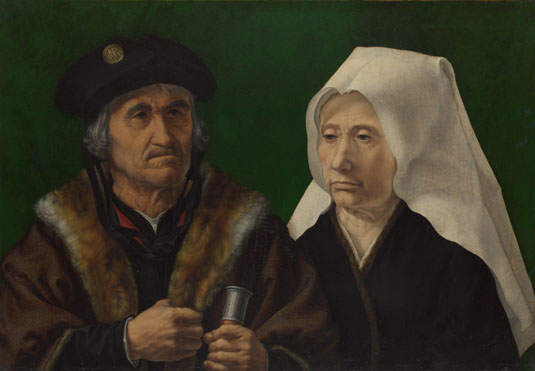
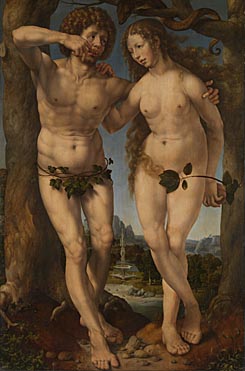
There's more to Gossaert than his portraits but these are the most obviously remarkable part of his work. The people he paints in portraits convince as human beings, simultaneously familiar and unknowable. This isn't just true of his secular portraits. There's a lavishly clad Mary Magdalen with sly glance and dirty fingernails. But he also paints relationships, including erotic relationships. There are various works showing Adam and Eve, including some copies of lost originals, but all convey an astonishing blend of tenderness and desire.
The work that stunned me most - and nearly moved me to tears - was a painting of Christ in the Garden of Gethsemane. It's a dark painting - even the red robes of the flying angel and the sleeping St John are barely lit. An elderly figure - St Peter, perhaps, lies on his back, asleep in the foreground. He has the pallor of exhaustion. But at the centre is the kneeling figure of a youthful Christ, beardless, confused and close to despair. It's not an attractive figure but terrifyingly recognizable. It's the expression of any child confronting an incomprehensible horror. It could be Libya or Afghanistan - or, too often, the U.K.
At the end of the exhibition I couldn't give an account of Gossaert. I had no sense of the man who painted the pictures, except that he could see and reproduce with pencil on paper or paint on canvas. He had, it seems, some human understanding that didn't take a verbal form. And he had the luck to be taken up by a succession of patrons who took him within reach of the influences he needed to develop his art.
It was luck. That's the problem with patrons. While Gossaert had the right patrons for his development as an artist, he was limited to painting what they required: a portrait of a marriageable daughter, erotic works for a private collection, an altar piece, a sketch for a tomb. There is no way of knowing what Gossaert would have liked to paint. It's lucky that some of his patrons' requirements suited a style that we can now appreciate.
It's luck too that has made me so familiar with the works in the National Gallery - the luck of living near a free art gallery and being encouraged by my parents to look inside. I was brought up to take advantage of free and cheap culture - to see culture as a good that should be shared.
It was shocking, therefore, to read, the day after my visit to the National Gallery, of a Labour MP calling for the introduction of admission charges to London's museums. He's not just any Labour MP. The Hon. Tristram Hunt, son of a life peer and a historian with a proclaimed interest in radicalism and the working class, has written an introduction to a recent edition of Robert Tressell's The Ragged-Trousered Philanthropists. In this book, Robert Tressell, through his main socialist characters, argues that culture is one of the necessities of life and should be available to all. I assume Tristram Hunt read the book before writing the introduction. It's a shame he didn't take in its arguments.
It's fair to say that Tristram Hunt wants free admission to the museums in his own constituency of Stoke-on-Trent and, by extension, to other regional museums. I think they should be free too. But I don't think the country's great art galleries and museums should become the preserve of the wealthy. And I'm not interested in any party that can consider excluding the poor from culture, which is not just an education but a means to nourish imagination.
Had there been a charge for the National Gallery, I might have visited once or twice when I was growing up. I know I wouldn't have gone there often - and I wouldn't have learnt much about the history of art. I remember when Mrs Thatcher introduced admission charges for museums and galleries in the 1980s. I was poor then and on many occasions I was stuck outside, wishing I could afford to go in.
Now I've joined the Art Fund. I make donations because museums and galleries were free in my childhood and it's time to say thank-you. If there had been a charge, I wouldn't have bothered. I'd have known museums and galleries weren't for the likes of me.
Labels:
art,
class,
culture,
economics,
exhibition,
museum,
New Labour
Tuesday, 26 October 2010
Seeing the naked youth
I also attended a reading at the first Beeston International Poetry Festival. I hope it's the first of many. The festival, organised by poet, professor and jazz-man John Lucas, offers bargain-price (£3!) and free events at small venues including shops, libraries and the splendid Flying Goose café which also hosts a series of literary events through the year. I hope to attend further Beeston poetry events and will blog about them later. This paragraph should be seen as a taster and an advertisement for the rest of the festival – details can be found by clicking here.
However the major event of the cultural calendar – at least as far as the national press is concerned – must be the arrival of the British Art Show, In The Days of the Comet. It's a quinquennial event and this year it opened in Nottingham, taking over four venues: Nottingham Contemporary, Nottingham Castle, the New Art Exchange and One Thoresby Street. By luck, I found myself invited to the preview and finally well enough to take advantage of the invitation.
Previews are strange events, half party and half excitable tour of art. There are speeches too and, as I walked up the stairs towards the Long Gallery at Nottingham Castle I realised that listening to speeches would be the first part of my duty. At first the combination of microphone and echo so distorted the sound that I was reminded of the opening of Chaplin's City Lights. Perhaps they aren't speeches at all but an installation, I reflected. But they were speeches and, as I moved round the gallery, the sound became clearer. There were several references to the cuts and quite a few to “bonking bunnies”. “In the Days of the Comet” seemed an apt title for the show – if the Comet was a metaphorical reference to George Osborne's hacksaw.
There was something strange about the roughness of the art in the 19th century grandeur of Nottingham Castle. But hints of destruction also seemed apt both for the castle's past - the locals set it alight and watched it burn in the Reform Bill riots of 1831 - and for current anxieties. "It feels like the end of days," a colleague remarked a week or so ago, and her words chimed so well with my own feelings that they have haunted me ever since.
While some works were carefully wrought - sometimes for wealthy patrons - others spoke of change, anger and destruction. I couldn't see all the art clearly for the crowds at the preview and have decided to go back and see the exhibitions again when they were less crowded. I certainly couldn't give the video installations the time they demanded. But I was mesmerised by a mysterious monochrome work with people and peacocks that turned out by a tapestry. And I gazed at what appeared to be a cross between a bombed and deserted house and the kind of cart tugged through battlefields by Mother Courage. It was fragile, dilapidated and strangely beautiful.
Downstairs in the castle café there was free champagne, provided by the exhibition's sponsors, for any visitor with the patience to get through the crush. I met my friend Katie there and we savoured a moment of cool luxury on the castle balcony before returning to look once more at the art.
We were both tired - Katie had come straight from teaching - so decided to leave our visit to the New Art Exchange for another day. Instead we made our way to the Nottingham Contemporary which was also so packed that it was sometimes hard to view the exhibits. I was pleased to find work by the remarkable Alasdair Gray on show - I'm so fond of his fiction that I often forget that he's an artist and designer as well. I hoped to spot him among the hordes but, if he was there, I didn't see him.
Tiredness induced frivolity. Katie looked at what appeared to be a giant teddy-bear's head made out of canvas and wondered if it would be possible to use it for camping. We inspected the guy ropes and looked for tent flaps before sadly concluding that there was no useful entrance to the main space. Then I saw the fire.
It was plainly meant to be there. As I approached I could see that the flame occupied part of a metal park bench. Perched next to it was an extraordinarily accurate life-size model of a bearded young man wearing only a pair of blue y-fronts. As I got closer, I realised that it was not a model at all but a young man, sitting very still and gazing at the flame beside him. There's something strange about being invited to stare at a semi-nude man in an art gallery. I became aware of textures, flesh tones, the unnevenness of toes, softness, imperfection, vulnerability.
Katie and I read the notice together. It informed us that the flame would be lit once a day and that, once a week, it would be tended by "a naked youth." "But he isn't naked," I whispered to Katie. She instantly urged me to complain. But how could I complain to a still youth who was involved in a work of art?
Katie considered other grounds for complaint. He wasn't tending the flame, merely watching it. As if to reinforce her comments, the flame extinguished itself and went out. We wandered back in the direction of the youth, who had started engaging in conversation with visitors. But we were too late. Just as we arrived at his bench, a curator appeared holding a dressing gown which the youth put on before departing round a corner.
We saw the youth later, in the bar. By this time he was wearing a check shirt and looking cheerful. Frivolity was taking over. Katie drew my attention to the visitors' shoes and fashion sense. Then she suggested we were too tired for more art - and indeed we were. We headed, briefly, to a cocktail bar before going home.
It's comforting to know that the exhibitions continue till January. That should give me the opportunity for several visits. I may even attempt a more serious review. In the meantime, the first newspaper reviews are being published, and they're good.
Thursday, 16 September 2010
Balzac's cafetiere

Much as I love Victor Hugo, I can't commend his taste in interior design. The intricate elaborations and extravagances that delight me in his prose style seem heavy and unnecessary when used to decorate a room. The reconstruction of the sitting room he designed for Juliette Drouet in Guernsey – moved to the Maison Victor Hugo on the place des Vosges – leaves me filled with admiration for Juliette's patient and tolerant love. I hope for her sake that Hugo's wife had more of a say on domestic interiors.
I returned to the Hugo house and the Musée Carnavalet, wondering if I would view them in a new way after reading Hugo novels and histories of Paris. Although I saw them with greater knowledge, it was the same things that struck me. In the Hugo house I lingered over his drawings, letters and the display connected with the death of his daughter, drowned when travelling with his new husband. I noticed a poem about her which I hadn't observed before, written for the fifth anniversary of her death – and, because such things trouble me, I wondered how I might translate it, given that the final stanza sets an impossible task. The rhymes give way to exact repetition: “tombe” is used first in its more usual sense of “fall” and then with the meaning of “tomb” while the second rhyme, which matches the place, Harfleur, with “fleur,” the word for “flower,” ends the poem on a lighter syllable than any English equivalent I can imagine. I suspect I'll keep returning to this poem for many years, as I do to Callimachus's recollection of Heracleitus and Catullus's early declaration of passion for Lesbia. I don't expect to solve the problem.
In the Carnavalet it was again the section on Revolution and war that held my attention longest. I noticed how the thoughtful declarations of rights gave way to the rigid imposition of a military discipline which forbade all question. The words “Liberté, Egalité, Fraternité” seemed out of place on a soldier's drum. Once again I admired the souvenirs made from the stone of the demolished Bastille, especially the doll's-house-sized solid model of the Bastille itself. But I wanted more – Paris deserves a bigger museum, though none would be sufficiently complex to do justice to the city's history and people.
But revisiting museums wasn't enough for me. With my urge for self-education, I looked at the list of Paris Museums and settled on Balzac's house. My reading of Hazan's book on Paris (not yet finished) has made me guiltily aware of how little French literature I have read. Although names from Balzac's fiction lurk at the fringes of my awareness, I don't think I've ever read any Balzac novel. His name and the titles of his books are heavily forbidding as were the pictures on the covers of the black-backed Penguin classics editions. I assumed the house would be a similarly forbidding presence but found a simple bus route with the aid of my Indispensable.
The street was steep, lined with tall and heavy houses, dating, I would guess from the late 19th century. There was nothing of the lightness of the Montparnasse apartment blocks. I counted my way by house numbers. The quiet in the street was almost oppressive – evidently there was no rush of devoted Balzac enthusiasts.
I passed a striking and very heavy 19th century building and then, just as the numbers told me I was reaching Balzac's house, there was a gap in the buildings, a garden and a small, light, white building with a grey roof and green window-frames and shutters. It looked like a bungalow and, compared to the heavy surrounding buildings, could have been an elaborate shed. The garden was small but delightfully leafy with archways and paths. Sitting there you would believe yourself far from the city, until you looked up to see the Eiffel Tower.
A few steep steps took me into the Balzac house and an interior as quiet and calm as the garden. It seems that Balzac liked quiet. His house was simple – not a bungalow, as I first thought: the uneven terrain meant that the main living quarters were on the upper floor, which led to the garden, but there was also an airy lower storey below. I decided that I would have liked to live in Balzac's house. He had a fine desk and chair. I could imagine myself sitting there and getting things done.
I found his method of working sympathetic too. He would start writing at midnight when the city was cool and quiet, and work through till 8 in the morning, fuelled by coffee from his personal cafetiere. I admired the cafetiere. It's now kept in a glass case, which makes it hard to photograph. I'm not entirely sure Balzac should have added his initials. Perhaps he wanted to make sure no-one walked off with his coffee-making equipment. I can understand that. Anyone would feel possessive about so fine a cafetiere.
As an additional and unexpected treat, the house offered the screening of a complete Japanese “ganime” version of Balzac's early novella “La Grenadiere” directed by Koji Fukada. I was charmed and moved by the fusion of pictures, music, Japanese voices and French subtitles. I'd love to find a copy for myself so that I can share it with friends. At the moment all I can locate is the trailer on youtube.
After leaving the Balzac house, I sat in the garden for a while, enjoying the light breeze and soft fragrances. Eventually I left, walked up the road past the late 19th century apartment blocks and caught a bus that would take me across the Seine and towards the Eiffel Tower. As I walked, I resolved to buy and read something by Balzac. I doubt it will surprise and delight me quite as much as his house.
Friday, 30 July 2010
In black and white
Looking back, I think my first encounter with the photos of Diane Arbus must have been in one of the glossy Sunday supplements – the sort with shiny paper that makes everything ravishing, even grief and poverty.
I don't know if the glossiness conditioned my response to Arbus, whether I was influenced by the accompanying text or whether it was the work itself that upset me. Her stark, black and white photos of poor people and people with disabilities – people who would never buy a glossy Sunday supplement – seemed to have the glamour and allure of a freak-show. I shuddered and looked away.
News of a forthcoming Diane Arbus exhibition at Nottingham Contemporary disappointed me. It seemed less interesting than the accompanying, more recent work by the Tobias twins. The brochure, with colour pictures of Tobias paintings, also suggested they might have more to offer although the one Arbus reproduction, of twin girls, haunted my imagination.
Accompanied by a friend, I looked at the Tobias works with curiosity and baffled amusement, which may be the response the brothers hoped to evoke. Many seem like a cross between a kitsch version of folk art and a Gothic, Transylvanian Disney. My strongest emotion in their presence was an amused affection. I drifted on to the Arbus rooms and was transfixed by something I hadn't noticed in that early encounter with her work: tenderness.
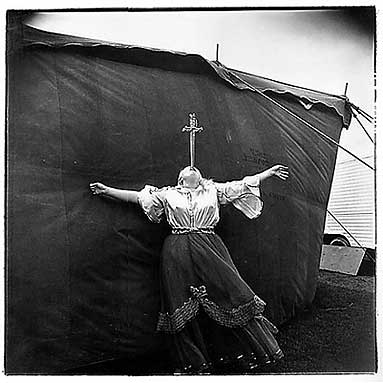
It wasn't in all the photos. Some, especially those of over-dressed rich women, seemed to expose their subjects to ridicule. I thought I glimpsed cruelty in the curve of the lips of a masked man. But in other pictures there seemed more gentleness and respect than I expected. I noticed how one of two drag queens, dressing or undressing for their act, seemed to reassure the other with a touch. I saw the dignified melancholy of a tattooed man, gazing into the distance beyond the camera. The albino girl, arms outstretched and head back as she swallowed a sword, seemed in control of her pose as she mirrored a crucifixion. So many of the subjects, often strange to the viewer or on the fringes of society, seemed to convey an inexplicable depth. Even the photographs of nudists seemed about much more than the nakedness of the subjects.
Some photographs still disturbed. I worried that the children might have disliked their portrayal – who would want to be shown in a gallery as “fat girl laughing” or to be famous as a skinny, laughing boy clutching a toy hand grenade? The extreme close-ups of babies' faces turned them into dolls or death masks. But when I came to the photos of people with disabilities which had so disturbed my teenage self, I began to ask other questions.
The subjects I'd characterised as a “freak show” looked out at me with self-confidence. They seemed as happy as any of the sitters to be recorded. So what exactly had disturbed me? Did I really think that photography was only for the beautiful, the confident or the normal (whatever that was) unless it had a proclaimed manifesto to change the world? These people just were – and were recorded.
This took me back to the photographs of August Sander and the records he made of Germany in the 1920s and 30s. Before Arbus, he had photographed people in fairgrounds and institutions, apparently letting them arrange their own poses before the camera. It was impossible to look at his photographs without the knowledge Sander lacked. I wondered how many of the people he recorded had been imprisoned, abused and killed in the Nazi regime's euthanasia programme, in concentration camps and in the bureaucratically-ordered extermination of those in the “wrong” racial groups.
My sense of recording and the influence of Sander became even stronger when I returned to the gallery for a guided tour by Alexander Nemerov, Arbus's nephew. He talked about her focus on the subjects of her portraits and the way she documented them as though in the face of impending catastrophe. I reflected later that Arbus looked more for a variety of individuals in every setting while Sander, though recording individuals, saw them more as representatives of types.
There are still problems with photography and the act of recording. For many people, the fact of being recorded and visible places them at risk. I can't help wondering whether any harm came to the subjects of Arbus's photos. It wasn't easy, in the 1960s, to be a mixed race couple, even in New York – and Arbus's caption makes it clear that the couple are married and the wife is pregnant. I wondered if the transsexuals and transvestites later regretted giving so much away or whether the disabled people in the institution suffered discomfort from the response to the publication of the photos. A photographer can try to achieve neutrality and simply observe, understandingly, a range of subjects. But as soon as the photographs are on display they enter an environment that is not neutral and which is all too eager to judge and condemn the lives of others.
Too many people still face a choice between vulnerability and invisibility. On any day I can say, without hesitation, which I would choose – but my answer isn't always the same.
Labels:
art,
exhibition,
Nottingham,
photography,
power,
voyeurism
Wednesday, 9 June 2010
The watchers

There's a right length of time for looking at a picture. Some demand lengthy, careful views. The Adoration of the Mystic Lamb in Ghent Cathedral rewards slow appreciation. It's worth sitting before Rembrandt's The Night Watch in the Rijksmuseum in Amsterdam or standing for a long while before the Breughels in Brussels' Musée des Beaux Arts or the classical scenes by Claude Lorrain in the Louvre.
Even some portraits are made for time-consuming adoration. These are usually pictures of the powerful, commissioned to demonstrate their finery as well as their faces. But the poor as well as the rich can seem in control of their images. Murillo's street urchins often display the confidence of the young and free. Even Goya's Maja, clothed or naked, seems in control of how we see her – as does Lucian Freud's model Sue Tilley, the Benefits Supervisor.
Elsewhere the subjects of paintings see less happy with the viewer's gaze. There are nudes by Titian whose lowered or averted eyes can cause discomfort. And I can never look at portraits or even staged domestic interiors by Vermeer for long. The framing of the paintings always brings me slightly too close – I'm forced into the scene like an intruder, as I am.
This history of looking was at the back of my mind as I dithered in the entrance hall of Tate Modern. I couldn't make up my mind about the new exhibition. Not only was the entrance ticket £10 – very high by East Midlands standards, especially for a show of photographs and videos – but the subject itself made me wonder whether I ought to look. The exhibition is called Exposed and the material it shows is grouped around themes of voyeurism and surveillance.
At first I decided I wouldn't look. I'd taken the long escalator to the third floor when I changed my mind and returned to the entrance. The escalator journey felt too much like running away.
There was, of course, something uncomfortable about so many photos grouped around such a theme. Few of them on their own would have sparked such concern even though some areas were banned to under-eighteens because of their sexual subject.
But sex and violence are too familiar to shock. Even the napalm picture, with the running, naked girl (her clothes burnt off) in a world beyond fear and pain, has been reproduced so often that I'm now immune to the horror. I was more moved by the photo of Jackie Kennedy with the new president Johnson and his wife. She seemed numbly vulnerable as she took on the unfamiliar role of presidential widow – beyond comfort and open to the camera's exploitation.
Elsewhere too the camera's glance was surreptitiously controlling. I was disturbed by Walker Evans' pictures of travellers on the New York subway, some tired at the end of the day and enjoying private rest in the carriage's public space. The photos were taken, before the Second World War, with a camera concealed in a coat-sleeve so that no-one could object. All the subjects must be dead by now. For all I know they would have liked the idea that gallery visitors would pay the unbelievable sum of £10 to see their faces – it's a kind of immortality.
Having seen the subway photos, I was initially suspicious of the work of August Sander as he posed and classified “types” - by profession, disability, social status – in his project to document the layers of German society. But as I looked at the individuals he photographed with such care, I warmed to him. The pictures seemed to be the product of a kind of negotiation between photographer and subject. Most of them gazed back at the photographer with the confidence of people who had chosen their pose. There were exceptions of course: the boy labelled “idiot” or the blind girls, sitting together at a school desk. They were photographed in the mid 1920s and despite the labels the children appeared individuals. I wondered what happened to them after the Nazis came to power. Sander's sympathetic categorisation reminded me of the Nazis' brutal hierarchy of types. Yet the Nazis disapproved of Sander's project. His son Erich, a socialist, was imprisoned in the early days of the Nazi regime. After many years, Erich died in prison. Sander photographed his son's death mask.
Of course the exhibition disturbed – it was meant to. But it was far less disturbing than the film I saw two days before, Renzo Martens' Episode 3: Enjoy Poverty.
Martens' film explores poverty in the Congo – the sort of daily, agonising poverty that causes children to die painfully of slow starvation. But it's not like the kind of TV documentary that ends with an appeal to send money, offering the comforting, self-congratulatory reflection that we in the west are nice, charitable people. This begins with a man in the Congo complaining about poverty as he works and angrily showing his small daughter's sores – a result of malnutrition.
At first the film seems a tourist's journey through poverty in which Martens' occasional efforts to understand what he sees don't measure up to the reality. He seems too innocent, too polite. But the guns of the U.N. peacekeepers disturb as do the sharp suits of the wealthy.
But it's easier to look at the powerful than the underpaid workers whose children die so that people like me can buy goods cheaply. And then there's the war and the photo-journalists who follow war and starvation, looking for a scoop. They cluster together with their expensive, heavy cameras, each trying to find the best lighting and angle for a picture of a corpse. The going rate for a publishable picture is $50, on top of the travel and expenses already paid to the photographers. Martens, playing the innocent, asks a photographer a series of questions. Who owns the picture? Do the people in it – or the relatives of the corpse - earn money from it? What pictures sell?
Of course, it's the photographer who profits. The poor children, who aid workers strip and arrange for the camera, get nothing. So Martens reaches his conclusion. Congo has few assets apart from poverty. If the people of Congo are to profit, they must learn to exploit their own poverty. He finds two Congolese photographers, making a small living from pictures of festivals, birthdays and weddings, and urges them to change their subject, telling them that the highest profits come from photographing the dead and injured, raped women and starving children. I'm used to seeing such pictures but I've never before had to sit uncomfortably still while the subject's pose is adjusted and the photographer closes in for the most affecting and aesthetic angle.
There were questions and answers after the film. Martens insisted his work changed nothing – it was art, not politics. But he made a telling comparison with Jonathan Swift's “Modest Proposal,” identifying the film as satire based on a horrible truth. And he said there would be no change because there was no will to change. The people in Congo thought that if those on the outside saw what was happening, they would act – they would not allow such suffering to continue. But there is no outside – we're all in the same world and those of us with power to act do nothing because we benefit from the same system.
Meanwhile, for reasons we cannot bring ourselves to comprehend, pictures of pain and suffering are bought in the west as though they were things of beauty. And the sufferers get nothing for them.
Thursday, 3 June 2010
Eliza and the Court of Miracles

In 1885 a tall, red-headed Irishman stood on a street corner in London selling copies of the Pall Mall Gazette. His name was George Bernard Shaw and he was one of many volunteers selling a newspaper publicising a story so scandalous that the usual distributors refused to stock the paper.
The story was headlined “THE MAIDEN TRIBUTE OF MODERN BABYLON” and it told the story of how W.T. Stead, the editor of the Pall Mall Gazette, had joined forces with the repentant madam of a brothel to purchase a girl of thirteen from her father. He didn't intend any harm to the child. He simply wanted to prove the truth of tales he had heard: that, in the poorer parts of London, parents sold their virgin daughters into prostitution. The response of the authorities was swift; Stead and his assistant were arrested and sentenced to terms of imprisonment for assault and child-abduction. But the scandal brought about the result Stead desired. It drew attention to the existence of child prostitution in Britain – and parliament passed an Act which raised the age of consent from thirteen to sixteen.
Of course, it wasn't as simple as that. The Act expressed all kinds of moral prejudices of the time – and it was the same Act that made homosexuality illegal. Ten years later, Shaw's fellow Irishman and playwright, Oscar Wilde, was sentenced to two years' imprisonment with hard labour under its provisions.
Even the case of the child sold into prostitution may not have been as simple as it seems – journalists (and many others) have been known to distort and exaggerate facts in order to prove something they “know to be true.” Shaw may have come to this conclusion himself by the time he wrote Pygmalion in which the entirely willing Eliza, who shares a name with the child in the “Maiden Tribute” case, is sold to Professor Higgins by her father for five pounds. These are his “rights as a father,” Alfred Doolittle insists. Five pounds is exactly what Stead paid for the earlier Eliza.
There are numerous myths about what Shaw calls, in the Victorian phrase, “the undeserving poor.” These myths both console and terrify the better off. The idea that the poor are feckless and immoral, prepared to sell their own children at a fiver a time, suggests that charity is always misguided, equality a dream and that what is needed is containment and control.
Paris has another myth (though it isn't limited to Paris): the myth of the Court of Miracles. Colin Jones' history of Paris considers the potency of this myth in the seventeenth century. It tells of a dangerous alternative society thriving in Paris since the Middle Ages – a society of beggars and gypsies who adopted disguises – false wounds, apparent blindness – to exploit the charity of the hard-working bourgeoisie. The Court of Miracles was supposed to have its own king and laws governing this exploitation – and the so-called beggars were not poor and maimed, as they appeared, but living a life of luxurious indolence.
The myth falls apart as soon as it's examined. The beggars are supposed to be simultaneously disciplined and hard-working (as the rules of the Court of Miracles demand) and fecklessly lazy. As Colin Jones points out, the Court of Miracles never existed – though some beggars may have been fakes and liars. But the myth gave Louis XIV the excuse he wanted to round up paupers, beggars, the sick and corral them into hospitals. His main concern was making the streets safe for kings and their courtiers. As the French Revolution shows, this wasn't a complete success.
There are similar myths elsewhere. In the 18th century John Gay's The Beggar's Opera picked up the idea of the Court of Miracles and sets it in London – and Bertolt Brecht's Threepenny Opera gave the story new, even more richly parodic life. The thieves and beggars in Gay and Brecht don't inhabit a space as large as the Court of Miracles but they still combine idleness with industrious trickery. They seem to live outside the law – but at the same time they obey a different, equally strict code. They sing and dance too – it's a fine life being a thief and a beggar.
The myth of the Court of Miracles still flourishes. There are undoubtedly crooks and con-artists among beggars and the poor – just as the rich have their tricksters, whose deceptions are coming to light with the collapse of the markets. As a story, it's a delight – the fortunate who are neither poor nor beggars revel in its freedom - but it's also a dangerous excuse for repression, and for failure to see an equal humanity in the faces of the unlucky who need help and justice.
The story W.T. Stead tells in “The Maiden Tribute of Modern Babylon” cannot help relying on the myth of the dangerous poor – the myth is too potent to avoid and the poor know it as well as the rich. His newspaper article is a rich mix – it starts with a lengthy and richly imagined account of the labyrinth in Crete and ends with the scream of a child. He insists that he doesn't oppose the freedom of the libertine rich, so long as the vulnerable poor are protected. He insists that the rich who prey on the young are his main target. Yet his account of the disorderly poor, who know just where to sell their daughters and whose profit is governed by a parody of market forces, recalls the Court of Miracles' parody of the establishment of its day.
Stead believed his own story and undoubtedly there were cases of child abuse, then as now. He served three months in jail for abducting Eliza – the repentant brothel-keeper who helped him served six months. I don't know what happened to her after that. Stead's fame as an editor was secured until his death brought him another kind of fame – he was drowned when the Titanic went down. As for Eliza – not Shaw's Eliza but the original girl – Stead gave her to the Salvation Army for safe keeping. They eventually returned her to her parents, judging that she was not at risk from them. I don't know what happened to her after that.
Saturday, 15 May 2010
Border police

From England, borders seem simple. There's sea. Motorway signs proclaim “Welcome to Scotland!” and “Croeso y Gymru” but passing these isn't a serious matter – even in Orkney or on Anglesey we're still in the United Kingdom.
Hadrian's Wall is a reminder of what a boundary might be but its watch-towers and forts have crumbled. Walking the path of Roman border patrols has become a challenge or delightful ramble. Sheep graze nearby and children scramble across what is left of the frontier. Like so many monuments built to control the neighbourhood, it's been reclaimed by the locals for tourism and play.
Maps tell another story. Boundaries are clear-cut – black lines that separate pink from green and yellow are as obvious as a railway track. There are even lines parcelling up the sea and white wildernesses governed by penguins and polar bears. In maps, boundaries are as unavoidable as the kiosks in which uniformed guards check and scan the passports of tourists.
Of course, I knew it was more complicated than that – just I knew there were nomadic people and people whose sense of nation and community crossed arbitrary frontiers. For years I've been fascinated by Auden's poem about the partition of India. The older Auden isn't often thought of as a radical poet but that poem is as critical as any I know about the cowardly bureaucracy of colonialism.
But I hadn't really thought about the no-man's-land crossed by migrants and patrolled by bored armed guards until I saw Ursula Biemann's video installation at Uneven Geographies, the latest exhibition at Nottingham Contemporary. Watching the guards in a nearly featureless desert, I suddenly saw the world from a perspective much closer to the migrants'.
The guards knew where the border was. There was a pile of stones here, the remnants of a building there and a railway line dividing to cross two indistinguishable pieces of ground. Sometimes the guards watched. They moved through crumbling buildings. At other times they just stood. One held a bunch of keys close to his waist. One drank water from a bottle. Dust and discarded plastic blew past them. They waited for the migrants to arrive.
The story was told of a Dutch tourist who found himself on the wrong side of the border. He was arrested and held for ten days. His belongings were confiscated. He never saw his car again. The story was routine – worth telling only because the man was an accidental migrant and a European. For those who cross frontiers these are everyday hazards.
Hunger and thirst don't stop the travellers. In another video, an imprisoned migrant told, without surprise, that ten men in his group of seventy had died of thirst when crossing the desert. The men who survived drank their own urine. They arrived and were imprisoned. They waited to be sent back – and to set out again.
Ursula Biemann's videos focus on the sub-Saharan area where the nomadic routes of the Tuareg have become the paths which migrants travel. She shows the practical demands of migrant life and the optimistic determination of travellers who are convinced life has more than poverty to offer.
Near the videos there's a series of photos of Tangier by Yto Barrada. One shows a football game on a run-down hard pitch in Tangier. The pitch is surrounded by torn wire. In the foreground a boy is making his way through a hole in the wire towards the players – it's another permeable boundary.
Between the photo and the videos, I began to see boundaries in a different way. I thought of the times when, as a child, I saw a boundary as a challenge. When my brother and I were small we liked to “go trespassing,” which meant entering any area where signs said we were forbidden. Building sites and college grounds were alluring. Most fascinating of all was an old air-raid shelter which I think we entered once – but I dreamt of it so often that dreams have obscured the reality. I can't recall exactly where the air-raid shelter was.
I still want to travel and see new places. Work and family detain me in Britain but I'm not rooted here. The film of the border guard awoke my migrant self. I realised that there aren't so many differences between me and the Africans setting out on their risky journey. I have some luck: the security provided by my red British passport and respectable appearance. I can book my journey on the internet or ask a travel agency to find me a tour and a guide.
The exhibition Uneven Geographies was worth visiting for the way it exposed and displaced my assumptions about boundaries. There's more to the exhibition than that. Delicate diagrams sketch out webs of financial power – webs so complicated it seems impossible to break free of them. The webs date back to the 1970s – it's all so much more complicated now. There are installations, photographs, displays. So many achieved a small adjustment in my way of seeing the world that, by the time I emerged, I was reeling.
Behind all the works is the net of global economic interests which holds us all. The exhibition lays bare the ways in which the rich west depends on people in other continents and the devastation of the earth. I'm haunted by new ways of seeing, in which the west is no longer central. I feel displaced from my safe, convenient way of life.
That doesn't mean I see a way out of the net. Neither vision nor analysis shows a way of adjusting the huge imbalance of power. But seeing differently still feels right and worthwhile. This is the first exhibition at Nottingham Contemporary that has changed my ideas.
Labels:
art,
economics,
globalisation,
money,
Nottingham,
politics,
power
Saturday, 27 February 2010
Shopping and space

I bribed myself to go shopping. If I forced myself into clothes shops, tried on jeans and actually purchased a pair, I would allow myself to revisit Nottingham Contemporary's current exhibition, Star City: The Future under Communism.
Even with the bribe, it was difficult. However I suddenly found two pairs of trousers that would do. My mood lightened as I climbed the short hill to the gallery.
It wasn't my first visit to Star City. I popped in on Light Night, the very first day it was opening, but didn't stay long. I wanted a range of Light Night experiences - and found them in the jitterbugging skeletons, a candlelit church, a free Schumann recital, giant insects in the castle grounds and fencers in the Long Gallery of the castle itself. Most of the Light Night events were for one night only. I knew I could return to Nottingham Contemporary.
The exhibition itself is a puzzle. Perhaps this is as it should be since many people of my generation and older are puzzled by their own reaction to the loss of the Soviet Union and the fall of the Berlin wall. We knew a great deal was wrong with the Soviet Union - I grew up aware of the show trials, the events in Hungary and saw the first black-and-white footage of Soviet tanks arriving in Prague. I haven't forgotten the name of Jan Palach.
Yet while the the smart-suited bureaucrats and party officials made speeches that betrayed their followers' ideals and their own lack of conviction, there seemed to be another Soviet Union composed of the dreams of many who wanted a different, better life. Those dreams - of comradeship, freedom from want, real involvement in the government of a country, hope for the future - still seem worth preserving. I don't believe that I live in the best system there will ever be, nor that freedom to shop is a major test of liberty.
A couple of the more recent works at the gallery seemed to equate consumerism with democracy. I wasn't sure what point Diango Hernandez was making by using elderly kitchen appliances to vibrate to a speech by Castro in morse code. I had a slight suspicion that my reaction - "I like the look of that blender" - wasn't quite what the artist hoped. But other exhibits let me remember and reflect.
The Soviet posters of the space age recalled the excitement I felt on hearing that Yuri Gagarin had become the first man in space and the thrill in learning just two years later that a woman, Valentina Tereshkova, had also become an astronaut. I didn't particularly want to travel in space when I grew up but I liked the sense that it was possible. The posters had the bright excitement of Janet and John books or Sunday school displays, infused with the glamour of space and Cyrillic script.
It was disappointing, therefore, to find that the Light Night opening featured two pretend Soviet astronauts at the entrance to the gallery. They played at space walks, called everyone "comrade" with exaggerated accents and treated the whole thing as a grand joke, as though going into space was nothing and seeking comradeship an absurd archaism. I wasn't angry but something inside me was hurt. Perhaps I still cherish a lost dream after all.
Elsewhere the exhibition was more complex and harder to put in words. I was reminded of Leon Rosselson's song "Wo sind die Elefanten?" which can convey its sense of loss only through an absurd sentence from a German language course. The gallery had several huge exhibits but I spent most time with a series of small illustrations by Ilya Kabakov, produced in the late Soviet era and called "The Flying Komarov." These pictures, which started in a cupboard and moved on to a world in which most people flew, seem to speak of hope for liberty and the importance of dreams. They allow space for the viewer too - not outer space but inner space to interpret and question.
I haven't given Star City all the time it needs. I'll be there again, wondering what to make of it all. I can drop in again and again - that's the benefit of a free gallery.
I'll go on thinking of the dreams we build about other countries and our own. It's not the dreams that are wrong. But across the world there are leaders and would-be leaders who twist those dreams to a hateful shape for the sake of riches and power.
Subscribe to:
Posts (Atom)