First there was one bell. It wasn't the tone of a church bell nor a small tinkling sound - and it didn't come from the usual chords of the musical stave. It came from somewhere behind me, compelling and mysterious. After a while another bell joined it. Then I saw the musicians, entering the theatre from different points but creating working together to create a soundscape in which they and the audience existed together. It was as though we entered another form of space, a place in which sound was chief among the senses. At last the four musicians stood together on the stage, playing their bells - Ghanaian instruments in music which came, I think, from the Siwe people. By this time I was in the place that they had created. And this was just the beginning of the concert by ensemblebash at Nottingham's Lakeside arts centre. I first encountered ensemblebash a couple of years ago, at Ignite, an exceptional free festival in Covent Garden's Royal Opera House. They were performing for free, sometimes joined by pianist Joanna MacGregor. If I'd been asked in advance, I wouldn't have thought a percussion quartet would be much to my taste. But it was free and gave me chance for a sit-down so I settled down with an audience which ranged from small children to regular opera-goers and prepared to give ensemblebash a courteous hearing. I was soon entranced and excited - and so, I think, was everyone else who had crowded in to listen. This was performance with wit, intensity and magic - like nothing I had heard before. So when I saw that ensemblebash were finally visiting the East Midlands I had to be there. I knew some of the music from ensemblebash's recent album, A Doll's House. But listening to a CD on fairly unsophisticated equipment is quite different from hearing pieces by David Bedford and Howard Skempton in a theatre - not to mention the added dimension of seeing them performed. With percussion the visual element is a particularly important extra dimension, whether it comes from watching four players hovering over a single marimba, the blowing of a conch shell or the way music can be made from a donkey's jaw-bone. The absurd and hilarious dinner-party of Stephen Montague's Chew Chow Chatterbox, in which the musicians use voice, chopsticks, bowls, wine glasses and bottles, couldn't work half as well in a recording as on stage since the players enact the roles of host and dinner guests. I loved the varied programme which ranged from Peter Garland's delicate variations in a single chord in Apple Blossom to an arrangement of free-form jazz evolved from Max Roach's improvisation with other drummers. As I lived in the world of sound, I found my emotions shifting from moment to moment in response to the music. At times it even seemed that I could see the sound hovering like a cloud above the players as they made the air vibrate. The evening ended with an exuberant performance of John Cage's Third Construction, using a range of found (but carefully-tuned) instruments. And I bought two more ensemblebash CDs. The CDs may not match up to the wonders of performance but they have introduced me to still more percussion music and have already been a source of considerable pleasure and well worth the money I spent. The CDs will have to suffice until ensemblebash return to the East Midlands. I hope they come back soon.
I wasn't planning to see the Olympic flame. There's so much that's wrong about the Olympics, especially as it's currently run. I worry about the way Londoners were uprooted, and the excuse for surveillance and repression - similar concerns have been raised about most cities where the Olympics have been held. When I'm told that London's aim is to rival Beijing, this adds to my concern.
Then there are the lesser worries. The sponsors are omnipresent and often absurd. There are concerns about drugs and cheating. These aren't new. The Victorian establishment may have idealised sport, by which it meant the amateurism of gentlemen, but the roots of the Olympic games are rougher. I've been looking at the kind of competitive sports described by Homer - for instance, the funeral games described in Book XXIII of the Iliad. There's nothing gentlemanly about them. The competitors want the very costly prizes promised to the winners and they are quite happy to cheat if that will help them win. The most common form of cheating involves asking for help from a friendly god, as the gods are usually willing to skew the results by tripping up an opponent or giving horses extra speed and strength. And when the event is over, there are rows between the competitors and appeals to the judges. Modern-day sports seem pretty fair and restrained by contrast.
But the Olympics evoke the idea of Greek sports so perhaps it's only right that I ascribe my encounter with the Olympic torch to the intervention of Zeus.
My plans for the day were simple: I would mix some necessary work with a trip to the supermarket and a necessary journey to the bank. If I got those done in the morning, I'd have the rest of the day clear. I didn't count on the rain.
It wasn't ordinary rain. It was a long, drenching downpour accompanied by long rumbles of thunder and occasional lightning. It was more dramatic than any rain I've seen this summer - and that's saying a great deal. I noted that the Olympic torch relay, which had reached Nottinghamshire, had been halted by the weather - and that the torch itself took a lunchbreak. That was when I began to blame Zeus. After all, he's the king of the Olympian gods and responsible for thunder and lightning. I wondered idly whether Zeus sent the weather as a sign of his displeasure or a particular indication of his pleasure. Whichever it was, it delayed my plans.
I reached Nottingham and the bank just before closing time. There was a high stage in the Old Market Square. To one side was a large, shiny cauldron, ready to receive the flame. Crowds and souvenir-sellers were beginning to assemble. There was a light drizzle and the sky was getting greyer. I wondered how long it would be until the next downpour.
Curiously, I began to wander round the sponsors' stalls. They wanted to give me free things - strange items that made loud noises, objects with a possible sporting connection or even free drinks. There was the opportunity to be photographed with an Olympic torch. I took it, as the queues were short. I had no problem with accepting gifts from a bank, an electronics firm and a soft-drink manufacturer - after all, it wouldn't make me more likely to buy or recommend their products. I noticed that Nottingham people were much keener on collecting freebies than on buying officially branded Olympics souvenirs - there wasn't much enthusiasm at the stand selling mementos of the torch relay.
Gradually the dark clouds receded. Instead the sun came out, the rain evaporated from the pavements and Nottingham was filled with an unfamiliar warmth. Perhaps Zeus was being benevolent - or perhaps he had lost interest in the torch-bearers. Most likely he was absent. I know from Homer that he often goes on trips, sometimes pursuing women but often to attend feasts. Once Zeus had departed, the weather had an unfamiliar warmth.
I strolled away from the market square towards Nottingham Contemporary. A few people were sitting on the base of Weekday Cross and the outdoor tables of the bars and cafés were all occupied. A waited and gradually a gentle crowd - mostly parents with young children - gathered. Mostly they were quiet but a group of Brownies sang while brandishing a large replica torch made from cardboard. Sponsors arrived and distributed flags and souvenirs. The Nottingham Contemporary zebra emerged from the gallery and shook hands with the children. Community police and organisers erected barriers to close the road but there weren't enough barriers to line the pavements - but the children sat patiently on the kerb, waiting. If there was any shoving or complaining, I didn't see it.
The first part of the procession was a convoy of police on motorbikes. The children applauded and waved their flags. Some of the policemen waved back. There were lorries, cars and vans (several from the sponsors) as well as occasional cyclists. No-one was sure whhttp://www.bbc.co.uk/news/o they were but we applauded generously as they smiled and waved. A coach driver did an imitation of the royal wave - or perhaps his arm was getting tired. One cyclist carried a typed sign telling us that the flame would arrive in six minutes. Suddenly I realised that the people smiling and waving from one of the cars were Jayne Torvill and Christopher Dean. They had an Olympic torch with them and had been skating with it in the Ice Centre. Now they were on their way to take the torch at the next stage and run together with it to the Old Market Square. I managed to take one, rather blurred photo - proof that I had seen them. Then we waited again.
Eventually there was another convoy and we could glimpse the torch behind a coach. Then the torch-bearer came into view. Someone said he was called Baz and that he ran a boxing club. We clapped, cheered, waved and made a noise - and, as the torch-bearer raised the torch aloft, I found I was unexpectedly moved by the event. The wasn't a glossy star or a photogenic youngster but an older man who looked like someone I might meet in the post office, greengrocer's, library or bus queue. I was pleased with how he looked and that I could applaud a local man who had helped others through sport. He ran holding the torch with the smoothness of an athlete.
I suppose we saw him for a minute at most. He ran comfortably down the hill to the next "kiss-point" - the toe-curlingly embarrassing name for the point at which the flame is passed from torch to torch. But for a moment I did feel, against all my expectations, that I had witnessed something that mattered - something as simple as a man holding a torch and running down a Nottingham street.
It doesn't solve any of the problems with the Olympics and I still have considerable respect for the anti-Olympics protesters, who are asking necessary questions. But the part of the torch relay I saw was impressive, for all its questionable history. I hope that the children who watched and cheered remember the event. I'd like to think that they might take from it a sense that they can witness and take part in history and that important events take place in their own streets. Unlikely, perhaps, but there was a gentle kindness in the occasion that let me dream, if only for an hour or so.
Later I mingled with the huge crowds in the Old Market Square. There too I noticed an unfamiliar gentleness. Local schoolchildren were performing on the stage as the flame burned in the cauldron. Then the flame was transferred to a small lantern and taken away. Apparently even the Olympic flame has to be put to bed at night.
It seems that there are demonstrations and protests in several European countries. Every so often there's a brief mention in the press - but it's usually an aside or footnote to another story. A fellow-blogger, travelling to Madrid on business was startled to find every square in the city under occupation by protesters - and it seems that other Spanish cities have been occupied as well. The Barcelona occupation did get a mention in the British press - in the football reports. Apparently there were fears that Barca would be unable to celebrate in the usual square, as it was occupied. A search on the internet quickly brought up video of the Spanish police trying to disperse the protesters with considerable force.
It seems that Greece has large protests too. Syntagma Square in Athens may still be under occupation and I found mention (in Greek papers in English) of further protests in Thessaloniki and Patra. Then there were references to protests and occupations in France - not just in the Place de la Bastille in Paris but in other cities as well. Struggling through information from a variety of courses and a variety of languages, I discovered that people in each square came from a variety of political and non-political background - but were almost always outside the mainstream - and that they worked co-operatively and consensually to write their own agendas for change.
This may all fade away. People may just accept the poverty and exploitation which comes with finding their country "bailed out" from a crisis caused by their government, bankers, and multi-national countries. But I find it far more interesting than the sex-life of bankers or the dresses worn by the wives of a president, a prime minister and the heir to the heir to the throne. And I wonder why the British press is ignoring it while similar actions in some Middle Eastern countries merit front page coverage. I have, however, noted that protests in some Middle Eastern countries get more publicity than others - the press now has little to say about Syria, Tunisia, Morocco Bahrain - and last Friday's protests in Egypt were barely mentioned.
When so much is happening abroad - and when there are plenty of political struggles at home - it seems slightly bizarre to spend time at a theatre festival. But NEAT11, Nottingham's new international arts and theatre festival is practically on my doorstep. If I wished, I could walk to some of the events. And while some are rather expensive (Opera North still offers too few cheap tickets), others are cheap or even free. I made a few extravagant bookings and promised myself hours of indulgence away from the anxieties of the Age of Austerity.
It didn't quite work out like that. Who would have thought that Henrik Ibsen wasn't always a gloomy Scandinavian but a writer of political comedy? The League of Youth, receiving its professional premiere in Britain nearly 150 years after it was written, was one of Ibsen's most popular plays in his native Norway, at least during his lifetime. And, more surprisingly, it turns out to be a satire on Nick Clegg. I came away from the Playhouse both cheered and musing on the effects empty rhetoric still has on voters who are fed up with the current system and desperate for something better - and a chance to be heard. The League of Youth runs till Wednesday so there's still a chance to get tickets.
I also made it to a free play-reading of Anna Yablonskaya's play The Irons. Yabolnskaya is one of two people associated with NEAT11 to be killed in an act of terrorism this year. (The other is Juliano Mer Khamis.) She was killed in a random and barely-explained bombing at Moscow's Domodedovo airport. I thought the knowledge of her death might affect my response to the reading but it was so complex, even in a semi-staged reading, that I was caught up in the characters and events. But again it led me back to the world of politics. At the centre of the play was a young man collecting irons and ironing the flags of countries that no longer exist - and this wasn't just some intellectual metaphor but part of the characters' experience, reflecting a world that was both known and imaginary.
The reading I attended was a shortened version of the full play (which is being read in full next week) and was followed by a discussion of theatre in Central Europe, with representatives of a Hungarian theatre company, a Kosovan theatre festival and Natalia Koliada of the Free Theatre of Belarus. While theatre in Hungary has experienced cuts and press attacks - and may suffer in the future under a recent Media Law - it is in a far stronger position than Kosovan theatre, which is desperately under-funded and suffering the effects of war, poverty and unemployment. But the problems in Belarus made others seem insignificant.
Natalia Koliada is living in exile; she has been warned not to return since her arrest and imprisonment last year. Her country is a dictatorship, torture is routine and her theatre company is prevented from giving public performances. Requests to perform plays by British playwrights including Sarah Kane, Mark Ravenhill and Edward Bond were turned down. One of the reasons given was that the plays show homosexuality, suicide and mental illness, which "don't exist in Belarus". So I was back to politics again, marvelling at the power of the arts and fictional worlds to upset those who rule and administer totalitarian regimes. I marvelled too at the courage of those who continue to make art in difficult circumstances, finding something within them that will not bow to the demands of authority.
These theatrical experiences were shared with other members of the audience and quite easy to discuss. I also chose two solitary theatre experiences. For one I had to download tracks to my MP3 player; for the other I was provided with a mobile phone.
Threads by Andy Barrett is the more conventional drama. It's also free for anyone with access to a computer and MP3 player. In a way, following Threads round Nottingham's Lacemarket is like listening to a radio play. But there's something different about following a play which asks you to look intently at your surroundings while listening - it requires an acuteness of visual observation and risks being interrupted by external factors such as a crowd of clubbers or loud conversation in a bar. While the events of the play are fairly slight, it's the accompanying visual intensity that stays with me - and the play itself demands that the listener look at people and places anew.
More disturbing is Ulrike and Eamon Compliant which was devised for Venice but has been rethought for Nottingham. As the solitary audience member, I picked up a mobile phone, turned it on and listened attentively. I was asked to choose one of two identities from the real (historical) terrorists Ulrike Meinhof and Eamon Collins. Clutching the phone to my ear I walked through streets that were suddenly unfamiliar, made choices, followed orders and heard snatches of Ulrike Meinhof's experience until my identity began to blur into hers. I did not entirely stop being myself and a pacifist but for half an hour or so I saw Nottingham - and the wider world - as a terrorist might see it: angry at the injustice and cruelty of the world, prepared to sacrifice myself and others for the dream of a better world.
Sometimes - often at its best - theatre challenges its audiences to imagine things they do not want to understand. I felt at times that being Ulrike, even for half an hour, had messed up my brain and my identity. But I also knew that I undertook the experience voluntarily - and paid for it too. In a world as complex as ours it may help to understand. Just at the moment, theatre seems closer to world events and dilemmas than anything I find in the British press.
As I made my way to the bus-stop after a day of theatre, I passed the Old Market Square. No-one was demonstrating. If anything it seemed slightly emptier than usual at that time of night. But suppose it had been occupied by a peaceful protest camp of people wanting to change the world, I wondered if I'd have been able to read about it in the next day's papers. I'm glad I don't live under the kind of totalitarian regime that people experience in Belarus. But perhaps in Britain too there are some things that aren't mentioned in the press because they don't happen here. And who knows what anger that press silence would evoke?
I've almost lost count of the number of times I've planned - and failed - to get to a "coffee-time" concert at St Peter's church in Nottingham. I almost always see the notice at the wrong time or discover the concert I'd like has been scheduled for a weekend when I have other plans.
I nearly forgot the Chaplin/Keaton double bill with live organ accompaniment. But I saw the sign again as I paid a brief visit to Light Night and determined not to miss the concert. The sound tracks added later to accompany silent movies leave them seeming incomplete. A live accompaniment, whether by soloist or full orchestra, brings early films to life - somehow when the music is live it more than takes the place of speech.
The concert offered two films: Charlie Chaplin in Easy Street and Buster Keaton inOne Week. Donald MacKenzie, the organist, announced his preference for Keaton but I can't agree with him. Keaton may be as physically brilliant as Chaplin - even as good an actor - but I never care about his characters as I do about the various manifestations of the Little Tramp. Keaton's character seems all about expressionless cleverness - although it masquerades as incompetence - and I'm never convinced he really belongs to the societies which provide a backdrop for his escapades.
But I can't help believing in Charlie Chaplin's world. He inhabits the fringes of a complex, recognizable society. Work is possible but gruellingly difficult - bosses employ and sack people for no evident reason. Some people exploit or tyrannise over others. Worklessness, hunger and beggary are regular dangers. This world offers no consistent reward for virtue or hard work but luck and optimism may just pay off. Charlie copes with a mixture of slyness and sympathy. He is also capable of imitating the ruling classes, even in an ill-fitting suit and big shoes.
I find Charlie's imitations of the aristocracy and those in power particularly attractive. They suggest that the easy confidence of the wealthy is no more than a mannerism which can be acquired. It has nothing to do with class superiority. In these days when too many of our rulers are graduates of the Bullingdon Club, this is something worth remembering.
Easy Streetisn't my favourite early Chaplin but I like the way it both records working-class life and parodies the contradictory middle-class views of the "dangerous" working class. There are bullies, thieves, families with too many children and - a staple of the time - a drug den supplied by an evil foreigner. Charlie, by the beautiful young woman at the Hope Mission, gives up his life as a tramp and petty thief and volunteers for the police force. But he continues to behave in his familiar way, avoiding bullies unless compelled to fight and easily swayed by sympathy for the poor, pretty and desperate. He may have joined the police but the audience knows that he's not really an agent of the law. He's taken the job and the uniform for the pay and so that he can get the girl.
As a character, Charlie never sets out to change the world. Any difference he makes it accidental. (The real Charlie Chaplin was more politically engaged and kept under surveillance by J. Edgar Hoover's agents at the FBI.) But Chaplin's films remind me constantly that I live in an unjust society where worklessness and desperation still lurk threateningly for many people. At the end of the screening I suddenly remembered I'd meant to attend a rally and march against the privatisation of the Post Office. My mood plummeted as I decided I'd probably missed it. I went to another short concert (by the pianist Alexandra Diarescu, including an outstanding performance of Ravel's "Ondine") and did some shopping before heading for the railway station.
As I got off the train I could hear drums and whistles in the distance. After what seemed a long time I saw the marchers, banners held high. The front of the march passed me and I still couldn't see where it ended. Laden with shopping as I was, I slipped into the march and headed onward. After a while my son greeted me and friends called "hello." "How many do you think there are?" one asked. "I thought there would only be twenty or thirty. I couldn't offer a guess. Later the local paper estimated the turn-out at a thousand - not bad for a suburban town.
I didn't walk far - just as well given the cans of baked beans in my shopping bag. It was plain there wouldn't be room for everyone in the hall booked for the rally. I left the marchers who had walked the whole distance to the chairs provided and headed home. My back hurt and I wanted to sit in a comfortable chair. But I was cheered by the combination of Charlie Chaplin, Ravel and a community of marchers prepared to carry banners on a cold, grey day to defend something of value.
Just as I succumbed to a horror of a cold – combined, inevitably, with a busy period at work – the East Midlands offered a cultural cornucopia of events. I missed too many, some because they clashed with work or other events and some because I feared to interrupt a reading or performance with a hacking cough. At least I made it to a recital by Trevor Pinnock, which included works by Couperin, Bach and Elizabeth Jacquet de la Guerre and to a range of poetry events including a small but well-attended celebration of National Poetry Day in Leicester and the first reading in the Nottingham Poetry Series.
I also attended a reading at the first Beeston International Poetry Festival. I hope it's the first of many. The festival, organised by poet, professor and jazz-man John Lucas, offers bargain-price (£3!) and free events at small venues including shops, libraries and the splendid Flying Goose café which also hosts a series of literary events through the year. I hope to attend further Beeston poetry events and will blog about them later. This paragraph should be seen as a taster and an advertisement for the rest of the festival – details can be found by clicking here.
However the major event of the cultural calendar – at least as far as the national press is concerned – must be the arrival of the British Art Show, In The Days of the Comet. It's a quinquennial event and this year it opened in Nottingham, taking over four venues: Nottingham Contemporary, Nottingham Castle, the New Art Exchange and One Thoresby Street. By luck, I found myself invited to the preview and finally well enough to take advantage of the invitation.
Previews are strange events, half party and half excitable tour of art. There are speeches too and, as I walked up the stairs towards the Long Gallery at Nottingham Castle I realised that listening to speeches would be the first part of my duty. At first the combination of microphone and echo so distorted the sound that I was reminded of the opening of Chaplin's City Lights. Perhaps they aren't speeches at all but an installation, I reflected. But they were speeches and, as I moved round the gallery, the sound became clearer. There were several references to the cuts and quite a few to “bonking bunnies”. “In the Days of the Comet” seemed an apt title for the show – if the Comet was a metaphorical reference to George Osborne's hacksaw.
There was something strange about the roughness of the art in the 19th century grandeur of Nottingham Castle. But hints of destruction also seemed apt both for the castle's past - the locals set it alight and watched it burn in the Reform Bill riots of 1831 - and for current anxieties. "It feels like the end of days," a colleague remarked a week or so ago, and her words chimed so well with my own feelings that they have haunted me ever since.
While some works were carefully wrought - sometimes for wealthy patrons - others spoke of change, anger and destruction. I couldn't see all the art clearly for the crowds at the preview and have decided to go back and see the exhibitions again when they were less crowded. I certainly couldn't give the video installations the time they demanded. But I was mesmerised by a mysterious monochrome work with people and peacocks that turned out by a tapestry. And I gazed at what appeared to be a cross between a bombed and deserted house and the kind of cart tugged through battlefields by Mother Courage. It was fragile, dilapidated and strangely beautiful.
Downstairs in the castle café there was free champagne, provided by the exhibition's sponsors, for any visitor with the patience to get through the crush. I met my friend Katie there and we savoured a moment of cool luxury on the castle balcony before returning to look once more at the art.
We were both tired - Katie had come straight from teaching - so decided to leave our visit to the New Art Exchange for another day. Instead we made our way to the Nottingham Contemporary which was also so packed that it was sometimes hard to view the exhibits. I was pleased to find work by the remarkable Alasdair Gray on show - I'm so fond of his fiction that I often forget that he's an artist and designer as well. I hoped to spot him among the hordes but, if he was there, I didn't see him.
Tiredness induced frivolity. Katie looked at what appeared to be a giant teddy-bear's head made out of canvas and wondered if it would be possible to use it for camping. We inspected the guy ropes and looked for tent flaps before sadly concluding that there was no useful entrance to the main space. Then I saw the fire.
It was plainly meant to be there. As I approached I could see that the flame occupied part of a metal park bench. Perched next to it was an extraordinarily accurate life-size model of a bearded young man wearing only a pair of blue y-fronts. As I got closer, I realised that it was not a model at all but a young man, sitting very still and gazing at the flame beside him. There's something strange about being invited to stare at a semi-nude man in an art gallery. I became aware of textures, flesh tones, the unnevenness of toes, softness, imperfection, vulnerability.
Katie and I read the notice together. It informed us that the flame would be lit once a day and that, once a week, it would be tended by "a naked youth." "But he isn't naked," I whispered to Katie. She instantly urged me to complain. But how could I complain to a still youth who was involved in a work of art?
Katie considered other grounds for complaint. He wasn't tending the flame, merely watching it. As if to reinforce her comments, the flame extinguished itself and went out. We wandered back in the direction of the youth, who had started engaging in conversation with visitors. But we were too late. Just as we arrived at his bench, a curator appeared holding a dressing gown which the youth put on before departing round a corner.
We saw the youth later, in the bar. By this time he was wearing a check shirt and looking cheerful. Frivolity was taking over. Katie drew my attention to the visitors' shoes and fashion sense. Then she suggested we were too tired for more art - and indeed we were. We headed, briefly, to a cocktail bar before going home.
It's comforting to know that the exhibitions continue till January. That should give me the opportunity for several visits. I may even attempt a more serious review. In the meantime, the first newspaper reviews are being published, and they're good.
Looking back, I think my first encounter with the photos of Diane Arbus must have been in one of the glossy Sunday supplements – the sort with shiny paper that makes everything ravishing, even grief and poverty.
I don't know if the glossiness conditioned my response to Arbus, whether I was influenced by the accompanying text or whether it was the work itself that upset me. Her stark, black and white photos of poor people and people with disabilities – people who would never buy a glossy Sunday supplement – seemed to have the glamour and allure of a freak-show. I shuddered and looked away.
News of a forthcoming Diane Arbus exhibition at Nottingham Contemporary disappointed me. It seemed less interesting than the accompanying, more recent work by the Tobias twins. The brochure, with colour pictures of Tobias paintings, also suggested they might have more to offer although the one Arbus reproduction, of twin girls, haunted my imagination.
Accompanied by a friend, I looked at the Tobias works with curiosity and baffled amusement, which may be the response the brothers hoped to evoke. Many seem like a cross between a kitsch version of folk art and a Gothic, Transylvanian Disney. My strongest emotion in their presence was an amused affection. I drifted on to the Arbus rooms and was transfixed by something I hadn't noticed in that early encounter with her work: tenderness.
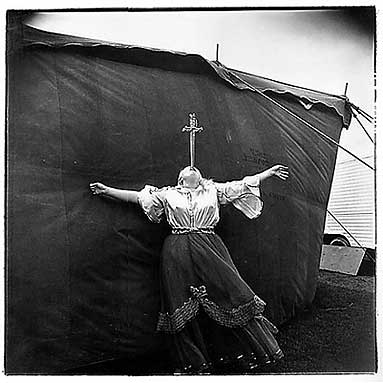
It wasn't in all the photos. Some, especially those of over-dressed rich women, seemed to expose their subjects to ridicule. I thought I glimpsed cruelty in the curve of the lips of a masked man. But in other pictures there seemed more gentleness and respect than I expected. I noticed how one of two drag queens, dressing or undressing for their act, seemed to reassure the other with a touch. I saw the dignified melancholy of a tattooed man, gazing into the distance beyond the camera. The albino girl, arms outstretched and head back as she swallowed a sword, seemed in control of her pose as she mirrored a crucifixion. So many of the subjects, often strange to the viewer or on the fringes of society, seemed to convey an inexplicable depth. Even the photographs of nudists seemed about much more than the nakedness of the subjects.
Some photographs still disturbed. I worried that the children might have disliked their portrayal – who would want to be shown in a gallery as “fat girl laughing” or to be famous as a skinny, laughing boy clutching a toy hand grenade? The extreme close-ups of babies' faces turned them into dolls or death masks. But when I came to the photos of people with disabilities which had so disturbed my teenage self, I began to ask other questions.
The subjects I'd characterised as a “freak show” looked out at me with self-confidence. They seemed as happy as any of the sitters to be recorded. So what exactly had disturbed me? Did I really think that photography was only for the beautiful, the confident or the normal (whatever that was) unless it had a proclaimed manifesto to change the world? These people just were – and were recorded.
This took me back to the photographs of August Sander and the records he made of Germany in the 1920s and 30s. Before Arbus, he had photographed people in fairgrounds and institutions, apparently letting them arrange their own poses before the camera. It was impossible to look at his photographs without the knowledge Sander lacked. I wondered how many of the people he recorded had been imprisoned, abused and killed in the Nazi regime's euthanasia programme, in concentration camps and in the bureaucratically-ordered extermination of those in the “wrong” racial groups.
My sense of recording and the influence of Sander became even stronger when I returned to the gallery for a guided tour by Alexander Nemerov, Arbus's nephew. He talked about her focus on the subjects of her portraits and the way she documented them as though in the face of impending catastrophe. I reflected later that Arbus looked more for a variety of individuals in every setting while Sander, though recording individuals, saw them more as representatives of types.
There are still problems with photography and the act of recording. For many people, the fact of being recorded and visible places them at risk. I can't help wondering whether any harm came to the subjects of Arbus's photos. It wasn't easy, in the 1960s, to be a mixed race couple, even in New York – and Arbus's caption makes it clear that the couple are married and the wife is pregnant. I wondered if the transsexuals and transvestites later regretted giving so much away or whether the disabled people in the institution suffered discomfort from the response to the publication of the photos. A photographer can try to achieve neutrality and simply observe, understandingly, a range of subjects. But as soon as the photographs are on display they enter an environment that is not neutral and which is all too eager to judge and condemn the lives of others.
Too many people still face a choice between vulnerability and invisibility. On any day I can say, without hesitation, which I would choose – but my answer isn't always the same.
There are mild grumbles in Nottingham about the new Robin Hood film. Nottingham can live with an Australian playing the outlaw, a newish story and even the usual dodgy accents – outsiders tend to be uncertain how Nottingham people speak. But word has got round that the character played by Russell Crowe – Robin Longstride – is a Yorkshireman.
Reviews of the new film were lukewarm. Nonetheless, Nottingham has declared that May is Robin Hood Month. There's an exhibition (costumes and set, I think) at the Castle and I've seen signs of other events in the area.
I hadn't expected the mediaeval market. I came across it on my way to Nottingham Contemporary, paying my second visit to the Uneven Geographies exhibition. While I hate shops, with few exceptions, I find it hard to resist a market and began to explore the stalls.
I watched a man making a thick leather tankard. I hadn't heard of leather tankards before but the procedure looked convincingly mediaeval. Opposite was a stall selling sausages and another offering Transylvanian glass – nothing to do with Dracula but delicate and glowing. There were stalls selling food, jewellery, carvings – all sorts of delights. It wasn't until I reached the stall selling baseball caps made of panels cut from tin-cans that my lazy, sun-soaked mind began to wonder about the label “mediaeval.” Still, the Heineken cans are a pleasing shade of green though the Coca-Cola logo might look out of place in the greenwood.
I started spotting other inconsistencies – a sausage stall, staffed by two smiling men in Robin Hood hats, was named after “King Tut” - much earlier, I think, and unremembered in mediaeval times. I know the Crusades saw returning soldiers bringing all kind of new goods to England - but would they have brought smiling Buddhas fashioned from resin? Did they eat ostrich burgers in baguettes in Sherwood Forest? I couldn't rule it out but kangaroo meat is totally implausible. Wodwos carved from wood seemed more authentic.
For a few minutes I counted inconsistencies. Then I began to delight in them. I love the Robin Hood legend but I've never insisted on historical accuracy – it's a baggy myth which is refashioned with every telling and imagining. Robin probably didn't wear tights, despite Douglas Fairbanks, Errol Flynn and Richard Greene – and at the same time he did, because imagination makes it so.
My Robin Hood isn't Robin of Locksley, returning nobleman, but the outlaw beyond class who sees an unfair society and acts for liberty and justice. His greenwood is a place of freedom and equality – and women are equal there, because that's how I've imagined it.
I began to wonder how my Robin would be today. He might be with the migrants who live outside the law in our cities, aiming at invisibility but too often exploited. Or perhaps he'd be an eco-warrior, defending the wild places and remaining greenwood from those who exploit them for cash. Either would be a more uncomfortable Robin than any Hollywood has produced. Only the TV series of my childhood really engaged with contemporary politics.
But Nottingham's mediaeval market didn't seem entirely out of place in the Robin Hood myth. People who'd come to Nottingham for all sorts of reasons mingled at the stalls. There were Goths, political protesters, parents whose children wanted to splash in the fountain – all assembling in the Old Market Square and strolling round the stalls. They moved easily from demonstrations of weaving and wood-turning to chat with the vendors of amber, carved elephants and eco-clothing.
Myths update themselves all the time. No single version can hold them.
From England, borders seem simple. There's sea. Motorway signs proclaim “Welcome to Scotland!” and “Croeso y Gymru” but passing these isn't a serious matter – even in Orkney or on Anglesey we're still in the United Kingdom.
Hadrian's Wall is a reminder of what a boundary might be but its watch-towers and forts have crumbled. Walking the path of Roman border patrols has become a challenge or delightful ramble. Sheep graze nearby and children scramble across what is left of the frontier. Like so many monuments built to control the neighbourhood, it's been reclaimed by the locals for tourism and play.
Maps tell another story. Boundaries are clear-cut – black lines that separate pink from green and yellow are as obvious as a railway track. There are even lines parcelling up the sea and white wildernesses governed by penguins and polar bears. In maps, boundaries are as unavoidable as the kiosks in which uniformed guards check and scan the passports of tourists.
Of course, I knew it was more complicated than that – just I knew there were nomadic people and people whose sense of nation and community crossed arbitrary frontiers. For years I've been fascinated by Auden's poem about the partition of India. The older Auden isn't often thought of as a radical poet but that poem is as critical as any I know about the cowardly bureaucracy of colonialism.
But I hadn't really thought about the no-man's-land crossed by migrants and patrolled by bored armed guards until I saw Ursula Biemann's video installation at Uneven Geographies, the latest exhibition at Nottingham Contemporary. Watching the guards in a nearly featureless desert, I suddenly saw the world from a perspective much closer to the migrants'.
The guards knew where the border was. There was a pile of stones here, the remnants of a building there and a railway line dividing to cross two indistinguishable pieces of ground. Sometimes the guards watched. They moved through crumbling buildings. At other times they just stood. One held a bunch of keys close to his waist. One drank water from a bottle. Dust and discarded plastic blew past them. They waited for the migrants to arrive.
The story was told of a Dutch tourist who found himself on the wrong side of the border. He was arrested and held for ten days. His belongings were confiscated. He never saw his car again. The story was routine – worth telling only because the man was an accidental migrant and a European. For those who cross frontiers these are everyday hazards.
Hunger and thirst don't stop the travellers. In another video, an imprisoned migrant told, without surprise, that ten men in his group of seventy had died of thirst when crossing the desert. The men who survived drank their own urine. They arrived and were imprisoned. They waited to be sent back – and to set out again.
Ursula Biemann's videos focus on the sub-Saharan area where the nomadic routes of the Tuareg have become the paths which migrants travel. She shows the practical demands of migrant life and the optimistic determination of travellers who are convinced life has more than poverty to offer.
Near the videos there's a series of photos of Tangier by Yto Barrada. One shows a football game on a run-down hard pitch in Tangier. The pitch is surrounded by torn wire. In the foreground a boy is making his way through a hole in the wire towards the players – it's another permeable boundary.
Between the photo and the videos, I began to see boundaries in a different way. I thought of the times when, as a child, I saw a boundary as a challenge. When my brother and I were small we liked to “go trespassing,” which meant entering any area where signs said we were forbidden. Building sites and college grounds were alluring. Most fascinating of all was an old air-raid shelter which I think we entered once – but I dreamt of it so often that dreams have obscured the reality. I can't recall exactly where the air-raid shelter was.
I still want to travel and see new places. Work and family detain me in Britain but I'm not rooted here. The film of the border guard awoke my migrant self. I realised that there aren't so many differences between me and the Africans setting out on their risky journey. I have some luck: the security provided by my red British passport and respectable appearance. I can book my journey on the internet or ask a travel agency to find me a tour and a guide.
The exhibition Uneven Geographies was worth visiting for the way it exposed and displaced my assumptions about boundaries. There's more to the exhibition than that. Delicate diagrams sketch out webs of financial power – webs so complicated it seems impossible to break free of them. The webs date back to the 1970s – it's all so much more complicated now. There are installations, photographs, displays. So many achieved a small adjustment in my way of seeing the world that, by the time I emerged, I was reeling.
Behind all the works is the net of global economic interests which holds us all. The exhibition lays bare the ways in which the rich west depends on people in other continents and the devastation of the earth. I'm haunted by new ways of seeing, in which the west is no longer central. I feel displaced from my safe, convenient way of life.
That doesn't mean I see a way out of the net. Neither vision nor analysis shows a way of adjusting the huge imbalance of power. But seeing differently still feels right and worthwhile. This is the first exhibition at Nottingham Contemporary that has changed my ideas.
I'm fussy about tea. I like it in large quantities. If it's ordinary tea in a market or transport café, I like a half-pint mug. If I go to a café or tea-room - or if I drink tea at home - I expect to pour my tea from a pot.
Just lately, tea-drinking at home has improved, thanks to my daughter. She never got round to sending her mother's day present but brought it with her when she visited for Easter. She knows I enjoy tea and presented me with an elaborately-wrapped wooden tea-box with tea pigs inside. I think they're called tea pigs. They are exotic, silky tea bags which feel as though they've been hand-crafted. The tea is delicious, worthy of my best Chinese tea-pot, which I bought as a treat for myself in my student days. It makes tea-drinking even more of a special occasion.
I felt the contrast when I made a journey to a good, free exhibition at a local art gallery. I'd decided the whole outing could be a special treat and that I'd round it off with tea and cake in the café. There was carrot cake - in the kind of big, chunky slices that require tea in a pot, ideally with a pot of hot water on the side to keep tea at the proper strength.
I chose my cake and asked for a pot of tea for one. "You can't have that," the young woman at the counter said. "You have to have a cup of tea. We only do pots of tea for two."
I smiled and asked whether I could just have one tea bag in a large pot. "Yes, but we'd have to charge you for a pot of tea for two."
I gave up. I was feeling embarrassed. Plainly there was something odd and awkward about the idea that someone should sit in a café alone and enjoy tea and cake. I was given a cup of tea, which consisted of a tea-bag floating in hot water. The tea was stewed before I paid for it and cold before I'd finished my cake. It wasn't much of a treat.
I wrote it off as a solitary episode. But the following week I went to the theatre. I decided to order an interval drink: nothing exciting - just a half of cider. "Just ONE drink?" the young woman serving me asked. She was polite and friendly. I explained that I had gone to the theatre alone - as I've been doing since my teens - and wondered if she pitied me. Or perhaps women on their own are expected to have ice cream in the interval rather than alcohol.
At this point I was feeling fed up. I tweeted about the theatre and, to my surprise, got a polite and friendly tweet in reply from the theatre. I felt better. I finally sent a message to the café and got a reply from them too, telling me their cups are big (yes, they may be, but they don't keep the tea warm and there's something depressing about a teabag floating in a cup) and that, if I asked, staff would provide tea for one in a pot at a reasonable price. I may try again, when I'm feeling tougher.
I'm beginning to notice a world increasingly geared for pairs and couples. Even the café of Nottingham Contemporary, one of my favourite places, has an evening menu based around "sharing platters." When I'm alone I can order "nibbles" but that's all. I like olives but sometimes I want bread and cheese. Sometimes I want to feel it's OK for a single, middle-aged woman to venture out alone. There's lots going on in the world and I'd like to enjoy it.
Not all elections are like this. The last election was marked by apathy and the sense that, when it was over, the New Labour regime would continue. I heard discussions of how to vote that were marked by a sense of guilt and despair – we hadn't stopped the war in Iraq and the war-mongers were about to claim their electoral victory as popular endorsement. Thatcher's dreadful phrase “There is no alternative” hung over us.
I assumed this election would be similarly despairing. After the chancellors' debate on TV, when Darling. Osborne and Cable agreed that, whoever got in, the cuts would be deeper and more painful than under Thatcher, I settled into the gloomy certainty that the next five years would mean the rapid unravelling of everything I value in the hard-won welfare state. Worries about my parents and my children broke into my sleep and woke me in the middle of the night.
I'm still worried. But there's a new thrill in the air. Many young people who never voted before seem to have infected the public debate with their excitement and conviction that change and hope are possible. They aren't agreeing with one another and many are still uncertain how to vote, but they want to listen to the arguments and join in the debates. The power of a single vote makes them feel like citizens.
I was in Leicester yesterday when Nick Clegg visited. I've seen visiting politicians before and remember how, when Tony Blair came to Leicester in 1997, everything was stage-managed and spun to ensure good camera angles. Blair's campaign team provided the crowds with flags to wave, played music (D-ream) interminably and swept dissenters aside.
Nick Clegg's visit wasn't like that. Students, enjoying the sunshine and their last day of term, came to join the crowds and see what Clegg had to say. Most banners were home-made though a couple of Labour supporters brought their own banners to wave. Plainly Clegg's team was taken aback by the hundreds of people. I heard them on mobile phones: “Yes, there really are that many.” Then the battle bus arrived.
A narrow pathway meant that Clegg could get through the crowd, preceded by photographers and cameramen who found it hard to get the pictures they wanted. Clegg stopped as he walked to answer questions – a socialist friend of mine who came at my suggestion managed to ask him about students and bankers. She got an answer though I couldn't hear it.
There was a speech with questions and applause but I was too far away to hear. Instead of trying to break into the crowds I started taking photographs of the posters. The pair produced by the Politics and Pints society cheered me, though Clegg didn't accept their invitation to the pub.
There were more banners today at Nottingham's all-purpose, leftish-to-revolutionary May Day march. The organisers couldn't afford the marches usual base near the castle so had booked Victoria Park instead, to remind locals of the recent closure of the Victoria Baths nearby. The weather forecast threatened rain and gloom and I packed a waterproof jacket. I didn't need it.
There were fewer people than in previous years. With only five days till the election, some of the regulars may have been out campaigning. But there was still a good range of stalls including one celebrating Nottingham's radical history in which a loaf on a stick, decorated with a black ribbon, had served as an incitement to riot. Of course, someone was carrying a loaf on a stick. I couldn't resist a badge with the words “TO THE CASTLE”, recalling the burning of Nottingham Castle in the 1831 riot in support of the Great Reform Bill. I hope no-one arrests me for incitement to violence. I'm still a Quaker and a pacifist – but I can't help wanting to celebrate Britain's radical past and the workers who demanded that their voice be heard.
Women dancers, energetic and costumed as if for an extravagantly-pagan Morris, led the march. Various factions of the left chanted their competing slogans without getting further than detailed debates. Home-made banners greeted the shoppers of Nottingham, mostly with thoughtful, witty and challenging slogans that might make people think. (I was a little uncertain about the demand for “revolutionary praxis now” - the word“praxis” is underused in most conversations I have.) A gorilla danced and handed out leaflets for Greenpeace. I wondered where to fit into the march and found a place with CND and near Friends of the Earth.
Behind me two socialists had a lengthy discussion about how to vote. One argued that a Labour defeat was the only hope for radical elements in the Labour Party. I didn't catch the response.I wondered whether competing groups urging people not to vote, on the grounds that direct action is needed, were debating the best way not to put a ballot paper in the ballot box.
We walked, sang, chanted and danced past the derelict wreck of a business which still proclaimed in large, wrought-iron letters "PALMER & SON LTD. BYRON WORKS." I thought we made a cheerful display and was pleased to see answering smiles from some of the shoppers. There were cheerful displays everywhere. Outside the glossy new pawnbrokers with its shiny blue fascia, smiling young women handed out white and blue balloons.
It wasn't a long walk to Nottingham's speaker's corner, by the Brian Clough statue. The Clarion Choir were there to greet us. So was Robin Hood in a home-made and decorated banner-gown. I stayed for a while to listen to the songs and speeches, marvelling at how harmonious and tolerant Nottingham radicals can be on such occasions. I'd have liked to go back to Victoria Park with the march but my back was hurting. I slipped away and decided to blog about the march instead.
I missed St. George's Day itself. I was too busy with work to head to Leicester Market for the traditional dragon-slaying and distribution of red roses. But Leicester has never been content with small festivals. St. George's Day has spilled over to become a three-day event, involving more than any individual could fit into the time available.
I scanned the programme in amazement. Everyone was getting in on the act. There were morris dances, a maypole, church services and a beer festival. There was face-painting and dragon-making and a choice between Shakespeare, poetry readings outdoors and prose and poetry indoors. Some of the events had a rather slight connection to St. George, unless there's something I missed - there wasn't any flamenco dancing in any version of the story I knew. But why not? It all sounded like great fun. I determined to attend on Saturday and take lots of pictures.
Plans don't always work. My back, still painful after my fall on the ice in January, was hurting more than usual. I left home late with my camera in my bag. Photogenic sights abounded. I saw the bunting first - I wonder if the council will leave it up for the World Cup. Two minutes later I spotted my first St George, accompanied by his maiden. They posed for a photo and smiled. I framed the picture, clicked - and the resulting image was flooded with light. I thought I'd messed up the settings, tried to check them, wished I had an instruction book. I tried new settings, more pictures. No luck - and they would have been such good pictures too. The ones that get away are always the best.
I listened to some readings. They were good but, worried about the camera and other matters, I could give then only half my concentration. I wriggled in my seat, trying to make my back comfortable. I failed and headed out into the sun.
Leicester was flooded with St. Georges, all much better-looking than the slightly sad specimen escorting Nick Griffin at the BNP manifesto launch. (I wonder if Nick Griffin knows how multi-cultural Leicester celebrates St. George's Day - and how pathetic his own attempt looks by comparison.) I think there was even a St. George on stilts but I was too far away to check the identification. I was happily impressed by the George and Dragon cupcakes.
I headed to the station via my favourite camera shop. The staff inspected my camera, checked the programming and eventually diagnosed the problem - serious and expensive. "It would cost a lot to mend it," one said. They didn't need to spell it out - I knew it would cost more than the camera itself. "Which is your cheapest camera?" I asked, and got out my credit card.
By the time I reached Nottingham St. George's Day celebrations were winding down - they had lasted a mere two days. Here England's special days involved William Booth and Feargus O'Connor as well as more markets, Georges and dragons. Shoppers, children, Goths and football supporters ambled in the sunny Market Square.
I didn't pause for long. My destination was the Playhouse and a play about another George. I read Julian Barnes' novel Arthur and George a couple of years ago and was curious to see what sort of play David Edgar would make of it. It didn't seem a natural choice for a drama - the novel goes back and forth in time and deals with complex questions of law and evidence. But David Edgar's a confident, experienced playwright who knows how to move characters and keep the audience interested. He's not to reshape a novel to ensure it works as a play.
In a way, Arthur and George is a play about Englishness, although Edgar doesn't labour the point. George Edalji, a vicar's son and solicitor, sees himself as an Englishman. His passions are railways and English law - he likes to see the world as an orderly place. Chris Nayak, in an entirely convincing performance, brought out the character's slight strangeness which the play relates in part to a protective and defensive family and in part to George's extreme short-sightedness and consequent focus on details.
At the beginning of the 20th century George takes his isolated life and its oddities for granted. When he comes under suspicion for horrific crimes - maiming horses and leaving them to bleed to death - he limits his consideration of the case to matters of evidence, law and courtroom practice. He never mentions the virulent racial hatred that condemns him because he is the product of a mixed marriage - his father is Indian and his mother Scottish. Eventually, when his life has been shattered, he turns for help to Sir Arthur Conan Doyle
Arthur - famous, admired but also an outsider - looks at the larger picture and is determined to secure justice, compensation and public vindication for George. Adrian Lukis's performance shows the bluff, hearty persona Arthur presents to the world but there's also a hint of vulnerability - Arthur is uneasy with his fame and the complications of his own personal life. George's case provides Arthur with an escape from guilt and worry as well as a cause to fight. One of the enjoyable aspects of the play is the way in which George and Arthur, who, with little in common, treat each other with careful respect and do their best to see one another's point of view.
It's an delightful play. The two major characters are complex and layered. Actors in the other roles take the opportunity to hint at complexity on occasion. While racism is uncovered - the kind of racism that was written into British text books at the time - it's not the only factor working against George. Ideas of manliness play part and so do networks of unspoken loyalty. George is a very convenient scapegoat.
Watching the play was entirely pleasurable. It helped that pain-killers, combined with rather good cider, banished my back-pain for a a few hours. Comfortable seats at the Playhouse helped too.
George Edalji probably contributed more to Britain than the historical St. George - or even the legendary dragon-killer. George Edlaji's case - and Arthur's defence of George - was a major factor in creating the Court of Appeal.
I bribed myself to go shopping. If I forced myself into clothes shops, tried on jeans and actually purchased a pair, I would allow myself to revisit Nottingham Contemporary's current exhibition, Star City: The Future under Communism.
Even with the bribe, it was difficult. However I suddenly found two pairs of trousers that would do. My mood lightened as I climbed the short hill to the gallery.
It wasn't my first visit to Star City. I popped in on Light Night, the very first day it was opening, but didn't stay long. I wanted a range of Light Night experiences - and found them in the jitterbugging skeletons, a candlelit church, a free Schumann recital, giant insects in the castle grounds and fencers in the Long Gallery of the castle itself. Most of the Light Night events were for one night only. I knew I could return to Nottingham Contemporary.
The exhibition itself is a puzzle. Perhaps this is as it should be since many people of my generation and older are puzzled by their own reaction to the loss of the Soviet Union and the fall of the Berlin wall. We knew a great deal was wrong with the Soviet Union - I grew up aware of the show trials, the events in Hungary and saw the first black-and-white footage of Soviet tanks arriving in Prague. I haven't forgotten the name of Jan Palach.
Yet while the the smart-suited bureaucrats and party officials made speeches that betrayed their followers' ideals and their own lack of conviction, there seemed to be another Soviet Union composed of the dreams of many who wanted a different, better life. Those dreams - of comradeship, freedom from want, real involvement in the government of a country, hope for the future - still seem worth preserving. I don't believe that I live in the best system there will ever be, nor that freedom to shop is a major test of liberty.
A couple of the more recent works at the gallery seemed to equate consumerism with democracy. I wasn't sure what point Diango Hernandez was making by using elderly kitchen appliances to vibrate to a speech by Castro in morse code. I had a slight suspicion that my reaction - "I like the look of that blender" - wasn't quite what the artist hoped. But other exhibits let me remember and reflect.
The Soviet posters of the space age recalled the excitement I felt on hearing that Yuri Gagarin had become the first man in space and the thrill in learning just two years later that a woman, Valentina Tereshkova, had also become an astronaut. I didn't particularly want to travel in space when I grew up but I liked the sense that it was possible. The posters had the bright excitement of Janet and John books or Sunday school displays, infused with the glamour of space and Cyrillic script.
It was disappointing, therefore, to find that the Light Night opening featured two pretend Soviet astronauts at the entrance to the gallery. They played at space walks, called everyone "comrade" with exaggerated accents and treated the whole thing as a grand joke, as though going into space was nothing and seeking comradeship an absurd archaism. I wasn't angry but something inside me was hurt. Perhaps I still cherish a lost dream after all.
Elsewhere the exhibition was more complex and harder to put in words. I was reminded of Leon Rosselson's song "Wo sind die Elefanten?" which can convey its sense of loss only through an absurd sentence from a German language course. The gallery had several huge exhibits but I spent most time with a series of small illustrations by Ilya Kabakov, produced in the late Soviet era and called "The Flying Komarov." These pictures, which started in a cupboard and moved on to a world in which most people flew, seem to speak of hope for liberty and the importance of dreams. They allow space for the viewer too - not outer space but inner space to interpret and question.
I haven't given Star City all the time it needs. I'll be there again, wondering what to make of it all. I can drop in again and again - that's the benefit of a free gallery.
I'll go on thinking of the dreams we build about other countries and our own. It's not the dreams that are wrong. But across the world there are leaders and would-be leaders who twist those dreams to a hateful shape for the sake of riches and power.
Snow isn't a problem here - we could cope with a few more inches. The problem is the cold. As people walk in the snow, or as cars drive on the less-travelled roads, the snow turns to slush. Then it refreezes. I don't need to head to an ice-rink for thrills - between home and the station I slide precariously every few yards. My new technique for walking involves checking for crisp, snowy patches and cluching at walls, fences, lamp-posts and railings. What was usually a walk of less than ten minutes required concentration. balance and quick reactions. As my feet slid away from me, I bent my legs and caught hold of the railing, pleased to have avoided a serious tumble.
I was determined to have a day out. I'd booked leave - I'd told my friends I would do something special, even if my ambition had shrunk to a china boot filled with gluhwein and a visit to the exhibition at Nottingham Castle. I was feeling good about it. If nothing else worked out, I could always settle down in a warm café with Les Misérables.
I rang the castle in advance. The man who answered assured me that it was open and, more importantly, that the steep path up Castle Mound was well-gritted. He didn't mention that the steep pavements in the way to Castle Mound were glazed with ice and compacted snow. I staggered and slithered uphill, looking anxiously at the other tottering pedestrians who seemed more practised at walking on ice. Somehow I didn't topple down the slope but, carefully taking small steps, passed the Robin Hood statue and reached the castle gate. At last there were clear paths. I walked up the slope, delighting in the sight of the black branches above the snowy bandstand; the small, cold Christmas tree and even two or three warmly-wrapped children playing in chill of the white playground.
Perhaps an exhibition of art inspired by prisons and surveillance wouldn't have been everyone's choice for a day out but it suited my mood - and my sense of questions that matter in Britain today. I walked up the stairs inside the castle and into the exhibition. The first two exhibits are probably the ones that will stay longest with me. Louise Bourgeois's "Cell (Eyes and Mirrors)" may not comment on wider social and political questions in any obvious ways but it evokes the horror of being imprisoned and watched. It seems right that this horror should provide the basis of any political consideration of prison and surveillance - surely horror is the natural reaction to both.
I don't always spend long in video installations but I caught Manu Luksch's Faceless shortly after it had started and stayed nearly fifty minutes till the end. The film consists entirely of CCTV images, following rules set out in a manifesto. CCTV has also inspired the story of the film, which is told in a voice-over by Tilda Swinton. Again, the film isn't a direct comment on contemporary life - it's set in a future envisioned according to the CCTV trail each of us leaves every day. I emerged disturbed and impressed by the way blurrily familiar CCTV film had been turned into narrative with actors and choreographed dancers performing amid passers by for the mechanical gaze of the cameras.
I blinked as I emerged from the viewing booth and caught sight of the "Millbank Penitentiary" a model by Langlands and Bell of a now-demolished panoptical prison. The idea of the pantopticon was originated by Jeremy Bentham. It envisaged prisoners kept in separate cells, never seeing their fellow inmates but believing that they were watched at all times. A modified version has influenced prison design for many years. Bentham thought up the design as a benevolent model that would achieve reform of the prisoners. When developed to the extremes of Bentham's vision, many prisoners went mad.
I wandered into the next room. The gallery was empty apart from me, the attendant and a man leaning over a computer at a desk. I smiled at the attendant as I passed him and began to concentrate on the exhibits.
First I gazed at a history of imprisonment and death in Nottingham Castle. The past seemed to blend into present as I saw the orange jumpsuits in a nearby photo.
Then my attention was caught by what looked like Lego boxes opened up and spread out on the wall. Looking closely, I realised the scenes involved black-clad armed guards herding, beating and executing white skeletons. The notice beside gave the title and artist: "Concentration Camp Series" by Zbigniew Libera. I gazed some more.
They had captured my attention more than the flayed man in the Marc Quinn sculpture though pictures of Quinn's work had drawn me to the exhibition. Christine Borland's "Air Heads" were similarly powerful but I was following a different trail of thought. I looked at the words projected on the wall ahead of me.
"LONDON REVIEW OF BOOKS," I read. "The lady with the LROB bag looks at the Lego posters." I paused and checked my bag. It's my favourite fabric bag from the London Review of Books. I was being watched and my actions were being described in large letters on the wall.
I looked round. The attendant was still sitting in the corner. The man with a computer on his desk was typing. I read an earlier entry projected on the wall. It referred to "desk man." Desk man was watching me.
I tried to forget the presence of desk man and gazed at an exhibit which invited members of the public to operate a surveillance camera. But the exhibit was enclosed in plastic - I couldn't see how this should be done and wasn't sure I wished to watch anything like that, not even plastic trees and houses. I moved on, out of sight of desk man. Looking up at the wall I saw that my uncertainty about the exhibit was now described for new visitors. I moved into a corner where I felt sure I'd be out of sight. Then I saw the joystick to move the CCTV camera. I touched it tentatively and moved it just slightly, catching a plastic house and tree in a dark noose of shadow.
A few minutes later the words on the wall said that I had touched the joystick but hadn't moved it. I stayed out of sight and was glad when a family came into the gallery. Desk man shifted his attention to them and I sidled out into a suddenly sinister collection of Victorian paintings. Every model seemed to be a victim of the artist's gaze.
I made my way down the stairs, uncertain whether desk man - or some CCTV operator - was watching my back. Then I paused in the café for an excellent macchiato and mince pie. I took out my copy of Les Misérables. Jean Valjean has eluded Javert again and is carefully staying out of sight. Reassured by a fictional past, I headed out of the castle to meet my children and enjoy a celebratory gluhwein in the Old Market Square.
Writer, former Creative Writing tutor who quit in order to write and escape stress. Quaker, concerned with equality and truth. Currently socially distant, usually more approachable.