Showing posts with label holiday. Show all posts

Thursday, 7 October 2010

No to the Kindle

British friends have occasionally asked me why I visit Paris in August. “There's no-one there,” they assure me. “The real Parisiens are all on holiday and everything's shut.”

It's a simplification. Some Parisiens – those who can afford it – try to take holidays in August. Some shops, businesses – even museums – are closed. Last year I was sorry to miss the municipal museum of Montreuil, which I still hope to visit one day. The Comedie Francaise and the Paris Opera are on holiday. Friends I would have liked to see were away – as was the owner of the splendid apartment I sublet.


Yet I enjoy Paris in August. It has a leisurely air. The discovery that a local shop or restaurant is shut for “les vacances” is not a disaster. It's a reminder that workers need holidays and there's more to life than making money.


In previous Augusts I did little to look for live events in Paris. Paris Plage was fun – and full of locals – but I missed it by a day this year. I wondered if my British friends were right in saying nothing else was on. I decided to investigate. I paused at a kiosk and invested in a copy of Pariscope – not a huge gamble at 40 eurocents – to see what was going on.
Leafing through the pages I read of theatres, cinemas, concerts, spectacles and markets.

At first I was baffled by the choice, then began to make decisions. The Lucernaire looked worth a visit, and quite near where I was staying. The second and third Millennium films were showing at the Cinema Chaplin, not too far away. There was a fund-raising piano festival at the Armenian Cathedral in the Marais – and much more.


I began at the Lucernaire. The list of theatre shows made me hesitate. I'd missed Cooking with Elvis at the local amateur theatre and was prepared to miss the French version as well. But I wondered about a one-man show of Oscar Wilde's De Profundis, well-reviewed in a number of French national papers. The price – 22 euros – is more than I usually pay for theatre tickets. But when I thought about seeing Wilde in French, there was a pleasant logic too it.
De Profundis is Wilde's long letter to his young lover, Lord Alfred Douglas, written from Reading Gaol. Some years ago I would have said I knew the English text reasonably well, although it has faded in my mind since. I recalled that, after leaving prison, Wilde went to Paris, where he died, and was buried in Pere Lachaise cemetery. And while I hesitated about seeing a work in translation, I recalled that I had twice seen Wilde's play Salomé, which he wrote in French for Sarah Bernhardt, in the translation by Lord Alfred Douglas. The idea of Wilde in French translation was almost symmetrical. I bought my ticket.

The set up at the Lucernaire wasn't quite like a theatre in England. Notices on the wall told us that the “ouvrieuses” (specifically female workers) showing us to our seats were unpaid and dependent on tips. The ouvrieuses were charming and had a neat way of sliding the proffered tips into a purse – but I felt uncomfortable about the procedure. Workers are often required to display charm as part of their jobs but I didn't want to measure and reward that charm directly with a tip – it felt too intimate a purchase. However as they were, according to the notices, dependent on the audience's generosity, it was plain that generosity was my responsibility. I handed over the tip as I was shown to my seat and wondered if I'd bought the bright smile that followed.


The theatre was small – a studio space without the formal grandeur of a proscenium arch. The actor playing Wilde was already on the stage, perched on a step-ladder and half-covered by a blanket. The audience leaned forward expectantly, displaying a quality of intense concentration that is rare in English theatre audiences – and this continued throughout the performance.


Occasionally I found the use of French distancing and at times my understanding flickered out - I probably grasped 80 to 85% of the text. Despite the strangeness, a French Wilde seemed a convincing possibility. I even found his mispronunciation of Reading (to resemble the activity rather than the town ir the gaol – endearing).
It was an intense and moving performance. I was surprised to find that, towards the end, I felt sympathy not just for Wilde but also for Lord Alfred Douglas – Bosie. De Profundis chronicles instances of Bosie's selfishness but, listed by Wilde, they seem like the follies of a very young man faced by an adoration he could not quite reciprocate and an intelligence he could not match. Even his cruel statements seemed like a dull attempt to match Wilde's wit while his neglect of Wilde's feelings could be forgiven as the uncertainty of a young man suffering from an appalling upbringing and unsure how to respond across the barriers of age and c lass. The young often do run from suffering – and how was Bosie to respond to Wilde's imprisonment and agony? Biographies suggest that Bosie was unpleasant throughout his long life but the pictures reveal a startling beauty which may also have been a disadvantage.

A week was not enough for all the events listed in Pariscope. I saw Millennium 2 – subtitled in French, which I find far easier than dubbing – and enjoyed a riveting performance of piano music by Chopin and Rachmaninov. That was as much cultural performance as I could take. I also haunted the bookshops, trying to add to my small collection of books in French.


There were two books I aimed to buy: Victor Hugo's Notre Dame de Paris and Eugene Sue's Les Mysteres de Paris. Both have been on my list of books I need to read for some time. But I was confronted by something unfamiliar from my life in the East Midlands – a wealth of bookshops. There were big shops like the many branches of Gibert Joseph in the Boul' Mich and the art chain Mona Lisait. Then there were many small independent shops – far more than in London, I think – where the stock seemed to reflect either the manager's taste or the surprises that often delight and infuriate in secondhand volumes.

I browsed contentedly and puzzled over what to buy.
I find nineteenth century French literature easier to read than modern light fiction; lengthy paragraphs allow unfamiliar words to become clear from the context and puzzles can be resolved with the aid of a dictionary. Recent thrillers, for all their popular appeal, are harder because they use so much contemporary slang. I have a further interest. I've noticed that, for generations, working-class readers in particular were absorbed by popular French fiction from the mid-19th century. Stories like The Count of Monte Cristo and Les Miserables are mentioned in working-class writing from the 1850s to the 1950s. And I knew that writers for the working class drew on French writers. For instance, G.W.M. Reynolds' terrific and popular serial, The Mysteries of London – which makes Dickens seem restrained in style and detail – was directly influenced by Sue's Mysteries of Paris. So far as I can see, no-one has gone into much detail chronicling this influence. While the effort necessary for a wide-ranging survey is beyond me – I imagine I'd need a year or so in French archives with no guarantee of success as well as another year combing comparable English publications - I could at least see what popular fiction of the period was available in paperback.

One of the joys of reading in French is the vast and largely unknown library of possible titles which spreads before me. Looking at Paul Feval's Le Bossu – which was the source for a couple of terrific swashbuckling films - I discovered that the same author had written his own Mysteres de Londres – quite different from Reynolds' serial. I haven't read it yet but, according to the back of the book jacket, it tells the story of an Irish plot against the British government and is set in exotically English locations. I had to buy a copy. There was a fine multi-volume edition of Les Mysteres de Paris, with illustrations, but in the end I concluded that it was too heavy.

I was also tempted by Eugene Sue's last book, Les Mysteres du Peuple, apparently a fictional account of working-class revolution from the time of Jesus to the era of Napoleon III. I wondered why so startling a book was so little known. Until I stumbled across a copy in Gibert Joseph, I hadn't heard of its existence. I nearly bought it but once again I hesitated, feeling the weight of the book. I could delay, I thought, and order it from amazon.fr when I had time to read it.


In the end, I succumbed to ten or twelve books, including a fine hardback edition of Notre Dame de Paris from one of the second hand shops set up by Abbé Pierre's Emmaus charity. A friend tipped me off that these were a great place for bargains and the shop I visited gave me an excuse for travel on the voguéo - I find it hard to resist river travel. My reading of French is still slow and I have less free time than I would like so my purchases will last me a long time. But I still regret the two books by Sue – perhaps I need to go to Paris again, very soon.


The chief problem was one of space – and what I reckoned I could carry home in my suitcase. Eurostar may not have a weight allowance but travellers still have to heave their cases onto the conveyor belt for scanning and manoeuvre them into the luggage areas of trains.


Briefly I thought of the solution suggested by a couple of friends: if I purchased a kindle or e-reader I could carry a whole library with me, unworried by weight. But I like the weight of books. I like the smell and texture of paper, the designs of covers. I like turning the pages with my fingers. I love the sensation of opening a new book for the first time – and I adore books with history, which carry a sense of their past readers. I can see the logic of an electronic reader but not the pleasure.


Nor would there be opportunities for communication. I discovered the novels of Michael Chabon after seeing a taxi driver was reading one. It was the beginning of a good conversation about books, which would never have been sparked by the anonymous cover of an e-reader. I like seeing what my fellow travellers are reading.


Then think of the hazards. I couldn't read an e-book in the bath – at least not safely. Amazon has been known to withdraw a text from the kindle, regardless of readers who were half-way through. An equipment failure or expired battery could put an entire library beyond my reach.

My books may occupy too much space. It's also true I don't always know where a particular title is. But I know my books by their shape, size, colours and texture. I could never gain so much affection for an electronic index.
Perhaps this simply marks me as a member of a dying generation, to be as much pitied or mocked as those who could not adjust from the scroll to the book. Wandering through the market of old and antique books in the Parc Georges Brassens (on the site of a former abattoir), I was unable to imagine surrendering my love for the book in favour of a screen called into grey and white life at the flick of a button.

Mind you, I didn't buy any of the book on sale in the Parc George Brassens. It was the last day of my holiday – and another book would have made my suitcase too heavy.

Thursday, 16 September 2010

Balzac's cafetiere


Much as I love Victor Hugo, I can't commend his taste in interior design. The intricate elaborations and extravagances that delight me in his prose style seem heavy and unnecessary when used to decorate a room. The reconstruction of the sitting room he designed for Juliette Drouet in Guernsey – moved to the Maison Victor Hugo on the place des Vosges – leaves me filled with admiration for Juliette's patient and tolerant love. I hope for her sake that Hugo's wife had more of a say on domestic interiors.

I returned to the Hugo house and the Musée Carnavalet, wondering if I would view them in a new way after reading Hugo novels and histories of Paris. Although I saw them with greater knowledge, it was the same things that struck me. In the Hugo house I lingered over his drawings, letters and the display connected with the death of his daughter, drowned when travelling with his new husband. I noticed a poem about her which I hadn't observed before, written for the fifth anniversary of her death – and, because such things trouble me, I wondered how I might translate it, given that the final stanza sets an impossible task. The rhymes give way to exact repetition: “tombe” is used first in its more usual sense of “fall” and then with the meaning of “tomb” while the second rhyme, which matches the place, Harfleur, with “fleur,” the word for “flower,” ends the poem on a lighter syllable than any English equivalent I can imagine. I suspect I'll keep returning to this poem for many years, as I do to Callimachus's recollection of Heracleitus and Catullus's early declaration of passion for Lesbia. I don't expect to solve the problem.

In the Carnavalet it was again the section on Revolution and war that held my attention longest. I noticed how the thoughtful declarations of rights gave way to the rigid imposition of a military discipline which forbade all question. The words “Liberté, Egalité, Fraternité” seemed out of place on a soldier's drum. Once again I admired the souvenirs made from the stone of the demolished Bastille, especially the doll's-house-sized solid model of the Bastille itself. But I wanted more – Paris deserves a bigger museum, though none would be sufficiently complex to do justice to the city's history and people.

But revisiting museums wasn't enough for me. With my urge for self-education, I looked at the list of Paris Museums and settled on Balzac's house. My reading of Hazan's book on Paris (not yet finished) has made me guiltily aware of how little French literature I have read. Although names from Balzac's fiction lurk at the fringes of my awareness, I don't think I've ever read any Balzac novel. His name and the titles of his books are heavily forbidding as were the pictures on the covers of the black-backed Penguin classics editions. I assumed the house would be a similarly forbidding presence but found a simple bus route with the aid of my Indispensable.

The street was steep, lined with tall and heavy houses, dating, I would guess from the late 19th century. There was nothing of the lightness of the Montparnasse apartment blocks. I counted my way by house numbers. The quiet in the street was almost oppressive – evidently there was no rush of devoted Balzac enthusiasts.

I passed a striking and very heavy 19th century building and then, just as the numbers told me I was reaching Balzac's house, there was a gap in the buildings, a garden and a small, light, white building with a grey roof and green window-frames and shutters. It looked like a bungalow and, compared to the heavy surrounding buildings, could have been an elaborate shed. The garden was small but delightfully leafy with archways and paths. Sitting there you would believe yourself far from the city, until you looked up to see the Eiffel Tower.

A few steep steps took me into the Balzac house and an interior as quiet and calm as the garden. It seems that Balzac liked quiet. His house was simple – not a bungalow, as I first thought: the uneven terrain meant that the main living quarters were on the upper floor, which led to the garden, but there was also an airy lower storey below. I decided that I would have liked to live in Balzac's house. He had a fine desk and chair. I could imagine myself sitting there and getting things done.

I found his method of working sympathetic too. He would start writing at midnight when the city was cool and quiet, and work through till 8 in the morning, fuelled by coffee from his personal cafetiere. I admired the cafetiere. It's now kept in a glass case, which makes it hard to photograph. I'm not entirely sure Balzac should have added his initials. Perhaps he wanted to make sure no-one walked off with his coffee-making equipment. I can understand that. Anyone would feel possessive about so fine a cafetiere.

As an additional and unexpected treat, the house offered the screening of a complete Japanese “ganime” version of Balzac's early novella “La Grenadiere” directed by Koji Fukada. I was charmed and moved by the fusion of pictures, music, Japanese voices and French subtitles. I'd love to find a copy for myself so that I can share it with friends. At the moment all I can locate is the trailer on youtube.

After leaving the Balzac house, I sat in the garden for a while, enjoying the light breeze and soft fragrances. Eventually I left, walked up the road past the late 19th century apartment blocks and caught a bus that would take me across the Seine and towards the Eiffel Tower. As I walked, I resolved to buy and read something by Balzac. I doubt it will surprise and delight me quite as much as his house.

Saturday, 11 September 2010

The patron saint of smoking


I was looking for Samuel Beckett. He was hard to find. Instead I stumbled across Serge Gainsbourg.

I'm never sure what to make of Gainsbourg. The recent film, which didn't aim at accuracy, deepened my ambivalence - and reminded me how erotic "Je t'aime ... moi non plus" is. So I stopped at Gainsbourg's grave.

I was in the Montparnasse cemetery. I hadn't meant to visit but, as I drifted round the 14th, that was where my feet took me.

The Cimetiere de Montparnasse not a tourist haunt in the way Pere Lachaise is. No-one was hawking pictures of the graves or plans of the cemetery. However there were casual and dedicated strollers as well as the mourners who came to place flowers on family graves. I was pleased to find a helpful plan of which graves were where although that didn't always make them easy to find.

Gainsbourg's grave was plainly a place of pilgrimage. There were flowers, photos, a packet of Gitanes and a colourful selection of cigarette lighters. As I watched, a young couple standing by the grave rolled cigarettes in silence and solemnly lit up. Whatever else he may have been, Gainsbourg has become the patron saint of smokers.

I've been anti-smoking for as long as I can remember. I recall my father's serious illness when I was six. As he was too ill to be moved, hospital staff brought equipment - including, I think, a portable x-ray machine - to the flat where we lived. As he recovered he was warned to give up smoking and struggled for years to overcome the addiction. Now, in his late 80s, he can't stand the stench of cigarette smoke.

But when I watched the young couple, I saw their cigarettes as a form of protest against a controlling state - and that too seemed admirable. France has a history of resistance which is the ground of the national belief in liberty, equality and fraternity. That belief is at the heart of protests from left and right against the forced deportations of "les Roms", the Roma who have travelled from eastern and central Europe, as allowed by law. Some deportations have been stopped by the courts - the grounds can be as slender as finding smoking in public which is not, the tribunal found, a serious public order offence - but many families, seeing their children scared by early-morning police raids, have simply agreed to leave, taking the very small amount of money the French state will pay as inducement or compensation.

It's easy to look away when a small group is under attack. Paris has numerous plaques to remind residents and visitors of the round-ups and deportations carried out by French police during the Occupation - and these are often cited as a reason to oppose the deportation of "les Roms". There's even a plaque commemorating the 1961 police massacre of Algerian protesters, although the French seem less comfortable considering the implications of that episode.

As a tourist I was observing and doing nothing. I strolled round the cemetery contemplating past injustice and resistance.

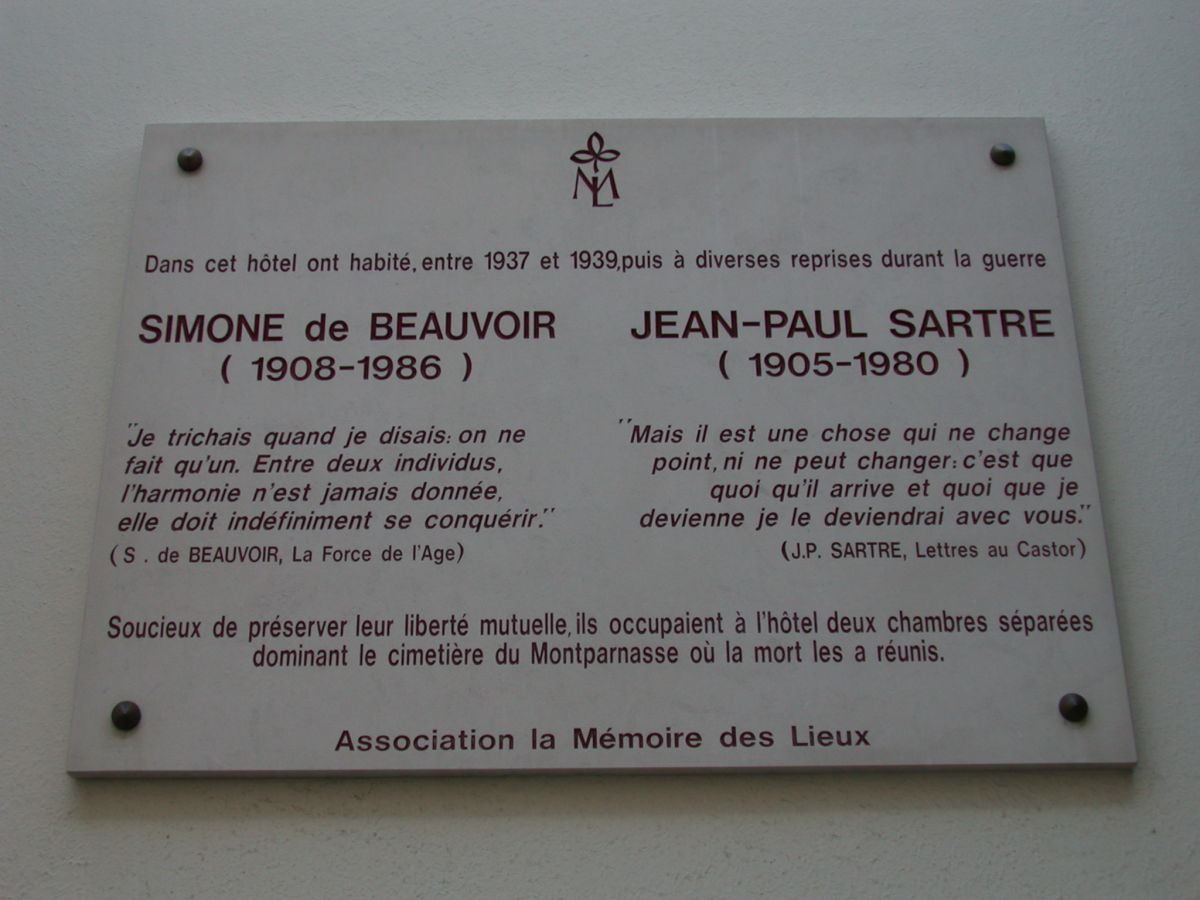
I chanced on the grave of Dreyfus, who sparked Zola's famous letter "J'accuse" and a huge campaign of resistance. I saw where Sartre and de Beauvoir were together in death, though forced to occupy separate hotel rooms in life, as a plaque on the Hotel Mistral recounts. They were forced by events to make difficult choices and their messy, muddled lives remind me that political involvement can't be limited to those whose lives are above reproach.

As the cemetery was closing, I made another attempt to find Beckett, who chose to stay in occupied France (though he could have escaped to neutral Ireland) and was awarded the Médaille de la Résistance and the Croix de Guerre for his activities. He didn't talk much about what he did but I wanted to pay tribute to his courage and reported kindness as well as his plays.

At last I found the grave, thanks to a shabbily-dressed and unshaven man who stood contemplating it. As I paused, the man turned to me. "Samuel Beckett," he said. "En attendant Godot."

I made a slightly stumbling attempt to explain why I thought Beckett a great man, trying to recall the French titles he gave his works when he first wrote them. But the man wasn't listening. "En attendant Godot," he repeated. "Samuel Beckett. En attendant Godot."

Then he bent down and began to clear the blossoms which had obscured the names of Beckett and his partner Suzanne.

I'm not sure what he meant to say. Was he just naming Beckett's most famous work? Was he telling me that in death too Beckett was "waiting for Godot." Or was he himself Godot, arrived too late and tenderly clearing the playwright's tomb?

Wednesday, 7 April 2010

Coffee at the Grand

Every so often, I like a taste of luxury. It was years since I'd last hidden in the Grand Hotel but I wanted a morning away from the office. Sometimes that's the only way to get things done. At the same time, I needed to keep in touch. The Grand wasn't far off my route. I checked the sign in the window: "free wi-fi." It would do.

Coffee at the Grand is good but expensive, even by the standards of frothy coffee bars. I usually make my own coffee or head for a small, independently-run coffee bar. There's an Italian coffee stall in Nottingham's Victoria Centre market which may just offer the best coffee in the East Midlands - and I can practise my Italian too. But I can't linger too long in an independent coffee shop - I know the manager needs my table and the profits from a continuous line of customers. The Grand Hotel is big and wealthy enough not to disturb me. It also has the benefits of comfortable sofas and piped music that is quiet enough not to disturb. The loos are luxurious too. And the woman who brings my cafetiere is quietly welcoming.

I used to be afraid of grand hotels. I thought they were meant only for the rich, that they had strange dress-codes and obscure rituals I wouldn't understand. I thought the well-dressed porters and waitresses would laugh, refuse to serve me and throw me out. Luckily, in my late teens, I encountered fellow teenagers who thought nothing of ordering coffee in a posh hotel - and it would have been more embarrassing to confess my fears than to join them.

I wouldn't want coffee at the Grand to be a regular experience. I like my luxuries to seem special. Perhaps I've already been too over-indulgent lately. As well as coffee in the Grand, I experienced another quiet luxury - first class rail travel.

I was booking on-line for a journey to see my parents. I was fairly flexible about times and looking for the best deal - a complex process that probably merits a higher-level GCSE. Then I saw that the cheapest single price on one train - the best deal going! - was the same for first or standard class. I booked it at once and then found a first class ticket back at only £5 more than the cheapest journey. It seemed worthwhile - even with a seat booked in advance, I've found myself standing for part of the journey lately and first class would surely guarantee a seat.

I was startled by the quiet spaciousness of first class travel. I think the thick carpets help. On the way back the carriage was full so there were the usual interruptions of mobile phone-calls and eager children. Neither were more interesting than fellow travellers in standard class and I didn't manage any more work or reading than usual. Instead I spent my time marvelling at the way the carriage seemed to soak up the sound and wondering whether the views were just slightly different from first class carriage windows. I didn't reach a conclusion. I was simply grateful for the quiet and the chance to rest my back. I think I could have gone to the buffet and collected a free coffee too, just by showing my ticket. But I fear that railway coffee doesn't reach the high standards achieved by the Grand Hotel. I did without.

Saturday, 3 April 2010

Going slow


“Productivity” is one of the ways in which our work and lives are measured. It's an idea from time-and-motion studies and is allied to another word: “output.” Lately they've been linked to other words, like “targets” and “league tables.” Underlying these is the notion that speed and quantity are always valuable.

Speed and quantity have their uses. Nobody would suggest putting out a fire slowly or labouring for a week to produce the single, perfect baked bean. But somewhere in the rush to achieve meet targets and achieve maximum productivity, important qualities are lost.


I began thinking about this when I heard Will Self talking on the radio about the experience of walking to the airport. I was mostly concentrating on making coffee but, in my usual quest for maximum productivity, I was listening to the radio as well. The coffee was fine but I caught only a few sentences from Will Self. He pointed out that, in people's haste to reach an exotic destination, they neglected the places in between. Huge suburbs were diminished to places which are crossed as quickly as possible by travellers who want to be somewhere else. Walking to an airport might be one way of regaining an older, more leisurely experience of travel.


I liked this idea of slow travel. I've been toying with the idea of a walking holiday. Perhaps my inspiration was the opening of Dorothy L. Sayers' Have His Carcase, though I don't expect to meet Lord Peter Wimsey and could do without the discovery of a corpse. But I think women – even women of my age – are less inclined to solitary walking than they were in the 1930s and, even if I could handle the necessary luggage, I've a feeling my conduct would seem eccentric. Still, I'd love a slow holiday – slow, at least, by modern standards – taking trains, boats and buses as well as strolling by rivers and lounging in bars and cafés. I've been glancing at holiday brochures and they all seem rather intense.


Going slow shouldn't just be a treat for holiday times. There are moments when work is better for going slow. Not all tasks are best done at speed. I prefer the carpenter who works carefully to the hasty worker with an eye on the clock. I think workers who pause occasionally to talk to one another may find they enjoy their work more than those who are harried into silent, urgent speed. The shop assistant who asks after the health of an elderly woman customer may hold up the queue for half a minute, but she's doing a good job.

Teachers have to account for every minute of classroom time under national strategies. They don't have enough time to listen to pupils, go over ideas or even meander slightly from the point, seeing where a thought or a new idea might take them. Children are educated to make every minute “productive” until they're afraid of the kind of day-dreaming in which genuine inspiration strikes. No wonder so many young people see leisure as a time for binge-drinking. An approach to leisure governed by productivity and target-setting is bound to ask “how much can you drink in the time?” and “how quickly can you achieve drunkenness?”


This focus on productivity doesn't seem to have much to do with the way humans deal well with one another. It comes from business.
Schools and public services are still being told to model themselves on business, as though no business could ever fail. It comes from the desire to compete and make maximum profits. The demand for high productivity can be found in a number of industries where firms compete with one another for work. Robert Tressell's The Ragged-Trousered Philanthropists describes the house-painters' unwillingness to skimp work in a competitive system which drives down prices and therefore wages. It was heightened by mass-production, in which people serve machines.

The Ford factories of the 1920s and 1930s moved from the craft of car-making, in which workers served an apprenticeship and learnt to make a car as a whole, to machine-tenders who did one simple, easily-learnt task. Initially, the machine-tenders were well paid, although they could easily be laid off or replaced. High productivity lowered prices. This made goods and leisure more widely available in a hugely unequal society. Perhaps it also reduced the demand for greater equality and a fairer distribution of wealth.


I have a taste for things that are produced slowly and with care. I like the idea that someone took trouble and that an item suits me rather than my “demographic.” I like wine, beer, bread and cheeses that are made by people who aim at the best taste they can rather than a neatly-packaged and predictable uniformity. I enjoy books that are a pleasure to touch as well as to read, with elegant type and clear design. I like ideas that have taken years to mature, ideas that are still being made, thought through and tested – ideas too lengthy to be one of five points on a small card and far too rich and complex ever to be shrunk into the neatness of a soundbite.

Thursday, 6 August 2009

"single blessedness"

I was early for the train so I browsed among the leaflets and timetables. Special offers for train travellers attracted me, especially since the illustrations showed attractions in the southern Peak District that I hadn't visited for years, if at all.

I picked up the leaflet hopefully and began to read. One offer was free child admission with a full-paying adult. That sort of offer used to be helpful but not any more. Almost all the remaining offers were "2 for 1" admission charges. Only one offered a discount for the single traveller.

Once again, I find an assumption that everyone moves around in couples. It's not just the train companies that think this way. I've been browsing holiday websites - more in hope than with any confidence that I'll manage an exciting holiday next year. There are some good headline prices. I even thought, briefly, that I might manage the trip to Iceland I've been dreaming about since my schooldays. But the prices come with the usual footnote "Prices are based on two adults sharing a room."

I can see that single travellers cost hoteliers more than couples. But why can't holiday companies just say what the single room supplement is? Too many ask single travellers to phone in - suggesting that singleness is a bizarre state - while some holidays, offering plenty of space for couples, say that nothing is available as soon as I enter information about my solitary state. Prices rocket out of my range when I confirm that I need a room of my own - and I'm not broke.

Why can't companies cater for single people? There's nothing wrong with travelling alone - lots of people do it. Solitude has advantages although it requires some toughness and self-reliance. Almost everyone is single at some point. Single people like holidays and days out just as much as couples.
In some cases - for example when people are newly widowed - this attitude must be intensely hurtful.

Why make us feel like oddities or burdens?

Saturday, 25 April 2009

Ruskin was wrong


Ruskin's appalled words are quoted on notices and in guidebooks all over Monsal Dale. He was shocked at the coming of the railway:

"
There was a rocky valley between Buxton and Bakewell, once upon a time, divine as the vale of Tempe; you might have seen the gods there morning and evening, - Apollo and all the sweet Muses of the Light, walking in fair procession on the lawns of it, and to and fro among the pinnacles of its crags. You cared neither for gods nor grass, but for cash (which you did not know the way to get). You thought you could get it by what the Times calls 'Railroad Enterprise'. You enterprised a railroad through the valley, you blasted its rocks away, heaped thousands of tons of shale into its lovely stream. The valley is gone, and the gods with it; and now, every fool in Buxton can be at Bakewell in half-an-hour, and every fool in Bakewell at Buxton; which you think a lucrative process of exchange, you Fools everywhere!"

Now the main railway line is closed and regretted, though there is a steam railway offering recreational trips from Matlock (I haven't travelled in it for years.) If I want to reach the Peak District, I need the Transpeak bus which not only connects Buxton to Bakewell but Nottingham to Manchester. I don't expect Ruskin would approve of that either - and I find tarmac roads with traffic jams far less pleasant than rails and steam trains. For me they have the magic of antiquity.

When I think about it, I realise that the building of the railway in the Peak District must have created even more horror than today's extra runways and nuclear power stations. But Ruskin's account of the Peak District, which sees it as an untouched playground of the gods, misses an important aspect of the landscape.

When Ruskin wrote, the Peak District had been an industrial district for centuries. Before the railways there were canals and mills and mines. Land was ordered for agriculture and grazing; streams were diverted, woods planted and cut down, dry stone walls built. Nature was placed under strict control. The first tourists who saw the caverns saw the work of generations of miners, who hacked and scooped stony pathways and caves. Gradually the nineteenth century drew the inhabitants of the Peaks away from its green fields, hills and rivers to the manufacturing towns. But they returned at weekends to walk the paths they had made on familiar slopes and to clamber on the forbidden bleakness of Kinder Scout.

The walkers still take the bus towards Monsal. Last Saturday, my daughter decided to come with me. We took the bus to Ashford-in-the-Water, then climbed the hill to Monsal Head where we stopped for a pub lunch. Then we descended into Monsal Dale and the viaduct, which had looked so small from the heights, loomed above us. It seemed as much a part of the scene as the hills. One day I'll hire a bike and cycle on the viaduct - it's part of the Monsal Trail which offers a fairly flat route for pedestrians and cyclists who would otherwise be unable to explore the valley.

Our six-mile route was tougher. We balanced on rocks in a stream and scrambled through steep woodland. We came out into sunny fields and walked by rivers, canals and mills. Some walkers seemed surprised by my daughter's outfit as though her Barbie-pink university hoodie and matching pink-soled trainers were unsuitable in serious walking territory. But she made good process and was faster than me - and not just because I stopped every few minutes to take another photo.

Eventually grandeur gave way to cosy quaintness as we returned to Ashford to wait for the bus.

I keep looking at the photos from the walk and recalling the day as an encounter with nature and remoteness. But I depended on the bus to get me to Ashford and the focus of the most splendid views in Monsal Dale was the railway viaduct Ruskin so detested.

Monday, 20 April 2009

Chucking out time at the cemetery

Any sense of the dead remained stubbornly absent as I headed back to the main entrance of Pere Lachaise to meet my friends. They're younger than me: Vicky's 30 and Katie was a day short of 27. The sun and the imminent birthday celebration made for a cheerful mood as we strolled, climbed and clambered among the graves.

We consulted the plan together and tried to work out a route, negotiating between our favourite dead people.
We began by retreading the tourist trail to Jim Morrison, with a short detour to Heloise and Abelard. I was glad to glimpse Francis Poulenc on the way. Then we headed up towards Edith Piaf. I suppose the black marble, adorned with crucifix, bore some relationship to her life but I wanted something as rough and moving as her songs.

While our route was determined by the locations of some of Pere Lachaise's famous inhabitants, we were soon distracted by the delights of unexpected monuments. None of us knew who Andre Gill was but we were cheered by his bust with bright red chrysanthemum button-hole - not to mention a starfish laid before it. Katie, facing her advancing age with determination, decided to contemplate the possibilities of her own tomb, and decided that she too would have a fresh button-hole every day and that the duty of replacing the flower would be linked to a scholarship for poor postgraduates.

As we progressed, Katie's tomb designs grew more extravagant. She liked the bats carved into a metal door, art nouveau mosaics, the numerous mourning figures (almost always female). She wondered how to commemorate her books, her study and her shoes. Seeing a gigantic obelisk which towered over a family tomb vast enough to accommodate a living family on two storeys, she briefly hesitated over which to choose, then announced that she wanted both. "I won't have a tomb - I'll have a theme park," she declared. This added to our enthusiastic search for extravagant memorials.

Then Vicky admitted, when she was a child having dramatic tantrums, her parents had compared her to Sarah Bernhardt. Katie and I decided that we must find Sarah Bernhardt's tomb and photograph Vicky (in suitably dramatic pose) beside it. Unfortunately the "divine Sarah" was interred some way back from the path and her tomb was hard to photograph. Just as we'd readied our cameras and persuaded Vicky to adopt a suitable pose, a group arrived with their tour guide to trudge round the tomb. Vicky immediately abandoned her pose and the tour group prevented us from taking photos.

There was little gloom at Pere Lachaise. Jacob Epstein's huge, angular angel over Oscar Wilde's grave was a place of particular jollity and celebration. Oscar's last three years were spent as a bankrupt in Paris. I wondered what he would have made of the lipstick kisses on his tomb or the beaming male couple who posed hand-in-hand in front of it for a photo.

But at the top of the cemetery, as we neared the wall where the last Communards were shot, I stopped taking photos. This the part of the cemetery which reminds strollers of the past inhumanities. At first I hastened to see the spectacular sculptures but then I realised they commemorated the people who had been denounced, rounded up and deported to concentration and extermination camps. Underneath the romance of "abroad" there lies, almost always, the barbarism of the past which calls to mind the barbarism of today. I was shaken but wanted to recapture the holiday mood.

As we walked in the courtyard of the vast, domed crematorium, I tried to sweep aside thoughts of other crematorium chimneys and focus on the rows of little boxes in which ashes were stored. We found Stephane Grappelli and Georges Perec - but it was hard to see any relation between their brilliance and the simple inscriptions. By then it was past 5, and the cemetery was due to close at 6. We decided to make some last searches.

We saw Melies and then set out in search of Brunhoff, inspired by Katie's love of the Babar books. But the tomb, belonging to the Brunhoff family, was a disappointment. There were absolutely no elephants. We made our way back to the cemetery's main entrance.

It was 10 to 6 and chucking out time at the cemetery. An attendant sped past us on a motorbike, shouting at everyone to get out. The gardiens at the gates vigorously urged everyone to leave. We took their advice and headed out in search of a bar.


Friday, 27 June 2008

Things to do


"Are you on holiday yet?" acquaintances ask.

Friends know better but even they assume that this is a quiet time of year for me. I wish it were. The "to do" list lengthens every day and any spare time must be spent on the house, if I can summon the energy.

Just getting on with jobs on the "to do" list would be good. Many of them would be enjoyable if I weren't so tired, and even housework might make enough of a difference for me to feel I'd achieved something after a few hours. But I'm continually held up by computer problems. I've been suffering from advice that doesn't always make sense. For instance, explaining problems with the screen of my borrowed laptop, I'm faced with the response that it must in some way be my fault.

"It's because you've dropped it," I'm told. I didn't drop it. Then, "You've downloaded Firefox. Why did you do that? Who said you could? You shouldn't download strange programmes. They always affect the computer. That's why the screen has gone black. Why didn't you stick with Explorer?"

I try to explain and, after a while, give up. Mostly the borrowed laptop works - every so often it stalls and takes yet more of my time. I begin to wonder if life was easier before computers.

Still, I know what I have to do this weekend. I have to spring-clean the house. Yes, I know it's past midsummer but spring was busy - and winter and autumn and all last year. And I'm giving a short talk at work which requires research - rather more than I anticipated. So I should reread the Bacchae of Euripides and, for the first time, the whole of Cervantes' Don Quixote. I've only read bits before. If I can do all that this weekend I'll be more or less on schedule.

I started Don Quixote on the train home - page 47 already. 800 or so pages to go. It's a lovely old Penguin edition with the price on the cover: 8/6.

I think I need a Sancho Panza to do the housework. I think I need more than a weekend.

In Marlowe's play of Doctor Faustus, Faustus quotes Ovid's Amores, begging that his last night will last longer: "O lente lente currite noctis equi!" (Run slowly, slowly, horses of the night). Time moves at its usual speed and the night comes to an end.

I expect the weekend will end before I've finished half the tasks I've intended.