I decided to give myself an Easter treat. Having found suitable eggs for my parents, who like milk chocolate; my son, who is a vegan and my daughter, who doesn't like chocolate very much, it seemed time to give myself a present. I determined on an Easter Day trip to the cinema and resolutely ignored the demands of house, garden and work.My first idea was to see the film Oranges and Sunshine by Jim Loach. I still hope to see that some time. The scandal of children shipped from Britain to Australia, where many were abused and exploited, has particular resonance in the East Midlands, where the story was first brought to public attention. Jim Loach's film, which tells that story, is well-cast and has received excellent reviews. But I wasn't sure I wanted to be distressed on Easter Sunday, which is supposed to be a day of rejoicing.A glimpse of a good review turned my attention to Wim Wenders' film, Pina. My daughter studied Pina Bausch's work at university and her views shifted from mild dislike to enthusiastic appreciation. It isn't easy to shift my daughter's views and I thought I would like to learn more about the choreographer who achieved that. While dance isn't one of my greatest interests, every so often a dance work does excite me and Pina Bausch, who used the term Tanztheater (dance-theatre) for her work, seemed the kind of creator who would at least be interesting. And when I heard of Wim Wenders' enthusiasm for 3D, my choice was settled.I've never taken 3D cinema seriously before. I've enjoyed a couple of 3D cinema experiences – at least, I think I have – but while they were probably exciting at the time they had the quality of theme-park rides: intense at the time but ultimately unmemorable. Yet 3D is a logical development of cinema which includes the stereoscope among its origins.I like stereoscopes. I've peered through them in museums and seen two similar, apparently-faded sepia prints spring into something resembling solidity. They recapture an unalterable past and give it a brief air of tangibility. The images shimmer into solidity before my uncertain gaze. I wasn't sure how 3D would work for dance but it seemed an appropriately elegaic mode for this subject – Pina Bausch died just as Wenders was starting work on a film about her.The film Wenders has made is an elegy. Dancers' words recalling Pina are heard as they gaze silently into camera. There are also clips which show Pina dancing. These are, of course, in 2D but the stereoscopic effect is achieved by the use of an on-screen audience, reminding us that what we watch belongs to the past and cannot be recreated. The inclusion of 2D footage also has the effect of ensuring that the 3D effects remain vivid and startling – the brain isn't allowed to become acclimatised to the novelty of the experience.I'm not sure I understand Pina Bausch's work. Even if I did, it resists being put into words. As she says during the film (so far as I can recollect), dance is an ideal medium for things which can be hinted but not spoken directly. Once I start describing what the dancers do and how they move, I know I'm diminishing their work. More than for most art-forms, the meaning of dance is unsayable.Moreover the dances Pina Bausch created work, like most dance, by repetition of movement. A sequence which is initially startling – often because of the skill employed by the dancers – ceases to astonish and appeals to the emotions as it is performed again and again. My brain can't unscramble the effects but I can feel them.At times, of course, my concentration flagged. Sometimes all I saw were the startling 3D effects as dancers moved towards me and away. That may have been because I was tired, because I'm insufficiently familiar with the vocabulary of dance or even because Wim Wenders is not yet sufficiently in command of 3D cinema and its effects. But my interest never fell away and I emerged from the darkened cinema feeling that I'd seen something that isn't usually available away from the screen.“After all,” I reflected on the train home, “3D is never quite so intensive and exciting in the real world. The 3D of reality is flatter than that.” And then, when I left the station, I looked up and was suddenly aware of distance – between sky, houses, trees, road and lamp-posts. It seems that the film has re-educated my brain. The world I see now has sprung back into its real, 3D perspective.
 I've almost lost count of the number of times I've planned - and failed - to get to a "coffee-time" concert at St Peter's church in Nottingham. I almost always see the notice at the wrong time or discover the concert I'd like has been scheduled for a weekend when I have other plans.
I nearly forgot the Chaplin/Keaton double bill with live organ accompaniment. But I saw the sign again as I paid a brief visit to Light Night and determined not to miss the concert. The sound tracks added later to accompany silent movies leave them seeming incomplete. A live accompaniment, whether by soloist or full orchestra, brings early films to life - somehow when the music is live it more than takes the place of speech.
The concert offered two films: Charlie Chaplin in Easy Street and Buster Keaton in One Week. Donald MacKenzie, the organist, announced his preference for Keaton but I can't agree with him. Keaton may be as physically brilliant as Chaplin - even as good an actor - but I never care about his characters as I do about the various manifestations of the Little Tramp. Keaton's character seems all about expressionless cleverness - although it masquerades as incompetence - and I'm never convinced he really belongs to the societies which provide a backdrop for his escapades.
But I can't help believing in Charlie Chaplin's world. He inhabits the fringes of a complex, recognizable society. Work is possible but gruellingly difficult - bosses employ and sack people for no evident reason. Some people exploit or tyrannise over others. Worklessness, hunger and beggary are regular dangers. This world offers no consistent reward for virtue or hard work but luck and optimism may just pay off. Charlie copes with a mixture of slyness and sympathy. He is also capable of imitating the ruling classes, even in an ill-fitting suit and big shoes.
I find Charlie's imitations of the aristocracy and those in power particularly attractive. They suggest that the easy confidence of the wealthy is no more than a mannerism which can be acquired. It has nothing to do with class superiority. In these days when too many of our rulers are graduates of the Bullingdon Club, this is something worth remembering.
Easy Street isn't my favourite early Chaplin but I like the way it both records working-class life and parodies the contradictory middle-class views of the "dangerous" working class. There are bullies, thieves, families with too many children and - a staple of the time - a drug den supplied by an evil foreigner. Charlie, by the beautiful young woman at the Hope Mission, gives up his life as a tramp and petty thief and volunteers for the police force. But he continues to behave in his familiar way, avoiding bullies unless compelled to fight and easily swayed by sympathy for the poor, pretty and desperate. He may have joined the police but the audience knows that he's not really an agent of the law. He's taken the job and the uniform for the pay and so that he can get the girl.
As a character, Charlie never sets out to change the world. Any difference he makes it accidental. (The real Charlie Chaplin was more politically engaged and kept under surveillance by J. Edgar Hoover's agents at the FBI.) But Chaplin's films remind me constantly that I live in an unjust society where worklessness and desperation still lurk threateningly for many people.
At the end of the screening I suddenly remembered I'd meant to attend a rally and march against the privatisation of the Post Office. My mood plummeted as I decided I'd probably missed it. I went to another short concert (by the pianist Alexandra Diarescu, including an outstanding performance of Ravel's "Ondine") and did some shopping before heading for the railway station.
As I got off the train I could hear drums and whistles in the distance. After what seemed a long time I saw the marchers, banners held high. The front of the march passed me and I still couldn't see where it ended. Laden with shopping as I was, I slipped into the march and headed onward. After a while my son greeted me and friends called "hello." "How many do you think there are?" one asked. "I thought there would only be twenty or thirty. I couldn't offer a guess. Later the local paper estimated the turn-out at a thousand - not bad for a suburban town.
I didn't walk far - just as well given the cans of baked beans in my shopping bag. It was plain there wouldn't be room for everyone in the hall booked for the rally. I left the marchers who had walked the whole distance to the chairs provided and headed home. My back hurt and I wanted to sit in a comfortable chair. But I was cheered by the combination of Charlie Chaplin, Ravel and a community of marchers prepared to carry banners on a cold, grey day to defend something of value.

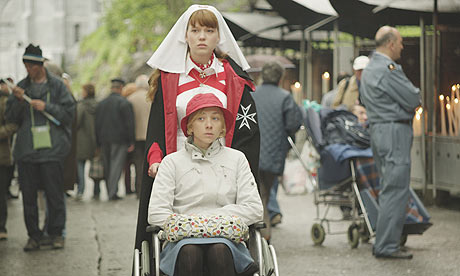
 I didn't plan a trip to the cinema. I just popped in to use the loo. Then, out of curiosity, I looked at the board to see what was on. The screening of Lourdes started in two minutes. I'd read a good review the day before and reasoned that it might improve my French. I bought a ticket, handed it to the usher and settled down to watch.I wasn't in the mood for a film. The advertisements and trailers, which can amuse me if I'm in the right mood, annoyed me with their bright, rapid, manipulative images. Within five minutes of taking my seat, I was regretting my decision. Then the film started.In less than a minute, I'd relaxed. The opening sequence - people entering a hotel dining room - was sufficient to tell me that I was in the hands of an expert film maker. I don't know quite what it was: the balance of colours, the composition of the frame, the camera angle, the movements of the actors - probably a mixture of all these but more as well. Lourdes isn't a film that offers obvious thrills and dramatic scenery - it's focus is on a small place, a short time-span and a small group of characters. But what is most startling about the film is what it doesn't tell the audience.Standard Hollywood films construct neat "backstories" for all the characters, which are quickly revealed to the audience. I'm sure the actors in Lourdes knew what their backstories were, but they didn't bother to tell us. We had to observe them in the present tense and make our own guesses and judgements - just as we do when meeting people in real life. There were plenty of questions and mysteries about the characters, who had as much depth as any human beings, but their complexity meant that the puzzles we had couldn't be resolved in the short timespan of a film. I left the cinema still wondering about them.As director, Jessica Hausner did something unusual - at least in relation to most of the films in British cinemas: she left members of the audience to make up their own minds. And we were left to think on the usual human basis of not knowing everything. I made judgements during the film, because that's what humans do, but I was uneasily aware of how little I knew. Every so often a new fact would be disclosed and I'd be forced to adjust my previous judgement. Most films simplify but Lourdes indicated a complexity that couldn't be resolved prettily in the course of a film.The setting of the film had been one reason for my hesitation. I've never felt comfortable with the idea of religions offering mass healing to the sick, disabled and unhappy. I worry about those who go and are not healed - some must feel guilty, judged and self-critical because they were not thought worthy of healing. I may be wrong, of course - this is guesswork and imagination. I've also felt uneasy about films of such places and events - I don't want to be a voyeur of other people's hope and misery. Perhaps I'm evading something. It was certainly good to see what a pilgrimage offered to the central character, Christine. Dependent on the help of others, she'd become a connoisseur of pilgrimages, which were her best chance to see the world though, as she explained, she preferred cultural trips.There were moments when the film did, quite rightly, make me feel uncomfortably voyeuristic. Pain and unhappiness are intimate subjects and the film was so close to life that I felt uneasy at seeing so much. But at times I also saw the pilgrimage from Christine's level, though not through her eyes, and became aware of the discomfort of forced dependency and casual, thoughtless cruelties.The film has, I discovered later, divided audiences. Some think it favours religion while others condemn it as atheistic propaganda. I don't think it sets out change people's views but it might uncover their doubts. It seems to me that it's a grown-up film that expects an audience of thoughtful adults - it explores a situation without telling people what to think. As a result, I've been thinking about it ever since.
 I'm never quite sure if I like Derby. Of the triangle of East Midlands cities, it's the one I know least. I'm more often there to change trains than to visit. But on impulse I decided to catch the train. There was a film I wanted to see at the Quad - the recent French film, The Army of Crime - and, after five weeks of overwork combined with a succession of viruses, it seemed splendid to be heading out for a treat on a Friday afternoon. I found to my delight that I was once more able to run for the train - it was a very last-minute decision - and, once on the train, reflected that my life was suddenly becoming quite self-indulgent. I'd been to a bonfire, firework and pizza party the night before and now I was off to the cinema. By the time I arrived in Derby, I'd decided I liked the city. Perhaps I could even move there, one day. I considered the advantages: good train services, easier access to the Peak District, the Joseph Wright paintings in the museum, the Victorian market hall. Above all, it would be a new place and I would feel as though I were starting life again. I started to think about small, manageable houses without gardens and in good repair. I tried not to think about the horror of moving or getting a house in sufficiently good order to be shown to buyers.I can never remember the quickest way from Derby station to the city centre. I took a slightly complicated route, past small modern factories and the huge Westfield shopping centre. It all seemed slightly dull in the November drizzle but I reminded myself that this was my afternoon out and determined to enjoy myself.I'd never been in the Quad before and this wasn't a good start. I'd just got my money out when I saw the sign "An Army of Crime - cancelled, replaced by Casablanca." I asked what had happened but didn't exactly follow the answer: something about the equipment failing to "ingest" the film. "Is it digital?" I asked, in an attempt to understand. I didn't understand at all. Apparently digital films have to be ingested at least two hours before the screening. However a new copy was on its way. I bought a ticket, with cash, for the early evening screening and headed out in the rain to explore Derby.I must have spent two and a half hours wandering, mainly gazing in shop windows in the hope that I'd feel inspired about birthday and Christmas presents. Then I thought I'd return to check that the replacement copy of the film had arrived and was being ingested safely.The courier, due at two, hadn't arrived and it was nearly four. I decided to wait in the faint hope that the film would arrive and sat in the foyer, leafing through the film programme. The woman running the box office was suddenly concerned about my wasted afternoon and offered me a complimentary drink from the bar. I asked for a pot of chai so I was at least warmer when the news came that the film had been cancelled. The box office woman gave me my money back and offered me a complimentary ticket for any film in November. I accepted, though I'm not sure I'll make it to Derby again. But the kindness began to make up for my disappointment. I finished my tea and headed along the damp, dreary route past the overhang of the Westfield centre and bleak garages toward the railway station.This time I managed the quick route and noticed the attractive railwaymen's cottages close the station. There were a couple of promising pubs too and an excellent chip shop. I began to fantasise about moving into one of the railwaymen's cottages. I thought I'd like being near the station. I always enjoy the possibility of easy escape. And I liked the idea of living in a railwayman's cottage. My dad was a railwayman - he worked as a fitter on the London Underground for 39 years and still takes an interest in trains. I was unexpectedly tired when I reached home. I should have picked up some work but felt unable. I went to bed with a couple of books and decided I'd have a lie in on Saturday. But in the morning I felt the after-effects of the Derby drizzle. I had a bad cold and was aching too much to go anywhere. I coughed, spluttered and slept. I have stopped dreaming of a move to Derby.
 We're still calling it "the credit crunch," although other terms have arisen: recession, depression, crisis, disaster. This morning brought a government admission of something most of us must have suspected for some time: that what has happened will be worse than the 1930s and longer lasting in its effects. Time to batten down the hatches, perhaps, and look after ourselves and our families?
While I'm concerned for my family - especially my children and my parents - that deosn't seem much of a solution. Nor can I feel any smug satisfaction in saying, "I was right all along - it's really bad." I may have realised it was bad but I don't know what to do about it. I've a few ideas - not well thought through - so if anyone trusts the public with information and a debate, I'll throw in a few sentences. But, so far as I can see, the government doesn't really trust or like the people. It seems to me that the more people involved in the debate, the more likely we are to curvive and cope. The government tends to treat the people as if they were a large class of obstreperous toddlers, too foolish and unruly to be trusted with the truth and too ignorant to have any useful ideas. Instead the government offers commands backed up by fear of punishment - or something worse.
So I'm living through the credit crunch or depression or recession or crisis or disaster - and trying to make sure that it is life and not mere existence. For me that involves reading books, fencing,listening to music, going to plays and films. Ideally this should involve communicating with other people and sharing experience, whether through discussion of a book or going out to an event. It's not a time for extravagance. I haunt the shops selling second-hand and remaindered books and look out for affordable culture.
On Sunday evening I cycled through the snow to the Paradiso Cinema. It's a new venture - a community cinema which doesn't set up to make a profit. Once a month, in the local secondary-school theatre, a film is shown. £4.50 buys a full-price ticket and there's a complimentary glass of wine or soft drink before the screening. This provides a chance to chat to other cinema-goers, and they seemed a friendly lot, even though there was no-one I knew and I was the only person attending the film alone. (I was the only cyclist too.)
The film was Mike Leigh's Happy Go Lucky, superficially a cheerful comedy from pre-credit crunch days (it opened last year), The main character, Poppy, as brightly dressed as her name, is relentlessly, infuriatingly cheerful. Occasionally this blossoms into a strength - she is credible as a good, loving primary-school teacher whose pupils flourish under her care. She has courage too, refusing to run away from the distressed and the mentally ill. But she is less happy meeting her sister, who tells her to settle down, grow up and get a mortgage. What she rejects is not this pathetic and limited definition of adulthood but the idea of adult responsibility. Poppy is an everyday Peter Pan who explicitly - at the start of the film - wants nothing to do with reality.
Viewers react to the film in different ways and it's open to opinions and interpretations. I'd have liked the opportunity to discuss it afterwards and hear how other people had responded. But the snow was still falling and everyone was eager to get home. My bike left clean dark tracks in the white of the cycle path as I headed away from the cinema and back to this credit-crunched, disaster-ridden world.