I don't feel comfortable in Piccadilly. It's the province of the rich, who can afford its casual extravagances. Suited and cloaked doormen - they are always men - stand at the entrances of buildings. I would be reluctant to risk their contempt. In Piccadilly, Fortnum and Mason's is mid-range while Pret-a-Manger is dangerously down-market.
It's partly my uneasiness with Piccadilly that keeps me away from the Royal Academy exhibitions, and partly the high cost of admission. It's expensive even with an Art Fund card. But when I saw the picture of the dancing satyr, I knew I had to brave Piccadilly, pay the admission price and see the exhibition in which he appeared. It's called "Bronze" and bronze is the linking motif between all the exhibits. It's about the material and its qualities rather than a period of history or changes in ideas. Its focus is what stays the same.
It's not just the material that is a constant in the exhibition. There was also a repeated response to it from numerous visitors throughout the exhibition. The gasps of awed admiration began as visitors opened the door to the exhibition and saw the first piece: the dancing satyr, in a room by himself.
The satyr is a recent discovery, found by fishermen in the sea off Sicily only fifteen years ago. He's slightly larger than life-size and displayed so that viewers have to look up to him. After his long immersion in salt-water, he's acquired a greenish patina and a slight roughness. This only seems to aid the satyr's fluid movement. It's as though his ecstatic dance continued without pause, whether he moved through air or water. There's a smoothness about the curve of the limbs and body that made me want to reach out and touch him - but the flung-back head and the blank eyes speak of possession and tell the watcher to keep a distance.
So awe was there at the beginning and it continued. There are massive statues: of saints, statesmen and peasants. There is even Rodin's Age of Bronze which conveys uses the material to convey masculinity - or perhaps masculinity to convey the material. There are tiny works. Perhaps the most disturbing are the tiny copulating grasshoppers, whose image was cast by encasing them in molten metal. There are gods and domestic objects. Men ride horses, and panthers, battle monsters, suffer agonies of torture or gaze sternly on the world.
Women are less in evidence. There are goddesses and rulers; a stern and prickly Catherine de Medici, showing off the fashion of the day, is particularly memorable. There are grief-stricken madonnas and a wonderful South Indian sculpture of the infant Krishna with his wet-nurse Mukhara. And there are objects of desire - often small pieces presumably intended for private collectors. Venus (naked, of course) removes a thorn from her foot, a satyr uncovers a sleeping nymph and, in another piece, a satyr and nymph are engaged in enthusiastic sexual intimacy. It's a mark of the exhibition's focus on the craft of casting that my first thought on seeing this explicit and detailed piece was awe at the skill involved in creating so fragile a scenario in bronze. Most of the workers in bronze have traditionally been men, so far as we can tell, but two twentieth-century pieces by women sculptors had a considerable impact: a large Louise Bourgeois spider mounted high on the wall and a curved abstract piece by Barbara Hepworth, which seemed to echo the sea evoked in the dancing satyr.
It's impossible to go into detail about all that is wonderful in an exhibition so far-ranging. The Royal Academy has borrowed pieces from many parts of the world, inviting viewers to make comparisons across cultures and time. I found myself particularly struck by a small chariot from Denmark made of bronze and gold in the 14th century B.C. No-one knows its purpose or why the horse is placed within the chariot rather than pulling it along. It is tiny, delicate and magical in its incomprehensibility - and the gilding on the circle which may be a sun, a shield or a great wheel is a thing of wonder. And, as the films shown in the exhibition display, it was probably made by one of the two main methods still in use all over the world today.
Coming away from this exhibition, I knew it had changed something in the way in which I saw the world. It had encouraged me to make comparisons and connections across cultures. It had helped me look at art through the materials it uses rather than just the period in which it was made. And it showed me the flexibility of that material in conveying a huge range of emotions and evoking numerous responses. I wondered if there was any emotion it could not show or evoke. Then I realised what was missing from that range which included desire, ecstasy, pride, fear, admiration and awe. A word trickled into my mind and reminded me that one emotion and response had been absence. Maybe bronze is for every emotion, every response - except love.
Showing posts with label exhibition. Show all posts
Sunday, 4 November 2012
Sunday, 6 March 2011
The problem with patrons
I was almost impossibly tired when I arrived at the National Gallery. I'd had a good but busy week and was still recovering from the amazing and absorbing experience of hearing Alan Moore, the Magus of Northampton, read aloud from his novel-in-process. [Note to anyone who hasn't come across Alan Moore: he is not only a remarkable writer but also one of the kindest and most courteous authors I have encountered. His reading held everyone in a huge lecture theatre spellbound for nearly an hour and he spent a further hour and a half speaking to everyone who had queued to have their books signed.]
The day after Alan Moore, I was on my way to visit my parents, unsure I was sufficiently awake to take in the Gossaert exhibition but knowing that I was unlikely to find another opportunity to see it. I also had my new Art Fund card with me - at last I've fulfilled my resolution to join, not just for the very welcome benefits but also because I have benefited from the Art Fund through a lifetime of gallery visits.
The route to the exhibition took me past many familiar paintings. On one side I spotted a favourite Titian. Through the entrance to another room I thought I glimpsed a Vermeer. There was Murillo, staring out of his frame like a competent marketer of his own paintings.
In my susceptible state of mind, even Rubens seemed set to lure me from my path toward Gossaert. After all, Rubens was not only free but there were comfortable padded benches from which his work could be admired. (I don't usually admire Rubens that much.)
I forced myself to make the long trek to the basement of the Sainsbury wing where the Gossaerts were displayed. It was worth it. I realised that I had seen and admired individual paintings by Gossaert in the past but I'd never seen them in relation to one another before. I hadn't even registered the artist's name.
There are six rooms in the exhibition. Gossaert's drawings and paintings are complemented by the work of artists who influenced him - a startling range from Northern European artists like Durer to the classical tradition of the Italian Renaissance. Although he's only mentioned in the timeline at the start of this exhibition, it's easy to see Holbein as the heir of this remarkable combination of influences.
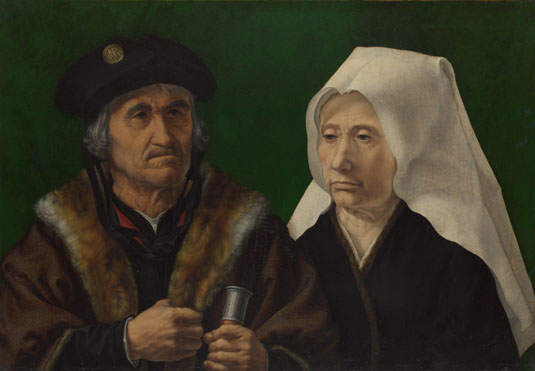
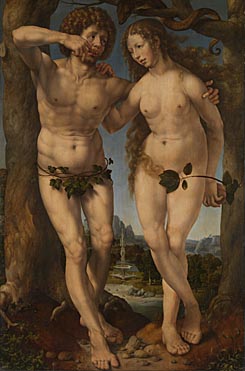
There's more to Gossaert than his portraits but these are the most obviously remarkable part of his work. The people he paints in portraits convince as human beings, simultaneously familiar and unknowable. This isn't just true of his secular portraits. There's a lavishly clad Mary Magdalen with sly glance and dirty fingernails. But he also paints relationships, including erotic relationships. There are various works showing Adam and Eve, including some copies of lost originals, but all convey an astonishing blend of tenderness and desire.
The work that stunned me most - and nearly moved me to tears - was a painting of Christ in the Garden of Gethsemane. It's a dark painting - even the red robes of the flying angel and the sleeping St John are barely lit. An elderly figure - St Peter, perhaps, lies on his back, asleep in the foreground. He has the pallor of exhaustion. But at the centre is the kneeling figure of a youthful Christ, beardless, confused and close to despair. It's not an attractive figure but terrifyingly recognizable. It's the expression of any child confronting an incomprehensible horror. It could be Libya or Afghanistan - or, too often, the U.K.
At the end of the exhibition I couldn't give an account of Gossaert. I had no sense of the man who painted the pictures, except that he could see and reproduce with pencil on paper or paint on canvas. He had, it seems, some human understanding that didn't take a verbal form. And he had the luck to be taken up by a succession of patrons who took him within reach of the influences he needed to develop his art.
It was luck. That's the problem with patrons. While Gossaert had the right patrons for his development as an artist, he was limited to painting what they required: a portrait of a marriageable daughter, erotic works for a private collection, an altar piece, a sketch for a tomb. There is no way of knowing what Gossaert would have liked to paint. It's lucky that some of his patrons' requirements suited a style that we can now appreciate.
It's luck too that has made me so familiar with the works in the National Gallery - the luck of living near a free art gallery and being encouraged by my parents to look inside. I was brought up to take advantage of free and cheap culture - to see culture as a good that should be shared.
It was shocking, therefore, to read, the day after my visit to the National Gallery, of a Labour MP calling for the introduction of admission charges to London's museums. He's not just any Labour MP. The Hon. Tristram Hunt, son of a life peer and a historian with a proclaimed interest in radicalism and the working class, has written an introduction to a recent edition of Robert Tressell's The Ragged-Trousered Philanthropists. In this book, Robert Tressell, through his main socialist characters, argues that culture is one of the necessities of life and should be available to all. I assume Tristram Hunt read the book before writing the introduction. It's a shame he didn't take in its arguments.
It's fair to say that Tristram Hunt wants free admission to the museums in his own constituency of Stoke-on-Trent and, by extension, to other regional museums. I think they should be free too. But I don't think the country's great art galleries and museums should become the preserve of the wealthy. And I'm not interested in any party that can consider excluding the poor from culture, which is not just an education but a means to nourish imagination.
Had there been a charge for the National Gallery, I might have visited once or twice when I was growing up. I know I wouldn't have gone there often - and I wouldn't have learnt much about the history of art. I remember when Mrs Thatcher introduced admission charges for museums and galleries in the 1980s. I was poor then and on many occasions I was stuck outside, wishing I could afford to go in.
Now I've joined the Art Fund. I make donations because museums and galleries were free in my childhood and it's time to say thank-you. If there had been a charge, I wouldn't have bothered. I'd have known museums and galleries weren't for the likes of me.
Labels:
art,
class,
culture,
economics,
exhibition,
museum,
New Labour
Friday, 30 July 2010
In black and white
Looking back, I think my first encounter with the photos of Diane Arbus must have been in one of the glossy Sunday supplements – the sort with shiny paper that makes everything ravishing, even grief and poverty.
I don't know if the glossiness conditioned my response to Arbus, whether I was influenced by the accompanying text or whether it was the work itself that upset me. Her stark, black and white photos of poor people and people with disabilities – people who would never buy a glossy Sunday supplement – seemed to have the glamour and allure of a freak-show. I shuddered and looked away.
News of a forthcoming Diane Arbus exhibition at Nottingham Contemporary disappointed me. It seemed less interesting than the accompanying, more recent work by the Tobias twins. The brochure, with colour pictures of Tobias paintings, also suggested they might have more to offer although the one Arbus reproduction, of twin girls, haunted my imagination.
Accompanied by a friend, I looked at the Tobias works with curiosity and baffled amusement, which may be the response the brothers hoped to evoke. Many seem like a cross between a kitsch version of folk art and a Gothic, Transylvanian Disney. My strongest emotion in their presence was an amused affection. I drifted on to the Arbus rooms and was transfixed by something I hadn't noticed in that early encounter with her work: tenderness.
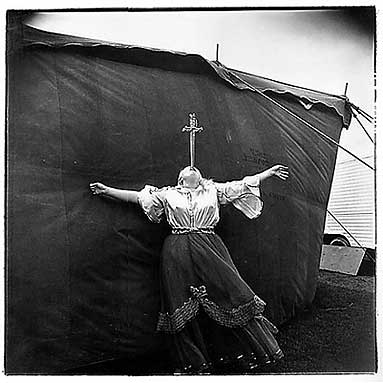
It wasn't in all the photos. Some, especially those of over-dressed rich women, seemed to expose their subjects to ridicule. I thought I glimpsed cruelty in the curve of the lips of a masked man. But in other pictures there seemed more gentleness and respect than I expected. I noticed how one of two drag queens, dressing or undressing for their act, seemed to reassure the other with a touch. I saw the dignified melancholy of a tattooed man, gazing into the distance beyond the camera. The albino girl, arms outstretched and head back as she swallowed a sword, seemed in control of her pose as she mirrored a crucifixion. So many of the subjects, often strange to the viewer or on the fringes of society, seemed to convey an inexplicable depth. Even the photographs of nudists seemed about much more than the nakedness of the subjects.
Some photographs still disturbed. I worried that the children might have disliked their portrayal – who would want to be shown in a gallery as “fat girl laughing” or to be famous as a skinny, laughing boy clutching a toy hand grenade? The extreme close-ups of babies' faces turned them into dolls or death masks. But when I came to the photos of people with disabilities which had so disturbed my teenage self, I began to ask other questions.
The subjects I'd characterised as a “freak show” looked out at me with self-confidence. They seemed as happy as any of the sitters to be recorded. So what exactly had disturbed me? Did I really think that photography was only for the beautiful, the confident or the normal (whatever that was) unless it had a proclaimed manifesto to change the world? These people just were – and were recorded.
This took me back to the photographs of August Sander and the records he made of Germany in the 1920s and 30s. Before Arbus, he had photographed people in fairgrounds and institutions, apparently letting them arrange their own poses before the camera. It was impossible to look at his photographs without the knowledge Sander lacked. I wondered how many of the people he recorded had been imprisoned, abused and killed in the Nazi regime's euthanasia programme, in concentration camps and in the bureaucratically-ordered extermination of those in the “wrong” racial groups.
My sense of recording and the influence of Sander became even stronger when I returned to the gallery for a guided tour by Alexander Nemerov, Arbus's nephew. He talked about her focus on the subjects of her portraits and the way she documented them as though in the face of impending catastrophe. I reflected later that Arbus looked more for a variety of individuals in every setting while Sander, though recording individuals, saw them more as representatives of types.
There are still problems with photography and the act of recording. For many people, the fact of being recorded and visible places them at risk. I can't help wondering whether any harm came to the subjects of Arbus's photos. It wasn't easy, in the 1960s, to be a mixed race couple, even in New York – and Arbus's caption makes it clear that the couple are married and the wife is pregnant. I wondered if the transsexuals and transvestites later regretted giving so much away or whether the disabled people in the institution suffered discomfort from the response to the publication of the photos. A photographer can try to achieve neutrality and simply observe, understandingly, a range of subjects. But as soon as the photographs are on display they enter an environment that is not neutral and which is all too eager to judge and condemn the lives of others.
Too many people still face a choice between vulnerability and invisibility. On any day I can say, without hesitation, which I would choose – but my answer isn't always the same.
Labels:
art,
exhibition,
Nottingham,
photography,
power,
voyeurism
Saturday, 8 May 2010
Tea for one
I'm fussy about tea. I like it in large quantities. If it's ordinary tea in a market or transport café, I like a half-pint mug. If I go to a café or tea-room - or if I drink tea at home - I expect to pour my tea from a pot.
Just lately, tea-drinking at home has improved, thanks to my daughter. She never got round to sending her mother's day present but brought it with her when she visited for Easter. She knows I enjoy tea and presented me with an elaborately-wrapped wooden tea-box with tea pigs inside. I think they're called tea pigs. They are exotic, silky tea bags which feel as though they've been hand-crafted. The tea is delicious, worthy of my best Chinese tea-pot, which I bought as a treat for myself in my student days. It makes tea-drinking even more of a special occasion.
I felt the contrast when I made a journey to a good, free exhibition at a local art gallery. I'd decided the whole outing could be a special treat and that I'd round it off with tea and cake in the café. There was carrot cake - in the kind of big, chunky slices that require tea in a pot, ideally with a pot of hot water on the side to keep tea at the proper strength.
I chose my cake and asked for a pot of tea for one. "You can't have that," the young woman at the counter said. "You have to have a cup of tea. We only do pots of tea for two."
I smiled and asked whether I could just have one tea bag in a large pot. "Yes, but we'd have to charge you for a pot of tea for two."
I gave up. I was feeling embarrassed. Plainly there was something odd and awkward about the idea that someone should sit in a café alone and enjoy tea and cake. I was given a cup of tea, which consisted of a tea-bag floating in hot water. The tea was stewed before I paid for it and cold before I'd finished my cake. It wasn't much of a treat.
I wrote it off as a solitary episode. But the following week I went to the theatre. I decided to order an interval drink: nothing exciting - just a half of cider. "Just ONE drink?" the young woman serving me asked. She was polite and friendly. I explained that I had gone to the theatre alone - as I've been doing since my teens - and wondered if she pitied me. Or perhaps women on their own are expected to have ice cream in the interval rather than alcohol.
At this point I was feeling fed up. I tweeted about the theatre and, to my surprise, got a polite and friendly tweet in reply from the theatre. I felt better. I finally sent a message to the café and got a reply from them too, telling me their cups are big (yes, they may be, but they don't keep the tea warm and there's something depressing about a teabag floating in a cup) and that, if I asked, staff would provide tea for one in a pot at a reasonable price. I may try again, when I'm feeling tougher.
I'm beginning to notice a world increasingly geared for pairs and couples. Even the café of Nottingham Contemporary, one of my favourite places, has an evening menu based around "sharing platters." When I'm alone I can order "nibbles" but that's all. I like olives but sometimes I want bread and cheese. Sometimes I want to feel it's OK for a single, middle-aged woman to venture out alone. There's lots going on in the world and I'd like to enjoy it.
Labels:
café,
exhibition,
Nottingham,
single,
tea,
theatre
Saturday, 14 November 2009
Between downpours

There were ten minutes to go when I got off the train at Nottingham station. I took the exit by the tramway, then headed up Middle Street to Weekday Cross. It didn't take me long to distinguish the art gallery. It glowed pale gold and dull green in the unexpected sun. I still wasn't sure about it - it looked like corrugated metal and slightly out of place among the older, weathered buildings.
During the past few months, I gradually became aware that the new gallery was planned. A stall in the Old Market Square gave me a badge saying "nottingham contemporary" in mirror writing. I wore it for a while and people were puzzled. Then there were complaints in the newspaper - how could anyone spend so much money on something so pretentious and unnecessary as art?
Suddenly there were stories about the opening - in the national press. Critics praised the building and visited the opening show: works by David Hockney and Frances Stark. I realised that today was the opening day and wanted to be there at the very beginning. So I climbed Middle Street and joined the queue penned in crash barriers.
I had only five minutes to wait. It gave me time to look at the unobtrusive details which recall the lace which was made by big, noisy machines in this part of Nottingham. Then a few ragged voices round the corner shouted "Nottingham Contemporary" and we shuffled in past cameras, microphones and a pair of fluffy zebras posing for photos in the gift shop.
Once in the gallery, I forgot about the building and started to look at the work. It's the opposite to the Guggenheim in New York. I was there nearly thirty years ago and I've forgotten the paintings - I just remember the long curving slope that led me past them. It's a beautiful building and I'm glad to have visited but if I were an artist I woudln't want my work displayed there.
The first two rooms showed work by the Californian artist, Frances Stark. At first I couldn't appreciate the flimsy collages with tiny writing and then, suddenly, I began to smile. I was looking at a drawing in which trees were made of words - the letters of the words separated into leaves, turned into birds and flew away. The first works had acclimatised me to the artist's humour and delight. I saw that around me other people were smiling too.
Frances Stark's work is full of transformations. I began to pick up themes: birds, telephones, dresses, words. In the largest exhibit three women I saw them as women - were both telephones and performers. I stopped trying to explain the work to myself and settled down to enjoy the resonances. I thought I'd like to go round again but could see the queue outside. It wouldn't be fair to go round twice while other people were waiting. "I can come back another day," I thought, "- several other days." It was a cheering thought.
Because of the crush, we were asked to take the simplest route through the museum. I saw the David Hockney exhibition backwards. It focussed on his work in the 1960s and the first thing I noticed was the huge, familiar canvas (borrowed from the Tate) of A Bigger Splash. This was Hockney newly sure of himself in California, painting sprinklers and swimming pools. In the next room Hockney was less secure. Although he drew himself beside Gandhi and Walt Whitman, he didn't claim equality with them. Each of the two famous men has a brief descriptive phrase summing up his influence. The unknown Hockney is tagged only with the words "I am 23 years old and wear glasses."
I thought I knew Hockney but much of the work on display was new to me. The drawings were a delight, especially the series illustrating poems by Cavafy and the reworking of Hogarth's Rake's Progress with Hockney as the rake arriving in California. Hockney's life unspooled further to his art school days when his work clearly came from the same tradition as Francis Bacon and Graham Sutherland. Now, of course, his small rebellions - his insistance that life painting was not merely an objective organisation of shapes, his declared preference for male models, his startling obsession with the beauty of Cliff Richard - seem to anticipate his later works. But there was also the possibility of other paths - directions Hockney didn't take.
I spent an hour and a half in the four main galleries - not enough to take it all in. Then I wandered into The Space, a performance and display area where children and adults were encouraged to respond to the exhibition by making card models in gold, green and black. I picked up some card, wrote on it, and eventually fumbled my pieces together. One of the assistants optimistically assured me that my bulging box-like shape was "good - it looks like a building." She took it with several others and addded it to the display. I wandered into the café-bar.
I was in the mood for self-indulgence and ordered an espresso. I was sitting in a draught. There was no more sunlight outside. Rain battered against the door. Two bronzed young men wearing brief swimming trunks and carrying towels wandered in confidently from outside. Had Hockney known, perhaps he would have been at the opening - though I suppose there's plenty of tanned male beauty elsewhere.
I drank my espresso and shivered out into the street. I could hear music - "The Bare Necessities" from Disney's film of The Jungle Book. The zebras were dancing under a canopy. A waitress gave cake to the people queuing in the rain. I read the slogan on the window of Nottingham Contemporary: "International art. For everyone. For free."
I'll be back.

Labels:
art,
exhibition,
Nottingham,
train,
tram
Sunday, 15 March 2009
Time and Relative Dimensions in Space

I wish I could remember which Big Issue seller to thank.
I wasn't going to buy a copy. I smiled, said sorry, walked past - and then had second thoughts. There was enough money in my pocket, I had a train journey ahead and the Big Issue seller would probably be cheered by a sale. I walked back and bought one.
I was already planning my trip to London. I'd have an afternoon free, starting in the Victoria area. Perhaps the V&A, I thought - free admission and I could enjoy treasures I'd loved in childhood, from the Bayeaux Tapestry reproduction to Tipoo's Tiger. But then I saw the picture of Mark Wallinger's TARDIS and read the review of the exhibition he's curating: The Russian Linesman. I looked up the cost of admission to the Hayward Gallery. £9. Quite a lot by East Midlands standards. But I hadn't been to a major London art exhibition for a couple of years.
The South Bank was peopled by large green lizards and faceless queens. That is not a metaphor. These were living statues and I don't know what had drawn them to congregate by the river. They sparkled in the March sun. Passers by and tourists stopped to marvel.
I'm less familiar with the South Bank than I was and briefly forgot which concrete walkway would take me to the Hayward. I found myself at the bottom of a damp-streaked stairwell stacked with rubbish where two young people in the bright uniforms of catering staff clung together in an intense embrace. I doubt they noticed me. From there I saw the way I should have gone and reached the Hayward entrance.
I hadn't realised there were three exhibitions. Before reaching The Russian Linesman, I had to pass through a retrospective exhibition of Annette Messager. I wasn't familiar with her work and at first I wasn't sure I wanted to be.
Messager uses all kinds of ordinary materials including pictures cut from magazines, soft toys, gloves, pencils and, disturbingly, dead birds to create sculptures and installations. Her early work was evidently influenced by the Women's Movement and concerned with how women were seen. People who look back on the Women's Movement tend to assume it simply criticised men for seeing women in sexual ways. But that wasn't the main problem. The real difficulty was that a particular way of seeing women had become so dominant that it was hard to establish any other way of seeing. The male view of women was so dominant that it influenced all areas of life: work, education, culture - even the way women saw themselves.
Messager's early work challenged this. She created alternative selves, presenting herself as a trickster who played with how women were seen (as mothers, lovers, objects of desire) and how women might see men. This was exciting - even dangerous - in the 1970s but I couldn't feel the raw thrill of it any more. I wanted something that challenged me now.
I found the first challenge in Messager's treatment of childhood and motherhood. Dead sparrows, dressed as dolls, fastened to miniature carriages for outings, pinned down for punishment reminded me of the cruelties that are taken for granted in conventional children's games. An exhibit called (I think) Children with their Eyes Scratched Out suggested that women's relationship to children and motherhood was less easy than society supposes.
The bigger, later works combined beauty and horror. Soft toys were dismembered and hung up like the kind of votive offerings I've seen in Mediterranean churches. And three room-sized exhibits were in motion. In Gonflage/Degonflage (Inflation/Deflation), huge body parts - pastel-shaded and cushiony soft - did what the title suggested: inflated and deflated. That wasn't frightening but filled me with awe. Casino (a section from Messager's Pinocchio-themed installation for the Venice Biennale) represented the interior of a whale. Movements of cloth, changes of light and the gradual descent of small shapes from the ceiling created an entrancing experience that simulatneously warmed and disturbed. Finally an installation triggered by mad cow disease created the kind of scene Hieronymus Bosch might have dreamt up if all he had at hand was a selection of human-size soft toys.
Disturbed by Messager's work, I fled up the stairs to the exhibition that had brought me to the gallery.
At first glance, The Russian Linesman looked small, restrained and sane. There was a lack of brightly-coloured soft toys. Instead there were sculptures, videos, frames. Most of the frames contained pictures. But there were also door frames (two frames, one door) and frames that were fragile outlines of thread, creating borders for empty air.
Borders were one of the themes of the exhibition - those fragile lines that contain us. But related to borders was the bigger theme of uncertainty and lack of knowledge. Some of the works exhibited were caught in history. No-one could see the Joseph Beuys lithograph, in which the twin towers are renamed Cosmos and Damian (for two saints killed because they refused to profit from good deeds) without recalling the destruction of 9/11 and the destruction that followed. There was no picture of Philippe Petit's tightrope walk between the towers but there was film from a CNN helicopter showing the thin cord still linking the towers, recalling what came immediately before as well as what occurred years later.
The exhibition showed how easily the brain processes and organises contradictory information - how we impose order on what is disorderly and incoherent. The most obvious way this was shown was the stereoscopic photographs, in which two different two-dimensional pictures - one seen by each eye - together create, in the brain of the viewer, an impossibly sharp and three-dimensional image. The photographs themselves were disturbing: including Nazi propaganda pictures of Hitler and a border post between Germany and Russia. But there were also films shown in parallel: East German feature films screened beside recreations in the same street twenty years later. It was hard to work out what I was seeing.
Everywhere the exhibition disconcerted me. There was raw footage from the recent conflict in Sarajevo - footage discarded by the BBC. It was shown in silence so that I was suddenly aware of how news footage is edited, and shaped by the commentary offered. When I watched film of a corpse clumsily taken from a river, I just saw that the man was dead and didn't know what side he was on. Somehow I was even more upset by the group of happy young people, relaxed and laughing in a bullet-pocked cafe.
There were tricks everywhere - old-style trompe-d'oeuil and Thomas Demand's Poll 2001, a huge photograph of a facsimile of the desk at the Palm Beach count which determined the United States election. There are no people, there is no writing, there are no numbers and the photograph has the same hyperreality as the stereoscopic images.
I wandered into an impossible maze, stood in a sound installation, looked at the 17th century painting by an unknown artist. It showed a dead, unknown soldier - so unknown that no-one knows what war he fought in nor what side he supported - only that he is quite young and wears the clothes of a wealthy man.
Finally I approached Mark Wallinger's stainless steel TARDIS. From a distance it looked disappointingly solid but, as I approached it, the shining, mirrored sides seemed less substantial. I walked round it. At times I caught sight of myself in the shining steel. At others, it seemed on the point of shimmering into nothingness. I walked away and found myself listening to the voice of James Joyce, reading from Anna Livia Plurabelle, in which words and meanings blur to make language anew.
I was losing track of the world. Between them, two exhibitions had skewed my visions so much that I'd find my way home if I stayed much longer. After two and a half hours it was time to leave, while I still could. Perhaps I'd return later, I thought, and asked if that was allowed. But once out, I knew I couldn't go back. I needed to reflect on what I'd seen.
On the way out, I spent time in the Hayward's third exhibition, an installation by Ujino and the Rotators. 1950s furniture and domestic appliances performed a cross between noise music and 1970s disco sounds. It seemed sensible and I listened for a while, feeling I'd returned to a safe, normal world.
Labels:
art,
boundaries,
certainty,
doubt,
exhibition,
London,
music
Saturday, 7 March 2009
American scenes and the WPA

When visiting art galleries in my teens, I used to dash past small, dingy prints for the lush expanses of oil on canvas. There were exceptions: I recall an exhibition of Durer which fascinated me and the Henry Moore lithographs for Auden poems - lovely to look at if not quite belonging to the poems that inspired them. Even now, I expect less of prints than of gaudy paintings so the touring exhibition The American Scene was a revelation.
I was reminded of the work of print-making - the various intricate methods from woodcuts to etching and engraving - which require the marriage of craft skills with inspiration. And in an exhibition in which most works were in shades of grey or brown, I soon realised how much variety, detail and texture could be achieved in a small space. Prints are also a more democratic form of art than the one-off big canvases. Public buildings that can never afford an original oil painting can display prints which convey the artist's work better than muddy reproductions. I began to understand why so many American artists had spent time learning to cut, etch and engrave.
The prints in this exhibition, made from the beginning of the 20th century to the early 1950s, are also a history of American life in miniature. There are cityscapes that still look like an imagined future and rural scenes from an age when electricity had not yet reached the remote farmlands. Grant Wood's print Sultry Night was judged obscene by the U.S. postal services for its depiction of a nude man. But what I see in the print is the farm-worker's exhaustion after a day's work in the draining heat. With no running water, he cools down by going to the horse-trough and tipping buckets of water over his aching body.
Violence and war are recurrent themes but despite the artists' shared love of their country there's no consistent approach. Sometimes, as in a print of a boxing match, it's hard to tell how we are expected to respond. War is both a source of pain and a matter for celebration. One print echoes Picasso's Guernica while another enjoys the geometric patterning of U.S. bombing aircraft. But to my surprise, the prints responding to the bombing of Hiroshima and Nagasaki showed nothing of the triumphalism that was the initial public reaction - the artists could imagine the victims.
Many of the prints from the 1930s and early 1940s were produced under the auspices of the Works Progress Administration, which funded public works including artistic projects. WPA-funded prints could be sent to schools, libraries and public offices, fulfilling the WPA's double purpose of employing the unemployed (the artists and print-makers) and benefiting communities across America through the hard years of the Depression. But the WPA had its own aesthetic, as the exhibition notes made clear. Realism was favoured over abstraction and experimentalism was discouraged.
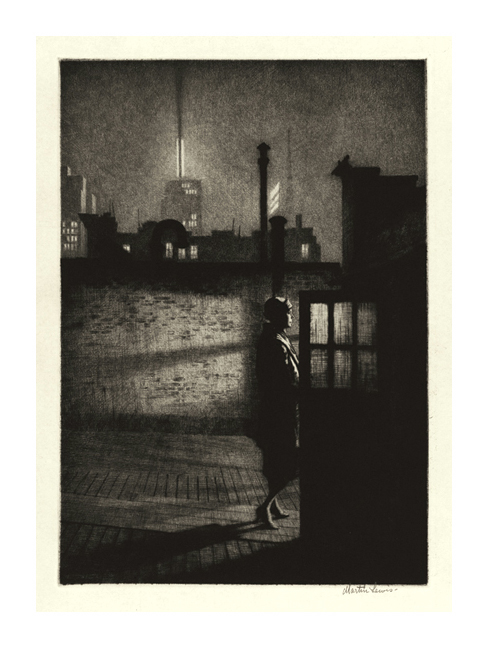
The WPA's preference for the figurative is disappointing. For me, the figurative prints that work best in the exhibition are those which suggest a mystery, whether its a wider, undisclosed story in the works of Edward Hopper and Martin Lewis or the terrifying enigmas of John Ward McClellan. Untutored audiences can respond to "difficult" abstraction - even the drip paintings of Jackson Pollock - so long as they aren't intimidated by overly obscure notes and allowed to experience their own responses.
My personal favourites in the exhibition were a sequence of plates with text by Louise Bourgeois with the title "He Disappeared into Complete Silence." The text heightens the mystery of the illustrations. There's a book, apparently, but it's out of stock at Amazon. One day, perhaps, it will return. Perhaps it will re-appear in time for Christmas. Or perhaps it's disappeared forever, as mysteriously as the tales it nearly tells.
Labels:
art,
censorship,
democracy,
exhibition,
prints,
United States
Subscribe to:
Posts (Atom)