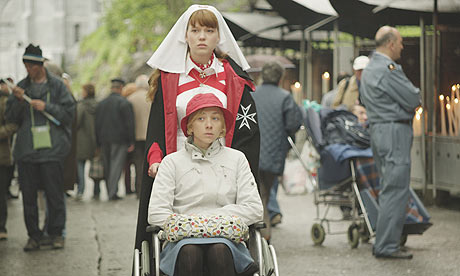
I decided to give myself an Easter treat. Having found suitable eggs for my parents, who like milk chocolate; my son, who is a vegan and my daughter, who doesn't like chocolate very much, it seemed time to give myself a present. I determined on an Easter Day trip to the cinema and resolutely ignored the demands of house, garden and work.
My first idea was to see the film Oranges and Sunshine by Jim Loach. I still hope to see that some time. The scandal of children shipped from Britain to Australia, where many were abused and exploited, has particular resonance in the East Midlands, where the story was first brought to public attention. Jim Loach's film, which tells that story, is well-cast and has received excellent reviews. But I wasn't sure I wanted to be distressed on Easter Sunday, which is supposed to be a day of rejoicing.
A glimpse of a good review turned my attention to Wim Wenders' film, Pina. My daughter studied Pina Bausch's work at university and her views shifted from mild dislike to enthusiastic appreciation. It isn't easy to shift my daughter's views and I thought I would like to learn more about the choreographer who achieved that. While dance isn't one of my greatest interests, every so often a dance work does excite me and Pina Bausch, who used the term Tanztheater (dance-theatre) for her work, seemed the kind of creator who would at least be interesting. And when I heard of Wim Wenders' enthusiasm for 3D, my choice was settled.
I've never taken 3D cinema seriously before. I've enjoyed a couple of 3D cinema experiences – at least, I think I have – but while they were probably exciting at the time they had the quality of theme-park rides: intense at the time but ultimately unmemorable. Yet 3D is a logical development of cinema which includes the stereoscope among its origins.
I like stereoscopes. I've peered through them in museums and seen two similar, apparently-faded sepia prints spring into something resembling solidity. They recapture an unalterable past and give it a brief air of tangibility. The images shimmer into solidity before my uncertain gaze. I wasn't sure how 3D would work for dance but it seemed an appropriately elegaic mode for this subject – Pina Bausch died just as Wenders was starting work on a film about her.
The film Wenders has made is an elegy. Dancers' words recalling Pina are heard as they gaze silently into camera. There are also clips which show Pina dancing. These are, of course, in 2D but the stereoscopic effect is achieved by the use of an on-screen audience, reminding us that what we watch belongs to the past and cannot be recreated. The inclusion of 2D footage also has the effect of ensuring that the 3D effects remain vivid and startling – the brain isn't allowed to become acclimatised to the novelty of the experience.
I'm not sure I understand Pina Bausch's work. Even if I did, it resists being put into words. As she says during the film (so far as I can recollect), dance is an ideal medium for things which can be hinted but not spoken directly. Once I start describing what the dancers do and how they move, I know I'm diminishing their work. More than for most art-forms, the meaning of dance is unsayable.
Moreover the dances Pina Bausch created work, like most dance, by repetition of movement. A sequence which is initially startling – often because of the skill employed by the dancers – ceases to astonish and appeals to the emotions as it is performed again and again. My brain can't unscramble the effects but I can feel them.
At times, of course, my concentration flagged. Sometimes all I saw were the startling 3D effects as dancers moved towards me and away. That may have been because I was tired, because I'm insufficiently familiar with the vocabulary of dance or even because Wim Wenders is not yet sufficiently in command of 3D cinema and its effects. But my interest never fell away and I emerged from the darkened cinema feeling that I'd seen something that isn't usually available away from the screen.
“After all,” I reflected on the train home, “3D is never quite so intensive and exciting in the real world. The 3D of reality is flatter than that.” And then, when I left the station, I looked up and was suddenly aware of distance – between sky, houses, trees, road and lamp-posts. It seems that the film has re-educated my brain. The world I see now has sprung back into its real, 3D perspective.
I didn't plan a trip to the cinema. I just popped in to use the loo. Then, out of curiosity, I looked at the board to see what was on. The screening of Lourdes started in two minutes. I'd read a good review the day before and reasoned that it might improve my French. I bought a ticket, handed it to the usher and settled down to watch.
I wasn't in the mood for a film. The advertisements and trailers, which can amuse me if I'm in the right mood, annoyed me with their bright, rapid, manipulative images. Within five minutes of taking my seat, I was regretting my decision. Then the film started.
In less than a minute, I'd relaxed. The opening sequence - people entering a hotel dining room - was sufficient to tell me that I was in the hands of an expert film maker. I don't know quite what it was: the balance of colours, the composition of the frame, the camera angle, the movements of the actors - probably a mixture of all these but more as well. Lourdes isn't a film that offers obvious thrills and dramatic scenery - it's focus is on a small place, a short time-span and a small group of characters. But what is most startling about the film is what it doesn't tell the audience.
Standard Hollywood films construct neat "backstories" for all the characters, which are quickly revealed to the audience. I'm sure the actors in Lourdes knew what their backstories were, but they didn't bother to tell us. We had to observe them in the present tense and make our own guesses and judgements - just as we do when meeting people in real life. There were plenty of questions and mysteries about the characters, who had as much depth as any human beings, but their complexity meant that the puzzles we had couldn't be resolved in the short timespan of a film. I left the cinema still wondering about them.
As director, Jessica Hausner did something unusual - at least in relation to most of the films in British cinemas: she left members of the audience to make up their own minds. And we were left to think on the usual human basis of not knowing everything. I made judgements during the film, because that's what humans do, but I was uneasily aware of how little I knew. Every so often a new fact would be disclosed and I'd be forced to adjust my previous judgement. Most films simplify but Lourdes indicated a complexity that couldn't be resolved prettily in the course of a film.
The setting of the film had been one reason for my hesitation. I've never felt comfortable with the idea of religions offering mass healing to the sick, disabled and unhappy. I worry about those who go and are not healed - some must feel guilty, judged and self-critical because they were not thought worthy of healing. I may be wrong, of course - this is guesswork and imagination. I've also felt uneasy about films of such places and events - I don't want to be a voyeur of other people's hope and misery. Perhaps I'm evading something. It was certainly good to see what a pilgrimage offered to the central character, Christine. Dependent on the help of others, she'd become a connoisseur of pilgrimages, which were her best chance to see the world though, as she explained, she preferred cultural trips.
There were moments when the film did, quite rightly, make me feel uncomfortably voyeuristic. Pain and unhappiness are intimate subjects and the film was so close to life that I felt uneasy at seeing so much. But at times I also saw the pilgrimage from Christine's level, though not through her eyes, and became aware of the discomfort of forced dependency and casual, thoughtless cruelties.
The film has, I discovered later, divided audiences. Some think it favours religion while others condemn it as atheistic propaganda. I don't think it sets out change people's views but it might uncover their doubts. It seems to me that it's a grown-up film that expects an audience of thoughtful adults - it explores a situation without telling people what to think. As a result, I've been thinking about it ever since.
I went back to Derby. I was determined to see L'Armee du Crime. This time I'd checked with QUAD that the film had been properly ingested. My cold was a bit better. Something at the back of my mind warned me that I wasn't quite well enough but I was fed up with limitations and headed back to the cinema.
I think this is only the second French film about the Resistance I've seen. The first, L'Armée des Ombres (Army of Shadows), shook me with its darkness. It began and ended during the occupation and showed members of a Resistance cell punishing their own members - always with execution - when any disobedience made the group vulnerable to betrayal. Although I knew that the Occupation ended, there was no happy ending of Liberation.
The title of L'Armée du Crime suggested a dialogue with the earlier film. There are other similarities. The film is similar in shape: it begins and ends during the Occupation, shows a key character being captured early in the film and ends by explaining what happened to the surviving characters. But there are key differences.
In L'Armée des Ombres, the main characters are members of mainstream French society who therefore seem to represent French opposition to Nazi occupation. I may be misrembering, but the film seemed to me as shadowy as its title. Shades were sombre as though brightness had been leached from the film-maker's palette.
L'Armée du Crime, like the recently-released photographs by André Zucca, has sequences of light. There are moments of happiness when Paris is, as one of the characters says, "beautiful". Ordinary Parisiens get on with their lives in technicolor. They - like the Resistance members and Nazi occupiers - have picnics, enjoy food, sing and make love. The Nazi occupiers who are killed and blown up by the Resistance are not deeply characterised but - perhaps more disturbingly - are shown enjoying life in Paris. The stroll in the sunshine, look at the Eiffel Tower, attend a book launch, chat with laughing young women in the doorway of a brothel. Neither they nor the Resistance members have lost their capacity for happiness.
Inevitably the light and happiness is in tension with darker events. Communist prisoners are executed in revenge for every Nazi killed. First ten are executed for every one Nazi, then twenty. A policeman who seems as kindly and anxious as every hero of a police procedural sighs as he reports a woman's anxieties about her neighbour - and sighs again when he watched the neighbour being tortured. Jews, trusting the French commitment to the "rights of man" stitch yellow stars onto their clothes. Then they obey the French policemen who cram them into ordinary buses on their way to the internment camp at Drancy. The buses roll past ordinary Parisiens who are unconcerned.
As the film proceeds, the contrast between everyday happiness and the cruelties that ordinary people would rather ignore becomes sharper. A soundtrack of Charles Trenet singing "Je chante" plays as a Jewish restaurant is smashed. Human beings are tortured in a cellar and no-one - not even the victims - questions that this is how things are. Outside is familiar Paris. There is still sunlight and beauty.
This isn't a film about typical French heroes defending their country from an external invader. Its focus is the cell led by the Armenian poet Missak Manouchian. Almost all the cell members are immigrants or stateless refugees. Manouchian's father was killed in the Armenian genocideand the group included Poles, Hungarians, Italians, Romanians and Spaniards. Some were Spanish Civil War veterans. Several were Jewish. Most were Communists and the story begins with news of the German invasion of the Soviet Union in 1941, which brought theNazi-Soviet pact to an end, heightening the vulnerability of communist exiles in France.
The decision to resist violently is not treated lightly in this film. Manouchian in particular, chooses to abandon his ethical principles. But there are no easy choices for the members of this Resistance cell. Most of them risk death merely by being "untermensch." But the official poster - l'affiche rouge - issued after their death failed in its attempt to show the cell members as criminals rather than liberators. Its description of the activities of the Manouchian group led to the accolade "morts pour la France" (died for France).
It's a long, complex and gripping film. I walked away from the cinema reflecting on French response to the film. Although it was shown out of competition at Cannes - and despite the director's reputation - the film did badly in reviews and at the box office. I wondered whether this was caused by the film's implicit response to L'Armée des Ombres. It's an uncomfortable film, given the way the Liberation of Paris is currently perceived: achieved by the Resistance with the support of the people of Paris. I wondered uncomfortably how current anti-immigrant feeling had worked against the film. Imprisonment and deportation of refugees take place regularly - in England too - to widespread silence from the safe, passport-holding citizens of Europe.
I was nervous on the dark, damp and empty streets that led to the station. After all the violence of the film, I was alert to the risk of attack. I glanced ahead and tried to check no-one was lurking in the shadowy spaces behind bollards or advertisements. Gradually, as the few strangers on the roads failed to attack me - I think they were more concerned with getting home or to the pub - I became calmer.
There was some time to wait before my train. I took up the recommendation of a commenter on my previous post and enjoyed a swift half in the Brunswick, a restored Georgian pub with micro-brewery. It's very convenient for the station and I hope to go there again when I'm next in Derby. A £1 cone of chips from the Station Fish Bar provided a warming supper as I headed home.
There are a few moments in film, opera and drama that always move me to tears. In Casablanca it's the bit where the Nazis are singing round the piano and Victor Laszlo tells the band to play the "Marseillaise". As the customers in Rick's Bar stand to sing and drown out the Nazis, I feel the familiar lump in my throat.
Resistance moves me. So does reconciliation - often the moment when parent and child are reunited. When, at the end of The Railway Children, Roberta finally cries out "Oh! My Daddy, my Daddy!" once again I'm moved to tears. The same happens with the less well-known reunion between father and daughter in Shakespeare's Pericleswhen the father summons up the sea metaphors to express his joy at seeing his sea-born daughter Marina:
"Give me a gash, put me to present pain; Lest this great sea of joys rushing upon me O'erbear the shores of my mortality, And drown me with their sweetness."
There's another kind of reconciliation that affects me at the end of Mozart's Marriage of Figaro when the Count asks the Countess for forgiveness and she, in the most heartbreakingly sweet music of the opera agrees. In the reality of the 18th century, she doesn't have much choice. Beaumarchais' third Figaro play, La Mere Coupable, takes a more cynical view of the characters while Mozart's own music in the final chorus seems to anticipate the greater cynicism of Cosi fan Tutte.
But the betrayal the Countess forgives is nothing to the forgiveness shown by Hermione at the end of Shakespeare's A Winter's Tale. Hermione cannot regain all that her husband's cruelty took from her. She has lost her small son for ever and has spent sixteen years in isolation, uncertain whether the baby stolen from her has survived. Her husband's guilt and suffering may be clear but he's still far from perfect as his reaction to Perdita and Florizel's romance makes plain. Yet when he stands before what he believes to be the statue of his dead wife, the audience usually holds its breath, willing the miracle that will bring forgiveness and reconciliation. And so, after long stillness, music sounds, the statue moves and the living woman reunited with husband and daughter.
This ideal of forgiveness despite deep wrong runs through many of Shakespeare's plays. In Measure for Measure, the would-be nun Isabella believes her brother has been executed on the orders of Angelo and still, at the pleading of Angelo's new wife, kneels to beg for mercy on his behalf. At least in Measure for Measure, the audience knows that Isabella's brother is still alive - but there is very little to be said in Angelo's favour. The most Isabella can say on his behalf is that he used the law to kill her brother and that he failed in his intention to rape her. When I find myself in tears at this point, it is not because I feel much sympathy for Angelo, or even his new wife who is never quite convincing as a character.
What moves me to tears is the generosity of those who forgive, despite their pain. It's an impossible, even risky act. In Hermione's case, it seems to be brought about by love but Isabella acts on the appeal from a woman who has helped her, sustained by the belief that mercy is better than the fierce justice that kills.
Forgiveness seems a long way from the public mood at present. I went to a school that required me to attend church regularly so I absorbed the words of the General Confession from the Prayer Book: "We have erred and strayed from thy ways, like lost sheep, We have followed too much the devices and desires of our own hearts, We have offended against thy holy laws, We have left undone those things which we ought to have done, And we have done those things which we ought not to have done, And there is no health in us: But thou, O Lord, have mercy upon us, miserable offenders; Spare thou them, O God, which confess their fault, Restore thou them that are penitent ...." This may seem like too much abasement but at least it united members of the congregation in the understanding that they required forgiveness as much as anyone else.
I wouldn't claim that Christians have a good record in offering forgiveness - history shows that many Christians in power have been smug, punitive, violent, racist and vicious. But that sense of the value of forgiveness, which comes from passages in the Gospels rather than the actions of so-called Christians, may have been lost for good. The rhetoric of justice - which is even harder to achieve - seems to have replaced any sense of the beauty of mercy and reconciliation. For me, forgiveness deals with the reality of fallible human people who don't seem able to avoid hurting one another but who are still capable of great love.
Future generations may still be moved by the singing of the "Marseillaise" in Casablanca. Resistance to wrong will still be necessary. Roberta's cry as she realises her father is free will still be potent because his release from prison is a matter of justice and his restoration to his family a vindication of their faith and love.
But what about the works where flawed and unworthy human beings are nonetheless loved and forgiven. Will future audiences have any sense of why those passages from Mozart and Shakespeare move me to tears?
We're still calling it "the credit crunch," although other terms have arisen: recession, depression, crisis, disaster. This morning brought a government admission of something most of us must have suspected for some time: that what has happened will be worse than the 1930s and longer lasting in its effects.Time to batten down the hatches, perhaps, and look after ourselves and our families?
While I'm concerned for my family - especially my children and my parents - that deosn't seem much of a solution. Nor can I feel any smug satisfaction in saying, "I was right all along - it's really bad." I may have realised it was bad but I don't know what to do about it. I've a few ideas - not well thought through - so if anyone trusts the public with information and a debate, I'll throw in a few sentences. But, so far as I can see, the government doesn't really trust or like the people. It seems to me that the more people involved in the debate, the more likely we are to curvive and cope. The government tends to treat the people as if they were a large class of obstreperous toddlers, too foolish and unruly to be trusted with the truth and too ignorant to have any useful ideas. Instead the government offers commands backed up by fear of punishment - or something worse.
So I'm living through the credit crunch or depression or recession or crisis or disaster - and trying to make sure that it is life and not mere existence. For me that involves reading books, fencing,listening to music, going to plays and films. Ideally this should involve communicating with other people and sharing experience, whether through discussion of a book or going out to an event. It's not a time for extravagance. I haunt the shops selling second-hand and remaindered books and look out for affordable culture.
On Sunday evening I cycled through the snow to the Paradiso Cinema. It's a new venture - a community cinema which doesn't set up to make a profit. Once a month, in the local secondary-school theatre, a film is shown. £4.50 buys a full-price ticket and there's a complimentary glass of wine or soft drink before the screening. This provides a chance to chat to other cinema-goers, and they seemed a friendly lot, even though there was no-one I knew and I was the only person attending the film alone. (I was the only cyclist too.)
The film was Mike Leigh's Happy Go Lucky, superficially a cheerful comedy from pre-credit crunch days (it opened last year), The main character, Poppy, as brightly dressed as her name, is relentlessly, infuriatingly cheerful. Occasionally this blossoms into a strength - she is credible as a good, loving primary-school teacher whose pupils flourish under her care. She has courage too, refusing to run away from the distressed and the mentally ill. But she is less happy meeting her sister, who tells her to settle down, grow up and get a mortgage. What she rejects is not this pathetic and limited definition of adulthood but the idea of adult responsibility. Poppy is an everyday Peter Pan who explicitly - at the start of the film - wants nothing to do with reality.
Viewers react to the film in different ways and it's open to opinions and interpretations. I'd have liked the opportunity to discuss it afterwards and hear how other people had responded. But the snow was still falling and everyone was eager to get home. My bike left clean dark tracks in the white of the cycle path as I headed away from the cinema and back to this credit-crunched, disaster-ridden world.
The criticisms are automatic. Whenever a commentator begins the phrase "useless subjects like ...", I know it's going to end with the words "media studies." Fifty per cent of the time, the commentator will continue by making the observation that media studies graduates aren't guaranteed jobs in the media at the end of their studies, as though the only end of a degreee was a relevant job. Obviously I'm old fashioned. I still believe - against all the declarations of politicians - that study can be an end in itself and that sustained thought on a range of subjects enriches the thinker, society as a whole and the democratic process.
Thirty years ago the phrase "useless subjects like ..." would have ended with the word "sociology." People still think of it as a new discipline - in fact the first university sociology departments were established in the nineteenth century - but at last its debates about society, the family and ways of life are taken for granted.
Eighty years ago English was the typical "useless subject" - so controversial that some Oxford and Cambridge colleges still refused to appoint tutors in English. The subject, which included Anglo-Saxon, history of language, the plays of Shakespeare and the poetry of Milton, was seen as best fitted for women, working-class people and colonial subjects but not a matter of serious scholarship. The subject which needed no justification was Classics - the study of Greek and Latin.
Now it's media studies that's under attack. And I wonder why. Our daily lives are saturated by the media. For the last couple of years I've barely watched TV, although I've managed to see most episodes of Doctor Who. But when I wake up, I turn on the radio. I check the internet so that I can read the papers and my favourite blogs. I notice advertisements on my way to work. Sometimes I go to the cinema. Occasionally I try playing a computer game or hunt for podcasts and video clips. I'm more influenced by the media than the literature I read - and I think that's true of most people. Surely something that influences people so much is worthy of study.
Media studies covers a huge area. It usually begins with thinking about the ways in which various kinds of media are created: what is the structure of a newspaper report, a film, a TV show, an advertisement? It's important to understand that these things are made to set rules and that the way they are shaped may control what they say.
The film-maker Peter Watkins, who is also one of the most acute critics of the media today, writes about what he calls the "monoform" - rules of editing, sound, etc. which are so aggressive and dominant that they deny the viewer or listener space for reflection, criticism or resistance. I once heard Peter Watkins speak to Media Studies students - I slipped in to hear him although I wasn't on the course. He asked the students to time the length of visual clips used in news broadcasts. I think they were about 6 seconds long then. They are shorter now, allowing even less time to reflect and question. But since Peter Watkins' lecture, I've found myself asking key questions: Whose film are we seeing? (Sometimes the film is library stock and not recent footage of the events described.) Does it tell the same story as the sound track? What story is being told by the way the clips are edited together? What stories are not being told? (A story without a useful film-clip is unlikely to make it onto the TV news. And complex stories which take time to understand don't fit the rules of narrative that rule the newsrooms.) Peter Watkins argues that these questions aren't asked enough in departments of media studies. I expect he's right. But outside the world of the media and media studies, these questions aren't asked at all.
I can't outline the huge scope of media studies. There are areas and debates of which I'm barely aware - and probably some I couldn't begin to understand. The practical skills some media students acquire - from storyboarding to sound recording to website design - require a range of abilities. I'm most aware of the work of media studies in film and cinema history. At times - as in studies of the documentary movement - it overlaps with literary, music and art history. And then media students use debates about society - about the treatment of class, race, gender, etc. - and apply them to their analysis.
For instance, in the clip below from Mervyn LeRoy's film, Gold Diggers of 1933, the media studies student would be able to use a range of approaches. It would be possible, using Peter Watkins, to consider how the intensity of the film - its use of music, the Busby Berkeley choreography, and the potency of its visual images and editing - make it hard to disagree with what it says. The power of the song is particularly strange given its place in the film - it is presented as a song in a stage show but it becomes something more powerful and political. An approach looking at the treatment of race and gender might note that something complex is happening. The song is sung by two women - Joan Blondell and Etta Moten. Although Etta Moten has the better, more powerful voice, the central role is given to the white woman, Joan Blondell. Etta Moten's name doesn't even appear in the credits. And while the words of the song say that women are dependent on men, the men's individuality gradually blurs them from objects of admiration and pity into a pattern on a screen. Meanwhile the historical approach would tell how the film picks up a famous speech by Franklin D. Roosevelt and sets its key phrase to music. And the historian might also have something to say about the film's original audience: mostly poor, suffering from the effects of the Depression and entering the luxury of the cinema in search of escape, hope and happy endings.
When I was in my early teens, I fell for Superman.
Comics were banned by Mum, who encouraged "proper books." I expect she worried about the cost too. As they were banned, I enjoyed the occasional sneaky look at Bunty or, later, Jackiebut I didn't always see the point, even though I looked at an old Girl annual again and again. Then the woman downstairs gave Mum a pile of comics for my brother, and it would have been rude to say no.
First of all, I looked at the English comics and was rather taken with Roy of the Rovers. Ididn't understand the rules of football but there was something in Roy's determination that gripped me. I'm sorry I didn't continue following his adventures. Compared to the predictability and childishness of The Four Marys in Bunty, Roy's life was uncertain and adult. He had a real job and suffered the risks of injury, unemployment and defeat. While the Four Marys lived secure lives, demonstrating their tolerance by including a scholarship girl in their number, Roy faced real anxieties in his touching attachment to Melchester Rovers.
But I was seduced away from Roy by the glamour of Superman. Or perhaps I fell for Superman's alter ego - the quiet, bespectacled, slightly clumsy Clark Kent. I don't think I knew who Superman was before I opened the first comic, and I was entranced by the shy outsider who could change costume in a convenient telephone box and defend "truth, justice and the American way."
By my late teens, I thought I'd grown out of superheroes. I'd even stopped watching repeats of Adam West as Batman, though I once caught a delightful episode in which the cowboy villains hid in the opera house and found themselves perfectly disguised by a production of Puccini's Golden Girl of the West. I was persuaded to watch Superman 3, which was a delight, but chiefly because of its lightness and humour. I left comic books and superheroes behind.
I hadn't registered what superheroes had in common - not just superpowers but super-damage. They were all orphaned outsiders, despised by the people around them. Even their super powers were a kind of damage, pushing them into danger, isolating them and causing prejudice. This is explored at its most extreme in The X-Men, which I discovered through the movie.
By 2000, superheroes were popular in cinema and my children were the right age to see the films. I rediscovered my love for superheroes, but now it was their vulnerability that moved me. As political debate was reshaped and often skewed by the events of 9/11, the cinema offered a choice between Spiderman and Batman.
Spiderman was young, poor and unglamorous, forced to design and launder his own superhero costume. He tried to save the world - or at least the people near him - while studying and working as a pizza delivery man. Attempts to save the world got in the way of his work, studies and love. The films explored New York so inclusively that the Twin Towers were digitally removed between the first cut and release - to avoid distressing the audience. But it was impossible to see the films without thinking of 9/11. The questions they raised - of responsibility, vengeance, love and guilt - seemed part of the new anxiety. And, as Spiderman, Tobey Maguire was the personification of anxiety, inadequate to the demands of a complex world but always doing slightly more than seemed possible.
Batman Begins was more plainly a post 9/11 film. Watching it for the first time, I began to wonder if the film was a piece of length anti-eastern, authoritarian propaganda. It wasn't. In the end, within the terms of the superhero genre, it was far more complex - and the casting of Christian Bale as Batman prevented the usual unthinking blend of admiration and sympathy for the super-hero. Christian Bale's record in films, from Empire of the Sun to American Psycho, ensures that audiences' first instinct is mistrust. This is a complex Batman in a difficult Gotham City - a film even darker than the one created by Tim Burton.
Like Spiderman, Batman has had a painful childhood. But, as Bruce Wayne, he is wealthy, powerful and adult. While Spiderman works, Batman cultivates his playboy image, aided by his devoted butler, Alfred. He can commission the gadgets he needs for his bat-identity. He can afford a batmobile.
I expect I'll watch the new Batman movie, The Dark Knight, if I get a chance. I've been gripped by the trailer and feel the familiar unease. It's the same team as Batman Begins. But I'd like to return to Spiderman. I wish I'd found an excuse - or time and money - to see Spiderman 3.
We know the shape of a film or news broadcast - and we have a sense of how long each takes. Feature films are expected to fit a comforting story arc. Even if the events are distressing, the shape contains it neatly and, as they come towards their end, we have, at least, the reassurance of completeness and inevitability.
Every so often a story breaks that pattern and the effect can be shattering. I first noticed this in a play that began like a folk tale: Once upon a time there was a king who had three daughters. And he said to his daughters, "I want to know which of you loves me most." The story span on with cruelty, madness and violence but finally the wicked acknowledged their guilt and were punished. I could relax into the comfort as resolution. "The gods are just," one of the characters remarked, and later, "The wheel is come full circle." And then King Lear entered with the dead body of Cordelia in his arms. That was beyond the comfort of tragedy. "Is this the promised end?" "Or image of that horror?" It doesn't matter who is speaking - the voices pick up the horror of the audience, denied the expected reassurance. Very few dramatists take risks like this - and no other Shakespeare play does.
News stories have a pattern too. Some years ago, I heard a lecture by a speaker who pointed out that the news we watch on television has its own pattern. He told us that the pace and rhythm of news broadcast dictated what we were told. Stories that didn't fit the familiar pattern were discarded. And complete news broadcasts also had to fit a familiar shape so that the news, however disturbing, would also comfort and reassure. He pointed to the pattern that began with the "big story" and ended with an amusing item, followed by the weather. He looked at the structure of broadcasts, the summary at beginning and end, the use of single newscasters or newscasters working in pairs. He said that the news was so carefully shaped to the familiar structure that we couldn't detect the difference between truth and falsehood.
It seemed a pretty radical idea and I wasn't sure about it. However there were two factors which made me take him seriously. Firstly, he suggested we could carry out a small task to demonstrate the truth of his assertions. He talked about the speed of edits in the visuals from news stories. He said that no sequence lasted longer than six seconds without a cut - and suggested we go home and time them. He said that with such short sequences we couldn't easily ask important questions such as: Where is the camera? Who is filming this and why? Is this live film or stock footage? I timed sequences in the news that evening. He was right. Then I recorded a news broadcast. I watched and analysed it sequence by sequence. I started asking the questions the speaker had suggested. Since then, I've never felt the same confidence in TV news.
There was a second reason to take the speaker seriously. Many years before, I'd seen two films he had directed for the BBC. They were brilliant. The first was called Cullodenand the second was The War Game. Peter Watkins talked a little about it. The film was made in black and white in 1965 with a mostly amateur cast but wasn't shown on BBC until 1985. Its subject - the possible effect of a nuclear attack on the town of Rochester in Kent - was judged too damaging to public confidence and, after consultations with the Home Office, the BBC announced that the film would not be shown. Eventually there was a screening at the National Film Theatre as well as a U.S. release. This meant that The War Game was eligible for the Academy Awards. It won the 1966 Oscar for best documentary feature. Peter Watkins said that, before representatives of the BBC could get up to collect the Oscar - which goes to the producer, not the director - he got up, made a speech and picked up the Oscar. I saw The War Game at a CND-sponsored screening ten years later. It still hadn't been on general release and there was a possibility that screenings were illegal. It was one of the most powerful and thought-provoking films I had ever seen. After he had made it, Peter Watkins never worked in England again.
Last weekend, I went to see Peter Watkins' most recent film, made in 1999 about the Paris Commune of 1871. I've wanted to see it ever since I first heard of it but this is the first screening I've ever seen advertised. I'd heard it was long but it was only when I bought my ticket that I discovered it lasted 5 hours 45 minutes. There would be an interval, I was told. I made a salad in a box and brought strawberries with me - perhaps not the most sustaining food.
La Commune is a huge film in every way. It has a cast of 220, mostly amateur actors. And it breaks many rules of film-making.
To begin with, the film declares itself a film. Two actors show the audience round the set, built in an empty warehouse. We're introduced to one of the central, fictional themes: in this recreation of 1871, television exists. The Versailles government influences the broadcast media so, in its early days, the Communards set up their own TV station. We watch the Versailles broadcasts as they misrepresent events. We watche people in the Commune watching TV - some prefer the broadcasts from Versaiiles. Then we see that the Commune broadcasters, without being asked, alter events to fit the usual rhythm of news broadcasts - they need to keep an audience. They wonder whether to ignore stories that make the commune look bad.
The events of the Commune aren't the backdrop to a love story or a small domestic drama as it would be in Hollywood. We follow a few individual stories in the 11th arrondissement but the focus is on complex political events and the effects they have on many different people - and, briefly, on society as a whole. Intertitles outline historical events and every so often a black screen gives the audience time to pause and reflect. The actors, who prepared for the film by researching the Commune and their roles, seem to improvise - or live - their roles.
I was tired before I reached the cinema and, towards the end of the first part, my concentration started to flag. But I returned (with peppermint tea) for part 2.
In the second half of the film, debates about the commune grew heated. The actors moved from conditions at the time to their relevance to 1999. There were discussions about women's rights, global economics, the need for action. I was riveted. Here were people considering their own time more clearly because they saw it through the lens of history - and, having researched what happened, they were impassioned about the events of history.
It's not an easy film or a tidy film. It offers more questions than answers. It's about the Commune and the media and the process of film-making. It's about history and what people think when they research the past and consider the present. It's history as hope and muddle and disastrous cruelty.
If you get a chance, see it. Go for the long version. You'll probably find it tiring. You may find it irritating. It's not a comforting film. It risks being condemned for its length, the facts it conveys, and its occasional repetitions. However, it looks marvellous - like early photographs come to life. The actors don't seem like amateurs; they inhabit their role. La Commune challenges the audience and cosy assumptions about what a film is. And there's no safe reassurance at the end.
Writer, former Creative Writing tutor who quit in order to write and escape stress. Quaker, concerned with equality and truth. Currently socially distant, usually more approachable.