I didn't mean to go to
London. I'd thought about Tony Harrison's poetry reading. I saw it
advertised and considered buying a ticket. Then I realise it was on
the evening of a day when I was working and that I'd have to rush to
London after work and get home again the same evening. I thought
about how tired I'd be, and how much the train tickets would cost.
Plainly it wasn't sensible.
I blame Twitter for
what happened next. I just glanced at my Twitterfeed – I don't
have time to read every tweet of every person I follow – and saw a
quiz question from the Poetry Society, offering tickets to Tony
Harrison's reading as a prize. I knew the answer. I didn't stop to
think but tweeted back to them – and won the prize. A journey to
London still didn't seem sensible but, after a little dithering, I
began to realise it was inevitable. I wanted to go.
I first became aware of
Tony Harrison as a playwright and translator. I was still at school
when I saw his translation of The Misanthrope – into heroic
couplets, I think – at the Old Vic. It was clear and witty. It
was more than a translation; instead of its original setting in the
time of Louis XIV, Moliere's play was transposed to the Paris of
Charles de Gaulle. And despite the outstanding acting of Alec
McCowen and Diana Rigg, what struck me most was the pulse and
neatness of the verse.
Harrison's poetry took
longer to reach me. My reading has always been a chancy affair.
Then I chose books following from the advice of others, because a
couple of lines quoted in a review startled me into a response, or
because of an encounter in a library or bookshop. I found Tony
Harrison's collection Continuous in a second-hand shop and, in a
quick glance through the poems, realised that there was something in
the voice that interested me. It took me a while to read more but,
as I did, I recognized not only the complexity and the wordplay.
This was a poet who was saying something important – and something
that mattered to me.
Harrison's work is
grounded in his two experiences I share: a sense – emphasised by
certain teachers at his schools – that he could never fit into the
cultural life of his country because he was born into the working
class, and a yearning to acquire knowledge and articulate it. These
experiences are part of what fuels his sequence from the School of
Eloquence but they are amplified by his awareness that in gaining the
education he desired he lost the close communication with his parents
that he knew in childhood.
I'm not sure how much that was caused by
education. Children often do find a separation from their parents
and education may be merely a convenient way to name it. However
when a child begins to move in cultural circles which are peopled
mainly by those who seem rich and self-confident, the child's
apparent confidence among such people can add to the parents' sense
of awkwardness, even as they enjoy their child's success. When that
is allied, as so much is in Britain, to a rigid class system, the high class barriers – which really do exist – are bound to
underline and intensify the separation of child and parent.
Harrison's reading at
the Purcell Room began with some of his public poems, which
characteristically move from a small personal perception: in one poem
the starting point is fish-scales scattered as cormorants fly with
gasping fish in the sky above Lindisfarne Castle. From this sight, glimpsed through a train window,
the poem moves to consider history, war, politics and the tragedies of
past and present life.
The length, scope and formal exactness of his public poems - often published on the news pages of a newspaper - makes them unusual. When Harrison said that his chief
influence and model for these works was the messenger's speech in Greek tragedy, I
suddenly understood what he was doing much more clearly. The
messenger, who arrives towards the end of the play to explain what
has happened, is not a major actor in events. He is
someone who is on the edge of the action, who is not in himself
particularly important but whose role is to tell what he has seen as
he saw it. It's a good position for a political poet since it is
neither powerful nor directly preachy. It is based in the “I” of
personal experience.
I was glad that
Harrison's reading included some sonnets from the School of Eloquence
sequence. They are what is known as “Meredithian sonnets” and
have sixteen lines instead of the usual fourteen. This allows for a
more sustained conclusion or reversal than is possible in the
fourteen lines of the Shakespearean sonnet. The poems were
interspersed with illuminating anecdotes. Before reading “Classics
Society,” Harrison explained that, as a schoolboy, he was
instructed to translate all Greek and Latin into a high-flown
language. This led to some absurdities. Translating a comedy by
the Roman playwright Plautus, Harrison had a character who was the Roman equivalent of a
policeman saying “Move along there.” The schoolmaster crossed
this through and substituted the more elevated command: “Vacate the
thoroughfare.”
Harrison also recalled
overhearing a woman in the audience for The Misanthrope say (and I
paraphrase from memory for I was listening too intently to take
notes): “What a command of the English language, my dear – even
though he comes from Sheffield” This led Harrison to address the
question of his own articulacy. He added to the little poem
“Heredity” the recollection of his father's deep shyness.
This
made me return with renewed understanding to Harrison's concern to
speak for the working class now and in history. The idea of someone
speaking on behalf of a class
makes me uneasy. I think that the problem is not so much that the
working class are silent but that they are often unheard. The
problem lies with the powerful who may mock but rarely listen.
But I share is Harrison's anger – an anger which plainly lives
on. I have heard recordings of Harrison reading his paired sonnets
“Them and [uz]” but I have never heard such anger in them.
Harrison takes the teacher's contempt for him and his Leeds accent,
expressed in the lines “You're one of those/ Shakespeare gives the
comic bits to: prose” and turns it back against the teacher,
using his knowledge to insist that poetry does not come only in
Received Pronunciation. The voices of poets of the past have, as
Harrison says, been “dubbed” into RP as a foreign language film
is dubbed into English – and much is lost in the translation.
I can't give details of
all Harrison said or all that he read. I was moved – as he was –
by the poems grieving at his parents' deaths. There was also a more
hopeful poem – though against a dark backdrop – which Harrison
had addressed to his grandson Alfie. On this occasion he read it for
the first time at a reading with his grandson in the audience. But
one of the final poems came from a play – Harrison's adaptation of
Sophocles' Trackers of Oxyrhyncus, which exists only in fragments of
papyrus. I have neither seen nor read the play but when I heard the
speech I wondered how I could have missed it.
Harrison's
introduction explained that the play had made allusions to the
cardboard city that grew up beneath Waterloo Bridge and in other
sheltered spaces on the South Bank in the 1980s. It was where the
homeless lived and established a community. I remember walking past
on occasions; it was not a dangerous place. In the end they were
moved on, their homes were dismantled and the area was cleansed. I
don't know where the people went.
But the fate of cardboard city and
its people was beyond the scope or Harrison's reading. Instead he
offered a speech in voice of the satyr Silenus, brother of Marsyas,
who was flayed alive on the command of Apollo for daring to learn to
play the flute. The satyrs – half man, half goat – are allowed
to be comical and inexpert but the Olympian gods will not permit them
to be are capable of art and culture. In the speech Apollo stands
by, playing the lute as Marsyas is tortured to death. At the end of
the speech Silenus resolves to conform and know his place – to take
the safe option.
It's a while since
Harrison has given public readings. He claims that he was prompted
to resume by the discovery that newspapers are updating his
obituaries ready for use. But judging from this reading, he's still
unwilling to take the safe option. His anger persists and he still
uses his poetry as a weapon to attack cruelty and injustice. And the
rhythms still sing and the words play on.
My very brief visit to London brought another joy. For the first time in more than thirty-five years I encountered the English teacher who taught and encouraged me in my last year and a half at school. She was also at the reading. She was an excellent teacher who shared her love of literature and I owe her a very great deal. Thank you, Miss Hann.
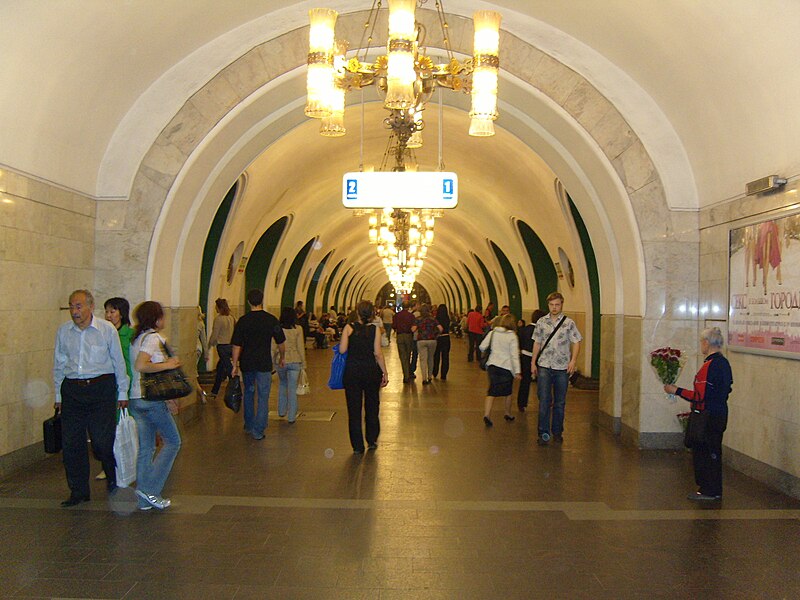
I'm not really about to travel on the trans-Siberian railway - or even on the Moscow metro. But when I attend my weekly Russian class, the tutor assumes we will all go to Russia one day.
She seems rather worried about this, especially as most of us fail to make the rapid progress she would like. My studies are hampered by my failure to find sufficient time for homework and my inability to pronounce words with long strings of consonants.
I've spent some time this evening writing out numbers, days and months in my neatest Russian script in the hope that I'll start to remember them. But somehow they fail to lodge properly in my brain. I really need 20 or 30 minutes a night on Russian to make any progress - an hour or so at the weekend, when lucky, doesn't have the same effect. So when the next lesson comes round, I'll feel like a dunce again.
But when I look back, I have made some small progress. I no longer struggle with Cyrillic script and have acquired a few useful phrases: I can say извините (excuse me) я не знаю (I don't know) and employ the useful word можно (our tutor's very keen on можно) which means something like "May I ...?" and can be used in a variety of situations.
At times we enact situations. Some are guided by the text book while others are invented by the tutor. The text book has a fine sense of exotic scenarios. I particularly enjoyed the conversation between the delegates to a conference for amateur accordianists, who enthusiastically introduced themselves to one another, giving details of their nationality and job - in Russian of course.
Then there was the keen but inexpert student of Russian (always asking Russian friends to speak slowly until they pronounced the words one careful syllable at a time). His evident lack of competence didn't stop him heading for a large bookshop (дом книги) where he asked the assistant for the book of his choice - not a simple reader or a Chekhov short story but Tolstoy's Anna Karenina. Later he set out to buy a balalaika as well - there's an enthusiasm for music running through the text book.
But we move away from the book to practise other scenarios. We have arrived at customs and are interrogated by an official who demands to see passport and visa, asks questions about nationality and profession and which bag belongs to which traveller. We buy tickets for the train at the main rail station (a word derived from Vauxhall, after the much-admired London station), and enquire about train times (numbers again). We learn how to navigate the metro in Moscow or Novosibirsk.
But again our tutor is anxious. "Don't go to Russia alone. You should go in a group or with a guide - unless you know Russian people." She's worried we'll be mugged or cheated - that we won't be able to cope with crowds or pickpockets. She also warns us about the high prices in Moscow and the risk of taking an unlicensed taxi. At the same time she wants us to understand that Russian people are hospitable and good friends who will, when we know them, welcome us into their homes.
I suspect she would be a little less worried were we more competent in the language. I would worry about any friend who arrived in London alone with little English and attempted to navigate the city. But the language, while fascinating, remains strange.
Of course, it's the strangeness that attracts me. I've reached the stage where I can notice the way Russian words have different boundaries to English words. For instance, there are different words for going somewhere on foot and going somewhere in a vehicle. There are other oddities. Numbers ending in 2-4 take the genitive singular while higher numbers that don't end in 2-4 take the genitive plural. And the sane word means both "world" and "peace".
That, for me, is one of the most exciting things about learning a language. As I discover the different concepts that are taken for granted in other languages, I feel my mind expanding to accommodate additional possibilities. At the same time, certainties I'd taken for granted become unstable. It's worth struggling with the numbers and the strings of consonants for that alone.
Of course, I'd rather become so expert that I could read Pushkin or Akhmatova in the original. It doesn't seem likely. Next week we learn how to book hotel rooms. I expect we'll be asking questions about bedding, showers and when breakfast is served. It's not quite the vocabulary of Eugene Onegin.
I don't suppose I'll even get to Moscow either, so I shan't use my expert knowledge on travelling by Metro or booking a hard or soft seat to Novosibirsk. I'd rather like to cross Russia alone, for all my tutor's anxieties. Perhaps, if I did, I'd find myself managing the language a little better.
But that's enough reflection. It's time to return to my Russian homework. I have to work out how to buy a samovar and some Russian chocolate. I might buy a bottle of vodka as well and a few postcards - or even a large, red piano. It doesn't really matter what I buy since I won't really be paying for it or bringing it home.
It took a long while to recover from the ice. Gradually I noticed that the cold had become less acute, the pavements were mostly safe to walk on and that muddly brown and a dull, dark green had been added to the dominant outdoor colours of grey and white. There's still mud in the garden where there should be a small patch of lawn. Every so often obscurity returned.
The fog seemed to echo a more general confusion. I don't know how to protest at the cuts with sufficient force. It's not just the loss of public services that puzzles me but the government's willingness to borrow more money so that services can be cut. Raising tuition fees will cost £13 billion in extra government debt - but apparently that goes in a special column in the accounts so no-one need worry. The re-organisation of the health service will cost £1 billion in redundancy payments. Every so often I hear a government spokesman explaining that there won't be any savings till 2015. I thought the economic crisis was supposed to be an emergency.
Meanwhile uncertainty stalks many of us who are neither millionaires nor members of the government. Some people are doing well. The luxury goods market is flourishing. Tesco continues its expansion; its vast retail hangars are no longer consigned to waste land but are intruding in city centres and suburban high streets. Small outposts of supermarkets move into once-friendly streets and undercut the local traders. I'm used to empty shops and office spaces now. Every so often I try to remember what used to be behind the blank glass or below the "To Let" sign but the memory seems to have moved on with the prosperity or extravagances of past times.
I went to rejoin my local library. I haven't been a member for years. Demands of work left me paying too much in fines. I tried using a library near my office instead - I liked the elegant curves of the walls and the helpful librarians ordered books from the County Reserve. But they're turning the building into a Job Centre, cramming the collection into another building and selling off all the books they can't fit neatly onto the public shelves - that includes the entire County Reserve.
Across the country libraries are being closed. Our local library is merely threatened with cuts in hours - and I think it's large and popular enough to avoid the most drastic cuts, at least this year. I missed the campaign meeting so I don't know all the details. But I know the cuts in opening hours, mobile library services and librarians risk won't just wreck a service - they'll wreck lives.
Council spokesmen, whatever their original allegiance, have become passionate advocates of the cuts. Every so often they take a step backward and insist that they don't want to do this - they are acting this way because the government makes them. Every council is fulfilling the government's demands - none is prepared to emulate the councillors of Poplar in the 1920s or Clay Cross in the 1970s and resist and risk imprisonment or bankruptcy. Instead they ask protesters "Do you want us to cut social services instead? Should we take money from children or the elderly to pay for libraries?"
It's not easy to answer those questions - until you look at the children, elderly people and social services who also depend on their local libraries. A library isn't just a place for borrowing books. The crude calculation which assesses the cost of a library at so much per book borrowed ignores the library's full value.
When I consult books in a library I don't always take them away with me. Quite often I look for ideas or information in several books and then return them to their shelves. I use the library as a source of local knowledge. I can consult maps and directories there, find out about clubs and evening classes, see what is happening, enjoy whatever exhibition is on at the time (I particularly like the work of local artists), use a computer if my internet connection is down. Members don't just arrive, choose a few books and then leave. Schoolchildren use the library for homework or just to sit and read for a while. Many locals settle in a comfortable chair for a quiet time with a book or journal. Parents and carers bring their children to special events - storytime for the very young is a particular favourite. I've been to talks, poetry readings, book launches and evening classes in my library - and that's only part of what happens there.
I suppose those who don't use libraries can't imagine that a quiet place with large quantities of books could be at the heart of a community. And those who want measurable results for statistical analysis won't find what they want in by counting loans and library users. Nonetheless public libraries seem as precise an image as I can achieve of what is good and valuable in our culture. They represent what I understand by the word "civilisation."
Wherever I go, I find myself wondering what will survive. Announcements of cuts have speeded up and I feel battered already, though the axe is still poised to fall. These months are a reversal of the norm, as if convalescence came before serious illness. Everyone seems to be waiting for things to get much, much worse.
It's hard to make culture a priority when so much else is under threat. How can I value a trip to the theatre or art gallery – even a book borrowed from a library – above the local day centre for people with mental health problems (under threat of closure)? Yet I notice that many of the activities offered by that day centre depend on what are broadly termed "the arts". The people whose lives are improved by help and friendship at the day centre also improve their lives by sculpting, painting, writing and singing. They share their skills with one another – and arrange local trips to take in the exhibitions which I also enjoy.
Millionaires never have to do without the arts. As patrons they commanded poets, painters, sculptors and musicians - they could buy whatever entertainment they fancied. I'll always be grateful to those millionaires who gave money to build theatres and public libraries. But my sympathies are with those who lived on the fringes of culture, grabbing whatever they saw and desired, without any sense of entitlement. I've always grabbed at culture.
Now the wealthy men in our government are snatching back. Education in arts and humanities will be restricted to the very rich and those prepared to embrace enormous debt. Were I young now, I'd have to give up my dreams of a good education. Meanwhile opportunities for self-education are being snatched away. Library hours are being cut. Soon galleries and concert halls will close and theatres will darken – though I suppose millionaires will continue to enjoy their holidays abroad and whatever command performances they choose to buy.
Until then, I'm grabbing as much culture as I can fit round work and a heavy cold. I've seen two shows at Nottingham Playhouse (She Stoops to Conquer and Twelfth Night – both excellent fun) and, most recently, a new play, Dolly by Andy Barrett, which is touring the region. I caught it at the Darwin Rooms in Derby.
The Darwin Rooms aren't a typical venue for New Perspectives, the theatre company behind the production. It's one of those small, regional touring companies which rarely get noticed in the national press touring the region. Mostly performances are in village halls and sports centres - the actors move around the region, setting up temporary stages, lighting rigs and sound systems for a night at the time.
I haven't seen the company before but they seem to take rural settings as their starting point. This play was set in Rosslyn near Edinburgh - according to the play a small farming community where any outsider was instantly identified as a visitor to the research laboratory. It picked up themes of ambition, success and failure. Farmer's daughter, Bettina, longed to be a country and western singer like her idol Dolly Parton. Her story was told in parallel to the story of the first cloned sheep, created at the Rosslyn Institute.
To my surprise, I found myself warming to the enthusiasm of the researchers as they explained what they were doing and why it was so difficult. Ethical questions lurked in the background - as did the desire of mourners to use cloning to bring back the dead. But the playwright and production trusted the audience to think through the questions - they weren't hammered out but left for thought and discussion later. The play was more interested in celebrating human achievement, whether the success of scientists in an improbable project or the ability of Dolly Parton to write and sing songs about triumph in the face of difficulty.
When I say that my favourite performer was Dolly the sheep, this is not a criticism of the cast. They almost convinced me that the two puppets - Dolly the new-born lamb and Dolly the adult sheep - were real and I held my breath for a moment when Dolly was born and presented to the waiting scientists. It still seems unlikely that messing around with theories, formulae and test tubes can produce a warm and breathing creature, let alone a sheep of character.
But even if ambitious and imaginative scientific research escapes, I don't suppose the idea of science will warm people through the cold isolation of the cuts. Dolly Parton, for all her artifice, may be a better source of warmth. She can, on occasion, be very funny - and she has a clear sense of what it's like to go without.
I can't recall exactly where in our flat the saying was. I think there was a paperweight – perhaps in a multi-sided geometrical shape – with a number of catch-phrases and sayings. When I first read it, I was too young to work out what it meant. I spent ages puzzling over the words: “Work is the curse of the drinking class.” Apparently it was a joke that I couldn't understand.
I suppose the joke played on too many assumptions: that work is a good thing, that the working class are seen (especially by the rich) as idlers, that drunkenness is a working-class problem and that the working class live feckless lives dedicated to the pursuit of pleasure. If someone had explained all that to me then, I'd have been politely incredulous. I could see that my parents worked hard and that they put the interests of others (including their children) first. They didn't even drink. My mother was fearful of pubs and drinkers and, although my father enjoyed beer, he gave it up for years for my mother's sake and, even now, finds a single can of lager turns a meal or an evening into a special occasion.
But there's one way in which the group of assumptions did chime with my parents' attitudes. They worked hard at their jobs and often found them rewarding. But they hadn't fallen for the idea so ingrained into many middle-class minds: that work is what gives meaning to people's lives. My parents put other things first: family, friends, neighbours, duty, social responsibility – and pleasure. They handed those values on to me.
Quite a lot came under that heading of “pleasure.” It could be a walk in Richmond Park, a trip to the theatre, a jazz concert, a TV programme, drawing, a maths puzzle, a cryptic crossword, a visit to a museum or a good book. We didn't make the usual distinction between high-brow and low-brow. I watched the London Transport Players perform Ivor Novello or Rogers & Hammerstein in a “proper” theatre and amateur Shakespeare in the London parks. I picked up whatever reading material was lying around: Tit-Bits magazine with its intriguing advertisements for Joan the Wad, poetry anthologies, Plato in translation. I learnt by watching that the aim of work was to live a good and enjoyable life.
My parents encouraged us to work hard at school but they didn't pretend that the aim of education was a career. Education was a means of expanding opportunities for pleasure – and might give us the chance to choose a job that was more enjoyable than those our parents did. I could see the point of that. In my early years my mum was a cleaner and a kitchen assistant. I didn't think I'd be much good at either and, given my incompetence in tidying my room, I didn't think I'd be much good at being a cleaner. I liked reading books and learning poems and plays by heart but I wasn't sure that many jobs would draw upon those skills. And I realised that I might want money so that I could buy books, travel to museums, go to the theatre and so on.
There's nothing in my parents' approach that seems wrong. The idea of devoting a life to work for its own sake seems ungenerous and mean-spirited. I'm lucky enough to enjoy much of my work – but not the bits involving form-filling, managerial jargon, the distress of others, or tidying my office. It's a good job but does it really shock you to learn that I do it for the money? After I've paid for the usual necessities of life, I spend that money on family, friends, duty, responsibility and – of course – on pleasure.
“Productivity” is one of the ways in which our work and lives are measured. It's an idea from time-and-motion studies and is allied to another word: “output.” Lately they've been linked to other words, like “targets” and “league tables.” Underlying these is the notion that speed and quantity are always valuable.
Speed and quantity have their uses. Nobody would suggest putting out a fire slowly or labouring for a week to produce the single, perfect baked bean. But somewhere in the rush to achieve meet targets and achieve maximum productivity, important qualities are lost.
I began thinking about this when I heard Will Self talking on the radio about the experience of walking to the airport. I was mostly concentrating on making coffee but, in my usual quest for maximum productivity, I was listening to the radio as well. The coffee was fine but I caught only a few sentences from Will Self. He pointed out that, in people's haste to reach an exotic destination, they neglected the places in between. Huge suburbs were diminished to places which are crossed as quickly as possible by travellers who want to be somewhere else. Walking to an airport might be one way of regaining an older, more leisurely experience of travel.
I liked this idea of slow travel. I've been toying with the idea of a walking holiday. Perhaps my inspiration was the opening of Dorothy L. Sayers' Have His Carcase, though I don't expect to meet Lord Peter Wimsey and could do without the discovery of a corpse. But I think women – even women of my age – are less inclined to solitary walking than they were in the 1930s and, even if I could handle the necessary luggage, I've a feeling my conduct would seem eccentric. Still, I'd love a slow holiday – slow, at least, by modern standards – taking trains, boats and buses as well as strolling by rivers and lounging in bars and cafés. I've been glancing at holiday brochures and they all seem rather intense.
Going slow shouldn't just be a treat for holiday times. There are moments when work is better for going slow. Not all tasks are best done at speed. I prefer the carpenter who works carefully to the hasty worker with an eye on the clock. I think workers who pause occasionally to talk to one another may find they enjoy their work more than those who are harried into silent, urgent speed. The shop assistant who asks after the health of an elderly woman customer may hold up the queue for half a minute, but she's doing a good job.
Teachers have to account for every minute of classroom time under national strategies. They don't have enough time to listen to pupils, go over ideas or even meander slightly from the point, seeing where a thought or a new idea might take them. Children are educated to make every minute “productive” until they're afraid of the kind of day-dreaming in which genuine inspiration strikes. No wonder so many young people see leisure as a time for binge-drinking. An approach to leisure governed by productivity and target-setting is bound to ask “how much can you drink in the time?” and “how quickly can you achieve drunkenness?”
This focus on productivity doesn't seem to have much to do with the way humans deal well with one another. It comes from business. Schools and public services are still being told to model themselves on business, as though no business could ever fail. It comes from the desire to compete and make maximum profits. The demand for high productivity can be found in a number of industries where firms compete with one another for work. Robert Tressell's The Ragged-Trousered Philanthropists describes the house-painters' unwillingness to skimp work in a competitive system which drives down prices and therefore wages. It was heightened by mass-production, in which people serve machines.
The Ford factories of the 1920s and 1930s moved from the craft of car-making, in which workers served an apprenticeship and learnt to make a car as a whole, to machine-tenders who did one simple, easily-learnt task. Initially, the machine-tenders were well paid, although they could easily be laid off or replaced. High productivity lowered prices. This made goods and leisure more widely available in a hugely unequal society. Perhaps it also reduced the demand for greater equality and a fairer distribution of wealth.
I have a taste for things that are produced slowly and with care. I like the idea that someone took trouble and that an item suits me rather than my “demographic.” I like wine, beer, bread and cheeses that are made by people who aim at the best taste they can rather than a neatly-packaged and predictable uniformity. I enjoy books that are a pleasure to touch as well as to read, with elegant type and clear design. I like ideas that have taken years to mature, ideas that are still being made, thought through and tested – ideas too lengthy to be one of five points on a small card and far too rich and complex ever to be shrunk into the neatness of a soundbite.
My laptop continues to languish in laptop hospital. I have odd moments when I get at computers but feel strangely cut-off from cyberworld. Fortunately there are still books - and time to think about writing blog entries.
Like most people, I have a pile of popular fiction for soothing bedtime reading. Recently I've returned to Dorothy L. Sayers.
"But she's a dreadful snob," some people respond. "She's a tory writing about an aristocrat."
There's some truth in that but it's not the whole truth. In the later novels, written in the mid-1930s, she sees Lord Peter Wimsey's class as a problem - at the same time as suggesting it is dangerously attractive. This isn't unusual in the 1930s. Winifred Holtby's South Riding - certainly not a tory novel - makes the same observation and shares Sayers' belief that the power of the aristocracy is doomed.
Most recently I've been reading Gaudy Night and remembered the influence it had over my teenage years. It influenced me in two ways. Like many girls, I grew up in a society that was uncertain of the value of education for girls. I remember debates - even in the 1970s - about whether girls should enter higher education or whether this rendered them unfit for their natural destiny as wives and mothers. Sayers painted such an alluring picture of a women's college in the 1930s that I knew university was for me. At Oxford and later I met other women who chose Oxford because they had read Gaudy Night. I have to thank Dorothy L. Sayers for my three years there.
Gaudy Night - and Oxford - attracted me for another reason. Like many young teenagers. I'd fallen into the habit of convenient, self-protective lies. Suddenly, when I was thirteen, I wanted to change that. I realised that the world was confusing and difficult to understand - and that lies and deceptions made it harder to reach the truth. I made a resolution to stop lying.
In Gaudy Night the values that are repeatedly attached to universities and learning are associated with truth and integrity. The dons may behave badly at times but they value evidence, facts and honesty, even when honesty hurts. The subjects of their research - English prosody, the economics of Tudor England, and so on - may have no immediate relevance to contemporary life but the dons' aim is to uncover the truth in their chosen field. Their integrity is set in opposition to Nazi oppression and the risks women run if they submit to their husbands.
There are, of course, arguments against women's equality and education in the novel. Lord Peter Wimsey is never more admirable in my eyes than when he shows, without question, his support for women at universities and for honesty, whatever the cost. It's undoubtedly an idealised view of university life but there's a lot to be said for ideals.
My latest reading of Gaudy Night set me wondering what Dorothy L Sayers would say to a different Lord Peter: the head of the governments Department of Business and Skills, which also has responsibility for higher education. I must have been at Oxford at the same time as Peter Mandelson but I don't recall him there. As minister in charge of the universities, he doesn't seem to care much for some of the values Sayers cherished. While she foresaw the end of the House of Lords, I don't think it occurred to her that universities would be told to sell their scholarship for economic advantage.
Lord Peter Mandelson doesn't look at universities and see scholars motivated by the search for truth. If he saw that, he would probably think it a bad idea. Instead he sees them as part of the "knowledge economy," and wants them to make money and teach the skill of making money. Universities are instructed to teach their students "business awareness" and to ask business people (bankers, perhaps) to come into universities and design courses which academics will deliver. Educations is now a product consumed by students. But students are also the product of education. They are to be prepared for their consumption by business and government. Research is another product and will be judged not for its truth but for its impact on business, the economy and government policy.
Disagreement with government policy or uncomfortable truths about new products. business and the market are unlikely to have much immediate impact. I wonder what value Lord Peter Mandelson places on academic honesty.
I was lucky enough to hear Tom Leonard read his poems a few weeks ago - the second time I heard him. The reading ending with questions and someone asked what started him off writing poems. I didn't expect him to mention Stephen Spender. But he did. He spoke of finding an exam paper in the school playground when he was 15 or 16 and on that paper he read Spender's poem "The Express." Tom Leonard mentioned that his father worked on the railway so he took an interest in the subject. But I wonder if he'd have been so interested in the poem if he'd encountered it in a classroom or exam.
I had some wonderful teachers who loved poetry and did their best to convey that love. (I also had one dreadful teacher who achieved the remarkable feat of making me dislike Hamlet). I've also tried to teach poetry within the English syllabus. It's an exciting and infuriating task because the teaching of poetry tends to talk round the central questions of what poetry is and what it is for.
If you're studying poetry for an exam, every poem turns from a thing of wonder to an object which must be interpreted, analysed and defined. I recall how, when I was in the the 6th form, my fascination with the poetry of John Donne was overshadowed by the question of what constituted "a conceit" and how I should write about the poetry in an essay. The thrilling oddness of Donne's images was smoothed away by the need to explain them in neat paragraphs about compasses, the opening up of the "new world" and so on. I was lucky that the craft elements of poetry were taught with encouragement to try things out - at least I learnt about metre, rhythm, cadence and form by writing rather than, as so many of today's students do, by a mechanical process of counting syllables and memorising Greek-derived terms.
I wouldn't condemn analysis of imagery, content, politics, craft, etc. - they are all enjoyable parts of the experience of poetry. But they aren't the main part and they don't answer the question of what poetry is for. Academic study of poetry often aims for a total solution - to explain away everything. But I don't believe any poet who has just finished writing a poem thinks, "Oh good! I've just written a wonderful set text" or longs to be set in an exam.
League tables and the need to measure degrees of success can easily limit the way in which poetry is read. "What does that image mean?" students are asked, "Can you identify the metre?" or "What is the poem's political perspective?" While the most sensitive and sophisticated response might confess uncertainty, students learn young that there are right or wrong answers and that a poem, like a quadratic equation, is there to be solved. Its component parts are pegged out and labelled and its political stance is subjected to praise or blame. Any pleasure gained prior to a solution is treated as purely incidental.
In most seminar rooms or classrooms, there's someone who ventures the opinion that a poem means whatever the reader thinks it means. It doesn't, of course. Wordsworth's daffodils remain yellow spring flowers however you happen to see them. The reader who think that daffodils looks like gladioli or Martians is making a serious mistake. And yet that insistence on the importance of the reader does say something important: it resists the stock definition that "solves" the poem and recognizes a transaction between the words on the page and the reader for whom they are meant.
I took a series of seminars and asked students to find poems they liked which puzzled them - poems that resisted an easy analysis or solution. And then I asked the students what they liked about those poems. They were hesitant at first - afraid of giving wrong answers or sounding silly. But as I scribbled their answers down, I realised we were getting closer to the answer of that impossible question "what is poetry?" And the answers were a helpful reminder that poetry isn't there so that people can pass exams - it's there to be enjoyed.
Here are some of the things students liked about poems:
- the sound of poems - the way poems sing - the way poems look on the page - simple images - seeing things in a different way for the first time - playing with words and forms - mystery - the sense that there's a deeper meaning that can't quite be reached - snatches of sense - concentration - weirdness - unfamiliar words - not understanding - the puzzle
Students started to remember the way poetry seemed to them when they were very young. They recalled nursery rhymes, nonsense verses and magical, powerful words that they didn't fully understand - like swearing. We were, at least, on the edge of finding out what poetry was for, even if we couldn't quite define it.
At it's best, for me at least, poetry is to do with lasting wonder and the kind of mystery evoked by W.S. Graham's poems "What is the Language Using Us For?" When I read the first stanza of the first poem while browsing in a bookshop, I knew this was magic. I was swept into the mystery of the words:
What is the language using us for Said Malcolm Mooney moving away Slowly over the white language. Where am I going said Malcolm Mooney.
I don't want to stop and analyse the poems - I want to read and revel in them. An analysis would merely skirt round the edges. I could learn about the W.S. Graham's craft as a poet - and that would be useful - but the mystery would remain. The most apt response isn't an academic essay but closer to "Wow! I want to read that again," or even, "I want to learn that by heart."
Schools and universities are right to teach skills of analysis and puzzle-solving. But they run the risk of being constrained by what is easily tested and measurable. You can't grade students on the enthusiasm with which they say "Wow!" or give them marks for saying that a poem is an insoluble mystery. Yet their sense of awe and mystery may be as close as any of us gets to understanding the nature of poetry.
I like ordered rowdiness of markets, the generous displays of goods, the shouted conversations. Last weekend's "continental market" turned out to be Italian, with a number of Sicilian stall-holders. Locals gazed, listened, sampled and sometimes bought, delighted at this fleeting encounter with another culture.
Shopping may not be the best way to sample another culture but - for those with money - it's the easiest. Stalls arrive with polite stall-holders for their two- or three-day visit, no doubt vetted for picturesque appeal as well as health and safety. It really is delightful to practise a language when buying real cheese or olive oil or bread - and the stall-holders seem so pleased to encourage customers' attempts. I still treasure the memory of a macaroon stall at a continental market when I startled the stall-holder by greeting him in one of my three phrases of holiday Dutch.
Of course, the visiting market stalls sweep aside much of the complexity of their countries' culture - and it's not a bad thing. We begin as observers, with a picture postcard impression of smiling unfamiliarity. A market encounter couldn't possibly convey deep insights but it's a starting point - and a place to enjoy differences as small as the taste of a new cheese or the lilt of a foreign tongue.
Money seems only incidental to the pleasures of the continental market but these days money and marketing are supposed to be central to everything. Public services (how quaintly out-of-date the term "service" sounds) are told to compete and set up "internal markets". When I grew up we were expected to value health and education for their own sake but now we're expected to see them as "products" produced by competing "brands." The glossy brochures and little give-aways - pens, toys, badges, notepads - that every service produces are signs of the dominance of market forces. So are league tables and the competition for grants. People who once cared for their work have to set out their stall at the market and compete for custom. ("Our school gives free notepads and badges." "Look at the cool fridge magnet produced by this university - not to mention the dons trained in marketing and presentation." "Come to our hospital - we have glossy leaflets, handsome doctors and free pens."
By contrast, the continental markets are restrained and courteous. The stall-holders set out their wares, wait for customers to arrive and answer questions. There are free samples at times but these are just samples of what the stall-holder is offering for sale. Health and education may have been sucked into the idea of the market but - fortunately, perhaps - they don't do it very well.
The criticisms are automatic. Whenever a commentator begins the phrase "useless subjects like ...", I know it's going to end with the words "media studies." Fifty per cent of the time, the commentator will continue by making the observation that media studies graduates aren't guaranteed jobs in the media at the end of their studies, as though the only end of a degreee was a relevant job. Obviously I'm old fashioned. I still believe - against all the declarations of politicians - that study can be an end in itself and that sustained thought on a range of subjects enriches the thinker, society as a whole and the democratic process.
Thirty years ago the phrase "useless subjects like ..." would have ended with the word "sociology." People still think of it as a new discipline - in fact the first university sociology departments were established in the nineteenth century - but at last its debates about society, the family and ways of life are taken for granted.
Eighty years ago English was the typical "useless subject" - so controversial that some Oxford and Cambridge colleges still refused to appoint tutors in English. The subject, which included Anglo-Saxon, history of language, the plays of Shakespeare and the poetry of Milton, was seen as best fitted for women, working-class people and colonial subjects but not a matter of serious scholarship. The subject which needed no justification was Classics - the study of Greek and Latin.
Now it's media studies that's under attack. And I wonder why. Our daily lives are saturated by the media. For the last couple of years I've barely watched TV, although I've managed to see most episodes of Doctor Who. But when I wake up, I turn on the radio. I check the internet so that I can read the papers and my favourite blogs. I notice advertisements on my way to work. Sometimes I go to the cinema. Occasionally I try playing a computer game or hunt for podcasts and video clips. I'm more influenced by the media than the literature I read - and I think that's true of most people. Surely something that influences people so much is worthy of study.
Media studies covers a huge area. It usually begins with thinking about the ways in which various kinds of media are created: what is the structure of a newspaper report, a film, a TV show, an advertisement? It's important to understand that these things are made to set rules and that the way they are shaped may control what they say.
The film-maker Peter Watkins, who is also one of the most acute critics of the media today, writes about what he calls the "monoform" - rules of editing, sound, etc. which are so aggressive and dominant that they deny the viewer or listener space for reflection, criticism or resistance. I once heard Peter Watkins speak to Media Studies students - I slipped in to hear him although I wasn't on the course. He asked the students to time the length of visual clips used in news broadcasts. I think they were about 6 seconds long then. They are shorter now, allowing even less time to reflect and question. But since Peter Watkins' lecture, I've found myself asking key questions: Whose film are we seeing? (Sometimes the film is library stock and not recent footage of the events described.) Does it tell the same story as the sound track? What story is being told by the way the clips are edited together? What stories are not being told? (A story without a useful film-clip is unlikely to make it onto the TV news. And complex stories which take time to understand don't fit the rules of narrative that rule the newsrooms.) Peter Watkins argues that these questions aren't asked enough in departments of media studies. I expect he's right. But outside the world of the media and media studies, these questions aren't asked at all.
I can't outline the huge scope of media studies. There are areas and debates of which I'm barely aware - and probably some I couldn't begin to understand. The practical skills some media students acquire - from storyboarding to sound recording to website design - require a range of abilities. I'm most aware of the work of media studies in film and cinema history. At times - as in studies of the documentary movement - it overlaps with literary, music and art history. And then media students use debates about society - about the treatment of class, race, gender, etc. - and apply them to their analysis.
For instance, in the clip below from Mervyn LeRoy's film, Gold Diggers of 1933, the media studies student would be able to use a range of approaches. It would be possible, using Peter Watkins, to consider how the intensity of the film - its use of music, the Busby Berkeley choreography, and the potency of its visual images and editing - make it hard to disagree with what it says. The power of the song is particularly strange given its place in the film - it is presented as a song in a stage show but it becomes something more powerful and political. An approach looking at the treatment of race and gender might note that something complex is happening. The song is sung by two women - Joan Blondell and Etta Moten. Although Etta Moten has the better, more powerful voice, the central role is given to the white woman, Joan Blondell. Etta Moten's name doesn't even appear in the credits. And while the words of the song say that women are dependent on men, the men's individuality gradually blurs them from objects of admiration and pity into a pattern on a screen. Meanwhile the historical approach would tell how the film picks up a famous speech by Franklin D. Roosevelt and sets its key phrase to music. And the historian might also have something to say about the film's original audience: mostly poor, suffering from the effects of the Depression and entering the luxury of the cinema in search of escape, hope and happy endings.
I hope the owner of this toolbox doesn't mind that I've borrowed the picture. It comes from a page of pictures of a garage workshop - and I love workshops like this. They remind me of my dad, who is not just intelligent but skilled at all kinds of craft. Even in the flat where I grew up, he assembled a range of tools, with small items like nuts and drillbits kept carefully in Golden Virginia tobacco tins.
I wish I had the practical skills of my parents - or that my school had taught me useful things like woodworking. But these were seen as boys' skills. The idea was that we girls would marry. We would sew and cook for husbands and children but husbands would do the repairs. The boys' school included woodwork and metalwork on the curriculum; my brother produced a poker and toasting fork, which were things of beauty but of little use in our centrally-heated flat.
When the cat-flap shattered in a fierce wind, I realised I had to do something about it. I may know that the first reference to a catflap comes in Chaucer (the Miller's Tale) but I had no idea how to fit one. At first I worried. Then I asked my son to choose a new one of about the same size. It arrived with incomprehensible illustrations that were suppsoed to indicate how to fit it. I gave up looking and began to piece the catflap parts together for myself. After a while it seemed clear. I went to the shed to look for the drill and discovered I no longer had one. Fortunately a neighbour lent me a drill, a crewdriver and a pair of pliers. It was a fine, hand-held drill - like the one my Dad has. I cracked, peeled and unscrewed the wreckage of the old catflap and my son and I went to work.
Together we marked the places where the new screws would go and took turns at the drilling. It wasn't easy - the holes had to be very close to the edge of the gap and it's hard to drill at the bottom of a door. I was glad that my son did most of the work but felt quite pleased that I was also playing a useful part. I've never fitted a catflap before.
Gradually we got it in place - not particularly skilfully as one of the screws is crooked. But fitting it at all seemed like an achievement - and a great improvement on the hole in the back door. Joe didn't approve, however. He had thought the hole much better than a catflap - easier to manage. He looked at the new contraption unconvincedly and tried to persuade us to open the door instead.
It's not a great catflap but it has three advantages: it's transparent, it has a magnet which stops it from flapping in the wind, and it can be sealed with a small plastic sheet that holds it shut. I'm not sure Joe sees these as advantages.
Odd jobs proliferate. The washing-line snapped under the weight of sodden sheets which I hung up just before a downpour. We need a new backdoor - and the garden is in a desperate state. Unfortunately work is busier than ever and after 11-hour days I find it hard to summon the energy for anything else, except fencing, which seems to have a brief energising effect. Yesterday my Chinese horoscope urged me to do sport or "relaxing activities like odd jobs." The odd jobs didn't seem particularly relaxing. I chose fencing. They didn't teach that at my school either.
The campus on Nottingham University is a peaceful place. Locals walk there, go boating on the lake, and take their children to play in the playground. It was alarming to hear on national radio of the arrest of two terrorist suspects.
The men weren't terrorists at all. One, Rizwaan Sabir, was a Ph.D. student - a Nottingham local - who had chosen to research Islamic terrorism. It seems a fairly important and relevant topic. I assume his research topic was registered with the university in the usual way - universities are very bureacratic places. It would be natural to list it in the university's submission for the Research Assessment Exercise earlier this year, since universities move up the rankings when they have a high number of research students.
Rizwaan Sabir thought that an Al-Qaeda training manual would be relevant to his research. He didn't download it from any old source. He went to a United States government website and downloaded an edited version, with anything judged to be dangerous edited out. He then contacted a friend, Hicham Yezza, who worked in the university and asked him to print it for him. Students do this kind of thing quite often. So do academics and people with temperamental printers or empty printer cartridges. But someone saw what the student's friend was reading and reported him to the police.
That's when the Counter-Terrorism Unit arrived. Both men were rushed off the jail and held for six days. They were questioned, their families were questioned and their homes were searched. Students at the university, in the middle of their exams, became rather nervous as police swarmed through the familiar buildings. Then, when the truth of the men's story became apparent, they were released.
But Hicham Yezza, a known peace activist from Algeria with a pending application for British citizenship, was immediately re-arrested. Someone had found a problem with his visa. This is very surprising. Universities are scrupulous in checking the immigration status of their students and employees. But I suppose most people make minor mistakes in completing complex forms.
Hicham Yezza - two weeks ago a trusted ex-student and employee of Nottingham University - is now in a detention centre pending deportation. He could be put on a plane and sent out of the country as early as Tuesday - and it's hard to do much on his behalf over a bank holiday weekend.
You may wish to write to your MP, asking him or her to contact Liam Byrne, the Immigration Minister, as a matter of urgency. At the very least, Hicham Yezza needs time to prepare his case. I can't help suspecting that this speed is an attempt to divert attention from two unnecessary arrests and the alarm they caused.
There's a fuller account and more helpful links in a recent post from Beeston Quakers - Beeston is a suburb of Nottingham which borders the Nottingham University campus. The Beeston Quakers post also considers further important questions raised by these events. (And it saves me the time I would usually take in researching and adding links.)
Do you think military awareness should be part of the national curriculum?
Do you want to see soldiers in uniform wherever you go?
Do you want your children encouraged to join in military activities at school?
Do you want discounts for soldiers in shops?
Do you think that discriminating against someone in military uniform should be a criminal offence?
Do you want more military parades - on the streets and on television?
Do you think major football clubs be compelled to host military parades?
Do you want a public holiday devoted to celebrating the armed forces?
And what would you think if these laws were in force in North Korea? in Iran? in the United States? in Russia? in Britain?
If you've been following the news, you'll know that these propsals have been welcomed enthusiastically by Gordon Brown and are likely to become law. And if you've been following this blog, you'll have guessed that, as a Quaker and a pacifist - and as a mother - I'm not pleased.
I should say that I haven't read the whole report. It's a big pdf file and I can't open it on my computer. Instead I've depended on a series of press reports. These seem in agreement on the main report but offer different details. I've met plenty of soldiers. I've talked to them, drunk with them - even fenced them. I disagree with their choice of career but I know that many are well-intentioned and courageous. I think that, as we have an army, we should treat soldiers well. The state of facilities for military families and the number of homeless ex-soldiers is a national scandal.
But I don't want to live in a society which celebrates the military or encourages small children to see themselves as soldiers. I don't want lies about the glory of battle or any suggestion that it's sweet and seemly to die for your country. I had enough of that at school.
I was nine years old when I was introduced to the poetry of Henry Newbolt. We read "Vitai Lampada" in class. It's a poem which begins with a cricket match one evening at a public school. The players, we are told, aren't after trophies - all any schoolboy cricketer cares for is " ...his Captain's hand on his shoulder smote -/ 'Play up! play up! and play the game!'"
In the second verse, the scene shifts to some outpost of empire:
The sand of the desert is sodden red, - Red with the wreck of a square that broke; - The Gatling's jammed and the Colonel dead, And the regiment blind with dust and smoke. The river of death has brimmed his banks, And England's far, and Honour a name, But the voice of a schoolboy rallies the ranks: 'Play up! play up! and play the game!' And there's a third verse, to tie it all together and imply that this is how it should be - that schoolboy games are train boys in unquestioning obedience to orders.
Even at nine, I knew there was something odd and disturbing about the poem. Like other poems by Newbolt (the second poem in the book we studied was "He Fell Among Thieves"), this poem is in love with death. There is so much it doesn't say. There's no indication of why the soldiers are fighting or who the enemy is. The opposing forces aren't even described - it's as though they don't exist. British soldiers are overwhelmed by "dust", "smoke" and "the river of death." There's not even any suggestion of ethics of loyalty - England and "honour" are discounted. All that matters is the memory of a schoolboy game and this time the game ends in death.
Newbolt wasn't the only writer of that period to praise the romance of death to a young audience. The first act of Peter Pan ends with Peter, trapped on an island with the seas rising. Alone on stage, he summons up his courage and declares, "To die will be an awfully big adventure."
They took that line out of the Christmas productions during the First World War. And many of the boys who had read read Newbolt and thrilled to Peter Pan did what was expected. They played the game and faced the big adventure of Gallipoli and the Western Front.
I've heard that terrorists say "You love life but we love death." A hundred years ago, there was a love affair with death in British culture. Please don't let this new celebration of the military bring it back.
Note: The children in the picture are North Korean, by the way.
A student friend was recalling her school days - not very long ago. "Don't write what you think," she was advised. "You don't pass A-levels that way. Write what you're told."
And that's how it works. She took the advice, kept quiet about her own ideas and wrote the unoriginal essays that would gain the highest marks.
Luckily the story has a happy ending. My friend is now studying Philosophy and Theology at university, filled with excitement at her studies and writing what she thinks. It sounds as though she's on track for a First. Meanwhile compliant students, who never considered thinking for themselves, are floundering and wondering where it all went wrong.
My school exams were something of a farce. For O-levels I relied a mixture of rote-learning, guesswork and, for the subject that interested me, extra reading and thought on the day. English Literature was almost a disaster. I launched into an essay on Shakespeare's King John which required a comparison of Cardinal Pandulph and Robert Faulconbridge. I'd nearly finished when the awful realisation struck me: I was writing about the wrong Faulconbridge. There was only one thing to do. I scribbled out the entire essay and wrote a hasty comparison of Elinor and Constance instead. The teacher, who didn't like me, was delighted that I didn't get an A and told me I shouldn't be studying English.
I have odd memories of other exams, including my last Geography paper. I had never passed a Geography exam in my life but I wrote rapidly, trying to recall my notes. Then, when I found myself with more time, I began to invent. I hope the examiner enjoyed my vivid account of logging on the forested mountainsides of Denmark. (I borrowed the facts from Norway. After all, I reasoned, it's all Scandanavia.)
My last essay was my piece de resistance. I was asked to compare the ways in which transport was adapted to environment in four contrasting parts of the world. This was my sort of question. I decided I would fail gloriously and chose the Amazon jungle, the Sahara Desert, the North Pole and Britain. I outlined the problems Father Christmas would face if he tried to travel by sleigh in the Amazon jungle. Tarzan wouldn't find it easy to swing through the trees in the Sahara Desert, I said. He'd have to wait a long time for a bus too. "On the other hand," I remarked, "I once had to wait more than an hour for a 73 bus in the Upper Richmond Road." And so it went on.
I wrote a note to the examiner at the end, congratulating him on reaching the end of my paper and commiserating with his misery at marking it. I added that "Kilmarnock carpets are made in the Killybegs". I'd learnt the fact and it seemed a shame to waste it. And then I included my favourite Latin quotation from Aeneid I: "Forsan et haec olim meminisse iuvabit" (Perhaps one day it will be a pleasure to remember even this.)
That was the only Geography exam I ever passed. Sometimes thought and imagination (and nerve) win out over rote learning. These days I don't think I'd have been entered for the exam. I certainly wouldn't have seemed a good bet for A-levels.
Today, exams are accompanied by celebrations and rituals, many borrowed from the United States. There's a school leavers' assembly - I'm not sure what happens there. And for many children, there's the school prom. It's an expensive, dressy event - an evening meal and dance. Not all pupils can afford to attend. Suits and posh frocks are expected - wedding shops have branched out to offer "prom dresses". Some pupils arrive in stretch limousines. It's extravagant and socially divisive.
At least this year's prom is relatively cheap: £25 for each 15- or 16-year-old. But the venue is in the outskirts of a neighbouring city, twelve miles away. The prom finishes later than the last bus and train. Obviously the school assumes that all parents have cars, or can afford 25-minutes in a taxi.
Writer, former Creative Writing tutor who quit in order to write and escape stress. Quaker, concerned with equality and truth. Currently socially distant, usually more approachable.