Showing posts with label power. Show all posts

Wednesday, 25 July 2012

A touch of class

I haven't read Shades of Grey.  Having seen numerous blogs and articles about the book, I used Amazon's "look inside" feature to get some idea about it - and I peeked inside a copy in Waterstone's.  At my age, I don't need to worry what other people think of me, and I expect fellow travellers assume I'm reading erotica when they see me with my kobo.  (At the moment I have James Joyce's Ulysses open and Zola's L'Argent - both pretty dodgy books in their way and immensely enjoyable.)

However the fuss about Shades of Grey has led me to think about the kind of book it is.  It's fanfic, obviously - and because it's Twilight fanfic it's not much to my taste.  It's porn so not rooted in realism or good writing.  And it's also romance with all the usual baggage that entails.  Its heroine is young, innocent and adoring while the hero is enormously rich, terrifically sexy, and enormously damaged.  Her role is to rescue and adore him.  His role is to give her extravagant presents, including - and this is where I'm almost hooked - a valuable first edition.

Romance is an odd genre with a curious descent.  Part of it is a male genre - it comes from the seduction narratives of courtly romance.  In these the woman are praised for their exceptional beauty and virtue.  There are traces of this in Elizabethan sonnet sequences.  Shakepseare's sonnets reverse some of the usual conventions; the fair youth is praised for beauty and virtue while the dark lady is seen as both desirable and dangerous.  This enables Shakespeare to emphasise another aspect of this kind of romance: the suffering endured by the male lover. 

Romance also has roots in the spiritual journals often kept by Puritans.  This may sound unlikely but, because they were concerned with the soul and the interior life, spiritual journals naturally recorded emotions.  Samuel Richardson's 18th-century novel Pamela, which is clearly a fore-runner of today's romantic novels, comes out of that tradition, with its focus on the struggles of a very young maidservant to retain her virtue as he male employer makes repeated attempts to seduce and rape her.  In the end her virtue and beauty win him over.  Richardson was an influence on Jane Austen, who turned his third novel, Sir Charles Grandison, into a play, and I think it likely that the plots of his novels, if not the novels themselves, influenced Charlotte and Anne Bronte.

It's also common to find the roots of contemporary romantic fiction in fairy tales, particularly those written or adapted by Perrault, such as "Cinderella" and "Sleeping Beauty".  But although the structure of these stories is quite like contemporary romantic fiction, the stories themselves lack two aspects that are key to romance as written today.  They don't have an interior narrative and the women tend to be curiously passive in terms of the romance plot.  The heroines marry princes because that is expected of them and not because they love or desire princes.  Fairy stories of this era are largely concerned with actions and appearances.  The feelings of the character are irrelevant.

Contemporary romance has quite a lot going for it.  It values women's feelings and says that their desires are important.  It also suggests that the choice of a partner is both difficult and important.  However, there are also shortcomings to the form.  It tends to treat the achievement of a partnership or marriage as the culmination of women's lives, though sometimes there is a brief epilogue, usually involving pregnancy or the birth of a child.  Plainly this ignores most of women's lives and relationships.

Heterosexual romantic fiction (the vast majority) has another worrying aspect.  The hero is typically richer, more powerful, older and taller than the heroine - and usually of a higher social class.  The attraction of the heroine is almost always based on a combination of innocence (not necessarily virginity but relative inexperience), modesty (she doesn't realise how attractive she is) and adoration of the hero despite his flaws.  But while the heroine looks up to the hero, she is often also a mother-substitute who tends to some hidden anguish or moral flaw - she has to heal him while she adores him.  The heroine is permitted some liveliness of speech - today she is often characterised as "feisty" - and she is allowed a character and a career.  But the only model for romance that women are offered involved both admiring and tending to the hero.

There's nothing wrong with admiring some aspects of a partner.  Indeed, it's pretty normal given that adults prefer partners of whom they think well.  And there's certainly nothing wrong with caring for a partner who is in need of care.  But there's something wrong with the kind of transaction romance offers if on one side the man provides money and power while the woman offers adoration and nurturing.  It's not an equal relationship - and surely all of us, men and women, want more than that, even in our fantasies.

It was reasonable for Elizabeth Bennett to fall in love with Mr Darcy when she saw what a big house he owned.  In the early 19th century a woman of her class without much money was much better off if she could marry a fortune.  In the mid 19th century, Jane Eyre followed the conventions of her time by insisting on legal marriage, although her inherited wealth would have passed to Mr Rochester when that marriage took place.  Perhaps it was as well that, when they finally married, he was maimed and even less attractive than before.

But isn't it time for a different kind of romance in which the partners share what money they have - and it may not be much - and help and nurture one another?  I recall the ideal of a loving, equal comradeship, which was not unknown when I was younger.  It's present even in some unexpected 19th century novels.Perhaps the most unexpected is Dickens' Little Dorrit, with its conclusion of a marriage in which both partners together "Went down into a modest life of usefulness and happiness", without the corruption of great wealth.  Although the novel ends with marriage, it doesn't treat that marriage as the culmination of the characters' lives.  Instead it indicated that they have a future.  

The final sentence is one of my favourite endings of any novel: 

"They went quietly down into the roaring streets, inseparable and blessed; and as they passed along in sunshine and shade, the noisy and the eager, and the arrogant and the froward and the vain, fretted and chafed, and made their usual uproar.

That's the kind of partnership in which I'd like to believe - and it may be a more enjoyable and plausible one to imagine in these difficult times.

Friday, 30 July 2010

In black and white


Looking back, I think my first encounter with the photos of Diane Arbus must have been in one of the glossy Sunday supplements – the sort with shiny paper that makes everything ravishing, even grief and poverty.

I don't know if the glossiness conditioned my response to Arbus, whether I was influenced by the accompanying text or whether it was the work itself that upset me. Her stark, black and white photos of poor people and people with disabilities – people who would never buy a glossy Sunday supplement – seemed to have the glamour and allure of a freak-show. I shuddered and looked away.


News of a forthcoming Diane Arbus exhibition at Nottingham Contemporary disappointed me. It seemed less interesting than the accompanying, more recent work by the Tobias twins. The brochure, with colour pictures of Tobias paintings, also suggested they might have more to offer although the one Arbus reproduction, of twin girls, haunted my imagination.


Accompanied by a friend, I looked at the Tobias works with curiosity and baffled amusement, which may be the response the brothers hoped to evoke. Many seem like a cross between a kitsch version of folk art and a Gothic, Transylvanian Disney. My strongest emotion in their presence was an amused affection. I drifted on to the Arbus rooms and was transfixed by something I hadn't noticed in that early encounter with her work: tenderness.


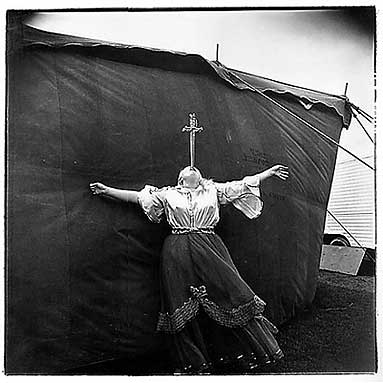
It wasn't in all the photos. Some, especially those of over-dressed rich women, seemed to expose their subjects to ridicule. I thought I glimpsed cruelty in the curve of the lips of a masked man. But in other pictures there seemed more gentleness and respect than I expected. I noticed how one of two drag queens, dressing or undressing for their act, seemed to reassure the other with a touch. I saw the dignified melancholy of a tattooed man, gazing into the distance beyond the camera. The albino girl, arms outstretched and head back as she swallowed a sword, seemed in control of her pose as she mirrored a crucifixion. So many of the subjects, often strange to the viewer or on the fringes of society, seemed to convey an inexplicable depth. Even the photographs of nudists seemed about much more than the nakedness of the subjects.

Some photographs still disturbed. I worried that the children might have disliked their portrayal – who would want to be shown in a gallery as “fat girl laughing” or to be famous as a skinny, laughing boy clutching a toy hand grenade? The extreme close-ups of babies' faces turned them into dolls or death masks. But when I came to the photos of people with disabilities which had so disturbed my teenage self, I began to ask other questions.

The subjects I'd characterised as a “freak show” looked out at me with self-confidence. They seemed as happy as any of the sitters to be recorded. So what exactly had disturbed me? Did I really think that photography was only for the beautiful, the confident or the normal (whatever that was) unless it had a proclaimed manifesto to change the world? These people just were – and were recorded.

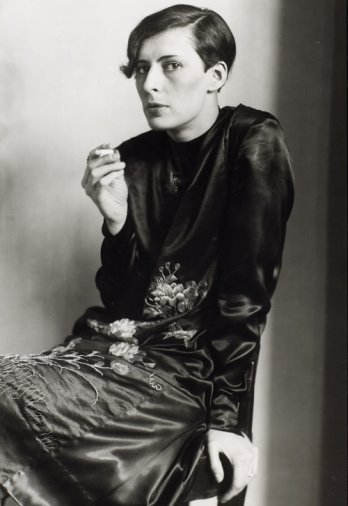
This took me back to the photographs of August Sander and the records he made of Germany in the 1920s and 30s. Before Arbus, he had photographed people in fairgrounds and institutions, apparently letting them arrange their own poses before the camera. It was impossible to look at his photographs without the knowledge Sander lacked. I wondered how many of the people he recorded had been imprisoned, abused and killed in the Nazi regime's euthanasia programme, in concentration camps and in the bureaucratically-ordered extermination of those in the “wrong” racial groups.

My sense of recording and the influence of Sander became even stronger when I returned to the gallery for a guided tour by Alexander Nemerov, Arbus's nephew. He talked about her focus on the subjects of her portraits and the way she documented them as though in the face of impending catastrophe. I reflected later that Arbus looked more for a variety of individuals in every setting while Sander, though recording individuals, saw them more as representatives of types.

There are still problems with photography and the act of recording. For many people, the fact of being recorded and visible places them at risk. I can't help wondering whether any harm came to the subjects of Arbus's photos. It wasn't easy, in the 1960s, to be a mixed race couple, even in New York – and Arbus's caption makes it clear that the couple are married and the wife is pregnant. I wondered if the transsexuals and transvestites later regretted giving so much away or whether the disabled people in the institution suffered discomfort from the response to the publication of the photos. A photographer can try to achieve neutrality and simply observe, understandingly, a range of subjects. But as soon as the photographs are on display they enter an environment that is not neutral and which is all too eager to judge and condemn the lives of others.


Too many people still face a choice between vulnerability and invisibility. On any day I can say, without hesitation, which I would choose – but my answer isn't always the same.

Wednesday, 9 June 2010

The watchers


There's a right length of time for looking at a picture. Some demand lengthy, careful views. The Adoration of the Mystic Lamb in Ghent Cathedral rewards slow appreciation. It's worth sitting before Rembrandt's The Night Watch in the Rijksmuseum in Amsterdam or standing for a long while before the Breughels in Brussels' Musée des Beaux Arts or the classical scenes by Claude Lorrain in the Louvre.

Even some portraits are made for time-consuming adoration. These are usually pictures of the powerful, commissioned to demonstrate their finery as well as their faces. But the poor as well as the rich can seem in control of their images. Murillo's street urchins often display the confidence of the young and free. Even Goya's Maja, clothed or naked, seems in control of how we see her – as does Lucian Freud's model Sue Tilley, the Benefits Supervisor.

Elsewhere the subjects of paintings see less happy with the viewer's gaze. There are nudes by Titian whose lowered or averted eyes can cause discomfort. And I can never look at portraits or even staged domestic interiors by Vermeer for long. The framing of the paintings always brings me slightly too close – I'm forced into the scene like an intruder, as I am.

This history of looking was at the back of my mind as I dithered in the entrance hall of Tate Modern. I couldn't make up my mind about the new exhibition. Not only was the entrance ticket £10 – very high by East Midlands standards, especially for a show of photographs and videos – but the subject itself made me wonder whether I ought to look. The exhibition is called Exposed and the material it shows is grouped around themes of voyeurism and surveillance.

At first I decided I wouldn't look. I'd taken the long escalator to the third floor when I changed my mind and returned to the entrance. The escalator journey felt too much like running away.

There was, of course, something uncomfortable about so many photos grouped around such a theme. Few of them on their own would have sparked such concern even though some areas were banned to under-eighteens because of their sexual subject.

But sex and violence are too familiar to shock. Even the napalm picture, with the running, naked girl (her clothes burnt off) in a world beyond fear and pain, has been reproduced so often that I'm now immune to the horror. I was more moved by the photo of Jackie Kennedy with the new president Johnson and his wife. She seemed numbly vulnerable as she took on the unfamiliar role of presidential widow – beyond comfort and open to the camera's exploitation.

Elsewhere too the camera's glance was surreptitiously controlling. I was disturbed by Walker Evans' pictures of travellers on the New York subway, some tired at the end of the day and enjoying private rest in the carriage's public space. The photos were taken, before the Second World War, with a camera concealed in a coat-sleeve so that no-one could object. All the subjects must be dead by now. For all I know they would have liked the idea that gallery visitors would pay the unbelievable sum of £10 to see their faces – it's a kind of immortality.

Having seen the subway photos, I was initially suspicious of the work of August Sander as he posed and classified “types” - by profession, disability, social status – in his project to document the layers of German society. But as I looked at the individuals he photographed with such care, I warmed to him. The pictures seemed to be the product of a kind of negotiation between photographer and subject. Most of them gazed back at the photographer with the confidence of people who had chosen their pose. There were exceptions of course: the boy labelled “idiot” or the blind girls, sitting together at a school desk. They were photographed in the mid 1920s and despite the labels the children appeared individuals. I wondered what happened to them after the Nazis came to power. Sander's sympathetic categorisation reminded me of the Nazis' brutal hierarchy of types. Yet the Nazis disapproved of Sander's project. His son Erich, a socialist, was imprisoned in the early days of the Nazi regime. After many years, Erich died in prison. Sander photographed his son's death mask.

Of course the exhibition disturbed – it was meant to. But it was far less disturbing than the film I saw two days before, Renzo Martens' Episode 3: Enjoy Poverty.

Martens' film explores poverty in the Congo – the sort of daily, agonising poverty that causes children to die painfully of slow starvation. But it's not like the kind of TV documentary that ends with an appeal to send money, offering the comforting, self-congratulatory reflection that we in the west are nice, charitable people. This begins with a man in the Congo complaining about poverty as he works and angrily showing his small daughter's sores – a result of malnutrition.

At first the film seems a tourist's journey through poverty in which Martens' occasional efforts to understand what he sees don't measure up to the reality. He seems too innocent, too polite. But the guns of the U.N. peacekeepers disturb as do the sharp suits of the wealthy.

But it's easier to look at the powerful than the underpaid workers whose children die so that people like me can buy goods cheaply. And then there's the war and the photo-journalists who follow war and starvation, looking for a scoop. They cluster together with their expensive, heavy cameras, each trying to find the best lighting and angle for a picture of a corpse. The going rate for a publishable picture is $50, on top of the travel and expenses already paid to the photographers. Martens, playing the innocent, asks a photographer a series of questions. Who owns the picture? Do the people in it – or the relatives of the corpse - earn money from it? What pictures sell?

Of course, it's the photographer who profits. The poor children, who aid workers strip and arrange for the camera, get nothing. So Martens reaches his conclusion. Congo has few assets apart from poverty. If the people of Congo are to profit, they must learn to exploit their own poverty. He finds two Congolese photographers, making a small living from pictures of festivals, birthdays and weddings, and urges them to change their subject, telling them that the highest profits come from photographing the dead and injured, raped women and starving children. I'm used to seeing such pictures but I've never before had to sit uncomfortably still while the subject's pose is adjusted and the photographer closes in for the most affecting and aesthetic angle.

There were questions and answers after the film. Martens insisted his work changed nothing – it was art, not politics. But he made a telling comparison with Jonathan Swift's “Modest Proposal,” identifying the film as satire based on a horrible truth. And he said there would be no change because there was no will to change. The people in Congo thought that if those on the outside saw what was happening, they would act – they would not allow such suffering to continue. But there is no outside – we're all in the same world and those of us with power to act do nothing because we benefit from the same system.

Meanwhile, for reasons we cannot bring ourselves to comprehend, pictures of pain and suffering are bought in the west as though they were things of beauty. And the sufferers get nothing for them.


Thursday, 3 June 2010

Eliza and the Court of Miracles


In 1885 a tall, red-headed Irishman stood on a street corner in London selling copies of the Pall Mall Gazette. His name was George Bernard Shaw and he was one of many volunteers selling a newspaper publicising a story so scandalous that the usual distributors refused to stock the paper.

The story was headlined “THE MAIDEN TRIBUTE OF MODERN BABYLON” and it told the story of how W.T. Stead, the editor of the Pall Mall Gazette, had joined forces with the repentant madam of a brothel to purchase a girl of thirteen from her father. He didn't intend any harm to the child. He simply wanted to prove the truth of tales he had heard: that, in the poorer parts of London, parents sold their virgin daughters into prostitution. The response of the authorities was swift; Stead and his assistant were arrested and sentenced to terms of imprisonment for assault and child-abduction. But the scandal brought about the result Stead desired. It drew attention to the existence of child prostitution in Britain – and parliament passed an Act which raised the age of consent from thirteen to sixteen.

Of course, it wasn't as simple as that. The Act expressed all kinds of moral prejudices of the time – and it was the same Act that made homosexuality illegal. Ten years later, Shaw's fellow Irishman and playwright, Oscar Wilde, was sentenced to two years' imprisonment with hard labour under its provisions.

Even the case of the child sold into prostitution may not have been as simple as it seems – journalists (and many others) have been known to distort and exaggerate facts in order to prove something they “know to be true.” Shaw may have come to this conclusion himself by the time he wrote Pygmalion in which the entirely willing Eliza, who shares a name with the child in the “Maiden Tribute” case, is sold to Professor Higgins by her father for five pounds. These are his “rights as a father,” Alfred Doolittle insists. Five pounds is exactly what Stead paid for the earlier Eliza.

There are numerous myths about what Shaw calls, in the Victorian phrase, “the undeserving poor.” These myths both console and terrify the better off. The idea that the poor are feckless and immoral, prepared to sell their own children at a fiver a time, suggests that charity is always misguided, equality a dream and that what is needed is containment and control.

Paris has another myth (though it isn't limited to Paris): the myth of the Court of Miracles. Colin Jones' history of Paris considers the potency of this myth in the seventeenth century. It tells of a dangerous alternative society thriving in Paris since the Middle Ages – a society of beggars and gypsies who adopted disguises – false wounds, apparent blindness – to exploit the charity of the hard-working bourgeoisie. The Court of Miracles was supposed to have its own king and laws governing this exploitation – and the so-called beggars were not poor and maimed, as they appeared, but living a life of luxurious indolence.

The myth falls apart as soon as it's examined. The beggars are supposed to be simultaneously disciplined and hard-working (as the rules of the Court of Miracles demand) and fecklessly lazy. As Colin Jones points out, the Court of Miracles never existed – though some beggars may have been fakes and liars. But the myth gave Louis XIV the excuse he wanted to round up paupers, beggars, the sick and corral them into hospitals. His main concern was making the streets safe for kings and their courtiers. As the French Revolution shows, this wasn't a complete success.

There are similar myths elsewhere. In the 18th century John Gay's The Beggar's Opera picked up the idea of the Court of Miracles and sets it in London – and Bertolt Brecht's Threepenny Opera gave the story new, even more richly parodic life. The thieves and beggars in Gay and Brecht don't inhabit a space as large as the Court of Miracles but they still combine idleness with industrious trickery. They seem to live outside the law – but at the same time they obey a different, equally strict code. They sing and dance too – it's a fine life being a thief and a beggar.

The myth of the Court of Miracles still flourishes. There are undoubtedly crooks and con-artists among beggars and the poor – just as the rich have their tricksters, whose deceptions are coming to light with the collapse of the markets. As a story, it's a delight – the fortunate who are neither poor nor beggars revel in its freedom - but it's also a dangerous excuse for repression, and for failure to see an equal humanity in the faces of the unlucky who need help and justice.

The story W.T. Stead tells in “The Maiden Tribute of Modern Babylon” cannot help relying on the myth of the dangerous poor – the myth is too potent to avoid and the poor know it as well as the rich. His newspaper article is a rich mix – it starts with a lengthy and richly imagined account of the labyrinth in Crete and ends with the scream of a child. He insists that he doesn't oppose the freedom of the libertine rich, so long as the vulnerable poor are protected. He insists that the rich who prey on the young are his main target. Yet his account of the disorderly poor, who know just where to sell their daughters and whose profit is governed by a parody of market forces, recalls the Court of Miracles' parody of the establishment of its day.

Stead believed his own story and undoubtedly there were cases of child abuse, then as now. He served three months in jail for abducting Eliza – the repentant brothel-keeper who helped him served six months. I don't know what happened to her after that. Stead's fame as an editor was secured until his death brought him another kind of fame – he was drowned when the Titanic went down. As for Eliza – not Shaw's Eliza but the original girl – Stead gave her to the Salvation Army for safe keeping. They eventually returned her to her parents, judging that she was not at risk from them. I don't know what happened to her after that.

Friday, 21 May 2010

Robin in Nottingham


There are mild grumbles in Nottingham about the new Robin Hood film. Nottingham can live with an Australian playing the outlaw, a newish story and even the usual dodgy accents – outsiders tend to be uncertain how Nottingham people speak. But word has got round that the character played by Russell Crowe – Robin Longstride – is a Yorkshireman.

Reviews of the new film were lukewarm. Nonetheless, Nottingham has declared that May is Robin Hood Month. There's an exhibition (costumes and set, I think) at the Castle and I've seen signs of other events in the area.

I hadn't expected the mediaeval market. I came across it on my way to Nottingham Contemporary, paying my second visit to the Uneven Geographies exhibition. While I hate shops, with few exceptions, I find it hard to resist a market and began to explore the stalls.

I watched a man making a thick leather tankard. I hadn't heard of leather tankards before but the procedure looked convincingly mediaeval. Opposite was a stall selling sausages and another offering Transylvanian glass – nothing to do with Dracula but delicate and glowing. There were stalls selling food, jewellery, carvings – all sorts of delights. It wasn't until I reached the stall selling baseball caps made of panels cut from tin-cans that my lazy, sun-soaked mind began to wonder about the label “mediaeval.” Still, the Heineken cans are a pleasing shade of green though the Coca-Cola logo might look out of place in the greenwood.

I started spotting other inconsistencies – a sausage stall, staffed by two smiling men in Robin Hood hats, was named after “King Tut” - much earlier, I think, and unremembered in mediaeval times. I know the Crusades saw returning soldiers bringing all kind of new goods to England - but would they have brought smiling Buddhas fashioned from resin? Did they eat ostrich burgers in baguettes in Sherwood Forest? I couldn't rule it out but kangaroo meat is totally implausible. Wodwos carved from wood seemed more authentic.

For a few minutes I counted inconsistencies. Then I began to delight in them. I love the Robin Hood legend but I've never insisted on historical accuracy – it's a baggy myth which is refashioned with every telling and imagining. Robin probably didn't wear tights, despite Douglas Fairbanks, Errol Flynn and Richard Greene – and at the same time he did, because imagination makes it so.

My Robin Hood isn't Robin of Locksley, returning nobleman, but the outlaw beyond class who sees an unfair society and acts for liberty and justice. His greenwood is a place of freedom and equality – and women are equal there, because that's how I've imagined it.

I began to wonder how my Robin would be today. He might be with the migrants who live outside the law in our cities, aiming at invisibility but too often exploited. Or perhaps he'd be an eco-warrior, defending the wild places and remaining greenwood from those who exploit them for cash. Either would be a more uncomfortable Robin than any Hollywood has produced. Only the TV series of my childhood really engaged with contemporary politics.

But Nottingham's mediaeval market didn't seem entirely out of place in the Robin Hood myth. People who'd come to Nottingham for all sorts of reasons mingled at the stalls. There were Goths, political protesters, parents whose children wanted to splash in the fountain – all assembling in the Old Market Square and strolling round the stalls. They moved easily from demonstrations of weaving and wood-turning to chat with the vendors of amber, carved elephants and eco-clothing.

Myths update themselves all the time. No single version can hold them.


Saturday, 15 May 2010

Border police


From England, borders seem simple. There's sea. Motorway signs proclaim “Welcome to Scotland!” and “Croeso y Gymru” but passing these isn't a serious matter – even in Orkney or on Anglesey we're still in the United Kingdom.

Hadrian's Wall is a reminder of what a boundary might be but its watch-towers and forts have crumbled. Walking the path of Roman border patrols has become a challenge or delightful ramble. Sheep graze nearby and children scramble across what is left of the frontier. Like so many monuments built to control the neighbourhood, it's been reclaimed by the locals for tourism and play.

Maps tell another story. Boundaries are clear-cut – black lines that separate pink from green and yellow are as obvious as a railway track. There are even lines parcelling up the sea and white wildernesses governed by penguins and polar bears. In maps, boundaries are as unavoidable as the kiosks in which uniformed guards check and scan the passports of tourists.

Of course, I knew it was more complicated than that – just I knew there were nomadic people and people whose sense of nation and community crossed arbitrary frontiers. For years I've been fascinated by Auden's poem about the partition of India. The older Auden isn't often thought of as a radical poet but that poem is as critical as any I know about the cowardly bureaucracy of colonialism.

But I hadn't really thought about the no-man's-land crossed by migrants and patrolled by bored armed guards until I saw Ursula Biemann's video installation at Uneven Geographies, the latest exhibition at Nottingham Contemporary. Watching the guards in a nearly featureless desert, I suddenly saw the world from a perspective much closer to the migrants'.

The guards knew where the border was. There was a pile of stones here, the remnants of a building there and a railway line dividing to cross two indistinguishable pieces of ground. Sometimes the guards watched. They moved through crumbling buildings. At other times they just stood. One held a bunch of keys close to his waist. One drank water from a bottle. Dust and discarded plastic blew past them. They waited for the migrants to arrive.

The story was told of a Dutch tourist who found himself on the wrong side of the border. He was arrested and held for ten days. His belongings were confiscated. He never saw his car again. The story was routine – worth telling only because the man was an accidental migrant and a European. For those who cross frontiers these are everyday hazards.

Hunger and thirst don't stop the travellers. In another video, an imprisoned migrant told, without surprise, that ten men in his group of seventy had died of thirst when crossing the desert. The men who survived drank their own urine. They arrived and were imprisoned. They waited to be sent back – and to set out again.

Ursula Biemann's videos focus on the sub-Saharan area where the nomadic routes of the Tuareg have become the paths which migrants travel. She shows the practical demands of migrant life and the optimistic determination of travellers who are convinced life has more than poverty to offer.

Near the videos there's a series of photos of Tangier by Yto Barrada. One shows a football game on a run-down hard pitch in Tangier. The pitch is surrounded by torn wire. In the foreground a boy is making his way through a hole in the wire towards the players – it's another permeable boundary.

Between the photo and the videos, I began to see boundaries in a different way. I thought of the times when, as a child, I saw a boundary as a challenge. When my brother and I were small we liked to “go trespassing,” which meant entering any area where signs said we were forbidden. Building sites and college grounds were alluring. Most fascinating of all was an old air-raid shelter which I think we entered once – but I dreamt of it so often that dreams have obscured the reality. I can't recall exactly where the air-raid shelter was.

I still want to travel and see new places. Work and family detain me in Britain but I'm not rooted here. The film of the border guard awoke my migrant self. I realised that there aren't so many differences between me and the Africans setting out on their risky journey. I have some luck: the security provided by my red British passport and respectable appearance. I can book my journey on the internet or ask a travel agency to find me a tour and a guide.

The exhibition Uneven Geographies was worth visiting for the way it exposed and displaced my assumptions about boundaries. There's more to the exhibition than that. Delicate diagrams sketch out webs of financial power – webs so complicated it seems impossible to break free of them. The webs date back to the 1970s – it's all so much more complicated now. There are installations, photographs, displays. So many achieved a small adjustment in my way of seeing the world that, by the time I emerged, I was reeling.

Behind all the works is the net of global economic interests which holds us all. The exhibition lays bare the ways in which the rich west depends on people in other continents and the devastation of the earth. I'm haunted by new ways of seeing, in which the west is no longer central. I feel displaced from my safe, convenient way of life.

That doesn't mean I see a way out of the net. Neither vision nor analysis shows a way of adjusting the huge imbalance of power. But seeing differently still feels right and worthwhile. This is the first exhibition at Nottingham Contemporary that has changed my ideas.


Friday, 11 December 2009

Voilà Jean


It seems as though I've always known the story. Before I first read Victor Hugo's story in my early teens, there was a classic comic - then a BBC Sunday evening serial. Perhaps my mother told me the tale - it was certainly one of her favourites. Cosette, Marius, Fantine, the Thenardiers and, above all, Javert and Jean Valjean weren't just characters in a book - they were part of the mythic structure by which I understood the world.

These days, fewer people read Les Misérables. "It's too long," someone told me last night." "I was put off by the musical," another commented. "I've read The Hunchback of Notre Dame," was another defence, as if one Hugo novel could stand for all the rest. Mind you, I haven't read much by Hugo. I'd like to find time for the late novels L'Homme qui Rit (The Man who Laughs) and Quatre-vingt Treize (1793). But before I do that, I have to finish Les Misérables and I'm still only 260 pages in. There are about 1200 to go so I'll be busy reading over Christmas.

Last time I tried to re-read Les Misérables, I picked up my old English-language version. It's a bulky tome from Collins, with mock-leather binding and pages as thin as any Bible's. I thought it the height of elegance when I was 13. A few years ago, I found the prose style dull and was bored by Hugo's sententious moralising. I put it down again.

This summer, in one of the French bookshops at South Kensington, I picked it up again - perhaps in an abridged edition - and the magic returned. I hesitated, thought I might buy a copy, then left the shop. I was having a small economy drive and wasn't convinced I'd get through more than a chapter. Besides, the exchange rate means that French books are no longer as cheap as they were. I thought I'd get over it. But throughout the autumn I found myself looking for copies in English bookshops and secondhand shops, checking the prices on-line and wondering if perhaps, for Christmas, for my birthday, I should buy myself a copy.

I didn't expect to find the three-volume paperback edition in the Canterbury Oxfam shop. I checked carefully to ensure it was a complete text, looked at the price (£4.99) and reflected that, even if I didn't read it, Oxfam could do with my money. Most of my long journey home was consumed with work but on the tube, on the bus, when waiting at stations, I started to read ... and I found it hard to stop. Even now I don't want to blog about Les Misérables - I want to read it, and I'm tired from reading it last night when I should have been catching up on sleep.

The first eighty or so pages dragged slightly - they focus on the good bishop who changes Jean Valjean's life. Maybe I needed to read myself into the book or just to get used to Hugo in French. Once Jean Valjean arrived, I found myself at risk of missing my stop on the bus. I've even walked along the road while reading - something I haven't done for at least forty years.

Perhaps it's the focus on the poor that commands my attention. I may respect the bishop but I care about Valjean, Fantine and the other "misérables" of the book's title. Reading in French makes me consider what "misérable" means. It's not "unhappy." I've seen the word translated as "wretched." But surely in France where Catholicism and the Latin Mass were so important, there's a connection to the Latin prayer "miserere nobis" - "have mercy upon us." Many of the people in Les Misérables are wretched and unhappy but, above all, they need and deserve mercy.

Hugo's conviction that mercy is a greater human responsibility than truth, justice or any other accepted virtue is startling in today's society. Mercy isn't restricted to the cute or angelic. When Jean Valjean first appears he is compared to a brute and an animal. His grievances about his treatment in jail have placed him outside human society. He's never been a great part of it. He doesn't even have a proper name. Hugo explains that he's inherited the name "Valjean" or "Vlajean" from his father and that it was simply a corruption of "Voilà Jean" - "There's Jean." He's an individual who has been despised all his life and who has learnt to hate in return.

In Les Misérables, Hugo insists that human beings can learn and change - that mercy transforms lives and communities. He was writing against the trend in his own time. Les Misérables was published in 1862, five years before Zola's
Thérese Raquin, the first of a string of major novels which proclaimed the belief that humans were controlled by the circumstances of their lives and had no means of escape or power over the events that affected them. I may care about Zola's characters but his view of the world doesn't fit the people I encounter.

The world I live in includes people who are cruel and vindictive like the Thenardiers. I've met plenty of people like Javert who obey laws and rules unthinkingly because they assume the forces of law government always know best - people who assume that the wealth and its trappings are a badge of virtue and respectability. But there are also many people like Jean Valjean and Fantine and even the Bishop - trying to do their best, making mistakes, giving way anger and misjudgement but also capable of enormous love and generosity. These are the flawed, good people who are willing to learn and change. They show mercy to others, even at great cost, because they also need and receive mercy.

It's not a very modern view of the world but I'm rushing back to it. I should be in bed asleep but Jean Valjean is on his way to Arras and I want to know - even though I know already - what happens next.

Tuesday, 1 December 2009

Miss Sayers and Lord Peter


My laptop continues to languish in laptop hospital. I have odd moments when I get at computers but feel strangely cut-off from cyberworld. Fortunately there are still books - and time to think about writing blog entries.

Like most people, I have a pile of popular fiction for soothing bedtime reading. Recently I've returned to Dorothy L. Sayers.

"But she's a dreadful snob," some people respond. "She's a tory writing about an aristocrat."

There's some truth in that but it's not the whole truth. In the later novels, written in the mid-1930s, she sees Lord Peter Wimsey's class as a problem - at the same time as suggesting it is dangerously attractive. This isn't unusual in the 1930s. Winifred Holtby's South Riding - certainly not a tory novel - makes the same observation and shares Sayers' belief that the power of the aristocracy is doomed.

Most recently I've been reading Gaudy Night and remembered the influence it had over my teenage years. It influenced me in two ways. Like many girls, I grew up in a society that was uncertain of the value of education for girls. I remember debates - even in the 1970s - about whether girls should enter higher education or whether this rendered them unfit for their natural destiny as wives and mothers. Sayers painted such an alluring picture of a women's college in the 1930s that I knew university was for me. At Oxford and later I met other women who chose Oxford because they had read Gaudy Night. I have to thank Dorothy L. Sayers for my three years there.

Gaudy Night - and Oxford - attracted me for another reason. Like many young teenagers. I'd fallen into the habit of convenient, self-protective lies. Suddenly, when I was thirteen, I wanted to change that. I realised that the world was confusing and difficult to understand - and that lies and deceptions made it harder to reach the truth. I made a resolution to stop lying.

In Gaudy Night the values that are repeatedly attached to universities and learning are associated with truth and integrity. The dons may behave badly at times but they value evidence, facts and honesty, even when honesty hurts. The subjects of their research - English prosody, the economics of Tudor England, and so on - may have no immediate relevance to contemporary life but the dons' aim is to uncover the truth in their chosen field. Their integrity is set in opposition to Nazi oppression and the risks women run if they submit to their husbands.

There are, of course, arguments against women's equality and education in the novel. Lord Peter Wimsey is never more admirable in my eyes than when he shows, without question, his support for women at universities and for honesty, whatever the cost. It's undoubtedly an idealised view of university life but there's a lot to be said for ideals.

My latest reading of Gaudy Night set me wondering what Dorothy L Sayers would say to a different Lord Peter: the head of the governments Department of Business and Skills, which also has responsibility for higher education. I must have been at Oxford at the same time as Peter Mandelson but I don't recall him there. As minister in charge of the universities, he doesn't seem to care much for some of the values Sayers cherished. While she foresaw the end of the House of Lords, I don't think it occurred to her that universities would be told to sell their scholarship for economic advantage.

Lord Peter Mandelson doesn't look at universities and see scholars motivated by the search for truth. If he saw that, he would probably think it a bad idea. Instead he sees them as part of the "knowledge economy," and wants them to make money and teach the skill of making money. Universities are instructed to teach their students "business awareness" and to ask business people (bankers, perhaps) to come into universities and design courses which academics will deliver. Educations is now a product consumed by students. But students are also the product of education. They are to be prepared for their consumption by business and government. Research is another product and will be judged not for its truth but for its impact on business, the economy and government policy.

Disagreement with government policy or uncomfortable truths about new products. business and the market are unlikely to have much immediate impact. I wonder what value Lord Peter Mandelson places on academic honesty.


Monday, 23 November 2009

After the murder


Murders always draw crowds. People hang around the site. These days little offerings of flowers in cellophane appear, sometimes with childish mementos - teddy bears and consciously cute toy animals.

The murder of an archbishop in his cathedral just after Christmas created a sensation. He was stabbed to death in a tussle for power between church and state. His death was a victory for the church over the English crown. Sometimes states and their rulers go to far and have to retreat.

The archbishop was Thomas Becket, Henry II's worldly chancellor who shifted his loyalty to the church when he was ordained priest and, the next day, created Archbishop of Canterbury. Thomas was murdered at the end of 1170. Two years later he was declared a saint. Four years after the murder, Henry II walked barefoot in penance through the streets of Canterbury while monks flogged him. I bet the tourists loved it.

They weren't tourists in the modern sense, of course. Mediaeval pilgrims got more than souvenirs, though there were plenty of those - every site of pilgrimage had special badges for sale. It's easier to understand that now than the religious impulse, especially since the religious element was so much taken for granted that it's hardly discussed, except by people who mock it or disapprove. I can just about understand the attraction of a partial or plenary indulgence, which offers time off Purgatory, although my protestant upbringing taught me that Purgatory was a fable. But the urge to go on pilgrimage seems more complex that the simple exchange of hardship now (with a bit of tourism thrown in) for the relief of suffering later.

These ideas have whirled round my mind since I visited Canterbury at the weekend. It was a brief trip to see my daughter but she needed to dye her hair and I liked the idea of a couple of hours of solitary tourism. I thought I'd go to Evensong in the cathedral. I like Evensong, especially when it's sung by a good choir, although I fear my motives were more secular than religious.

I didn't make it. Arriving at a quarter to four, I discovered that Evensong had begun half an hour earlier and, if I wanted to enter the cathedral, I would have to pay the £7.50 admission charge. I decided against it and wandered off, looking for somewhere else to visit.

I must have walked past the Eastbridge Pilgrims' Hospital on my last visit to Canterbury but this time I glanced inside, saw that the admission charge was a mere £1 and decided to look round. The man on the desk talked about the history of the hospital and then I was left to wander round the hospital itself - now below street level - and the refectory and chapel outside.

I was glad I went in. According to the notice, the building was for poor pilgrims - people whose pilgrimage involved sleeping in fields and under bushes on the way. At the hospital they would receive a place to sleep - not a bed but shelter and a shared rush-strewn alcove. Then there would be a meal upstairs and opportunities to pray.

It hadn't occurred to me that there were poor pilgrims. I've read Chaucer, writing a couple of centuries after Becket's murder. He left me with the impression that pilgrimage was an amusing Spring excursion for the rich. But this twelfth century foundation offered shelter to those who couldn't afford a night's bed and breakfast in one of Canterbury's expensive inns. I began to think about the nobleman who founded the hospital. All the notices gave was a name - and the suggestion that the money he gave ran out quite soon. I wondered what had prompted him to found the hospital and what he thought of the poor pilgrims who stayed there. I read that another early donor was Roesia, Becket's sister. I'd never thought about Becket having a sister or how his family might have felt about his murder.

The hospital seemed a warm, friendly place and I was sorry to leave. There was a chill in the dark street outside. On the bridge a young man was bedding down with his dog, wrapping a sleeping bag and blanket around them both. He drew an old black bottle from his backpack, removed the stopper and took a swig. I hurried on to the station.

Saturday, 5 September 2009

Loving Paris


Arriving at the Gare du Nord, I was equipped with the carnet ticket that would take me to Montreuil. I like to keep fresh carnet tickets in my purse, telling myself that I have the tickets ready and therefore I must be back in Paris soon. I keep old tickets and use them as bookmarks so that every so often, when I pause in my reading, I'm reminded of journeys in the city I love.

This time I was over-confident. I didn't read the sign telling travellers to push their cases ahead of them. Instead I walked through the automatic gates pulling my suitcase behind me. They closed sharply and my case was trapped.

I was, of course, embarrassed. But a fellow-traveller, seeing my hopeless efforts to tug my case free, came to assist and quickly solved the problem. "You need a navigo," she told me (in French) and started asking other travellers whether they could help me by loaning one. Within a couple of minutes a young man realised what would work and laid his navigo on the panel that would recognize him as a legal traveller. The gates sprang open to admit him, the woman pushed my case through and went on when I'd hardly finishe stuttering my thanks.

It's hard to manage on the metro with a heavy case. The lines must have been built separately so the connections between them involve long tunnels, steep staircases and only occasional escalators or lifts. Sometimes I struggled alone but quite often people came to my help - smartly-dressed young people insisted on helping and so did one of the vendors of cheap toys and fluorescent Eiffel towers who left his pitch in the tunnel to run up a flight of stairs and help with my case.

Even with the help, my feet ached from the journey. Somehow they acquired small cuts and blisters which made walking difficult for the first part of the week. Perhaps the pain in my feet combined with my distaste for Versailles to make me less sympathetic than usual to the momuments to the French Republic.

I can't love the Panthéon. It's fine from the outside and when I stook in rue Soufflot under a dark grey sky with thunder crashing and lightning streaking across the sky the building came into its own. But the vast interior with its huge sculptural representation of the Convention doesn't grip me as much as the colourful Gothic delights of the much smaller Sainte Chapelle. Nor do I enjoy the collection of great men in the crypt (one woman is honoured there - Marie Curie was added in 1995). There are aspects to enjoy. I was amused by notices explaining how several people initially honoured at the Panthéon had later been demoted and buried elsewhere - even in death, it seems, the great men and their supporters were jostling for distinction. But it was good to see a memorial to Toussaint l'Ouverture and I could remember watching part of the ceremony in which the elder Alexandre Dumas was finally moved there in 2002. But it's part of the assertion of national greatness on a monumental scale which fails to touch me. In the same way, when I look at the Arc du Triomphe, so vast on its traffic island that it diminishes its visitors into insignificance, I feel regret rather than admiration.

Among all this neo-classical monumentalism, the Eiffel Tower is striking because it's so plainly linked to a people's Paris. It's a work of craft as well as art - whenever I see it I think of the skill with which it was designed and the hard work which created it. I've been to the top of the Eiffel Tower only once, when my son urged me to conquer my fear of heights. (That fear left me a year or so later but I faced my fear and got to the top - I still have the ticket to remind me.) But there's nothing intimidating about the Tower - it doesn't celebrate great men or the power of kings or state but human achievement in a city.

My favourite places aren't the great Haussmann boulevards, so convenient for crowds or armies and tanks. I like the small streets like the rue Mouffetard where people wander and work and shop and worry. I like places where the workers of Paris sit and talk at café tables the moment there's the faintest gleam of sun. I enjoy the everyday life of the city which can be rough as any city but which also has space for casual kindness. I'll remember all the sightseeing from my visit - and there's much I haven't mentioned here. But I'll also remember a comfortable basement cinema where the staff made viewers welcome, a hospitable African shop in Montreuil which serves - for 1 euro - the best espresso I've experienced in Paris, and a friendly Belgian pub near the Panthéon where happy hour starts at 4.00 p.m. so that draught Leffe arrives in double quantities.

Tuesday, 1 September 2009

Bare feet and unknown princesses


I was doing Paris on the cheap - and on my own. None of my friends were there but Anna offered the loan of her house in Montreuil. I needed to decide how to manage my holiday and make my money last.

Obviously, being alone, I wouldn't need to eat out. A regular morning coffee and the occasional pression - Leffe, by preference - would be bound to keep me going. And in Paris you can almost always find a boulangerie when you need one. I could have a good breakfast in the mornings and make myself an excellent salad with wine when I returned home.

I decided the time had come for the kind of tourism I'd been putting off for years. A web investigation told me a 6-day museum pass would be a good investment if I was serious about sightseeing. It costs 64 euros but many of the places I wanted to visit cost between 8 and 10 euros, and I reckoned I'd probably visit two or three in a day. It has the additional advantage of letting the holder bypass the long queues for tickets.

The metro was easy too. Thanks to Gerard, I already had a navigo (the French equivalent to the London oyster card) and had been educated in how the pricing systems work. I checked the zone map on the internet. Versailles was in zone 4 so it would be sensible to go on Sunday, using a 4-zone mobilis which allows flexible travel for the day. Then I would load a 2-zone weekly carte orange on my navigo from Monday. The carte orange, which is now virtual and therefore no longer orange, always starts on a Monday. It's a bargain for anyone staying for most of a calendar week. For just over 17 euros I could travel by bus, metro, the regional RER trains (some of them double-deckers) and even a little ferry on the Seine - the voguéo. While my museum pass made me feel like a tourist, the navigo let me think of myself as a true Parisienne.

But it was hard to settle into sightseeing after the oppressive grandeur and gilding of Versailles. I thought I'd better follow the Marie Antoinette trail to the Conciergerie, where her former cell is now equipped with a TV. There were expiatory mouments too. Louis XVIII was keen that the French people and the Parisiens in particular should repent of executing a monarch and his consort. I had more sympathy for the victims of the Terror of whom nothing was known but their name. All those guilloutined - more than 2,000 of them, which was fewer than I'd thought - were listed; the Terror was conducted along carefully bureaucratic lines. Former titles and professions were written down but there were many who had nothing but a name to record that they had once been sentenced to die quickly and in public. Of course I looked for familiar names - Madame Roland, Charlotte Corday, Georges Danton, Camille Desmoulins, Philippe Egalité - but then I lingered on professions. There was an actress, a tailor, a servant. I wondered if they'd really cared for the ideals of some revolutionary or counter-revolutionary group or if they were victims of a local grudge. And how about all those people with no rank and no profession? What circumstances brought them to the tumbril, the abuse and the rough but efficient blade? They could have been anyone - rough-sleepers, immigrants, the destitute. Most regimes have their favoured victims on whom suspicion for all disruption and disorder rests. Even Robespierre had his special white plaque and many of the famous prisoners - including criminals killed slowly in pre-guillotine days - were recalled in pictures, words or sculpture. But my mind kept returning to those of whom nothing was known but their name.

After the Conciergerie, the colourful Gothic exuberance of Sante-Chapelle was a delight. But soon I'd left the Ile-de-la Cité and was in Saint-Denis, heading past the children playing football in the square to enter the church and its necropolis. (Katie had told me I shouldn't miss it.)

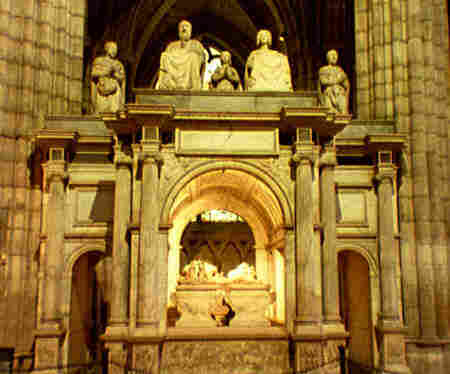
The first thing I noticed was the bare, marble feet. At the centre of the huge marble monument effigies of the almost naked monarch and consort lay, the soles of their feet facing tourists as they entered. At last I saw the human vulnerability of the monarchs. It was only later that I saw the fully-dressed king and queen kneeling in prayer, their children behind them, on the high top of the monument.

I wandered among the dead kings and queens. There was Marie Antoinette again, slightly larger than life and kneeling elegantly next to husband. And there were the plainer, earlier kings, from Clovis onward, looking stiff, still and much the same as one another.

Wandering among the royal monuments, I caught sight of a notice on one of the stiff mediaeval ladies: "une princesse inconnue" - an unknown princess. She may not have been a very significant princess but presumably, a long time ago, she thought herself an important person in the world. And now she was just a monument, much like all the others, and no-one even knew her name or which of the many dead princesses she was.

Beyond her lay another, smaller monument, no longer than a five-year-old but a miniaturised adult in polished white marble. I leant over to look at the notice - another "princesse inconnue."


Thursday, 27 August 2009

Rechauffage


There are no kitchens at Versailles.

English tours of palaces, castles and stately homes show visitors where the servants lived and worked. That's where most of us see ourselves. We know, logically, that we wouldn't be the ones in the fancy dresses. We'd have been taking orders, making things, clearing up after grand parties and making do on too little sleep.

But in Versailles, cooking was seen as messy and vulgar. Meals were transported from a huge building in the town to be reheated, tasted for poison and served. Even in Le Petit Trianon, Marie Antoinette's modest mansion in the park grounds, there was a room for reheating the meals. And in the farm and model village she created, there's a whole building dedicated to rechauffage - reheating.

The farm and village created for Marie Antoinette has a picturesque unreality, although there was a real farmer who has to provide eggs and milk for the queen's dairy. Everything is clean and fake. The houses, dovecote, mill and so on may seem miniature compared to the vastness of Versailles. Perhaps Marie Antoinette really believed that this was how peasants lived as she and her friends played at being poor but it's Disneyfication before Disney. Versailles left me marvelling at the remoteness of the French monarchy but the little fake village, constructed so prettily around a carp-filled lake, sickened me. I was also reminded of Poundbury.

There was a gift shop, of course, selling mementos, mostly of Marie Antoinette. And the real farm has become an animal sanctuary where sheep, cows, goats, rabbits and donkeys enjoyed plentiful feed, sunshine and admiring glances. Nearby, horses graze and a couple of farm carts - tumbrils - stand empty, ready for use.

Tuesday, 25 August 2009

Being Jupiter


Nothing prepared me for the gilded enormity of Versailles. I tried to imagine being in a mob storming the castle and could manage only incredulity at the excess. I've never seen a better argument for republicanism.

I don't understand the way of thinking that commissioned such an enormity nor the way the court understood itself. I thought Tale of Two Cities an exaggeration but now I realise it understated the reality.

There are notices at Versailles about the practices of the court. Every evening at 10 p.m. Louis XIV dined with his family. This was a public event and members of the court were privileged to watch. They didn't get to eat. The ladies perched on small stools and the gentlemen stood behind them as they watched the monarch and his family at dinner.

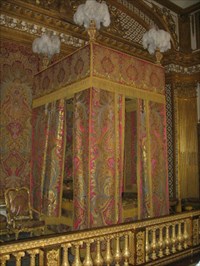
Going to bed and getting up were ceremonies too. There are gilded rails in front of the high four-poster beds and at the top corners of the bed - the structure must be fifteen feet high - are white fleur-de-lis made out of ostrich feathers. A few chairs stools are placed nearby, presumably for the attendance at court.

It's perhaps not remarkable that the chapel is a baroque riot or that there were strict rules based on orders of precedence about who could attend and where different levels of the nobility could sit.

But strangest of all are the paintings. Some are religious, with Jesus and his disciples in peasant dress. At a last supper, an extravagantly-dressed Mary Magdalen washes Jesus' feet. You wouldn't catch the royals in any such gestures of humility. Anne of Austria appears as Minerva, Louis XIV as Jupiter. One of Louis XV's toddler sons reclines as Cupid. Louis is everywhere: winning wars, making peace, implicitly compared with Alexander the Great, honoured by a winged Victory as he stays aloof from the battle. He even poses to show off his red shoes and his fine leg - he could sing and dance as well as making war.

The French royal family moved among paintings of themselves as divinities, usually in the Roman style. How they combined this with their public Christian faith, I don't know. But they seem to have seen themselves as more than heroes. In the oddest painting of all, Hercules, nude but for a carefully-placed drape, paints a portrait of Le Grand Condé on a lion-skin while assorted nymphs and divinities stand around.


Thursday, 30 July 2009

Power


I came upon the statue of Constantine from behind. He lounges back in his chair as arrogantly as any Bullingdon boy. I was taken aback. The image of Constantine that I learnt at school as of a good ruler, brought to Christianity and tolerance through the prayers of his good mother, St Helena. I should have mistrusted this - there was always something sick about turning the cross, a Roman implement of torture and execution, into a banner for battle.

But in York, Constantine is a local lad. There's a spot at the centre of the Minster where he's supposed to have stood when he heard of his accession to the imperial throne. Decrying Constantine in York might not be quite as bad as criticising Shakespeare in Stratford-on-Avon, but it's unwise to attack those who give importance to a town. Who wants to remember Constantine's judicial murder of his wife and son (at his Christian mother's behest) or his contempt for those he deemed barbarians?

York - that beautiful, ancient city - also records the history of power and its abuses. Clifford's Tower was originally built to control rebellious Saxons but in 1190 the keep served first as a sanctuary for the Jews of York and then, when the mob came to get them, the site of their mass suicide. Eventually the castle caught fire and the few Jews who survived and surrendered, believing the offers of clemency made by the townspeople, were executed.

The tale of that massacre is one of the few instances when the townspeople of York are mentioned. If you want history from below, you have to trawl stories for references to "masses" or "the mob." The daily lives that are remembered are, at best, those of prosperous tradesmen rich enough to be celebrated in a tomb or stained glass window.

The Minster is lovely with its tall, calm spaces. The voices of the choir echo in the chancel and below the great tower. But on the screen which divides people from priests the figures are not the usual saints who have made great sacrifices, been persecuted or offered wisdom to the people. Instead the screen shows figures of English kings bearing swords and sceptres, with Stephen in a short tunic as a sign that he never managed to subdue the kingdom.

Sunday, 8 March 2009

Propaganda and art


Only two minutes' walk from the exhibition of American prints is a smaller, less flashy exhibition with much narrower scope. As its title suggests, Windows on War: Soviet War Posters 1943-45 looks at the development of a particular kind of propaganda poster in a narrow but significant period.

The collection of posters survived in Nottingham by a mixture of chance and generosity. A university professor - Vivian de Sola Pinto - was posted to Moscow on war service and collected a number of the window posters and printed posters which were produced by TASS (the Central Soviet Telegraph Agency). He collected more than 100 big window posters as well as some smaller printed posters and brought them home with them. Eventually he donated them to Nottingham University. They're a fragile collection and rare too - although major artists and poets collaborated on the work, the posters were a response to the war and intended to have an immediate effect.

I've never worried that artists of all kinds create work that is labelled "propaganda." Every work of art is propaganda for something, whether the work is loudly and ostentatiously political or quietly insists that art itself matters. All artistic creators have views, beliefs and prejudices - not necessarily comfortable ones - and these inevitably leak into their work. I'd rather deal with the unpleasant beliefs of Pound or the jingoism of Kipling, which are openly proclaimed, than the respectable-sounding class and racial sneers of T.S. Eliot or the deeply embedded prejudices of Philip Larkin. But it's the Eliot and Larkin who make it into school syllabuses while Pound and Kipling are judged too propagandist.

On the whole I can deal with overt propaganda, though I may dislike it and disagree strongly. I'm less comfortable when artists have been forced to produce propagandist art, not just because of the danger of bad art (though insincere art isn't necessarily bad; the compliments to Elizabeth I in A Midsummer Night's Dream are as delightful as they were - almost certainly - insincere). What I dislike is the power structure that harnesses art in this way and treats its effects as utilitarian and quantifiable. There's almost always something brutal about governments that do this.

The Soviet posters disturbed me for a range of reasons. Few of these were to do with power structures. To my surprise, Soviet leaders were rarely present in the posters though there was one in which a child held up a picture of Stalin as if brandishing an icon for veneration. The posters in the collection were largely focussed on hatred of Germans and the desire for vengeance. I suppose that in the years since World War II we've become so used to the evils of Nazism that we expect war posters to assert some sort of moral high ground. Looking back on British posters and cartoons of the period, they probably show the same desire for hatred and vengeance. I notice it less because it's rooted in traditions with which I'm familiar. But that desire to inflict known and unbearable pain on other human beings makes me feel sick and hopeless.

Occasionally the posters were gentler in tone. A headscarfed woman held her finger to her lips, warning that careless talk costs lives. A nurse gave water to a wounded soldier. A sturdy blond woman stood surrounded by her sturdy blond children. She was a "heroine of the Soviet Union," officially honoured for giving birth ten times. Her children, it was implied, would grow into new soldiers, replacing those who had died repelling the invaders.

Invading armies are not loved. It's not a new thought. From Sparta to the present day, mothers have sent their children to kill or be killed - and poets have praised vengeance as wel as lovel.

Thursday, 11 December 2008

The brave people of Sark


There has been an election on the small island of Sark. The Barclay brothers, who own a number of businesses on the island insisted. The Barclay brothers are billionaires who own a number of businesses on Sark as well as a nearby island. They cast themselves as the defenders of democracy.

Shortly before the vote took place, the Barclay brothers issued threats against the voters of Sark. The Barclay brothers wanted their own candidates to win. They therefore warned the voters of Sark that they would withdraw their investments, causing poverty among the islanders, if the islanders voted
in a way the Barclay brothers didn't like. This threat was published in the Daily Telegraph, which the Barclay brothers own.

The people of Sark voted for the candidates they wanted. And now the Barclay brothers have announced that they are closing all their businesses on Sark, making 100 people - a sixth of the island's population - unemployed.

The people of Sark showed that their understanding of democracy was far better than that of the Barclay brothers. They refused to be bribed or blackmailed into voting as the Barclay brothers wished.

I have occasionally bought The Daily Telegraph. As long as the Barclay brothers own it, I shall never buy it again. People who try to bribe and blackmail voters in the exercise of their democratic rights are not fit to own a newspaper.