Showing posts with label money. Show all posts

Wednesday, 25 July 2012

A touch of class

I haven't read Shades of Grey.  Having seen numerous blogs and articles about the book, I used Amazon's "look inside" feature to get some idea about it - and I peeked inside a copy in Waterstone's.  At my age, I don't need to worry what other people think of me, and I expect fellow travellers assume I'm reading erotica when they see me with my kobo.  (At the moment I have James Joyce's Ulysses open and Zola's L'Argent - both pretty dodgy books in their way and immensely enjoyable.)

However the fuss about Shades of Grey has led me to think about the kind of book it is.  It's fanfic, obviously - and because it's Twilight fanfic it's not much to my taste.  It's porn so not rooted in realism or good writing.  And it's also romance with all the usual baggage that entails.  Its heroine is young, innocent and adoring while the hero is enormously rich, terrifically sexy, and enormously damaged.  Her role is to rescue and adore him.  His role is to give her extravagant presents, including - and this is where I'm almost hooked - a valuable first edition.

Romance is an odd genre with a curious descent.  Part of it is a male genre - it comes from the seduction narratives of courtly romance.  In these the woman are praised for their exceptional beauty and virtue.  There are traces of this in Elizabethan sonnet sequences.  Shakepseare's sonnets reverse some of the usual conventions; the fair youth is praised for beauty and virtue while the dark lady is seen as both desirable and dangerous.  This enables Shakespeare to emphasise another aspect of this kind of romance: the suffering endured by the male lover. 

Romance also has roots in the spiritual journals often kept by Puritans.  This may sound unlikely but, because they were concerned with the soul and the interior life, spiritual journals naturally recorded emotions.  Samuel Richardson's 18th-century novel Pamela, which is clearly a fore-runner of today's romantic novels, comes out of that tradition, with its focus on the struggles of a very young maidservant to retain her virtue as he male employer makes repeated attempts to seduce and rape her.  In the end her virtue and beauty win him over.  Richardson was an influence on Jane Austen, who turned his third novel, Sir Charles Grandison, into a play, and I think it likely that the plots of his novels, if not the novels themselves, influenced Charlotte and Anne Bronte.

It's also common to find the roots of contemporary romantic fiction in fairy tales, particularly those written or adapted by Perrault, such as "Cinderella" and "Sleeping Beauty".  But although the structure of these stories is quite like contemporary romantic fiction, the stories themselves lack two aspects that are key to romance as written today.  They don't have an interior narrative and the women tend to be curiously passive in terms of the romance plot.  The heroines marry princes because that is expected of them and not because they love or desire princes.  Fairy stories of this era are largely concerned with actions and appearances.  The feelings of the character are irrelevant.

Contemporary romance has quite a lot going for it.  It values women's feelings and says that their desires are important.  It also suggests that the choice of a partner is both difficult and important.  However, there are also shortcomings to the form.  It tends to treat the achievement of a partnership or marriage as the culmination of women's lives, though sometimes there is a brief epilogue, usually involving pregnancy or the birth of a child.  Plainly this ignores most of women's lives and relationships.

Heterosexual romantic fiction (the vast majority) has another worrying aspect.  The hero is typically richer, more powerful, older and taller than the heroine - and usually of a higher social class.  The attraction of the heroine is almost always based on a combination of innocence (not necessarily virginity but relative inexperience), modesty (she doesn't realise how attractive she is) and adoration of the hero despite his flaws.  But while the heroine looks up to the hero, she is often also a mother-substitute who tends to some hidden anguish or moral flaw - she has to heal him while she adores him.  The heroine is permitted some liveliness of speech - today she is often characterised as "feisty" - and she is allowed a character and a career.  But the only model for romance that women are offered involved both admiring and tending to the hero.

There's nothing wrong with admiring some aspects of a partner.  Indeed, it's pretty normal given that adults prefer partners of whom they think well.  And there's certainly nothing wrong with caring for a partner who is in need of care.  But there's something wrong with the kind of transaction romance offers if on one side the man provides money and power while the woman offers adoration and nurturing.  It's not an equal relationship - and surely all of us, men and women, want more than that, even in our fantasies.

It was reasonable for Elizabeth Bennett to fall in love with Mr Darcy when she saw what a big house he owned.  In the early 19th century a woman of her class without much money was much better off if she could marry a fortune.  In the mid 19th century, Jane Eyre followed the conventions of her time by insisting on legal marriage, although her inherited wealth would have passed to Mr Rochester when that marriage took place.  Perhaps it was as well that, when they finally married, he was maimed and even less attractive than before.

But isn't it time for a different kind of romance in which the partners share what money they have - and it may not be much - and help and nurture one another?  I recall the ideal of a loving, equal comradeship, which was not unknown when I was younger.  It's present even in some unexpected 19th century novels.Perhaps the most unexpected is Dickens' Little Dorrit, with its conclusion of a marriage in which both partners together "Went down into a modest life of usefulness and happiness", without the corruption of great wealth.  Although the novel ends with marriage, it doesn't treat that marriage as the culmination of the characters' lives.  Instead it indicated that they have a future.  

The final sentence is one of my favourite endings of any novel: 

"They went quietly down into the roaring streets, inseparable and blessed; and as they passed along in sunshine and shade, the noisy and the eager, and the arrogant and the froward and the vain, fretted and chafed, and made their usual uproar.

That's the kind of partnership in which I'd like to believe - and it may be a more enjoyable and plausible one to imagine in these difficult times.

Saturday, 21 August 2010

Myths of work and money


I can't recall exactly where in our flat the saying was. I think there was a paperweight – perhaps in a multi-sided geometrical shape – with a number of catch-phrases and sayings. When I first read it, I was too young to work out what it meant. I spent ages puzzling over the words: “Work is the curse of the drinking class.” Apparently it was a joke that I couldn't understand.

I suppose the joke played on too many assumptions: that work is a good thing, that the working class are seen (especially by the rich) as idlers, that drunkenness is a working-class problem and that the working class live feckless lives dedicated to the pursuit of pleasure. If someone had explained all that to me then, I'd have been politely incredulous. I could see that my parents worked hard and that they put the interests of others (including their children) first. They didn't even drink. My mother was fearful of pubs and drinkers and, although my father enjoyed beer, he gave it up for years for my mother's sake and, even now, finds a single can of lager turns a meal or an evening into a special occasion.

But there's one way in which the group of assumptions did chime with my parents' attitudes. They worked hard at their jobs and often found them rewarding. But they hadn't fallen for the idea so ingrained into many middle-class minds: that work is what gives meaning to people's lives. My parents put other things first: family, friends, neighbours, duty, social responsibility – and pleasure. They handed those values on to me.

Quite a lot came under that heading of “pleasure.” It could be a walk in Richmond Park, a trip to the theatre, a jazz concert, a TV programme, drawing, a maths puzzle, a cryptic crossword, a visit to a museum or a good book. We didn't make the usual distinction between high-brow and low-brow. I watched the London Transport Players perform Ivor Novello or Rogers & Hammerstein in a “proper” theatre and amateur Shakespeare in the London parks. I picked up whatever reading material was lying around: Tit-Bits magazine with its intriguing advertisements for Joan the Wad, poetry anthologies, Plato in translation. I learnt by watching that the aim of work was to live a good and enjoyable life.

My parents encouraged us to work hard at school but they didn't pretend that the aim of education was a career. Education was a means of expanding opportunities for pleasure – and might give us the chance to choose a job that was more enjoyable than those our parents did. I could see the point of that. In my early years my mum was a cleaner and a kitchen assistant. I didn't think I'd be much good at either and, given my incompetence in tidying my room, I didn't think I'd be much good at being a cleaner. I liked reading books and learning poems and plays by heart but I wasn't sure that many jobs would draw upon those skills. And I realised that I might want money so that I could buy books, travel to museums, go to the theatre and so on.

There's nothing in my parents' approach that seems wrong. The idea of devoting a life to work for its own sake seems ungenerous and mean-spirited. I'm lucky enough to enjoy much of my work – but not the bits involving form-filling, managerial jargon, the distress of others, or tidying my office. It's a good job but does it really shock you to learn that I do it for the money? After I've paid for the usual necessities of life, I spend that money on family, friends, duty, responsibility and – of course – on pleasure.

Wednesday, 9 June 2010

The watchers


There's a right length of time for looking at a picture. Some demand lengthy, careful views. The Adoration of the Mystic Lamb in Ghent Cathedral rewards slow appreciation. It's worth sitting before Rembrandt's The Night Watch in the Rijksmuseum in Amsterdam or standing for a long while before the Breughels in Brussels' Musée des Beaux Arts or the classical scenes by Claude Lorrain in the Louvre.

Even some portraits are made for time-consuming adoration. These are usually pictures of the powerful, commissioned to demonstrate their finery as well as their faces. But the poor as well as the rich can seem in control of their images. Murillo's street urchins often display the confidence of the young and free. Even Goya's Maja, clothed or naked, seems in control of how we see her – as does Lucian Freud's model Sue Tilley, the Benefits Supervisor.

Elsewhere the subjects of paintings see less happy with the viewer's gaze. There are nudes by Titian whose lowered or averted eyes can cause discomfort. And I can never look at portraits or even staged domestic interiors by Vermeer for long. The framing of the paintings always brings me slightly too close – I'm forced into the scene like an intruder, as I am.

This history of looking was at the back of my mind as I dithered in the entrance hall of Tate Modern. I couldn't make up my mind about the new exhibition. Not only was the entrance ticket £10 – very high by East Midlands standards, especially for a show of photographs and videos – but the subject itself made me wonder whether I ought to look. The exhibition is called Exposed and the material it shows is grouped around themes of voyeurism and surveillance.

At first I decided I wouldn't look. I'd taken the long escalator to the third floor when I changed my mind and returned to the entrance. The escalator journey felt too much like running away.

There was, of course, something uncomfortable about so many photos grouped around such a theme. Few of them on their own would have sparked such concern even though some areas were banned to under-eighteens because of their sexual subject.

But sex and violence are too familiar to shock. Even the napalm picture, with the running, naked girl (her clothes burnt off) in a world beyond fear and pain, has been reproduced so often that I'm now immune to the horror. I was more moved by the photo of Jackie Kennedy with the new president Johnson and his wife. She seemed numbly vulnerable as she took on the unfamiliar role of presidential widow – beyond comfort and open to the camera's exploitation.

Elsewhere too the camera's glance was surreptitiously controlling. I was disturbed by Walker Evans' pictures of travellers on the New York subway, some tired at the end of the day and enjoying private rest in the carriage's public space. The photos were taken, before the Second World War, with a camera concealed in a coat-sleeve so that no-one could object. All the subjects must be dead by now. For all I know they would have liked the idea that gallery visitors would pay the unbelievable sum of £10 to see their faces – it's a kind of immortality.

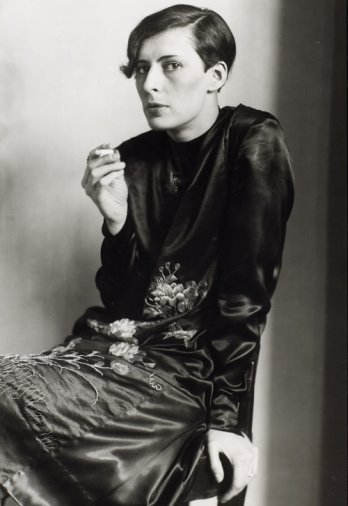
Having seen the subway photos, I was initially suspicious of the work of August Sander as he posed and classified “types” - by profession, disability, social status – in his project to document the layers of German society. But as I looked at the individuals he photographed with such care, I warmed to him. The pictures seemed to be the product of a kind of negotiation between photographer and subject. Most of them gazed back at the photographer with the confidence of people who had chosen their pose. There were exceptions of course: the boy labelled “idiot” or the blind girls, sitting together at a school desk. They were photographed in the mid 1920s and despite the labels the children appeared individuals. I wondered what happened to them after the Nazis came to power. Sander's sympathetic categorisation reminded me of the Nazis' brutal hierarchy of types. Yet the Nazis disapproved of Sander's project. His son Erich, a socialist, was imprisoned in the early days of the Nazi regime. After many years, Erich died in prison. Sander photographed his son's death mask.

Of course the exhibition disturbed – it was meant to. But it was far less disturbing than the film I saw two days before, Renzo Martens' Episode 3: Enjoy Poverty.

Martens' film explores poverty in the Congo – the sort of daily, agonising poverty that causes children to die painfully of slow starvation. But it's not like the kind of TV documentary that ends with an appeal to send money, offering the comforting, self-congratulatory reflection that we in the west are nice, charitable people. This begins with a man in the Congo complaining about poverty as he works and angrily showing his small daughter's sores – a result of malnutrition.

At first the film seems a tourist's journey through poverty in which Martens' occasional efforts to understand what he sees don't measure up to the reality. He seems too innocent, too polite. But the guns of the U.N. peacekeepers disturb as do the sharp suits of the wealthy.

But it's easier to look at the powerful than the underpaid workers whose children die so that people like me can buy goods cheaply. And then there's the war and the photo-journalists who follow war and starvation, looking for a scoop. They cluster together with their expensive, heavy cameras, each trying to find the best lighting and angle for a picture of a corpse. The going rate for a publishable picture is $50, on top of the travel and expenses already paid to the photographers. Martens, playing the innocent, asks a photographer a series of questions. Who owns the picture? Do the people in it – or the relatives of the corpse - earn money from it? What pictures sell?

Of course, it's the photographer who profits. The poor children, who aid workers strip and arrange for the camera, get nothing. So Martens reaches his conclusion. Congo has few assets apart from poverty. If the people of Congo are to profit, they must learn to exploit their own poverty. He finds two Congolese photographers, making a small living from pictures of festivals, birthdays and weddings, and urges them to change their subject, telling them that the highest profits come from photographing the dead and injured, raped women and starving children. I'm used to seeing such pictures but I've never before had to sit uncomfortably still while the subject's pose is adjusted and the photographer closes in for the most affecting and aesthetic angle.

There were questions and answers after the film. Martens insisted his work changed nothing – it was art, not politics. But he made a telling comparison with Jonathan Swift's “Modest Proposal,” identifying the film as satire based on a horrible truth. And he said there would be no change because there was no will to change. The people in Congo thought that if those on the outside saw what was happening, they would act – they would not allow such suffering to continue. But there is no outside – we're all in the same world and those of us with power to act do nothing because we benefit from the same system.

Meanwhile, for reasons we cannot bring ourselves to comprehend, pictures of pain and suffering are bought in the west as though they were things of beauty. And the sufferers get nothing for them.


Saturday, 15 May 2010

Border police


From England, borders seem simple. There's sea. Motorway signs proclaim “Welcome to Scotland!” and “Croeso y Gymru” but passing these isn't a serious matter – even in Orkney or on Anglesey we're still in the United Kingdom.

Hadrian's Wall is a reminder of what a boundary might be but its watch-towers and forts have crumbled. Walking the path of Roman border patrols has become a challenge or delightful ramble. Sheep graze nearby and children scramble across what is left of the frontier. Like so many monuments built to control the neighbourhood, it's been reclaimed by the locals for tourism and play.

Maps tell another story. Boundaries are clear-cut – black lines that separate pink from green and yellow are as obvious as a railway track. There are even lines parcelling up the sea and white wildernesses governed by penguins and polar bears. In maps, boundaries are as unavoidable as the kiosks in which uniformed guards check and scan the passports of tourists.

Of course, I knew it was more complicated than that – just I knew there were nomadic people and people whose sense of nation and community crossed arbitrary frontiers. For years I've been fascinated by Auden's poem about the partition of India. The older Auden isn't often thought of as a radical poet but that poem is as critical as any I know about the cowardly bureaucracy of colonialism.

But I hadn't really thought about the no-man's-land crossed by migrants and patrolled by bored armed guards until I saw Ursula Biemann's video installation at Uneven Geographies, the latest exhibition at Nottingham Contemporary. Watching the guards in a nearly featureless desert, I suddenly saw the world from a perspective much closer to the migrants'.

The guards knew where the border was. There was a pile of stones here, the remnants of a building there and a railway line dividing to cross two indistinguishable pieces of ground. Sometimes the guards watched. They moved through crumbling buildings. At other times they just stood. One held a bunch of keys close to his waist. One drank water from a bottle. Dust and discarded plastic blew past them. They waited for the migrants to arrive.

The story was told of a Dutch tourist who found himself on the wrong side of the border. He was arrested and held for ten days. His belongings were confiscated. He never saw his car again. The story was routine – worth telling only because the man was an accidental migrant and a European. For those who cross frontiers these are everyday hazards.

Hunger and thirst don't stop the travellers. In another video, an imprisoned migrant told, without surprise, that ten men in his group of seventy had died of thirst when crossing the desert. The men who survived drank their own urine. They arrived and were imprisoned. They waited to be sent back – and to set out again.

Ursula Biemann's videos focus on the sub-Saharan area where the nomadic routes of the Tuareg have become the paths which migrants travel. She shows the practical demands of migrant life and the optimistic determination of travellers who are convinced life has more than poverty to offer.

Near the videos there's a series of photos of Tangier by Yto Barrada. One shows a football game on a run-down hard pitch in Tangier. The pitch is surrounded by torn wire. In the foreground a boy is making his way through a hole in the wire towards the players – it's another permeable boundary.

Between the photo and the videos, I began to see boundaries in a different way. I thought of the times when, as a child, I saw a boundary as a challenge. When my brother and I were small we liked to “go trespassing,” which meant entering any area where signs said we were forbidden. Building sites and college grounds were alluring. Most fascinating of all was an old air-raid shelter which I think we entered once – but I dreamt of it so often that dreams have obscured the reality. I can't recall exactly where the air-raid shelter was.

I still want to travel and see new places. Work and family detain me in Britain but I'm not rooted here. The film of the border guard awoke my migrant self. I realised that there aren't so many differences between me and the Africans setting out on their risky journey. I have some luck: the security provided by my red British passport and respectable appearance. I can book my journey on the internet or ask a travel agency to find me a tour and a guide.

The exhibition Uneven Geographies was worth visiting for the way it exposed and displaced my assumptions about boundaries. There's more to the exhibition than that. Delicate diagrams sketch out webs of financial power – webs so complicated it seems impossible to break free of them. The webs date back to the 1970s – it's all so much more complicated now. There are installations, photographs, displays. So many achieved a small adjustment in my way of seeing the world that, by the time I emerged, I was reeling.

Behind all the works is the net of global economic interests which holds us all. The exhibition lays bare the ways in which the rich west depends on people in other continents and the devastation of the earth. I'm haunted by new ways of seeing, in which the west is no longer central. I feel displaced from my safe, convenient way of life.

That doesn't mean I see a way out of the net. Neither vision nor analysis shows a way of adjusting the huge imbalance of power. But seeing differently still feels right and worthwhile. This is the first exhibition at Nottingham Contemporary that has changed my ideas.


Monday, 21 September 2009

Who pays?


Apparently we saved the banks. Now it's time to face the question of who pays.

The political conferences are full of politicians competing as to who can be the most threatening, though Nick Clegg of the Liberal Democrats, ditched the word "savage" at the last moment and chose instead to talk of "serious cuts."

The Confederation of British Industry, combined with university vice-chancellors, has decided that students should pay for the university through higher fees, higher interest and cuts in grants. Oh yes, and their degrees should do more to train them for work in industry. Leaving aside the question of why students should pay to be moulded in the way employers demand (shouldn't they develop a capacity for original thought that enables them to remake industry and shape the future?), there's clearly a problem in the economics of what the CBI and vice-chancellors suggest. The economy needs money now - the suggestion that students are lent more money from 2010 or 2011 won't bring in any repayments until 2013 at the earliest, even if all graduating students walk straight into well-paid jobs.

It's an uncomfortable time. There are plenty of shrieks of "Not me!" which is to be expected. But there's also a great deal of finger-pointing, usually at individuals and social groups. Comments in newspapers and on-line forums are directed at the usual groups: immigrants, asylum-seekers, single mothers, the poor, the unconventional. "Punish them!" editorials and commentators demand. Facts on how little the poor and needy receive in benefits are no use - anecdotes of luxury are everywhere. Nor does it help to point out that the poor have to spend most of the money they receive, thus returning it to the economy. Spending by the poor is instantly labelled fecklessness.

I don't have a solution - I can't see any way of finding these impossible sums without hurting the economy more and damaging even more individuals. (Withdrawing troops from Afghanistan would save money and lives, but it wouldn't be enough.) Every cut brings its cost. There are bound to be cuts in public servants who include nurses, teachers, ambulance drivers, cleaners, lollipop ladies, and many others on whom we rely. Most will be entitled to redundancy pay and benefits - and in many cases it won't be enough for the rent or the mortgage. The newly unemployed will become the newly desperate. They will cut their spending (savagely, of course) and this will have an effect on all the businesses which depend on selling services and minor luxuries. Lots of small and large businesses are just keeping going. With less money coming in they will first shed more staff - that's even less spending money in the system - and then collapse.

The government has to look for cuts which affect the fewest people and from which the economy can recover most quickly. Logic points to taxing the rich and inherited wealth - money that doesn't circulate in the system. It's not going to happen. There are too many millionaires and too few paupers in government. But even taxing the wealthy won't solve the problems. I don't know if the kind of redistribution and rationing employed in World War II would help. My mum remembers the Second World War as a time of plenty after the scarcity of the 1930s - rationing fed children who were used to going without. But I'd worry about the centralisation and trust in government that requires, particularly when I look at the way the three main parties are funded.

The more I listen to political debates, the more I realise that no-one has a solution. I hear stale rhetoric and the rehearsal of prejudices and realise these are going to influence what happens next. It's going to be nasty. I don't want to speculate any further. I'd rather not think about the future but it's lurking and waiting to hit me in the face.


Note: the illustration is by the street artist Meek. I hope s/he doesn't mind my use of it.

Monday, 9 June 2008

Money money money money money money money money


As prices rocket and companies start laying people off, there's one good news story - allegedly. I heard it on the news and read it on the BBC website. British companies are the best at creating wealth.

To me, that raises two questions: where does the wealth come from and where does it go? I assume the companies aren't simply printing banknotes and handing them out in the street.

Looking more closely at the story, it turns out that 23% of British or part-British companies have been placed in the top 750 for a league table I've never heard of. It's the 2007 Value Added Scoreboard from the Department for Business, Enterprise and Regulatory Reform - a government department which has the job of boosting British business. I suppose the story would have had less impact if it had been billed as "British government says British companies are the best."

So what precisely is being measured? According to the BBC, the scoreboard measures wealth-generation - which it also terms "productivity" by deducting "bought-in" goods and services from profits made by sales. I'm not quite sure where the value is added in all this. But I find it curious that "buying-in" goods and services is seen as such a bad thing in the private sector. In the public sector we're always being told that buying-in from outside, private industries boosts efficiency.

The top five British companies in terms of wealth generation are a surprising group. They're not exactly known for innovation. Some of them aren't even known for being British. They are: Royal Dutch Shell, BP, HSBC, Vodafone, Royal Bank of Scotland.

Royal Dutch Shell may be registered in Britain but its headquarters are in the Hague. Its subsidiary, Shell, has caused debate, especially for its operations in Nigeria, denounced by Ken Saro-Wiwa and others, and for alleged damage to the environment.

BP, initially the Anglo-Persian Oil Company, is a huge multi-national which has come in for criticism and lawsuits alleging environmental damage and human rights abuses. Most of its activities are far from Britain.

HSBC operates under four initials in Britain. They stand for the Hongkong and Shanghai Banking Corporation. While its HQ is in Britain it operates in 83 countries. It may be the world's largest company. It certainly knows how to make money. In the past two years it has made £100 million from running NHS hospitals. The bank's routine charge for fitting an electric socket is £200 - far above the usual rate.

Vodafone is a global mobile phone company. Two years ago it posted a loss before tax of £14.9 billion (for 2005) - the biggest loss ever posted in British corporate history. For all this, it seems to be profitable at the level of current operations. I'm not sure what - if any - the effect of the loss is.

Royal Bank of Scotland seems to have overcome recent problems from the "credit crunch" by asking shareholders to give it £12 billion. Apparently they did. Like most banks, RBS as it is now known is proud of its abilities in "wealth management", helping "high net worth individuals" look after their assets - in offshore trusts, for instance.

I'm sure all five companies will be celebrating their position in this new league table. But I'm still not sure why it's a good news story or what, if anything, it means to British people today.


Tuesday, 13 May 2008

What schools do


A student friend was recalling her school days - not very long ago. "Don't write what you think," she was advised. "You don't pass A-levels that way. Write what you're told."

And that's how it works. She took the advice, kept quiet about her own ideas and wrote the unoriginal essays that would gain the highest marks.

Luckily the story has a happy ending. My friend is now studying Philosophy and Theology at university, filled with excitement at her studies and writing what she thinks. It sounds as though she's on track for a First. Meanwhile compliant students, who never considered thinking for themselves, are floundering and wondering where it all went wrong.

My school exams were something of a farce. For O-levels I relied a mixture of rote-learning, guesswork and, for the subject that interested me, extra reading and thought on the day. English Literature was almost a disaster. I launched into an essay on Shakespeare's King John which required a comparison of Cardinal Pandulph and Robert Faulconbridge. I'd nearly finished when the awful realisation struck me: I was writing about the wrong Faulconbridge. There was only one thing to do. I scribbled out the entire essay and wrote a hasty comparison of Elinor and Constance instead. The teacher, who didn't like me, was delighted that I didn't get an A and told me I shouldn't be studying English.

I have odd memories of other exams, including my last Geography paper. I had never passed a Geography exam in my life but I wrote rapidly, trying to recall my notes. Then, when I found myself with more time, I began to invent. I hope the examiner enjoyed my vivid account of logging on the forested mountainsides of Denmark. (I borrowed the facts from Norway. After all, I reasoned, it's all Scandanavia.)

My last essay was my piece de resistance. I was asked to compare the ways in which transport was adapted to environment in four contrasting parts of the world. This was my sort of question. I decided I would fail gloriously and chose the Amazon jungle, the Sahara Desert, the North Pole and Britain. I outlined the problems Father Christmas would face if he tried to travel by sleigh in the Amazon jungle. Tarzan wouldn't find it easy to swing through the trees in the Sahara Desert, I said. He'd have to wait a long time for a bus too. "On the other hand," I remarked, "I once had to wait more than an hour for a 73 bus in the Upper Richmond Road." And so it went on.

I wrote a note to the examiner at the end, congratulating him on reaching the end of my paper and commiserating with his misery at marking it. I added that "Kilmarnock carpets are made in the Killybegs". I'd learnt the fact and it seemed a shame to waste it. And then I included my favourite Latin quotation from Aeneid I: "Forsan et haec olim meminisse iuvabit" (Perhaps one day it will be a pleasure to remember even this.)

That was the only Geography exam I ever passed. Sometimes thought and imagination (and nerve) win out over rote learning. These days I don't think I'd have been entered for the exam. I certainly wouldn't have seemed a good bet for A-levels.

Today, exams are accompanied by celebrations and rituals, many borrowed from the United States. There's a school leavers' assembly - I'm not sure what happens there. And for many children, there's the school prom. It's an expensive, dressy event - an evening meal and dance. Not all pupils can afford to attend. Suits and posh frocks are expected - wedding shops have branched out to offer "prom dresses". Some pupils arrive in stretch limousines. It's extravagant and socially divisive.

At least this year's prom is relatively cheap: £25 for each 15- or 16-year-old. But the venue is in the outskirts of a neighbouring city, twelve miles away. The prom finishes later than the last bus and train. Obviously the school assumes that all parents have cars, or can afford 25-minutes in a taxi.