Showing posts with label France. Show all posts

Thursday, 7 October 2010

No to the Kindle

British friends have occasionally asked me why I visit Paris in August. “There's no-one there,” they assure me. “The real Parisiens are all on holiday and everything's shut.”

It's a simplification. Some Parisiens – those who can afford it – try to take holidays in August. Some shops, businesses – even museums – are closed. Last year I was sorry to miss the municipal museum of Montreuil, which I still hope to visit one day. The Comedie Francaise and the Paris Opera are on holiday. Friends I would have liked to see were away – as was the owner of the splendid apartment I sublet.


Yet I enjoy Paris in August. It has a leisurely air. The discovery that a local shop or restaurant is shut for “les vacances” is not a disaster. It's a reminder that workers need holidays and there's more to life than making money.


In previous Augusts I did little to look for live events in Paris. Paris Plage was fun – and full of locals – but I missed it by a day this year. I wondered if my British friends were right in saying nothing else was on. I decided to investigate. I paused at a kiosk and invested in a copy of Pariscope – not a huge gamble at 40 eurocents – to see what was going on.
Leafing through the pages I read of theatres, cinemas, concerts, spectacles and markets.

At first I was baffled by the choice, then began to make decisions. The Lucernaire looked worth a visit, and quite near where I was staying. The second and third Millennium films were showing at the Cinema Chaplin, not too far away. There was a fund-raising piano festival at the Armenian Cathedral in the Marais – and much more.


I began at the Lucernaire. The list of theatre shows made me hesitate. I'd missed Cooking with Elvis at the local amateur theatre and was prepared to miss the French version as well. But I wondered about a one-man show of Oscar Wilde's De Profundis, well-reviewed in a number of French national papers. The price – 22 euros – is more than I usually pay for theatre tickets. But when I thought about seeing Wilde in French, there was a pleasant logic too it.
De Profundis is Wilde's long letter to his young lover, Lord Alfred Douglas, written from Reading Gaol. Some years ago I would have said I knew the English text reasonably well, although it has faded in my mind since. I recalled that, after leaving prison, Wilde went to Paris, where he died, and was buried in Pere Lachaise cemetery. And while I hesitated about seeing a work in translation, I recalled that I had twice seen Wilde's play Salomé, which he wrote in French for Sarah Bernhardt, in the translation by Lord Alfred Douglas. The idea of Wilde in French translation was almost symmetrical. I bought my ticket.

The set up at the Lucernaire wasn't quite like a theatre in England. Notices on the wall told us that the “ouvrieuses” (specifically female workers) showing us to our seats were unpaid and dependent on tips. The ouvrieuses were charming and had a neat way of sliding the proffered tips into a purse – but I felt uncomfortable about the procedure. Workers are often required to display charm as part of their jobs but I didn't want to measure and reward that charm directly with a tip – it felt too intimate a purchase. However as they were, according to the notices, dependent on the audience's generosity, it was plain that generosity was my responsibility. I handed over the tip as I was shown to my seat and wondered if I'd bought the bright smile that followed.


The theatre was small – a studio space without the formal grandeur of a proscenium arch. The actor playing Wilde was already on the stage, perched on a step-ladder and half-covered by a blanket. The audience leaned forward expectantly, displaying a quality of intense concentration that is rare in English theatre audiences – and this continued throughout the performance.


Occasionally I found the use of French distancing and at times my understanding flickered out - I probably grasped 80 to 85% of the text. Despite the strangeness, a French Wilde seemed a convincing possibility. I even found his mispronunciation of Reading (to resemble the activity rather than the town ir the gaol – endearing).
It was an intense and moving performance. I was surprised to find that, towards the end, I felt sympathy not just for Wilde but also for Lord Alfred Douglas – Bosie. De Profundis chronicles instances of Bosie's selfishness but, listed by Wilde, they seem like the follies of a very young man faced by an adoration he could not quite reciprocate and an intelligence he could not match. Even his cruel statements seemed like a dull attempt to match Wilde's wit while his neglect of Wilde's feelings could be forgiven as the uncertainty of a young man suffering from an appalling upbringing and unsure how to respond across the barriers of age and c lass. The young often do run from suffering – and how was Bosie to respond to Wilde's imprisonment and agony? Biographies suggest that Bosie was unpleasant throughout his long life but the pictures reveal a startling beauty which may also have been a disadvantage.

A week was not enough for all the events listed in Pariscope. I saw Millennium 2 – subtitled in French, which I find far easier than dubbing – and enjoyed a riveting performance of piano music by Chopin and Rachmaninov. That was as much cultural performance as I could take. I also haunted the bookshops, trying to add to my small collection of books in French.


There were two books I aimed to buy: Victor Hugo's Notre Dame de Paris and Eugene Sue's Les Mysteres de Paris. Both have been on my list of books I need to read for some time. But I was confronted by something unfamiliar from my life in the East Midlands – a wealth of bookshops. There were big shops like the many branches of Gibert Joseph in the Boul' Mich and the art chain Mona Lisait. Then there were many small independent shops – far more than in London, I think – where the stock seemed to reflect either the manager's taste or the surprises that often delight and infuriate in secondhand volumes.

I browsed contentedly and puzzled over what to buy.
I find nineteenth century French literature easier to read than modern light fiction; lengthy paragraphs allow unfamiliar words to become clear from the context and puzzles can be resolved with the aid of a dictionary. Recent thrillers, for all their popular appeal, are harder because they use so much contemporary slang. I have a further interest. I've noticed that, for generations, working-class readers in particular were absorbed by popular French fiction from the mid-19th century. Stories like The Count of Monte Cristo and Les Miserables are mentioned in working-class writing from the 1850s to the 1950s. And I knew that writers for the working class drew on French writers. For instance, G.W.M. Reynolds' terrific and popular serial, The Mysteries of London – which makes Dickens seem restrained in style and detail – was directly influenced by Sue's Mysteries of Paris. So far as I can see, no-one has gone into much detail chronicling this influence. While the effort necessary for a wide-ranging survey is beyond me – I imagine I'd need a year or so in French archives with no guarantee of success as well as another year combing comparable English publications - I could at least see what popular fiction of the period was available in paperback.

One of the joys of reading in French is the vast and largely unknown library of possible titles which spreads before me. Looking at Paul Feval's Le Bossu – which was the source for a couple of terrific swashbuckling films - I discovered that the same author had written his own Mysteres de Londres – quite different from Reynolds' serial. I haven't read it yet but, according to the back of the book jacket, it tells the story of an Irish plot against the British government and is set in exotically English locations. I had to buy a copy. There was a fine multi-volume edition of Les Mysteres de Paris, with illustrations, but in the end I concluded that it was too heavy.

I was also tempted by Eugene Sue's last book, Les Mysteres du Peuple, apparently a fictional account of working-class revolution from the time of Jesus to the era of Napoleon III. I wondered why so startling a book was so little known. Until I stumbled across a copy in Gibert Joseph, I hadn't heard of its existence. I nearly bought it but once again I hesitated, feeling the weight of the book. I could delay, I thought, and order it from amazon.fr when I had time to read it.


In the end, I succumbed to ten or twelve books, including a fine hardback edition of Notre Dame de Paris from one of the second hand shops set up by Abbé Pierre's Emmaus charity. A friend tipped me off that these were a great place for bargains and the shop I visited gave me an excuse for travel on the voguéo - I find it hard to resist river travel. My reading of French is still slow and I have less free time than I would like so my purchases will last me a long time. But I still regret the two books by Sue – perhaps I need to go to Paris again, very soon.


The chief problem was one of space – and what I reckoned I could carry home in my suitcase. Eurostar may not have a weight allowance but travellers still have to heave their cases onto the conveyor belt for scanning and manoeuvre them into the luggage areas of trains.


Briefly I thought of the solution suggested by a couple of friends: if I purchased a kindle or e-reader I could carry a whole library with me, unworried by weight. But I like the weight of books. I like the smell and texture of paper, the designs of covers. I like turning the pages with my fingers. I love the sensation of opening a new book for the first time – and I adore books with history, which carry a sense of their past readers. I can see the logic of an electronic reader but not the pleasure.


Nor would there be opportunities for communication. I discovered the novels of Michael Chabon after seeing a taxi driver was reading one. It was the beginning of a good conversation about books, which would never have been sparked by the anonymous cover of an e-reader. I like seeing what my fellow travellers are reading.


Then think of the hazards. I couldn't read an e-book in the bath – at least not safely. Amazon has been known to withdraw a text from the kindle, regardless of readers who were half-way through. An equipment failure or expired battery could put an entire library beyond my reach.

My books may occupy too much space. It's also true I don't always know where a particular title is. But I know my books by their shape, size, colours and texture. I could never gain so much affection for an electronic index.
Perhaps this simply marks me as a member of a dying generation, to be as much pitied or mocked as those who could not adjust from the scroll to the book. Wandering through the market of old and antique books in the Parc Georges Brassens (on the site of a former abattoir), I was unable to imagine surrendering my love for the book in favour of a screen called into grey and white life at the flick of a button.

Mind you, I didn't buy any of the book on sale in the Parc George Brassens. It was the last day of my holiday – and another book would have made my suitcase too heavy.

Monday, 15 February 2010

The purpose of the Pantheon


For six weeks I've been too busy to blog. I've a number of excuses: work took over my life, my computer keyboard started playing tricks on me, and I slipped on black ice causing painful damage to my back.

Perhaps these are merely excuses. I may not have blogged but I found time - even when I should have slept - to keep reading Les Misérables. It gripped me in the way books caught and held me in my teens. As I neared the end of the final volume, I wasn't merely reading it on trains and buses, and in bed at night. I was reading while cooking and even while walking down the road. On one occasion I was so caught up in the story that I left a suitcase on a train. (Fortunately the helpful station staff ensured that the suitcase and I were reunited.)

I'm not sure what was so gripping about Les Misérables. A few years ago I tried to re-read it in the old translation I'd read in my early teens and was soon bogged down in the heavy prose. Reading in French should have been harder but I followed the advice to stay away from dictionaries and the story came to life through Hugo's words. Of course, every so often I would check a tricky word or phrase - but how bland the English seemed next to the French, and how untranslateable. A neatly-turned phrase loses so much in translation. There's no equivalent for "amourette pour lui, passion pour elle" or "Parfois insurrection, c'est résurrection" that echoes and dances as the original does.

Of course, reading in French demanded an unfamiliar level of concentration. My French O-level of many years ago didn't demand so high a level of expertise, although we were expected to read Camus's L'Etranger and easy extracts from older works. But the language alone wouldn't have held me for through three volumes and more than 1500 pages. And I already knew the story from that first reading and various film and TV versions. But I had missed so much.

In French, Hugo is sometimes funny, sometimes angry, and frequently moves me to tears. There was much I'd missed on that early reading: the chapter in praise of "le mot de Cambronne", for instance. The word attributed to Cambronne, spoken as he was taken prisoner at the end of the gruelling battle of Waterloo, is "merde". (The nearest English equivalent would be "shit.") Hugo dedicates a whole chapter to fulsome praise of the acuity and rhetorical brilliance of this word. My Victorian translation was too delicate to tell me what the word was, offering a myserious dash instead. Moreover, as a teenager I was insufficiently used to 19th century novels to realise how different French and British attitudes were. Hugo thinks it necessary to explain - at length - just why Cosette and Marius (aged 16 and 21) haven't had sex, even though they have met one another every evening for a whole six weeks without a chaperone.

Cosette and Marius are young, silly and more conventional than they realise. Hugo knows that and at times he invites the reader to laugh at them. I never found them as interesting as the wilder characters, Eponine and Gavroche, nor as sympathetic as the numerous elderly characters who are frequently at the centre of the story. Perhaps my age is showing.

What startled me most was Hugo the revolutionary. I remembered the depiction of the failed rising of 5th- 6th June, 1832 from film versions. It was exciting but not particularly important - part of the lead-up to the journey through the Paris sewers. But Hugo takes the rising seriously and asks the readers to consider both why it was necessary and why it failed.

Hugo believed in revolutions - not all revolutions but those on the side of progress. He discusses when revolutions are necessary. His characters tear up paving stones, seize vehicles, grab weapons and barricades the streets of Paris. Hugo may like individual kings and royalists - as human beings - but he believes a republic is necessary and that the royalist cause must, for the sake of freedom and justice, end in defeat. He is furious - far angrier than Dickens - at the ill-treatment of children who are left to roam the streets and starve. He sees that the poor are suffering. He's appalled by inhumanity. He wants a better world and understands why sometimes people might decide to die or kill so that the future can be happier and more just.

Les Misérables is also a love letter to the lost streets of Paris. Hugo wrote most of Les Misérables from exile. He knew that the dangerous, dirty and loveable Paris he described was being ripped apart by Napoléon III and his architect Haussmann. In place of the familiar mediaeval mazes, whose squalor Hugo condemned, they constructed new, broad boulevards that welcomed shoppers and armies and were harder to barricade.

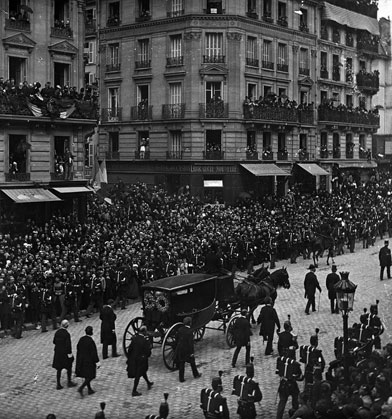
Hugo wrote most of his novel during his 19-year exile from France. He didn't return until six years after the first (Belgian) publication of Les Misérables. His return was greeted by celebrations in the streets. He was now a Parisien. He died in Paris at the age of 83. His will set out his wishes for his funeral. His body was to be carried to Pere Lachaise on a pauper's hearse and buried in the part of the cemetery reserved for paupers. The government decided otherwise. The church of Saint Genevieve, otherwise known as the Panthéon, was restored to its revolutionary secular state so that Hugo could be buried there. Hugo's body lay in state under the Arc de Triomphe and the pauper's hearse was escorted down the new, broad streets by senators, academicians and a military procession. Most of Paris seems to have turned out to watch. There were no riots - the spectacle of Hugo's funeral was carefully ordered.

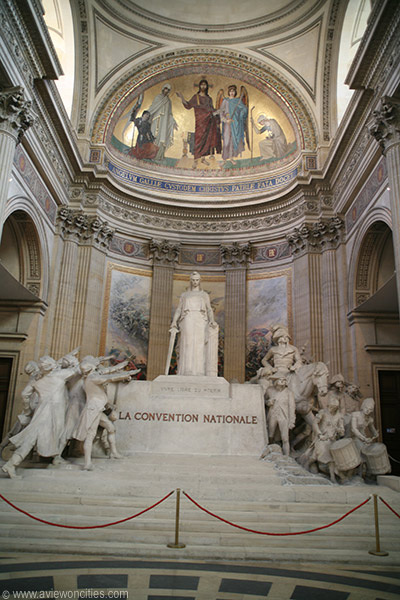
The account of Hugo's funeral, which I discovered in Colin Jones' biography of Paris, has made me reconsider the Panthéon - a place that has puzzled me since my second visit last year. There's something odd about this commemoration of greatness. Even revolution is solidified into marble. The Panthéon seems to offer the rulers of France a means in which they can attempt to curb dissent. The belated reburial of the elder Alexandre Dumas, like the recent memorial to Toussaint l'Ouverture, insists that France has recovered from the racism and cruelties of its colonial past - but I'm not sure that all French citizens would agree.

Recently President Sarkozy has attempted to move the remains of
Camus to the Panthéon. The account of Hugo's funeral has set me wondering what Sarkozy's agenda is - and why the demand to own the bones of the great persists. I can show my love of Victor Hugo by reading his books (Quatre-Vingt Treize and L'Homme Qui Rit) come next. And perhaps, if I'm lucky, I'll go back to Paris soon to explore what is left of the Paris of Les Misérables: not that cold monument the Panthéon but the lively warmth of the nearby rue Mouffetard.

But before I start on another Hugo volume, I'm back to blogging. And, in an attempt to improve my inadequate Italian, I've started on Pinocchio, that cruel and painful book for children which is quite unlike the cute neatness of the Disney film.

Friday, 11 December 2009

Voilà Jean


It seems as though I've always known the story. Before I first read Victor Hugo's story in my early teens, there was a classic comic - then a BBC Sunday evening serial. Perhaps my mother told me the tale - it was certainly one of her favourites. Cosette, Marius, Fantine, the Thenardiers and, above all, Javert and Jean Valjean weren't just characters in a book - they were part of the mythic structure by which I understood the world.

These days, fewer people read Les Misérables. "It's too long," someone told me last night." "I was put off by the musical," another commented. "I've read The Hunchback of Notre Dame," was another defence, as if one Hugo novel could stand for all the rest. Mind you, I haven't read much by Hugo. I'd like to find time for the late novels L'Homme qui Rit (The Man who Laughs) and Quatre-vingt Treize (1793). But before I do that, I have to finish Les Misérables and I'm still only 260 pages in. There are about 1200 to go so I'll be busy reading over Christmas.

Last time I tried to re-read Les Misérables, I picked up my old English-language version. It's a bulky tome from Collins, with mock-leather binding and pages as thin as any Bible's. I thought it the height of elegance when I was 13. A few years ago, I found the prose style dull and was bored by Hugo's sententious moralising. I put it down again.

This summer, in one of the French bookshops at South Kensington, I picked it up again - perhaps in an abridged edition - and the magic returned. I hesitated, thought I might buy a copy, then left the shop. I was having a small economy drive and wasn't convinced I'd get through more than a chapter. Besides, the exchange rate means that French books are no longer as cheap as they were. I thought I'd get over it. But throughout the autumn I found myself looking for copies in English bookshops and secondhand shops, checking the prices on-line and wondering if perhaps, for Christmas, for my birthday, I should buy myself a copy.

I didn't expect to find the three-volume paperback edition in the Canterbury Oxfam shop. I checked carefully to ensure it was a complete text, looked at the price (£4.99) and reflected that, even if I didn't read it, Oxfam could do with my money. Most of my long journey home was consumed with work but on the tube, on the bus, when waiting at stations, I started to read ... and I found it hard to stop. Even now I don't want to blog about Les Misérables - I want to read it, and I'm tired from reading it last night when I should have been catching up on sleep.

The first eighty or so pages dragged slightly - they focus on the good bishop who changes Jean Valjean's life. Maybe I needed to read myself into the book or just to get used to Hugo in French. Once Jean Valjean arrived, I found myself at risk of missing my stop on the bus. I've even walked along the road while reading - something I haven't done for at least forty years.

Perhaps it's the focus on the poor that commands my attention. I may respect the bishop but I care about Valjean, Fantine and the other "misérables" of the book's title. Reading in French makes me consider what "misérable" means. It's not "unhappy." I've seen the word translated as "wretched." But surely in France where Catholicism and the Latin Mass were so important, there's a connection to the Latin prayer "miserere nobis" - "have mercy upon us." Many of the people in Les Misérables are wretched and unhappy but, above all, they need and deserve mercy.

Hugo's conviction that mercy is a greater human responsibility than truth, justice or any other accepted virtue is startling in today's society. Mercy isn't restricted to the cute or angelic. When Jean Valjean first appears he is compared to a brute and an animal. His grievances about his treatment in jail have placed him outside human society. He's never been a great part of it. He doesn't even have a proper name. Hugo explains that he's inherited the name "Valjean" or "Vlajean" from his father and that it was simply a corruption of "Voilà Jean" - "There's Jean." He's an individual who has been despised all his life and who has learnt to hate in return.

In Les Misérables, Hugo insists that human beings can learn and change - that mercy transforms lives and communities. He was writing against the trend in his own time. Les Misérables was published in 1862, five years before Zola's
Thérese Raquin, the first of a string of major novels which proclaimed the belief that humans were controlled by the circumstances of their lives and had no means of escape or power over the events that affected them. I may care about Zola's characters but his view of the world doesn't fit the people I encounter.

The world I live in includes people who are cruel and vindictive like the Thenardiers. I've met plenty of people like Javert who obey laws and rules unthinkingly because they assume the forces of law government always know best - people who assume that the wealth and its trappings are a badge of virtue and respectability. But there are also many people like Jean Valjean and Fantine and even the Bishop - trying to do their best, making mistakes, giving way anger and misjudgement but also capable of enormous love and generosity. These are the flawed, good people who are willing to learn and change. They show mercy to others, even at great cost, because they also need and receive mercy.

It's not a very modern view of the world but I'm rushing back to it. I should be in bed asleep but Jean Valjean is on his way to Arras and I want to know - even though I know already - what happens next.

Thursday, 12 November 2009

Derby revisited


I went back to Derby. I was determined to see L'Armee du Crime. This time I'd checked with QUAD that the film had been properly ingested. My cold was a bit better. Something at the back of my mind warned me that I wasn't quite well enough but I was fed up with limitations and headed back to the cinema.

I think this is only the second French film about the Resistance I've seen. The first, L'Armée des Ombres (Army of Shadows), shook me with its darkness. It began and ended during the occupation and showed members of a Resistance cell punishing their own members - always with execution - when any disobedience made the group vulnerable to betrayal. Although I knew that the Occupation ended, there was no happy ending of Liberation.

The title of L'Armée du Crime suggested a dialogue with the earlier film. There are other similarities. The film is similar in shape: it begins and ends during the Occupation, shows a key character being captured early in the film and ends by explaining what happened to the surviving characters. But there are key differences.

In L'Armée des Ombres, the main characters are members of mainstream French society who therefore seem to represent French opposition to Nazi occupation. I may be misrembering, but the film seemed to me as shadowy as its title. Shades were sombre as though brightness had been leached from the film-maker's palette.

L'Armée du Crime, like the recently-released photographs by André Zucca, has sequences of light. There are moments of happiness when Paris is, as one of the characters says, "beautiful". Ordinary Parisiens get on with their lives in technicolor. They - like the Resistance members and Nazi occupiers - have picnics, enjoy food, sing and make love. The Nazi occupiers who are killed and blown up by the Resistance are not deeply characterised but - perhaps more disturbingly - are shown enjoying life in Paris. The stroll in the sunshine, look at the Eiffel Tower, attend a book launch, chat with laughing young women in the doorway of a brothel. Neither they nor the Resistance members have lost their capacity for happiness.

Inevitably the light and happiness is in tension with darker events. Communist prisoners are executed in revenge for every Nazi killed. First ten are executed for every one Nazi, then twenty. A policeman who seems as kindly and anxious as every hero of a police procedural sighs as he reports a woman's anxieties about her neighbour - and sighs again when he watched the neighbour being tortured. Jews, trusting the French commitment to the "rights of man" stitch yellow stars onto their clothes. Then they obey the French policemen who cram them into ordinary buses on their way to the internment camp at Drancy. The buses roll past ordinary Parisiens who are unconcerned.

As the film proceeds, the contrast between everyday happiness and the cruelties that ordinary people would rather ignore becomes sharper. A soundtrack of Charles Trenet singing "Je chante" plays as a Jewish restaurant is smashed. Human beings are tortured in a cellar and no-one - not even the victims - questions that this is how things are. Outside is familiar Paris. There is still sunlight and beauty.

This isn't a film about typical French heroes defending their country from an external invader. Its focus is the cell led by the Armenian poet Missak Manouchian. Almost all the cell members are immigrants or stateless refugees. Manouchian's father was killed in the Armenian genocide and the group included Poles, Hungarians, Italians, Romanians and Spaniards. Some were Spanish Civil War veterans. Several were Jewish. Most were Communists and the story begins with news of the German invasion of the Soviet Union in 1941, which brought the Nazi-Soviet pact to an end, heightening the vulnerability of communist exiles in France.

The decision to resist violently is not treated lightly in this film. Manouchian in particular, chooses to abandon his ethical principles. But there are no easy choices for the members of this Resistance cell. Most of them risk death merely by being "untermensch." But the official poster - l'affiche rouge - issued after their death failed in its attempt to show the cell members as criminals rather than liberators. Its description of the activities of the Manouchian group led to the accolade "morts pour la France" (died for France).

It's a long, complex and gripping film. I walked away from the cinema reflecting on French response to the film. Although it was shown out of competition at Cannes - and despite the director's reputation - the film did badly in reviews and at the box office. I wondered whether this was caused by the film's implicit response to L'Armée des Ombres. It's an uncomfortable film, given the way the Liberation of Paris is currently perceived: achieved by the Resistance with the support of the people of Paris. I wondered uncomfortably how current anti-immigrant feeling had worked against the film. Imprisonment and deportation of refugees take place regularly - in England too - to widespread silence from the safe, passport-holding citizens of Europe.

I was nervous on the dark, damp and empty streets that led to the station. After all the violence of the film, I was alert to the risk of attack. I glanced ahead and tried to check no-one was lurking in the shadowy spaces behind bollards or advertisements. Gradually, as the few strangers on the roads failed to attack me - I think they were more concerned with getting home or to the pub - I became calmer.

There was some time to wait before my train. I took up the recommendation of a commenter on my previous post and enjoyed a swift half in the Brunswick, a restored Georgian pub with micro-brewery. It's very convenient for the station and I hope to go there again when I'm next in Derby. A £1 cone of chips from the Station Fish Bar provided a warming supper as I headed home.

Tuesday, 8 September 2009

The writing on the wall


When I was small, I went to Madame Tussaud's eager for the Chamber of Horrors. I rushed past the rather dull waxworks of unknown famous murderers. I wanted to see something horrid and scary, and to stroll on unafraid. It was something to do with testing courage, I think.

Children still love dungeons and horrors. They read the Horrible History books and learn details of torture. They haven't quite grasped - as I hadn't - that torture hurt people like us. Turning torture into a tourist thrill with wax victims, fake blood and feigned screams suggests that it's not quite real and, if it did happen, it was a long time ago to people wearing fancy costumes who talked rather differently from us.

We tend to ignore other people's pain, unless we're revelling in it. I'm startled when I see a teenage girl got up for a party with a gold cross - even a gold crucifix - worn on a chain. The twisted body of a man tortured to death is so familiar that it's lost its power to shock. We don't attend public executions but I've watched footage from real wars while eating supper in front of the TV. True crime sells well even if misery memoirs have waned in popularity.

We're protecting ourselves, I suppose. If I think about killing, torture and suffering today - really think about it and try to feel what it means - the thought becomes unbearable. The degree of suffering threatens to paralyse me but I should take action and protest.

Every so often the bleakness and pain of prisoners' lives reaches me. Wandering round the Chateau de Vincennes, I read notices which explained how the king's rooms had become cells where prisoners had sometimes been held for years. Usually prisoners find a means of scrawling or carving their names into the walls. There was less carving than usual at Vincennes. Instead the prisoners, who were often wealthy, had obtained paint and decorated their cells. This was no prison for paupers, whose lives were less important. The prison paintings of Vincennes are careful and accurate renditions of swagged curtains and lit candles on candelabras.

The plaster had begun to flake away before restoration was begun and I had to peer carefully to make out these creations of nostalgia and longing. There were words too but I couldn't make more than a fragmentary meaning:

"... ns la nuit de la tombe un jour desen...
..................................re nos noms ................
....la ..............................monde .....................
.... mais .....................rite profonde .............
P0urquoi ......................................................."

[......?.. the night of the tomb one day..?.....
...................................?..our names ...............
...the............?.....................world ....................
...but.................................?...deep..................
Why ..............................................................]

And after that, there's a word which might be "larmes" [tears] - but the more I look the less sure I am. I can understand nothing.

Saturday, 5 September 2009

Loving Paris


Arriving at the Gare du Nord, I was equipped with the carnet ticket that would take me to Montreuil. I like to keep fresh carnet tickets in my purse, telling myself that I have the tickets ready and therefore I must be back in Paris soon. I keep old tickets and use them as bookmarks so that every so often, when I pause in my reading, I'm reminded of journeys in the city I love.

This time I was over-confident. I didn't read the sign telling travellers to push their cases ahead of them. Instead I walked through the automatic gates pulling my suitcase behind me. They closed sharply and my case was trapped.

I was, of course, embarrassed. But a fellow-traveller, seeing my hopeless efforts to tug my case free, came to assist and quickly solved the problem. "You need a navigo," she told me (in French) and started asking other travellers whether they could help me by loaning one. Within a couple of minutes a young man realised what would work and laid his navigo on the panel that would recognize him as a legal traveller. The gates sprang open to admit him, the woman pushed my case through and went on when I'd hardly finishe stuttering my thanks.

It's hard to manage on the metro with a heavy case. The lines must have been built separately so the connections between them involve long tunnels, steep staircases and only occasional escalators or lifts. Sometimes I struggled alone but quite often people came to my help - smartly-dressed young people insisted on helping and so did one of the vendors of cheap toys and fluorescent Eiffel towers who left his pitch in the tunnel to run up a flight of stairs and help with my case.

Even with the help, my feet ached from the journey. Somehow they acquired small cuts and blisters which made walking difficult for the first part of the week. Perhaps the pain in my feet combined with my distaste for Versailles to make me less sympathetic than usual to the momuments to the French Republic.

I can't love the Panthéon. It's fine from the outside and when I stook in rue Soufflot under a dark grey sky with thunder crashing and lightning streaking across the sky the building came into its own. But the vast interior with its huge sculptural representation of the Convention doesn't grip me as much as the colourful Gothic delights of the much smaller Sainte Chapelle. Nor do I enjoy the collection of great men in the crypt (one woman is honoured there - Marie Curie was added in 1995). There are aspects to enjoy. I was amused by notices explaining how several people initially honoured at the Panthéon had later been demoted and buried elsewhere - even in death, it seems, the great men and their supporters were jostling for distinction. But it was good to see a memorial to Toussaint l'Ouverture and I could remember watching part of the ceremony in which the elder Alexandre Dumas was finally moved there in 2002. But it's part of the assertion of national greatness on a monumental scale which fails to touch me. In the same way, when I look at the Arc du Triomphe, so vast on its traffic island that it diminishes its visitors into insignificance, I feel regret rather than admiration.

Among all this neo-classical monumentalism, the Eiffel Tower is striking because it's so plainly linked to a people's Paris. It's a work of craft as well as art - whenever I see it I think of the skill with which it was designed and the hard work which created it. I've been to the top of the Eiffel Tower only once, when my son urged me to conquer my fear of heights. (That fear left me a year or so later but I faced my fear and got to the top - I still have the ticket to remind me.) But there's nothing intimidating about the Tower - it doesn't celebrate great men or the power of kings or state but human achievement in a city.

My favourite places aren't the great Haussmann boulevards, so convenient for crowds or armies and tanks. I like the small streets like the rue Mouffetard where people wander and work and shop and worry. I like places where the workers of Paris sit and talk at café tables the moment there's the faintest gleam of sun. I enjoy the everyday life of the city which can be rough as any city but which also has space for casual kindness. I'll remember all the sightseeing from my visit - and there's much I haven't mentioned here. But I'll also remember a comfortable basement cinema where the staff made viewers welcome, a hospitable African shop in Montreuil which serves - for 1 euro - the best espresso I've experienced in Paris, and a friendly Belgian pub near the Panthéon where happy hour starts at 4.00 p.m. so that draught Leffe arrives in double quantities.

Tuesday, 1 September 2009

Bare feet and unknown princesses


I was doing Paris on the cheap - and on my own. None of my friends were there but Anna offered the loan of her house in Montreuil. I needed to decide how to manage my holiday and make my money last.

Obviously, being alone, I wouldn't need to eat out. A regular morning coffee and the occasional pression - Leffe, by preference - would be bound to keep me going. And in Paris you can almost always find a boulangerie when you need one. I could have a good breakfast in the mornings and make myself an excellent salad with wine when I returned home.

I decided the time had come for the kind of tourism I'd been putting off for years. A web investigation told me a 6-day museum pass would be a good investment if I was serious about sightseeing. It costs 64 euros but many of the places I wanted to visit cost between 8 and 10 euros, and I reckoned I'd probably visit two or three in a day. It has the additional advantage of letting the holder bypass the long queues for tickets.

The metro was easy too. Thanks to Gerard, I already had a navigo (the French equivalent to the London oyster card) and had been educated in how the pricing systems work. I checked the zone map on the internet. Versailles was in zone 4 so it would be sensible to go on Sunday, using a 4-zone mobilis which allows flexible travel for the day. Then I would load a 2-zone weekly carte orange on my navigo from Monday. The carte orange, which is now virtual and therefore no longer orange, always starts on a Monday. It's a bargain for anyone staying for most of a calendar week. For just over 17 euros I could travel by bus, metro, the regional RER trains (some of them double-deckers) and even a little ferry on the Seine - the voguéo. While my museum pass made me feel like a tourist, the navigo let me think of myself as a true Parisienne.

But it was hard to settle into sightseeing after the oppressive grandeur and gilding of Versailles. I thought I'd better follow the Marie Antoinette trail to the Conciergerie, where her former cell is now equipped with a TV. There were expiatory mouments too. Louis XVIII was keen that the French people and the Parisiens in particular should repent of executing a monarch and his consort. I had more sympathy for the victims of the Terror of whom nothing was known but their name. All those guilloutined - more than 2,000 of them, which was fewer than I'd thought - were listed; the Terror was conducted along carefully bureaucratic lines. Former titles and professions were written down but there were many who had nothing but a name to record that they had once been sentenced to die quickly and in public. Of course I looked for familiar names - Madame Roland, Charlotte Corday, Georges Danton, Camille Desmoulins, Philippe Egalité - but then I lingered on professions. There was an actress, a tailor, a servant. I wondered if they'd really cared for the ideals of some revolutionary or counter-revolutionary group or if they were victims of a local grudge. And how about all those people with no rank and no profession? What circumstances brought them to the tumbril, the abuse and the rough but efficient blade? They could have been anyone - rough-sleepers, immigrants, the destitute. Most regimes have their favoured victims on whom suspicion for all disruption and disorder rests. Even Robespierre had his special white plaque and many of the famous prisoners - including criminals killed slowly in pre-guillotine days - were recalled in pictures, words or sculpture. But my mind kept returning to those of whom nothing was known but their name.

After the Conciergerie, the colourful Gothic exuberance of Sante-Chapelle was a delight. But soon I'd left the Ile-de-la Cité and was in Saint-Denis, heading past the children playing football in the square to enter the church and its necropolis. (Katie had told me I shouldn't miss it.)

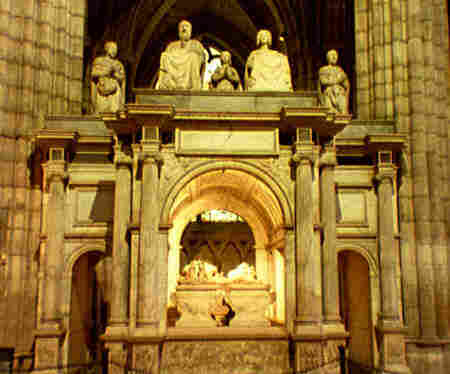
The first thing I noticed was the bare, marble feet. At the centre of the huge marble monument effigies of the almost naked monarch and consort lay, the soles of their feet facing tourists as they entered. At last I saw the human vulnerability of the monarchs. It was only later that I saw the fully-dressed king and queen kneeling in prayer, their children behind them, on the high top of the monument.

I wandered among the dead kings and queens. There was Marie Antoinette again, slightly larger than life and kneeling elegantly next to husband. And there were the plainer, earlier kings, from Clovis onward, looking stiff, still and much the same as one another.

Wandering among the royal monuments, I caught sight of a notice on one of the stiff mediaeval ladies: "une princesse inconnue" - an unknown princess. She may not have been a very significant princess but presumably, a long time ago, she thought herself an important person in the world. And now she was just a monument, much like all the others, and no-one even knew her name or which of the many dead princesses she was.

Beyond her lay another, smaller monument, no longer than a five-year-old but a miniaturised adult in polished white marble. I leant over to look at the notice - another "princesse inconnue."


Thursday, 27 August 2009

Rechauffage


There are no kitchens at Versailles.

English tours of palaces, castles and stately homes show visitors where the servants lived and worked. That's where most of us see ourselves. We know, logically, that we wouldn't be the ones in the fancy dresses. We'd have been taking orders, making things, clearing up after grand parties and making do on too little sleep.

But in Versailles, cooking was seen as messy and vulgar. Meals were transported from a huge building in the town to be reheated, tasted for poison and served. Even in Le Petit Trianon, Marie Antoinette's modest mansion in the park grounds, there was a room for reheating the meals. And in the farm and model village she created, there's a whole building dedicated to rechauffage - reheating.

The farm and village created for Marie Antoinette has a picturesque unreality, although there was a real farmer who has to provide eggs and milk for the queen's dairy. Everything is clean and fake. The houses, dovecote, mill and so on may seem miniature compared to the vastness of Versailles. Perhaps Marie Antoinette really believed that this was how peasants lived as she and her friends played at being poor but it's Disneyfication before Disney. Versailles left me marvelling at the remoteness of the French monarchy but the little fake village, constructed so prettily around a carp-filled lake, sickened me. I was also reminded of Poundbury.

There was a gift shop, of course, selling mementos, mostly of Marie Antoinette. And the real farm has become an animal sanctuary where sheep, cows, goats, rabbits and donkeys enjoyed plentiful feed, sunshine and admiring glances. Nearby, horses graze and a couple of farm carts - tumbrils - stand empty, ready for use.

Tuesday, 25 August 2009

Being Jupiter


Nothing prepared me for the gilded enormity of Versailles. I tried to imagine being in a mob storming the castle and could manage only incredulity at the excess. I've never seen a better argument for republicanism.

I don't understand the way of thinking that commissioned such an enormity nor the way the court understood itself. I thought Tale of Two Cities an exaggeration but now I realise it understated the reality.

There are notices at Versailles about the practices of the court. Every evening at 10 p.m. Louis XIV dined with his family. This was a public event and members of the court were privileged to watch. They didn't get to eat. The ladies perched on small stools and the gentlemen stood behind them as they watched the monarch and his family at dinner.

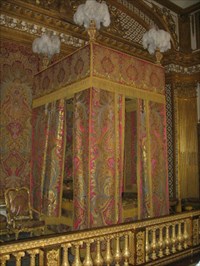
Going to bed and getting up were ceremonies too. There are gilded rails in front of the high four-poster beds and at the top corners of the bed - the structure must be fifteen feet high - are white fleur-de-lis made out of ostrich feathers. A few chairs stools are placed nearby, presumably for the attendance at court.

It's perhaps not remarkable that the chapel is a baroque riot or that there were strict rules based on orders of precedence about who could attend and where different levels of the nobility could sit.

But strangest of all are the paintings. Some are religious, with Jesus and his disciples in peasant dress. At a last supper, an extravagantly-dressed Mary Magdalen washes Jesus' feet. You wouldn't catch the royals in any such gestures of humility. Anne of Austria appears as Minerva, Louis XIV as Jupiter. One of Louis XV's toddler sons reclines as Cupid. Louis is everywhere: winning wars, making peace, implicitly compared with Alexander the Great, honoured by a winged Victory as he stays aloof from the battle. He even poses to show off his red shoes and his fine leg - he could sing and dance as well as making war.

The French royal family moved among paintings of themselves as divinities, usually in the Roman style. How they combined this with their public Christian faith, I don't know. But they seem to have seen themselves as more than heroes. In the oddest painting of all, Hercules, nude but for a carefully-placed drape, paints a portrait of Le Grand Condé on a lion-skin while assorted nymphs and divinities stand around.


Saturday, 13 September 2008

The watchers and the watched


It began as a lecture - about psychology. Against the backdrop of a clinic the doctor and his assistant introduced themselves and then, with smug authority, brought on their patient, pyjama-clad and shambling.

Of course, we knew it was a play. This was Nottingham Playhouse. We had tickets for Vertigo - not the Hitchcock film but the French novel on which it was based, adapted for the stage by Jonathan Holloway. Butfrom the start our role as audience was uneasy - we were spectators of a disturbed man who seemed unaware of our presence.

Gradually we were absorbed into the story ... then, from time to time, jolted out of it. Ben Keaton, as Roger the patient, moved from semi-consciousness into apparent alertness as he enacted his past. But in all this he was under hypnosis - paraded before us by the doctor treating him. For most of the first act he remained in pyjamas while appearing suave and confident; the doctor and nurse moved in and out of other roles - to show us how things were. At times the doctor would return his patient to sleep so that he could underline a point for us, the viewers.

It's a tale of fear and obsession that begins in Paris in 1940. German troops threaten inavsion. Roger's outward confidence masks guilt and uncertainty; he's an ex-policeman whose fear of heights led to the death of a colleague. He takes on the job of following Medeleine, the delicate young wife of a rich older man. First he just watches and begins to idealise her. Then he finds himself forced into an action which makes her acknowledge his presence. As he spends more time with Madeleine, Roger's obsession deepens. Who is exerting power, the doctor asks us, the watcher or the watched?

The story twists unexpectedly, leaps past the Occupation and introduces an uneasy post-war France. Sympathies switch. We remain uneasy as watchers but we remain transfixed because there is so much we need to know.

I don't want to give away the plot. We went to the first preview. The press night is next Tuesday. But it's gripping theatre - and as sinister and shocking as any film noir. From my second-row seat I felt like a voyeur - failing to intervene because I wanted to know how the story would end.

I saw the play with my teenage children - a last family outing before my daughter departs for university. I'm glad to see that Nottingham Playhouse still has the cheap tickets and special offers that make a family outing possible. The Playhouse wasn't quite full but the audience was rapt and thrilled. And I'm glad to report that my daughter - an enthusiastic theatre-goer - reckons it one of the best productions she's ever seen.


Note: The play is a reworking of a touring production by Red Shift. I note that the smaller production reached the Wyeside in Builth Wells earlier this year, giving audiences in Powys a chance to see outstanding theatre. It's a shame that the long-term future of the Wyeside - an outstanding small arts centre - remains uncertain. I hope the campaign to save the Wyeside secures its long-term future.

Friday, 5 September 2008

A communist barbeque


The first vote I cast was for a communist. It was in the Greater London Council elections of 1973.

Back in those days, I had great hopes of elections. I attended the public meetings - there were several and they were packed. I interrogated canvassers about their beliefs. I met the candidates as they campaigned in shopping centres and asked my questions. In that first election, I didn't make up my mind till just before polling day. I never agonised so much about a vote till 1997, when an encounter with Tony Blair finally persuaded me that I couldn't vote New Labour.

Back in 1973, there were four candidates. I can't remember who the Tory was. Records name a Mrs Williams. The Labour candidate was Marie Jenkins, wife of the MP standing in what was then a safe Labour seat. I didn't consider voting Liberal as I'd never met the candidate, Walter Hain. (Later I came to know, like and respect him and his wife, especially for their opposition to apartheid which cost them so much.) The communist candidate was called Dave Welsh.

I must have wanted to vote Labour because I sought out Marie Jenkins and asked her about her policies. Perhaps she thought I was younger than I was or perhaps I took her manner the wrong way. I can't remember what she said but I burned with shame at what I read as her condescension. In my memory, which may be false, she is wearing a fur coat - not necessarily real fur - and was visiting the council estate in a large car. I am certain she didn't take my earnestness seriously. I was eighteen and very intense. And I'd come across several people who assumed council tenants were stupid and criminal. I saw no reason to vote for someone who saw me, on the evidence of my address, as an inferior.

Dave Welsh was different from the other candidates. He lived in a council flat and, like my dad, worked for London Transport. When he spoke, he spoke with knowledge and experience about council housing and public transport. He also spoke approvingly of the Soviet Union, suggesting things were much better there. I wasn't convinced about Russia - films of tanks on the streets of Prague in 1968 suggested a grey oppression far from the optimism of the Communist Manifesto. But the Greater London Council wasn't concerned with foreign policy. I cared about council housing and public transport. I wanted a councillor who would speak with knowledge on behalf of other working people. I voted for Dave Welsh and, for a few hours, hoped that enough other people would vote as I did. He didn't win.

Communist councillors and councils are pretty rare in Britain. It's different in France. My friends in France have communist councillors and, when I last visited, I saw their announcements of a forthcoming communist barbeque in the public square.

As a non-tenant and non-voter, I was a little hesitant about turning up. I also realised that, in France, there wouldn't be anything for me to eat. But I could at least see what a communist barbeque looked like.

I arrived too early, just as they were setting up, but the communists didn't look intimidating. They were busy cooking sausages and dispensing cans of drink. I'd hoped there would be a sale of badges or stickers so that I could find a gift for my son but there was nothing like that. Instead there were leaflets advertising the latest communist initiatives: sales of fruit and vegetables at fair prices.

The French communist party has formed an alliance with some French farmers who, like British farmers, complain that they are forced to sell their produce at low prices so that it can be sold on at a high price in the shops. Communist leaflets suggest that, as a result, fruit and vegetables are becoming a luxury. The Communist response was simple and practical: they were transporting 60 tonnes of fruit and vegetables from the countryside and selling them at 100 stalls in the Paris area. The aim was fairer pay for the farmers and cheaper produce for hard-up Parisiens. Apparently they do this regularly.

I was impressed. My local councillors may hold surgeries, but they don't hold public barbecues in the High Road. Instead of helping small farmers make a living, they agree planning permission for yet another large supermarket and tell their angry electors that it's all for their good.

My French still isn't great but I managed a conversation with some of the communists. Mostly we compared rising prices in France and Britain. I remember that I characterised New Labour as "Les Pseudo-Travaillistes", speaking of the government's current fondness for big business. A communist ventured the opinion that Sarkozy and Thatcher were the same. I think I can detect differences but I saw his point. Anyway, my French wasn't up to a more detailed discussion.

I looked at the prices on the list of fruit and vegetables for sale. They were definitely cheaper than the supermarket. And they seemed to have a lot of nectarines. I'm allergic to nectarines. In any case, the sales were meant for the local people and I was getting ready to go home.

Friday, 22 August 2008

Bringing home the dead


It may be the middle of the Olympics but, when I turned on the TV, there were no sports and the news had been delayed. The state funeral for ten French soldiers killed in Afghanistan was carried live.

I don't approve of war and I don't usually like state ceremonies. I'm opposed to most of President Sarkozy's policies, including his pursuit of the west's unwinnable war in Afghanistan. But when I watched the end of the funeral ceremonies in the courtyard of Les Invalides, he seemed to have done something right.

Certainly the funeral included rhetoric about the heroism of war. The the French President - and most of his cabinet - faced the ten coffins and watched saw the grief of the families of the dead. Wives, children, parents clutched one another and cried. In turn they stooped over the flag-draped coffin that held the familiar flesh and kissed it - some once, some many times. No-one could erase their pain - it was part of the ceremony.

Soldiers, ministers and families faced that grief as the band played the Marseillaise.

There was a strange ceremony - strange to me, though I think it's familiar in France. Sarkozy stood at the foot of each coffin in turn and appointed each dead soldier, by name, a knight of the Legion d'Honeur. So far as I could see, he had no notes. He had to speak the name of each soldier in turn before pinning the medal on a red cushion at the foot of the coffin. I couldn't help recalling what happened when Maya Evans and Milan Rai read the names of the British soldiers killed in Iraq at the Cenotaph in Whitehall.

Of course, there were gaps. The debate about the war and the funerals of the Afghan dead take place elsewhere. But it seemed right that a President should name and honour the dead while his cabinet stands with head bowed. It seemed right that the leader who pursues a war should pay homage to the men he sent to kill and be killed in pursuit of his policy. It seemed right that a country should see mourning and grief on live TV.

So far, 116 British soldiers have died in Afghanistan. 176 have died in Iraq. I haven't noticed any state funerals, though there have been public messages of condolence to the families. Sometimes the funerals have been reported. Sometimes these are intimate family occasions with uniformed soldiers joining the congregation. On other occasions they are full-scale military events. Sometimes there are no coffins because there are no remains. Some funerals include denunciations of the war and attacks on government policy.

The absence of British cabinet ministers from the funerals of dead soldiers seems a kind of cowardice but perhaps it's just the usual concern for image and spin. In the United States this goes further. President Bush has attempted to prevent journalists from acquiring any photographs of the coffins coming home.

At the end of the French state funeral I saw something else surprising. There was a soldier in a wheelchair. His comrades were helping him over the cobbles. In Britain we don't see much of the injured. A group of severely injured soldiers wanted to join the Remembrance Day ceremonies at the cenotaph last year. At first they were encouraged to take part. Then they were told they weren't welcome because serving soldiers aren't allowed.

They do things differently in France.


Sunday, 11 May 2008

Who's in charge?


It's summer. Suddenly the centre of Nottingham, which has been almost empty in the cold and rain, was thronged with people. I'd forgotten about the noise of happy crowds. In the Old Market Square a French market drew smiling queues. I couldn't resist the quince jelly or chestnut jam, let alone a wonderful mustard "aromatisee" with goats' cheese and basil.

Real baguettes were a necessity. And although French cheeses are more expensive after the change in the exchange rate, I succumbed to the lure of some favourites: a good comte and emmenthal, a thin slice of tome de Savoie and a small piece of Roquefort. They offer a taste of holidays - just a taste as I asked the young man on the cheese stall for "cent gramme, seulement."

He served everyone with a flourish, in French when the customer spoke French but otherwise in an English sprinkled with French words and intonations, rapidly charming customer after customer. He was swift as he sliced and wrapped cheeses but always found time for smiles and politeness - and he had a happiness in his work that infected everyone. I was nearly tempted to extravagance.

Nottingham must have one of the most crowded city centres in Europe. It's compact, held in by a dull inner ring road, Maid Marion Way. (Maid Marion deserves better.) The Old Market Square has recently been rebuilt with fountains where children play when the weather is hot. Much of the central area has been paved so that only buses, trams and taxis trouble pedestrians. Despite the hilly terrain, the centre itself is as flat as it can be, so that it's easy for wheelchair users to navigate.

Around the city, traffic crawls along access roads and car parks are crowded. There have been debates about a congestion charge but the city council has come up with a different solution: taxing car parking spaces at work. I haven't read through the arguments as I don't live in the city but I have noticed that public transport is excellent, especially in the day-time, and there are the usual park-and-ride schemes. In a small city, traffic adds to pollution. Not everyone enjoys the sunny weather in the city centre; some choke or gasp.

Yesterday's Nottingham Evening Post published the response of businesses to the proposed parking charge. "Impose the charge and we'll quit the city," they say. The threat - to withdraw employment from the area - is a serious one. It raises a serious question: who's in charge?

Nottingham electors vote for their council. If they don't like the parking charge, they can vote the council out. It's called democracy and, for all its shortcomings, it's a decent, fairly open system. But when businesses threaten publicly-agreed policies, they short-circuit the democratic process. Are our cities run by elected councillors or by wealthy corporations?

Companies have always influenced politics. Councils and countries want thriving, successful economies. Today they court businesses as the providers of wealth and apparently fail to notice that they give more than they gain. Companies demand tax inducements, special provisions, an education system that serves its needs, subsidies, consultation - even deference - when the government proposes new policies. In a global economy, the threats of big companies are huge and dangerous. They can relocate where workers are cheap and unprotected - and where no-one expects them to care about the environment. They can get together and threaten mass unemployment. And despite legislation, they can achieve a near monopoly in the supply of necessities. Small traders have to look out.

If councils and governments defer to businesses, we don't live in a democracy. Bribes and blackmail govern our lives. Of course, there are organisations which could protect democracy against the corporations: the World Bank, the World Trade Organisation, the European Community and the United Nations. But these seem to have fallen for an absurd notion which correlates the free market with freedom and democracy. And it's not the same thing at all.