Showing posts with label protest. Show all posts

Saturday, 12 October 2013

Museum by night

There was an  anxious cluster of people outside the Victoria and Albert Museum.  They were reading the hoardings that had appeared.  "NEW RESIDENTIAL DEVELOPMENT" it proclaimed, and a second line added, "AT PRIME CULTURAL HERITAGE LOCATION."

I could hear what the people were saying, although their voices rarely rose above a quiet mutter.  "They're selling everything off."  "I never thought we'd lose the V&A."  "It's such a shame - I'll miss it."  But although passers-by really thought that the government had decided to convert one of London's great museum into luxury housing, none of those I heard suggested a protest.  They minded, they were upset, but not one of them even suggested wearing a badge or writing a letter to an MP.  This was what the government was doing and they would have to put up with it.

I'd have been there with a banner and loud-hailer if I thought the government was selling off the V&A to property developers.  I've loved this museum since, as a London child, I wandered through its galleries and got lost amidst its marvels.  There used to be a reproduction of the Bayeaux Tapestry on rollers so that you could view it in stages.  I lost count of the number of times my brother and I surveyed it, looking for the figure we believed was Harold with the arrow in his eye.  The huge and detailed Raphael cartoons were another attraction and for some reason I was fascinated by the sculpture of the serpents entangling Laocoon and his sons.  There were even visits to the cast gallery, if I could persuade an adult to take me past the sign which banned unaccompanied children under 15.  I don't know if this was to project the fragile casts or to keep us from the replica of Michaelangelo's David with which I was obsessed, though more for the expression of his face than for his nudity.  Fortunately I rarely had any problem in finding a grown-up to escort me past the museum guards.  If only for the strength of my memories, I would fight to preserve the V&A for future generations of children.

But I knew that, for now at least, the V&A is safe from property developers.  I was on my way to see the Elmgreen and Dragset installation and, after a moment's shock, came to the conclusion that the hoardings were part of the game they were playing with visitors.  

It was Friday evening.  I've never been to a late evening opening at the V&A before and the feel of the museum is different.  As the skies darken outside, the light in the museum changes.  Visitors seem more hushed and slightly tentative, as though they fear they're trespassing.  And because some of the galleries were closed, I had to find new routes and, as usual with so large a museum, I found myself in unfamiliar rooms.  I couldn't work out if I'd seen the Turners before and hurried past but on Friday evening they were luminous and compelling.  I've only just begun to appreciate Turner after the hackneyed reproductions of The Fighting Temeraire that appeared on so many biscuit tins in my childhood.  But after spending time in the small room of the National Gallery where two Turners are hung with two paintings by Claude, I have gradually come to realise, some years after falling for Claude, that I've learned to like Turner as well.

I wanted to linger by the Turners but I had come to the V&A to see the Elmgreen and Dragset installation, called Tomorrow.  I loved the idea of the installation: five galleries of the V&A have been turned into the apartment of a rich and unsuccessful architect which he has been compelled to sell but has not yet left.  Visitors are encouraged to snoop on the invisible inhabitant while the museum guards, dressed as butlers and maids, stand about and respond to queries with deferential courtesy.

At first I thought the installation was great.  My sense of being an intruder matched my sense of strangeness at being in the museum at night.  There weren't many other visitors just then, and I wondered if some of them were part of the installation.  Nervously I picked up items, stroked them, read postcards and bills, leafed through newspapers (lots of stories of the London riots) and perched on sofas and chairs.  There were a few moments which added to my uneasiness - but not many and, for my taste, not enough.  In the end I wasn't sufficiently engaged with the setting nor with the film script which was provided to accompany it.  I was left as cold as I was by Elmgreen and Dragset's consciously kitsch sculpture on the fourth plinth in Trafalgar Square.  It's the only fourth plinth sculpture that I've actually disliked.  

I've been trying to work out why I was so unengaged by the installation.  I know other visitors have liked it.  There were elements I enjoyed: the unwashed coffee cups, the unmade bed, the sound of the shower, the fireplace in the living room and the vultures.  But in the end I was uninterested in the people that the room conjured up - apart from the servants.  The servants were great and I'd like to have known more about them.  I leafed through the postcards and photograph album and worked out, from the pictures, that I was supposed to understand that the rich inhabitant of the flat was gay and liked looking at attractive young men - but why was this presented as a puzzle?  It seemed to be presenting the character's sexuality as a not-very-hidden secret, which would have made some sense forty or fifty years ago but is a little strange now.  I looked at the architecture posters and models and wondered what point was being made, then found that I didn't much care.  The installation seemed to be about wealth and people to whom wealth came easily.  In real life I feel much more uneasy in such a world than I did in the installation.  I left unmoved.

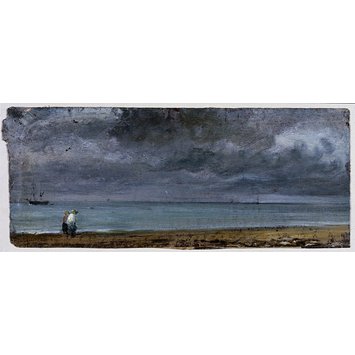
But then I found myself among the drawings in the V&A's collection, and I was riveted.  Here there were people and scenes I could care about.  There was clear craft as well as art, and surprising experimentation.  A startling ink drawing which Constable made in old age caught my attention, and I looked with care at some of the tiny oil sketches he had made too.  I particularly loved those of the seashore.  I fell into conversation with people who had taken a different route to the museum and been distracted by the small Constables on their way to the installation.  They were more knowledgeable than me and could trace the influence Constable had on twentieth century artists.   I couldn't stay long enough but I want to get back to see the Turners and Constables again.  It seems that my views of Constable have been unfairly limited by exposure to frequent reproductions of his paintings of Salisbury Cathedral and the Hay Wain.

So it wasn't the temporary installation that awoke my sense of wonder but the familiar seen anew.  I left the V&A determined to return again soon - and on a Friday evening if I can.

Monday, 30 May 2011

Hidden stories and imagined worlds

It seems that there are demonstrations and protests in several European countries. Every so often there's a brief mention in the press - but it's usually an aside or footnote to another story. A fellow-blogger, travelling to Madrid on business was startled to find every square in the city under occupation by protesters - and it seems that other Spanish cities have been occupied as well. The Barcelona occupation did get a mention in the British press - in the football reports. Apparently there were fears that Barca would be unable to celebrate in the usual square, as it was occupied. A search on the internet quickly brought up video of the Spanish police trying to disperse the protesters with considerable force.

It seems that Greece has large protests too. Syntagma Square in Athens may still be under occupation and I found mention (in Greek papers in English) of further protests in Thessaloniki and Patra. Then there were references to protests and occupations in France - not just in the Place de la Bastille in Paris but in other cities as well. Struggling through information from a variety of courses and a variety of languages, I discovered that people in each square came from a variety of political and non-political background - but were almost always outside the mainstream - and that they worked co-operatively and consensually to write their own agendas for change.

This may all fade away. People may just accept the poverty and exploitation which comes with finding their country "bailed out" from a crisis caused by their government, bankers, and multi-national countries. But I find it far more interesting than the sex-life of bankers or the dresses worn by the wives of a president, a prime minister and the heir to the heir to the throne. And I wonder why the British press is ignoring it while similar actions in some Middle Eastern countries merit front page coverage. I have, however, noted that protests in some Middle Eastern countries get more publicity than others - the press now has little to say about Syria, Tunisia, Morocco Bahrain - and last Friday's protests in Egypt were barely mentioned.

When so much is happening abroad - and when there are plenty of political struggles at home - it seems slightly bizarre to spend time at a theatre festival. But NEAT11, Nottingham's new international arts and theatre festival is practically on my doorstep. If I wished, I could walk to some of the events. And while some are rather expensive (Opera North still offers too few cheap tickets), others are cheap or even free. I made a few extravagant bookings and promised myself hours of indulgence away from the anxieties of the Age of Austerity.

It didn't quite work out like that. Who would have thought that Henrik Ibsen wasn't always a gloomy Scandinavian but a writer of political comedy? The League of Youth, receiving its professional premiere in Britain nearly 150 years after it was written, was one of Ibsen's most popular plays in his native Norway, at least during his lifetime. And, more surprisingly, it turns out to be a satire on Nick Clegg. I came away from the Playhouse both cheered and musing on the effects empty rhetoric still has on voters who are fed up with the current system and desperate for something better - and a chance to be heard. The League of Youth runs till Wednesday so there's still a chance to get tickets.

I also made it to a free play-reading of Anna Yablonskaya's play The Irons. Yabolnskaya is one of two people associated with NEAT11 to be killed in an act of terrorism this year. (The other is Juliano Mer Khamis.) She was killed in a random and barely-explained bombing at Moscow's Domodedovo airport. I thought the knowledge of her death might affect my response to the reading but it was so complex, even in a semi-staged reading, that I was caught up in the characters and events. But again it led me back to the world of politics. At the centre of the play was a young man collecting irons and ironing the flags of countries that no longer exist - and this wasn't just some intellectual metaphor but part of the characters' experience, reflecting a world that was both known and imaginary.

The reading I attended was a shortened version of the full play (which is being read in full next week) and was followed by a discussion of theatre in Central Europe, with representatives of a Hungarian theatre company, a Kosovan theatre festival and Natalia Koliada of the Free Theatre of Belarus. While theatre in Hungary has experienced cuts and press attacks - and may suffer in the future under a recent Media Law - it is in a far stronger position than Kosovan theatre, which is desperately under-funded and suffering the effects of war, poverty and unemployment. But the problems in Belarus made others seem insignificant.

Natalia Koliada is living in exile; she has been warned not to return since her arrest and imprisonment last year. Her country is a dictatorship, torture is routine and her theatre company is prevented from giving public performances. Requests to perform plays by British playwrights including Sarah Kane, Mark Ravenhill and Edward Bond were turned down. One of the reasons given was that the plays show homosexuality, suicide and mental illness, which "don't exist in Belarus". So I was back to politics again, marvelling at the power of the arts and fictional worlds to upset those who rule and administer totalitarian regimes. I marvelled too at the courage of those who continue to make art in difficult circumstances, finding something within them that will not bow to the demands of authority.

These theatrical experiences were shared with other members of the audience and quite easy to discuss. I also chose two solitary theatre experiences. For one I had to download tracks to my MP3 player; for the other I was provided with a mobile phone.

Threads by Andy Barrett is the more conventional drama. It's also free for anyone with access to a computer and MP3 player. In a way, following Threads round Nottingham's Lacemarket is like listening to a radio play. But there's something different about following a play which asks you to look intently at your surroundings while listening - it requires an acuteness of visual observation and risks being interrupted by external factors such as a crowd of clubbers or loud conversation in a bar. While the events of the play are fairly slight, it's the accompanying visual intensity that stays with me - and the play itself demands that the listener look at people and places anew.

More disturbing is Ulrike and Eamon Compliant which was devised for Venice but has been rethought for Nottingham. As the solitary audience member, I picked up a mobile phone, turned it on and listened attentively. I was asked to choose one of two identities from the real (historical) terrorists Ulrike Meinhof and Eamon Collins. Clutching the phone to my ear I walked through streets that were suddenly unfamiliar, made choices, followed orders and heard snatches of Ulrike Meinhof's experience until my identity began to blur into hers. I did not entirely stop being myself and a pacifist but for half an hour or so I saw Nottingham - and the wider world - as a terrorist might see it: angry at the injustice and cruelty of the world, prepared to sacrifice myself and others for the dream of a better world.

Sometimes - often at its best - theatre challenges its audiences to imagine things they do not want to understand. I felt at times that being Ulrike, even for half an hour, had messed up my brain and my identity. But I also knew that I undertook the experience voluntarily - and paid for it too. In a world as complex as ours it may help to understand. Just at the moment, theatre seems closer to world events and dilemmas than anything I find in the British press.

As I made my way to the bus-stop after a day of theatre, I passed the Old Market Square. No-one was demonstrating. If anything it seemed slightly emptier than usual at that time of night. But suppose it had been occupied by a peaceful protest camp of people wanting to change the world, I wondered if I'd have been able to read about it in the next day's papers. I'm glad I don't live under the kind of totalitarian regime that people experience in Belarus. But perhaps in Britain too there are some things that aren't mentioned in the press because they don't happen here. And who knows what anger that press silence would evoke?

Saturday, 2 May 2009

The all-purpose May Day march


It's May. Some of the empty shops have unexpected blossoms: bright new businesses nestling in bankrupt empty caverns and urging sunlit strollers to enter and buy. I have little hope they'll make it through next winter but there's something appealing about their optimism, even though I doubt a champagne bar will succeed in a suburban high street.

All over Europe, yesterday was May Day. In England, they waited till today for the marches and the holiday is on Monday. I read about Nottingham's march on Indymedia and decided to join in.

We assembled in Brewhouse Yard at the bottom of Castle Rock against a background of caves. There were flimsy but colourful stalls with banners, books and badges. A van was selling vegetarian food and the Clarion choir was preparing to sing.

Sometimes Nottingham's May Day marches have a focus - I've been on one which was against the war in Iraq - but this year all sorts of people were involved. The campaign against privatising the Post Office had top billing but there were marchers from several trades unions, peace groups, and left-wing organisations or parties. I was offered a CND placard, against the renewal of Trident, and agreed to carry it. That made it hard to take photos.

We ambled cheerfully through Nottingham, led by a samba band. Caught in the middle of the crowd of people and banners (police estimates reckoned about 500 of us), I couldn't see the band or many of the marchers. My view was largely of the backs of banners, police (with numbers and earpieces securely in place) and smiling crowds. No-one seemed greatly perturbed at the slight delay we caused - instead bystanders stopped to read the banners, raised their phones to take photos or even started dancing along to the samba band. Occasional attempts to start chanting slogans foundered. There was some annoyance at bankers but this didn't flower into anger. Instead brief conversations sprang up in which individuals shared their concern. But conversations subsided. We were enjoying the sun, the crowds, the company and the walk.

It was a short amble, causing no difficulties for the small children in family groups or the people in power-wheelchairs. We passed the edge of the Market Square, the Robin Hood statue beneath the castle and the abandoned Lace Centre before re-entering Brewhouse Yard. Then the marchers looked at one another's stalls, queued for vegetarian food and sat on the grass to hear the music and speeches.

I deposited my placard and bought a veggie burger before wandering round the stall. I paused for a while to talk to people at the Refugee Forum, still collecting for the destitute asylum seekers whose poverty shames us. I accepted a leaflet for the campaign to free Hicham Yezza. Like many people who are arrested with a great fanfare on terrorism charges, he's now been imprisoned on visa irregularities and is threatened with deportation. And I spoke to a fellow Quaker behind the stall for the City of Sanctuary campaign, which asks, simply, that we make refugees and asylum seekers welcome.

There was a speech by Alan Simpson, one of the few Labour MPs I would vote for. Unfortunately he's not my MP and he's retiring at the next election. He spoke passionately about the environment, but I was enjoying the sun so much my concentration wandered. I couldn't focus on the songs (by Red Banner) for long either. I wandered off to inspect the trades union banners, now propped against the caves that were carved from the sandstone centuries ago. (No-one lives there now.) I wondered briefly what the march might have achieved. At least we all enjoyed it - and the event was encouraging. I felt less alone in my concerns. And so, encouraged, I slipped away.

Wednesday, 24 December 2008

To whom it may concern


I heard Adrian Mitchell perform only once, back in the 1970s. Then it was his poem about Victor Jara (later set to music) that made an impression.

I'm hesitant about political conviction as I am about religious conviction. Both have the capacity for evil as well as good and justified anger can lead swiftly to the cruelties of hate and vengeance. But Adrian Mitchell's poem for Victor Jara didn't call for vengeance. It simply insisted that we listen to what had done. Victor Jara was a folk singer who had supported the socialist President Allende. In the wake of the CIA-backed coup (on September 11, 1973) that toppled Allende and installed the dictator Pinochet, Jara was one of thousands taken to the Chile Stadium. His captors tortured him before they killed him; the broke his hands to make sure that he could never play the guitar again. Sometimes it's the details of cruelty that appal - it's easy to let the wealth of statistics sweep over me. But I couldn't forget about Victor Jara's hands.

These days, like most people, I've become infected by a kind of cynical helplessness. There is more I could do to oppose injustice, cruelty and so forth, but it's hard to believe it will do any good. But when I heard that Adrian Mitchell had died, I sought out his most famous poem, "To whom it may concern," and found a youtube video of his performance at the Albert Hall for the Poetry International. When Adrian Mitchell performed in 1965, he seemed like the voice of an angry hope for the future. The huge audience included Alan Ginsberg. The Vietnam war is long over but the there are still wars and safe, convenient, public lies. Adrian Mitchell went on campaigning and writing, though the audiences were smaller. But something seems to have vanished from the world since the campaign against the Vietnam War. Perhaps it was lost when our government refused to listen to the people who marched against war in Iraq. These days the innocence of hope is almost dead.

The world is a poorer place for the loss of Adrian Mitchell.