A colleague showed us a video from youtube. A newly-married couple came out of a church. The camera panned along the street. There was a brief glimpse of a young girl looking out of a window, curious to see what was happening. She could have been any girl of 12 or 13, watching the adult world and anticipating her own future. This young girl's life is well-documented and her diary is translated into numerous languages. Her name was Anne Frank. She wasn't quite sixteen years old when she died in Bergen-Belsen concentration camp.
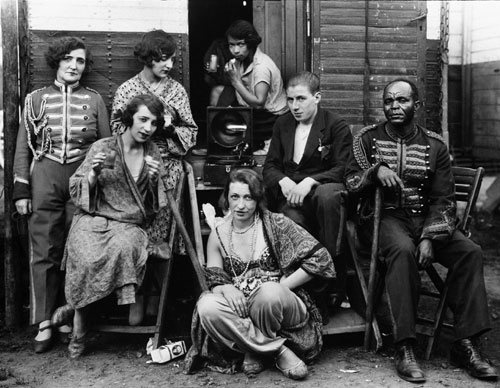
For most of the photographs of August Sander, now on display at Leicester's New Walk Museum, as part of a touring exhibition sponsored by the Art Fund, viewers can know little of how people began or ended. Sander's initial aim was to present a study of German life, using individuals to represent different types within German society. But however determined Sander's categorisation, the people he photographed resist being mere types. Some perform their occupations, often surprisingly. A farmer in the 1920s still ploughs with oxen Another, in 1952, sows seed by hand, scattering it from a basket. Others pose with the implements of their trade. Almost all gaze straight into the camera, leaving the viewer with no more information that the brief labels provide. The more I look, the more I understand the impossibility of reading a whole human being from a face.
I never have the sense that Sander's photography mocks or diminishes its subjects. I always see them as complex, interesting human beings. If I wish, I can build stories. I have to set those stories in the time through which they lived. Almost all of them were confronted by the dilemmas and persecutions of Nazism. But when I start wondering "How did that farm-worker vote?" or "What did that woman do when the Nazis came to power?" I can't answer the questions I want to ask. People's actions don't always harmonize with their faces. An SS officer in one of the photos of Nazis looks benevolent and slightly unsure of himself. His uniform does not.
I can and do make guesses. Some of the circus people in the photo above are plainly not Aryans. I hope they got away. I would like to imagine a happy future for the gypsies, the children with severe disabilities, those who are simply labelled "persecuted people" or "political prisoners." But I know most didn't get away. The exhibition ends with a portrait of the death mask of Sander's son Erich, who died towards the end of his ten-year jail sentence. Escapes are temporary. None of us ever walks out of history or politics, however hard we try. I wonder what future generations will think, if they ever look back on photographs, film and videos of the time in which we live.
August Sander didn't lead the life that was mapped out for him at childhood. He was supposed to be a miner. One day, working at the mine, he helped a visiting photographer and looked through the lens of a camera. He never forgot what he saw - the sky, the movement of clouds. That moment gave birth to one of the great photographers of the twentieth century. He was part of his time but the records he made speak to the future.
I have paid one visit to the August Sander exhibition so far. I hope to visit at least once a week while the exhibition is in Leicester. I want to look more closely at many of the portraits. I would like to commit them to memory, which is another way of letting the people of the past live on. I also want to spend more time on Sander's pictures of human hands and of landscapes.
But I can't spend too long in the gallery with Sander's pictures. There's too much humanity there, real people set to face a dreadful future.
I think if I stayed too long, I would cry.
 I'm in danger of succumbing to a new addiction. In the past few weeks I don't just come downstairs desperate to ignite the gas beneath the espresso-maker. I also tune feverishly to Radio 3.
It began with Buchner. I read his plays years ago and have twice seen excellent productions of Berg's opera Wozzeck. But I've never seen the original plays performed. So when, by chance, I noticed that Danton's Death was being broadcast on Radio 3, I tuned to the station - and didn't tune away.
In the past Radio 4 has been my default station. But the new and views have weighed on me, as has the immense wordiness of it all. I spend so much of my life with words that every so often, I need a break - and the music on Radio 3, at its best, provides that.
But this week started unfortunately. Paul Dukas is composer of the week - and that should have been excellent, because I know so little about him or his work. It was a shame that, early on, the compiler of the programmes felt compelled to play his most famous work, "The Sorcerer's Apprentice." I'd have liked to consider it in relation to the Goethe poem on which it was based but I couldn't. I've seen Fantasia. My mind was flooded with images of Mickey Mouse.
It was a relief, therefore, to find a piece of music which I could experience simply as music - which didn't crowd my mind with words and images but existed in sound and space, on its own terms.
I was at De Montfort University's Cultural eXchanges festival - an annual event that offers a range of cultural events, talks and debates - mostly for free - to locals in Leicester and the wider East Midlands. I've managed to attend a number of sessions but the one that stands out for me is the one that's hardest to describe and explain. Its resistance to description and explanation is one of the things I liked best about it.
Simon Emmerson's Memory Machine is an installation. I didn't know what to expect. What I found was a darkened studio - there were coloured lights and bean-bags. We entered in small groups, advised to walk carefully andlet our eyes adjust. Some people chose to sit or lie on the floor. I remained standing and, from time to time, walked around. My interest was in the sound.
When sound doesn't conform to the normal expectations of music - when it isn't in a definable strict form and doesn't include words - the only thing to do is to experience it and either succumb or not succumb. There were occasional sounds that seemed familiar - the fall of water, for instance - that conjured up ideas and past experiences. But other sounds I seemed to feel physically - in my body as much as through my ears. The sound came from different directions at once - the balance changed as I moved (as quietly as I could) across the studio. I felt at times excited - and at others intensely relaxed.
I couldn't stay as long as I wished. Perhaps that is as well. If I'd stayed too long I might have felt I was floating. As it was I had found, briefly, something I craved - a way of being that was neither speech nor image.
I suppose some people would dismiss such work as "avant-garde" or label it "difficult." I found it neither - but I know little about music. All I know is that sometimes, when I choose to experience a new work and am ready to accept what it has to offer, I discover new and unexpected sources of delight.
Note: The photograph is not associated with Simon Emmerson's composition. It was taken during a performance of Ligeti's Poeme Symphonique for a hundred metronomes at Covent Garden last year.
 "Can I have a word?"
It was early evening and I was walking down Leicester's New Walk. I looked at the young man who had accosted me. He was polite, hesitant, holding a clip-board and pen.
"I'd like a word," he said. "Just one. Any word you like."
This was difficult. There are so many words. I paused for a few moments and thought.
"Insubstantial," I offered.
He looked hesitant, then held out his clip-board. "Would you write it down, please?"
I wrote it as clearly as I could, in capital letters, at the bottom of his word-crammed page.
"Thank you," he said as I handed back the clip-board.
I smiled, wished him a good evening, and walked on.
When I tell friends about the encounter, they assume I'm making it up. I don't know why. I often want a word. Asking people for words seems an altogether sensible endeavour. I did my best to respond with a good one - I wouldn't have wanted to fob the young man off with something like "nice" or "tomato." And I didn't want to ask why he wanted a word. That was his own business - a question would have seemed too intrusive and familiar. It would have wasted his time. After all, there are lots of words out there and he needed the time to track as many as he could. I hope he made good use of them.
I thought of that young man again when I headed to the Turkey Café for an evening of poetry. I'd been looking forward to the launch of Cleaves Magazine's East Midlands section. But it had been a long day and I wondered if I was tired enough to concentrate on an evening of difficult poetry. At the bar I was persuaded to try a Cosmopolitan cocktail - it didn't take much persuasion and was worth it for the sight of flaming orange peel alone.
Poetry seems to pull in the punters in the East Midlands. As soon as the doors were opened, there was a dash for the chairs. The young were asked to sit on the floor instead - but soon the floor was full too. Late-comers stood by the door. Dazed by heat, crowds, tiredness and a cocktail, perched on a high stool in a hot room, cocktail in hand, I wondered if I'd be able to concentrate.
That's when I remembered the young man making his assiduous collection of words. I didn't have to take in every poem in all its complexity - as if this could ever be achieved when hearing a poem for the first time. This was a poetry reading, not an exam, and it was up to me how I enjoyed it. If all I could take in was a few words and the curving melody of a rhythm, that would be enough.
I settled down as comfortably as I could, and listened without straining. If I wanted, I could find the poems elsewhere and read them.
Readers performed in alphabetical order. Jennifer Cooke offered harsh words and disturbing images, pushing the boundaries of a sonnet. Kerry Featherstone offered English and French words; they almost mirrored each other but not quite - there are no exact translations. Mark Goodwin offered a kingfisher and the mountainous slopes of Ullswater.
There was an interval. Then Daniel O'Donnell-Smith offered modern technology and loss. I love his poems. They move reader or hearer without the easy tricks of modern sentimentality. Finally, as I was tiring, Simon Perril read and summoned up werewolves.
I was unsurprised to see clouds streaking a full moon as I left - an image from silent cinema, I thought.
I ran. Words from the reading clattered and echoed in my brain.
 Political conversations are everywhere. Not all elections are like this. The last election was marked by apathy and the sense that, when it was over, the New Labour regime would continue. I heard discussions of how to vote that were marked by a sense of guilt and despair – we hadn't stopped the war in Iraq and the war-mongers were about to claim their electoral victory as popular endorsement. Thatcher's dreadful phrase “There is no alternative” hung over us.I assumed this election would be similarly despairing. After the chancellors' debate on TV, when Darling. Osborne and Cable agreed that, whoever got in, the cuts would be deeper and more painful than under Thatcher, I settled into the gloomy certainty that the next five years would mean the rapid unravelling of everything I value in the hard-won welfare state. Worries about my parents and my children broke into my sleep and woke me in the middle of the night.I'm still worried. But there's a new thrill in the air. Many young people who never voted before seem to have infected the public debate with their excitement and conviction that change and hope are possible. They aren't agreeing with one another and many are still uncertain how to vote, but they want to listen to the arguments and join in the debates. The power of a single vote makes them feel like citizens.I was in Leicester yesterday when Nick Clegg visited. I've seen visiting politicians before and remember how, when Tony Blair came to Leicester in 1997, everything was stage-managed and spun to ensure good camera angles. Blair's campaign team provided the crowds with flags to wave, played music (D-ream) interminably and swept dissenters aside.Nick Clegg's visit wasn't like that. Students, enjoying the sunshine and their last day of term, came to join the crowds and see what Clegg had to say. Most banners were home-made though a couple of Labour supporters brought their own banners to wave. Plainly Clegg's team was taken aback by the hundreds of people. I heard them on mobile phones: “Yes, there really are that many.” Then the battle bus arrived.A narrow pathway meant that Clegg could get through the crowd, preceded by photographers and cameramen who found it hard to get the pictures they wanted. Clegg stopped as he walked to answer questions – a socialist friend of mine who came at my suggestion managed to ask him about students and bankers. She got an answer though I couldn't hear it.There was a speech with questions and applause but I was too far away to hear. Instead of trying to break into the crowds I started taking photographs of the posters. The pair produced by the Politics and Pints society cheered me, though Clegg didn't accept their invitation to the pub.There were more banners today at Nottingham's all-purpose, leftish-to-revolutionary May Day march. The organisers couldn't afford the marches usual base near the castle so had booked Victoria Park instead, to remind locals of the recent closure of the Victoria Baths nearby. The weather forecast threatened rain and gloom and I packed a waterproof jacket. I didn't need it.There were fewer people than in previous years. With only five days till the election, some of the regulars may have been out campaigning. But there was still a good range of stalls including one celebrating Nottingham's radical history in which a loaf on a stick, decorated with a black ribbon, had served as an incitement to riot. Of course, someone was carrying a loaf on a stick. I couldn't resist a badge with the words “TO THE CASTLE”, recalling the burning of Nottingham Castle in the 1831 riot in support of the Great Reform Bill. I hope no-one arrests me for incitement to violence. I'm still a Quaker and a pacifist – but I can't help wanting to celebrate Britain's radical past and the workers who demanded that their voice be heard.Women dancers, energetic and costumed as if for an extravagantly-pagan Morris, led the march. Various factions of the left chanted their competing slogans without getting further than detailed debates. Home-made banners greeted the shoppers of Nottingham, mostly with thoughtful, witty and challenging slogans that might make people think. (I was a little uncertain about the demand for “revolutionary praxis now” - the word“praxis” is underused in most conversations I have.) A gorilla danced and handed out leaflets for Greenpeace. I wondered where to fit into the march and found a place with CND and near Friends of the Earth.
Behind me two socialists had a lengthy discussion about how to vote. One argued that a Labour defeat was the only hope for radical elements in the Labour Party. I didn't catch the response. I wondered whether competing groups urging people not to vote, on the grounds that direct action is needed, were debating the best way not to put a ballot paper in the ballot box.We walked, sang, chanted and danced past the derelict wreck of a business which still proclaimed in large, wrought-iron letters "PALMER & SON LTD. BYRON WORKS." I thought we made a cheerful display and was pleased to see answering smiles from some of the shoppers. There were cheerful displays everywhere. Outside the glossy new pawnbrokers with its shiny blue fascia, smiling young women handed out white and blue balloons.It wasn't a long walk to Nottingham's speaker's corner, by the Brian Clough statue. The Clarion Choir were there to greet us. So was Robin Hood in a home-made and decorated banner-gown. I stayed for a while to listen to the songs and speeches, marvelling at how harmonious and tolerant Nottingham radicals can be on such occasions. I'd have liked to go back to Victoria Park with the march but my back was hurting. I slipped away and decided to blog about the march instead.

 I missed St. George's Day itself. I was too busy with work to head to Leicester Market for the traditional dragon-slaying and distribution of red roses. But Leicester has never been content with small festivals. St. George's Day has spilled over to become a three-day event, involving more than any individual could fit into the time available.
I scanned the programme in amazement. Everyone was getting in on the act. There were morris dances, a maypole, church services and a beer festival. There was face-painting and dragon-making and a choice between Shakespeare, poetry readings outdoors and prose and poetry indoors. Some of the events had a rather slight connection to St. George, unless there's something I missed - there wasn't any flamenco dancing in any version of the story I knew. But why not? It all sounded like great fun. I determined to attend on Saturday and take lots of pictures.
Plans don't always work. My back, still painful after my fall on the ice in January, was hurting more than usual. I left home late with my camera in my bag. Photogenic sights abounded. I saw the bunting first - I wonder if the council will leave it up for the World Cup. Two minutes later I spotted my first St George, accompanied by his maiden. They posed for a photo and smiled. I framed the picture, clicked - and the resulting image was flooded with light. I thought I'd messed up the settings, tried to check them, wished I had an instruction book. I tried new settings, more pictures. No luck - and they would have been such good pictures too. The ones that get away are always the best.
I listened to some readings. They were good but, worried about the camera and other matters, I could give then only half my concentration. I wriggled in my seat, trying to make my back comfortable. I failed and headed out into the sun.
Leicester was flooded with St. Georges, all much better-looking than the slightly sad specimen escorting Nick Griffin at the BNP manifesto launch. (I wonder if Nick Griffin knows how multi-cultural Leicester celebrates St. George's Day - and how pathetic his own attempt looks by comparison.) I think there was even a St. George on stilts but I was too far away to check the identification. I was happily impressed by the George and Dragon cupcakes.
I headed to the station via my favourite camera shop. The staff inspected my camera, checked the programming and eventually diagnosed the problem - serious and expensive. "It would cost a lot to mend it," one said. They didn't need to spell it out - I knew it would cost more than the camera itself. "Which is your cheapest camera?" I asked, and got out my credit card.
By the time I reached Nottingham St. George's Day celebrations were winding down - they had lasted a mere two days. Here England's special days involved William Booth and Feargus O'Connor as well as more markets, Georges and dragons. Shoppers, children, Goths and football supporters ambled in the sunny Market Square.
I didn't pause for long. My destination was the Playhouse and a play about another George. I read Julian Barnes' novel Arthur and George a couple of years ago and was curious to see what sort of play David Edgar would make of it. It didn't seem a natural choice for a drama - the novel goes back and forth in time and deals with complex questions of law and evidence. But David Edgar's a confident, experienced playwright who knows how to move characters and keep the audience interested. He's not to reshape a novel to ensure it works as a play.
In a way, Arthur and George is a play about Englishness, although Edgar doesn't labour the point. George Edalji, a vicar's son and solicitor, sees himself as an Englishman. His passions are railways and English law - he likes to see the world as an orderly place. Chris Nayak, in an entirely convincing performance, brought out the character's slight strangeness which the play relates in part to a protective and defensive family and in part to George's extreme short-sightedness and consequent focus on details.
At the beginning of the 20th century George takes his isolated life and its oddities for granted. When he comes under suspicion for horrific crimes - maiming horses and leaving them to bleed to death - he limits his consideration of the case to matters of evidence, law and courtroom practice. He never mentions the virulent racial hatred that condemns him because he is the product of a mixed marriage - his father is Indian and his mother Scottish. Eventually, when his life has been shattered, he turns for help to Sir Arthur Conan Doyle
Arthur - famous, admired but also an outsider - looks at the larger picture and is determined to secure justice, compensation and public vindication for George. Adrian Lukis's performance shows the bluff, hearty persona Arthur presents to the world but there's also a hint of vulnerability - Arthur is uneasy with his fame and the complications of his own personal life. George's case provides Arthur with an escape from guilt and worry as well as a cause to fight. One of the enjoyable aspects of the play is the way in which George and Arthur, who, with little in common, treat each other with careful respect and do their best to see one another's point of view.
It's an delightful play. The two major characters are complex and layered. Actors in the other roles take the opportunity to hint at complexity on occasion. While racism is uncovered - the kind of racism that was written into British text books at the time - it's not the only factor working against George. Ideas of manliness play part and so do networks of unspoken loyalty. George is a very convenient scapegoat.
Watching the play was entirely pleasurable. It helped that pain-killers, combined with rather good cider, banished my back-pain for a a few hours. Comfortable seats at the Playhouse helped too.
George Edalji probably contributed more to Britain than the historical St. George - or even the legendary dragon-killer. George Edlaji's case - and Arthur's defence of George - was a major factor in creating the Court of Appeal.
 What is happening to books?
Even the most committed and enthusiastic writers and publishers have scare stories. On World Book Day I listened to a talk by Chris Hamilton-Emery of independent publisher Salt. He's gambled his own and his family's livelihood on the idea that books - including books of short stories and poetry - have a future.
My first job, for four months before university, was at Foyle's bookshop in London. The manager was said to believe all staff were potential thieves. He certainly acted that way. New staff members were kept away from departments in which they had any interest, so that members of the public tended to be served by ill-informed shop assistants. Our bags were searched from time to time, in case we were stealing the stock.
As a book-lover, I was placed in an office that was little more than a cupboard safely away from temptation and provided with a candle in a bottle. It was the three-day week and the candle meant I could work through power-cuts. In front of me was a large book with a list of the names and addresses of publishers, a stack of envelopes and a huge, unsorted heap of flimsy order-forms. My task was to reduce the backlog, place orders in the correct pigeon-holes and then, if they weren't collected, send them out in envelopes which I had to address. I felt a little like the would-be princess in the story of Rumplestiltskin. No-one from the shop had sorted the orders for the past six weeks - they had simply piled up waiting for someone to do something.
My allies were the publishers' representatives, who would find their way to my cubby-hole and help me to rummage. They showed me how to find my way round the pigeon-holes, which required expert knowledge about which publishers had merged and which clubbed together to share a rep. The reps also told me about their glossy new books and grumbled when the manager of Foyle's failed to see their sales potential. Occasionally they offered me free books from their back catalogues. Gifts included some lovely Loeb parallel texts, a hardback of Women in Love and a slim Samuel Beckett volume. There were lots of reps, mostly enthusiastic and never seriously in competition with one another. There were many bookshops and many buyers.
Those of us who worked there - mostly on insecure, temporary contracts - sometimes wondered how long Foyle's could survive on the strength of its famous name. We muttered among ourselves that it had lost touch with books and book-lovers - that its concern with making money was driving customers away and even encouraging them to shoplift, though the two store-detectives regularly hauled suspects to the manager's office.
Somehow Foyle's re-invented itself and survived - there's even a small, helpful branch at St. Pancras. Instead the small shops - small rooms in paradise to their devotees - quietly crumpled and vanished. Chains are collapsing too. Waterstone's survives but it's no longer the treasure-house Tim Waterstone created. Now any branch in any city is much any other. Bestsellers are piled high and 3 for 2 offers abound. Display space and promotions are paid for by publishers and it shows. I don't browse there often - what's the point? There's little chance of being surprised into a purchase or of falling in love with a hitherto-unknown book.
Bookshops and publishers always needed to make money. I'm sure that most of the people who start work in the book trade choose their career out of love. But something seems to have gone wrong. As modest publishing houses are swept up by conglomerates, I have to look very hard to find the books I like. Some authors - established, prize-winning authors - find that publishers won't take a risk on their work. Joolz Denby, who was recently short-listed for the Orange prize, is offering her novel free to readers as an email attachment. While publishers praise her writing, they're no longer willing to take a risk on a book that doesn't fit neatly into a marketable genre.
At least there are still independent publishing houses, like Chris Hamilton-Emery's Salt, though it's hard to find the books the smaller houses publish in Waterstone's, or W.H. Smith's (or Tesco). When I want to recapture the thrill of the bookshop, I have to head to London or Cromford - or go to one of the one-day-only independent press fairs where smaller, keener publishers who really care about books can display and sell their wares.
 Perhaps it's the bitter cold or the recession. Perhaps I've missed - or avoided - most of the good Christmas displays. But Christmas decorations seem a little sparse this year.
I don't mind a lack of decoration - it makes the good displays I discover more delightful. I was cheered to find that this year's moving displays in Town Hall Square, Leicester show Paddington Bear and friends and a lively Christmas scene from Wind in the Willows where even the stoats and weasels are having a happy, if malevolent, time. There's the usual nativity tableau as well. Outsiders sometimes assume that Leicester downplays the religious elements of Christmas but posters advertise both the religious festival and the secular feast. Even Advent celebrations (at the cathedral, I think) were proclaimed on official posters.
I don't remember any decorations at Nottingham Contemporary when I made a return visit but there were real carol-singers: the choir of St. Mary's in the Lacemarket. They were dressed in everyday clothes and standing in the gift shop, books of music on the floor before them. I came upon them as they were half-way through "Silent Night" inGerman. It's not my favourite carol but the beauty of the voices held me. I stood to hear a succession of traditional carols from "Hark the herald angels" with descant to "Adam lay y-bounden." As they finished and I went out into the winter dark, I felt more in tune with Christmas than I have for many years.
The memory of the carols helped me through the crowded shops. The queues haven't been long this year - I hardly had to wait in the Post Office when I took my parcels to be weighed and stamped. Perhaps that's why I didn't pause to observe the decorations.
But I have noticed one trend - or perhaps it's a trend from previous years that I didn't notice before. Every so often I encounter blue decorations: blue trees, blue fairy lights and blue tinsel. Gardens that were once bright with white or coloured fairy lights now glow ominously in the falling snow. Walking through streets, I find I'm watching out for faint blue sparkles rather than the old-fashioned red and green. Perhaps blue is supposed to be tasteful. I prefer cheerful vulgarity.
I haven't seen many Christmas tree lights shining through house windows. This strikes me as strange - but that's absurd. As usual, I'm late with decorations. Our decorations are still in the roof and I'm unlikely to get the tree sorted before Christmas Eve.
I'll get the cards up soon. I've enjoyed opening Christmas cards this year. I like seeing the designs friends have chosen or created, reading the messages and hearing snippets of news from the past year. I wish I'd written more in the cards I sent and that my handwriting was better.
Perhaps I should buy some new tinsel for the tree and even a couple of new decorations. I hope I can find things in red, green and gold for my slightly tatty dark-green artificial tree. It won't be tasteful at all but it might be quite cheerful. It may even remind me of my childhood and add some extra comfort as I continue reading Les Misérables.

I determined to cheer the dragon. Isn't there an English tradition of supporting the underdog? (Well, unless the underdog is poor, foreign, an asylum-seeker, a gypsy ...) And when the dragon arrived, the smallest children in the crowd agreed with me.I was in Leicester Market on St. George's Day. I usually avoid St. George's Day festivities, though I've been known to celebrate 23rd April as Shakespeare's birthday. But when I heard about the Leicester festivities, I decided to take a look.Leicester is good at festivities. There are lights and events to celebrate Eid, Christmas, Diwali, Hannukah and any other occasion that calls for a bit of a party. Apparently Leicester Market has a tradition of annual draogn-slaughtering but I only found out about it this year, when I overheard a conversation in a cafe and checked on the Council's website. The battle started shortly after 11. A small crowd has gathered, some with England flags, hats, football shirts and wigs but most simply curious and willing to be entertained. Children from a nursery stood watching curiously in the sunshine. The actor playing St George took the microphone and told us what is known or guessed about St. George, pointing out that he was probably a Roman soldier of Turkish origin. "So he wasn't English," said the actor, "but then, neither am I."We were instructed to provide suitable sound effects: to wolf-whistle at the maiden, provide the clip-clop sounds of St. George's absent steed, to cheer St. George's successes and boo the dragon. There wasn't much enthusiasm for booing the dragon, whose big eyes and soft green fur made him a target for affectionate cuddles from the children, but when the maiden screamed and the dragon pursued first the maiden and then St. George through the crowd, we all joined in with shouts of "Look behind you!"Eventually the dragon was conquered and the maiden rescued but, while most of the crowd applauded, the small children had to be reassured that no damage had been done to the dragon in the making of the play. So the dragon sat up, then stood and spent some time shaking hands with worried children as St. George and maiden took their bow.Then St. George distributed long-stemmed red roses. I bore mine back to the office, leading at least one colleague to assume I'd slipped out for a romantic assignation.