Showing posts with label democracy. Show all posts

Monday, 18 June 2012

Pretty policemen and agents provocateurs

When I arrived at university, one of the first stories I read in a student publication was about police spies.  It said that for the entire summer vacation, two policemen, disguised as hippies, had been instructed to punt up and down the rivers watching out for students or other layabouts smoking pot.  They may have enjoyed their summer but they never managed to catch anyone.  A cartoon accompanying the story showed two policeman, dressed as stereotypical hippies but wearing policemen's helmets.

I don't know whether the story was true.  I do know that, in the three years of my first degree, I was never offered cannabis or any other illegal drug.

At the time, the story just made me laugh.  It fitted with the comforting view that the police were so incompetent at going undercover that, if they tried, they'd fail amusingly.

A little later I became aware of a more disturbing story circulating about the activities of some police forces - and I heard this so often and from so many different sources that it seemed quite evident that it was true.  This was all back in the 1970s when homosexual acts in private between consenting adults aged 21 or over had only recently ceased to be a crime.  I suppose this affected the arrest totals of many police forces.  However it remained illegal for a man to solicit sex with another man, raising an interesting question as to how gay men were ever to form sexual relationships.  Several police forces went beyond looking out for gay men meeting one another.  They sent policemen in plain clothes (known as "pretty policemen") to places where gay men met so that, if a man mentioned the possibility of sex, they could whip out the handcuffs and arrest the man.  There were stories of pretty policemen who did their best to ensure gay men would make advances to them.  It all seemed fairly disgraceful to the policemen and forces involved and I'm glad to say that the practice seems to have died out.  I don't think today's police would countenance such activities.  I don't think the government would allow it.


But I have been disturbed by what I've learned in the last year or so about the activities of undercover policemen.   There are plenty of cases of companies going under cover to spy on their opponents.  The McLibel case in the 1990s revealed that seven spies working for McDonald's had infiltrated the small London Greenpeace group so that at some meetings the infiltrators were in a majority.  The campaigning organisation Campaign Against Arms Trade was infiltrated by a man who worked with them first as a paid volunteer and then as their paid Campaigns Co-ordinator.  He was also being paid through a company working for arms muanufacturers British Aerospace.  According to the Sunday Times story which uncovered this espionage, he was one of half a dozen paid infiltrators.  Although it's a national organisation, CAAT is pretty small.  


At least when McDonalds or BAe engage in infiltration and spying they merely lower my already low opinion of them.  I had occasionally visited McDonalds with my children when the McLibel trial began but after I heard about the infiltration and spying, I initiated a family boycott.  Some people may find James Bond glamorous but I reckon there's something rather sickening about spies.


For a long time I've heard stories about state infiltrators in political groups.  I didn't think too much about who organised them.  I'd probably have thought it was the secret services, whoever they are.  I wanted them to be something shady because I didn't want to put a face to them.  I've been involved in some left-wing, mainly pacifist campaigning.  I don't want to discover that my friends aren't my friends at all - that they're pretending to like me and share my ideals so that they can spy on me, for money.  And I don't want to look at the people who really are my friends with suspicion, because if I began to do that, how could any friendship survive?

But in the past year or so it's become evident that that the state infiltrators might be quite close to home.  Mark Kennedy worked as a serving police officer by infiltrating protest groups, some of them near where I live.  I don't know if he went on the same anti-war marches but it's possible.  He looks vaguely familiar but that's all.  At least I wasn't one of the women campaigners with whom he had affairs, while concealing the existence of a wife and family elsewhere.  As the story of his spying became public, other spies were unmasked.  Some of them had affairs with activists too.  Some of them fathered children.


The police response to this was to say that the spies were "grossly unprofessional," "morally wrong" and "rogue."  My assumption was that at least, after this, the behaviour of police spies would be reined in.

I was wrong.  The Home Office minister Nick Herbert has stated that police acting as undercover spies should be allowed - in certain circumstances - to have sex with activists.  I don't know what that makes the government.  Paying someone to have sex with people as part of a job isn't quite the same as being a pimp, although morally it seems roughly equivalent.  In a few countries encouraging the deception might count as inciting rape - but this wouldn't be the case in English law.  I expect the women who have been deceived feel pretty damaged by it - especially if they have had a long-term relationship and a child with the spy.   But it's not something I want my government to permit, organise or encourage.  I think it's wrong.


I'm relying a lot on instinctive reactions here.  So I thought I'd better consider other circumstances.  What if the police spy was infiltrating an extreme right-wing group?  Would I think this worthwhile?


I dislike extreme right-wing groups, particularly those which incite racism and carry out racist attacks.  I want them to stop doing this.  It's possible an effective infiltrator would find a way of stopping them.  But I'm still not happy about the spying.


Anyone who infiltrates a group has to take part in its activities.  Police spies risk arrest when they break the law - Mark Kennedy was arrested on more than one occasion.  If they reach a position of power - which must be their aim - they need to suggest activities and encourage them.  So the police spy infiltrating a racist group might need to establish his or her credibility by abusing people on the grounds of their race, by spraying racist graffiti on walls, by suggesting groups to be targeted on a demonstration - even by initiating or taking part in racist violence.  This comes close to acting as an agent provocateur by encouraging people to break the law.  I don't want any police officer to do this, however noble the initial aims.  Nor do I want any police spy to be expected to have sex with a racist as part of his or her job.  


Doubtless some people - including members of the government - will say I'm being naive.  But I think members of the police who go undercover as spies cease to act as upholders of the law and move into a shadowy area of questionable morality.  When Nick Herbert endorses undercover policing and says that police spies may have sex with activists to reinforce their cover, he may speak for the government, but he doesn't speak for me.  I wonder whether the majority of voters - or the majority of police officers - would agree with him.


Sunday, 10 June 2012

What's so bad about Cyclops?

As I mentioned in my last post, I'm re-reading the Odyssey. It's many years since I last set out to read it cover to cover.  On this occasion I've chosen the E.V. Rieu translation, published by Penguin - not poetry but a quick and pleasurable read in prose.  It's probably the best translation if you want - as I do now - to read for the story.  

At times I'm struck by how familiar the people seem.  I've reached Book IX, where Odysseus meets Nausicaa, the young princess.  It's a hilarious encounter.  Nausicaa is by the stream with other young women, doing the laundry when Odysseus, who has been shipwrecked on the shore, wakes up from the bed of leaves he has made in the nearby woods. He needs to ask for help but is faced with a problem - he is completely naked.  In the end, he does he maintains his modesty by holding a branch in front of him - and decides it is best not to ask for help in the usual way by kneeling before the princess and clasping her knees.

The comedy of Odysseus' situation develops - and then it gives way to something rather different.  Odysseus becomes a guest in the household of King Alcinous, and, after all the rituals due to a guest (bathing, feasting, libations, drinking and so on), Odysseus starts to tell the story of his adventures. For instance, he explains the way in which he and his men would raid settlements, kill the men, rob the settlements and enslave the women.  There is no moral justification for this - it's treated as a perfectly ordinary way of carrying on so long as there is no breach of the obligations of hospitality.  By contrast, the behaviour of the Cyclops is seen as deeply shocking, in ways that the editor of the Penguin edition points out.

If you know anything about Cyclops, you probably know that they are one-eyed giants who practise cannibalism.  But in the world of the Odyssey, their size and cannibalism aren't the only strange things about them.  There are also two important things they do not do.  They don't build ships - and as a result they don't trade or have the habit of visiting other communities.  And, even more significantly, they don't meet in assemblies to conduct business and make laws.  Although there are social interactions - Cyclops listen out for one another and come to one another's help - each family has its own individual laws and customs.  In other words, they don't take part in politics (the word comes from the Greek polis, which means the city state).  They live entirely private lives.

Odysseus and a group of his men are trapped in the cave of the Cyclops Polyphemus.  There they observe his domestic arrangements.  He is an efficient farmer - even a kindly one, by today's standards.  He lets his flocks into the cave at night where he milks the ewes before putting their lambs back beside them.  This seems to suggest that he takes only the superfluous milk, which he uses to make cheese.  In the morning he lets the sheep out to graze.  But he starts to eat Odysseus' men, two at a time.

When Odysseus sets out to trick him, he does so through a version of gift-exchange, which Polyphemus seems to recognize in a limited way.  He gives Polyphemus fine and very strong wine and Polyphemus reciprocates by promising that he will eat Odysseus last - not a very adequate response.  But the wine renders Polyphemus drunk - there's a particularly disgusting description of him vomiting as a result, and bringing up chunks of the men he has just eaten - allowing Odysseus and his men to blind him.  This will give them the opportunity to escape when Polyphemus next opens the cave.

This set me reflecting that, while we would agree that Polyphemus is wrong to eat people, the other standards by which Polyphemus shows his lack of civilization apply less today than they did thirty or forty years ago.  We may not eat strangers but the idea of hospitality as a virtue seems to be slipping away.  In the Odyssey, whenever a courteous stranger arrives and asks for help, the rules of decent behaviour dictate that he will be given a bath, food and drink before he is even asked his name, that he will be provided with somewhere to sleep and will be given generous gifts.

In the time of the Odyssey, a properly-evolved society is also seen as one in which there is a widespread obligation to take part in political decision-making: to work out, through talk with others, what laws should apply.  There aren't equal societies - slaves don't take part in politics and women's status is mostly based on their relationship to men.  But it's not a dictatorship either - decisions are made after discussion.  Speaking well in public forums is valued as much as action.

When I think about society today, it has more in common than the life of the Cyclops than I would like.  The life we live is largely private - solitary or with family and friends.  Most talk and grumbling about politics takes place in the private sphere and without any sense that it will change anything.  Our society doesn't do much to welcome strangers either.  At least we don't eat them.


Saturday, 4 June 2011

Bread and circuses


After a busy period at work when I haven't found time to blog, I'm experiencing the delights of bread and circuses.

The bread is literally bread. I've finally explored one of the Polish shops near work and discovered a range of central European breads: heavy rye bread, bread with sunflower seeds and so on, reflecting the cuisine of various countries - not just Poland but also Latvia and Lithuania. They seem to me better than the supermarket "specialty" brands - and cheaper too.

I went to a circus as well - the Moscow State Circus which was touring near me on the day of the Royal Wedding. It was a good counter-balance to that other circus. It had a story too. If I grasped the moral correctly, it was something about taking money from the rich and spending it sensibly so that everyone could enjoy the arts. Just now that seems a pretty good idea.

All round me there's anxiety. Friends find their jobs at risk. (I seem to be safe - at least till next year, and that's ages in the present economic climate.) Health and social care are in the news. The Financial Times has picked up a story about health authorities and hospitals at risk. In many cases the risk has been caused or worsened by the involvement of private companies, who were quick to enter into Private Finance Initiative agreements that safeguarded profits at the expense of the ill, the injured and the dying. Meanwhile the big companies that make money out of caring for frail elderly people and those with disabilities have in their turn been brought close to collapse by private equity companies. From the point of view of profiteers, it seemed a neat arrangement: sell the homes to other companies, agree an ever-rising rent, trust the market - and get out quickly when the economy falters.

Obviously I should have arranged a better pension for myself, according to the right-wingers. That's the same right-wingers who object that my public-sector pension will be too generous (if I ever get there) and who tell me I should find ever more to spend on my children, my parents and every cause and charity near to my heart. But if I do my best, it's never quite enough. According to them, I should also spend more on insurance and save more - but in the present economic climate insurance companies can go bust. Even banks, which may be bailed out, seem a bit of a gamble. They depend on the markets, which depend on an ever-increasing chain of gambles and exploitation.

So besides bread, I comfort myself with circuses. I may have visited only one actual circus in the past month, but I've been making up for it by enjoying other activities which give me pleasure. They remind me that life is more than a dragged-out existence. Life isn't just about duty - we need pleasure too. For some people that means getting out into a new place, whether it's roaming the countryside or strolling through towns. Others enjoy dancing or sport - and my regular experience of wielding an epée makes me understand that these can be sources of intense pleasure. For other people it's watching sport going to gigs that's important. My circuses involve engagement with the arts.

I headed to London to see my parents, travelling as lightly as I could so that I could sandwich my visit with artistic pleasures. I was a groundling for a matinée of All's Well That Ends Well at the Globe - a difficult play that's rarely performed. It's not just its unfamiliarity that makes it one of my favourites. There's a pair of determined, assertive young women - even though the times mean that the best either can hope is an attractive, wealthy husband to lord it over them.

I've seen All's Well twice before - and in both productions the focus was on the central relationship between Helena and Bertram. The comedy was played either as abstruse courtly wit, at a distance from the audience, or a cue for over-emphasis with lots of "isn't this funny?" expressions in the hope that the audience would laugh. The revelation of this production was that, for the groundlings at least, the comedy worked and was genuinely funny. It comes, I think, from the shape of the theatre which encourages the actors to establish a relationship with the audience. Comic lines were played with the clarity of the successful stand-up - and were irresistible. I engaged with the play as a whole - how could I do otherwise with my forearms leaning on the front of the stage? - and, when the final scene of reconciliation came, my eyes filled with unexpected tears.

I stayed overnight with my parents, still in their own flat so less immediately threatened by the private profits of the market. We had supper and a quiet evening. In the morning I left with them when they headed out to the shops but my aim was a further exploration of London.

I was unsure of my destination but eventually decided on the Guildhall Museum, which I hadn't visited before, followed by the London Museum, which I hadn't seen for many years. Walking between and around the two, I found myself in a many-layered city, where modern structures of glass and metal loomed high above small Wren churches. There are traces of an even older city. I glimpsed the old London Wall through a museum window and saw what's left of the Roman amphitheatre in the Guildhall Museum basement.

That's the kind of structure Juvenal meant when he talked about bread and circuses: a place where shows of all kinds were put on, including gladiatorial combat and public execution. Being in some ways a typical Roman of his class, I don't suppose he minded the gladiators or the executions. But he was concerned that the citizens of Rome, once the source of democratic power, had been diverted from their proper concerns for the state to making demands for bread and circuses.

I agree with Juvenal that people should recognize and exert their democratic power. But I think he's wrong to dismiss bread and circuses. We all need food to live - not just food for the body but something that nourishes the imagination and tells us that life is worthwhile. It's also the circuses, whether we find them in physical activity, travel, music or the arts, that open us to a wider imaginative understanding of the world. They nourish curiosity and sympathy. They offer laughter, tears and reconciliation.

Yes, Juvenal - I want democratic involvement and responsibility. But I'll take the bread and circuses as well.


Tuesday, 15 March 2011

Against the dark times


I have succumbed to temptation again.

The Flying Goose café hosted one of its regular poetry readings and I returned with books by the three poets who read - Ann Atkinson, Alan Baker and Wayne Burrows - as well as books by the Australian Andrew Sant and the Dutch poet and children's writer Toon Tellegen.

As I carried my shiny treasures home I reflected that these are not the kind of books you see in Waterstone's. They come from small presses - Shoestring, Skysill and Smith/Doorstop - and are, like so many books from small presses, lovingly made. While mass market paperbacks can seem impersonal - made to fit in with a marketing officer's idea of what "brand" each book fits - small press books often show the personal care of the tiny teams that put them together. The smallest presses are run by people who make no money from them but work for pay elsewhere. The books small presses produce have a personality which seems to come from their close link with both publisher and author.

These carefully-crafted books and the skilfully-managed poems within them cannot compensate for the horrors on the news. The optimistic and peaceful protests in the Middle East seem to be ending in bloody repression and torture by regimes to whom the British government has been - and in most cases still is - selling military equipment. The threats and massacres that silence dissent have been knocked off the front page by the pain of Japan for which I have no words.

I can't look at the television for long - it's not just the sense of helplessness I experience that prevents me but the fear that if I look too long I'll be a mere voyeur - or worse, be hardened to ignore the devastation and anguish of others.

But literature (and art and music and many other sources of beauty and pleasure) still have their place in the world. I was reminded of this by a short blog message to her Japanese readers from the science fiction writer Ursula Le Guin, who posted at the request of her translator and friend. Reading this - and the first comment that followed - made me feel reassured that there is nothing wrong in the refuge I seek in words, art and music. These have many roles. They deepen understanding and cause us to question. They also nourish and console, in part because of the care with which they are wrought.

So I feel less bad about the joy I take in music on Radio 3, in sunshine, in books, in poetry. These good things exist in the same world in which humans and nature cause great damage. I'll campaign and write letters and even march against great wrongs. I'll try to work out how the world might be better and say what I think. I'll never have most of the answers but can try to contribute to debate and trains of thought - the more people share ideas and work together, the better hope for humanity. And I'll pay attention to things that are quite small and made with love.

This Saturday Leicester hosts States of Independence II, an independent press fair where small and independent publishers will display their wares and writers will read, talk and answer questions. It's a free, all-day event to which members of the public are welcome. It's a chance to celebrate words and the makers of books. However dark the world, these remain worthy of celebration.

Saturday, 1 May 2010

The battle of the banners


Political conversations are everywhere.

Not all elections are like this. The last election was marked by apathy and the sense that, when it was over, the New Labour regime would continue. I heard discussions of how to vote that were marked by a sense of guilt and despair – we hadn't stopped the war in Iraq and the war-mongers were about to claim their electoral victory as popular endorsement. Thatcher's dreadful phrase “There is no alternative” hung over us.

I assumed this election would be similarly despairing. After the chancellors' debate on TV, when Darling. Osborne and Cable agreed that, whoever got in, the cuts would be deeper and more painful than under Thatcher, I settled into the gloomy certainty that the next five years would mean the rapid unravelling of everything I value in the hard-won welfare state. Worries about my parents and my children broke into my sleep and woke me in the middle of the night.

I'm still worried. But there's a new thrill in the air. Many young people who never voted before seem to have infected the public debate with their excitement and conviction that change and hope are possible. They aren't agreeing with one another and many are still uncertain how to vote, but they want to listen to the arguments and join in the debates. The power of a single vote makes them feel like citizens.

I was in Leicester yesterday when Nick Clegg visited. I've seen visiting politicians before and remember how, when Tony Blair came to Leicester in 1997, everything was stage-managed and spun to ensure good camera angles. Blair's campaign team provided the crowds with flags to wave, played music (D-ream) interminably and swept dissenters aside.

Nick Clegg's visit wasn't like that. Students, enjoying the sunshine and their last day of term, came to join the crowds and see what Clegg had to say. Most banners were home-made though a couple of Labour supporters brought their own banners to wave. Plainly Clegg's team was taken aback by the hundreds of people. I heard them on mobile phones: “Yes, there really are that many.” Then the battle bus arrived.

A narrow pathway meant that Clegg could get through the crowd, preceded by photographers and cameramen who found it hard to get the pictures they wanted. Clegg stopped as he walked to answer questions – a socialist friend of mine who came at my suggestion managed to ask him about students and bankers. She got an answer though I couldn't hear it.

There was a speech with questions and applause but I was too far away to hear. Instead of trying to break into the crowds I started taking photographs of the posters. The pair produced by the Politics and Pints society cheered me, though Clegg didn't accept their invitation to the pub.

There were more banners today at Nottingham's all-purpose, leftish-to-revolutionary May Day march. The organisers couldn't afford the marches usual base near the castle so had booked Victoria Park instead, to remind locals of the recent closure of the Victoria Baths nearby. The weather forecast threatened rain and gloom and I packed a waterproof jacket. I didn't need it.

There were fewer people than in previous years. With only five days till the election, some of the regulars may have been out campaigning. But there was still a good range of stalls including one celebrating Nottingham's radical history in which a loaf on a stick, decorated with a black ribbon, had served as an incitement to riot. Of course, someone was carrying a loaf on a stick. I couldn't resist a badge with the words “TO THE CASTLE”, recalling the burning of Nottingham Castle in the 1831 riot in support of the Great Reform Bill. I hope no-one arrests me for incitement to violence. I'm still a Quaker and a pacifist – but I can't help wanting to celebrate Britain's radical past and the workers who demanded that their voice be heard.

Women dancers, energetic and costumed as if for an extravagantly-pagan Morris, led the march. Various factions of the left chanted their competing slogans without getting further than detailed debates. Home-made banners greeted the shoppers of Nottingham, mostly with thoughtful, witty and challenging slogans that might make people think. (I was a little uncertain about the demand for “revolutionary praxis now” - the word“praxis” is underused in most conversations I have.) A gorilla danced and handed out leaflets for Greenpeace. I wondered where to fit into the march and found a place with CND and near Friends of the Earth.

Behind me two socialists had a lengthy discussion about how to vote. One argued that a Labour defeat was the only hope for radical elements in the Labour Party. I didn't catch the response.
I wondered whether competing groups urging people not to vote, on the grounds that direct action is needed, were debating the best way not to put a ballot paper in the ballot box.

We walked, sang, chanted and danced past the derelict wreck of a business which still proclaimed in large, wrought-iron letters "PALMER & SON LTD. BYRON WORKS." I thought we made a cheerful display and was pleased to see answering smiles from some of the shoppers. There were cheerful displays everywhere. Outside the glossy new pawnbrokers with its shiny blue fascia, smiling young women handed out white and blue balloons.

It wasn't a long walk to Nottingham's speaker's corner, by the Brian Clough statue. The Clarion Choir were there to greet us. So was Robin Hood in a home-made and decorated banner-gown. I stayed for a while to listen to the songs and speeches, marvelling at how harmonious and tolerant Nottingham radicals can be on such occasions. I'd have liked to go back to Victoria Park with the march but my back was hurting. I slipped away and decided to blog about the march instead.

Saturday, 5 September 2009

Loving Paris


Arriving at the Gare du Nord, I was equipped with the carnet ticket that would take me to Montreuil. I like to keep fresh carnet tickets in my purse, telling myself that I have the tickets ready and therefore I must be back in Paris soon. I keep old tickets and use them as bookmarks so that every so often, when I pause in my reading, I'm reminded of journeys in the city I love.

This time I was over-confident. I didn't read the sign telling travellers to push their cases ahead of them. Instead I walked through the automatic gates pulling my suitcase behind me. They closed sharply and my case was trapped.

I was, of course, embarrassed. But a fellow-traveller, seeing my hopeless efforts to tug my case free, came to assist and quickly solved the problem. "You need a navigo," she told me (in French) and started asking other travellers whether they could help me by loaning one. Within a couple of minutes a young man realised what would work and laid his navigo on the panel that would recognize him as a legal traveller. The gates sprang open to admit him, the woman pushed my case through and went on when I'd hardly finishe stuttering my thanks.

It's hard to manage on the metro with a heavy case. The lines must have been built separately so the connections between them involve long tunnels, steep staircases and only occasional escalators or lifts. Sometimes I struggled alone but quite often people came to my help - smartly-dressed young people insisted on helping and so did one of the vendors of cheap toys and fluorescent Eiffel towers who left his pitch in the tunnel to run up a flight of stairs and help with my case.

Even with the help, my feet ached from the journey. Somehow they acquired small cuts and blisters which made walking difficult for the first part of the week. Perhaps the pain in my feet combined with my distaste for Versailles to make me less sympathetic than usual to the momuments to the French Republic.

I can't love the Panthéon. It's fine from the outside and when I stook in rue Soufflot under a dark grey sky with thunder crashing and lightning streaking across the sky the building came into its own. But the vast interior with its huge sculptural representation of the Convention doesn't grip me as much as the colourful Gothic delights of the much smaller Sainte Chapelle. Nor do I enjoy the collection of great men in the crypt (one woman is honoured there - Marie Curie was added in 1995). There are aspects to enjoy. I was amused by notices explaining how several people initially honoured at the Panthéon had later been demoted and buried elsewhere - even in death, it seems, the great men and their supporters were jostling for distinction. But it was good to see a memorial to Toussaint l'Ouverture and I could remember watching part of the ceremony in which the elder Alexandre Dumas was finally moved there in 2002. But it's part of the assertion of national greatness on a monumental scale which fails to touch me. In the same way, when I look at the Arc du Triomphe, so vast on its traffic island that it diminishes its visitors into insignificance, I feel regret rather than admiration.

Among all this neo-classical monumentalism, the Eiffel Tower is striking because it's so plainly linked to a people's Paris. It's a work of craft as well as art - whenever I see it I think of the skill with which it was designed and the hard work which created it. I've been to the top of the Eiffel Tower only once, when my son urged me to conquer my fear of heights. (That fear left me a year or so later but I faced my fear and got to the top - I still have the ticket to remind me.) But there's nothing intimidating about the Tower - it doesn't celebrate great men or the power of kings or state but human achievement in a city.

My favourite places aren't the great Haussmann boulevards, so convenient for crowds or armies and tanks. I like the small streets like the rue Mouffetard where people wander and work and shop and worry. I like places where the workers of Paris sit and talk at café tables the moment there's the faintest gleam of sun. I enjoy the everyday life of the city which can be rough as any city but which also has space for casual kindness. I'll remember all the sightseeing from my visit - and there's much I haven't mentioned here. But I'll also remember a comfortable basement cinema where the staff made viewers welcome, a hospitable African shop in Montreuil which serves - for 1 euro - the best espresso I've experienced in Paris, and a friendly Belgian pub near the Panthéon where happy hour starts at 4.00 p.m. so that draught Leffe arrives in double quantities.

Wednesday, 3 June 2009

Endings

Last week, I went to the local branch of Somerfield's for the last time. Large notices proclaimed that it was one day from closure. There were already expanses of bare white metal shelving and half the supermarket was roped shut.

It was mid-morning and most of the shoppers were retired women - some with husbands - seeking the last bargains. Beside their neatly-permed hair and crisply-ironed summer costumes, I felt scruffy; for me this was a chore but for them this was an outing. They knew the assistants at the check-outs well enough for enquiries after health, relatives - even conversations about last weekend. The journey was as much for conversation as for shopping.

But the shop was going to close. "What will you do now? Will you have a job?" the shopper at the head of the queue asked, looking at the large posters that told us the nearest store would soon be two long bus-rides away. The check-out assistant smiled tiredly. "I don't know. They haven't told us."

She managed the same smile as the next woman asked and the next but I think there may have been tears in her eyes. All I could do was wish her good luck.

A few days later I saw that the windows were shielded with metal shutters. Nearby, five youths with dogs made loud and obscene proposals to a young woman walking past. She paused to strap her baby more securely in its buggy and ensure that her two older children were holding on firmly. The obscene suggestions continued despite the mother's calmness; the youths called after her as she walked away. Then the young men strolled off, heads in the air, dogs tugging at their leads. A few small, optimistic shops remain near the expanse of metal blinds. I hope they survive.

So much is coming to an end. I can't grieve for this government, but I'm anxious about what may replace them. I have to vote in a few hours and I'm still not entirely sure where I'll place my cross. I think the Greens get it. I may not agree with all their policies but they certainly care about more than just being in power - and there's much that's close to my own thoughts. I know few people who are sure of how to vote and, for the first time in a British election campaign, I haven't seen a single house displaying an election poster. People declare their trust in our MP's honesty but most say they can't vote for his party. The words "lies", "greed" and "corruption" are everywhere as the initial shock and mocking laughter turns into pain and doubt. What has happened to that old ideal of public service?

The Nottingham Music Society, formed more than 80 years ago by people who wanted to bring classical music to the city and suburbs, has come to an end. All the organisation was done by volunteers. I went to their last concert, in the wonderful, barrel-roofed Congregational Hall. The Nash Ensemble played Schubert - the Trout Quintet before the interval and then the Octet. They were both sad and joyous - the kind of music that makes me feel vividly alive. It was an apt reminder of all those people who gave so much of their time unpaid so that culture, thought and learning might live.

Saturday, 2 May 2009

The all-purpose May Day march


It's May. Some of the empty shops have unexpected blossoms: bright new businesses nestling in bankrupt empty caverns and urging sunlit strollers to enter and buy. I have little hope they'll make it through next winter but there's something appealing about their optimism, even though I doubt a champagne bar will succeed in a suburban high street.

All over Europe, yesterday was May Day. In England, they waited till today for the marches and the holiday is on Monday. I read about Nottingham's march on Indymedia and decided to join in.

We assembled in Brewhouse Yard at the bottom of Castle Rock against a background of caves. There were flimsy but colourful stalls with banners, books and badges. A van was selling vegetarian food and the Clarion choir was preparing to sing.

Sometimes Nottingham's May Day marches have a focus - I've been on one which was against the war in Iraq - but this year all sorts of people were involved. The campaign against privatising the Post Office had top billing but there were marchers from several trades unions, peace groups, and left-wing organisations or parties. I was offered a CND placard, against the renewal of Trident, and agreed to carry it. That made it hard to take photos.

We ambled cheerfully through Nottingham, led by a samba band. Caught in the middle of the crowd of people and banners (police estimates reckoned about 500 of us), I couldn't see the band or many of the marchers. My view was largely of the backs of banners, police (with numbers and earpieces securely in place) and smiling crowds. No-one seemed greatly perturbed at the slight delay we caused - instead bystanders stopped to read the banners, raised their phones to take photos or even started dancing along to the samba band. Occasional attempts to start chanting slogans foundered. There was some annoyance at bankers but this didn't flower into anger. Instead brief conversations sprang up in which individuals shared their concern. But conversations subsided. We were enjoying the sun, the crowds, the company and the walk.

It was a short amble, causing no difficulties for the small children in family groups or the people in power-wheelchairs. We passed the edge of the Market Square, the Robin Hood statue beneath the castle and the abandoned Lace Centre before re-entering Brewhouse Yard. Then the marchers looked at one another's stalls, queued for vegetarian food and sat on the grass to hear the music and speeches.

I deposited my placard and bought a veggie burger before wandering round the stall. I paused for a while to talk to people at the Refugee Forum, still collecting for the destitute asylum seekers whose poverty shames us. I accepted a leaflet for the campaign to free Hicham Yezza. Like many people who are arrested with a great fanfare on terrorism charges, he's now been imprisoned on visa irregularities and is threatened with deportation. And I spoke to a fellow Quaker behind the stall for the City of Sanctuary campaign, which asks, simply, that we make refugees and asylum seekers welcome.

There was a speech by Alan Simpson, one of the few Labour MPs I would vote for. Unfortunately he's not my MP and he's retiring at the next election. He spoke passionately about the environment, but I was enjoying the sun so much my concentration wandered. I couldn't focus on the songs (by Red Banner) for long either. I wandered off to inspect the trades union banners, now propped against the caves that were carved from the sandstone centuries ago. (No-one lives there now.) I wondered briefly what the march might have achieved. At least we all enjoyed it - and the event was encouraging. I felt less alone in my concerns. And so, encouraged, I slipped away.

Tuesday, 10 March 2009

Billy and the bananas


On Friday evening I got to hear - and briefly talk to - Billy Bragg. On Saturday morning I encountered a large number of bananas. It was an unusual beginning to the weekend.

Billy Bragg was "in conversation." Tickets cost £3 and, as my son's a fan, I bought two. Then my son was ill with a virus. At the last minute, I asked a colleague. She turned out to be a fan and was delighted at the invitation - she'd been too late to get a ticket. "I'm going to marry Billy Bragg," she told me, as we headed to the event. "My husband says it's fine and he quite understands, so long as it's Billy."

I didn't have quite the same enthusiasm. I enjoy some of Billy Bragg's songs and was interested to hear him talk but half my reason for attending was to report back to my son.

Within two minutes' of Billy Bragg's arrival, I knew I'd made the right decision. He's quick-witted, intelligent, funny, modest and passionate about changing the world. One of the questioners from the audience asked why he didn't stand from parliament. Billy gave two answers. First, he's a singer, not a politicians. And second, he thinks politics is for ever, not just professional politicians.

I don't always agree with Billy. I can see why he thinks patriotism is important (and I'd like "Jerusalem" as an English national anthem) but I simply don't share his love of country. I love places and people but I'm not a patriot in that sense. Perhaps I felt an outsider to early in my life. And I think Billy is too optimistic - but that's a good fault. I wouldn't mind sharing his optimism.

What I share is his concern to involve people in political action and public debate. There are dangers in that - people won't always make the right decision - but sometimes the people are right and their leaders wrong. At least 1 in 50 people in Britain marched against the Iraq war and they were supported by the majority of the population. That opposition came out of public debate - but the leaders told us contemptuously that we were wrong, stupid and cowardly. On the question of Iraq, the majority was right and our leaders were disastrously, cruelly wrong.

Billy was on his way to a gig for the 25th anniversary of the miners' strike. He'd been involved in the campaign to support the miners. I wasn't. Living in London at the time, I thought Arthur Scargill should call a ballot - and that no government would ever close the coalmines on the scale Scargill suggested. I was wrong. I couldn't have done much to support the striking miners but I wish I'd done something.

On the day that Billy prepared for his gig, I too took political action - but it was more modestly expressed. I ate a banana.

It was part of an attempt to set a world banana-eating record (the most in a particular place in a 24-hour period) in support of Fair Trade. There were fairly-traded goods to try (mostly cake and chocolate) as well as games and information. Quite a few people were dressed as bananas.

I'm in support of Fair Trade. Rich countries have a bad record of exploiting poor people in poor countries, forcing them to work for low wages. Obviously we should pay decent wages rather than forcing farmers and labourers into near-destitution. But I'm uncomfortable about the way bigger companies have begun to use Fair Trade to lure shoppers away from small companies and shops. Cadbury is to start using Fair Trade cocoa in its chocolate bars, guaranteeing the minimum Fair Trade wage to its producers. But the world price of cocoa has risen so much in the recent market turmoil that it's not going to cost Cadbury anything just now.

The Fair Trade bananas which we ate for our attempt on the record were provided by Sainsbury's. Speakers thanked Sainsbury's for their generosity and the people in the square applauded. But I wonder what the small greengrocer on the edge of the square thought. Hallam's has been selling fish and vegetables for more than a century. I don't eat fish but the vegetables are good and often grown locally. They had a fine display of organic, fairly-traded bananas - but I wonder how many people bought from Hallam's when Sainsbury's was giving bananas away.


Saturday, 7 March 2009

American scenes and the WPA


When visiting art galleries in my teens, I used to dash past small, dingy prints for the lush expanses of oil on canvas. There were exceptions: I recall an exhibition of Durer which fascinated me and the Henry Moore lithographs for Auden poems - lovely to look at if not quite belonging to the poems that inspired them. Even now, I expect less of prints than of gaudy paintings so the touring exhibition The American Scene was a revelation.

I was reminded of the work of print-making - the various intricate methods from woodcuts to etching and engraving - which require the marriage of craft skills with inspiration. And in an exhibition in which most works were in shades of grey or brown, I soon realised how much variety, detail and texture could be achieved in a small space. Prints are also a more democratic form of art than the one-off big canvases. Public buildings that can never afford an original oil painting can display prints which convey the artist's work better than muddy reproductions. I began to understand why so many American artists had spent time learning to cut, etch and engrave.

The prints in this exhibition, made from the beginning of the 20th century to the early 1950s, are also a history of American life in miniature. There are cityscapes that still look like an imagined future and rural scenes from an age when electricity had not yet reached the remote farmlands. Grant Wood's print Sultry Night was judged obscene by the U.S. postal services for its depiction of a nude man. But what I see in the print is the farm-worker's exhaustion after a day's work in the draining heat. With no running water, he cools down by going to the horse-trough and tipping buckets of water over his aching body.

Violence and war are recurrent themes but despite the artists' shared love of their country there's no consistent approach. Sometimes, as in a print of a boxing match, it's hard to tell how we are expected to respond. War is both a source of pain and a matter for celebration. One print echoes Picasso's Guernica while another enjoys the geometric patterning of U.S. bombing aircraft. But to my surprise, the prints responding to the bombing of Hiroshima and Nagasaki showed nothing of the triumphalism that was the initial public reaction - the artists could imagine the victims.

Many of the prints from the 1930s and early 1940s were produced under the auspices of the Works Progress Administration, which funded public works including artistic projects. WPA-funded prints could be sent to schools, libraries and public offices, fulfilling the WPA's double purpose of employing the unemployed (the artists and print-makers) and benefiting communities across America through the hard years of the Depression. But the WPA had its own aesthetic, as the exhibition notes made clear. Realism was favoured over abstraction and experimentalism was discouraged.

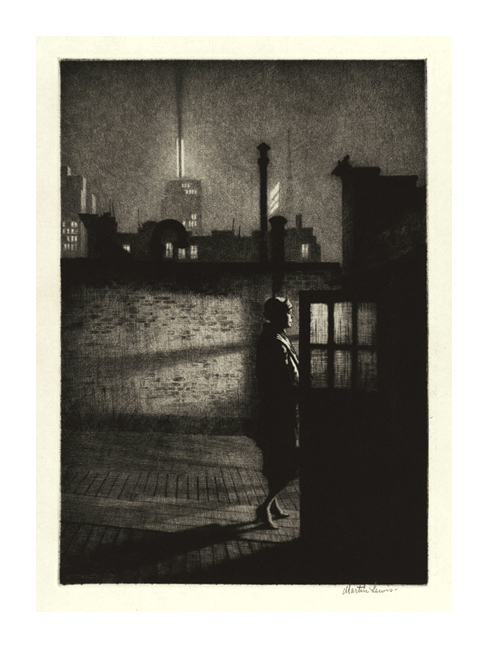
The WPA's preference for the figurative is disappointing. For me, the figurative prints that work best in the exhibition are those which suggest a mystery, whether its a wider, undisclosed story in the works of Edward Hopper and Martin Lewis or the terrifying enigmas of John Ward McClellan. Untutored audiences can respond to "difficult" abstraction - even the drip paintings of Jackson Pollock - so long as they aren't intimidated by overly obscure notes and allowed to experience their own responses.

My personal favourites in the exhibition were a sequence of plates with text by Louise Bourgeois with the title "He Disappeared into Complete Silence." The text heightens the mystery of the illustrations. There's a book, apparently, but it's out of stock at Amazon. One day, perhaps, it will return. Perhaps it will re-appear in time for Christmas. Or perhaps it's disappeared forever, as mysteriously as the tales it nearly tells.

Saturday, 14 February 2009

Friday the thirteenth


Going to Nottingham has become a kind of memory test: which shop was where? I play a gloomy game of prediction too: which will be the next shop to fail? There are plenty of shops still standing but they're emptier than they were and even in Primark people browse and deliberate over the quality of goods.

I was headed to a bookshop to collect a book for a friend but browsed a little on my way. I didn't buy anything though later I had a half of Marston's Pedigree (50p) and a freshly-baked pretzel (75p) to supplement the apple I had brought with me. I'm turning into a virtuoso credit-crunch shopper.

I was also in search of happenings. An announcement at fencing alerted me to Light Night and it sounded fun, though the information on the web was hard to follow. There would be lights, sounds and activities - well, you can usually find those in Nottingham on a Friday night. Presumably there would be something extra that I might like seeing - and I could also support friends from my fencing club who were demonstrating epee and sabre on the cold flagstones of the Exchange Arcade.

The evening began slightly before the billed opening at 6.00. as school musicians began to play and the Council House was luminously strange in a sequence of bright and acid colours. I watched the changing lights for a while, then was drawn a little out of the square towards the Brian Clough statue. I don't know what Brian would have made of his pale green, glow-in-the-dark jumper but I suspect he'd have liked the attention he was receiving.

The streets around the Old Market Square were illuminated by tall, slender, pyramidal lanterns. I think they had been decorated in schools and libraries. I walked away from the noise towards Hockley and the Lacemarket. It's a slightly offbeat area and every so often I'm beguiled by something unexpected. On Light Night, it was the hula hoop dancer with glowing hula hoops and the juggler tossing luminous clubs high in the air. They were outside the shop that sells juggling equipment and magic equipment but for all I know they later roamed the streets. Nottingham was a magical, unlikely place where brides on stilts might appear round a corner, a robot danced and sprayed crowds with a water pistol and a blue, lit-up wheelie bin called Sid terrorised pedestrian by ... doing wheelies, of course.

Fencing in the city's poshest shopping centre - below the Council House - made perfect sense on a night like this. Crowds flocked to wonder at the speed and skill on display - and perhaps to fantasise about d'Artagnan or, of course, Robin Hood. People asked the usual questions: "are the swords sharp?" and "what are the strongs for?" (the strings were the wires that connected the fencers to the electric score box). I watched for a while, applauding points and inwardly cheering my friends.

Then I began to wander further - to St Mary's in the Lacemarket. I pushed open the door and found the late mediaeval space lit mostly by clustered candles. Their light wavered fragilely amid the deep shadows. There was a fragile music too - chords that filled the air, then faded into silence. And above the altar a black and white film of a smiling boy running on a bridge flickered into life, then died. It took a while for me to realise that the sounds and film were being produced by a typewriter and that visitors to the church were invited to type on it in response to the question, "What gives you hope?" This was the typophonium. Small children and adults queued in wonder. I queued too and noted that the clatter of typewriter keys stopped me from hearing the chords or seeing the film.

Eventually I headed back towards the train station but paused at the Congregational Hall where there was a music and film installation by Streetwise Opera and Mira Calix. My Secret Heart was projected on a huge oval at the centre of the church. I watched and wondered for a while. I knew the work was based on Allegri's Miserere and knew it was strange and beautiful and that was all. As I left, the film was still running.

Many of the wonders I'd seen would scare people if placed in a gallery and labelled "art." But on Light Night people thronged the streets, their minds open to novelty and wonder. There were no worries that reverence was required. Instead we all displayed that capacity to marvel that is regularly evoked at circuses, pantomimes and football matches.

I walked past a street sign promising "Biscuits for 800 metres." There may have been biscuits. I didn't check. By the Broadmarsh Centre, great signs in vacant shops offered "wonderful retail opportunities." But that suggestion required more imagination than I possess. I hurried on past.

Thursday, 11 December 2008

The brave people of Sark


There has been an election on the small island of Sark. The Barclay brothers, who own a number of businesses on the island insisted. The Barclay brothers are billionaires who own a number of businesses on Sark as well as a nearby island. They cast themselves as the defenders of democracy.

Shortly before the vote took place, the Barclay brothers issued threats against the voters of Sark. The Barclay brothers wanted their own candidates to win. They therefore warned the voters of Sark that they would withdraw their investments, causing poverty among the islanders, if the islanders voted
in a way the Barclay brothers didn't like. This threat was published in the Daily Telegraph, which the Barclay brothers own.

The people of Sark voted for the candidates they wanted. And now the Barclay brothers have announced that they are closing all their businesses on Sark, making 100 people - a sixth of the island's population - unemployed.

The people of Sark showed that their understanding of democracy was far better than that of the Barclay brothers. They refused to be bribed or blackmailed into voting as the Barclay brothers wished.

I have occasionally bought The Daily Telegraph. As long as the Barclay brothers own it, I shall never buy it again. People who try to bribe and blackmail voters in the exercise of their democratic rights are not fit to own a newspaper.

Friday, 4 July 2008

Disqualified


I couldn't do that. I couldn't take an oath while crossing my fingers and believe that gave me an excuse to lie. That's what little children do. It's not proper for adults - certainly not for adults who become MPs and magistrates.

I'm disqualified from being either. Plenty of MPs and magistrates lie when they take the oath, or make a mental reservation that, if they had the chance, they would vote against a monarchy or call for a referendum to let the people decide.

I don't think I'd make a particularly good MP, though once I would have liked to stand for parliament. I briefly thought I could consider being a magistrate but didn't have to investigate further. I'm disqualified. If there were a referendum I would vote for a republic and that means I'm disqualified from a range of positions. I couldn't even join the police although, oddly, the Royal Navy is exempt from the oath of allegiance.

Of course, I can lobby my MP and ask him to vote for the abolition of the monarchy. But my MP was only able to take his seat after swearing allegiance to the Queen and her heirs. Moreover, even if he changed his mind and became an ardent republican, Members of Parliament aren't allowed to pass any laws affecting the Crown without the Queen's express permission.

There's criticism of royal expenses but, on the whole, the Queen is admired. I don't think republicans would win if there were a referendum to abolish the monarchy. Although I would almost certainly vote for abolition, I don't make a great deal of fuss about the matter. I have many more urgent political concerns.

Yet it irks me that I, and other honest republicans, are banned from so many posts simply because we would be unwilling to comence our public service with a public lie. It worries me that, were people to vote for an honest republican in such numbers that he or she were elected, the new MP would be banned from the House of Commons. And I'm really annoyed that MPs aren't allowed to debate this unless they first ask for the Queen's permission.

There's a simple petition on the Downing Street website which urges a change in the law. It asks that MPs and lords should no longer be required to swear allegiance to the Crown. In my opinion, it would be a good first step in making this country a proper democracy and opening public service to all who care about it. It would widen the choice for voters and put honest republicans on equal terms with those who swear dishonest oaths.

The petition closes tomorrow (5th July, 2008). It already has sufficient signatures to gain a response from the government. If you would like to sign the petition and receive that government response when the petition closes, click here. Monarchists can sign as well as republicans. The petition seeks honesty, responsibility in public life, and true democracy - that is, giving all the people the right to choose.

Tuesday, 24 June 2008


When I was much younger, I occasionally took part in Reclaim the Night marches. One of the favourite chants was "However we dress, wherever we go,/ Yes means yes and no means no." It was a simple message but objectors frequently assured me that life wasn't as simple as that because women didn't actually say what they meant. Some added that women didn't know what they wanted anyway. At the extreme end of the anti-feminist brigade were the men who would declare that women liked being raped and that Reclaim the Night marchers were angry and soured because they hadn't been.

I've been reminded of those attitudes by some of the responses to the result of the Irish referendum on the Lisbon treaty. As the politicans campaigned and debates took place, almost everyone assumed the Irish would vote Yes to the new Treaty. It was only on the eve of poll that I noted a little doubt in the commentators' voices. Then the Irish voted No. The majority was between 7 and 8 %. so there wasn't any room for doubt. Or so I thought.

Suddenly there was a string of European spokesmen (and all but one I heard were men) talking on TV and radio and to any journalists who would listen, explaining that no didn't really mean no but something else entirely. "It's not about Europe or the Lisbon treaty," one French speaker explained. "It's about the voters' attitude to the Irish government." He went on to explain that the result could therefore be disregarded or, if necessary, the Irish people could be asked to vote again and again - until they got it "right."

I don't know why the Irish people voted as they did, although they seem to have had access to a great range of relevant information, including the text of the Treaty. But their reasons for voting No don't matter. If, in an election, I chose to vote for a member of the Monster Raving Loony Party because he used my favourite brand of toothpaste, my motivation might be regarded as strange. But no-one would have the right to take my vote and re-assign it to the Green Party candidate on the grounds that the Green Party had more sensible policies. As long as I am eligible to vote, my vote should be counted. And it's not for anyone else to re-assign my vote on the grounds that I should have voted in a different way.

The Irish referendum can have only one result. The Lisbon Treaty cannot be adopted. The current rules of the European Community require all member states to endorse major changes. The Irish constitution as interpreted by the highest courts in Ireland declares that such major changes to national sovereignty can be decided only in a referendum. Spokesmen can condemn the Irish people as stupid and ungrateful (I have heard such epithets) but the pro-Europeans who use such terms betray the best ideals of the European Union. If it is to succeed, the European Union must respect the views of all nations involved. It mustn't become a community of bullies and it certainly mustn't ignore legal and democratic requirements.

Pro-Europeans should be encouraging a proper debate on what Europe is for and how it is run. A British referendum would have provided a good opportunity to explore all manner of anxieties, from the question of sovereignty to anxieties about fraudulent use of expenses. But although Britain was promised a referendum on the constitution, we were assured none was necessary for the Lisbon Treaty. Sometimes being a British voter feels like being a woman in Britain before women got the vote. I could almost hear government spokesmen saying, "Don't bother your pretty little head about that, my dear."

There are big issues to discuss about Europe and everyone should be encouraged to think them through. When the constitution was debated - and rejected in France and the Netherlands - I learnt about issues that weren't discussed in the British press, so far as I could see. There were debates on the possible effects of a free market in Labour - would it kill off the minimum wage? And questions were raised about the role of the European Central Bank, which was to have the status of a nation and a right of veto over legislation.

Being pro-European isn't a coherent political position on its own. Pro-Europeans have to say what kind of Europe they support, how it will be achieved and how the dangers of a united Europe can be avoided. A united Europe may be dangerous. While it could have the strength to stand up to other super-powers, world super-powers have often been a force for bad.

For a few days it seemed as though the Irish vote might be disregarded or that Ireland would be sidelined by other countries. Then the Czech president said that the Irish vote must be respected and the Treaty could not be ratified.

I don't know what happens next. But a sensible, thoughtful and well-informed debate on Europe is overdue. If we need a new Treaty or Constitution, we'd better all think and vote on it - and accept what the voters in each nation say, even if we don't agree.


Note: Computer problems and lack of time prevented me assembling the range of links I would have liked for this post.

Sunday, 15 June 2008

"like a dead man"


Just at the moment, I'm unable to post as frequently as I would wish. But I ask anyone visiting my blog to read Mark Haddon's article in today's Observer in full. He's writing about the treatment of refugees in Britain. I thought I knew enough about this subject, but his account of human beings denied life-saving medical treatment, parents and children forbidden from meeting, and brutal deportation procedures makes me feel sick and angry. And that's before I think of human beings who have been raped and tortured condemned to destitution in Britain. They are punished because they believed Britain's favourite myth of itself - that Britain cares about freedom and democracy, and defends the oppressed and persecuted.

Refugee Week starts tomorrow. There are events all over the United Kingdom. It's a good opportunity to find out the truth behind the headlines. You can find local events on-line - and there may be programmes in public libraries.

The picture shows Yarl's Wood Detention centre. In the last year for which figures are available, 1,160 children were imprisoned there. They had not committed any crime. 116 were imprisoned for more than 28 days. Because they are asylum seekers, they aren't protected by the same laws as the rest of us.

The video below illustrates one contribution made by asylum seekers to this country: the Amadeus Quartet plays Beethoven (part of the 16th string quartet).


Thursday, 12 June 2008

Freedom


Freedom has had a bad press lately. There was Operation Enduring Freedom, which turned out to be nothing of the kind. And there have been numerous statements from politicians throughout the west, declaring that the bedrock of freedom is free market economics. These are often made by the same politicians who proclaim that physical safety is the most important civil liberty.

But when I heard David Davis's speech resigning from the House of Commons to prompt a by-election, I was moved. He spoke about questions of freedom that have worried me for some time. He spoke of last night's vote to extend detention without trial to 42 days. He spoke of the growth of the surveillance society: the extension of CCTV cameras and the effect of ID cards, the threat to trial by jury and the prevention of peaceful protest.

Nu-Labour supporters hurried to attack David Davis, condemning his decisions as "expensive" and describing him as "unhinged." He sounded pretty sane to me. Of course, he may seem unhinged by Nu-Labour standards - ideas about democracy and civil liberties may seem pretty strange in an organisation that's apparently obsessed by micro-management and control.

I couldn't help noticing that David Davis undermines one of the arguments often advanced by Nu-Labour MPs: that the defence of freedom is a cause only supported by a comfortable, middle-class minority who don't know what poverty or "real life" is. David Davis and I have one thing in common: we both spent much of our childhood on Wandsworth council estates. He probably had a harder time than I did.

On many other questions I disagree strongly with David Davis. I have never voted Conservative. I strongly oppose some of the positions he has taken on law and order. In particular, I'm against capital punishment, which he supports. But I think the question of freedom that David Davis has raised is so very important that, if I were one of his constituents in Haltemprice and Howden, I'd vote for him. I might even campaign for him - on this issue alone.

I never thought I'd say that of a tory MP.