I have seen Svengali and I was afraid.I could just about cope with seeing him on stage, though in the small space of the Finborough that meant that, at times, I could have reached out to touch him – but who would dare to touch Svengali? But seeing Svengali in the bar afterwards, drinking Leffe and smiling in my direction …. that was scary.I treated myself to two shows in London – an afternoon and evening out while visiting my parents. The first I booked for was Trilby. It's a long time since I read the novel but the thought of a late Victorian melodrama for Christmas was enticing. I enjoy shows that provoke thought and reflection but I also love to be caught up in events, to laugh and to feel a shiver down my spine.On one level, it's impossible to take Trilby seriously. It purports to reinforce the virtues of manly Englishness but, although the actors deliver lines like “You must bear it like a man” with the necessary conviction, the audience can't take them quite seriously. The three would-be artists who share a Paris studio are endearing and appeal, like the cultural references, to the audience's sense of superiority. But the studio setting, however comic and delightful, is merely the background against which the relationship between Trilby, the artists' model, and Svengali, the dangerous oustider, is played out.In theory, the story of Svengali and Trilby should be regarded with caution. Trilby is poor, charming and generous – her only ambition is to care for Little Billee, the diminutive artist whose respectable family warn her that their marriage represents ruin. As for Svengali, the East European Jew who craves power, wealth and adoration, and achieves all three through his mesmeric powers – he could easily seem no more than an anti-semitic fantasy.But in David Cottis's production, the audience falls victim to the fascination of both Rebecca Brewer's delightfully Bohemian Trilby and the unblinking stare of Jack Klaff's Svengali, who in one instant assumes the fawning posture of a beggar only to dismiss his landlady and generous neighbours as “pig-dogs” in a venemously angry aside. The artists, whose English sense of superiority includes contemptuous xenophobia, are never as interesting as the man they despise. They are also little more than tourists in the Latin Quarter where Trilby and Svengali are so engagingly at home. The production also includes a brief scene in which Svengali, fearing death, identifies himself as a bad Jew, atypical of his race and religion.The cast worked so well together that it's hard to single out any of the other actors. However I liked Jon Shaw's concerned and loyal Taffy and laughed a great deal at the prurience of Christopher Morgan's Rev. Bagot, justifying his pleasure in the nude drawings in the studio as specimens of “the antique.” Congratulations are also due to the artist whose work decorated the set.It should have been enough to see Trilby but I reasoned that I could have a whole day at the theatre and see Quality Street as well. I couldn't resist seeing the play that inspired the chocolates, even though I've boycotted Nestlé for years.This is the fifth play by J.M. Barrie I've seen. I've observed that they shine in performance. I'm also fascinated by his treatment of class (mostly servants) and how this is connected with ideas of self-deception and masquerade.Quality Street seems to be about the virtues of ladylike behaviour and women's quiet strength and endurance. But other questions keep surfacing: the double standards applied to the behaviour or mistress and servant; the barely-suppressed desires of women for men and the financial stability they represent; the bad behaviour of English soldiers in war; and the maimed men who return home. Phoebe (charmingly played by Claire Redcliffe) may be the play's embodiment of strong and long-suffering female virtue but she is implicated in dishonesty from the first scene of the play. First she pretends to exert power over her servant and then, in a telling exchange with the Recruiting Sergeant, refuses to accept that English soldiers join the army to sack, to loot and even, it is implied, to rape. Patty, the servant, wonderfully played by Catherine Harvey, seems to know all this. She is the real power in the household, though she too would like to escape into the security of marriage, reasoning that her chance may come with the returning soldiers who will need wives to take off and put on their wooden legs.Louise Hill's delightful production sensibly plays down these elements, allowing the audience to revel in the comedy and frothy sweetness. The play is superficially reassuring, suggesting that England is at its best as a place of ladylike deception. But Quality Street has the synthetic sweetness of strawberry cremes – delicious at first but with a disturbingly metallic aftertaste.I recommend the Finborough to everyone but hope that there isn't too big a rush to this tiny theatre -I'd hate to find a show sold out next time I try to book.
 I was looking for Samuel Beckett. He was hard to find. Instead I stumbled across Serge Gainsbourg.
I'm never sure what to make of Gainsbourg. The recent film, which didn't aim at accuracy, deepened my ambivalence - and reminded me how erotic "Je t'aime ... moi non plus" is. So I stopped at Gainsbourg's grave.
I was in the Montparnasse cemetery. I hadn't meant to visit but, as I drifted round the 14th, that was where my feet took me.
The Cimetiere de Montparnasse not a tourist haunt in the way Pere Lachaise is. No-one was hawking pictures of the graves or plans of the cemetery. However there were casual and dedicated strollers as well as the mourners who came to place flowers on family graves. I was pleased to find a helpful plan of which graves were where although that didn't always make them easy to find.
Gainsbourg's grave was plainly a place of pilgrimage. There were flowers, photos, a packet of Gitanes and a colourful selection of cigarette lighters. As I watched, a young couple standing by the grave rolled cigarettes in silence and solemnly lit up. Whatever else he may have been, Gainsbourg has become the patron saint of smokers.
I've been anti-smoking for as long as I can remember. I recall my father's serious illness when I was six. As he was too ill to be moved, hospital staff brought equipment - including, I think, a portable x-ray machine - to the flat where we lived. As he recovered he was warned to give up smoking and struggled for years to overcome the addiction. Now, in his late 80s, he can't stand the stench of cigarette smoke.
But when I watched the young couple, I saw their cigarettes as a form of protest against a controlling state - and that too seemed admirable. France has a history of resistance which is the ground of the national belief in liberty, equality and fraternity. That belief is at the heart of protests from left and right against the forced deportations of "les Roms", the Roma who have travelled from eastern and central Europe, as allowed by law. Some deportations have been stopped by the courts - the grounds can be as slender as finding smoking in public which is not, the tribunal found, a serious public order offence - but many families, seeing their children scared by early-morning police raids, have simply agreed to leave, taking the very small amount of money the French state will pay as inducement or compensation.
It's easy to look away when a small group is under attack. Paris has numerous plaques to remind residents and visitors of the round-ups and deportations carried out by French police during the Occupation - and these are often cited as a reason to oppose the deportation of "les Roms". There's even a plaque commemorating the 1961 police massacre of Algerian protesters, although the French seem less comfortable considering the implications of that episode.
As a tourist I was observing and doing nothing. I strolled round the cemetery contemplating past injustice and resistance.
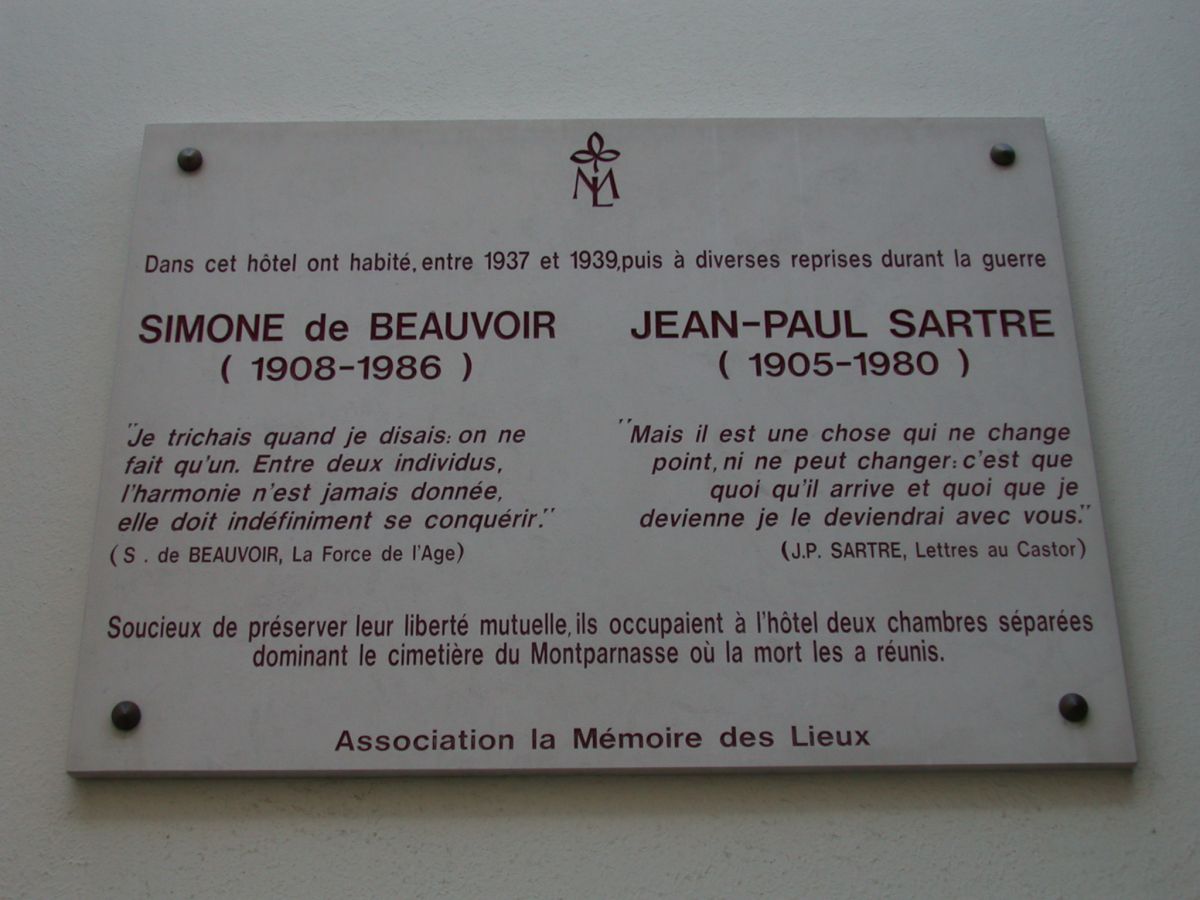
I chanced on the grave of Dreyfus, who sparked Zola's famous letter "J'accuse" and a huge campaign of resistance. I saw where Sartre and de Beauvoir were together in death, though forced to occupy separate hotel rooms in life, as a plaque on the Hotel Mistral recounts. They were forced by events to make difficult choices and their messy, muddled lives remind me that political involvement can't be limited to those whose lives are above reproach.
As the cemetery was closing, I made another attempt to find Beckett, who chose to stay in occupied France (though he could have escaped to neutral Ireland) and was awarded the Médaille de la Résistance and the Croix de Guerre for his activities. He didn't talk much about what he did but I wanted to pay tribute to his courage and reported kindness as well as his plays.
At last I found the grave, thanks to a shabbily-dressed and unshaven man who stood contemplating it. As I paused, the man turned to me. "Samuel Beckett," he said. "En attendant Godot."
I made a slightly stumbling attempt to explain why I thought Beckett a great man, trying to recall the French titles he gave his works when he first wrote them. But the man wasn't listening. "En attendant Godot," he repeated. "Samuel Beckett. En attendant Godot."
Then he bent down and began to clear the blossoms which had obscured the names of Beckett and his partner Suzanne.
I'm not sure what he meant to say. Was he just naming Beckett's most famous work? Was he telling me that in death too Beckett was "waiting for Godot." Or was he himself Godot, arrived too late and tenderly clearing the playwright's tomb?

 The children stayed up to mark the moment when 1999 slipped into 2000. I think we toasted the new millennium. There was a crash of fireworks and a splatter of colour in the sky. Then came the sound of people laughing and singing. I opened the door and saw a dancing procession of neighbours and friends doing the conga round our cul-de-sac. We left the door open and joined in. Suddenly it seemed that the future could be filled with trust and friendship.Before that, we'd been watching the celebrations from the new Millennium Dome and flashes from around the world. I recall Tuvalu, Sydney and Paris. I remember little of Britain's Millennium celebration. Tony Blair and his family were there, still glossy with the people's love and trust. I noted that, of all the celebrations shown from all over the world, ours was the only one with a guest list and entrance fee - others were free and open to the public. George Carey as archbishop of Canterbury had insisted on a Christian element to the event. He was a late addition to the programme and was squeezed in long before midnight. He stood in the centre of the vast dome and the words of the Lord's prayer echoed emptily. The audience seemed rightly embarrassed - religion was out of place in this monument to commercial sponsorship.At some point before going to bed, I rang my brother in Canada. "This is the voice of the next millennium," I declared. Looking back on the 20th century, it seemed possible that I'd reached a better time. The Berlin Wall had come down, apartheid had ended and it still seemed possible that the divisiveness and hatreds of Thatcherism would be pushed back. The afterglow of the 1997 election still shed a little light, even though I hadn't brought myself to vote New Labour. I mistrusted the surface shimmer and worried about the number of times Blair urged the voters, "Trust me." Honest people rarely insist that they tell the truth - they simply speak.On the morning of 1st January 2000, hope persisted. Nations and people could work together. If we couldn't save Tuvalu from global warming, surely we'd welcome its dispossessed people. Perhaps as a world we could learn to love the stranger, just as the dancers in the streets welcomed all comers, regardless of origin or ability. I chose to take the conga as my symbol of the millennium rather than that exclusive, expensive party in London which I'd watched at a distance through the glass of my TV screen.I don't know when hope dispersed.I'm not sure it's possible to recover that hope. But the people I meet are so much better than party politicians, gearing up for the election, suggest. There's much more to human beings than the hatred of strangers and blind pursuit of personal profit.I don't think I'll be able to celebrate the new decade. But, when midnight tolls, if I'm still up, I'll toast it with a small glass of Jura malt, hoping for hope in 2010.