I was looking for Samuel Beckett. He was hard to find. Instead I stumbled across Serge Gainsbourg.
I'm never sure what to make of Gainsbourg. The recent film, which didn't aim at accuracy, deepened my ambivalence - and reminded me how erotic "Je t'aime ... moi non plus" is. So I stopped at Gainsbourg's grave.
I was in the Montparnasse cemetery. I hadn't meant to visit but, as I drifted round the 14th, that was where my feet took me.
The Cimetiere de Montparnasse not a tourist haunt in the way Pere Lachaise is. No-one was hawking pictures of the graves or plans of the cemetery. However there were casual and dedicated strollers as well as the mourners who came to place flowers on family graves. I was pleased to find a helpful plan of which graves were where although that didn't always make them easy to find.
Gainsbourg's grave was plainly a place of pilgrimage. There were flowers, photos, a packet of Gitanes and a colourful selection of cigarette lighters. As I watched, a young couple standing by the grave rolled cigarettes in silence and solemnly lit up. Whatever else he may have been, Gainsbourg has become the patron saint of smokers.
I've been anti-smoking for as long as I can remember. I recall my father's serious illness when I was six. As he was too ill to be moved, hospital staff brought equipment - including, I think, a portable x-ray machine - to the flat where we lived. As he recovered he was warned to give up smoking and struggled for years to overcome the addiction. Now, in his late 80s, he can't stand the stench of cigarette smoke.
But when I watched the young couple, I saw their cigarettes as a form of protest against a controlling state - and that too seemed admirable. France has a history of resistance which is the ground of the national belief in liberty, equality and fraternity. That belief is at the heart of protests from left and right against the forced deportations of "les Roms", the Roma who have travelled from eastern and central Europe, as allowed by law. Some deportations have been stopped by the courts - the grounds can be as slender as finding smoking in public which is not, the tribunal found, a serious public order offence - but many families, seeing their children scared by early-morning police raids, have simply agreed to leave, taking the very small amount of money the French state will pay as inducement or compensation.
It's easy to look away when a small group is under attack. Paris has numerous plaques to remind residents and visitors of the round-ups and deportations carried out by French police during the Occupation - and these are often cited as a reason to oppose the deportation of "les Roms". There's even a plaque commemorating the 1961 police massacre of Algerian protesters, although the French seem less comfortable considering the implications of that episode.
As a tourist I was observing and doing nothing. I strolled round the cemetery contemplating past injustice and resistance.
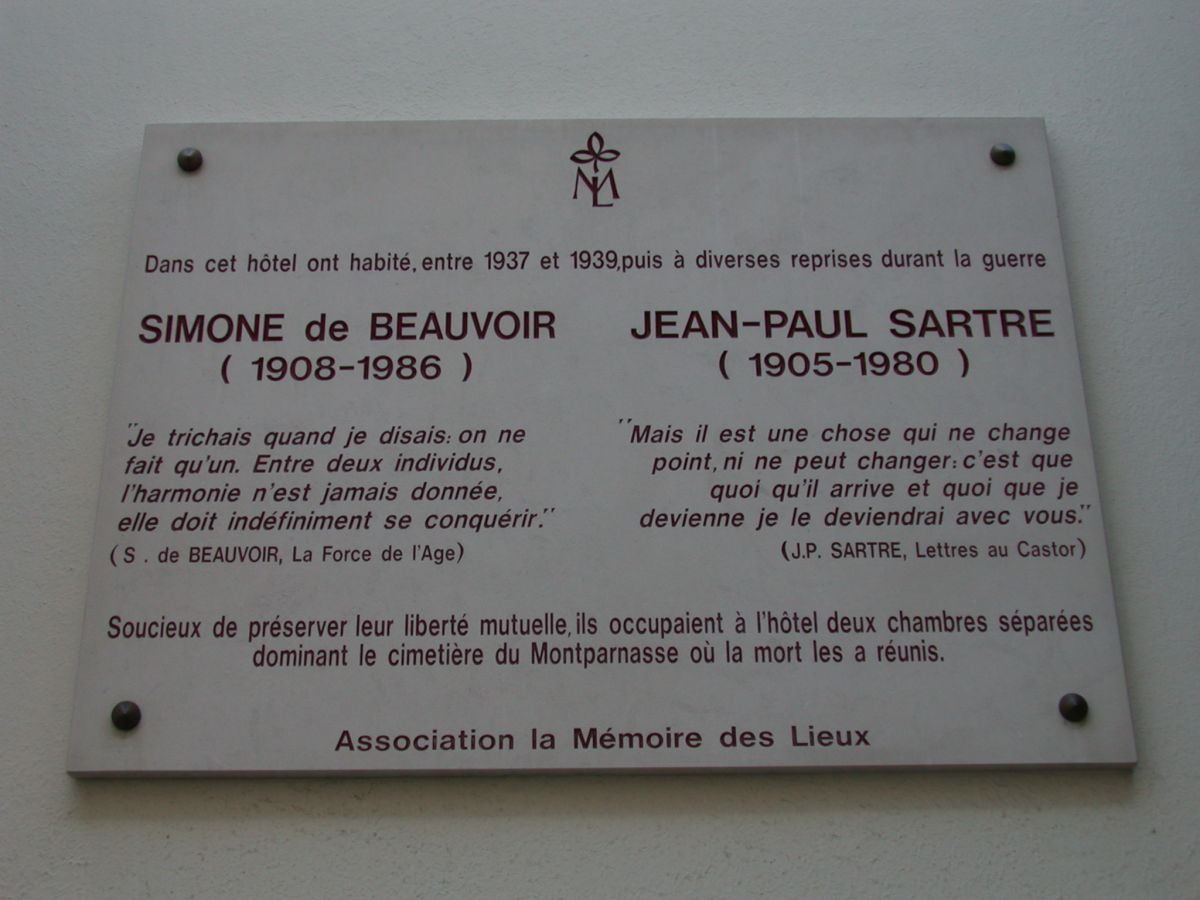
I chanced on the grave of Dreyfus, who sparked Zola's famous letter "J'accuse" and a huge campaign of resistance. I saw where Sartre and de Beauvoir were together in death, though forced to occupy separate hotel rooms in life, as a plaque on the Hotel Mistral recounts. They were forced by events to make difficult choices and their messy, muddled lives remind me that political involvement can't be limited to those whose lives are above reproach.
As the cemetery was closing, I made another attempt to find Beckett, who chose to stay in occupied France (though he could have escaped to neutral Ireland) and was awarded the Médaille de la Résistance and the Croix de Guerre for his activities. He didn't talk much about what he did but I wanted to pay tribute to his courage and reported kindness as well as his plays.
At last I found the grave, thanks to a shabbily-dressed and unshaven man who stood contemplating it. As I paused, the man turned to me. "Samuel Beckett," he said. "En attendant Godot."
I made a slightly stumbling attempt to explain why I thought Beckett a great man, trying to recall the French titles he gave his works when he first wrote them. But the man wasn't listening. "En attendant Godot," he repeated. "Samuel Beckett. En attendant Godot."
Then he bent down and began to clear the blossoms which had obscured the names of Beckett and his partner Suzanne.
I'm not sure what he meant to say. Was he just naming Beckett's most famous work? Was he telling me that in death too Beckett was "waiting for Godot." Or was he himself Godot, arrived too late and tenderly clearing the playwright's tomb?