Even some portraits are made for time-consuming adoration. These are usually pictures of the powerful, commissioned to demonstrate their finery as well as their faces. But the poor as well as the rich can seem in control of their images. Murillo's street urchins often display the confidence of the young and free. Even Goya's Maja, clothed or naked, seems in control of how we see her – as does Lucian Freud's model Sue Tilley, the Benefits Supervisor.
Elsewhere the subjects of paintings see less happy with the viewer's gaze. There are nudes by Titian whose lowered or averted eyes can cause discomfort. And I can never look at portraits or even staged domestic interiors by Vermeer for long. The framing of the paintings always brings me slightly too close – I'm forced into the scene like an intruder, as I am.
This history of looking was at the back of my mind as I dithered in the entrance hall of Tate Modern. I couldn't make up my mind about the new exhibition. Not only was the entrance ticket £10 – very high by East Midlands standards, especially for a show of photographs and videos – but the subject itself made me wonder whether I ought to look. The exhibition is called Exposed and the material it shows is grouped around themes of voyeurism and surveillance.
At first I decided I wouldn't look. I'd taken the long escalator to the third floor when I changed my mind and returned to the entrance. The escalator journey felt too much like running away.
There was, of course, something uncomfortable about so many photos grouped around such a theme. Few of them on their own would have sparked such concern even though some areas were banned to under-eighteens because of their sexual subject.
But sex and violence are too familiar to shock. Even the napalm picture, with the running, naked girl (her clothes burnt off) in a world beyond fear and pain, has been reproduced so often that I'm now immune to the horror. I was more moved by the photo of Jackie Kennedy with the new president Johnson and his wife. She seemed numbly vulnerable as she took on the unfamiliar role of presidential widow – beyond comfort and open to the camera's exploitation.
Elsewhere too the camera's glance was surreptitiously controlling. I was disturbed by Walker Evans' pictures of travellers on the New York subway, some tired at the end of the day and enjoying private rest in the carriage's public space. The photos were taken, before the Second World War, with a camera concealed in a coat-sleeve so that no-one could object. All the subjects must be dead by now. For all I know they would have liked the idea that gallery visitors would pay the unbelievable sum of £10 to see their faces – it's a kind of immortality.
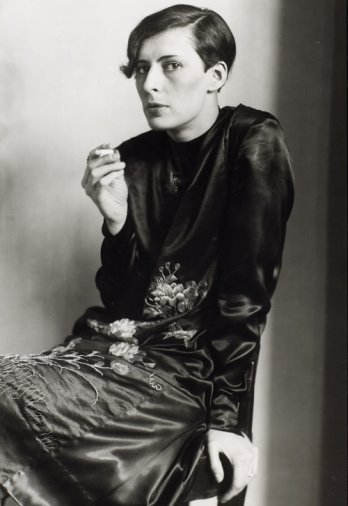
Having seen the subway photos, I was initially suspicious of the work of August Sander as he posed and classified “types” - by profession, disability, social status – in his project to document the layers of German society. But as I looked at the individuals he photographed with such care, I warmed to him. The pictures seemed to be the product of a kind of negotiation between photographer and subject. Most of them gazed back at the photographer with the confidence of people who had chosen their pose. There were exceptions of course: the boy labelled “idiot” or the blind girls, sitting together at a school desk. They were photographed in the mid 1920s and despite the labels the children appeared individuals. I wondered what happened to them after the Nazis came to power. Sander's sympathetic categorisation reminded me of the Nazis' brutal hierarchy of types. Yet the Nazis disapproved of Sander's project. His son Erich, a socialist, was imprisoned in the early days of the Nazi regime. After many years, Erich died in prison. Sander photographed his son's death mask.
Of course the exhibition disturbed – it was meant to. But it was far less disturbing than the film I saw two days before, Renzo Martens' Episode 3: Enjoy Poverty.
Martens' film explores poverty in the Congo – the sort of daily, agonising poverty that causes children to die painfully of slow starvation. But it's not like the kind of TV documentary that ends with an appeal to send money, offering the comforting, self-congratulatory reflection that we in the west are nice, charitable people. This begins with a man in the Congo complaining about poverty as he works and angrily showing his small daughter's sores – a result of malnutrition.
At first the film seems a tourist's journey through poverty in which Martens' occasional efforts to understand what he sees don't measure up to the reality. He seems too innocent, too polite. But the guns of the U.N. peacekeepers disturb as do the sharp suits of the wealthy.
But it's easier to look at the powerful than the underpaid workers whose children die so that people like me can buy goods cheaply. And then there's the war and the photo-journalists who follow war and starvation, looking for a scoop. They cluster together with their expensive, heavy cameras, each trying to find the best lighting and angle for a picture of a corpse. The going rate for a publishable picture is $50, on top of the travel and expenses already paid to the photographers. Martens, playing the innocent, asks a photographer a series of questions. Who owns the picture? Do the people in it – or the relatives of the corpse - earn money from it? What pictures sell?
Of course, it's the photographer who profits. The poor children, who aid workers strip and arrange for the camera, get nothing. So Martens reaches his conclusion. Congo has few assets apart from poverty. If the people of Congo are to profit, they must learn to exploit their own poverty. He finds two Congolese photographers, making a small living from pictures of festivals, birthdays and weddings, and urges them to change their subject, telling them that the highest profits come from photographing the dead and injured, raped women and starving children. I'm used to seeing such pictures but I've never before had to sit uncomfortably still while the subject's pose is adjusted and the photographer closes in for the most affecting and aesthetic angle.
There were questions and answers after the film. Martens insisted his work changed nothing – it was art, not politics. But he made a telling comparison with Jonathan Swift's “Modest Proposal,” identifying the film as satire based on a horrible truth. And he said there would be no change because there was no will to change. The people in Congo thought that if those on the outside saw what was happening, they would act – they would not allow such suffering to continue. But there is no outside – we're all in the same world and those of us with power to act do nothing because we benefit from the same system.
Meanwhile, for reasons we cannot bring ourselves to comprehend, pictures of pain and suffering are bought in the west as though they were things of beauty. And the sufferers get nothing for them.
Snow isn't a problem here - we could cope with a few more inches. The problem is the cold. As people walk in the snow, or as cars drive on the less-travelled roads, the snow turns to slush. Then it refreezes. I don't need to head to an ice-rink for thrills - between home and the station I slide precariously every few yards. My new technique for walking involves checking for crisp, snowy patches and cluching at walls, fences, lamp-posts and railings. What was usually a walk of less than ten minutes required concentration. balance and quick reactions. As my feet slid away from me, I bent my legs and caught hold of the railing, pleased to have avoided a serious tumble.
I was determined to have a day out. I'd booked leave - I'd told my friends I would do something special, even if my ambition had shrunk to a china boot filled with gluhwein and a visit to the exhibition at Nottingham Castle. I was feeling good about it. If nothing else worked out, I could always settle down in a warm café with Les Misérables.
I rang the castle in advance. The man who answered assured me that it was open and, more importantly, that the steep path up Castle Mound was well-gritted. He didn't mention that the steep pavements in the way to Castle Mound were glazed with ice and compacted snow. I staggered and slithered uphill, looking anxiously at the other tottering pedestrians who seemed more practised at walking on ice. Somehow I didn't topple down the slope but, carefully taking small steps, passed the Robin Hood statue and reached the castle gate. At last there were clear paths. I walked up the slope, delighting in the sight of the black branches above the snowy bandstand; the small, cold Christmas tree and even two or three warmly-wrapped children playing in chill of the white playground.
Perhaps an exhibition of art inspired by prisons and surveillance wouldn't have been everyone's choice for a day out but it suited my mood - and my sense of questions that matter in Britain today. I walked up the stairs inside the castle and into the exhibition. The first two exhibits are probably the ones that will stay longest with me. Louise Bourgeois's "Cell (Eyes and Mirrors)" may not comment on wider social and political questions in any obvious ways but it evokes the horror of being imprisoned and watched. It seems right that this horror should provide the basis of any political consideration of prison and surveillance - surely horror is the natural reaction to both.
I don't always spend long in video installations but I caught Manu Luksch's Faceless shortly after it had started and stayed nearly fifty minutes till the end. The film consists entirely of CCTV images, following rules set out in a manifesto. CCTV has also inspired the story of the film, which is told in a voice-over by Tilda Swinton. Again, the film isn't a direct comment on contemporary life - it's set in a future envisioned according to the CCTV trail each of us leaves every day. I emerged disturbed and impressed by the way blurrily familiar CCTV film had been turned into narrative with actors and choreographed dancers performing amid passers by for the mechanical gaze of the cameras.
I blinked as I emerged from the viewing booth and caught sight of the "Millbank Penitentiary" a model by Langlands and Bell of a now-demolished panoptical prison. The idea of the pantopticon was originated by Jeremy Bentham. It envisaged prisoners kept in separate cells, never seeing their fellow inmates but believing that they were watched at all times. A modified version has influenced prison design for many years. Bentham thought up the design as a benevolent model that would achieve reform of the prisoners. When developed to the extremes of Bentham's vision, many prisoners went mad.
I wandered into the next room. The gallery was empty apart from me, the attendant and a man leaning over a computer at a desk. I smiled at the attendant as I passed him and began to concentrate on the exhibits.
First I gazed at a history of imprisonment and death in Nottingham Castle. The past seemed to blend into present as I saw the orange jumpsuits in a nearby photo.
Then my attention was caught by what looked like Lego boxes opened up and spread out on the wall. Looking closely, I realised the scenes involved black-clad armed guards herding, beating and executing white skeletons. The notice beside gave the title and artist: "Concentration Camp Series" by Zbigniew Libera. I gazed some more.
They had captured my attention more than the flayed man in the Marc Quinn sculpture though pictures of Quinn's work had drawn me to the exhibition. Christine Borland's "Air Heads" were similarly powerful but I was following a different trail of thought. I looked at the words projected on the wall ahead of me.
"LONDON REVIEW OF BOOKS," I read. "The lady with the LROB bag looks at the Lego posters." I paused and checked my bag. It's my favourite fabric bag from the London Review of Books. I was being watched and my actions were being described in large letters on the wall.
I looked round. The attendant was still sitting in the corner. The man with a computer on his desk was typing. I read an earlier entry projected on the wall. It referred to "desk man." Desk man was watching me.
I tried to forget the presence of desk man and gazed at an exhibit which invited members of the public to operate a surveillance camera. But the exhibit was enclosed in plastic - I couldn't see how this should be done and wasn't sure I wished to watch anything like that, not even plastic trees and houses. I moved on, out of sight of desk man. Looking up at the wall I saw that my uncertainty about the exhibit was now described for new visitors. I moved into a corner where I felt sure I'd be out of sight. Then I saw the joystick to move the CCTV camera. I touched it tentatively and moved it just slightly, catching a plastic house and tree in a dark noose of shadow.
A few minutes later the words on the wall said that I had touched the joystick but hadn't moved it. I stayed out of sight and was glad when a family came into the gallery. Desk man shifted his attention to them and I sidled out into a suddenly sinister collection of Victorian paintings. Every model seemed to be a victim of the artist's gaze.
I made my way down the stairs, uncertain whether desk man - or some CCTV operator - was watching my back. Then I paused in the café for an excellent macchiato and mince pie. I took out my copy of Les Misérables. Jean Valjean has eluded Javert again and is carefully staying out of sight. Reassured by a fictional past, I headed out of the castle to meet my children and enjoy a celebratory gluhwein in the Old Market Square.
Freedom has had a bad press lately. There was Operation Enduring Freedom, which turned out to be nothing of the kind. And there have been numerous statements from politicians throughout the west, declaring that the bedrock of freedom is free market economics. These are often made by the same politicians who proclaim that physical safety is the most important civil liberty.
But when I heard David Davis's speech resigning from the House of Commons to prompt a by-election, I was moved. He spoke about questions of freedom that have worried me for some time. He spoke of last night's vote to extend detention without trial to 42 days. He spoke of the growth of the surveillance society: the extension of CCTV cameras and the effect of ID cards, the threat to trial by jury and the prevention of peaceful protest.
Nu-Labour supporters hurried to attack David Davis, condemning his decisions as "expensive" and describing him as "unhinged." He sounded pretty sane to me. Of course, he may seem unhinged by Nu-Labour standards - ideas about democracy and civil liberties may seem pretty strange in an organisation that's apparently obsessed by micro-management and control.
I couldn't help noticing that David Davis undermines one of the arguments often advanced by Nu-Labour MPs: that the defence of freedom is a cause only supported by a comfortable, middle-class minority who don't know what poverty or "real life" is. David Davis and I have one thing in common: we both spent much of our childhood on Wandsworth council estates. He probably had a harder time than I did. On many other questions I disagree strongly with David Davis. I have never voted Conservative. I strongly oppose some of the positions he has taken on law and order. In particular, I'm against capital punishment, which he supports. But I think the question of freedom that David Davis has raised is so very important that, if I were one of his constituents in Haltemprice and Howden, I'd vote for him. I might even campaign for him - on this issue alone.
Writer, former Creative Writing tutor who quit in order to write and escape stress. Quaker, concerned with equality and truth. Currently socially distant, usually more approachable.