Showing posts with label history. Show all posts

Sunday, 4 November 2012

The satyr dances

I don't feel comfortable in Piccadilly.  It's the province of the rich, who can afford its casual extravagances.  Suited and cloaked doormen - they are always men - stand at the entrances of buildings.  I would be reluctant to risk their contempt.  In Piccadilly, Fortnum and Mason's is mid-range while Pret-a-Manger is dangerously down-market.

It's partly my uneasiness with Piccadilly that keeps me away from the Royal Academy exhibitions, and partly the high cost of admission.  It's expensive even with an Art Fund card.  But when I saw the picture of the dancing satyr, I knew I had to brave Piccadilly, pay the admission price and see the exhibition in which he appeared.  It's called "Bronze" and bronze is the linking motif between all the exhibits.  It's about the material and its qualities rather than a period of history or changes in ideas.  Its focus is what stays the same.

 It's not just the material that is a constant in the exhibition.  There was also a repeated response to it from numerous visitors throughout the exhibition.  The gasps of awed admiration began as visitors opened the door to the exhibition and saw the first piece: the dancing satyr, in a room by himself.

The satyr is a recent discovery, found by fishermen in the sea off Sicily only fifteen years ago.  He's slightly larger than life-size and displayed so that viewers have to look up to him.  After his long immersion in salt-water, he's acquired a greenish patina and a slight roughness.  This only seems to aid the satyr's fluid movement.  It's as though his ecstatic dance continued without pause, whether he moved through air or water.  There's a smoothness about the curve of the limbs and body that made me want to reach out and touch him - but the flung-back head and the blank eyes speak of possession and tell the watcher to keep a distance.

So awe was there at the beginning and it continued.  There are massive statues: of saints, statesmen and peasants.  There is even Rodin's Age of Bronze which conveys uses the material to convey masculinity - or perhaps masculinity to convey the material.  There are tiny works.  Perhaps the most disturbing are the tiny copulating grasshoppers, whose image was cast by encasing them in molten metal.  There are gods and domestic objects.  Men ride horses, and panthers, battle monsters,  suffer agonies of torture or gaze sternly on the world.

Women are less in evidence.  There are goddesses and rulers; a stern and prickly Catherine de Medici, showing off the fashion of the day, is particularly memorable.  There are grief-stricken madonnas and a wonderful South Indian sculpture of the infant Krishna with his wet-nurse Mukhara.  And there are objects of desire - often small pieces presumably intended for private collectors.  Venus (naked, of course) removes a thorn from her foot, a satyr uncovers a sleeping nymph and, in another piece, a satyr and nymph are engaged in enthusiastic sexual intimacy.  It's a mark of the exhibition's focus on the craft of casting that my first thought on seeing this explicit and detailed piece was awe at the skill involved in creating so fragile a scenario in bronze.  Most of the workers in bronze have traditionally been men, so far as we can tell, but two twentieth-century pieces by women sculptors had a considerable impact: a large Louise Bourgeois spider mounted high on the wall and a curved abstract piece by Barbara Hepworth, which seemed to echo the sea evoked in the dancing satyr.

It's impossible to go into detail about all that is wonderful in an exhibition so far-ranging.  The Royal Academy has borrowed pieces from many parts of the world, inviting viewers to make comparisons across cultures and time.  I found myself particularly struck by a small chariot from Denmark made of bronze and gold in the 14th century B.C.  No-one knows its purpose or why the horse is placed within the chariot rather than pulling it along.  It is tiny, delicate and magical in its incomprehensibility - and the gilding on the circle which may be a sun, a shield or a great wheel is a thing of wonder.  And, as the films shown in the exhibition display, it was probably made by one of the two main methods still in use all over the world today.

Coming away from this exhibition, I knew it had changed something in the way in which I saw the world.  It had encouraged me to make comparisons and connections across cultures.  It had helped me look at art through the materials it uses rather than just the period in which it was made.  And it showed me the flexibility of that material in conveying a huge range of emotions and evoking numerous responses.  I wondered if there was any emotion it could not show or evoke.  Then I realised what was missing from that range which included desire, ecstasy, pride, fear, admiration and awe.  A word trickled into my mind and reminded me that one emotion and response had been absence.  Maybe bronze is for every emotion, every response - except love.

Saturday, 6 October 2012

After, and before

A colleague showed us a video from youtube.  A newly-married couple came out of a church.  The camera panned along the street.  There was a brief glimpse of a young girl looking out of a window, curious to see what was happening.  She could have been any girl of 12 or 13, watching the adult world and anticipating her own future.    This young girl's life is well-documented and her diary is translated into numerous languages.  Her name was Anne Frank.  She wasn't quite sixteen years old when she died in Bergen-Belsen concentration camp.

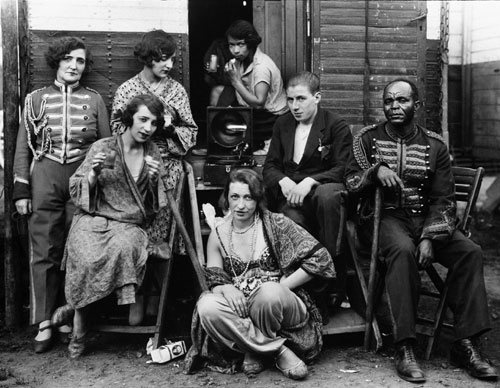
For most of the photographs of August Sander, now on display at Leicester's New Walk Museum, as part of a touring exhibition sponsored by the Art Fund, viewers can know little of how people began or ended.  Sander's initial aim was to present a study of German life, using individuals to represent different types within German society.  But however determined Sander's categorisation, the people he photographed resist being mere types.  Some perform their occupations, often surprisingly.  A farmer in the 1920s still ploughs with oxen  Another, in 1952, sows seed by hand, scattering it from a basket.  Others pose with the implements of their trade.  Almost all gaze straight into the camera, leaving the viewer with no more information that the brief labels provide.  The more I look, the more I understand the impossibility of reading a whole human being from a face.

I never have the sense that Sander's photography mocks or diminishes its subjects.  I always see them as complex, interesting human beings.  If I wish, I can build stories.  I have to set those stories in the time through which they lived.  Almost all of them were confronted by the dilemmas and persecutions of Nazism.  But when I start wondering "How did that farm-worker vote?" or "What did that woman do when the Nazis came to power?" I can't answer the questions I want to ask.  People's actions don't always harmonize with their faces.  An SS officer in one of the photos of Nazis looks benevolent and slightly unsure of himself.  His uniform does not.

I can and do make guesses.  Some of the circus people in the photo above are plainly not Aryans.  I hope they got away.  I would like to imagine a happy future for the gypsies, the children with severe disabilities, those who are simply labelled "persecuted people" or "political prisoners."  But I know most didn't get away.  The exhibition ends with a portrait of the death mask of Sander's son Erich, who died towards the end of his ten-year jail sentence.  Escapes are temporary.  None of us ever walks out of history or politics, however hard we try.  I wonder what future generations will think, if they ever look back on photographs, film and videos of the time in which we live.

August Sander didn't lead the life that was mapped out for him at childhood.  He was supposed to be a miner.  One day, working at the mine, he helped a visiting photographer and looked through the lens of a camera.  He never forgot what he saw - the sky, the movement of clouds.  That moment gave birth to one of the great photographers of the twentieth century.  He was part of his time but the records he made speak to the future.

I have paid one visit to the August Sander exhibition so far.  I hope to visit at least once a week while the exhibition is in Leicester.  I want to look more closely at many of the portraits.  I would like to commit them to memory, which is another way of letting the people of the past live on.  I also want to spend more time on Sander's pictures of human hands and of landscapes.

But I can't spend too long in the gallery with Sander's pictures.  There's too much humanity there, real people set to face a dreadful future.  

I think if I stayed too long, I would cry.

Monday, 4 April 2011

The Harrods of the ancient world


How could something so fragile last so long?

I gazed at the remains of brittle gold bowls and goblets. I could see where the stem of the goblet should be. The amazing thing is not that it has vanished but the thin, ridged bowl should have survived. I peered closer to make out the outlines of bulls on part of a bowl. A craftsman scored them gently into the gold around four thousand years ago. They are evidence of a vanished civilization of which little else is known. They come from Afghanistan.


I was hesitant about visiting the Afghan Treasures exhibition at the British Museum. I thought uncomfortably of conquerors, loot and triumphal processions. Exhibitions often arrive with an agenda, especially when they have been negotiated by diplomats. But this exhibition seems to have a gentler and more laudable cause. The British Museum has been restoring ivories that were stolen in the looting of Kabul Museum and recovered by an unnamed philanthropists. The British Museum staff have been working with the staff of Kabul Museum and the exhibition, however dependent on diplomatic goodwill and corporate sponsors, comes out of their joint work. The exhibition tells another story too – of museum staff who hid the treasures so that the history of their country could be preserved.


The history of Afghanistan is not well known. There is much that has not yet been recovered or understood. Western history books have tended to simplify the region as a place of romantic barbarism which briefly encountered civilization with the arrival of Alexander the Great. Alexander the Great, who married an Afghan wife and adopted local customs, may have viewed it differently.


So far as I can gather and recollect, the region had two reasons for importance in the world. It was a source of lapis lazuli, which was rare and much in demand. And although its terrain is difficult by contemporary vehicles, it stood on major trade routes, bordering India, China and the Persian Empire. Traders went as far as Greece and Rome, although the journey each way would have taken a year. The treasures they brought back, particularly to Begram, are protected in glass cases in the exhibition.


Captions show the uncertainty of the curators about the exhibits on view. There is a head of Silenus, clearly recognizable, but did the Afghans really know who Silenus was? Its unclear whether the owners of valuable items purchased deities or just attractive statues – rather as a modern mantlepiece may bear statues of Ganesh or the Buddha without necessarily demonstrating any religious allegiance or knowledge.


There's glass, too – Roman glass most probably or perhaps made in Egypt - the curators cannot be sure how it reached Begram from Rome since the way was blocked by war with Parthia. One piece is enamelled with full-length figures which even I can see are Roman in style. Another's delicately ornamented with vines made from the glass itself. But beside these are statues carved in turned ivory – chair-legs, the inscription suggests – each with a swaying female figure in what seems to me an Indian style. There are glass fish, a face that resembles a Greek or Chinese theatrical mask. There are Corinthian columns and finials. Some items must have been made in Afghanistan by craftsmen who had learnt skills from crafts practised elsewhere. But many items are imports, suggesting a place like Britain today where beautiful objects from all over the world can be prized and owned.


Half-way round the exhibition, I realised something else that was troubling me, though it's not unusual. I had little sense of the lives of the people who owned these objects, other than that they were very rich and could afford goods imported from far-off places. It was as if, one day far in the future, someone were to excavate Harrods and, finding only a few of the goods on show, tried to understand life today on that basis. Perhaps that is what has survived. Perhaps these expensive, traded goods represent the Harrods of the ancient world.


As I wandered through the exhibition, the past seemed both more distant and more familiar. I couldn't grasp past Afghan cultures but then, if asked, I couldn't give a simple account that took in the whole of west European culture today. Artefacts left by Afghan trading centres, which drew goods and influence from across the world, speak of a complex, varied society. This shouldn't be surprising or unusual. But I began to realise that many exhibitions treat the past as a collection of small, separate societies. They don't just assume that societies are culturally pure – they often treat cultural purity as something good in itself. The textbooks I studied at school were wary of cultural mixing. Rome's interest in things Greek was regarded with disdain although the Renaissance interest in Greek art and sculpture was excused as a means of regaining artistic purity after the confused muddle of the Middle Ages.


Looking at the wide range of objects on display and marvelling at their variety, I realised how much ancient history has been filtered through subjective and questionable value judgements. I suppose curators have to simplify – just as their displays provide the kind of neat, comforting pattern humans are trained to prefer. But in real life I like variety and complexity – and am glad that human existence resists a neatly moral narrative arc.


At last I neared the object I recognized from the posters for the exhibition: the gold crown once worn, so the captions assured me, by a nomad princess. I expected something bright and golden but I hadn't realised the tiny golden discs would tremble continuously, as though there were a breeze or breath inside the glass case. I read that the crown could be packed away and folded – and that all the nomad treasures, buried two thousand years ago, could be carried easily on horseback. In my imagination an Afghan princess rode through wild landscapes, the trembling crown on her head and a gold-studded cloak behind her. It's an improbable fantasy. I have no idea what the concept “princess” means in terms of nomadic people two thousand years ago - I wonder if the women were princesses in any way we can understand.


Little seems to be known of Afghan nomadic life beyond the six graves in Tilya Tepe. But the adornments found in the tombs of five women and one man link the items closely to the humans who wore them. It's not just the photos showing how the bodies lay when the tombs were opened or the glass case where the golden items mark out the shape of a human form. It's more to do with the sense that these items once touched living flesh and the the gold was caught on wisps of cloth the tombs were found. I peered as directed to see that the bracelets show signs of wear – in contact with an arm over time, gold diminishes.


The exhibition isn't big or cheap (I got in for half price – £5 – with my Art Fund membership). Space inside is limited because items are small and, when I visited on Saturday, that meant queuing briefly before reaching most cabinets. I haven't carried away a neat package of knowledge about an obscure culture. Instead I have grounds for wonder and wondering – more than enough.


Wednesday, 30 March 2011

Berkoff and Dionysos


Last week, I realised I'd never seen Sophocles' King Oedipus on stage.

Few people would be surprised by that, but I was. These days I don't get to the theatre as often as I'd like but I still think of myself as a theatre-goer. In the past, I've sought out obscure productions of Greek plays – in Greek as well as in English – because of the challenge they pose to today's theatre.

I'm not an expert but, when I struggled through two happy years to achieve a weak pass in Greek A-level, I supplemented my tussles with verbs and syntax with reading everything I could find on Greek history and culture. According to the curriculum, my school didn't offer Greek. Greek, like writing Latin verse, tended to be the preserve of boys' grammar and public schools. But somehow I wangled my way into Greek A-level, which was taught intensively from scratch in the Latin teacher's spare time. I've been grateful to her ever since. I was an unpromising prospect with nothing except a desire to learn to recommend me. There must have been considerable doubt whether I would pass. But the teacher – her name was Miss Blench – did her very best for me, setting plenty of work and urging me to read as much as I could. I think there were four shelves of books about Ancient and Classical Greece in the school library. I probably read every one.

I don't suppose any school would let a pupil take that risk nowadays, what with league tables and so on. But I'm more proud of the grade D I attained (a clear pass!) than any other academic achievement.

My teenage passion for things Greek has subsided now but I still turn to Greek texts from time to time – often in translation with the original Greek beside me, if I can find it, so that I can have some idea of the sound and the way meaning is made. But heading to Steven Berkoff's production of Oedipus at Nottingham Playhouse, I couldn't find a Greek text. I had to make do with a few extracts in The Oxford Book of Greek Verse, which were far too difficult for me.

Instead I thought of the problems posed by staging Greek tragedy today. It's never going to be the same for us as the Greeks. A director could offer a singing, dancing chorus and principle actors in masks and elevated shoes, but it wouldn't have the same effect. The Greeks were as familiar with that convention as we are with drawing-room comedies or Shakespeare framed by a proscenium arch.

Nor does theatre have the same role in society. These days there's a debate about the purpose of theatre and whether it should be funded. There's always someone to say it's superfluous and that, if people want theatre, they should pay for it, however high the prices and however limited their means. The defenders of theatre talk of heritage and culture. They even act like economists and produce charts showing how much money theatres bring into their towns and cities. Meanwhile the government imposes cuts which are made at one remove, leaving the lovers of theatre and custodians of culture to decide whose potential will be stifled and whose lives they will impoverish

None of that would have made sense in Athens, when Sophocles' play was first produced at the Great Dionysia. Performing plays and going to the theatre was a religious duty. Citizens attended to honour the god Dionysos. There was a fund to ensure that those who couldn't afford the tickets could still join the audience. And it was an honour to be the wealthy citizen who sponsored a playwright's work.

As I remember – it's a long time since I worked through those books – the Great Dionysia was also a theatrical competition. A small jury would vote for the best set of plays (three from each playwright and a satyr play). However not all the votes were counted, giving the god a chance to intervene. And the plays were all on familiar topics so the question was not what the story was but always how it was told – and how it honoured the god - in the vast Athenian auditorium.

There was no way Steve Berkoff could offer that experience for an audience seeing a single play from the comfortable seats of the Playhouse. I did wonder whether he would try to bring the audience to a state of catharsis – the state of purification from emotions which King Oedipus achieves, according to Aristotle. But I'm not convinced such a state is possible today. We see the world differently.

One of the main differences is the set of questions we can't help asking about Oedipus: what did he do wrong? what could he have done differently? does he deserve his punishment? But these aren't, I think, the questions Sophocles' original audience would have askes. (These aren't my own ideas. I'm following classical scholars. I don't have my books to hand but I believe I encountered the arguments in essays by E.R. Dodds and Erich Segal.)

Sophocles' first audience believed in curses and prophecies. They probably didn't think about it all the time but the question could even enter politics. When things were going badly, citizens would mutter that there was a curse on the family of Pericles and Alcibiades – not because they thought there must be but because the curse was a matter of historical fact. Electing a leader from a cursed family could cause problems for the city as a whole.

The baby Oedipus was no more than three days old when the prophecy was pronounced – and it derived from a curse on his family. From the time of his birth it was inevitable that he would kill his father and marry his mother. The Christian idea of sin doesn't come into it because his fate was always inescapable. So is the punishment he and his family must endure for his actions – not because Oedipus has committed any conscious or willed wrong but because father-murder and incest are punished by divine law, even if they occur accidentally. What the play shows is not the way we should live but the way the power of the gods and prophecies work out. If it has a moral – and I think it does – it is simply that humans should believe in oracles and honour the gods.

I can see those views at a distance and understand logically that people held them but, like most people, I'm too wrapped up in a world that believes in personal guilt, human responsibility and the innocence of babies to feel what such views mean. Although people today often suffer for the actions of their rulers, few would find it just that a whole city should suffer from plague because its king has acted in the way the gods or Fate ordained. Because our understanding of the world has changed, ideas like this don't work in the theatre of today. Actors need characters they can inhabit and audiences need to sense a world that isn't too distant from their own.

In Steven Berkoff's production (after Oedipus rather than an exact translation) it's surprising how little this difference matters and how much of Sophocles' play survives. Berkoff may have created an Oedipus who is something of a mobster or mafioso rather than a king but Stephen Merrells' arrogant boss fits the play – he is the sort of man who, unfortunately for him, is bound to attract the notice of the gods.

I admired Louise Jameson's Jocasta too. She seemed softer than I would have expected – sympathetic and believable. I don't shudder in the way the original audience would have done when she repeatedly denies the power of oracles – to the watching Athenians this was the kind of blasphemy that could threaten the city as well as the speaker. For a modern audience this is more understandable. She's a mother who has lost her child and her husband and whose love for Oedipus is, in consequence, tender and protective.

What interested me above all was how the play itself would work. After all, telling a well-known story can mean there's little suspense. But just as children like to repeat the same suspense-filled journey, grown-ups can be interested in how a familiar story is told – and knowing the ending doesn't necessarily spoil the excitement.

I was surprised how well the tension builds. As members of the audience we observe the unfolding of events, alert to every little irony and clue. When Oedipus promises, with an oath as binding as an oracle, that he will punish the murderer of Laius with exile, we already know that he is promising to punish himself. And when we're told of his similarity to Laius, we know this is because he is Laius's son. Yet the inevitability enthralls the audience, as I suppose it enthralls the audience of a slasher-movie. And I found that, whereas I would watch Hamlet, which I've seen many times, for how the play is staged and acted, with Oedipus most of my attentions was given to the way in which the story unfolds. I suppose in that respect the modern audience is very like the Greek audience, who would have seen a number of plays on the Oedipus theme.

There were two points where I was less certain of the production, though this may suggest I'm something of a purist when it comes to Greek theatre. While at times the stylised mime of the chorus worked well – when performing clear emotions or recognizable actions, as, for instance, when a member of the ensemble suddenly became a horseback messenger – at other times I found the movements too vague in intent, though performed with complete conviction. But what a pleasure it was to see such a range of faces. Each chorus-member was both part of an ensemble and a human individual, whose face could at times be transformed into the fixed pain and astonishment of a Greek tragedian's mask.

For me one of the highlights of Greek or French classical drama is the messenger's speech when an actor tells the story of horrors that happen offstage. I'll never forget Robert Edison in the Phedre of Racine, holding a full theatre still and on edge as his mellifluous voice painted a succession of cruel catastrophes. The horror that occurs in my imagination is always more terrible than any that can be shown on stage.

I was unhappy, therefore, at the decision to show Jocasta's suicide and Oedipus's eye-gouging on stage. Even a simple dumb-show distracts from the power of language to shock. The conclusion did allow a moment that moved me deeply: when Oedipus gently embraced and kissed his dead mother-wife. But that gentleness somehow made the ending less bleak and powerful. The play moved me but not to the extent that I felt purged and purified by having seen it. Good as the production was, it offered me no catharsis.

But then, I didn't go to Nottingham Playhouse to worship Dionysos. I'm not sure I believe in him.

Thursday, 7 October 2010

No to the Kindle

British friends have occasionally asked me why I visit Paris in August. “There's no-one there,” they assure me. “The real Parisiens are all on holiday and everything's shut.”

It's a simplification. Some Parisiens – those who can afford it – try to take holidays in August. Some shops, businesses – even museums – are closed. Last year I was sorry to miss the municipal museum of Montreuil, which I still hope to visit one day. The Comedie Francaise and the Paris Opera are on holiday. Friends I would have liked to see were away – as was the owner of the splendid apartment I sublet.


Yet I enjoy Paris in August. It has a leisurely air. The discovery that a local shop or restaurant is shut for “les vacances” is not a disaster. It's a reminder that workers need holidays and there's more to life than making money.


In previous Augusts I did little to look for live events in Paris. Paris Plage was fun – and full of locals – but I missed it by a day this year. I wondered if my British friends were right in saying nothing else was on. I decided to investigate. I paused at a kiosk and invested in a copy of Pariscope – not a huge gamble at 40 eurocents – to see what was going on.
Leafing through the pages I read of theatres, cinemas, concerts, spectacles and markets.

At first I was baffled by the choice, then began to make decisions. The Lucernaire looked worth a visit, and quite near where I was staying. The second and third Millennium films were showing at the Cinema Chaplin, not too far away. There was a fund-raising piano festival at the Armenian Cathedral in the Marais – and much more.


I began at the Lucernaire. The list of theatre shows made me hesitate. I'd missed Cooking with Elvis at the local amateur theatre and was prepared to miss the French version as well. But I wondered about a one-man show of Oscar Wilde's De Profundis, well-reviewed in a number of French national papers. The price – 22 euros – is more than I usually pay for theatre tickets. But when I thought about seeing Wilde in French, there was a pleasant logic too it.
De Profundis is Wilde's long letter to his young lover, Lord Alfred Douglas, written from Reading Gaol. Some years ago I would have said I knew the English text reasonably well, although it has faded in my mind since. I recalled that, after leaving prison, Wilde went to Paris, where he died, and was buried in Pere Lachaise cemetery. And while I hesitated about seeing a work in translation, I recalled that I had twice seen Wilde's play Salomé, which he wrote in French for Sarah Bernhardt, in the translation by Lord Alfred Douglas. The idea of Wilde in French translation was almost symmetrical. I bought my ticket.

The set up at the Lucernaire wasn't quite like a theatre in England. Notices on the wall told us that the “ouvrieuses” (specifically female workers) showing us to our seats were unpaid and dependent on tips. The ouvrieuses were charming and had a neat way of sliding the proffered tips into a purse – but I felt uncomfortable about the procedure. Workers are often required to display charm as part of their jobs but I didn't want to measure and reward that charm directly with a tip – it felt too intimate a purchase. However as they were, according to the notices, dependent on the audience's generosity, it was plain that generosity was my responsibility. I handed over the tip as I was shown to my seat and wondered if I'd bought the bright smile that followed.


The theatre was small – a studio space without the formal grandeur of a proscenium arch. The actor playing Wilde was already on the stage, perched on a step-ladder and half-covered by a blanket. The audience leaned forward expectantly, displaying a quality of intense concentration that is rare in English theatre audiences – and this continued throughout the performance.


Occasionally I found the use of French distancing and at times my understanding flickered out - I probably grasped 80 to 85% of the text. Despite the strangeness, a French Wilde seemed a convincing possibility. I even found his mispronunciation of Reading (to resemble the activity rather than the town ir the gaol – endearing).
It was an intense and moving performance. I was surprised to find that, towards the end, I felt sympathy not just for Wilde but also for Lord Alfred Douglas – Bosie. De Profundis chronicles instances of Bosie's selfishness but, listed by Wilde, they seem like the follies of a very young man faced by an adoration he could not quite reciprocate and an intelligence he could not match. Even his cruel statements seemed like a dull attempt to match Wilde's wit while his neglect of Wilde's feelings could be forgiven as the uncertainty of a young man suffering from an appalling upbringing and unsure how to respond across the barriers of age and c lass. The young often do run from suffering – and how was Bosie to respond to Wilde's imprisonment and agony? Biographies suggest that Bosie was unpleasant throughout his long life but the pictures reveal a startling beauty which may also have been a disadvantage.

A week was not enough for all the events listed in Pariscope. I saw Millennium 2 – subtitled in French, which I find far easier than dubbing – and enjoyed a riveting performance of piano music by Chopin and Rachmaninov. That was as much cultural performance as I could take. I also haunted the bookshops, trying to add to my small collection of books in French.


There were two books I aimed to buy: Victor Hugo's Notre Dame de Paris and Eugene Sue's Les Mysteres de Paris. Both have been on my list of books I need to read for some time. But I was confronted by something unfamiliar from my life in the East Midlands – a wealth of bookshops. There were big shops like the many branches of Gibert Joseph in the Boul' Mich and the art chain Mona Lisait. Then there were many small independent shops – far more than in London, I think – where the stock seemed to reflect either the manager's taste or the surprises that often delight and infuriate in secondhand volumes.

I browsed contentedly and puzzled over what to buy.
I find nineteenth century French literature easier to read than modern light fiction; lengthy paragraphs allow unfamiliar words to become clear from the context and puzzles can be resolved with the aid of a dictionary. Recent thrillers, for all their popular appeal, are harder because they use so much contemporary slang. I have a further interest. I've noticed that, for generations, working-class readers in particular were absorbed by popular French fiction from the mid-19th century. Stories like The Count of Monte Cristo and Les Miserables are mentioned in working-class writing from the 1850s to the 1950s. And I knew that writers for the working class drew on French writers. For instance, G.W.M. Reynolds' terrific and popular serial, The Mysteries of London – which makes Dickens seem restrained in style and detail – was directly influenced by Sue's Mysteries of Paris. So far as I can see, no-one has gone into much detail chronicling this influence. While the effort necessary for a wide-ranging survey is beyond me – I imagine I'd need a year or so in French archives with no guarantee of success as well as another year combing comparable English publications - I could at least see what popular fiction of the period was available in paperback.

One of the joys of reading in French is the vast and largely unknown library of possible titles which spreads before me. Looking at Paul Feval's Le Bossu – which was the source for a couple of terrific swashbuckling films - I discovered that the same author had written his own Mysteres de Londres – quite different from Reynolds' serial. I haven't read it yet but, according to the back of the book jacket, it tells the story of an Irish plot against the British government and is set in exotically English locations. I had to buy a copy. There was a fine multi-volume edition of Les Mysteres de Paris, with illustrations, but in the end I concluded that it was too heavy.

I was also tempted by Eugene Sue's last book, Les Mysteres du Peuple, apparently a fictional account of working-class revolution from the time of Jesus to the era of Napoleon III. I wondered why so startling a book was so little known. Until I stumbled across a copy in Gibert Joseph, I hadn't heard of its existence. I nearly bought it but once again I hesitated, feeling the weight of the book. I could delay, I thought, and order it from amazon.fr when I had time to read it.


In the end, I succumbed to ten or twelve books, including a fine hardback edition of Notre Dame de Paris from one of the second hand shops set up by AbbĂ© Pierre's Emmaus charity. A friend tipped me off that these were a great place for bargains and the shop I visited gave me an excuse for travel on the voguĂ©o - I find it hard to resist river travel. My reading of French is still slow and I have less free time than I would like so my purchases will last me a long time. But I still regret the two books by Sue – perhaps I need to go to Paris again, very soon.


The chief problem was one of space – and what I reckoned I could carry home in my suitcase. Eurostar may not have a weight allowance but travellers still have to heave their cases onto the conveyor belt for scanning and manoeuvre them into the luggage areas of trains.


Briefly I thought of the solution suggested by a couple of friends: if I purchased a kindle or e-reader I could carry a whole library with me, unworried by weight. But I like the weight of books. I like the smell and texture of paper, the designs of covers. I like turning the pages with my fingers. I love the sensation of opening a new book for the first time – and I adore books with history, which carry a sense of their past readers. I can see the logic of an electronic reader but not the pleasure.


Nor would there be opportunities for communication. I discovered the novels of Michael Chabon after seeing a taxi driver was reading one. It was the beginning of a good conversation about books, which would never have been sparked by the anonymous cover of an e-reader. I like seeing what my fellow travellers are reading.


Then think of the hazards. I couldn't read an e-book in the bath – at least not safely. Amazon has been known to withdraw a text from the kindle, regardless of readers who were half-way through. An equipment failure or expired battery could put an entire library beyond my reach.

My books may occupy too much space. It's also true I don't always know where a particular title is. But I know my books by their shape, size, colours and texture. I could never gain so much affection for an electronic index.
Perhaps this simply marks me as a member of a dying generation, to be as much pitied or mocked as those who could not adjust from the scroll to the book. Wandering through the market of old and antique books in the Parc Georges Brassens (on the site of a former abattoir), I was unable to imagine surrendering my love for the book in favour of a screen called into grey and white life at the flick of a button.

Mind you, I didn't buy any of the book on sale in the Parc George Brassens. It was the last day of my holiday – and another book would have made my suitcase too heavy.

Thursday, 3 June 2010

Eliza and the Court of Miracles


In 1885 a tall, red-headed Irishman stood on a street corner in London selling copies of the Pall Mall Gazette. His name was George Bernard Shaw and he was one of many volunteers selling a newspaper publicising a story so scandalous that the usual distributors refused to stock the paper.

The story was headlined “THE MAIDEN TRIBUTE OF MODERN BABYLON” and it told the story of how W.T. Stead, the editor of the Pall Mall Gazette, had joined forces with the repentant madam of a brothel to purchase a girl of thirteen from her father. He didn't intend any harm to the child. He simply wanted to prove the truth of tales he had heard: that, in the poorer parts of London, parents sold their virgin daughters into prostitution. The response of the authorities was swift; Stead and his assistant were arrested and sentenced to terms of imprisonment for assault and child-abduction. But the scandal brought about the result Stead desired. It drew attention to the existence of child prostitution in Britain – and parliament passed an Act which raised the age of consent from thirteen to sixteen.

Of course, it wasn't as simple as that. The Act expressed all kinds of moral prejudices of the time – and it was the same Act that made homosexuality illegal. Ten years later, Shaw's fellow Irishman and playwright, Oscar Wilde, was sentenced to two years' imprisonment with hard labour under its provisions.

Even the case of the child sold into prostitution may not have been as simple as it seems – journalists (and many others) have been known to distort and exaggerate facts in order to prove something they “know to be true.” Shaw may have come to this conclusion himself by the time he wrote Pygmalion in which the entirely willing Eliza, who shares a name with the child in the “Maiden Tribute” case, is sold to Professor Higgins by her father for five pounds. These are his “rights as a father,” Alfred Doolittle insists. Five pounds is exactly what Stead paid for the earlier Eliza.

There are numerous myths about what Shaw calls, in the Victorian phrase, “the undeserving poor.” These myths both console and terrify the better off. The idea that the poor are feckless and immoral, prepared to sell their own children at a fiver a time, suggests that charity is always misguided, equality a dream and that what is needed is containment and control.

Paris has another myth (though it isn't limited to Paris): the myth of the Court of Miracles. Colin Jones' history of Paris considers the potency of this myth in the seventeenth century. It tells of a dangerous alternative society thriving in Paris since the Middle Ages – a society of beggars and gypsies who adopted disguises – false wounds, apparent blindness – to exploit the charity of the hard-working bourgeoisie. The Court of Miracles was supposed to have its own king and laws governing this exploitation – and the so-called beggars were not poor and maimed, as they appeared, but living a life of luxurious indolence.

The myth falls apart as soon as it's examined. The beggars are supposed to be simultaneously disciplined and hard-working (as the rules of the Court of Miracles demand) and fecklessly lazy. As Colin Jones points out, the Court of Miracles never existed – though some beggars may have been fakes and liars. But the myth gave Louis XIV the excuse he wanted to round up paupers, beggars, the sick and corral them into hospitals. His main concern was making the streets safe for kings and their courtiers. As the French Revolution shows, this wasn't a complete success.

There are similar myths elsewhere. In the 18th century John Gay's The Beggar's Opera picked up the idea of the Court of Miracles and sets it in London – and Bertolt Brecht's Threepenny Opera gave the story new, even more richly parodic life. The thieves and beggars in Gay and Brecht don't inhabit a space as large as the Court of Miracles but they still combine idleness with industrious trickery. They seem to live outside the law – but at the same time they obey a different, equally strict code. They sing and dance too – it's a fine life being a thief and a beggar.

The myth of the Court of Miracles still flourishes. There are undoubtedly crooks and con-artists among beggars and the poor – just as the rich have their tricksters, whose deceptions are coming to light with the collapse of the markets. As a story, it's a delight – the fortunate who are neither poor nor beggars revel in its freedom - but it's also a dangerous excuse for repression, and for failure to see an equal humanity in the faces of the unlucky who need help and justice.

The story W.T. Stead tells in “The Maiden Tribute of Modern Babylon” cannot help relying on the myth of the dangerous poor – the myth is too potent to avoid and the poor know it as well as the rich. His newspaper article is a rich mix – it starts with a lengthy and richly imagined account of the labyrinth in Crete and ends with the scream of a child. He insists that he doesn't oppose the freedom of the libertine rich, so long as the vulnerable poor are protected. He insists that the rich who prey on the young are his main target. Yet his account of the disorderly poor, who know just where to sell their daughters and whose profit is governed by a parody of market forces, recalls the Court of Miracles' parody of the establishment of its day.

Stead believed his own story and undoubtedly there were cases of child abuse, then as now. He served three months in jail for abducting Eliza – the repentant brothel-keeper who helped him served six months. I don't know what happened to her after that. Stead's fame as an editor was secured until his death brought him another kind of fame – he was drowned when the Titanic went down. As for Eliza – not Shaw's Eliza but the original girl – Stead gave her to the Salvation Army for safe keeping. They eventually returned her to her parents, judging that she was not at risk from them. I don't know what happened to her after that.

Saturday, 1 May 2010

The battle of the banners


Political conversations are everywhere.

Not all elections are like this. The last election was marked by apathy and the sense that, when it was over, the New Labour regime would continue. I heard discussions of how to vote that were marked by a sense of guilt and despair – we hadn't stopped the war in Iraq and the war-mongers were about to claim their electoral victory as popular endorsement. Thatcher's dreadful phrase “There is no alternative” hung over us.

I assumed this election would be similarly despairing. After the chancellors' debate on TV, when Darling. Osborne and Cable agreed that, whoever got in, the cuts would be deeper and more painful than under Thatcher, I settled into the gloomy certainty that the next five years would mean the rapid unravelling of everything I value in the hard-won welfare state. Worries about my parents and my children broke into my sleep and woke me in the middle of the night.

I'm still worried. But there's a new thrill in the air. Many young people who never voted before seem to have infected the public debate with their excitement and conviction that change and hope are possible. They aren't agreeing with one another and many are still uncertain how to vote, but they want to listen to the arguments and join in the debates. The power of a single vote makes them feel like citizens.

I was in Leicester yesterday when Nick Clegg visited. I've seen visiting politicians before and remember how, when Tony Blair came to Leicester in 1997, everything was stage-managed and spun to ensure good camera angles. Blair's campaign team provided the crowds with flags to wave, played music (D-ream) interminably and swept dissenters aside.

Nick Clegg's visit wasn't like that. Students, enjoying the sunshine and their last day of term, came to join the crowds and see what Clegg had to say. Most banners were home-made though a couple of Labour supporters brought their own banners to wave. Plainly Clegg's team was taken aback by the hundreds of people. I heard them on mobile phones: “Yes, there really are that many.” Then the battle bus arrived.

A narrow pathway meant that Clegg could get through the crowd, preceded by photographers and cameramen who found it hard to get the pictures they wanted. Clegg stopped as he walked to answer questions – a socialist friend of mine who came at my suggestion managed to ask him about students and bankers. She got an answer though I couldn't hear it.

There was a speech with questions and applause but I was too far away to hear. Instead of trying to break into the crowds I started taking photographs of the posters. The pair produced by the Politics and Pints society cheered me, though Clegg didn't accept their invitation to the pub.

There were more banners today at Nottingham's all-purpose, leftish-to-revolutionary May Day march. The organisers couldn't afford the marches usual base near the castle so had booked Victoria Park instead, to remind locals of the recent closure of the Victoria Baths nearby. The weather forecast threatened rain and gloom and I packed a waterproof jacket. I didn't need it.

There were fewer people than in previous years. With only five days till the election, some of the regulars may have been out campaigning. But there was still a good range of stalls including one celebrating Nottingham's radical history in which a loaf on a stick, decorated with a black ribbon, had served as an incitement to riot. Of course, someone was carrying a loaf on a stick. I couldn't resist a badge with the words “TO THE CASTLE”, recalling the burning of Nottingham Castle in the 1831 riot in support of the Great Reform Bill. I hope no-one arrests me for incitement to violence. I'm still a Quaker and a pacifist – but I can't help wanting to celebrate Britain's radical past and the workers who demanded that their voice be heard.

Women dancers, energetic and costumed as if for an extravagantly-pagan Morris, led the march. Various factions of the left chanted their competing slogans without getting further than detailed debates. Home-made banners greeted the shoppers of Nottingham, mostly with thoughtful, witty and challenging slogans that might make people think. (I was a little uncertain about the demand for “revolutionary praxis now” - the word“praxis” is underused in most conversations I have.) A gorilla danced and handed out leaflets for Greenpeace. I wondered where to fit into the march and found a place with CND and near Friends of the Earth.

Behind me two socialists had a lengthy discussion about how to vote. One argued that a Labour defeat was the only hope for radical elements in the Labour Party. I didn't catch the response.
I wondered whether competing groups urging people not to vote, on the grounds that direct action is needed, were debating the best way not to put a ballot paper in the ballot box.

We walked, sang, chanted and danced past the derelict wreck of a business which still proclaimed in large, wrought-iron letters "PALMER & SON LTD. BYRON WORKS." I thought we made a cheerful display and was pleased to see answering smiles from some of the shoppers. There were cheerful displays everywhere. Outside the glossy new pawnbrokers with its shiny blue fascia, smiling young women handed out white and blue balloons.

It wasn't a long walk to Nottingham's speaker's corner, by the Brian Clough statue. The Clarion Choir were there to greet us. So was Robin Hood in a home-made and decorated banner-gown. I stayed for a while to listen to the songs and speeches, marvelling at how harmonious and tolerant Nottingham radicals can be on such occasions. I'd have liked to go back to Victoria Park with the march but my back was hurting. I slipped away and decided to blog about the march instead.

Monday, 15 February 2010

The purpose of the Pantheon


For six weeks I've been too busy to blog. I've a number of excuses: work took over my life, my computer keyboard started playing tricks on me, and I slipped on black ice causing painful damage to my back.

Perhaps these are merely excuses. I may not have blogged but I found time - even when I should have slept - to keep reading Les Misérables. It gripped me in the way books caught and held me in my teens. As I neared the end of the final volume, I wasn't merely reading it on trains and buses, and in bed at night. I was reading while cooking and even while walking down the road. On one occasion I was so caught up in the story that I left a suitcase on a train. (Fortunately the helpful station staff ensured that the suitcase and I were reunited.)

I'm not sure what was so gripping about Les Misérables. A few years ago I tried to re-read it in the old translation I'd read in my early teens and was soon bogged down in the heavy prose. Reading in French should have been harder but I followed the advice to stay away from dictionaries and the story came to life through Hugo's words. Of course, every so often I would check a tricky word or phrase - but how bland the English seemed next to the French, and how untranslateable. A neatly-turned phrase loses so much in translation. There's no equivalent for "amourette pour lui, passion pour elle" or "Parfois insurrection, c'est résurrection" that echoes and dances as the original does.

Of course, reading in French demanded an unfamiliar level of concentration. My French O-level of many years ago didn't demand so high a level of expertise, although we were expected to read Camus's L'Etranger and easy extracts from older works. But the language alone wouldn't have held me for through three volumes and more than 1500 pages. And I already knew the story from that first reading and various film and TV versions. But I had missed so much.

In French, Hugo is sometimes funny, sometimes angry, and frequently moves me to tears. There was much I'd missed on that early reading: the chapter in praise of "le mot de Cambronne", for instance. The word attributed to Cambronne, spoken as he was taken prisoner at the end of the gruelling battle of Waterloo, is "merde". (The nearest English equivalent would be "shit.") Hugo dedicates a whole chapter to fulsome praise of the acuity and rhetorical brilliance of this word. My Victorian translation was too delicate to tell me what the word was, offering a myserious dash instead. Moreover, as a teenager I was insufficiently used to 19th century novels to realise how different French and British attitudes were. Hugo thinks it necessary to explain - at length - just why Cosette and Marius (aged 16 and 21) haven't had sex, even though they have met one another every evening for a whole six weeks without a chaperone.

Cosette and Marius are young, silly and more conventional than they realise. Hugo knows that and at times he invites the reader to laugh at them. I never found them as interesting as the wilder characters, Eponine and Gavroche, nor as sympathetic as the numerous elderly characters who are frequently at the centre of the story. Perhaps my age is showing.

What startled me most was Hugo the revolutionary. I remembered the depiction of the failed rising of 5th- 6th June, 1832 from film versions. It was exciting but not particularly important - part of the lead-up to the journey through the Paris sewers. But Hugo takes the rising seriously and asks the readers to consider both why it was necessary and why it failed.

Hugo believed in revolutions - not all revolutions but those on the side of progress. He discusses when revolutions are necessary. His characters tear up paving stones, seize vehicles, grab weapons and barricades the streets of Paris. Hugo may like individual kings and royalists - as human beings - but he believes a republic is necessary and that the royalist cause must, for the sake of freedom and justice, end in defeat. He is furious - far angrier than Dickens - at the ill-treatment of children who are left to roam the streets and starve. He sees that the poor are suffering. He's appalled by inhumanity. He wants a better world and understands why sometimes people might decide to die or kill so that the future can be happier and more just.

Les Misérables is also a love letter to the lost streets of Paris. Hugo wrote most of Les Misérables from exile. He knew that the dangerous, dirty and loveable Paris he described was being ripped apart by Napoléon III and his architect Haussmann. In place of the familiar mediaeval mazes, whose squalor Hugo condemned, they constructed new, broad boulevards that welcomed shoppers and armies and were harder to barricade.

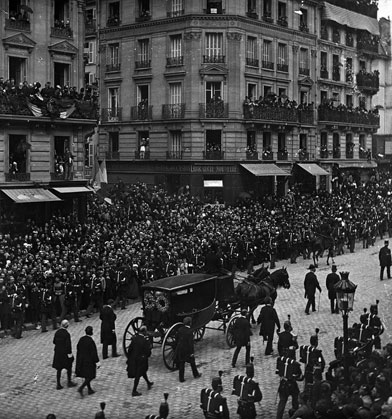
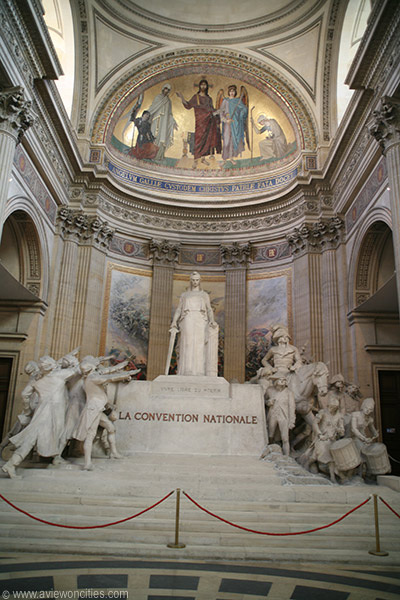
Hugo wrote most of his novel during his 19-year exile from France. He didn't return until six years after the first (Belgian) publication of Les Misérables. His return was greeted by celebrations in the streets. He was now a Parisien. He died in Paris at the age of 83. His will set out his wishes for his funeral. His body was to be carried to Pere Lachaise on a pauper's hearse and buried in the part of the cemetery reserved for paupers. The government decided otherwise. The church of Saint Genevieve, otherwise known as the Panthéon, was restored to its revolutionary secular state so that Hugo could be buried there. Hugo's body lay in state under the Arc de Triomphe and the pauper's hearse was escorted down the new, broad streets by senators, academicians and a military procession. Most of Paris seems to have turned out to watch. There were no riots - the spectacle of Hugo's funeral was carefully ordered.

The account of Hugo's funeral, which I discovered in Colin Jones' biography of Paris, has made me reconsider the Panthéon - a place that has puzzled me since my second visit last year. There's something odd about this commemoration of greatness. Even revolution is solidified into marble. The Panthéon seems to offer the rulers of France a means in which they can attempt to curb dissent. The belated reburial of the elder Alexandre Dumas, like the recent memorial to Toussaint l'Ouverture, insists that France has recovered from the racism and cruelties of its colonial past - but I'm not sure that all French citizens would agree.

Recently President Sarkozy has attempted to move the remains of
Camus to the Panthéon. The account of Hugo's funeral has set me wondering what Sarkozy's agenda is - and why the demand to own the bones of the great persists. I can show my love of Victor Hugo by reading his books (Quatre-Vingt Treize and L'Homme Qui Rit) come next. And perhaps, if I'm lucky, I'll go back to Paris soon to explore what is left of the Paris of Les Misérables: not that cold monument the Panthéon but the lively warmth of the nearby rue Mouffetard.

But before I start on another Hugo volume, I'm back to blogging. And, in an attempt to improve my inadequate Italian, I've started on Pinocchio, that cruel and painful book for children which is quite unlike the cute neatness of the Disney film.

Saturday, 3 October 2009

Goose Fair unvisited


I learnt about Goose Fair on my first visit to Nottingham, twenty-one years ago. The traffic jams were the first clue that something was going on. "Goose Fair," locals explained, and later, leaving Nottingham, I gazed at the huge expanse of fairground lights and wished I were among the crowds clutching bags, purses, toys, balloons and children as they swarmed around the vast site.

No-one is quite sure of the origins of Goose Fair. A book from the 1930s comments snootily that it is "not of any high antiquity, for the earliest mention of it is in 1541." People in Nottingham know that's rubbish. The fair celebrated its 700th anniversary in 1994 - I was there with my parents and children. More recently, writers have suggested it's more than 1,000 years old. It won't be long before someone establishes that it was set up by Druids or visited by Alfred the Great or Julius Caesar. But in fiction it was certainly visited by Arthur Seaton in Alan Sillitoe's novel Saturday Night and Sunday Morning, which captures some of the wildness.

My mum didn't see the point of fairs - all that money for a short ride when you could buy a good book or a theatre ticket instead. But I loved the thrills, the garish prizes, the crowds, the shouting, the smells and the tastes of fairground food. I don't think I've ever bought the Nottingham speciality of "cocks on sticks," usually bought with a giggle from a stall-holder who was bored with the joke years ago and is more concern with the quality of the lurid confections. But it was at Goose Fair that I discovered the joys of hot mushy peas, seasoned with pepper and mint sauce and eaten from a small tub.

It's proper Goose Fair weather today: cold, windy with the possibility of rain. Sometimes the crowd stomp and teeter through mud to the cakewalk, the gallopers, the big wheel, the hook-a-duck stalls and all the other rides and games of chance. Bad weather is no excuse for missing Goose Fair though it drives many to the Scouts' simple brick building where the sale of tea and sandwiches to sheltering crowds probably funds activities for the following year.

I'd like to go to Goose Fair again though I no longer have the excuse of taking children. I can hardly take a tall 18-year-old to hear the ringing of the Goose Fair bell or suggest he hold my hand if he's scared by the rush of the Magic Mouse or the neon skeletons of the ghost train. Perhaps next year I'll take my camera again or see if a friend wants to experience the rides. This year it would definitely be unwise. I've pulled a muscle and don't want to risk the pain of jostling crowds or further damage that might be caused by the attempt to maintain my balance on the jiggling of the cakewalk. Tying my shoelaces is quite bad enough though I'm surprised to discover that attempting to stab people with an epee turns out to be an almost pain-free experience.

Perhaps next year I'll find time to go on the quiet first afternoon, when rides are cheaper. I may even stop at one of the fortune-telling booths in the neighbouring front gardens - not because I believe in fortune-telling but because I'm uneasy about the rules banning fortune-tellers from the Goose Fair site. When I first moved to the East Midlands, people said openly that gypsies weren't allowed on the Goose Fair site. The current rules simply say that fortune-telling and character-reading are banned.

The wind is getting stronger - it just threw one of the wheelie bins to the ground. I reckon I'll be warmer and more comfortable indoors - and I have the fifth Thursday Next book to finish.

Tuesday, 8 September 2009

The writing on the wall


When I was small, I went to Madame Tussaud's eager for the Chamber of Horrors. I rushed past the rather dull waxworks of unknown famous murderers. I wanted to see something horrid and scary, and to stroll on unafraid. It was something to do with testing courage, I think.

Children still love dungeons and horrors. They read the Horrible History books and learn details of torture. They haven't quite grasped - as I hadn't - that torture hurt people like us. Turning torture into a tourist thrill with wax victims, fake blood and feigned screams suggests that it's not quite real and, if it did happen, it was a long time ago to people wearing fancy costumes who talked rather differently from us.

We tend to ignore other people's pain, unless we're revelling in it. I'm startled when I see a teenage girl got up for a party with a gold cross - even a gold crucifix - worn on a chain. The twisted body of a man tortured to death is so familiar that it's lost its power to shock. We don't attend public executions but I've watched footage from real wars while eating supper in front of the TV. True crime sells well even if misery memoirs have waned in popularity.

We're protecting ourselves, I suppose. If I think about killing, torture and suffering today - really think about it and try to feel what it means - the thought becomes unbearable. The degree of suffering threatens to paralyse me but I should take action and protest.

Every so often the bleakness and pain of prisoners' lives reaches me. Wandering round the Chateau de Vincennes, I read notices which explained how the king's rooms had become cells where prisoners had sometimes been held for years. Usually prisoners find a means of scrawling or carving their names into the walls. There was less carving than usual at Vincennes. Instead the prisoners, who were often wealthy, had obtained paint and decorated their cells. This was no prison for paupers, whose lives were less important. The prison paintings of Vincennes are careful and accurate renditions of swagged curtains and lit candles on candelabras.

The plaster had begun to flake away before restoration was begun and I had to peer carefully to make out these creations of nostalgia and longing. There were words too but I couldn't make more than a fragmentary meaning:

"... ns la nuit de la tombe un jour desen...
..................................re nos noms ................
....la ..............................monde .....................
.... mais .....................rite profonde .............
P0urquoi ......................................................."

[......?.. the night of the tomb one day..?.....
...................................?..our names ...............
...the............?.....................world ....................
...but.................................?...deep..................
Why ..............................................................]

And after that, there's a word which might be "larmes" [tears] - but the more I look the less sure I am. I can understand nothing.

Tuesday, 6 January 2009

The David of Michelangelo


When I was young, everyone knew the story. There was war between the Philistines and the Jews. The Philistines were brutal and bullying. Nonetheless, for some unspecified reason, they sent out their champion and invited the Jews to send their own champion to face him in single combat.

The Philistines' champion was Goliath - a giant and a one-man killing machine. The Jews had no idea who to send against him until David, the shepherd boy, volunteered with stories of how he'd killed a lion and a bear while looking after his father's flocks. King Saul did his best for David and dressed him in fancy armour but David couldn't even walk in it. Instead he chose to go out against Goliath in his everday clothes, armed only with a stick, a sling and five round pebbles. And of course, he had his faith in God - this is the Bible after all.

Even if you've never heard the story before, you know how it must end. David took his sling and a pebble and hit Goliath right in the centre of his forehead. When the giant toppled down, David hacked his head off. Then the Philistines fled.

The story's a popular one. I've known about the statues of David by the sculptors Donatello and Michelangelo. But I never wondered why they were made. It was only a few years ago that I learnt the way in which David was seen as the symbol of Florence, which saw itself as a weak city surrounded by larger, threatening states.

Florence certainly faced threats but these days we see it as strong and influential rather than weak and threatened. The symbol of David's weakness overcoming strength is one that could easily be appropriated by any faction, family or individual who ruled Florence. Even the strongest states and leaders often present themselves as victims.

Most states have been victims at some time. Britain, which ruled an empire with the usual mix of occasional benevolence and institutional brutality, saw rebellious "natives" as a threat - and the colonised could be cruel and violent. More recently, the Blitz in World War Two haunts us.

The United States grew out of British persecution of dissenters - and persecuted the American Indians to the brink of extermination. Recently the televised horror of 9/11 showed us America as victim again. What happened in Fallujah was not televised.

And Israel came out of centuries of persecution culminating in the mechanised brutality of the Shoah. When the state of Israel was founded, a horrified and remorseful west recognized the state at once. A culture soaked in Bible readings was bound to sympathise with the people of David. But the land was already inhabited and, shaken by its own war and refugees, the West didn't consider the newly dispossessed Palestinians.

And now we're watching Gaza, the land of Gath and Ashkalon, the land of the Philistines. There's another unequal contest between strength and weakness. Israel faces real threats. But it's a well-armed country, the only nuclear power in the Middle East. Gaza has starved under a blockade and most of its inhabitants are children. In the Bible the giant killing-machine is killed and a massacre ensues. In real life, I don't know what comes next. I long for an end to the violence and vengeance.


Wednesday, 13 August 2008

A killing machine


"Will you see the Victory?" everyone asks.

A trip to Portsmouth is unthinkable, it seems, without a visit to the historic dockyard. So we went to the dockyard. I found money-off vouchers at the tourist information office and bought annual season tickets, which meant that we could spread our visits out over the week.

The Victory came first.

In traditional British history, HMS Victory is iconic - the flagship where Nelson died while leading the British fleet to victory over the French and Spanish at the Battle of Trafalgar. I'm of the generation that can quote Nelson's phrases: "England expects every man to do his duty" - his message to the fleet before the battle, and "Kiss me, Hardy" - his final words. (The respectable version says that his last words were, "Thank God I have done my duty" - perhaps that version is true.) I also recall that Nelson left his beautiful mistress, Emma, Lady Hamilton, as a "bequest to the nation". The nation, as usual, averted its eyes from this evidence of Nelson's scandalous misbehaviour and Emma Hamilton died as she was born, in poverty. The nation was more concerned in the return of Nelson's body in a cask of brandy to St Paul's Cathedral where, after a period of laying in state, public mourning and processions, it was buried. It's still hard to escape Nelson memorials - the most famous if Trafalgar Square in London, where a stone Nelson stands high on his column.

The romance of Nelson takes over from the reality - the small sailor, blind in one eye, with one arm amputated, never free of seasickness. The glamour cheered Britain in later wars - Winston Churchill was a fan of the 1941 Alexander Korda film Lady Hamilton in which Laurence Olivier played Nelson and Vivien Leigh was Emma.

Visiting the Victory took me away from the myth - to some degree at least, although the decks are scrubbed and the cannon shine. The ship seems spacious - big enough to take 200 tourists at once - but its full crew was 850 men. Much was made in my school history lessons of the opportunities for advancement offered by the navy - and there were certainly chances for the midshipmen who joined at the age of 11 or 12 from their middle-class families. But midshipmen had it easy compared with the common seamen who were often taken by the press gang. These took turns to sleep in hammocks between the cannon and were punished by brutal naval discipline if they broke any minor rule.

The Victory, like all warships, was a machine for killing people. But it maintained class distinctions. The captain's cabin was lavishly furnished and he had special supplies - as did other officers. The men had no space that was their own. They were fed and provided with water so that they could, when necessary, play their part. Each cannon needed 10 or 12 or 14 men to load and fire it. Cannon balls had to be stored carefully and gunpowder was sealed away in barrels. A single rat getting into the gunpowder could cause a spark that would destroy an entire wooden ship.

The ship is kept clean and tidy for tourists. But I was reminded of battle by a notice which drew attention to the role of the ship's carpenters. During battle, a corridor was kept free for them so that they could run up and down the side of the ship, stopping the holes torn by cannon balls.

57 men on the Victory were killed at the Battle of Trafalgar or died of their wounds shortly after. 102 further men were wounded. They came from England, Scotland, Ireland, Wales and eighteen other nations. For most of them the Victory must have been entirely unromantic - the place where they worked. The sea stopped them escaping from their workplace. And most of the corpses were slid overboard before the Victory returned with Nelson's body. And of all those killed in battle, Nelson's is the only name I know.


Friday, 1 August 2008

To the Bois de Vincennes


I spent the morning in Ivry on an errand for a friend. I'd never been there before and found it delightful. There were no tourist sites - or if there were, I didn't notice them. What I discovered was a small town within the Paris metro, apparently peaceful and cared for by its inhabitants. For a while I wished I could live in Ivry.

My errand included an inspection of a highly-recommended boulangerie/patisserie. I spent a euro on one of their specialist baguettes, put it in my bag and headed towards the Bois de Vincennes.

The word "bois" was enough to attract me as the heat increased. I dreamt of breezes in woodland. The chateau had also been recommended - I'd heard it was the scene of Henry V's death and thought that perhaps I'd sign up for a tour. But my first stop was close to the Porte Doree, where the Palais originally called the Musee Coloniale has now become a Museum of the History of Immigration, with, for historical reasons, an aquarium in the basement.

The palais is a glorious example of inter-war architecture, but the reliefs and murals recall the prejudices which were endorsed by the French government when the Palais opened as the central hall of the Colonial Exhibition of 1931.

The new museum has taken those prejudices as its starting point in mounting a splendid exhibition - about the exhibition of 1931. The Colonial Exhibition was a huge, popular spectacle. Indivdually, many of the exhibits told of complex cultures and artistic achievement. However the effect of showing all France's colonies together diminished this element. The powerful and the banal were jumbled together, offering a vision in which the overpowering impact was of quaintness and difference. Talented citizens from the colonies took part but the exhibition as a whole glorified French colonial power and took for granted the superiority of the French to their colonial subjects.

Reflecting on 1931, the current exhibition doesn't permit a simple response - it would be too easy to say "Things were bad then," and pass on. But the exhibition, which merges with the permanent exhibits, shows the complexity of what the exhibition offered and what it achieved.

There are films, installations, sculptures, photographs, information boards. And there are the identity cards and simple records of people accepted - or rejected - for residency or citizenship. Each entry in a register, each tiny photo represents a whole life.

The exhibition explores ideas about race and immigration before the exhibition, the protests against the exhibition (which led to an anti-colonial exhibition, and the influence the exhibition had on the arts in France. There are the histories of different groups of immigrants. The lucky were accepted as French but the less fortunate, who included Sigmund Freud and Pablo Picasso, had their applications refused. There's one chilling photograph from the early 1940s: a group of men stand in front of a hut, looking towards the camera. Without the caption I wouldn't have known its purpose. The picture was taken for a major French newspaper during the occupation. The men, photographed in a concentration camp, had been selected to demonstrate different semitic types - presumably so that French citizens could identify and denounce their neighbours.

I didn't emerge with an easy solution or simple summary in response to all the prejudice and hatred. I became aware of a multitude of perspectives and numberless experiences. I wanted to read more but was growing tired. The effort of reading in French and trying to follow a largely unfamiliar political and economic history, was lowering my concentration. I paused for an espresso, then headed out, baguette in hand, to eat as I walked through the Bois de Vincennes.

I got as far as the entrance to the zoo and looked at the outside of the chateau. I decided that hiring a boat or bicycle must wait for another visit and simply wandered through the paths, enjoying the cool breeze, drinking water and eating torn hunks of bread.

Eventually I turned back, only to realise that I was on a different path. Inidispensible in hand, I worked out a new route back to my friends. It involved changing buses, taking a metro and catching another bus. Luckily this was Parisien public transport - regular and reliable. I had one wait of more than ten minutes but the route worked perfectly.

I was welcomed by the offer of tea or a drink, followed by one of Jana's splendid meals.


I think it was over supper that I learned that my hosts' son, who was born in Paris,has never lived anywhere else, and speaks French as his first language, missed his right to automatic French citizenship by a month, under the reforms of 1992. Although they are long-term residents, neither of his parents is a French citizen. Though their son takes an interest in the countries of both his parents, he is plainly, above all, a Parisien - but not, it seems, French.