Saturday, 3 April 2010

Going slow


“Productivity” is one of the ways in which our work and lives are measured. It's an idea from time-and-motion studies and is allied to another word: “output.” Lately they've been linked to other words, like “targets” and “league tables.” Underlying these is the notion that speed and quantity are always valuable.

Speed and quantity have their uses. Nobody would suggest putting out a fire slowly or labouring for a week to produce the single, perfect baked bean. But somewhere in the rush to achieve meet targets and achieve maximum productivity, important qualities are lost.


I began thinking about this when I heard Will Self talking on the radio about the experience of walking to the airport. I was mostly concentrating on making coffee but, in my usual quest for maximum productivity, I was listening to the radio as well. The coffee was fine but I caught only a few sentences from Will Self. He pointed out that, in people's haste to reach an exotic destination, they neglected the places in between. Huge suburbs were diminished to places which are crossed as quickly as possible by travellers who want to be somewhere else. Walking to an airport might be one way of regaining an older, more leisurely experience of travel.


I liked this idea of slow travel. I've been toying with the idea of a walking holiday. Perhaps my inspiration was the opening of Dorothy L. Sayers' Have His Carcase, though I don't expect to meet Lord Peter Wimsey and could do without the discovery of a corpse. But I think women – even women of my age – are less inclined to solitary walking than they were in the 1930s and, even if I could handle the necessary luggage, I've a feeling my conduct would seem eccentric. Still, I'd love a slow holiday – slow, at least, by modern standards – taking trains, boats and buses as well as strolling by rivers and lounging in bars and cafés. I've been glancing at holiday brochures and they all seem rather intense.


Going slow shouldn't just be a treat for holiday times. There are moments when work is better for going slow. Not all tasks are best done at speed. I prefer the carpenter who works carefully to the hasty worker with an eye on the clock. I think workers who pause occasionally to talk to one another may find they enjoy their work more than those who are harried into silent, urgent speed. The shop assistant who asks after the health of an elderly woman customer may hold up the queue for half a minute, but she's doing a good job.

Teachers have to account for every minute of classroom time under national strategies. They don't have enough time to listen to pupils, go over ideas or even meander slightly from the point, seeing where a thought or a new idea might take them. Children are educated to make every minute “productive” until they're afraid of the kind of day-dreaming in which genuine inspiration strikes. No wonder so many young people see leisure as a time for binge-drinking. An approach to leisure governed by productivity and target-setting is bound to ask “how much can you drink in the time?” and “how quickly can you achieve drunkenness?”


This focus on productivity doesn't seem to have much to do with the way humans deal well with one another. It comes from business.
Schools and public services are still being told to model themselves on business, as though no business could ever fail. It comes from the desire to compete and make maximum profits. The demand for high productivity can be found in a number of industries where firms compete with one another for work. Robert Tressell's The Ragged-Trousered Philanthropists describes the house-painters' unwillingness to skimp work in a competitive system which drives down prices and therefore wages. It was heightened by mass-production, in which people serve machines.

The Ford factories of the 1920s and 1930s moved from the craft of car-making, in which workers served an apprenticeship and learnt to make a car as a whole, to machine-tenders who did one simple, easily-learnt task. Initially, the machine-tenders were well paid, although they could easily be laid off or replaced. High productivity lowered prices. This made goods and leisure more widely available in a hugely unequal society. Perhaps it also reduced the demand for greater equality and a fairer distribution of wealth.


I have a taste for things that are produced slowly and with care. I like the idea that someone took trouble and that an item suits me rather than my “demographic.” I like wine, beer, bread and cheeses that are made by people who aim at the best taste they can rather than a neatly-packaged and predictable uniformity. I enjoy books that are a pleasure to touch as well as to read, with elegant type and clear design. I like ideas that have taken years to mature, ideas that are still being made, thought through and tested – ideas too lengthy to be one of five points on a small card and far too rich and complex ever to be shrunk into the neatness of a soundbite.

Saturday, 20 March 2010

What did you get?


Each workplace has its ritual conversations. There are the standard grumbles: “Seems like a long day,” “Feels like Friday,” “Wish I’d stayed in bed.” – even, “I think I’ll throw a sickie tomorrow.” They don’t mean quite what they say. The colleague who speaks most fiercely of gloom will smile encouragingly as soon as the first problem of the day arises. The colleague who threatens to “throw a sickie” never fakes illness and struggles in, a few days later, taking paracetemol to quell a burning head and aching limbs.

Most workplace conversations are like talking to neighbours about the weather. They imply that, however bad things get – and all workplaces are bad from time to time – we’re in it together and can sympathise with one another’s experiences.

Other conversations are less pleasant. Fellow workers jockey for superiority, find ways to imply “I’m more important than you.” The workers who play these games are usually those who never question their employer’s changing values – or, if they do, keep their doubts to the privacy of home. I suppose this lack of thought and adventure will increase as the recession continues – and that workplaces will be filled with a new competitive passivity as workers insist on their importance to the employer. In the new fear, anger and fear will burst out as strikes, usually on the wrong issues and expressing grievances in ways that the – public – especially the fearful and newly-unemployed public - won’t understand.

Not all workplace conversations are about work. There’s “Did you do anything nice at the weekend?”, “Got any plans?” – the conversations that look back and forward to times of leisure if not of liberty. Too often the answer is: “The house needed work,” “The children were ill,” or, simply, “I caught up on sleep.” But they're a chance to remember that work does not define us - we are more than that.

In the past few years, a new question has crept in after fetes and festivals. I was quite shocked when first I heard it, one year after Chrsitmas. A colleague turned to me and said, "What did you get?", following it up with, "Did you get anything nice?"

"It's childish," I thought, recalling on that urge to fierce for possession and experience that adults learn to quell. And it seemed so materialistic - not "did you have a nice time?" but "what did you get?" as though life was no more than a competition about who owned the flashiest possessions. It didn't help that the question came from a colleague who I didn't expect to view the world in that way.

Now it seems as though that was the first time I noticed a change in how people viewed the world. I've got used to the question. I hear them everywhere: at work, on the train, from friends and acquaintances: "What did you get for Christmas?", "for your birthday?", "for Valentine's Day?", "for Mother's Day?" It's a horror. What do people say when the answer is "nothing"? When did intimate family festivals turn into a public parade of acquisition and consumption? I never thought money or posessions a fair measure of value - or love.

Sometimes I think I'll feel more comfortable in an economic downturn.

Wednesday, 10 March 2010

Late for the punk revolution


I missed the punk revolution the first time round.

Of course, I was aware of punk rock - it was impossible to miss the shock-and-horror news stories or the deliberately outrageous album covers - but I never paused to listen to the music. Looking back, this seems startling, especially since I headed to Anti-Nazi League festivals - I think I may have heard The Clash play live in Victoria Park without noticing.

It's hard to be sure why I missed out. In part I was busy discovering other aspects of music. I was prepared to travel a long way for a Monteverdi opera and to sit through an otherwise dull concert for a spectacularly good performance of Villa-Lobos's Bachianas Brasileiras number 5.

I first encountered punk through an Oxford filter, which didn't help. Punk was greeted enthusiastically by mostly well-off students - the students who would soon vote Thatcher into power. They loved the excuse to dress down. My sense of punk in those early years is crystallised by watching a gang of twenty or thirty Oxford undergraduates dressed in carefully-styled binbags with imitation safety pins stuck to their faces. They were on their way to a fancy-dress party. I hated the aura of condescending fakery and avoided the whole movement.

It was a long time later that my son started listening to punk as well as metal, folk and other genres. I began hearing snatches of his albums an realising that I'd missed something exciting, angry and thoughtful. A friend who was much more open to a wide range of music educated me further with recommendations of bands beyond my experience.

Sadly, I didn't follow up all his recommendations as he gave them - I tended to listen to a clip or watch a youtube video and mentally file it for later reference. It was only when he died at the end of last year that I re-read his emails and returned to his recommendations. One band cropped up again and again: the Yorkshire-based Sex Patels. I started visiting their myspace page to hear the few tracks there. I watched all the youtube videos I could find. Eventually I managed to acquire their rare and wonderful CD (I shan't say how I did this - I'll just thank the people who helped) and have been listening to it ever since.


I don't know if I'll ever get to see the Sex Patels perform live. I don't know where they would be - and I feel a little uneasy at the idea of going to a gig alone, especially at my age. I fear I've missed something tremendous - a mixture of celebration, anger and fun that fuses punk classics with bhangra .

I'm a little sad that Jacqui Wicks has left the band - she has such a terrific voice. I'm sure her new work will be successful but, just at the moment, I'm sticking with the Sex Patels - and I've a feeling I'll be playing that CD for ever.

Sunday, 7 March 2010

Falling in love with books


What is happening to books?

Even the most committed and enthusiastic writers and publishers have scare stories. On World Book Day I listened to a talk by Chris Hamilton-Emery of independent publisher Salt. He's gambled his own and his family's livelihood on the idea that books - including books of short stories and poetry - have a future.

My first job, for four months before university, was at Foyle's bookshop in London. The manager was said to believe all staff were potential thieves. He certainly acted that way. New staff members were kept away from departments in which they had any interest, so that members of the public tended to be served by ill-informed shop assistants. Our bags were searched from time to time, in case we were stealing the stock.

As a book-lover, I was placed in an office that was little more than a cupboard safely away from temptation and provided with a candle in a bottle. It was the three-day week and the candle meant I could work through power-cuts. In front of me was a large book with a list of the names and addresses of publishers, a stack of envelopes and a huge, unsorted heap of flimsy order-forms. My task was to reduce the backlog, place orders in the correct pigeon-holes and then, if they weren't collected, send them out in envelopes which I had to address. I felt a little like the would-be princess in the story of Rumplestiltskin. No-one from the shop had sorted the orders for the past six weeks - they had simply piled up waiting for someone to do something.

My allies were the publishers' representatives, who would find their way to my cubby-hole and help me to rummage. They showed me how to find my way round the pigeon-holes, which required expert knowledge about which publishers had merged and which clubbed together to share a rep. The reps also told me about their glossy new books and grumbled when the manager of Foyle's failed to see their sales potential. Occasionally they offered me free books from their back catalogues. Gifts included some lovely Loeb parallel texts, a hardback of Women in Love and a slim Samuel Beckett volume. There were lots of reps, mostly enthusiastic and never seriously in competition with one another. There were many bookshops and many buyers.

Those of us who worked there - mostly on insecure, temporary contracts - sometimes wondered how long Foyle's could survive on the strength of its famous name. We muttered among ourselves that it had lost touch with books and book-lovers - that its concern with making money was driving customers away and even encouraging them to shoplift, though the two store-detectives regularly hauled suspects to the manager's office.

Somehow Foyle's re-invented itself and survived - there's even a small, helpful branch at St. Pancras. Instead the small shops - small rooms in paradise to their devotees - quietly crumpled and vanished. Chains are collapsing too. Waterstone's survives but it's no longer the treasure-house Tim Waterstone created. Now any branch in any city is much any other. Bestsellers are piled high and 3 for 2 offers abound. Display space and promotions are paid for by publishers and it shows. I don't browse there often - what's the point? There's little chance of being surprised into a purchase or of falling in love with a hitherto-unknown book.

Bookshops and publishers always needed to make money. I'm sure that most of the people who start work in the book trade choose their career out of love. But something seems to have gone wrong. As modest publishing houses are swept up by conglomerates, I have to look very hard to find the books I like. Some authors - established, prize-winning authors - find that publishers won't take a risk on their work. Joolz Denby, who was recently short-listed for the Orange prize, is offering her novel free to readers as an email attachment. While publishers praise her writing, they're no longer willing to take a risk on a book that doesn't fit neatly into a marketable genre.

At least there are still independent publishing houses, like Chris Hamilton-Emery's Salt, though it's hard to find the books the smaller houses publish in Waterstone's, or W.H. Smith's (or Tesco). When I want to recapture the thrill of the bookshop, I have to head to London or Cromford - or go to one of the one-day-only independent press fairs where smaller, keener publishers who really care about books can display and sell their wares.

Saturday, 27 February 2010

Shopping and space


I bribed myself to go shopping. If I forced myself into clothes shops, tried on jeans and actually purchased a pair, I would allow myself to revisit Nottingham Contemporary's current exhibition, Star City: The Future under Communism.

Even with the bribe, it was difficult. However I suddenly found two pairs of trousers that would do. My mood lightened as I climbed the short hill to the gallery.

It wasn't my first visit to Star City. I popped in on Light Night, the very first day it was opening, but didn't stay long. I wanted a range of Light Night experiences - and found them in the jitterbugging skeletons, a candlelit church, a free Schumann recital, giant insects in the castle grounds and fencers in the Long Gallery of the castle itself. Most of the Light Night events were for one night only. I knew I could return to Nottingham Contemporary.

The exhibition itself is a puzzle. Perhaps this is as it should be since many people of my generation and older are puzzled by their own reaction to the loss of the Soviet Union and the fall of the Berlin wall. We knew a great deal was wrong with the Soviet Union - I grew up aware of the show trials, the events in Hungary and saw the first black-and-white footage of Soviet tanks arriving in Prague. I haven't forgotten the name of Jan Palach.

Yet while the the smart-suited bureaucrats and party officials made speeches that betrayed their followers' ideals and their own lack of conviction, there seemed to be another Soviet Union composed of the dreams of many who wanted a different, better life. Those dreams - of comradeship, freedom from want, real involvement in the government of a country, hope for the future - still seem worth preserving. I don't believe that I live in the best system there will ever be, nor that freedom to shop is a major test of liberty.

A couple of the more recent works at the gallery seemed to equate consumerism with democracy. I wasn't sure what point Diango Hernandez was making by using elderly kitchen appliances to vibrate to a speech by Castro in morse code. I had a slight suspicion that my reaction - "I like the look of that blender" - wasn't quite what the artist hoped. But other exhibits let me remember and reflect.

The Soviet posters of the space age recalled the excitement I felt on hearing that Yuri Gagarin had become the first man in space and the thrill in learning just two years later that a woman, Valentina Tereshkova, had also become an astronaut. I didn't particularly want to travel in space when I grew up but I liked the sense that it was possible. The posters had the bright excitement of Janet and John books or Sunday school displays, infused with the glamour of space and Cyrillic script.

It was disappointing, therefore, to find that the Light Night opening featured two pretend Soviet astronauts at the entrance to the gallery. They played at space walks, called everyone "comrade" with exaggerated accents and treated the whole thing as a grand joke, as though going into space was nothing and seeking comradeship an absurd archaism. I wasn't angry but something inside me was hurt. Perhaps I still cherish a lost dream after all.

Elsewhere the exhibition was more complex and harder to put in words. I was reminded of Leon Rosselson's song "Wo sind die Elefanten?" which can convey its sense of loss only through an absurd sentence from a German language course. The gallery had several huge exhibits but I spent most time with a series of small illustrations by Ilya Kabakov, produced in the late Soviet era and called "The Flying Komarov." These pictures, which started in a cupboard and moved on to a world in which most people flew, seem to speak of hope for liberty and the importance of dreams. They allow space for the viewer too - not outer space but inner space to interpret and question.

I haven't given Star City all the time it needs. I'll be there again, wondering what to make of it all. I can drop in again and again - that's the benefit of a free gallery.

I'll go on thinking of the dreams we build about other countries and our own. It's not the dreams that are wrong. But across the world there are leaders and would-be leaders who twist those dreams to a hateful shape for the sake of riches and power.

Saturday, 20 February 2010

The limits of language


I once heard Harold Pinter read. It must have been in the early 1980s. The occasion was a CND benefit and it took place, I think, in Kensington Town Hall. Numerous poets were reading and Harold Pinter's name came some way down the list. However, as soon as I entered the hall I realised that the Longford clan was out in support. I wasn't sure whether they were backing CND or their new son-in-law but they were very noticeable, perhaps because of the aristocratic confidence with which they took possession of their area of the hall. I watched with curiosity. I didn't recognize Pinter himself. I rather expected him to look and sound like a character in one of his plays - perhaps Aston in The Caretaker.

Plenty of poets read before Pinter. It was a difficult audience - more interested in nuclear disarmament than in poetry - and the hall itself made it hard to achieve intimate effects, though Ivor Cutler drew the audience together with his surreal wit. By the time Pinter's turn came, about half the audience were sneaking glances at their watches.

I hadn't realised Pinter had been an actor but he knew how to command an audience. His voice surprised me with its richness and I was startled by his choice of reading. After a number of poets reading their own work, Pinter chose to introduce and read John Donne's "Nocturnal upon St. Lucie's Day." I think it may be the best reading of a poem I have ever heard. It also changed my view of Harold Pinter. I realised that this playwright, most famous for his pauses, had a deep love and understanding of the music and meaning of language.

I haven't seen many Pinter plays so when the opportunity came, through this blog, to see A Pair of Pinters at the Guildhall in Derby, I couldn't resist the opportunity. I had two worries: were my expectations too high? and would my back injury prevent me from concentrating? I chose a matinée perfomance as the discomfort worsens in the evening.

I knew I was right to attend before a word was spoken. I was not just comfortable in my seat - and that's become an important consideration in the past five weeks. I felt the kind of comfort that comes from seeing actors who are secure in their roles, the production and with one another - and who communnicate that security to the audience. I sat back in my chair and prepared to be unsettled.

Two men talked, joked, and argued while waiting for a message from a third, who did not appear. The echoes of Waiting for Godot were unmissable at first - The Dumb Waiter was written two years after the London premiere of Beckett's play - but Pinter's characters have less freedom than Beckett's. Ben and Gus are enclosed in a windowless room. They may be disturbed by the series of jobs they are required to perform but they never question the obedience required. At most Gus (James Holmes) complains and Ben (Joe Tucker) betrays his anxiety by threatening Gus. It would be possible to suggest that the play means more than it says or shows but I think the best way of enjoying it is to enter the world of the play, laugh at the jokes and to let the memory of it resonate later.

After the interval comes the much later play, A Kind of Alaska, set in another enclosed room. There are no mirrors and presumably, once again, no windows since Deborah, the central character, cannot see her reflection. But while the characters in The Dumb Waiter inhabit a violent world, kindness and love cause pain in the later play. Deborah has woken after a 29-year sleep - she suffers from Encephalitis. In her mind she hovers between childhood and adolescence but and cannot quite understand that her younger sister is suddenly middle-aged. Julia Tarnoky is luminous and heart-breaking as Deborah, stretching out urgent, awkward hands and evoking the lost promise of her teenage years. Simon Molloy and Eunice Roberts as Hornby and Pauline are gently self-controlled as they try to work out how much reality the newly-woken Deborah can bear.

I was struck in these plays by the small range of language with which Pinter does so much. Every word counts and repeated words and phrases add depth and complexity. But both plays also reach through language to areas for which there are no words, for which the immediate human response may be a prickle on the spine or the ache behind the eyes when tears are unshed.


Thank you, Esther Richardson, for posting on my blog to offer tickets - and for directing these plays.

Monday, 15 February 2010

The purpose of the Pantheon


For six weeks I've been too busy to blog. I've a number of excuses: work took over my life, my computer keyboard started playing tricks on me, and I slipped on black ice causing painful damage to my back.

Perhaps these are merely excuses. I may not have blogged but I found time - even when I should have slept - to keep reading Les Misérables. It gripped me in the way books caught and held me in my teens. As I neared the end of the final volume, I wasn't merely reading it on trains and buses, and in bed at night. I was reading while cooking and even while walking down the road. On one occasion I was so caught up in the story that I left a suitcase on a train. (Fortunately the helpful station staff ensured that the suitcase and I were reunited.)

I'm not sure what was so gripping about Les Misérables. A few years ago I tried to re-read it in the old translation I'd read in my early teens and was soon bogged down in the heavy prose. Reading in French should have been harder but I followed the advice to stay away from dictionaries and the story came to life through Hugo's words. Of course, every so often I would check a tricky word or phrase - but how bland the English seemed next to the French, and how untranslateable. A neatly-turned phrase loses so much in translation. There's no equivalent for "amourette pour lui, passion pour elle" or "Parfois insurrection, c'est résurrection" that echoes and dances as the original does.

Of course, reading in French demanded an unfamiliar level of concentration. My French O-level of many years ago didn't demand so high a level of expertise, although we were expected to read Camus's L'Etranger and easy extracts from older works. But the language alone wouldn't have held me for through three volumes and more than 1500 pages. And I already knew the story from that first reading and various film and TV versions. But I had missed so much.

In French, Hugo is sometimes funny, sometimes angry, and frequently moves me to tears. There was much I'd missed on that early reading: the chapter in praise of "le mot de Cambronne", for instance. The word attributed to Cambronne, spoken as he was taken prisoner at the end of the gruelling battle of Waterloo, is "merde". (The nearest English equivalent would be "shit.") Hugo dedicates a whole chapter to fulsome praise of the acuity and rhetorical brilliance of this word. My Victorian translation was too delicate to tell me what the word was, offering a myserious dash instead. Moreover, as a teenager I was insufficiently used to 19th century novels to realise how different French and British attitudes were. Hugo thinks it necessary to explain - at length - just why Cosette and Marius (aged 16 and 21) haven't had sex, even though they have met one another every evening for a whole six weeks without a chaperone.

Cosette and Marius are young, silly and more conventional than they realise. Hugo knows that and at times he invites the reader to laugh at them. I never found them as interesting as the wilder characters, Eponine and Gavroche, nor as sympathetic as the numerous elderly characters who are frequently at the centre of the story. Perhaps my age is showing.

What startled me most was Hugo the revolutionary. I remembered the depiction of the failed rising of 5th- 6th June, 1832 from film versions. It was exciting but not particularly important - part of the lead-up to the journey through the Paris sewers. But Hugo takes the rising seriously and asks the readers to consider both why it was necessary and why it failed.

Hugo believed in revolutions - not all revolutions but those on the side of progress. He discusses when revolutions are necessary. His characters tear up paving stones, seize vehicles, grab weapons and barricades the streets of Paris. Hugo may like individual kings and royalists - as human beings - but he believes a republic is necessary and that the royalist cause must, for the sake of freedom and justice, end in defeat. He is furious - far angrier than Dickens - at the ill-treatment of children who are left to roam the streets and starve. He sees that the poor are suffering. He's appalled by inhumanity. He wants a better world and understands why sometimes people might decide to die or kill so that the future can be happier and more just.

Les Misérables is also a love letter to the lost streets of Paris. Hugo wrote most of Les Misérables from exile. He knew that the dangerous, dirty and loveable Paris he described was being ripped apart by Napoléon III and his architect Haussmann. In place of the familiar mediaeval mazes, whose squalor Hugo condemned, they constructed new, broad boulevards that welcomed shoppers and armies and were harder to barricade.

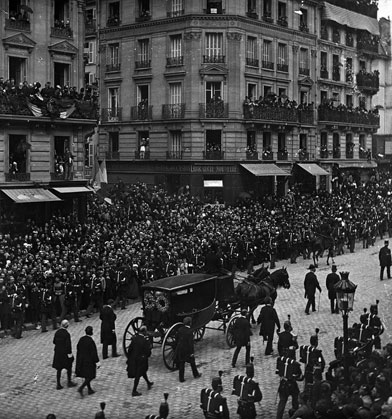
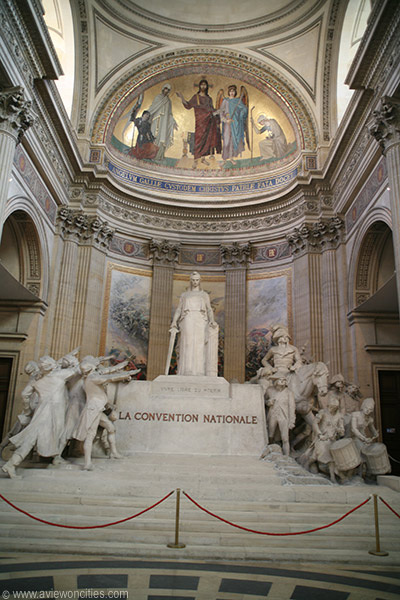
Hugo wrote most of his novel during his 19-year exile from France. He didn't return until six years after the first (Belgian) publication of Les Misérables. His return was greeted by celebrations in the streets. He was now a Parisien. He died in Paris at the age of 83. His will set out his wishes for his funeral. His body was to be carried to Pere Lachaise on a pauper's hearse and buried in the part of the cemetery reserved for paupers. The government decided otherwise. The church of Saint Genevieve, otherwise known as the Panthéon, was restored to its revolutionary secular state so that Hugo could be buried there. Hugo's body lay in state under the Arc de Triomphe and the pauper's hearse was escorted down the new, broad streets by senators, academicians and a military procession. Most of Paris seems to have turned out to watch. There were no riots - the spectacle of Hugo's funeral was carefully ordered.

The account of Hugo's funeral, which I discovered in Colin Jones' biography of Paris, has made me reconsider the Panthéon - a place that has puzzled me since my second visit last year. There's something odd about this commemoration of greatness. Even revolution is solidified into marble. The Panthéon seems to offer the rulers of France a means in which they can attempt to curb dissent. The belated reburial of the elder Alexandre Dumas, like the recent memorial to Toussaint l'Ouverture, insists that France has recovered from the racism and cruelties of its colonial past - but I'm not sure that all French citizens would agree.

Recently President Sarkozy has attempted to move the remains of
Camus to the Panthéon. The account of Hugo's funeral has set me wondering what Sarkozy's agenda is - and why the demand to own the bones of the great persists. I can show my love of Victor Hugo by reading his books (Quatre-Vingt Treize and L'Homme Qui Rit) come next. And perhaps, if I'm lucky, I'll go back to Paris soon to explore what is left of the Paris of Les Misérables: not that cold monument the Panthéon but the lively warmth of the nearby rue Mouffetard.

But before I start on another Hugo volume, I'm back to blogging. And, in an attempt to improve my inadequate Italian, I've started on Pinocchio, that cruel and painful book for children which is quite unlike the cute neatness of the Disney film.