Thursday, 7 October 2010

No to the Kindle

British friends have occasionally asked me why I visit Paris in August. “There's no-one there,” they assure me. “The real Parisiens are all on holiday and everything's shut.”

It's a simplification. Some Parisiens – those who can afford it – try to take holidays in August. Some shops, businesses – even museums – are closed. Last year I was sorry to miss the municipal museum of Montreuil, which I still hope to visit one day. The Comedie Francaise and the Paris Opera are on holiday. Friends I would have liked to see were away – as was the owner of the splendid apartment I sublet.


Yet I enjoy Paris in August. It has a leisurely air. The discovery that a local shop or restaurant is shut for “les vacances” is not a disaster. It's a reminder that workers need holidays and there's more to life than making money.


In previous Augusts I did little to look for live events in Paris. Paris Plage was fun – and full of locals – but I missed it by a day this year. I wondered if my British friends were right in saying nothing else was on. I decided to investigate. I paused at a kiosk and invested in a copy of Pariscope – not a huge gamble at 40 eurocents – to see what was going on.
Leafing through the pages I read of theatres, cinemas, concerts, spectacles and markets.

At first I was baffled by the choice, then began to make decisions. The Lucernaire looked worth a visit, and quite near where I was staying. The second and third Millennium films were showing at the Cinema Chaplin, not too far away. There was a fund-raising piano festival at the Armenian Cathedral in the Marais – and much more.


I began at the Lucernaire. The list of theatre shows made me hesitate. I'd missed Cooking with Elvis at the local amateur theatre and was prepared to miss the French version as well. But I wondered about a one-man show of Oscar Wilde's De Profundis, well-reviewed in a number of French national papers. The price – 22 euros – is more than I usually pay for theatre tickets. But when I thought about seeing Wilde in French, there was a pleasant logic too it.
De Profundis is Wilde's long letter to his young lover, Lord Alfred Douglas, written from Reading Gaol. Some years ago I would have said I knew the English text reasonably well, although it has faded in my mind since. I recalled that, after leaving prison, Wilde went to Paris, where he died, and was buried in Pere Lachaise cemetery. And while I hesitated about seeing a work in translation, I recalled that I had twice seen Wilde's play Salomé, which he wrote in French for Sarah Bernhardt, in the translation by Lord Alfred Douglas. The idea of Wilde in French translation was almost symmetrical. I bought my ticket.

The set up at the Lucernaire wasn't quite like a theatre in England. Notices on the wall told us that the “ouvrieuses” (specifically female workers) showing us to our seats were unpaid and dependent on tips. The ouvrieuses were charming and had a neat way of sliding the proffered tips into a purse – but I felt uncomfortable about the procedure. Workers are often required to display charm as part of their jobs but I didn't want to measure and reward that charm directly with a tip – it felt too intimate a purchase. However as they were, according to the notices, dependent on the audience's generosity, it was plain that generosity was my responsibility. I handed over the tip as I was shown to my seat and wondered if I'd bought the bright smile that followed.


The theatre was small – a studio space without the formal grandeur of a proscenium arch. The actor playing Wilde was already on the stage, perched on a step-ladder and half-covered by a blanket. The audience leaned forward expectantly, displaying a quality of intense concentration that is rare in English theatre audiences – and this continued throughout the performance.


Occasionally I found the use of French distancing and at times my understanding flickered out - I probably grasped 80 to 85% of the text. Despite the strangeness, a French Wilde seemed a convincing possibility. I even found his mispronunciation of Reading (to resemble the activity rather than the town ir the gaol – endearing).
It was an intense and moving performance. I was surprised to find that, towards the end, I felt sympathy not just for Wilde but also for Lord Alfred Douglas – Bosie. De Profundis chronicles instances of Bosie's selfishness but, listed by Wilde, they seem like the follies of a very young man faced by an adoration he could not quite reciprocate and an intelligence he could not match. Even his cruel statements seemed like a dull attempt to match Wilde's wit while his neglect of Wilde's feelings could be forgiven as the uncertainty of a young man suffering from an appalling upbringing and unsure how to respond across the barriers of age and c lass. The young often do run from suffering – and how was Bosie to respond to Wilde's imprisonment and agony? Biographies suggest that Bosie was unpleasant throughout his long life but the pictures reveal a startling beauty which may also have been a disadvantage.

A week was not enough for all the events listed in Pariscope. I saw Millennium 2 – subtitled in French, which I find far easier than dubbing – and enjoyed a riveting performance of piano music by Chopin and Rachmaninov. That was as much cultural performance as I could take. I also haunted the bookshops, trying to add to my small collection of books in French.


There were two books I aimed to buy: Victor Hugo's Notre Dame de Paris and Eugene Sue's Les Mysteres de Paris. Both have been on my list of books I need to read for some time. But I was confronted by something unfamiliar from my life in the East Midlands – a wealth of bookshops. There were big shops like the many branches of Gibert Joseph in the Boul' Mich and the art chain Mona Lisait. Then there were many small independent shops – far more than in London, I think – where the stock seemed to reflect either the manager's taste or the surprises that often delight and infuriate in secondhand volumes.

I browsed contentedly and puzzled over what to buy.
I find nineteenth century French literature easier to read than modern light fiction; lengthy paragraphs allow unfamiliar words to become clear from the context and puzzles can be resolved with the aid of a dictionary. Recent thrillers, for all their popular appeal, are harder because they use so much contemporary slang. I have a further interest. I've noticed that, for generations, working-class readers in particular were absorbed by popular French fiction from the mid-19th century. Stories like The Count of Monte Cristo and Les Miserables are mentioned in working-class writing from the 1850s to the 1950s. And I knew that writers for the working class drew on French writers. For instance, G.W.M. Reynolds' terrific and popular serial, The Mysteries of London – which makes Dickens seem restrained in style and detail – was directly influenced by Sue's Mysteries of Paris. So far as I can see, no-one has gone into much detail chronicling this influence. While the effort necessary for a wide-ranging survey is beyond me – I imagine I'd need a year or so in French archives with no guarantee of success as well as another year combing comparable English publications - I could at least see what popular fiction of the period was available in paperback.

One of the joys of reading in French is the vast and largely unknown library of possible titles which spreads before me. Looking at Paul Feval's Le Bossu – which was the source for a couple of terrific swashbuckling films - I discovered that the same author had written his own Mysteres de Londres – quite different from Reynolds' serial. I haven't read it yet but, according to the back of the book jacket, it tells the story of an Irish plot against the British government and is set in exotically English locations. I had to buy a copy. There was a fine multi-volume edition of Les Mysteres de Paris, with illustrations, but in the end I concluded that it was too heavy.

I was also tempted by Eugene Sue's last book, Les Mysteres du Peuple, apparently a fictional account of working-class revolution from the time of Jesus to the era of Napoleon III. I wondered why so startling a book was so little known. Until I stumbled across a copy in Gibert Joseph, I hadn't heard of its existence. I nearly bought it but once again I hesitated, feeling the weight of the book. I could delay, I thought, and order it from amazon.fr when I had time to read it.


In the end, I succumbed to ten or twelve books, including a fine hardback edition of Notre Dame de Paris from one of the second hand shops set up by Abbé Pierre's Emmaus charity. A friend tipped me off that these were a great place for bargains and the shop I visited gave me an excuse for travel on the voguéo - I find it hard to resist river travel. My reading of French is still slow and I have less free time than I would like so my purchases will last me a long time. But I still regret the two books by Sue – perhaps I need to go to Paris again, very soon.


The chief problem was one of space – and what I reckoned I could carry home in my suitcase. Eurostar may not have a weight allowance but travellers still have to heave their cases onto the conveyor belt for scanning and manoeuvre them into the luggage areas of trains.


Briefly I thought of the solution suggested by a couple of friends: if I purchased a kindle or e-reader I could carry a whole library with me, unworried by weight. But I like the weight of books. I like the smell and texture of paper, the designs of covers. I like turning the pages with my fingers. I love the sensation of opening a new book for the first time – and I adore books with history, which carry a sense of their past readers. I can see the logic of an electronic reader but not the pleasure.


Nor would there be opportunities for communication. I discovered the novels of Michael Chabon after seeing a taxi driver was reading one. It was the beginning of a good conversation about books, which would never have been sparked by the anonymous cover of an e-reader. I like seeing what my fellow travellers are reading.


Then think of the hazards. I couldn't read an e-book in the bath – at least not safely. Amazon has been known to withdraw a text from the kindle, regardless of readers who were half-way through. An equipment failure or expired battery could put an entire library beyond my reach.

My books may occupy too much space. It's also true I don't always know where a particular title is. But I know my books by their shape, size, colours and texture. I could never gain so much affection for an electronic index.
Perhaps this simply marks me as a member of a dying generation, to be as much pitied or mocked as those who could not adjust from the scroll to the book. Wandering through the market of old and antique books in the Parc Georges Brassens (on the site of a former abattoir), I was unable to imagine surrendering my love for the book in favour of a screen called into grey and white life at the flick of a button.

Mind you, I didn't buy any of the book on sale in the Parc George Brassens. It was the last day of my holiday – and another book would have made my suitcase too heavy.

Thursday, 16 September 2010

Balzac's cafetiere


Much as I love Victor Hugo, I can't commend his taste in interior design. The intricate elaborations and extravagances that delight me in his prose style seem heavy and unnecessary when used to decorate a room. The reconstruction of the sitting room he designed for Juliette Drouet in Guernsey – moved to the Maison Victor Hugo on the place des Vosges – leaves me filled with admiration for Juliette's patient and tolerant love. I hope for her sake that Hugo's wife had more of a say on domestic interiors.

I returned to the Hugo house and the Musée Carnavalet, wondering if I would view them in a new way after reading Hugo novels and histories of Paris. Although I saw them with greater knowledge, it was the same things that struck me. In the Hugo house I lingered over his drawings, letters and the display connected with the death of his daughter, drowned when travelling with his new husband. I noticed a poem about her which I hadn't observed before, written for the fifth anniversary of her death – and, because such things trouble me, I wondered how I might translate it, given that the final stanza sets an impossible task. The rhymes give way to exact repetition: “tombe” is used first in its more usual sense of “fall” and then with the meaning of “tomb” while the second rhyme, which matches the place, Harfleur, with “fleur,” the word for “flower,” ends the poem on a lighter syllable than any English equivalent I can imagine. I suspect I'll keep returning to this poem for many years, as I do to Callimachus's recollection of Heracleitus and Catullus's early declaration of passion for Lesbia. I don't expect to solve the problem.

In the Carnavalet it was again the section on Revolution and war that held my attention longest. I noticed how the thoughtful declarations of rights gave way to the rigid imposition of a military discipline which forbade all question. The words “Liberté, Egalité, Fraternité” seemed out of place on a soldier's drum. Once again I admired the souvenirs made from the stone of the demolished Bastille, especially the doll's-house-sized solid model of the Bastille itself. But I wanted more – Paris deserves a bigger museum, though none would be sufficiently complex to do justice to the city's history and people.

But revisiting museums wasn't enough for me. With my urge for self-education, I looked at the list of Paris Museums and settled on Balzac's house. My reading of Hazan's book on Paris (not yet finished) has made me guiltily aware of how little French literature I have read. Although names from Balzac's fiction lurk at the fringes of my awareness, I don't think I've ever read any Balzac novel. His name and the titles of his books are heavily forbidding as were the pictures on the covers of the black-backed Penguin classics editions. I assumed the house would be a similarly forbidding presence but found a simple bus route with the aid of my Indispensable.

The street was steep, lined with tall and heavy houses, dating, I would guess from the late 19th century. There was nothing of the lightness of the Montparnasse apartment blocks. I counted my way by house numbers. The quiet in the street was almost oppressive – evidently there was no rush of devoted Balzac enthusiasts.

I passed a striking and very heavy 19th century building and then, just as the numbers told me I was reaching Balzac's house, there was a gap in the buildings, a garden and a small, light, white building with a grey roof and green window-frames and shutters. It looked like a bungalow and, compared to the heavy surrounding buildings, could have been an elaborate shed. The garden was small but delightfully leafy with archways and paths. Sitting there you would believe yourself far from the city, until you looked up to see the Eiffel Tower.

A few steep steps took me into the Balzac house and an interior as quiet and calm as the garden. It seems that Balzac liked quiet. His house was simple – not a bungalow, as I first thought: the uneven terrain meant that the main living quarters were on the upper floor, which led to the garden, but there was also an airy lower storey below. I decided that I would have liked to live in Balzac's house. He had a fine desk and chair. I could imagine myself sitting there and getting things done.

I found his method of working sympathetic too. He would start writing at midnight when the city was cool and quiet, and work through till 8 in the morning, fuelled by coffee from his personal cafetiere. I admired the cafetiere. It's now kept in a glass case, which makes it hard to photograph. I'm not entirely sure Balzac should have added his initials. Perhaps he wanted to make sure no-one walked off with his coffee-making equipment. I can understand that. Anyone would feel possessive about so fine a cafetiere.

As an additional and unexpected treat, the house offered the screening of a complete Japanese “ganime” version of Balzac's early novella “La Grenadiere” directed by Koji Fukada. I was charmed and moved by the fusion of pictures, music, Japanese voices and French subtitles. I'd love to find a copy for myself so that I can share it with friends. At the moment all I can locate is the trailer on youtube.

After leaving the Balzac house, I sat in the garden for a while, enjoying the light breeze and soft fragrances. Eventually I left, walked up the road past the late 19th century apartment blocks and caught a bus that would take me across the Seine and towards the Eiffel Tower. As I walked, I resolved to buy and read something by Balzac. I doubt it will surprise and delight me quite as much as his house.

Saturday, 11 September 2010

The patron saint of smoking


I was looking for Samuel Beckett. He was hard to find. Instead I stumbled across Serge Gainsbourg.

I'm never sure what to make of Gainsbourg. The recent film, which didn't aim at accuracy, deepened my ambivalence - and reminded me how erotic "Je t'aime ... moi non plus" is. So I stopped at Gainsbourg's grave.

I was in the Montparnasse cemetery. I hadn't meant to visit but, as I drifted round the 14th, that was where my feet took me.

The Cimetiere de Montparnasse not a tourist haunt in the way Pere Lachaise is. No-one was hawking pictures of the graves or plans of the cemetery. However there were casual and dedicated strollers as well as the mourners who came to place flowers on family graves. I was pleased to find a helpful plan of which graves were where although that didn't always make them easy to find.

Gainsbourg's grave was plainly a place of pilgrimage. There were flowers, photos, a packet of Gitanes and a colourful selection of cigarette lighters. As I watched, a young couple standing by the grave rolled cigarettes in silence and solemnly lit up. Whatever else he may have been, Gainsbourg has become the patron saint of smokers.

I've been anti-smoking for as long as I can remember. I recall my father's serious illness when I was six. As he was too ill to be moved, hospital staff brought equipment - including, I think, a portable x-ray machine - to the flat where we lived. As he recovered he was warned to give up smoking and struggled for years to overcome the addiction. Now, in his late 80s, he can't stand the stench of cigarette smoke.

But when I watched the young couple, I saw their cigarettes as a form of protest against a controlling state - and that too seemed admirable. France has a history of resistance which is the ground of the national belief in liberty, equality and fraternity. That belief is at the heart of protests from left and right against the forced deportations of "les Roms", the Roma who have travelled from eastern and central Europe, as allowed by law. Some deportations have been stopped by the courts - the grounds can be as slender as finding smoking in public which is not, the tribunal found, a serious public order offence - but many families, seeing their children scared by early-morning police raids, have simply agreed to leave, taking the very small amount of money the French state will pay as inducement or compensation.

It's easy to look away when a small group is under attack. Paris has numerous plaques to remind residents and visitors of the round-ups and deportations carried out by French police during the Occupation - and these are often cited as a reason to oppose the deportation of "les Roms". There's even a plaque commemorating the 1961 police massacre of Algerian protesters, although the French seem less comfortable considering the implications of that episode.

As a tourist I was observing and doing nothing. I strolled round the cemetery contemplating past injustice and resistance.

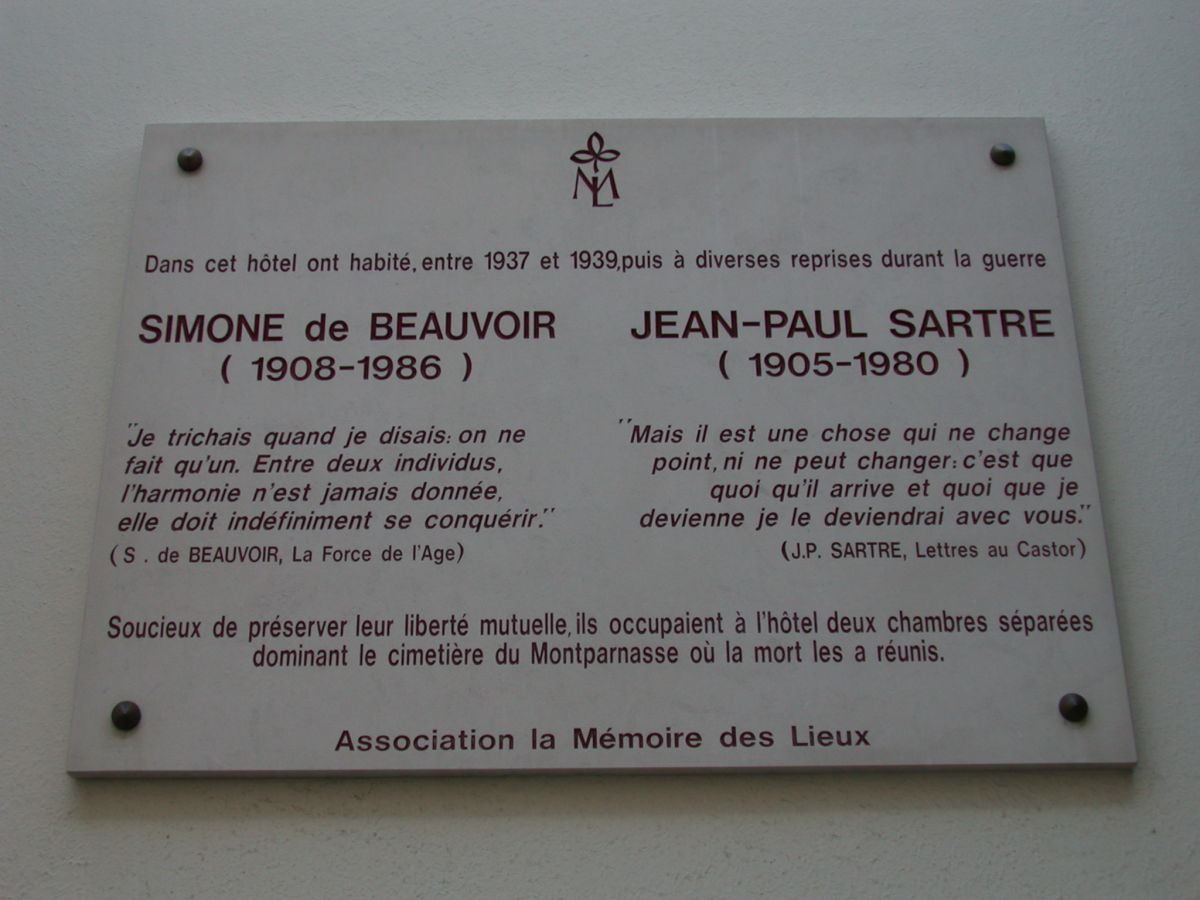
I chanced on the grave of Dreyfus, who sparked Zola's famous letter "J'accuse" and a huge campaign of resistance. I saw where Sartre and de Beauvoir were together in death, though forced to occupy separate hotel rooms in life, as a plaque on the Hotel Mistral recounts. They were forced by events to make difficult choices and their messy, muddled lives remind me that political involvement can't be limited to those whose lives are above reproach.

As the cemetery was closing, I made another attempt to find Beckett, who chose to stay in occupied France (though he could have escaped to neutral Ireland) and was awarded the Médaille de la Résistance and the Croix de Guerre for his activities. He didn't talk much about what he did but I wanted to pay tribute to his courage and reported kindness as well as his plays.

At last I found the grave, thanks to a shabbily-dressed and unshaven man who stood contemplating it. As I paused, the man turned to me. "Samuel Beckett," he said. "En attendant Godot."

I made a slightly stumbling attempt to explain why I thought Beckett a great man, trying to recall the French titles he gave his works when he first wrote them. But the man wasn't listening. "En attendant Godot," he repeated. "Samuel Beckett. En attendant Godot."

Then he bent down and began to clear the blossoms which had obscured the names of Beckett and his partner Suzanne.

I'm not sure what he meant to say. Was he just naming Beckett's most famous work? Was he telling me that in death too Beckett was "waiting for Godot." Or was he himself Godot, arrived too late and tenderly clearing the playwright's tomb?

Friday, 10 September 2010

In praise of Alphand


Paris again, and luck brought me to a quiet apartment in the 14th. I looked it up in my history of Paris and found familiar names: Denfert-Rochereau, Raspail, Montparnasse. I knew them from books and metro maps - it wasn't an area I knew at all and had no idea what to expect. All I knew was that I was very tired and it was time to take things easily.

I'm also trying to budget carefully without being absurdly stingy. Like so many people, I'm anxious about what George Osborne's statement of cuts on the 20th October will bring. Every time I hear him there seems to be an additional note of relish in his tones. As the millionaire heir to a baronetcy he's cushioned from any temptation to join the "welfare-scroungers" he condemns. I remember interrogations by job centre staff in the 1980s; they made it plain that my pregnancy was proof of my feckless laziness and told me off severely for wanting to breast-feed my baby. However much I wanted to escape from memories and fears, they were bound to gang up on me. Sleep wasn't easy; three nights in a row I was carried back to England in vivid nightmares.

Days were for calm wandering. Last year I visited a wealth of museums and monuments. This year I looked for the free Paris city museums and wandered vaguely, sometimes taking buses with only a vague idea of their destination. Suddenly I came across the rue Soufflot, which leads up to the Panthéon. But I turned, strolled in the opposite direction and found myself at an entrance to the Luxembourg gardens where Parisiens strolled, watched their children and sat, in considerable numbers, on the white metal chairs provided. Some ate picnics but more had brought books and enjoyed the sun and the calm as they read.

As I strolled, I seemed to have found an August Paris that was in holiday mood and not over-run by tourists. I gazed at the pond and the palace which houses the Senate, reflecting that no government building in London is so lightly protected - but the people seem to have a sense that they own the gardens and the city.

I decided that this week in Paris would include time spent wandering in gardens, partly in tribute the engineer Alphand who decided that a city needed parks as a body needs lungs. The Park of Montsouris was one of his creations and only a short bus-ride or long stroll from the wonderful boulangerie where I could enjoy an espresso with mini-croissant or brioche for a delicious and leisurely breakfast.

Montsouris is made for slow wandering, though excellent small playgrounds allow parents to rest can watch their energetic children. There's a lake, trees and curving paths. It's easy to get lost, so I did. Gradually the gardens of Paris unpicked the nightmares and brought me back to calm. I knew it wouldn't last - and much as I love Paris, it has its own anxieties - but Alphand's gardens gave me the breathing space I needed.

Saturday, 21 August 2010

Myths of work and money


I can't recall exactly where in our flat the saying was. I think there was a paperweight – perhaps in a multi-sided geometrical shape – with a number of catch-phrases and sayings. When I first read it, I was too young to work out what it meant. I spent ages puzzling over the words: “Work is the curse of the drinking class.” Apparently it was a joke that I couldn't understand.

I suppose the joke played on too many assumptions: that work is a good thing, that the working class are seen (especially by the rich) as idlers, that drunkenness is a working-class problem and that the working class live feckless lives dedicated to the pursuit of pleasure. If someone had explained all that to me then, I'd have been politely incredulous. I could see that my parents worked hard and that they put the interests of others (including their children) first. They didn't even drink. My mother was fearful of pubs and drinkers and, although my father enjoyed beer, he gave it up for years for my mother's sake and, even now, finds a single can of lager turns a meal or an evening into a special occasion.

But there's one way in which the group of assumptions did chime with my parents' attitudes. They worked hard at their jobs and often found them rewarding. But they hadn't fallen for the idea so ingrained into many middle-class minds: that work is what gives meaning to people's lives. My parents put other things first: family, friends, neighbours, duty, social responsibility – and pleasure. They handed those values on to me.

Quite a lot came under that heading of “pleasure.” It could be a walk in Richmond Park, a trip to the theatre, a jazz concert, a TV programme, drawing, a maths puzzle, a cryptic crossword, a visit to a museum or a good book. We didn't make the usual distinction between high-brow and low-brow. I watched the London Transport Players perform Ivor Novello or Rogers & Hammerstein in a “proper” theatre and amateur Shakespeare in the London parks. I picked up whatever reading material was lying around: Tit-Bits magazine with its intriguing advertisements for Joan the Wad, poetry anthologies, Plato in translation. I learnt by watching that the aim of work was to live a good and enjoyable life.

My parents encouraged us to work hard at school but they didn't pretend that the aim of education was a career. Education was a means of expanding opportunities for pleasure – and might give us the chance to choose a job that was more enjoyable than those our parents did. I could see the point of that. In my early years my mum was a cleaner and a kitchen assistant. I didn't think I'd be much good at either and, given my incompetence in tidying my room, I didn't think I'd be much good at being a cleaner. I liked reading books and learning poems and plays by heart but I wasn't sure that many jobs would draw upon those skills. And I realised that I might want money so that I could buy books, travel to museums, go to the theatre and so on.

There's nothing in my parents' approach that seems wrong. The idea of devoting a life to work for its own sake seems ungenerous and mean-spirited. I'm lucky enough to enjoy much of my work – but not the bits involving form-filling, managerial jargon, the distress of others, or tidying my office. It's a good job but does it really shock you to learn that I do it for the money? After I've paid for the usual necessities of life, I spend that money on family, friends, duty, responsibility and – of course – on pleasure.

Saturday, 14 August 2010

Groundling afternoon


I knew my place. I learned to love theatre from the gods. I can still conjure up the smell of those side entrances to theatres and the plain, uncarpeted stairways that seemed to go on for ever. My early theatrical experiences included a panoramic view of the more-expensively seated audience, comfortable on red plush. But my favourite performers seemed to reach over the permed and lacquered hair of the wealthy to speak directly to the longing, needy hearts of the poor on their benches. I was convinced that shows were aimed directly at the inhabitants of the gods. The rich clapped politely but we yearned, cried, gasped and almost swooned in rapture. How could the actors not love us?

Later I began to criticise and analyse. But I still cherished the moments of awe and hope before the play began, as members of the audience shuffled into their seats, waiting for the lights to dim. The audience – at least, its richer members – was part of the spectacle and the actors shouted or whispered their words over the heads of the rich.

Of course, I knew that things had once been different. It was, I think, the Victorians who placed a distance between the actors and the poorer members of the audience. It's hard to generalise - I don't know enough about the difference between patent houses (the few theatres permitted by law to perform the plays of Shakespeare) and minor theatres (the home of musical theatre and burlesque), let alone the details of such wonderfully-named popular theatres as the blood-tubs and the penny gaffs. I suspect it was the posh theatres that pushed the poor up the bleak side stairs to the gods and turned the rich theatre-goers into part of the spectacle. There have probably always been small theatres charging a single price for all tickets. It took me a while to discover the joys of what were, in my youth, called “studio theatres.” I've been to many and enjoyed their intimacy.

But, having finally visited the reconstructed Globe, I realise that I'd never really imagined what it would have been like to attend an Elizabethan or Jacobean theatre – or to be part of what Alexander Pope calls, with contempt, “the many-headed monster of the pit.” Of course, I had to be a groundling - I didn't feel I'd belong in any other part of the theatre. So, clutching my £5 ticket, I joined the groundlings' queue – a friend had advised me to arrive early to be sure of a good space.

I'd always planned to see Shakespeare at the Globe – it seemed an obvious decision. But it had taken me so many years to organise a ticket and an afternoon that I ended up booking for a new play with an early Tudor setting – Howard Brenton's Anne Boleyn. I was a little embarrassed about this until a fellow groundling pointed out the sense of my decision – the original Globe had, after all, been a place where new plays had been performed.

My fellow groundlings were a welcoming crowd. I've always found a great deal of comradeship among people who queue for cheap seats at plays, operas and concerts. I was lucky to be among regulars, who assured me that watching as a groundling was the best experience the theatre had to offer. They also compared experiences of bad weather. The worst had been a hailstorm during a performance of Macbeth – groundlings are hardy folk and few left. The play also achieved more humour than is customary as the playgoers roared their approval at the repeated greeting “All hail.”

As advised, I found myself a space near the stage – something to lean on should I need it and a good opportunity to be close to the action – and the actors' feet. This could have been disconcerting but the play was written for the Globe and the actors knew how to use the theatre. Before the show started, some of them knelt down to engage the groundlings in conversation. Then, as the play started, in broad daylight (as in Shakespeare's time), the actors ensured that the audience was involved, sometimes pausing to share a joke or addressing us directly. While I didn't suspend my critical faculties (and it would be hard to do so from such a position) I also knew that I was part of the experience – even part of the performance.

At the same time, the play was literally over my head. While the audience seated in the stalls of a modern theatre occupy a position of power, much like the interviewer who sits watching the performance of a succession of nervous candidates, the groundlings stand at the feet of the actors and below the level of the audience in the galleries behind them. While I followed the plot with interest, particularly enjoying the discussion of Tyndale's theology and the problems of Bible translation from the Greek, I had a sneaking suspicion that I was not supposed to follow this from where I was standing – that the theatre building itself assumed my ignorance and inferiority.

Looking back, I'm surprised that I didn't mind this. But I slipped more happily into the role of poor, ignorant theatre-goer than I would have expected. I didn't feel half the discomfort I still experience when, by chance or luck, I find myself in the posh seats surrounded by people who seem to take wealth and privilege. I belong with the groundlings.

And I really liked the play.

Friday, 30 July 2010

In black and white


Looking back, I think my first encounter with the photos of Diane Arbus must have been in one of the glossy Sunday supplements – the sort with shiny paper that makes everything ravishing, even grief and poverty.

I don't know if the glossiness conditioned my response to Arbus, whether I was influenced by the accompanying text or whether it was the work itself that upset me. Her stark, black and white photos of poor people and people with disabilities – people who would never buy a glossy Sunday supplement – seemed to have the glamour and allure of a freak-show. I shuddered and looked away.


News of a forthcoming Diane Arbus exhibition at Nottingham Contemporary disappointed me. It seemed less interesting than the accompanying, more recent work by the Tobias twins. The brochure, with colour pictures of Tobias paintings, also suggested they might have more to offer although the one Arbus reproduction, of twin girls, haunted my imagination.


Accompanied by a friend, I looked at the Tobias works with curiosity and baffled amusement, which may be the response the brothers hoped to evoke. Many seem like a cross between a kitsch version of folk art and a Gothic, Transylvanian Disney. My strongest emotion in their presence was an amused affection. I drifted on to the Arbus rooms and was transfixed by something I hadn't noticed in that early encounter with her work: tenderness.


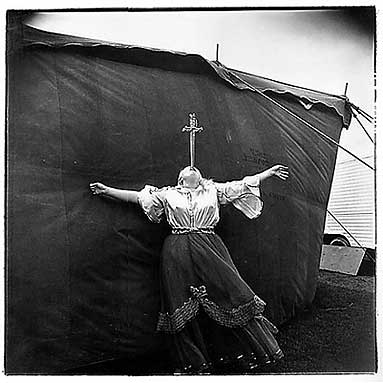
It wasn't in all the photos. Some, especially those of over-dressed rich women, seemed to expose their subjects to ridicule. I thought I glimpsed cruelty in the curve of the lips of a masked man. But in other pictures there seemed more gentleness and respect than I expected. I noticed how one of two drag queens, dressing or undressing for their act, seemed to reassure the other with a touch. I saw the dignified melancholy of a tattooed man, gazing into the distance beyond the camera. The albino girl, arms outstretched and head back as she swallowed a sword, seemed in control of her pose as she mirrored a crucifixion. So many of the subjects, often strange to the viewer or on the fringes of society, seemed to convey an inexplicable depth. Even the photographs of nudists seemed about much more than the nakedness of the subjects.

Some photographs still disturbed. I worried that the children might have disliked their portrayal – who would want to be shown in a gallery as “fat girl laughing” or to be famous as a skinny, laughing boy clutching a toy hand grenade? The extreme close-ups of babies' faces turned them into dolls or death masks. But when I came to the photos of people with disabilities which had so disturbed my teenage self, I began to ask other questions.

The subjects I'd characterised as a “freak show” looked out at me with self-confidence. They seemed as happy as any of the sitters to be recorded. So what exactly had disturbed me? Did I really think that photography was only for the beautiful, the confident or the normal (whatever that was) unless it had a proclaimed manifesto to change the world? These people just were – and were recorded.

This took me back to the photographs of August Sander and the records he made of Germany in the 1920s and 30s. Before Arbus, he had photographed people in fairgrounds and institutions, apparently letting them arrange their own poses before the camera. It was impossible to look at his photographs without the knowledge Sander lacked. I wondered how many of the people he recorded had been imprisoned, abused and killed in the Nazi regime's euthanasia programme, in concentration camps and in the bureaucratically-ordered extermination of those in the “wrong” racial groups.

My sense of recording and the influence of Sander became even stronger when I returned to the gallery for a guided tour by Alexander Nemerov, Arbus's nephew. He talked about her focus on the subjects of her portraits and the way she documented them as though in the face of impending catastrophe. I reflected later that Arbus looked more for a variety of individuals in every setting while Sander, though recording individuals, saw them more as representatives of types.

There are still problems with photography and the act of recording. For many people, the fact of being recorded and visible places them at risk. I can't help wondering whether any harm came to the subjects of Arbus's photos. It wasn't easy, in the 1960s, to be a mixed race couple, even in New York – and Arbus's caption makes it clear that the couple are married and the wife is pregnant. I wondered if the transsexuals and transvestites later regretted giving so much away or whether the disabled people in the institution suffered discomfort from the response to the publication of the photos. A photographer can try to achieve neutrality and simply observe, understandingly, a range of subjects. But as soon as the photographs are on display they enter an environment that is not neutral and which is all too eager to judge and condemn the lives of others.


Too many people still face a choice between vulnerability and invisibility. On any day I can say, without hesitation, which I would choose – but my answer isn't always the same.