After the tame bribes of the election campaign, we're preparing for disaster.
The strange thing is that, long before the election campaign, we knew there would be cuts and that they would be severe. In the debate of the three prospective chancellors, all three agreed that the new government would impose cuts that were deeper than those made by Thatcher. But when the election campaign proper started, the candidates and parties slipped into the conventional mode of offering little inducements to voters: funding for this and that project, the promise that some groups of people would be better off. It was as though the entire country colluded with the leaders and candidates in an act of voluntary amnesia so that we could all enjoy the spectacle of the election campaign and participate in a limited political debate without considering the future.
On one level there was a serious public debate. For the first time in years people seemed to be taking their power seriously. Wherever I went – on the train, in the pub, in corridors at work – people were discussing the election and agonising how to cast their vote. I was agonising too. But there was a sense in which the major debates of the last few years had been forgotten. We seemed to have stepped back in time so that the parties could posture in their familiar roles rather than addressing the current crisis. A great deal was made of family values and immigration. The NHS was defended and “welfare scroungers” attacked. There were occasional mentions of Europe and Britain's need to defend itself. I was struck by how little was said on civil liberties and Afghanistan – and how all parties offered to spend more money on pet projects rather than talking about what they would cut. Meanwhile the newspapers assessed parties as much on the power to spin and present themselves as on any substantial policies. Looking good on TV or choosing the right poster designs was treated as a vital qualification for office.
On the day of the election, I heard several people remark that now the difficult times would begin. And then we held our breaths for a few days as though hoping that the failure to hand any party an overall majority would mean that the economic crisis would go away and we could all sit securely in our jobs, if we had them, and rely on the frayed safety net the welfare state continued to provide.
There was never going to be a happy ending. Even if a Labour -Lib Dem-Nationalist-Green coalition had been formed (and the arithmetic was against it), we all knew the cuts were coming. The only remaining question was where they would fall – and that had hardly been discussed in the election campaign. No party wants to threaten the jobs and income of voters. The coalition cabinet looked like a parody of the new parliament: overwhelmingly male, white, public-school educated, Oxbridge graduates, mostly millionaires, distinguished by the kind of overweening self-confidence and self-righteousness that politicians and the press sometimes praise as “leadership.” No-one speaks of followership, that quality of subservience that all strong leaders require.
I haven't been surprised by any of the proposed cuts – and I don't think they're different from anything the relaxed-about-the filthy-rich, market-driven New Labour party would have required. Perhaps Labour would have delayed for a year but perhaps not – politicians were never going to be good about keeping their election promises. I am shocked by how much the Liberal Democrats conceded, and how quickly. Abstentions on tuition fees, Trident renewal and nuclear power ensure they will pass. If abstention is a fig-leaf, it's transparent. They may be working toward an end to the detention of children but they have hooked up with a party happy to deport asylum seekers – including unaccompanied children – to Afghanistan, apparently on the grounds that they will be safe there. Documents exposing the previous government's enthusiastic involvement in extraordinary rendition and torture have been published but that was as a result of a court judgment – our new, human-rights loving government was just as keen as its predecessors on a cover-up. It's the same with the treatment of children in privatised jails; brutality was authorised by New Labour but the coalition government sought to keep the evidence secret – and, so far as I can see, advice on how to hurt and injure children in prison has not yet been withdrawn. Every so often a cabinet member says something on human rights or civil liberties that I applaud but I don't trust them a bit. And I note that the Labour Party, while opposing cuts in a half-hearted sort of way, has stepped up the kind of rhetoric that prevents me from voting for its candidates. Labour assumes its potential working-class voters are fearful racists, who cannot see beyond narrow self-interest. No, they are not. They insist civil liberties and human rights are a middle class concern. No, they are not.
I support moves towards greater equality. I am not “relaxed about people getting filthy rich” when the evidence of poverty is clear. I want to a society that combines concern for individual freedom with a belief in equality, that welcomes internationalism at a human level rather than supporting uncontrolled corporate globalisation, in which companies are more powerful than countries or their citizens. There is no major party in England that promotes these views, though I know plenty of people who share them.
Meanwhile, I wonder what the government's rush to cut and privatise means for my neighbourhood and for me. I'm angry at local cuts that don't affect me directly; the county council plans to close centres which support people with mental health problems – people who are unlikely to campaign on their own behalf. The theatres, galleries, libraries and arts projects which I love must be at risk – the benefits supplied by free or very cheap access to culture cannot be quantified easily in a balance sheet. Given my age and my work in the public sector – combined with the level of projected cuts - I should probably prepare to face unemployment. Every so often the polite millionaires who rule us remember to say that public employees are valued and that the contribution they're cutting has been provided with care and dedication. As they cut contractual rights and sell the welfare state's fixtures and fittings to the private sector, they assure us we're “all in it together” and that “everyone has to make sacrifices.” But there's another aspect of their rhetoric which has been picked up by the screaming editorials of the right-wing press. They insist I do a “non-job” and look forward to a “gold-plated pension.” I'm luckier than most. I simply wonder if I'll be able to pay off the rest of the mortgage, how I can help my children and what I can do if my elderly parents need help.
I'm trying to be positive about the possibility of unemployment. I'm planning a T-shirt for the day I sign on. It will feature the words “WELFARE SCROUNGER” in big letters. Meanwhile I'll make the most of my free time to enjoy free culture, write like mad and campaign against the government for a better, kinder world.
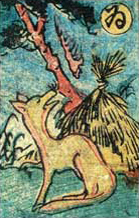
I spent childhood Saturdays at the Natural History Museum Club. One week someone came in with a pair of soft grey fox-cubs, rescued from their den after their mother had been killed. Their protector brought them back, week after week. They were bottle-fed at first, then weaned onto raw meat as their grey down gave way to red and their faces acquired an adult point. I think there was a plan to release them back into to the wild but I never heard the ending of the story.
Most of the animals I admire are predators. I love the swoop of falcons and eagles – growing up on the ninth floor of a towerblock, I sometimes watched the stoop of sparrowhawks from above in the expanse of sky above Richmond Park. I never feared the coil of a snake and would willingly handle boas and pythons when the animal-man brought them to school. I saw the young foxes grow strong on bloody meat and never doubted their violence.
Encounters with foxes were rarities. I remember deer, rabbits, and badgers in the park – we made special trips to watch them at dawn and dusk – but I think I was an adult when I first sighted a fox in the wild.
“The wild” is an inexact description. It was an urban fox – nervous at night – running across a road. It was hard to be sure it was a fox and not a cat. It was small and some way off. I was enchanted, even though the fox was probably on its way to raid a bin filled with remnants of Kentucky Fried Chicken. The encounter - like many later ones – fulfilled my affection for the untamed. I like the word “feral.”
In the past two months, I've seen several foxes, and begun to wonder if I still like them as much as I did. Urban foxes stroll the pavements of our quiet suburban street in daylight – they sometimes turn to glare. Usually I see just one at a time but there are more than one – a friend, giving me a lift home, caught sight of two outside the gates of different houses. I found one in the garden, two yards away. It lifted its head and looked at me without anxiety. I clapped my hands and shouted until finally it turned and slowly made its way through a gap in the hedge.The foxes seem larger than any I've previously seen in town.
There are stories in the local press about foxes attacking cats – we haven't yet had local stories about foxes attacking children but there have been some in the national papers. Something seems to have changed in the balance of species - I don't know if the new conditions have been created by the hard winter or infrequent bin collections or some other factor. I don't think it's related to the hunting ban – we're a very long way from the nearest hunt and no-one is going to suggest pursuing foxes through tarmac streets crowded with houses and people. Perhaps it's a side-effect of new building developments – could this be another reason to blame Tesco whose vast building site scars our town and whose placards promise an unwanted superstore?
I worry about my cat Joe, who arches his back and prepares to defend his territory when he sees a fox (or dog). I want to keep him in the house but he has his own streak of wildness and needs the outdoors. Like the fox, he's a hunter. He wears a collar with bell - I don't want him to attack – but not all the birds he brings home survive, though my son does his best to rescue and revive them.
Even some portraits are made for time-consuming adoration. These are usually pictures of the powerful, commissioned to demonstrate their finery as well as their faces. But the poor as well as the rich can seem in control of their images. Murillo's street urchins often display the confidence of the young and free. Even Goya's Maja, clothed or naked, seems in control of how we see her – as does Lucian Freud's model Sue Tilley, the Benefits Supervisor.
Elsewhere the subjects of paintings see less happy with the viewer's gaze. There are nudes by Titian whose lowered or averted eyes can cause discomfort. And I can never look at portraits or even staged domestic interiors by Vermeer for long. The framing of the paintings always brings me slightly too close – I'm forced into the scene like an intruder, as I am.
This history of looking was at the back of my mind as I dithered in the entrance hall of Tate Modern. I couldn't make up my mind about the new exhibition. Not only was the entrance ticket £10 – very high by East Midlands standards, especially for a show of photographs and videos – but the subject itself made me wonder whether I ought to look. The exhibition is called Exposed and the material it shows is grouped around themes of voyeurism and surveillance.
At first I decided I wouldn't look. I'd taken the long escalator to the third floor when I changed my mind and returned to the entrance. The escalator journey felt too much like running away.
There was, of course, something uncomfortable about so many photos grouped around such a theme. Few of them on their own would have sparked such concern even though some areas were banned to under-eighteens because of their sexual subject.
But sex and violence are too familiar to shock. Even the napalm picture, with the running, naked girl (her clothes burnt off) in a world beyond fear and pain, has been reproduced so often that I'm now immune to the horror. I was more moved by the photo of Jackie Kennedy with the new president Johnson and his wife. She seemed numbly vulnerable as she took on the unfamiliar role of presidential widow – beyond comfort and open to the camera's exploitation.
Elsewhere too the camera's glance was surreptitiously controlling. I was disturbed by Walker Evans' pictures of travellers on the New York subway, some tired at the end of the day and enjoying private rest in the carriage's public space. The photos were taken, before the Second World War, with a camera concealed in a coat-sleeve so that no-one could object. All the subjects must be dead by now. For all I know they would have liked the idea that gallery visitors would pay the unbelievable sum of £10 to see their faces – it's a kind of immortality.
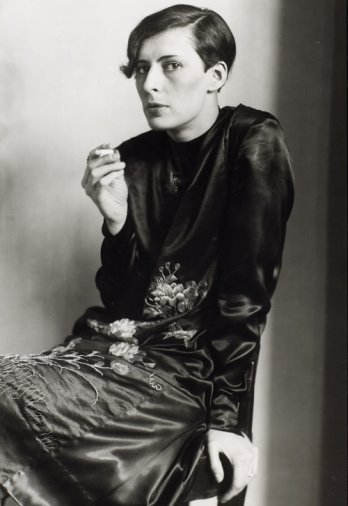
Having seen the subway photos, I was initially suspicious of the work of August Sander as he posed and classified “types” - by profession, disability, social status – in his project to document the layers of German society. But as I looked at the individuals he photographed with such care, I warmed to him. The pictures seemed to be the product of a kind of negotiation between photographer and subject. Most of them gazed back at the photographer with the confidence of people who had chosen their pose. There were exceptions of course: the boy labelled “idiot” or the blind girls, sitting together at a school desk. They were photographed in the mid 1920s and despite the labels the children appeared individuals. I wondered what happened to them after the Nazis came to power. Sander's sympathetic categorisation reminded me of the Nazis' brutal hierarchy of types. Yet the Nazis disapproved of Sander's project. His son Erich, a socialist, was imprisoned in the early days of the Nazi regime. After many years, Erich died in prison. Sander photographed his son's death mask.
Of course the exhibition disturbed – it was meant to. But it was far less disturbing than the film I saw two days before, Renzo Martens' Episode 3: Enjoy Poverty.
Martens' film explores poverty in the Congo – the sort of daily, agonising poverty that causes children to die painfully of slow starvation. But it's not like the kind of TV documentary that ends with an appeal to send money, offering the comforting, self-congratulatory reflection that we in the west are nice, charitable people. This begins with a man in the Congo complaining about poverty as he works and angrily showing his small daughter's sores – a result of malnutrition.
At first the film seems a tourist's journey through poverty in which Martens' occasional efforts to understand what he sees don't measure up to the reality. He seems too innocent, too polite. But the guns of the U.N. peacekeepers disturb as do the sharp suits of the wealthy.
But it's easier to look at the powerful than the underpaid workers whose children die so that people like me can buy goods cheaply. And then there's the war and the photo-journalists who follow war and starvation, looking for a scoop. They cluster together with their expensive, heavy cameras, each trying to find the best lighting and angle for a picture of a corpse. The going rate for a publishable picture is $50, on top of the travel and expenses already paid to the photographers. Martens, playing the innocent, asks a photographer a series of questions. Who owns the picture? Do the people in it – or the relatives of the corpse - earn money from it? What pictures sell?
Of course, it's the photographer who profits. The poor children, who aid workers strip and arrange for the camera, get nothing. So Martens reaches his conclusion. Congo has few assets apart from poverty. If the people of Congo are to profit, they must learn to exploit their own poverty. He finds two Congolese photographers, making a small living from pictures of festivals, birthdays and weddings, and urges them to change their subject, telling them that the highest profits come from photographing the dead and injured, raped women and starving children. I'm used to seeing such pictures but I've never before had to sit uncomfortably still while the subject's pose is adjusted and the photographer closes in for the most affecting and aesthetic angle.
There were questions and answers after the film. Martens insisted his work changed nothing – it was art, not politics. But he made a telling comparison with Jonathan Swift's “Modest Proposal,” identifying the film as satire based on a horrible truth. And he said there would be no change because there was no will to change. The people in Congo thought that if those on the outside saw what was happening, they would act – they would not allow such suffering to continue. But there is no outside – we're all in the same world and those of us with power to act do nothing because we benefit from the same system.
Meanwhile, for reasons we cannot bring ourselves to comprehend, pictures of pain and suffering are bought in the west as though they were things of beauty. And the sufferers get nothing for them.
In 1885 a tall, red-headed Irishman stood on a street corner in London selling copies of the Pall Mall Gazette. His name was George Bernard Shaw and he was one of many volunteers selling a newspaper publicising a story so scandalous that the usual distributors refused to stock the paper.
The story was headlined “THE MAIDEN TRIBUTE OF MODERN BABYLON” and it told the story of how W.T. Stead, the editor of the Pall Mall Gazette, had joined forces with the repentant madam of a brothel to purchase a girl of thirteen from her father. He didn't intend any harm to the child. He simply wanted to prove the truth of tales he had heard: that, in the poorer parts of London, parents sold their virgin daughters into prostitution. The response of the authorities was swift; Stead and his assistant were arrested and sentenced to terms of imprisonment for assault and child-abduction. But the scandal brought about the result Stead desired. It drew attention to the existence of child prostitution in Britain – and parliament passed an Act which raised the age of consent from thirteen to sixteen.
Of course, it wasn't as simple as that. The Act expressed all kinds of moral prejudices of the time – and it was the same Act that made homosexuality illegal. Ten years later, Shaw's fellow Irishman and playwright, Oscar Wilde, was sentenced to two years' imprisonment with hard labour under its provisions.
Even the case of the child sold into prostitution may not have been as simple as it seems – journalists (and many others) have been known to distort and exaggerate facts in order to prove something they “know to be true.” Shaw may have come to this conclusion himself by the time he wrote Pygmalion in which the entirely willing Eliza, who shares a name with the child in the “Maiden Tribute” case, is sold to Professor Higgins by her father for five pounds. These are his “rights as a father,” Alfred Doolittle insists. Five pounds is exactly what Stead paid for the earlier Eliza.
There are numerous myths about what Shaw calls, in the Victorian phrase, “the undeserving poor.” These myths both console and terrify the better off. The idea that the poor are feckless and immoral, prepared to sell their own children at a fiver a time, suggests that charity is always misguided, equality a dream and that what is needed is containment and control.
Paris has another myth (though it isn't limited to Paris): the myth of the Court of Miracles. Colin Jones' history of Paris considers the potency of this myth in the seventeenth century. It tells of a dangerous alternative society thriving in Paris since the Middle Ages – a society of beggars and gypsies who adopted disguises – false wounds, apparent blindness – to exploit the charity of the hard-working bourgeoisie. The Court of Miracles was supposed to have its own king and laws governing this exploitation – and the so-called beggars were not poor and maimed, as they appeared, but living a life of luxurious indolence.
The myth falls apart as soon as it's examined. The beggars are supposed to be simultaneously disciplined and hard-working (as the rules of the Court of Miracles demand) and fecklessly lazy. As Colin Jones points out, the Court of Miracles never existed – though some beggars may have been fakes and liars. But the myth gave Louis XIV the excuse he wanted to round up paupers, beggars, the sick and corral them into hospitals. His main concern was making the streets safe for kings and their courtiers. As the French Revolution shows, this wasn't a complete success.
There are similar myths elsewhere. In the 18th century John Gay's The Beggar's Opera picked up the idea of the Court of Miracles and sets it in London – and Bertolt Brecht's Threepenny Opera gave the story new, even more richly parodic life. The thieves and beggars in Gay and Brecht don't inhabit a space as large as the Court of Miracles but they still combine idleness with industrious trickery. They seem to live outside the law – but at the same time they obey a different, equally strict code. They sing and dance too – it's a fine life being a thief and a beggar.
The myth of the Court of Miracles still flourishes. There are undoubtedly crooks and con-artists among beggars and the poor – just as the rich have their tricksters, whose deceptions are coming to light with the collapse of the markets. As a story, it's a delight – the fortunate who are neither poor nor beggars revel in its freedom - but it's also a dangerous excuse for repression, and for failure to see an equal humanity in the faces of the unlucky who need help and justice.
The story W.T. Stead tells in “The Maiden Tribute of Modern Babylon” cannot help relying on the myth of the dangerous poor – the myth is too potent to avoid and the poor know it as well as the rich. His newspaper article is a rich mix – it starts with a lengthy and richly imagined account of the labyrinth in Crete and ends with the scream of a child. He insists that he doesn't oppose the freedom of the libertine rich, so long as the vulnerable poor are protected. He insists that the rich who prey on the young are his main target. Yet his account of the disorderly poor, who know just where to sell their daughters and whose profit is governed by a parody of market forces, recalls the Court of Miracles' parody of the establishment of its day.
Stead believed his own story and undoubtedly there were cases of child abuse, then as now. He served three months in jail for abducting Eliza – the repentant brothel-keeper who helped him served six months. I don't know what happened to her after that. Stead's fame as an editor was secured until his death brought him another kind of fame – he was drowned when the Titanic went down. As for Eliza – not Shaw's Eliza but the original girl – Stead gave her to the Salvation Army for safe keeping. They eventually returned her to her parents, judging that she was not at risk from them. I don't know what happened to her after that.
I never wanted to be someone's property. Human beings shouldn't own one another. . For women in Britain, the Married Woman's Property Act of 1882 was the first step in a vital succession of laws freeing women from forced dependency on - and subjection to - their husbands.
Many relationships aren't easy to define or regulate. They can be fragile and new. They can be an extension of friendship. They can be more casual than the law would like - and, unless we want the state to be the guardian of our personal morality, we should be very careful about how we allow it to legislate against pleasure.
The case of David Laws falls into this difficult area. He says that he never considered his relationship a partnership: it wasn't public, it didn't involve sharing bills or even a shared social life. That sounds convincing to me, even though it's evident the relationship was important to him. Not all relationships are partnerships. I'm also old enough to remember that anti-gay prejudice and persecution continued long after consensual acts between adult males were legalised. I can understand why someone of his generation - even though he's a little younger than me - might choose not to turn a relationship into something as public as a partnership. Privacy can become a habit. Not everyone wishes to share details of a relationship with friends, let alone the broadsheet and tabloid press.
I'm no fan of David Laws. I don't like the economic policies he has outlined in the Orange Book - and I don't suppose I'll like the cuts he's eager to impose. But it would be unjust to condemn him when I wouldn't condemn a benefits claimant in a similar situation.
I'd rather save my opposition for the economic policies he represents.
There are mild grumbles in Nottingham about the new Robin Hood film. Nottingham can live with an Australian playing the outlaw, a newish story and even the usual dodgy accents – outsiders tend to be uncertain how Nottingham people speak. But word has got round that the character played by Russell Crowe – Robin Longstride – is a Yorkshireman.
Reviews of the new film were lukewarm. Nonetheless, Nottingham has declared that May is Robin Hood Month. There's an exhibition (costumes and set, I think) at the Castle and I've seen signs of other events in the area.
I hadn't expected the mediaeval market. I came across it on my way to Nottingham Contemporary, paying my second visit to the Uneven Geographies exhibition. While I hate shops, with few exceptions, I find it hard to resist a market and began to explore the stalls.
I watched a man making a thick leather tankard. I hadn't heard of leather tankards before but the procedure looked convincingly mediaeval. Opposite was a stall selling sausages and another offering Transylvanian glass – nothing to do with Dracula but delicate and glowing. There were stalls selling food, jewellery, carvings – all sorts of delights. It wasn't until I reached the stall selling baseball caps made of panels cut from tin-cans that my lazy, sun-soaked mind began to wonder about the label “mediaeval.” Still, the Heineken cans are a pleasing shade of green though the Coca-Cola logo might look out of place in the greenwood.
I started spotting other inconsistencies – a sausage stall, staffed by two smiling men in Robin Hood hats, was named after “King Tut” - much earlier, I think, and unremembered in mediaeval times. I know the Crusades saw returning soldiers bringing all kind of new goods to England - but would they have brought smiling Buddhas fashioned from resin? Did they eat ostrich burgers in baguettes in Sherwood Forest? I couldn't rule it out but kangaroo meat is totally implausible. Wodwos carved from wood seemed more authentic.
For a few minutes I counted inconsistencies. Then I began to delight in them. I love the Robin Hood legend but I've never insisted on historical accuracy – it's a baggy myth which is refashioned with every telling and imagining. Robin probably didn't wear tights, despite Douglas Fairbanks, Errol Flynn and Richard Greene – and at the same time he did, because imagination makes it so.
My Robin Hood isn't Robin of Locksley, returning nobleman, but the outlaw beyond class who sees an unfair society and acts for liberty and justice. His greenwood is a place of freedom and equality – and women are equal there, because that's how I've imagined it.
I began to wonder how my Robin would be today. He might be with the migrants who live outside the law in our cities, aiming at invisibility but too often exploited. Or perhaps he'd be an eco-warrior, defending the wild places and remaining greenwood from those who exploit them for cash. Either would be a more uncomfortable Robin than any Hollywood has produced. Only the TV series of my childhood really engaged with contemporary politics.
But Nottingham's mediaeval market didn't seem entirely out of place in the Robin Hood myth. People who'd come to Nottingham for all sorts of reasons mingled at the stalls. There were Goths, political protesters, parents whose children wanted to splash in the fountain – all assembling in the Old Market Square and strolling round the stalls. They moved easily from demonstrations of weaving and wood-turning to chat with the vendors of amber, carved elephants and eco-clothing.
Myths update themselves all the time. No single version can hold them.
From England, borders seem simple. There's sea. Motorway signs proclaim “Welcome to Scotland!” and “Croeso y Gymru” but passing these isn't a serious matter – even in Orkney or on Anglesey we're still in the United Kingdom.
Hadrian's Wall is a reminder of what a boundary might be but its watch-towers and forts have crumbled. Walking the path of Roman border patrols has become a challenge or delightful ramble. Sheep graze nearby and children scramble across what is left of the frontier. Like so many monuments built to control the neighbourhood, it's been reclaimed by the locals for tourism and play.
Maps tell another story. Boundaries are clear-cut – black lines that separate pink from green and yellow are as obvious as a railway track. There are even lines parcelling up the sea and white wildernesses governed by penguins and polar bears. In maps, boundaries are as unavoidable as the kiosks in which uniformed guards check and scan the passports of tourists.
Of course, I knew it was more complicated than that – just I knew there were nomadic people and people whose sense of nation and community crossed arbitrary frontiers. For years I've been fascinated by Auden's poem about the partition of India. The older Auden isn't often thought of as a radical poet but that poem is as critical as any I know about the cowardly bureaucracy of colonialism.
But I hadn't really thought about the no-man's-land crossed by migrants and patrolled by bored armed guards until I saw Ursula Biemann's video installation at Uneven Geographies, the latest exhibition at Nottingham Contemporary. Watching the guards in a nearly featureless desert, I suddenly saw the world from a perspective much closer to the migrants'.
The guards knew where the border was. There was a pile of stones here, the remnants of a building there and a railway line dividing to cross two indistinguishable pieces of ground. Sometimes the guards watched. They moved through crumbling buildings. At other times they just stood. One held a bunch of keys close to his waist. One drank water from a bottle. Dust and discarded plastic blew past them. They waited for the migrants to arrive.
The story was told of a Dutch tourist who found himself on the wrong side of the border. He was arrested and held for ten days. His belongings were confiscated. He never saw his car again. The story was routine – worth telling only because the man was an accidental migrant and a European. For those who cross frontiers these are everyday hazards.
Hunger and thirst don't stop the travellers. In another video, an imprisoned migrant told, without surprise, that ten men in his group of seventy had died of thirst when crossing the desert. The men who survived drank their own urine. They arrived and were imprisoned. They waited to be sent back – and to set out again.
Ursula Biemann's videos focus on the sub-Saharan area where the nomadic routes of the Tuareg have become the paths which migrants travel. She shows the practical demands of migrant life and the optimistic determination of travellers who are convinced life has more than poverty to offer.
Near the videos there's a series of photos of Tangier by Yto Barrada. One shows a football game on a run-down hard pitch in Tangier. The pitch is surrounded by torn wire. In the foreground a boy is making his way through a hole in the wire towards the players – it's another permeable boundary.
Between the photo and the videos, I began to see boundaries in a different way. I thought of the times when, as a child, I saw a boundary as a challenge. When my brother and I were small we liked to “go trespassing,” which meant entering any area where signs said we were forbidden. Building sites and college grounds were alluring. Most fascinating of all was an old air-raid shelter which I think we entered once – but I dreamt of it so often that dreams have obscured the reality. I can't recall exactly where the air-raid shelter was.
I still want to travel and see new places. Work and family detain me in Britain but I'm not rooted here. The film of the border guard awoke my migrant self. I realised that there aren't so many differences between me and the Africans setting out on their risky journey. I have some luck: the security provided by my red British passport and respectable appearance. I can book my journey on the internet or ask a travel agency to find me a tour and a guide.
The exhibition Uneven Geographies was worth visiting for the way it exposed and displaced my assumptions about boundaries. There's more to the exhibition than that. Delicate diagrams sketch out webs of financial power – webs so complicated it seems impossible to break free of them. The webs date back to the 1970s – it's all so much more complicated now. There are installations, photographs, displays. So many achieved a small adjustment in my way of seeing the world that, by the time I emerged, I was reeling.
Behind all the works is the net of global economic interests which holds us all. The exhibition lays bare the ways in which the rich west depends on people in other continents and the devastation of the earth. I'm haunted by new ways of seeing, in which the west is no longer central. I feel displaced from my safe, convenient way of life.
That doesn't mean I see a way out of the net. Neither vision nor analysis shows a way of adjusting the huge imbalance of power. But seeing differently still feels right and worthwhile. This is the first exhibition at Nottingham Contemporary that has changed my ideas.
Writer, former Creative Writing tutor who quit in order to write and escape stress. Quaker, concerned with equality and truth. Currently socially distant, usually more approachable.